Computer
Engineering
PRESENTATION BY:
PROF. GEHAD KERAZI
101
TEACH A COURSE 2
Intro to the Fundamentals of
Computer Engineering
o1. Intro to Computer Engineering
o3. Computer Architecture
o4. Programming Fundamentals
o5. Data Structure and Algorithms
o2. Digital Logic and Boolean Algebra
Lesson One
We will cover these skills
o Basic concepts
o Overview of hardware and
software
o Intro to computer systems
and application
Skill one: Understanding
computer components
Functionality of the central processing unit (CPU). Explore the central
processing unit (CPU) in detail, delving into its role as the "brain" of the
computer. Discuss how the CPU executes instructions, performs
arithmetic and logical operations, and manages data flow within the
computer system.
Overview of memory systems. RAM, ROM, and cache: Dive into the
different types of computer memory systems, including random access
memory (RAM), read-only memory (ROM), and cache. Explain how
each type of memory functions, their purpose in data storage, and their
impact on computer performance.
TEACH A COURSE 4
Skill one: Understanding
computer components (2)
Role of input/output devices in computer systems. Examine the
significance of input/output devices in computer systems. Discuss how
input devices like keyboards and mice enable users to interact with the
computer, while output devices such as monitors and printers present
information and results. Highlight the importance of input/output devices
in facilitating communication between users and the computer.
TEACH A COURSE 5
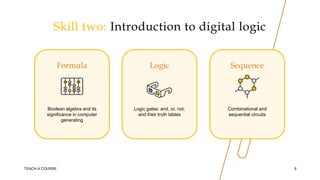
Skill two: Introduction to digital logic
Formula
Boolean algebra and its
significance in computer
generating
Logic
Logic gates: and, or, not,
and their truth tables
Sequence
Combinational and
sequential circuits
TEACH A COURSE 6
Skill two: Introduction to digital logic (2)
Formula
Boolean algebra and its
significance in computer
generating
Logic
Logic gates: and, or, not,
and their truth tables
Sequence
Combinational and
sequential circuits
TEACH A COURSE 7
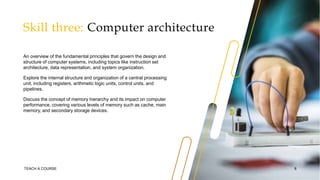
Skill three: Computer architecture
An overview of the fundamental principles that govern the design and
structure of computer systems, including topics like instruction set
architecture, data representation, and system organization.
Explore the internal structure and organization of a central processing
unit, including registers, arithmetic logic units, control units, and
pipelines.
Discuss the concept of memory hierarchy and its impact on computer
performance, covering various levels of memory such as cache, main
memory, and secondary storage devices.
TEACH A COURSE 8
Lesson one summary
What we’ve learned so far
Skill one
Familiarize students with the basics of
computer engineering and the key components
of a computer system.
Skill two
Introduce students to digital logic, Boolean
algebra, and the design of logic circuits.
Skill three
Explore the internal organization of computers,
including CPU design and memory systems.
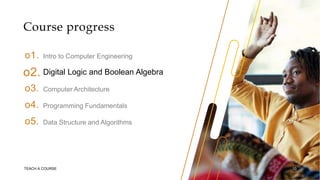
Course progress
o1. Intro to Computer Engineering
o2. Digital Logic and Boolean Algebra
o3. Computer Architecture
o4. Programming Fundamentals
o5. Data Structure and Algorithms
TEACH A COURSE 10
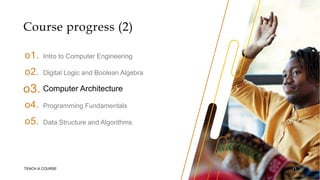
Course progress (2)
o1. Intro to Computer Engineering
o2. Digital Logic and Boolean Algebra
o3. Computer Architecture
o4. Programming Fundamentals
o5. Data Structure and Algorithms
TEACH A COURSE 11
Thank you
Office hours:
M-Th 3:00pm-4:30pm room C402
Please send all questions to:
gehad@example.com

Classic corporate teach a course slides.pptx

  • 1.
  • 2.
    TEACH A COURSE2 Intro to the Fundamentals of Computer Engineering o1. Intro to Computer Engineering o3. Computer Architecture o4. Programming Fundamentals o5. Data Structure and Algorithms o2. Digital Logic and Boolean Algebra
  • 3.
    Lesson One We willcover these skills o Basic concepts o Overview of hardware and software o Intro to computer systems and application
  • 4.
    Skill one: Understanding computercomponents Functionality of the central processing unit (CPU). Explore the central processing unit (CPU) in detail, delving into its role as the "brain" of the computer. Discuss how the CPU executes instructions, performs arithmetic and logical operations, and manages data flow within the computer system. Overview of memory systems. RAM, ROM, and cache: Dive into the different types of computer memory systems, including random access memory (RAM), read-only memory (ROM), and cache. Explain how each type of memory functions, their purpose in data storage, and their impact on computer performance. TEACH A COURSE 4
  • 5.
    Skill one: Understanding computercomponents (2) Role of input/output devices in computer systems. Examine the significance of input/output devices in computer systems. Discuss how input devices like keyboards and mice enable users to interact with the computer, while output devices such as monitors and printers present information and results. Highlight the importance of input/output devices in facilitating communication between users and the computer. TEACH A COURSE 5
  • 6.
    Skill two: Introductionto digital logic Formula Boolean algebra and its significance in computer generating Logic Logic gates: and, or, not, and their truth tables Sequence Combinational and sequential circuits TEACH A COURSE 6
  • 7.
    Skill two: Introductionto digital logic (2) Formula Boolean algebra and its significance in computer generating Logic Logic gates: and, or, not, and their truth tables Sequence Combinational and sequential circuits TEACH A COURSE 7
  • 8.
    Skill three: Computerarchitecture An overview of the fundamental principles that govern the design and structure of computer systems, including topics like instruction set architecture, data representation, and system organization. Explore the internal structure and organization of a central processing unit, including registers, arithmetic logic units, control units, and pipelines. Discuss the concept of memory hierarchy and its impact on computer performance, covering various levels of memory such as cache, main memory, and secondary storage devices. TEACH A COURSE 8
  • 9.
    Lesson one summary Whatwe’ve learned so far Skill one Familiarize students with the basics of computer engineering and the key components of a computer system. Skill two Introduce students to digital logic, Boolean algebra, and the design of logic circuits. Skill three Explore the internal organization of computers, including CPU design and memory systems.
  • 10.
    Course progress o1. Introto Computer Engineering o2. Digital Logic and Boolean Algebra o3. Computer Architecture o4. Programming Fundamentals o5. Data Structure and Algorithms TEACH A COURSE 10
  • 11.
    Course progress (2) o1.Intro to Computer Engineering o2. Digital Logic and Boolean Algebra o3. Computer Architecture o4. Programming Fundamentals o5. Data Structure and Algorithms TEACH A COURSE 11
  • 12.
    Thank you Office hours: M-Th3:00pm-4:30pm room C402 Please send all questions to: gehad@example.com