GEOG5426 Megadrought II
MEDIEVAL
WARM
PERIOD
Professor Hubert H. Lamb University of East Anglia
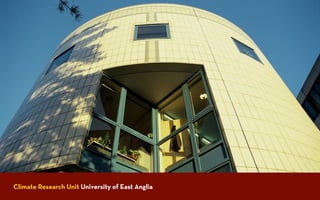
Climate Research Unit University of East Anglia
And multifarious evidence of a meterological
nature from historical records in various parts of
the world from the Arctic to New Zealand... has
been found to suggest a warmer epoch lasting
several centuries between about A.D. 900 or
1000 and about 1200 or 1200.”
“
Lamb 1965. The early medieval warm epoch and its sequel.
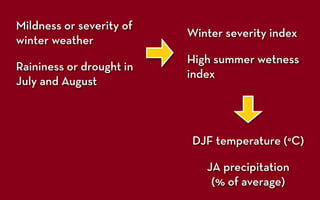
Mildness or severity of
winter weather
Raininess or drought in
July and August
Winter severity index
High summer wetness
index
DJF temperature (°C)
JA precipitation
(% of average)
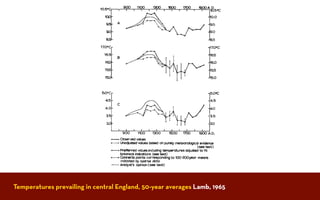
Temperatures prevailing in central England, 50-year averages Lamb, 1965
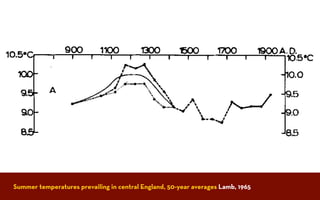
Summer temperatures prevailing in central England, 50-year averages Lamb, 1965
A prevailing warm epoch with dry anticyclonic character,
especially in summer, in temperate Europe between
about 1000 and 1300 A.D. appears to be confirmed.”
“
Lamb 1965. The early medieval warm epoch and its sequel.
Intergovernmental Panel on Climate Change
Climate Change: The IPCC Scientific Assessment
1990
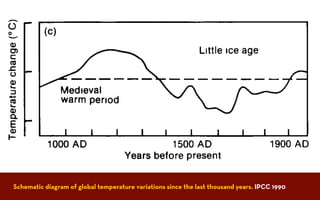
Schematic diagram of global temperature variations since the last thousand years. IPCC 1990
The do ed line nominally represents
conditions near the beginning of the
twentieth century.”
“
Schematic diagram of global temperature variations since the last thousand years. IPCC 1990
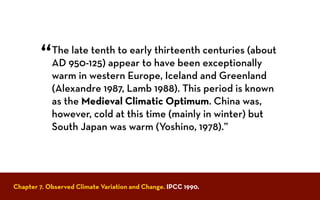
Chapter 7. Observed Climate Variation and Change. IPCC 1990.
The late tenth to early thirteenth centuries (about
AD 950-125) appear to have been exceptionally
warm in western Europe, Iceland and Greenland
(Alexandre 1987, Lamb 1988). This period is known
as the Medieval Climatic Optimum. China was,
however, cold at this time (mainly in winter) but
South Japan was warm (Yoshino, 1978).”
“
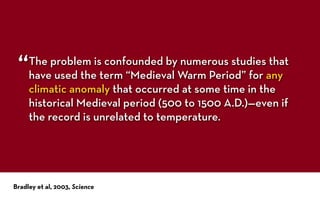
The problem is confounded by numerous studies that
have used the term “Medieval Warm Period” for any
climatic anomaly that occurred at some time in the
historical Medieval period (500 to 1500 A.D.)—even if
the record is unrelated to temperature.
Bradley et al, 2003, Science
“
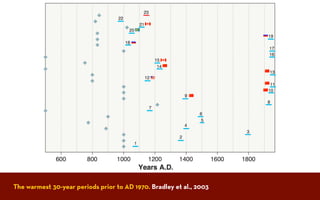
The warmest 30-year periods prior to AD 1970. Bradley et al., 2003
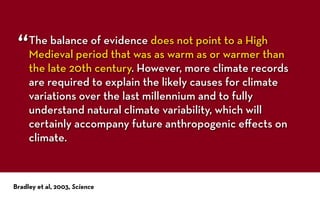
The balance of evidence does not point to a High
Medieval period that was as warm as or warmer than
the late 20th century. However, more climate records
are required to explain the likely causes for climate
variations over the last millennium and to fully
understand natural climate variability, which will
certainly accompany future anthropogenic effects on
climate.
Bradley et al, 2003, Science
“
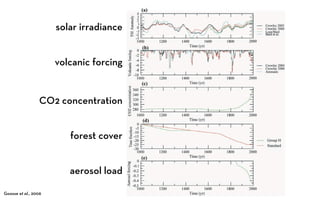
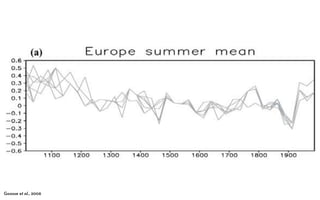
Goosse et al., 2006
solar irradiance
volcanic forcing
CO2 concentration
forest cover
aerosol load
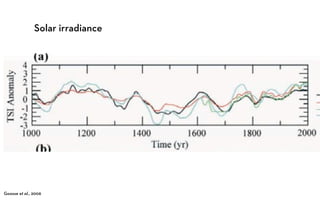
Goosse et al., 2006
Solar irradiance
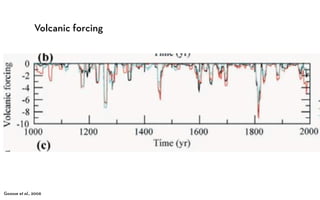
Goosse et al., 2006
Volcanic forcing
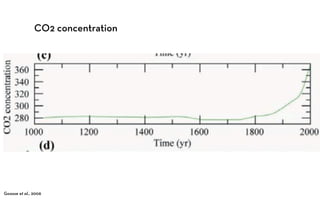
Goosse et al., 2006
CO2 concentration
Goosse et al., 2006
The term “Medieval Warm Period”, of limited meaning at
hemispheric scale, nonetheless thus appears reasonable
as applied specifically to summer European temperatures,
the region the term was originally applied to.”
“
Goosse 2006. The origin of the European “Medieval Warm Period”.
By November 3
[Tentative] list of 10 articles related to
your region and time period.

Class 7, Megadroughts II

  • 1.
  • 2.
  • 4.
    Professor Hubert H.Lamb University of East Anglia
  • 5.
    Climate Research UnitUniversity of East Anglia
  • 6.
    And multifarious evidenceof a meterological nature from historical records in various parts of the world from the Arctic to New Zealand... has been found to suggest a warmer epoch lasting several centuries between about A.D. 900 or 1000 and about 1200 or 1200.” “ Lamb 1965. The early medieval warm epoch and its sequel.
  • 8.
    Mildness or severityof winter weather Raininess or drought in July and August Winter severity index High summer wetness index DJF temperature (°C) JA precipitation (% of average)
  • 9.
    Temperatures prevailing incentral England, 50-year averages Lamb, 1965
  • 10.
    Summer temperatures prevailingin central England, 50-year averages Lamb, 1965
  • 11.
    A prevailing warmepoch with dry anticyclonic character, especially in summer, in temperate Europe between about 1000 and 1300 A.D. appears to be confirmed.” “ Lamb 1965. The early medieval warm epoch and its sequel.
  • 12.
    Intergovernmental Panel onClimate Change Climate Change: The IPCC Scientific Assessment 1990
  • 13.
    Schematic diagram ofglobal temperature variations since the last thousand years. IPCC 1990
  • 14.
    The do edline nominally represents conditions near the beginning of the twentieth century.” “ Schematic diagram of global temperature variations since the last thousand years. IPCC 1990
  • 15.
    Chapter 7. ObservedClimate Variation and Change. IPCC 1990. The late tenth to early thirteenth centuries (about AD 950-125) appear to have been exceptionally warm in western Europe, Iceland and Greenland (Alexandre 1987, Lamb 1988). This period is known as the Medieval Climatic Optimum. China was, however, cold at this time (mainly in winter) but South Japan was warm (Yoshino, 1978).” “
  • 16.
    The problem isconfounded by numerous studies that have used the term “Medieval Warm Period” for any climatic anomaly that occurred at some time in the historical Medieval period (500 to 1500 A.D.)—even if the record is unrelated to temperature. Bradley et al, 2003, Science “
  • 17.
    The warmest 30-yearperiods prior to AD 1970. Bradley et al., 2003
  • 18.
    The balance ofevidence does not point to a High Medieval period that was as warm as or warmer than the late 20th century. However, more climate records are required to explain the likely causes for climate variations over the last millennium and to fully understand natural climate variability, which will certainly accompany future anthropogenic effects on climate. Bradley et al, 2003, Science “
  • 19.
    Goosse et al.,2006 solar irradiance volcanic forcing CO2 concentration forest cover aerosol load
  • 20.
    Goosse et al.,2006 Solar irradiance
  • 21.
    Goosse et al.,2006 Volcanic forcing
  • 22.
    Goosse et al.,2006 CO2 concentration
  • 23.
  • 24.
    The term “MedievalWarm Period”, of limited meaning at hemispheric scale, nonetheless thus appears reasonable as applied specifically to summer European temperatures, the region the term was originally applied to.” “ Goosse 2006. The origin of the European “Medieval Warm Period”.
  • 25.
    By November 3 [Tentative]list of 10 articles related to your region and time period.