



Evolution
of
Entrepreneurship
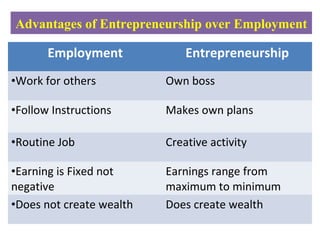
Advantages of Entrepreneurship over Employment
Employment Entrepreneurship
•Work for others Own boss
•Follow Instructions Makes own plans
•Routine Job Creative activity
•Earning is Fixed not
negative
Earnings range from
maximum to minimum
•Does not create wealth Does create wealth
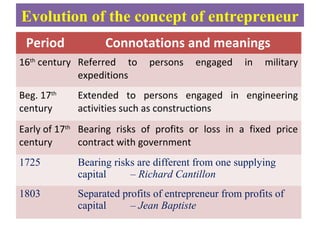
Evolution of the concept of entrepreneur
Period Connotations and meanings
16th
century Referred to persons engaged in military
expeditions
Beg. 17th
century
Extended to persons engaged in engineering
activities such as constructions
Early of 17th
century
Bearing risks of profits or loss in a fixed price
contract with government
1725 Bearing risks are different from one supplying
capital – Richard Cantillon
1803 Separated profits of entrepreneur from profits of
capital – Jean Baptiste
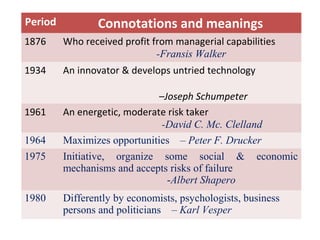
Period Connotations and meanings
1876 Who received profit from managerial capabilities
-Fransis Walker
1934 An innovator & develops untried technology
–Joseph Schumpeter
1961 An energetic, moderate risk taker
-David C. Mc. Clelland
1964 Maximizes opportunities – Peter F. Drucker
1975 Initiative, organize some social & economic
mechanisms and accepts risks of failure
-Albert Shapero
1980 Differently by economists, psychologists, business
persons and politicians – Karl Vesper
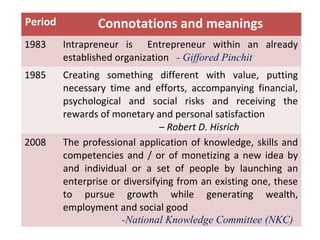
Period Connotations and meanings
1983 Intrapreneur is Entrepreneur within an already
established organization - Giffored Pinchit
1985 Creating something different with value, putting
necessary time and efforts, accompanying financial,
psychological and social risks and receiving the
rewards of monetary and personal satisfaction
– Robert D. Hisrich
2008 The professional application of knowledge, skills and
competencies and / or of monetizing a new idea by
and individual or a set of people by launching an
enterprise or diversifying from an existing one, these
to pursue growth while generating wealth,
employment and social good
-National Knowledge Committee (NKC)
THANK YOUTHANK YOU
THANK YOUTHANK YOU

Class 3-evolution of entrepreneurship

  • 1.
  • 2.
    Advantages of Entrepreneurshipover Employment Employment Entrepreneurship •Work for others Own boss •Follow Instructions Makes own plans •Routine Job Creative activity •Earning is Fixed not negative Earnings range from maximum to minimum •Does not create wealth Does create wealth
  • 3.
    Evolution of theconcept of entrepreneur Period Connotations and meanings 16th century Referred to persons engaged in military expeditions Beg. 17th century Extended to persons engaged in engineering activities such as constructions Early of 17th century Bearing risks of profits or loss in a fixed price contract with government 1725 Bearing risks are different from one supplying capital – Richard Cantillon 1803 Separated profits of entrepreneur from profits of capital – Jean Baptiste
  • 4.
    Period Connotations andmeanings 1876 Who received profit from managerial capabilities -Fransis Walker 1934 An innovator & develops untried technology –Joseph Schumpeter 1961 An energetic, moderate risk taker -David C. Mc. Clelland 1964 Maximizes opportunities – Peter F. Drucker 1975 Initiative, organize some social & economic mechanisms and accepts risks of failure -Albert Shapero 1980 Differently by economists, psychologists, business persons and politicians – Karl Vesper
  • 5.
    Period Connotations andmeanings 1983 Intrapreneur is Entrepreneur within an already established organization - Giffored Pinchit 1985 Creating something different with value, putting necessary time and efforts, accompanying financial, psychological and social risks and receiving the rewards of monetary and personal satisfaction – Robert D. Hisrich 2008 The professional application of knowledge, skills and competencies and / or of monetizing a new idea by and individual or a set of people by launching an enterprise or diversifying from an existing one, these to pursue growth while generating wealth, employment and social good -National Knowledge Committee (NKC)
  • 6.
  • 7.