EWRT 1A
Day 17
Essay Revisions:
 Essay revisions are due before Monday, March 19th at 6 AM.
NOTE: New deadline!
 You may only submit one revision: essay #1 or #2.
 If you did not submit one of the first two essays before the initial essay due date,
you may submit that one essay as your revision.
 If you want to see me to discuss your revision, please make an appointment.
 Before you come to talk to me, please read the comments and suggestions that I wrote
on your essay when I graded it. Have your questions ready.
 There is no grade penalty or averaging or other method of determining a revision
grade. I will grade the essay like it is a new submission and substitute your new,
better grade for the lower grade you initially received.
 I do not comment on revisions.
 I do not accept late revisions.
When can you see me this
week?
Office Hours:
--Wed 1-2.
--Thurs. 8:30-9:30.
I also could be available
Wed. between 2 and 3:30
for appointments and
(briefly) after class on Thurs.
Agenda
Return essay # 3
Revising problem essay #3
Sentence level errors
Essay #4
Brainstorming the solution (the thesis).
Outlining the plan
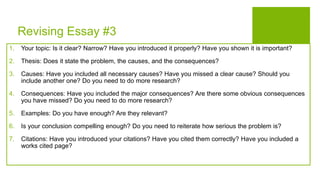
Revising Essay #3
1. Your topic: Is it clear? Narrow? Have you introduced it properly? Have you shown it is important?
2. Thesis: Does it state the problem, the causes, and the consequences?
3. Causes: Have you included all necessary causes? Have you missed a clear cause? Should you
include another one? Do you need to do more research?
4. Consequences: Have you included the major consequences? Are there some obvious consequences
you have missed? Do you need to do more research?
5. Examples: Do you have enough? Are they relevant?
6. Is your conclusion compelling enough? Do you need to reiterate how serious the problem is?
7. Citations: Have you introduced your citations? Have you cited them correctly? Have you included a
works cited page?
Sentence level
Writing Errors
Let’s take a look at your in-
class writing!
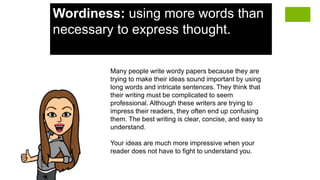
Many people write wordy papers because they are
trying to make their ideas sound important by using
long words and intricate sentences. They think that
their writing must be complicated to seem
professional. Although these writers are trying to
impress their readers, they often end up confusing
them. The best writing is clear, concise, and easy to
understand.
Your ideas are much more impressive when your
reader does not have to fight to understand you.
Wordiness: using more words than
necessary to express thought.
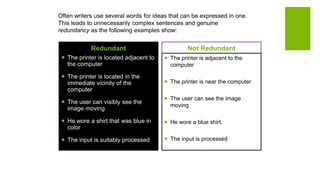
Often writers use several words for ideas that can be expressed in one.
This leads to unnecessarily complex sentences and genuine
redundancy as the following examples show:
Redundant
 The printer is located adjacent to
the computer
 The printer is located in the
immediate vicinity of the
computer
 The user can visibly see the
image moving
 He wore a shirt that was blue in
color
 The input is suitably processed
Not Redundant
 The printer is adjacent to the
computer
 The printer is near the computer
 The user can see the image
moving
 He wore a blue shirt.
 The input is processed
Now you try it. Write this sentence in as few
words as possible without changing the
meaning!
The available receptacle, in any
case, was of insufficient size to
contain the total quantity of
unnecessary waste.
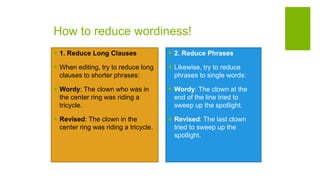
How to reduce wordiness!
 1. Reduce Long Clauses
 When editing, try to reduce long
clauses to shorter phrases:
 Wordy: The clown who was in
the center ring was riding a
tricycle.
 Revised: The clown in the
center ring was riding a tricycle.
 2. Reduce Phrases
 Likewise, try to reduce
phrases to single words:
 Wordy: The clown at the
end of the line tried to
sweep up the spotlight.
 Revised: The last clown
tried to sweep up the
spotlight.
Eliminating Wordiness: Strategies
 3. Avoid Empty Openers
 Avoid There is, There are, and
There were as sentence openers
when There adds nothing to the
meaning of a sentence:
 Wordy: There is a prize in every
box of Quacko cereal.
 Revised: A prize is in every box of
Quacko cereal.
 Wordy: There are two security
guards at the gate.
 Revised: Two security guards
stand at the gate.
 4. Don’t Overwork Modifiers
 Do not overwork very, really,
totally, and other modifiers that
add little or nothing to the meaning
of a sentence.
 Wordy: By the time she got home,
Merdine was very tired.
 Revised: By the time she got
home, Merdine was exhausted
 Wordy: She was also really
hungry.
 Revised: She was also hungry [or
famished].
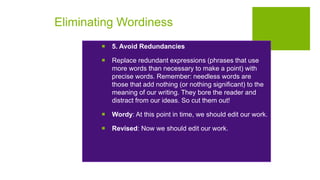
Eliminating Wordiness
 5. Avoid Redundancies
 Replace redundant expressions (phrases that use
more words than necessary to make a point) with
precise words. Remember: needless words are
those that add nothing (or nothing significant) to the
meaning of our writing. They bore the reader and
distract from our ideas. So cut them out!
 Wordy: At this point in time, we should edit our work.
 Revised: Now we should edit our work.
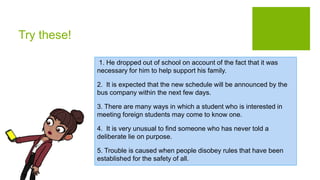
Try these!
1. He dropped out of school on account of the fact that it was
necessary for him to help support his family.
2. It is expected that the new schedule will be announced by the
bus company within the next few days.
3. There are many ways in which a student who is interested in
meeting foreign students may come to know one.
4. It is very unusual to find someone who has never told a
deliberate lie on purpose.
5. Trouble is caused when people disobey rules that have been
established for the safety of all.
Possible Answers
1. He dropped out of school to support his family.
2. The bus company will probably announce its schedule during
the next few days.
3. Any student who wants to meet foreign students can do so in
many ways.
4. Rarely will you find someone who has never told a deliberate
lie.
5. Disobeying safety regulations causes trouble.
Find a Wordy Sentence
Check your writing for wordiness. Look
for a sentence that falls into one of the
categories we just discussed. Edit it for
clarity and conciseness.
Essay #4
Essay #4: Proposing a Solution:
This essay is due at the end of the
quarter.
Assignment: Write an essay from five to seven
pages in length, that addresses the topic below.
Use a minimum of five credible sources to
support your argument.
Prompt: Write an essay proposing a solution to a
well-defined problem faced by, or in, education
today. Address your proposal to your audience:
one or more members of the education board, its
leadership, or to outsiders who may be able to
contribute to solving the problem.
Calendar
• You got Essay #3 back today.
• We will meet at the library for
a quick review and some
research time in class #18.
• The peer revision will take
place during our finals
meeting in Week 12: Thurs,
March 29, 10 AM.
• Essay #4 will be due via
Canvas on Saturday, March
31, by 8 AM.
Refer to your prewriting (Post 20):
You should have two different paragraphs
written for two different solutions.
Look at what you have.
It usually helps to consider several possible
solutions before focusing on one solution; problem
solving requires creativity.
Let’s take one more look before we limit our
solution to the single, best one.
Listing Multiple Possible
Solutions to your Problem
 Answer the following questions to help you
make a list of more creative solutions you
could consider for your problem:
1. Can you adapt a solution that has already been tried
or proposed for related problems? Which? How?
2. What smaller, more manageable aspect of the larger
problem could you solve? How might you do so?
3. Could re-imagining the goal help you make
fundamental changes?
4. Could the problem be solved from the bottom up
instead of from the top down?
5. Could an ongoing process help solve the problem?
Exploring Potential Solutions
Now, take the answers
to those questions and
write another
paragraph addressing
a third potential
solution to your
problem.
 Focus on the solution
that seems the most
interesting to explore.
In a sentence or two,
describe the solution
you want to explore
further. You should
choose a solution that
you feel motivated to
pursue. This will be your
working thesis!
In order to solve the
problem of bullying
lgbtq+ students in junior
high, …..
Choosing the Most Promising Solution
Explain Why Your Solution
Would Solve the Problem.
Now, write for a few minutes explaining
why you think this solution could solve the
problem. For example, would it
1. eliminate one or more causes?
2. change people’s attitudes?
3. re-imagine the objective?
4. reduce anxiety and tension?
Show Why Your Solution Is
Possible.
 Write for a few minutes
explaining why people could
agree to put the solution into
effect. For example, what would
it cost them in time or money?
Explain How It Could Be Implemented.
 Write down the major stages
or steps necessary to carry out
your solution. This list of steps
will provide an early test of
whether your solution can, in
fact, be implemented.
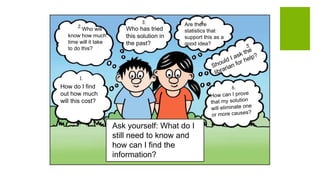
How do I find
out how much
will this cost?
Who will
know how much
time will it take
to do this?
Who has tried
this solution in
the past?
Ask yourself: What do I
still need to know and
how can I find the
information?
Are there
statistics that
support this as a
good idea?
Library Visit
In order to do research for this essay, we will meet
in the library lobby for our next class.
Be prepared with one or two questions you want to
research, so you can spend the
time we have with the librarian in a fruitful manner.
Please do not be late to class.
 Discussion #21: Post the in-class writing from slides 20-23:
This should be your thesis statement and three paragraphs:
an explanation of why your solution would work, an
explanation for why your solution is possible, a list of steps to
implement your solution.
 Make notes about what kind of information you need to
support your arguments. Bring them to our next meeting at
the library.
Homework

D17-EWRT 1A

  • 1.
  • 2.
    Essay Revisions:  Essayrevisions are due before Monday, March 19th at 6 AM. NOTE: New deadline!  You may only submit one revision: essay #1 or #2.  If you did not submit one of the first two essays before the initial essay due date, you may submit that one essay as your revision.  If you want to see me to discuss your revision, please make an appointment.  Before you come to talk to me, please read the comments and suggestions that I wrote on your essay when I graded it. Have your questions ready.  There is no grade penalty or averaging or other method of determining a revision grade. I will grade the essay like it is a new submission and substitute your new, better grade for the lower grade you initially received.  I do not comment on revisions.  I do not accept late revisions. When can you see me this week? Office Hours: --Wed 1-2. --Thurs. 8:30-9:30. I also could be available Wed. between 2 and 3:30 for appointments and (briefly) after class on Thurs.
  • 3.
    Agenda Return essay #3 Revising problem essay #3 Sentence level errors Essay #4 Brainstorming the solution (the thesis). Outlining the plan
  • 4.
    Revising Essay #3 1.Your topic: Is it clear? Narrow? Have you introduced it properly? Have you shown it is important? 2. Thesis: Does it state the problem, the causes, and the consequences? 3. Causes: Have you included all necessary causes? Have you missed a clear cause? Should you include another one? Do you need to do more research? 4. Consequences: Have you included the major consequences? Are there some obvious consequences you have missed? Do you need to do more research? 5. Examples: Do you have enough? Are they relevant? 6. Is your conclusion compelling enough? Do you need to reiterate how serious the problem is? 7. Citations: Have you introduced your citations? Have you cited them correctly? Have you included a works cited page?
  • 5.
    Sentence level Writing Errors Let’stake a look at your in- class writing!
  • 6.
    Many people writewordy papers because they are trying to make their ideas sound important by using long words and intricate sentences. They think that their writing must be complicated to seem professional. Although these writers are trying to impress their readers, they often end up confusing them. The best writing is clear, concise, and easy to understand. Your ideas are much more impressive when your reader does not have to fight to understand you. Wordiness: using more words than necessary to express thought.
  • 7.
    Often writers useseveral words for ideas that can be expressed in one. This leads to unnecessarily complex sentences and genuine redundancy as the following examples show: Redundant  The printer is located adjacent to the computer  The printer is located in the immediate vicinity of the computer  The user can visibly see the image moving  He wore a shirt that was blue in color  The input is suitably processed Not Redundant  The printer is adjacent to the computer  The printer is near the computer  The user can see the image moving  He wore a blue shirt.  The input is processed
  • 8.
    Now you tryit. Write this sentence in as few words as possible without changing the meaning! The available receptacle, in any case, was of insufficient size to contain the total quantity of unnecessary waste.
  • 9.
    How to reducewordiness!  1. Reduce Long Clauses  When editing, try to reduce long clauses to shorter phrases:  Wordy: The clown who was in the center ring was riding a tricycle.  Revised: The clown in the center ring was riding a tricycle.  2. Reduce Phrases  Likewise, try to reduce phrases to single words:  Wordy: The clown at the end of the line tried to sweep up the spotlight.  Revised: The last clown tried to sweep up the spotlight.
  • 10.
    Eliminating Wordiness: Strategies 3. Avoid Empty Openers  Avoid There is, There are, and There were as sentence openers when There adds nothing to the meaning of a sentence:  Wordy: There is a prize in every box of Quacko cereal.  Revised: A prize is in every box of Quacko cereal.  Wordy: There are two security guards at the gate.  Revised: Two security guards stand at the gate.  4. Don’t Overwork Modifiers  Do not overwork very, really, totally, and other modifiers that add little or nothing to the meaning of a sentence.  Wordy: By the time she got home, Merdine was very tired.  Revised: By the time she got home, Merdine was exhausted  Wordy: She was also really hungry.  Revised: She was also hungry [or famished].
  • 11.
    Eliminating Wordiness  5.Avoid Redundancies  Replace redundant expressions (phrases that use more words than necessary to make a point) with precise words. Remember: needless words are those that add nothing (or nothing significant) to the meaning of our writing. They bore the reader and distract from our ideas. So cut them out!  Wordy: At this point in time, we should edit our work.  Revised: Now we should edit our work.
  • 12.
    Try these! 1. Hedropped out of school on account of the fact that it was necessary for him to help support his family. 2. It is expected that the new schedule will be announced by the bus company within the next few days. 3. There are many ways in which a student who is interested in meeting foreign students may come to know one. 4. It is very unusual to find someone who has never told a deliberate lie on purpose. 5. Trouble is caused when people disobey rules that have been established for the safety of all.
  • 13.
    Possible Answers 1. Hedropped out of school to support his family. 2. The bus company will probably announce its schedule during the next few days. 3. Any student who wants to meet foreign students can do so in many ways. 4. Rarely will you find someone who has never told a deliberate lie. 5. Disobeying safety regulations causes trouble.
  • 14.
    Find a WordySentence Check your writing for wordiness. Look for a sentence that falls into one of the categories we just discussed. Edit it for clarity and conciseness.
  • 15.
  • 16.
    Essay #4: Proposinga Solution: This essay is due at the end of the quarter. Assignment: Write an essay from five to seven pages in length, that addresses the topic below. Use a minimum of five credible sources to support your argument. Prompt: Write an essay proposing a solution to a well-defined problem faced by, or in, education today. Address your proposal to your audience: one or more members of the education board, its leadership, or to outsiders who may be able to contribute to solving the problem. Calendar • You got Essay #3 back today. • We will meet at the library for a quick review and some research time in class #18. • The peer revision will take place during our finals meeting in Week 12: Thurs, March 29, 10 AM. • Essay #4 will be due via Canvas on Saturday, March 31, by 8 AM.
  • 17.
    Refer to yourprewriting (Post 20): You should have two different paragraphs written for two different solutions. Look at what you have. It usually helps to consider several possible solutions before focusing on one solution; problem solving requires creativity. Let’s take one more look before we limit our solution to the single, best one.
  • 18.
    Listing Multiple Possible Solutionsto your Problem  Answer the following questions to help you make a list of more creative solutions you could consider for your problem: 1. Can you adapt a solution that has already been tried or proposed for related problems? Which? How? 2. What smaller, more manageable aspect of the larger problem could you solve? How might you do so? 3. Could re-imagining the goal help you make fundamental changes? 4. Could the problem be solved from the bottom up instead of from the top down? 5. Could an ongoing process help solve the problem?
  • 19.
    Exploring Potential Solutions Now,take the answers to those questions and write another paragraph addressing a third potential solution to your problem.
  • 20.
     Focus onthe solution that seems the most interesting to explore. In a sentence or two, describe the solution you want to explore further. You should choose a solution that you feel motivated to pursue. This will be your working thesis! In order to solve the problem of bullying lgbtq+ students in junior high, ….. Choosing the Most Promising Solution
  • 21.
    Explain Why YourSolution Would Solve the Problem. Now, write for a few minutes explaining why you think this solution could solve the problem. For example, would it 1. eliminate one or more causes? 2. change people’s attitudes? 3. re-imagine the objective? 4. reduce anxiety and tension?
  • 22.
    Show Why YourSolution Is Possible.  Write for a few minutes explaining why people could agree to put the solution into effect. For example, what would it cost them in time or money?
  • 23.
    Explain How ItCould Be Implemented.  Write down the major stages or steps necessary to carry out your solution. This list of steps will provide an early test of whether your solution can, in fact, be implemented.
  • 24.
    How do Ifind out how much will this cost? Who will know how much time will it take to do this? Who has tried this solution in the past? Ask yourself: What do I still need to know and how can I find the information? Are there statistics that support this as a good idea?
  • 25.
    Library Visit In orderto do research for this essay, we will meet in the library lobby for our next class. Be prepared with one or two questions you want to research, so you can spend the time we have with the librarian in a fruitful manner. Please do not be late to class.
  • 26.
     Discussion #21:Post the in-class writing from slides 20-23: This should be your thesis statement and three paragraphs: an explanation of why your solution would work, an explanation for why your solution is possible, a list of steps to implement your solution.  Make notes about what kind of information you need to support your arguments. Bring them to our next meeting at the library. Homework