CBSE
12TH
CLASS
SESSION
2020-21
BY: BHAWANI PRATAP SINGH SHEKHAWAT
CHAPTER – 5
Children and Women in sports
CONTENTS
By:BhawaniPratapSinghShekhawat,//
bhawani912@gmail.com/+918005864874//
1.Motor development and factors affecting it
1.Exercise guidelines at different stages of growth and
development
1.Common postural deformities- Knock-knees; Flatfoot; Round shoulders;
Lordosis, Kyphosis, Bow legs and Scoliosis
1.Corrective measures for postural deformities
1.Sports participation of women in India
Special consideration ( Menarche and Menstrual dysfunction)
Female athlete triad ( Osteoporosis, Amenorrhea and Eating Disorder
5.1 Motor Development and Factors
Affecting It
Meaning of motor development
 Development of a child’s bone, muscles and ability
to move around and ability to manipulate his/her
environment
 Motor skills are essential for everyday life activities
such as walking, running, jumping
 Motor development can be divided into two
sections:
 gross motor development
 fine motor development.
By : Bhawani Pratap Singh Shekhawat , // bhawani912@gmail.com / +91 8005864874 //
Gross motor development
It involves the development of
large muscles in the child’s
body specially while sitting,
walking, running, climbing, etc.
By : Bhawani Pratap Singh Shekhawat , // bhawani912@gmail.com / +91 8005864874 //
Fine motor development
Fine motor skills is the
coordination of small
muscles, in movements—
usually involving the
synchronization of hands
and fingers—with the eyes.
By : Bhawani Pratap Singh Shekhawat , // bhawani912@gmail.com / +91 8005864874 //
Motor development in children
Stages of Motor Development in Children
 Early Childhood (2 to 6Years)
 Middle Childhood (7 to 10 years)
 Late Childhood (11 to 12Years)
By : Bhawani Pratap Singh Shekhawat , // bhawani912@gmail.com / +91 8005864874 //
Early Childhood (2 to 6 Years)
 Learns various movements such as running,
jumping and throwing
 Learns to climb stairs
 Learns basic dance steps
By : Bhawani Pratap Singh Shekhawat , // bhawani912@gmail.com / +91 8005864874 //
Middle Childhood (7 to 10 years)
 Development of Hand-Eye
coordination
 Motor skills are perfected
 Learns to run faster, jumps
higher, improves balance
By : Bhawani Pratap Singh Shekhawat , // bhawani912@gmail.com / +91 8005864874 //
Late Childhood (11 to 12 years)
 Girls grow faster than boys
 No difference in physical abilities of boys and girls
 Children are equipped to master complete movements
By : Bhawani Pratap Singh Shekhawat , // bhawani912@gmail.com / +91 8005864874 //
Factors
Affecting
Motor
Development
Biological factors
Environmental factors
Physical activities
Nutrition
Opportunities
Sensory impairment
Obesity
Postural deformities
By : Bhawani Pratap Singh Shekhawat , // bhawani912@gmail.com / +91 8005864874 //
5.2 Exercise guidelines at different
stages of growth and development
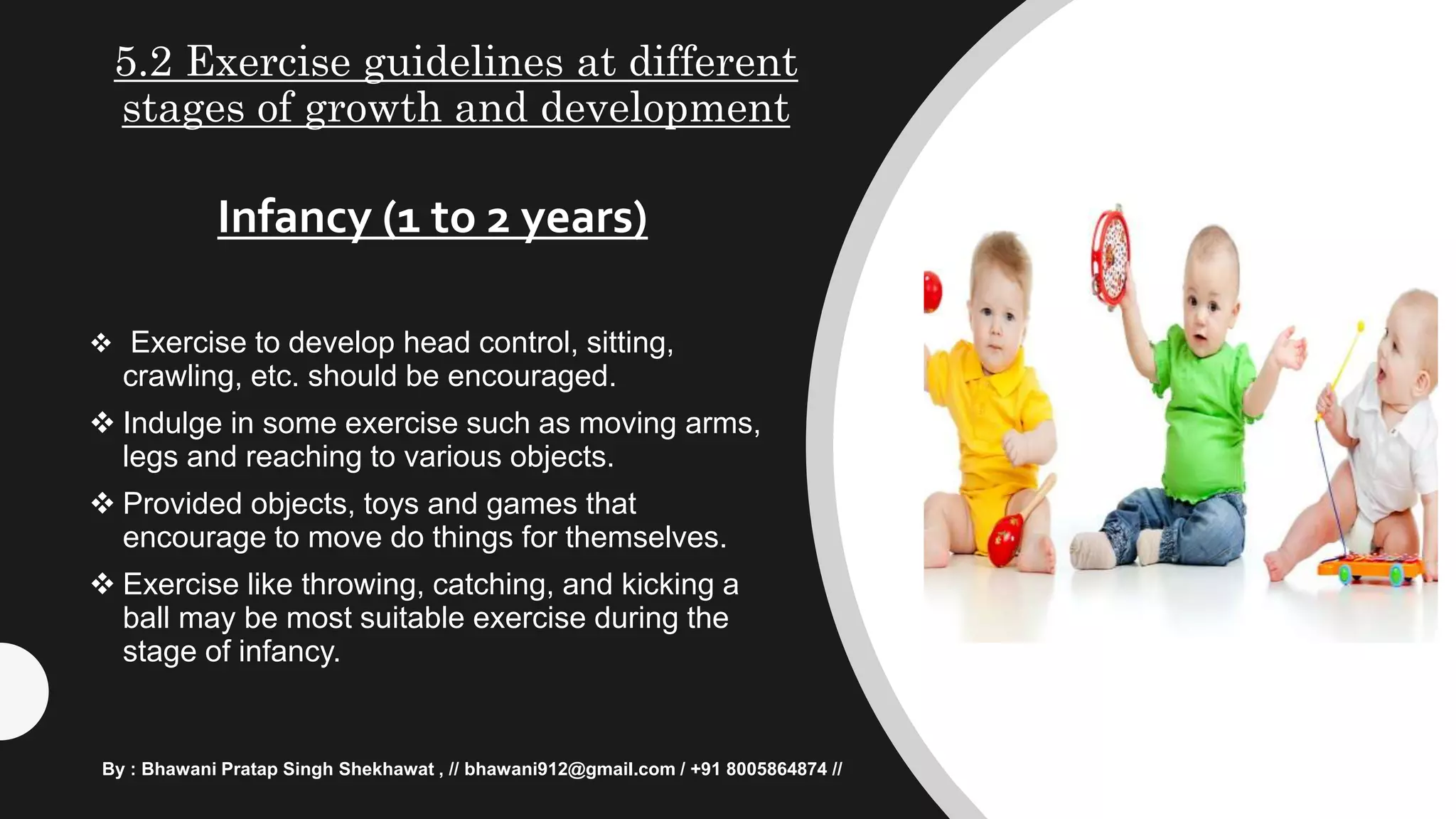
Infancy (1 to 2 years)
 Exercise to develop head control, sitting,
crawling, etc. should be encouraged.
 Indulge in some exercise such as moving arms,
legs and reaching to various objects.
 Provided objects, toys and games that
encourage to move do things for themselves.
 Exercise like throwing, catching, and kicking a
ball may be most suitable exercise during the
stage of infancy.
By : Bhawani Pratap Singh Shekhawat , // bhawani912@gmail.com / +91 8005864874 //
Early Childhood (3 to 7 Years)
 Developing competence in movement skills
(Throwing, catching, jumping or kicking the ball)
 Emphasis should be laid down on participation
and not on competition
 Activities related to fine motor skills, i.e.,
coordinative abilities should be emphasized
 structured as well as unstructured physical
activities should also be performed daily for at
least sixty minutes by children during this stage
of growth
By : Bhawani Pratap Singh Shekhawat , // bhawani912@gmail.com / +91 8005864874 //
later Childhood (8 to 12 Years)
 Children should indulge in activities such as
stunts, throwing, jumping, catching, running,
etc., so they can acquire body-control, strength
and coordination.
 Endurance related activities should be avoided
 Children should be introduced to competitive
sports and taught the basic rules of the sports
competition, i.e., enjoying the game, fair play,
simple strategies and tactics
 Introduced the exercises that build endurance,
strength, coordination and balance
By : Bhawani Pratap Singh Shekhawat , // bhawani912@gmail.com / +91 8005864874 //
Adolescence (13 to 19 Years)
 In this stage moderate to vigorous intensity
exercise/physical activity is recommended for at
least 60 minutes and up to several hours every
day
 Indulge in muscle strengthening exercise at
least three days per week
 Reduce sedentary lifestyle
 Exercise such as running, gymnastics, push-
ups, jumping rope, playing hockey, basketball,
swimming, tennis, and resistance exercise
should be included
By : Bhawani Pratap Singh Shekhawat , // bhawani912@gmail.com / +91 8005864874 //
Adulthood (Above 19 Years)
By : Bhawani Pratap Singh Shekhawat , // bhawani912@gmail.com / +91 8005864874 //
 Adults require such exercises or activities that
help to increase their muscular and bone
strength
 They should perform resistance exercises at
least two days a week to tone their muscles
and bones
 For Bone strengthening, they should include
running, jumping rope and weight training
exercises.
 Bone strengthening exercises/activities produce
an impact or tension force on the bones that
promotes bone growth and strength.
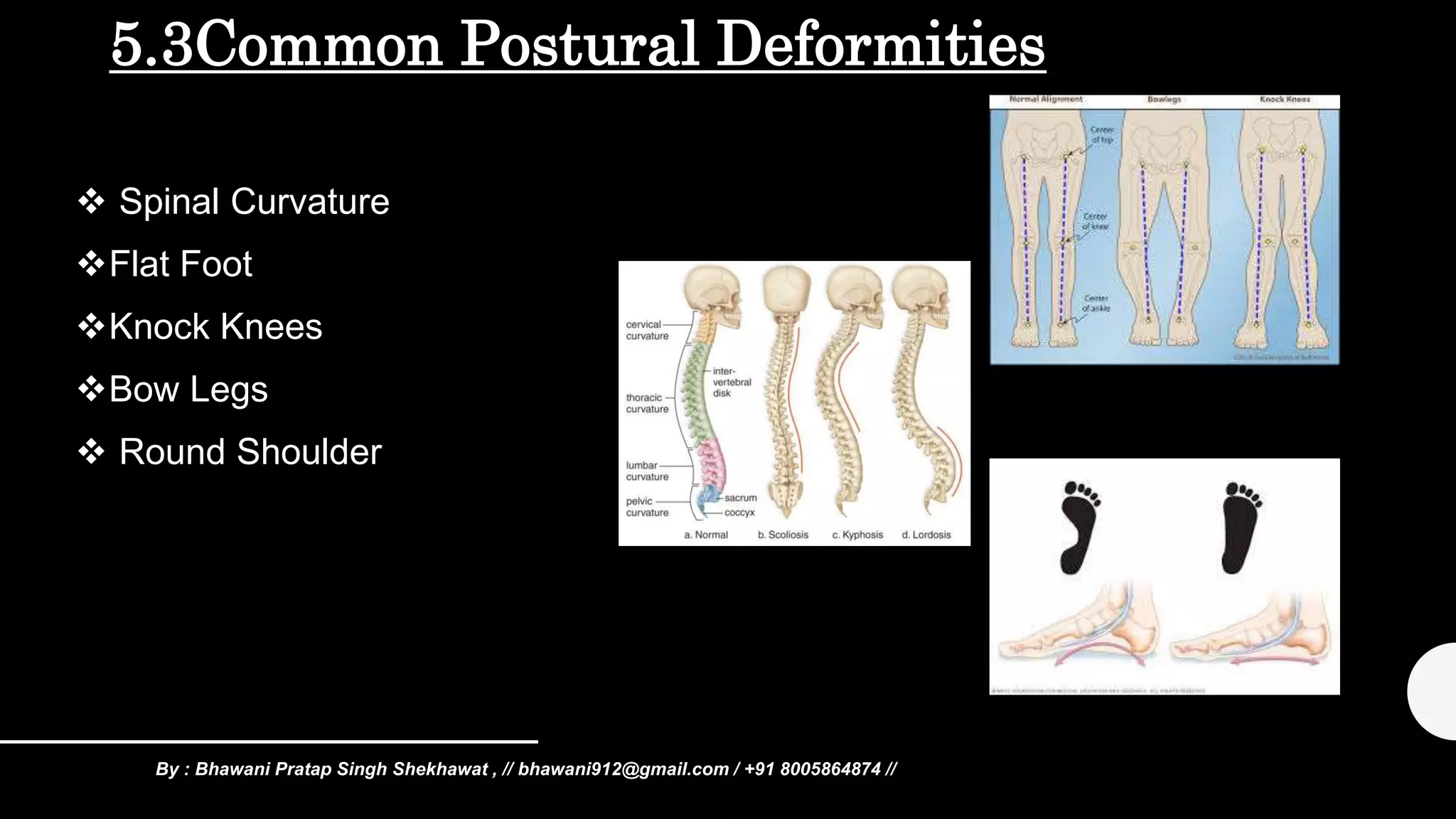
5.3Common Postural Deformities
 Spinal Curvature
Flat Foot
Knock Knees
Bow Legs
 Round Shoulder
By : Bhawani Pratap Singh Shekhawat , // bhawani912@gmail.com / +91 8005864874 //
Spinal Curvature
 Deformity is related to spine.
 Weak muscles cause the
formation of spine curvature.
 Three types :
 Scoliosis
 Kyphosis
 Lordosis
By : Bhawani Pratap Singh Shekhawat , // bhawani912@gmail.com / +91 8005864874 //
Kyphosis
 An increase or exaggeration of a backward
or posterior curve or a decrease or reversal
of a forward curve.
 Caused
malnutrition, illness, deficiency of pure air,
insufficient exercises, rickets, carrying heavy
loads on shoulders, unsuitable furniture,
weak muscles and habit of doing work by
leaning forward etc.
 Precautions :
From the very beginning, appropriate posture
of sitting, standing and walking should be
paid attention Kyphosis
By : Bhawani Pratap Singh Shekhawat , // bhawani912@gmail.com / +91 8005864874 //
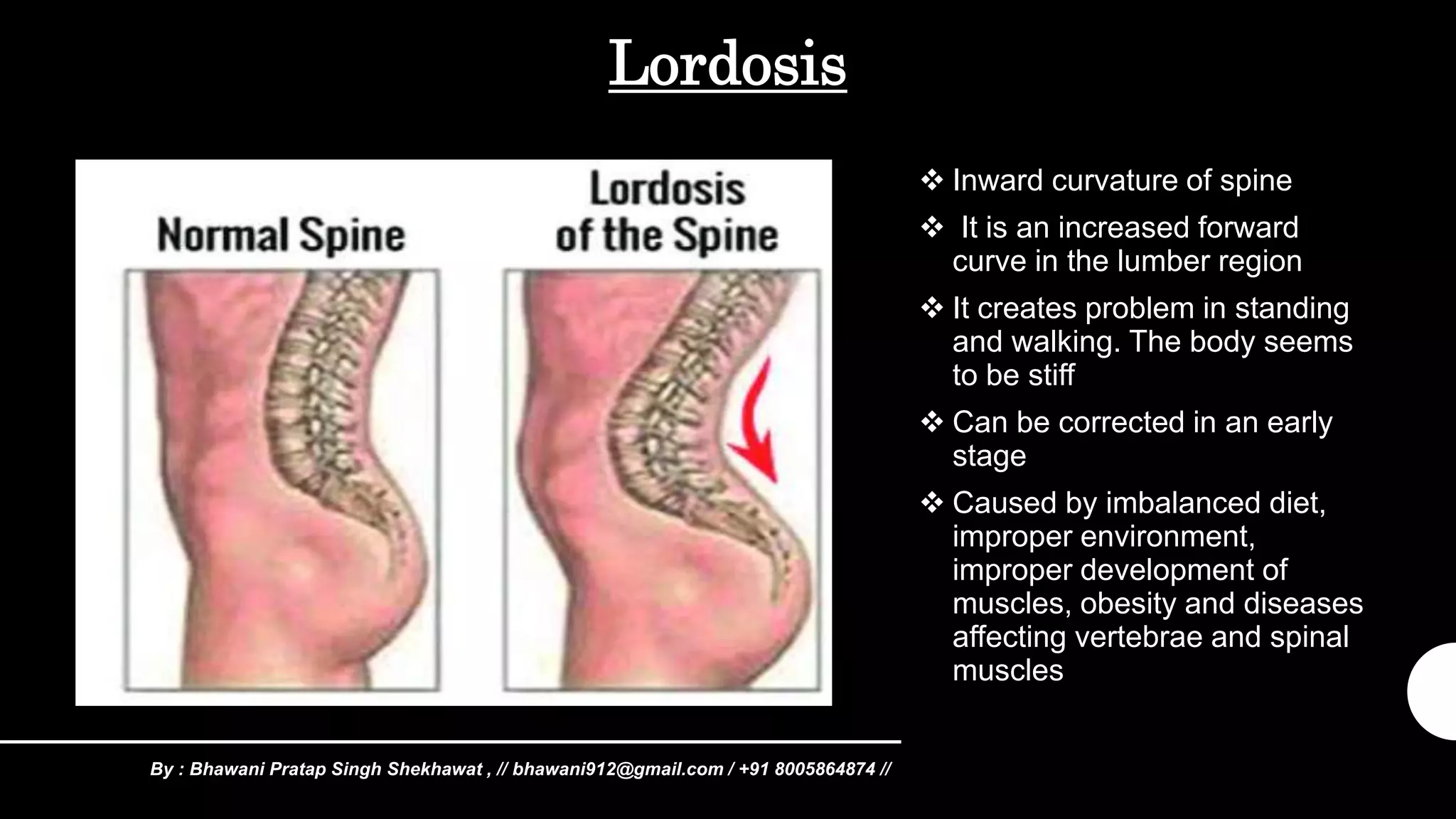
Lordosis
 Inward curvature of spine
 It is an increased forward
curve in the lumber region
 It creates problem in standing
and walking. The body seems
to be stiff
 Can be corrected in an early
stage
 Caused by imbalanced diet,
improper environment,
improper development of
muscles, obesity and diseases
affecting vertebrae and spinal
muscles
By : Bhawani Pratap Singh Shekhawat , // bhawani912@gmail.com / +91 8005864874 //
Scoliosis
 Postural adaptation of the
spine in lateral position
 Scoliosis means bending,
twisting or rotating
 Scoliotic curves are defined
in terms of their convexities.
 Caused by disease in the
joints of bones,
underdeveloped legs,
infantile paralysis, rickets,
congenital or acquired
abnormalities of vertebrae,
muscles or nerves.
By : Bhawani Pratap Singh Shekhawat , // bhawani912@gmail.com / +91 8005864874 //
Flat Foot
 A condition in which the foot
has an arch that is lower
than usual
 Children with flat feet feel
pain in feet
 Person with flat feet can not
walk long distances or walk
at a brisk pace
 Caused by weak muscles,
rapid increase in weight,
improper shoes
By : Bhawani Pratap Singh Shekhawat , // bhawani912@gmail.com / +91 8005864874 //
Knock Knees
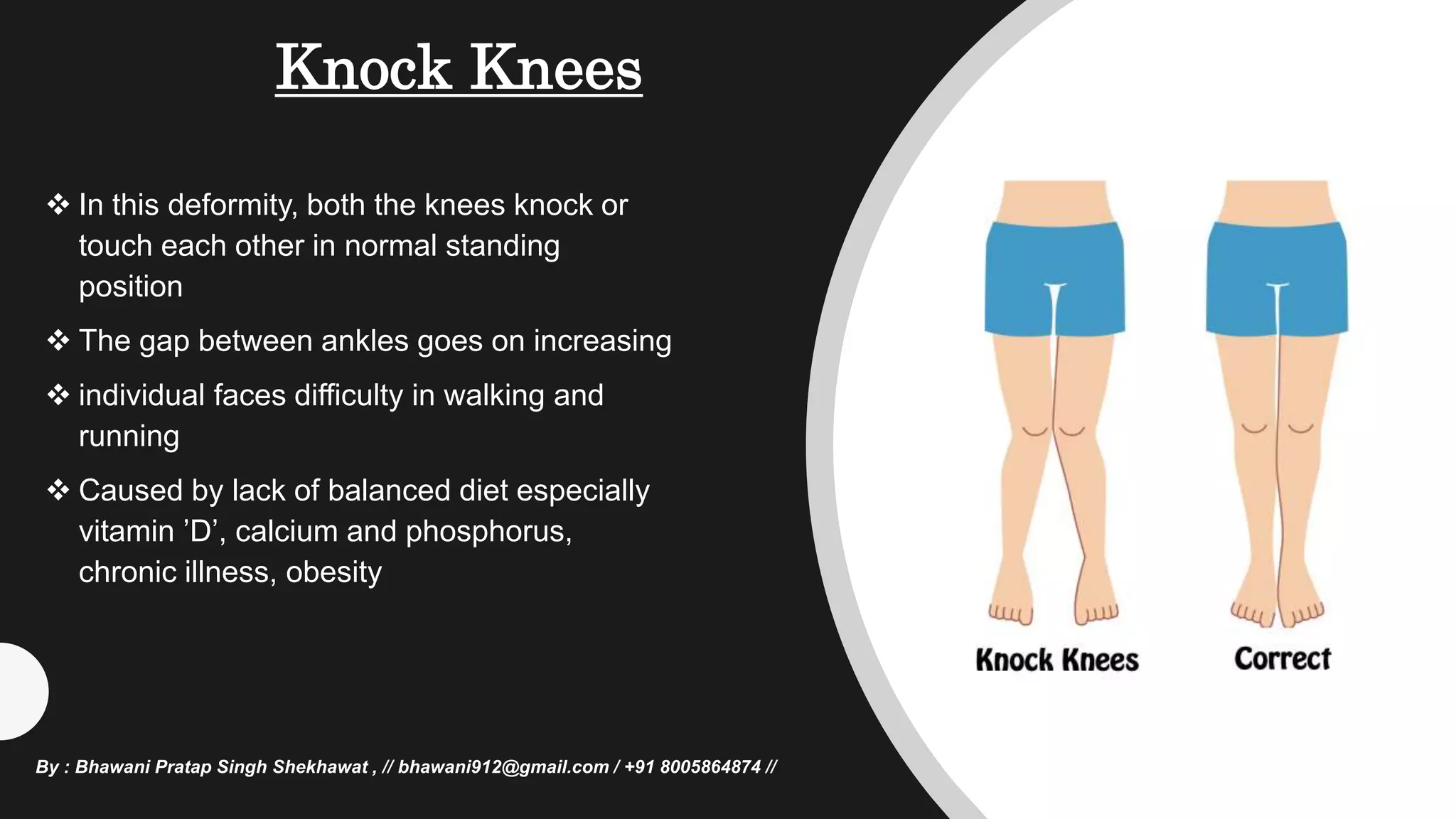
 In this deformity, both the knees knock or
touch each other in normal standing
position
 The gap between ankles goes on increasing
 individual faces difficulty in walking and
running
 Caused by lack of balanced diet especially
vitamin ’D’, calcium and phosphorus,
chronic illness, obesity
By : Bhawani Pratap Singh Shekhawat , // bhawani912@gmail.com / +91 8005864874 //
Bow Legs
 Lower long bones of the legs get bent
 Wide gap between the knees when
standing with feet together
 Can be observed when a person walks or
runs
 Caused by deficiency of calcium and
phosphorus in bones, obesity, deficiency of
Vitamin D, improper way of walking
By : Bhawani Pratap Singh Shekhawat , // bhawani912@gmail.com / +91 8005864874 //
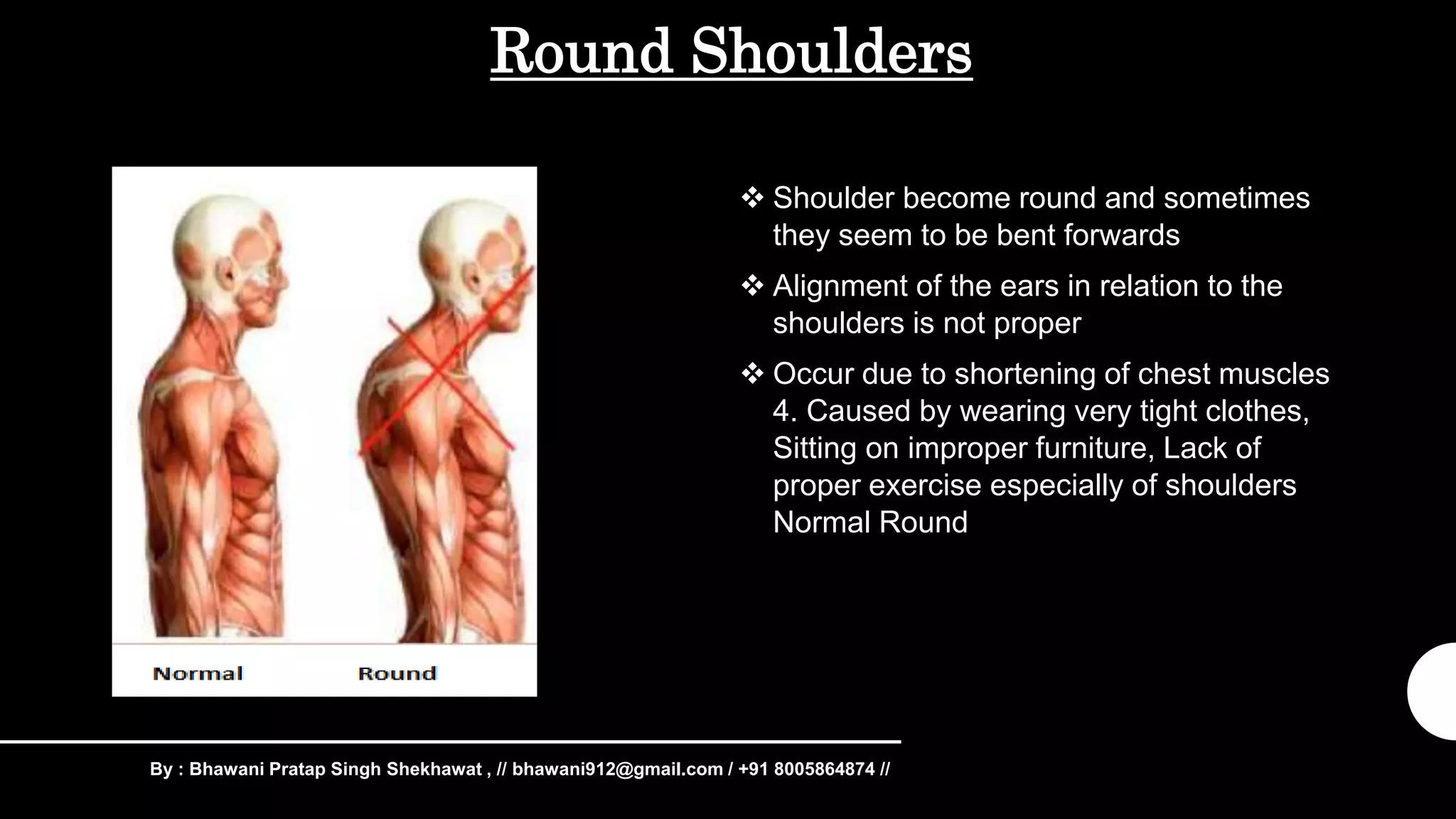
Round Shoulders
 Shoulder become round and sometimes
they seem to be bent forwards
 Alignment of the ears in relation to the
shoulders is not proper
 Occur due to shortening of chest muscles
4. Caused by wearing very tight clothes,
Sitting on improper furniture, Lack of
proper exercise especially of shoulders
Normal Round
By : Bhawani Pratap Singh Shekhawat , // bhawani912@gmail.com / +91 8005864874 //
5.4 CORRECTIVE MEASURES FOR
POSTURAL DEFORMITIES
By : Bhawani Pratap Singh Shekhawat , // bhawani912@gmail.com / +91 8005864874 //
CORRECTIVE MEASURE FOR KYPHOSIS
By : Bhawani Pratap Singh Shekhawat , // bhawani912@gmail.com / +91 8005864874 //
CORRECTIVE MEASURE FOR LORDOSIS
By : Bhawani Pratap Singh Shekhawat , // bhawani912@gmail.com / +91 8005864874 //
CORRECTIVE
MEASURE FOR
SCOLIOSIS
By : Bhawani Pratap Singh Shekhawat , // bhawani912@gmail.com / +91 8005864874 //
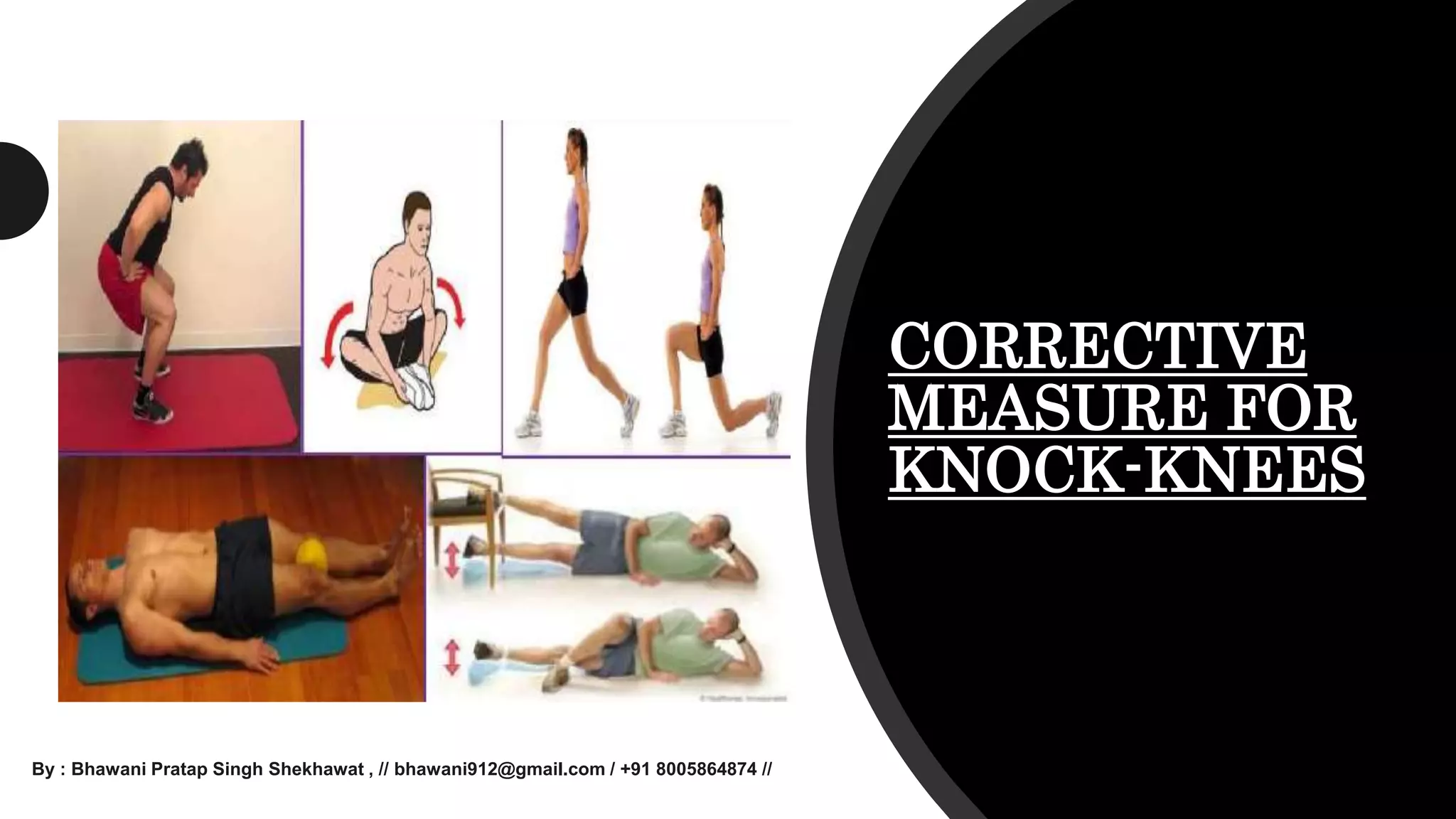
CORRECTIVE
MEASURE FOR
KNOCK-KNEES
By : Bhawani Pratap Singh Shekhawat , // bhawani912@gmail.com / +91 8005864874 //
CORRECTIVE
MEASURE FOR
BOW LEGS
By : Bhawani Pratap Singh Shekhawat , // bhawani912@gmail.com / +91 8005864874 //
CORRECTIVE
MEASURE FOR
ROUND
SHOULDER
By : Bhawani Pratap Singh Shekhawat , // bhawani912@gmail.com / +91 8005864874 //
CORRECTIVE
MEASURE FOR
FLAT FOOT
By : Bhawani Pratap Singh Shekhawat , // bhawani912@gmail.com / +91 8005864874 //
5.5 SPORTS PARTICIPATION OF WOMEN IN INDIA
By : Bhawani Pratap Singh Shekhawat , // bhawani912@gmail.com / +91 8005864874 //
Sports participation of women in
India
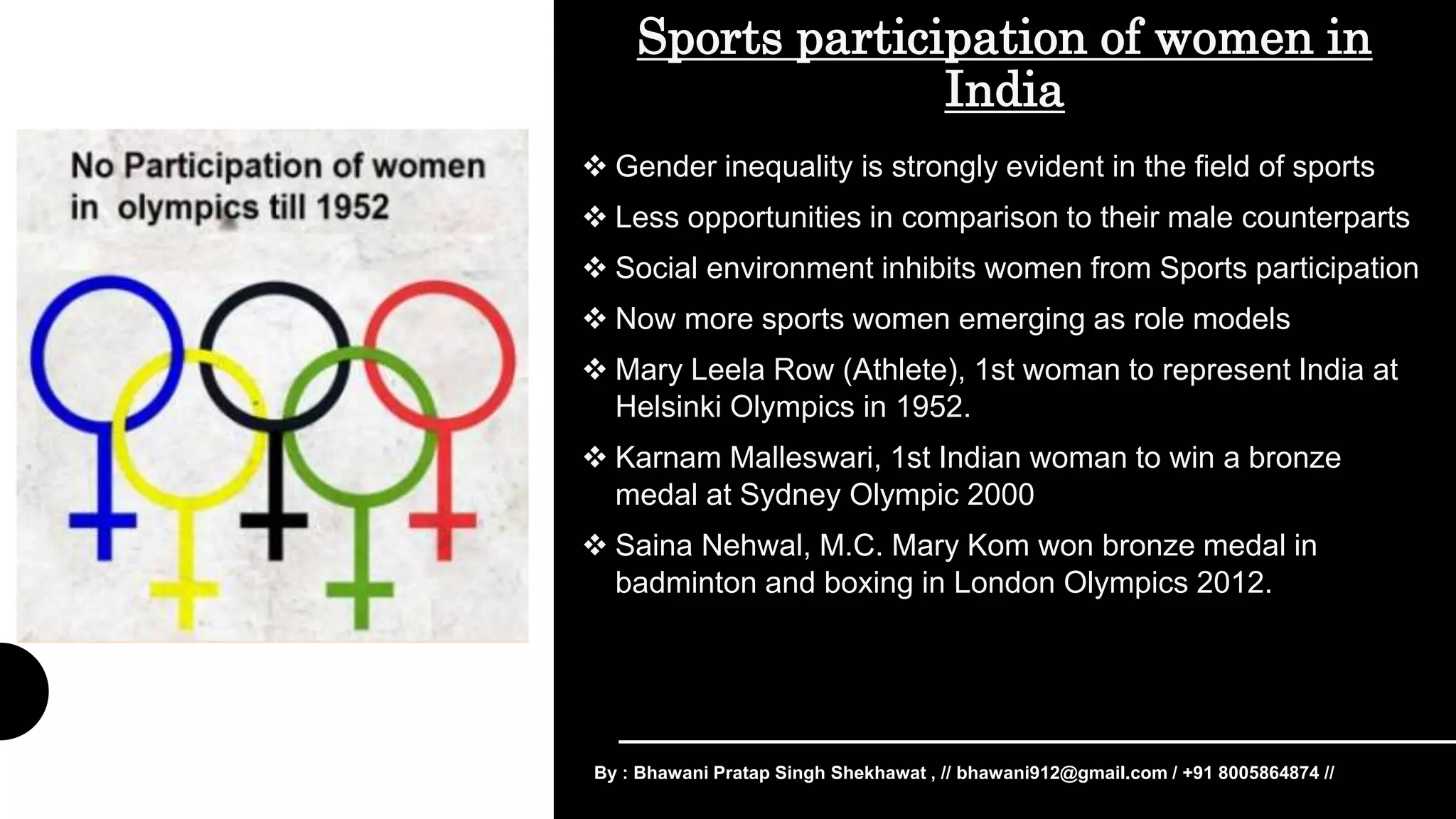
 Gender inequality is strongly evident in the field of sports
 Less opportunities in comparison to their male counterparts
 Social environment inhibits women from Sports participation
 Now more sports women emerging as role models
 Mary Leela Row (Athlete), 1st woman to represent India at
Helsinki Olympics in 1952.
 Karnam Malleswari, 1st Indian woman to win a bronze
medal at Sydney Olympic 2000
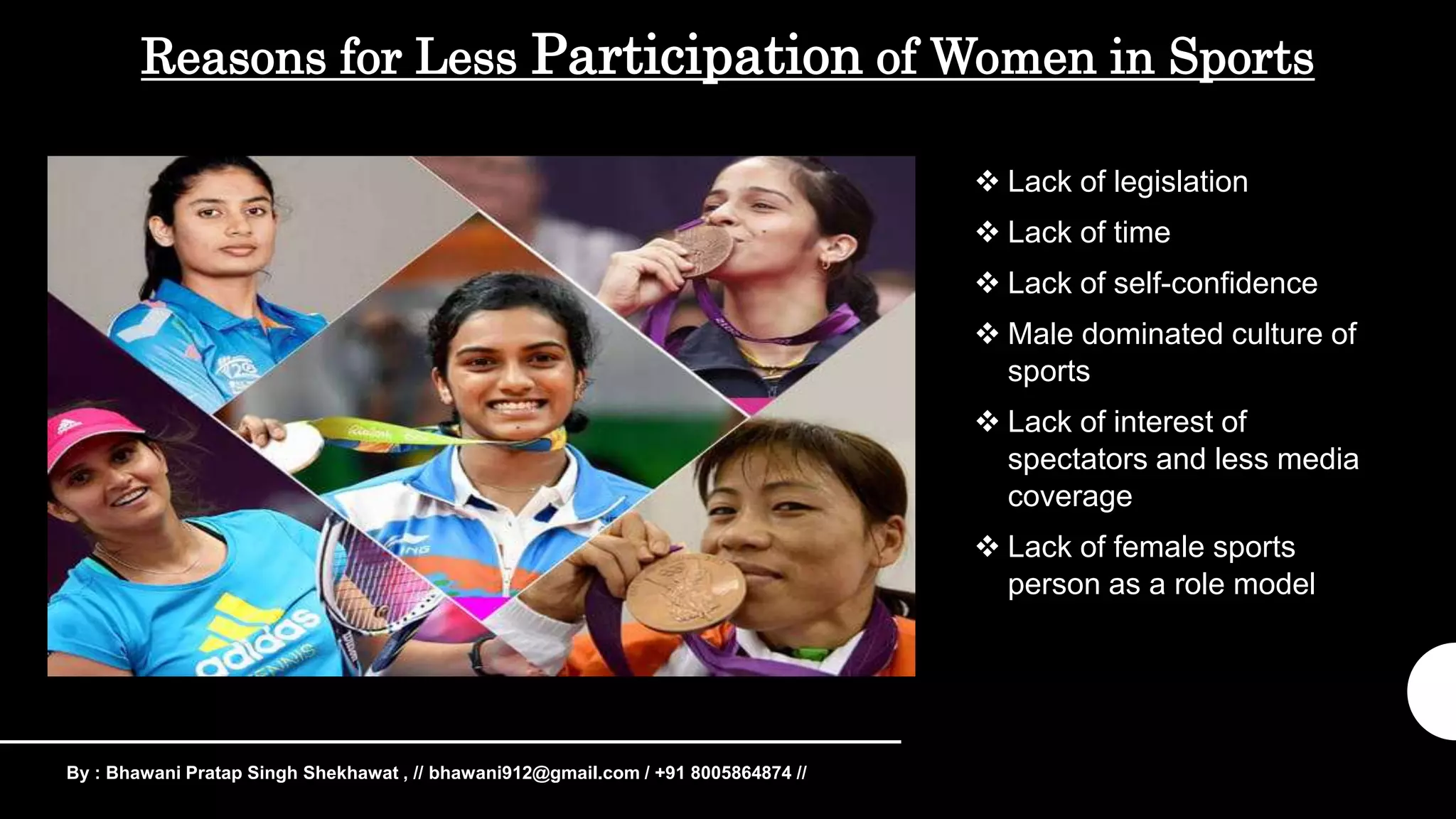
 Saina Nehwal, M.C. Mary Kom won bronze medal in
badminton and boxing in London Olympics 2012.
By : Bhawani Pratap Singh Shekhawat , // bhawani912@gmail.com / +91 8005864874 //
Reasons for Less Participation of Women in Sports
 Lack of legislation
 Lack of time
 Lack of self-confidence
 Male dominated culture of
sports
 Lack of interest of
spectators and less media
coverage
 Lack of female sports
person as a role model
By : Bhawani Pratap Singh Shekhawat , // bhawani912@gmail.com / +91 8005864874 //
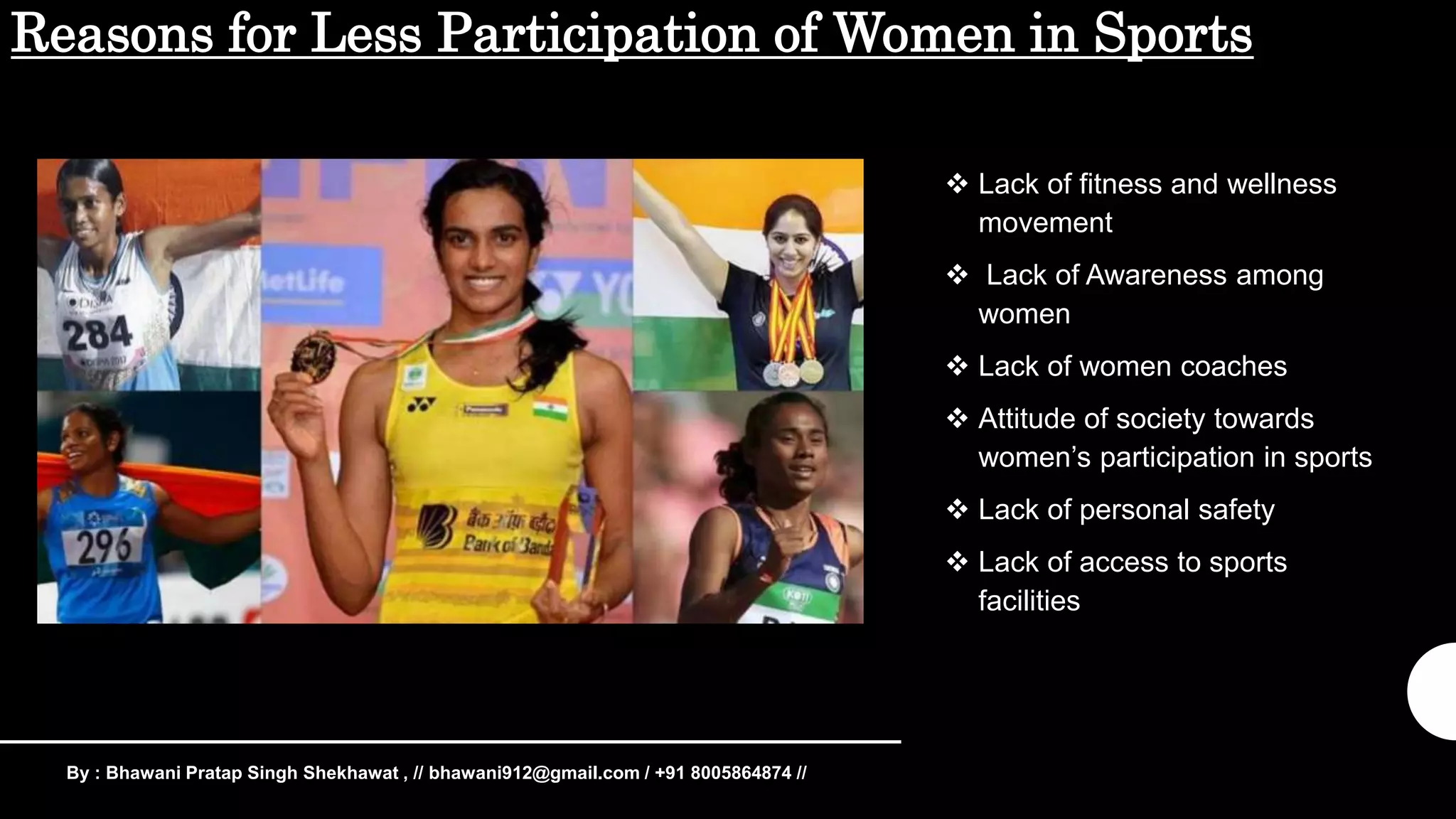
Reasons for Less Participation of Women in Sports
 Lack of fitness and wellness
movement
 Lack of Awareness among
women
 Lack of women coaches
 Attitude of society towards
women’s participation in sports
 Lack of personal safety
 Lack of access to sports
facilities
By : Bhawani Pratap Singh Shekhawat , // bhawani912@gmail.com / +91 8005864874 //
5.6 SPECIAL CONSIDERATION (MENARCHE
AND MENSTRUAL DYSFUNCTION)
By : Bhawani Pratap Singh Shekhawat , // bhawani912@gmail.com / +91 8005864874 //
Special Problems Faced by Women
Sportspersons
Menarche
 It is the first menstrual period of a girl that generally happens approximately at the age
of 12
 It can happen as early as during 8 to 9 years of age or as last as during 16 years of
age.
 Intensive sports activity may lead to health risk to young girls and it is reflected as an
abnormal menarche.
By : Bhawani Pratap Singh Shekhawat , // bhawani912@gmail.com / +91 8005864874 //
Special Problems Faced by Women
Sportspersons
Menstrual dysfunction
 It is disorder or irregularity in menstrual cycle. The disorders are:
 Absence of menstrual period
 Abdominal cramps
 Heavy or prolonged periods.
 Irregular periods.
 Delay in first menstrual period.
 There is a misconception that sports participation during menstruation could be physiologically harmful.
Research studies have indicated that there is no specific effect on sports performance during all phases of
the menstrual cycle.
By : Bhawani Pratap Singh Shekhawat , // bhawani912@gmail.com / +91 8005864874 //
5.7 FEMALE ATHLETE TRIAD( OSTEOPOROSIS,
AMENORRHEA AND EATING DISORDERS)
By : Bhawani Pratap Singh Shekhawat , // bhawani912@gmail.com / +91 8005864874 //
Female Athlete Triad
 It is a health concern for active women
and girls who are driven to excel in
sports. It involves 3 distinct and
interrelated conditions:
 Osteoporosis
 Amenorrhea
 Eating disorder
By : Bhawani Pratap Singh Shekhawat , // bhawani912@gmail.com / +91 8005864874 //
Symptoms of Triad
 Symptoms of triad may include
 Fatigue
 frequent injuries
 loss of endurance and power
 Irritability
 increased healing time of injuries
 Enhance chances of fracture
 cessation of menstruation
 Low self esteem
 symptoms depend on the condition of triad
By : Bhawani Pratap Singh Shekhawat , // bhawani912@gmail.com / +91 8005864874 //
Osteoporosis
 It refers to the decreased bone material contents.
 It is a skeletal disorder.
 It puts women athlete at a risk of bone fracture.
 Low oestrogen level and low calcium intake can lead to osteoporosis.
 Following factors lead to osteoporosis among the women athlete.
 Insufficient calcium in diet
 Amenorrhea
 Eating disorders
By : Bhawani Pratap Singh Shekhawat , // bhawani912@gmail.com / +91 8005864874 //
Amenorrhea
It is an absence of menstruation for three months or more.
 Primary Amenorrhea ( delayed beginning of menstrual cycle)
 Secondary Amenorrhea ( stopping of regular menstrual cycle for 3 months or more)
Various factors influencing Amenorrhea:
 Hormonal changes
 Intensive exercises
 Intake of less calories
By : Bhawani Pratap Singh Shekhawat , // bhawani912@gmail.com / +91 8005864874 //
Eating Disorders
Girls try to lose their body weight as a way to improve their performance in
the field of games and sports.
In order to lose weight, they may practice
Unhealthy weight control methods
Including restricted food intake
Self induced vomiting
Using Diet Pills or Laxatives
By : Bhawani Pratap Singh Shekhawat , // bhawani912@gmail.com / +91 8005864874 //
Anorexia Nervosa
 Pretend to Eat
 Dieting despite being Thin
 Afraid of Gaining weight
 More Cautious about Calories
 Remain conscious about appearance
 In front of the mirror they see themselves as
obese
By : Bhawani Pratap Singh Shekhawat , // bhawani912@gmail.com / +91 8005864874 //
Bulimia Nervosa
 Eating Disorder
 Person eats in excessive amount and then
vomits to avoid gaining weight
 An individual binges on food and feels a
loss of control
 To prevent weight gain, tries to vomit the
food
By : Bhawani Pratap Singh Shekhawat , // bhawani912@gmail.com / +91 8005864874 //
For Any
QUERY feel Free to
contact me!!!
For Any
QUERY feel Free to
contact me!!!
By : Bhawani Pratap Singh Shekhawat , // bhawani912@gmail.com / +91 8005864874 //

class 12th Ch 5 children and women in sports cbse by bhawani pratap singh shekhawat

  • 1.
  • 2.
    CHAPTER – 5 Childrenand Women in sports
  • 3.
    CONTENTS By:BhawaniPratapSinghShekhawat,// bhawani912@gmail.com/+918005864874// 1.Motor development andfactors affecting it 1.Exercise guidelines at different stages of growth and development 1.Common postural deformities- Knock-knees; Flatfoot; Round shoulders; Lordosis, Kyphosis, Bow legs and Scoliosis 1.Corrective measures for postural deformities 1.Sports participation of women in India Special consideration ( Menarche and Menstrual dysfunction) Female athlete triad ( Osteoporosis, Amenorrhea and Eating Disorder
  • 4.
    5.1 Motor Developmentand Factors Affecting It Meaning of motor development  Development of a child’s bone, muscles and ability to move around and ability to manipulate his/her environment  Motor skills are essential for everyday life activities such as walking, running, jumping  Motor development can be divided into two sections:  gross motor development  fine motor development. By : Bhawani Pratap Singh Shekhawat , // bhawani912@gmail.com / +91 8005864874 //
  • 5.
    Gross motor development Itinvolves the development of large muscles in the child’s body specially while sitting, walking, running, climbing, etc. By : Bhawani Pratap Singh Shekhawat , // bhawani912@gmail.com / +91 8005864874 //
  • 6.
    Fine motor development Finemotor skills is the coordination of small muscles, in movements— usually involving the synchronization of hands and fingers—with the eyes. By : Bhawani Pratap Singh Shekhawat , // bhawani912@gmail.com / +91 8005864874 //
  • 7.
    Motor development inchildren Stages of Motor Development in Children  Early Childhood (2 to 6Years)  Middle Childhood (7 to 10 years)  Late Childhood (11 to 12Years) By : Bhawani Pratap Singh Shekhawat , // bhawani912@gmail.com / +91 8005864874 //
  • 8.
    Early Childhood (2to 6 Years)  Learns various movements such as running, jumping and throwing  Learns to climb stairs  Learns basic dance steps By : Bhawani Pratap Singh Shekhawat , // bhawani912@gmail.com / +91 8005864874 //
  • 9.
    Middle Childhood (7to 10 years)  Development of Hand-Eye coordination  Motor skills are perfected  Learns to run faster, jumps higher, improves balance By : Bhawani Pratap Singh Shekhawat , // bhawani912@gmail.com / +91 8005864874 //
  • 10.
    Late Childhood (11to 12 years)  Girls grow faster than boys  No difference in physical abilities of boys and girls  Children are equipped to master complete movements By : Bhawani Pratap Singh Shekhawat , // bhawani912@gmail.com / +91 8005864874 //
  • 11.
    Factors Affecting Motor Development Biological factors Environmental factors Physicalactivities Nutrition Opportunities Sensory impairment Obesity Postural deformities By : Bhawani Pratap Singh Shekhawat , // bhawani912@gmail.com / +91 8005864874 //
  • 12.
    5.2 Exercise guidelinesat different stages of growth and development Infancy (1 to 2 years)  Exercise to develop head control, sitting, crawling, etc. should be encouraged.  Indulge in some exercise such as moving arms, legs and reaching to various objects.  Provided objects, toys and games that encourage to move do things for themselves.  Exercise like throwing, catching, and kicking a ball may be most suitable exercise during the stage of infancy. By : Bhawani Pratap Singh Shekhawat , // bhawani912@gmail.com / +91 8005864874 //
  • 13.
    Early Childhood (3to 7 Years)  Developing competence in movement skills (Throwing, catching, jumping or kicking the ball)  Emphasis should be laid down on participation and not on competition  Activities related to fine motor skills, i.e., coordinative abilities should be emphasized  structured as well as unstructured physical activities should also be performed daily for at least sixty minutes by children during this stage of growth By : Bhawani Pratap Singh Shekhawat , // bhawani912@gmail.com / +91 8005864874 //
  • 14.
    later Childhood (8to 12 Years)  Children should indulge in activities such as stunts, throwing, jumping, catching, running, etc., so they can acquire body-control, strength and coordination.  Endurance related activities should be avoided  Children should be introduced to competitive sports and taught the basic rules of the sports competition, i.e., enjoying the game, fair play, simple strategies and tactics  Introduced the exercises that build endurance, strength, coordination and balance By : Bhawani Pratap Singh Shekhawat , // bhawani912@gmail.com / +91 8005864874 //
  • 15.
    Adolescence (13 to19 Years)  In this stage moderate to vigorous intensity exercise/physical activity is recommended for at least 60 minutes and up to several hours every day  Indulge in muscle strengthening exercise at least three days per week  Reduce sedentary lifestyle  Exercise such as running, gymnastics, push- ups, jumping rope, playing hockey, basketball, swimming, tennis, and resistance exercise should be included By : Bhawani Pratap Singh Shekhawat , // bhawani912@gmail.com / +91 8005864874 //
  • 16.
    Adulthood (Above 19Years) By : Bhawani Pratap Singh Shekhawat , // bhawani912@gmail.com / +91 8005864874 //  Adults require such exercises or activities that help to increase their muscular and bone strength  They should perform resistance exercises at least two days a week to tone their muscles and bones  For Bone strengthening, they should include running, jumping rope and weight training exercises.  Bone strengthening exercises/activities produce an impact or tension force on the bones that promotes bone growth and strength.
  • 17.
    5.3Common Postural Deformities Spinal Curvature Flat Foot Knock Knees Bow Legs  Round Shoulder By : Bhawani Pratap Singh Shekhawat , // bhawani912@gmail.com / +91 8005864874 //
  • 18.
    Spinal Curvature  Deformityis related to spine.  Weak muscles cause the formation of spine curvature.  Three types :  Scoliosis  Kyphosis  Lordosis By : Bhawani Pratap Singh Shekhawat , // bhawani912@gmail.com / +91 8005864874 //
  • 19.
    Kyphosis  An increaseor exaggeration of a backward or posterior curve or a decrease or reversal of a forward curve.  Caused malnutrition, illness, deficiency of pure air, insufficient exercises, rickets, carrying heavy loads on shoulders, unsuitable furniture, weak muscles and habit of doing work by leaning forward etc.  Precautions : From the very beginning, appropriate posture of sitting, standing and walking should be paid attention Kyphosis By : Bhawani Pratap Singh Shekhawat , // bhawani912@gmail.com / +91 8005864874 //
  • 20.
    Lordosis  Inward curvatureof spine  It is an increased forward curve in the lumber region  It creates problem in standing and walking. The body seems to be stiff  Can be corrected in an early stage  Caused by imbalanced diet, improper environment, improper development of muscles, obesity and diseases affecting vertebrae and spinal muscles By : Bhawani Pratap Singh Shekhawat , // bhawani912@gmail.com / +91 8005864874 //
  • 21.
    Scoliosis  Postural adaptationof the spine in lateral position  Scoliosis means bending, twisting or rotating  Scoliotic curves are defined in terms of their convexities.  Caused by disease in the joints of bones, underdeveloped legs, infantile paralysis, rickets, congenital or acquired abnormalities of vertebrae, muscles or nerves. By : Bhawani Pratap Singh Shekhawat , // bhawani912@gmail.com / +91 8005864874 //
  • 22.
    Flat Foot  Acondition in which the foot has an arch that is lower than usual  Children with flat feet feel pain in feet  Person with flat feet can not walk long distances or walk at a brisk pace  Caused by weak muscles, rapid increase in weight, improper shoes By : Bhawani Pratap Singh Shekhawat , // bhawani912@gmail.com / +91 8005864874 //
  • 23.
    Knock Knees  Inthis deformity, both the knees knock or touch each other in normal standing position  The gap between ankles goes on increasing  individual faces difficulty in walking and running  Caused by lack of balanced diet especially vitamin ’D’, calcium and phosphorus, chronic illness, obesity By : Bhawani Pratap Singh Shekhawat , // bhawani912@gmail.com / +91 8005864874 //
  • 24.
    Bow Legs  Lowerlong bones of the legs get bent  Wide gap between the knees when standing with feet together  Can be observed when a person walks or runs  Caused by deficiency of calcium and phosphorus in bones, obesity, deficiency of Vitamin D, improper way of walking By : Bhawani Pratap Singh Shekhawat , // bhawani912@gmail.com / +91 8005864874 //
  • 25.
    Round Shoulders  Shoulderbecome round and sometimes they seem to be bent forwards  Alignment of the ears in relation to the shoulders is not proper  Occur due to shortening of chest muscles 4. Caused by wearing very tight clothes, Sitting on improper furniture, Lack of proper exercise especially of shoulders Normal Round By : Bhawani Pratap Singh Shekhawat , // bhawani912@gmail.com / +91 8005864874 //
  • 26.
    5.4 CORRECTIVE MEASURESFOR POSTURAL DEFORMITIES By : Bhawani Pratap Singh Shekhawat , // bhawani912@gmail.com / +91 8005864874 //
  • 27.
    CORRECTIVE MEASURE FORKYPHOSIS By : Bhawani Pratap Singh Shekhawat , // bhawani912@gmail.com / +91 8005864874 //
  • 28.
    CORRECTIVE MEASURE FORLORDOSIS By : Bhawani Pratap Singh Shekhawat , // bhawani912@gmail.com / +91 8005864874 //
  • 29.
    CORRECTIVE MEASURE FOR SCOLIOSIS By :Bhawani Pratap Singh Shekhawat , // bhawani912@gmail.com / +91 8005864874 //
  • 30.
    CORRECTIVE MEASURE FOR KNOCK-KNEES By :Bhawani Pratap Singh Shekhawat , // bhawani912@gmail.com / +91 8005864874 //
  • 31.
    CORRECTIVE MEASURE FOR BOW LEGS By: Bhawani Pratap Singh Shekhawat , // bhawani912@gmail.com / +91 8005864874 //
  • 32.
    CORRECTIVE MEASURE FOR ROUND SHOULDER By :Bhawani Pratap Singh Shekhawat , // bhawani912@gmail.com / +91 8005864874 //
  • 33.
    CORRECTIVE MEASURE FOR FLAT FOOT By: Bhawani Pratap Singh Shekhawat , // bhawani912@gmail.com / +91 8005864874 //
  • 34.
    5.5 SPORTS PARTICIPATIONOF WOMEN IN INDIA By : Bhawani Pratap Singh Shekhawat , // bhawani912@gmail.com / +91 8005864874 //
  • 35.
    Sports participation ofwomen in India  Gender inequality is strongly evident in the field of sports  Less opportunities in comparison to their male counterparts  Social environment inhibits women from Sports participation  Now more sports women emerging as role models  Mary Leela Row (Athlete), 1st woman to represent India at Helsinki Olympics in 1952.  Karnam Malleswari, 1st Indian woman to win a bronze medal at Sydney Olympic 2000  Saina Nehwal, M.C. Mary Kom won bronze medal in badminton and boxing in London Olympics 2012. By : Bhawani Pratap Singh Shekhawat , // bhawani912@gmail.com / +91 8005864874 //
  • 36.
    Reasons for LessParticipation of Women in Sports  Lack of legislation  Lack of time  Lack of self-confidence  Male dominated culture of sports  Lack of interest of spectators and less media coverage  Lack of female sports person as a role model By : Bhawani Pratap Singh Shekhawat , // bhawani912@gmail.com / +91 8005864874 //
  • 37.
    Reasons for LessParticipation of Women in Sports  Lack of fitness and wellness movement  Lack of Awareness among women  Lack of women coaches  Attitude of society towards women’s participation in sports  Lack of personal safety  Lack of access to sports facilities By : Bhawani Pratap Singh Shekhawat , // bhawani912@gmail.com / +91 8005864874 //
  • 38.
    5.6 SPECIAL CONSIDERATION(MENARCHE AND MENSTRUAL DYSFUNCTION) By : Bhawani Pratap Singh Shekhawat , // bhawani912@gmail.com / +91 8005864874 //
  • 39.
    Special Problems Facedby Women Sportspersons Menarche  It is the first menstrual period of a girl that generally happens approximately at the age of 12  It can happen as early as during 8 to 9 years of age or as last as during 16 years of age.  Intensive sports activity may lead to health risk to young girls and it is reflected as an abnormal menarche. By : Bhawani Pratap Singh Shekhawat , // bhawani912@gmail.com / +91 8005864874 //
  • 40.
    Special Problems Facedby Women Sportspersons Menstrual dysfunction  It is disorder or irregularity in menstrual cycle. The disorders are:  Absence of menstrual period  Abdominal cramps  Heavy or prolonged periods.  Irregular periods.  Delay in first menstrual period.  There is a misconception that sports participation during menstruation could be physiologically harmful. Research studies have indicated that there is no specific effect on sports performance during all phases of the menstrual cycle. By : Bhawani Pratap Singh Shekhawat , // bhawani912@gmail.com / +91 8005864874 //
  • 41.
    5.7 FEMALE ATHLETETRIAD( OSTEOPOROSIS, AMENORRHEA AND EATING DISORDERS) By : Bhawani Pratap Singh Shekhawat , // bhawani912@gmail.com / +91 8005864874 //
  • 42.
    Female Athlete Triad It is a health concern for active women and girls who are driven to excel in sports. It involves 3 distinct and interrelated conditions:  Osteoporosis  Amenorrhea  Eating disorder By : Bhawani Pratap Singh Shekhawat , // bhawani912@gmail.com / +91 8005864874 //
  • 43.
    Symptoms of Triad Symptoms of triad may include  Fatigue  frequent injuries  loss of endurance and power  Irritability  increased healing time of injuries  Enhance chances of fracture  cessation of menstruation  Low self esteem  symptoms depend on the condition of triad By : Bhawani Pratap Singh Shekhawat , // bhawani912@gmail.com / +91 8005864874 //
  • 44.
    Osteoporosis  It refersto the decreased bone material contents.  It is a skeletal disorder.  It puts women athlete at a risk of bone fracture.  Low oestrogen level and low calcium intake can lead to osteoporosis.  Following factors lead to osteoporosis among the women athlete.  Insufficient calcium in diet  Amenorrhea  Eating disorders By : Bhawani Pratap Singh Shekhawat , // bhawani912@gmail.com / +91 8005864874 //
  • 45.
    Amenorrhea It is anabsence of menstruation for three months or more.  Primary Amenorrhea ( delayed beginning of menstrual cycle)  Secondary Amenorrhea ( stopping of regular menstrual cycle for 3 months or more) Various factors influencing Amenorrhea:  Hormonal changes  Intensive exercises  Intake of less calories By : Bhawani Pratap Singh Shekhawat , // bhawani912@gmail.com / +91 8005864874 //
  • 46.
    Eating Disorders Girls tryto lose their body weight as a way to improve their performance in the field of games and sports. In order to lose weight, they may practice Unhealthy weight control methods Including restricted food intake Self induced vomiting Using Diet Pills or Laxatives By : Bhawani Pratap Singh Shekhawat , // bhawani912@gmail.com / +91 8005864874 //
  • 47.
    Anorexia Nervosa  Pretendto Eat  Dieting despite being Thin  Afraid of Gaining weight  More Cautious about Calories  Remain conscious about appearance  In front of the mirror they see themselves as obese By : Bhawani Pratap Singh Shekhawat , // bhawani912@gmail.com / +91 8005864874 //
  • 48.
    Bulimia Nervosa  EatingDisorder  Person eats in excessive amount and then vomits to avoid gaining weight  An individual binges on food and feels a loss of control  To prevent weight gain, tries to vomit the food By : Bhawani Pratap Singh Shekhawat , // bhawani912@gmail.com / +91 8005864874 //
  • 49.
    For Any QUERY feelFree to contact me!!! For Any QUERY feel Free to contact me!!! By : Bhawani Pratap Singh Shekhawat , // bhawani912@gmail.com / +91 8005864874 //