CLASS 12 PHYSICAL EDUCATION
ch : 2
Free Notes Pdf 100% Result 1 Shot Video
Boards 2025
Children and
Women in Sports
School Engineer
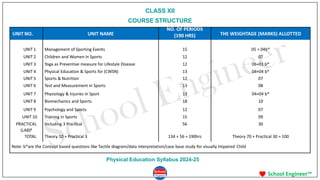
CLASS XII
COURSE STRUCTURE
UNIT NO. UNIT NAME
NO. OF PERIODS
(190 HRS) THE WEIGHTAGE (MARKS) ALLOTTED
UNIT 1 Management of Sporting Events 15 05 + 04b*
UNIT 2 Children and Women in Sports 12 07
UNIT 3 Yoga as Preventive measure for Lifestyle Disease 12 06+01 b*
UNIT 4 Physical Education & Sports for (CWSN) 13 04+04 b*
UNIT 5 Sports & Nutrition 12 07
UNIT 6 Test and Measurement in Sports 13 08
UNIT 7 Physiology & Injuries in Sport 13 04+04 b*
UNIT 8 Biomechanics and Sports 18 10
UNIT 9 Psychology and Sports 12 07
UNIT 10 Training in Sports 15 09
PRACTICAL
(LAB)#
Including 3 Practical 56 30
TOTAL Theory 10 + Practical 3 134 + 56 = 190hrs Theory 70 + Practical 30 = 100
Note: b*are the Concept based questions like Tactile diagram/data interpretation/case base study for visually Impaired Child
Physical Education Syllabus 2024-25
♥ School Engineer™
School Engineer
1. Exercise guidelines of WHO for different age groups.
2. Common postural deformities- Knock knees, flat foot, round shoulders,
Lordosis, Kyphosis, Scoliosis, and bow legs and their respective corrective
measures.
3. Women’s participation in Sports – Physical, Psychological, and social
benefits.
4. Special considerations (menarche and menstrual dysfunction)
5. Female athlete triad (osteoporosis, amenorrhea, eating disorders).
♥ School Engineer™
Unit Topics
School Engineer
2.1 Exercise guidelines of WHO for different age groups
• Human growth goes through different
stages from infancy to adulthood.
• These stages involve changes in physical
appearance and mental development.
• Growth depends on factors like heredity,
environment, and physical activities.
• Exercise is important for both the mind
and body at every stage.
• The stages of growth are
• Infancy
• Early Childhood
• Middle Childhood
• Adolescence, and Adulthood.
♥ School Engineer™
School Engineer
• Infanthood (0-2 Years):
• This stage is from birth to 2 years old.
• Babies develop gross motor skills quickly, starting with moving their head to grasping things.
• Key activities include turning and lifting the head, moving arms and legs, rolling, crawling, grasping,
standing, walking, hand-eye coordination, and balancing.
Exercise guidelines for infants:
• Encourage babies to be active throughout the day by playing with them.
• Light exercises like reaching, grasping, pulling, and pushing should be encouraged.
• Include exercises that involve body and limb movements.
• Focus on exercises to develop gross motor skills like head control, sitting, and crawling.
• Provide a safe environment for these activities.
• Toddlers should be active for at least 3 hours a day.
♥ School Engineer™
2.1 Exercise guidelines of WHO for different age groups
School Engineer
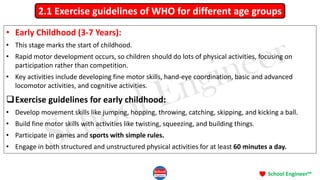
• Early Childhood (3-7 Years):
• This stage marks the start of childhood.
• Rapid motor development occurs, so children should do lots of physical activities, focusing on
participation rather than competition.
• Key activities include developing fine motor skills, hand-eye coordination, basic and advanced
locomotor activities, and cognitive activities.
Exercise guidelines for early childhood:
• Develop movement skills like jumping, hopping, throwing, catching, skipping, and kicking a ball.
• Build fine motor skills with activities like twisting, squeezing, and building things.
• Participate in games and sports with simple rules.
• Engage in both structured and unstructured physical activities for at least 60 minutes a day.
♥ School Engineer™
2.1 Exercise guidelines of WHO for different age groups
School Engineer
• Middle Childhood (8-12 Years):
• Children start competing and want to excel in motor skills.
• Key characteristics include better balance, precise movements, and increased speed.
Exercise guidelines for middle childhood:
• Develop body control, balance, and coordination.
• Engage in activities that build endurance.
• Play games that teach rules, fair play, and simple strategies.
• Do bone and muscle strengthening activities like cycling, riding, and jumping rope.
♥ School Engineer™
2.1 Exercise guidelines of WHO for different age groups
School Engineer
• Adolescence (13-18 Years):
• This is the transition from childhood to adulthood.
• Rapid growth in height and body changes affect sports and physical activities.
• Key characteristics include biological growth, increased decision-making, self-consciousness, and
social changes.
Exercise guidelines for adolescence:
• Get at least 60 minutes of moderate-to-vigorous exercise daily.
• Activities like brisk walking, cycling, and swimming strengthen the heart.
• Running, jumping rope, and playing basketball strengthen bones and muscles.
• Lifting weights and yoga are also good for muscle strength.
♥ School Engineer™
2.1 Exercise guidelines of WHO for different age groups
School Engineer
• Adulthood (18-64 Years):
• Exercise remains important to keep the body healthy and in good shape.
• Adults need at least an hour of exercise daily.
• Exercise intensity may decrease with age, but it is still necessary.
Exercise guidelines for adulthood:
• Perform resistance exercises at least two days a week to strengthen muscles and bones.
• Do slow stretching exercises that involve limb movement.
• Engage in light to moderate jogging.
• Walk with intervals of jogging and at different paces.
• Practice yoga for an hour.
• Do vigorous exercises like running, push-ups, and longer physical activities.
♥ School Engineer™
2.1 Exercise guidelines of WHO for different age groups
School Engineer
• Adults (65 years and above):
• Older adults should engage in regular physical activity.
• Aim for 150 to 300 minutes of moderate-intensity aerobic activity like brisk walking, or 75 to 150
minutes of vigorous-intensity aerobic activity each week.
• Do muscle-strengthening activities involving all major muscle groups at least two days a week.
• Include activities that improve balance and strength at least three days a week to enhance
functional capacity and prevent falls.
• Reduce sedentary time and replace it with any physical activity, even light intensity, to gain health
benefits.
♥ School Engineer™
2.1 Exercise guidelines of WHO for different age groups
School Engineer
 Various types of postural deformities are discussed below:
1. Spinal Curvature
2. Knock Knee
3. Bow Legs
4. Flat Foot
5. Round Shoulders
♥ School Engineer™
2.2 Common Postural Deformities
School Engineer
1. Spinal Curvature:
• Spinal curvature deformities are related to the spine and can be caused by carrying too much
weight or having weak muscles.
• The normal lumbar spine has a slight forward curve when viewed from the side, but there is no
exact standard for this curve.
 There are three types of spinal deformities:
A. Kyphosis: Excessive outward curve of the upper spine, creating a hunchback appearance.
B. Lordosis: Excessive inward curve of the lower spine, causing a swayback posture.
C. Scoliosis: Sideways curve of the spine, creating an "S" or "C" shape.
♥ School Engineer™
Common Postural Deformities
School Engineer
Kyphosis is a spinal deformity with an exaggerated backward curve, often called "round upper back" or
"hunchback."
 Causes:
• Malnutrition and illness
• Carrying heavy loads on shoulders
• Habit of bending while walking
• Muscle weakness in the upper back
• Osteoporosis (loss of bone strength)
• Injury to the spine
 Precautions:
• Eat a balanced diet
• Keep the body straight while carrying weight
• Avoid walking too long with weight on one hand
• Learn proper posture for sitting, standing, and walking
• Do proper and adequate exercise ♥ School Engineer™
Common Postural Deformities
Kyphosis
School Engineer
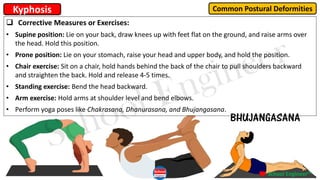
 Corrective Measures or Exercises:
• Supine position: Lie on your back, draw knees up with feet flat on the ground, and raise arms over
the head. Hold this position.
• Prone position: Lie on your stomach, raise your head and upper body, and hold the position.
• Chair exercise: Sit on a chair, hold hands behind the back of the chair to pull shoulders backward
and straighten the back. Hold and release 4-5 times.
• Standing exercise: Bend the head backward.
• Arm exercise: Hold arms at shoulder level and bend elbows.
• Perform yoga poses like Chakrasana, Dhanurasana, and Bhujangasana.
♥ School Engineer™
Common Postural Deformities
Kyphosis
School Engineer
Lordosis is the inward curvature of the spine, specifically in the lumbar region, causing problems with
standing and walking.
 Causes:
• Habitual overeating
• Improper environment
• Diseases affecting vertebrae
• Improper muscle development
• Lack of regular exercise
• Obesity or overweight
 Precautions:
• Eat healthy and less oily foods
• Maintain a normal body weight
• Avoid bending too much while sitting
• Do regular lower back stretching exercises
♥ School Engineer™
Common Postural Deformities
Lordosis
School Engineer
 Corrective Measures or Exercises:
• Prone position exercise: Lie on your stomach, raise the lower back region by keeping hands under
the abdomen, with hips and shoulders down.
• Prone position push-up: Lie on your stomach, push the torso up while keeping the pelvic region on
the floor, with palms flat on the floor.
• Chair exercise: Sit on a chair, bend and reach to the floor with shoulders positioned between the
knees.
• Back exercise: Lie on your back and lift feet vertically.
• Perform yoga poses like Halasana and Paschimottanasana.
• Do sit-ups slowly.
♥ School Engineer™
Common Postural Deformities
Lordosis
School Engineer
Scoliosis is an abnormal sideways curvature of the spine, often developing during the growth spurt
before puberty. The spine may curve in a "C" or "S" shape.
 Causes:
• Birth defects or heredity
• Having one leg shorter than the other
• One side flat foot
• Carrying heavy loads on one shoulder
• Paralysis of spinal muscles on one side
• Poor posture while standing
• Neurological abnormalities
 Precautions:
• Avoid walking, sitting, or standing in a bent position
• Keep the body straight while carrying weights
• Avoid carrying weight in one hand for too long
• Eat a balanced diet ♥ School Engineer™
Common Postural Deformities
Scoliosis
School Engineer
♥ School Engineer™
School Engineer
 Corrective Measures or Exercises:
• Flat foot exercise: Addressing one side flat foot
• Trikonasana: Perform this yoga pose with proper technique
• Prone position: Lie on your chest with the right arm upward and left arm at the side, then move the
right arm overhead to the left, press down with the left hand, and slide the left hip up
• Standing exercise: Stand straight, lift the left heel and hip, extend the right arm in an arch to the
left, and press the left hand against the ribs
• Upper body bend: Stand straight, touch the fingertips of the left hand to the left shoulder, and bend
the upper body to the right
Common Postural Deformities
Scoliosis
♥ School Engineer™
School Engineer
Knock knee is a postural deformity where the knees touch or overlap each other when standing,
causing difficulty in walking and running. Also called genu valgum.
 Causes:
• Weak muscles and ligaments
• Overweight and lack of balanced diet
• Lack of vitamin D, calcium, and phosphorus
• Chronic illness, injury, and flat foot
• Rickets (bone development problems)
• Genetic conditions affecting bone or joint development
 Precautions:
• Eat a balanced diet
• Do not force babies to walk at an early age
Common Postural Deformities
Knock Knee
♥ School Engineer™
School Engineer
 Corrective Measures or Exercises:
• Treat knock knees early while bones are still soft
• Regular horse riding
• Stand straight with a pillow between the knees and feet touching each other
• Perform yoga poses like Padmasana and Gomukhasana
• Use walking callipers
♥ School Engineer™
Common Postural Deformities
Knock Knee
School Engineer
Bow legs is a deformity where there is a wide gap between the knees when standing with feet
together, causing difficulty in walking and running. Also called Genu Varum.
 Causes:
• Extra weight on leg muscles
• Lack of balanced diet and deficiency of calcium and phosphorus
• Improper walking habits
• Forcing babies to walk too early
• Overweight
• Vitamin D deficiency
• Bone fractures that haven't healed properly
• Abnormal bone development or bone dysplasia
 Precautions:
• Eat a balanced diet
• Do not force babies to walk too early
♥ School Engineer™
Common Postural Deformities
Bow Legs
School Engineer
 Corrective Measures or Exercises:
• Correct bow legs early while bones are still soft
• Walk by bending the toes inward or on the inner edge of the feet
• Squat with a cloth tied around both legs at knee level
• Perform yoga poses like Ardh Matseyendrasana, Garudasana, and Ardha Chakrasana
♥ School Engineer™
Common Postural Deformities
Bow Legs
School Engineer
Flat foot is a deformity where the feet lack an arch, remaining completely flat. This can cause
difficulties in standing, walking, jumping, and running.
 Causes:
• Carrying heavy weight for long periods
• Leg length inequality
• Being overweight
• Standing for long periods
• Poor quality footwear without arch support
• Faulty posture
• Weak muscles unable to support body weight
 Precautions:
• Wear properly shaped and sized shoes
• Avoid high heels and walking barefoot for long durations
• Avoid obesity and carrying heavy weight in early childhood
• Do not force babies to walk too early
♥ School Engineer™
Common Postural Deformities
Flat Foot
School Engineer
 Corrective Measures or Exercises:
• Walk on heels and toes
• Pick up marbles with toes
• Walk on a wooden staircase
• Perform rope skipping
• Do therapeutic massage, like rolling a ball under the foot
• Perform the downward dog yoga pose to strengthen calf muscles and Achilles tendon
 To check for flat feet, dip your feet in water and walk on a dry surface. If your footprints show a
complete impression without an arch, you have flat feet.
♥ School Engineer™
Common Postural Deformities
Flat Foot
School Engineer
Round shoulders is a postural deformity where the shoulders are drawn forward, causing the head and
chin to extend forward.
 Causes:
• Poor posture, especially at a desk job
• Sitting on improper furniture
• Incorrect habits of standing, walking, and sitting
• Carrying heavy loads on shoulders
• Wearing tight clothes
• Lack of shoulder exercises
 Precautions:
• Avoid sitting, standing, or walking in a bent position
• Avoid tight-fitting clothes
• Avoid sitting on improper furniture
♥ School Engineer™
Common Postural Deformities
Round Shoulders
School Engineer
 Corrective Measures or Exercises:
• Stand in the correct posture
• Place fingertips on shoulders and move elbows in clockwise and anti-clockwise circles
• Perform yoga poses like Chakrasana and Dhanurasana
• Hang from a horizontal bar for some time
Common Postural Deformities
Round Shoulders
♥ School Engineer™
School Engineer
• Knowledge of Proper Posture: Educate people about proper posture while sitting, standing,
and walking to help them maintain it.
• Taking a Balanced Diet: Eat nutritious food with essential nutrients to prevent postural
deformities.
• Avoid Sitting at One Place: Avoid sitting for long periods, as it can lead to obesity and
postural deformities.
• Doing Specific Exercises: Perform exercises that strengthen and tone the back muscles,
spine, and bones to correct postural deformities.
♥ School Engineer™
Common Postural Deformities
Corrective Measures for Postural Deformities
School Engineer
• Sports are really important for girls.
• They learn commitment, respect, how to handle stress, set goals, and deal with success and failure
gracefully.
• Research shows that playing sports and being active can make Indian girls and young women
healthier in their minds, emotions, and spirits.
 These benefits are given below
1. Physical Benefits
2. Psychological Benefits
3. Social Benefits
♥ School Engineer™
2.3 Women's Participation in Sports
School Engineer
 Participation in sports offers important physical benefits for women:
1. Reduces Lifestyle Diseases: Sports help lower the risk of diseases like diabetes, high blood
pressure, and obesity, promoting overall health.
2. Increases Bone Density: Women, who are more prone to osteoporosis, can strengthen
their bones through sports, improving bone density.
3. Tones Muscles: Regular exercise and sports participation tone women's muscles, making
them stronger.
4. Improves Cardiovascular System: Exercise increases capillaries, enhancing oxygen intake
and allowing women to participate in sports longer without getting tired.
5. Aids in Reducing Obesity: Sports help women maintain a healthy weight and shape,
reducing the risk of obesity, which is a common lifestyle concern.
♥ School Engineer™
Women's Participation in Sports
Physical Benefits
School Engineer
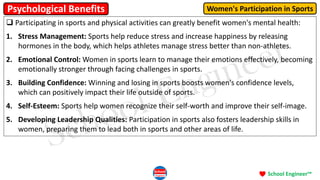
 Participating in sports and physical activities can greatly benefit women's mental health:
1. Stress Management: Sports help reduce stress and increase happiness by releasing
hormones in the body, which helps athletes manage stress better than non-athletes.
2. Emotional Control: Women in sports learn to manage their emotions effectively, becoming
emotionally stronger through facing challenges in sports.
3. Building Confidence: Winning and losing in sports boosts women's confidence levels,
which can positively impact their life outside of sports.
4. Self-Esteem: Sports help women recognize their self-worth and improve their self-image.
5. Developing Leadership Qualities: Participation in sports also fosters leadership skills in
women, preparing them to lead both in sports and other areas of life.
♥ School Engineer™
Women's Participation in Sports
Psychological Benefits
School Engineer
• Women's participation in sports contributes to building a society where gender equality
and empowerment are promoted by providing equal opportunities and rights.
 Here are some social benefits of sports:
1. Coordination: Sports are team activities that enhance coordination among players.
Women who participate learn how to work together effectively.
2. Communication: Sports encourage strong communication skills among players, helping
women to become more vocal and expressive.
3. Inter-relationships: Team sports emphasize teamwork, teaching women to maintain
relationships and respect others both on and off the field.
4. Cooperation: Sports foster cooperation among players, teaching women essential life skills
in working together towards common goals.
♥ School Engineer™
Women's Participation in Sports
Social Benefits
School Engineer
• Sportswomen need to think about important things like their first period (menarche) and problems
with their periods (menstrual dysfunction).
• These are natural things that happen to all women.
• Girls and women who do sports need to take these seriously because they affect their body and
how they feel.
 They are described in detail below
1. Menarche
2. Menstrual Dysfunction
♥ School Engineer™
2.4 Special Considerations
School Engineer
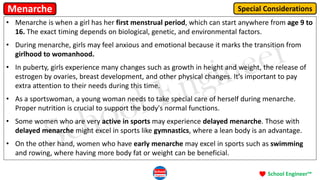
• Menarche is when a girl has her first menstrual period, which can start anywhere from age 9 to
16. The exact timing depends on biological, genetic, and environmental factors.
• During menarche, girls may feel anxious and emotional because it marks the transition from
girlhood to womanhood.
• In puberty, girls experience many changes such as growth in height and weight, the release of
estrogen by ovaries, breast development, and other physical changes. It's important to pay
extra attention to their needs during this time.
• As a sportswoman, a young woman needs to take special care of herself during menarche.
Proper nutrition is crucial to support the body's normal functions.
• Some women who are very active in sports may experience delayed menarche. Those with
delayed menarche might excel in sports like gymnastics, where a lean body is an advantage.
• On the other hand, women who have early menarche may excel in sports such as swimming
and rowing, where having more body fat or weight can be beneficial.
♥ School Engineer™
Special Considerations
Menarche
School Engineer
• Menstrual dysfunction refers to abnormal bleeding patterns and irregular menstrual cycles.
• Normally, a menstrual cycle lasts 3 to 7 days and occurs every 22 to 35 days.
• During menstrual dysfunction, women often experience symptoms like headaches, back pain,
fatigue, cramps, and tiredness.
• The participation of women in physical fitness and competitive endurance sports has increased the
incidence of menstrual dysfunction.
• Activities like long-distance running can affect hormone levels such as androgen, estrogen, and
progesterone, leading to menstrual irregularities in some women.
• This not only affects their physical performance but also poses psychological challenges.
• During these times, women should pay special attention to cleanliness and hygiene practices.
♥ School Engineer™
Special Considerations
Menstrual Dysfunction
School Engineer
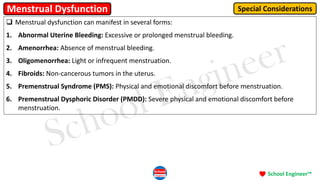
 Menstrual dysfunction can manifest in several forms:
1. Abnormal Uterine Bleeding: Excessive or prolonged menstrual bleeding.
2. Amenorrhea: Absence of menstrual bleeding.
3. Oligomenorrhea: Light or infrequent menstruation.
4. Fibroids: Non-cancerous tumors in the uterus.
5. Premenstrual Syndrome (PMS): Physical and emotional discomfort before menstruation.
6. Premenstrual Dysphoric Disorder (PMDD): Severe physical and emotional discomfort before
menstruation.
♥ School Engineer™
Special Considerations
Menstrual Dysfunction
School Engineer
• The 'Female Athlete Triad' is a health issue where female athletes, especially teenagers and adults,
experience three related problems: weak bones (osteoporosis), missed menstrual periods
(amenorrhea), and eating disorders.
• It happens when athletes don't eat enough to match their energy needs, which can harm their
health and performance.
• If an athlete has one part of the triad, they likely have the other two too.
• They might focus on staying very thin by eating less or avoiding fats, but this can lead to serious
problems like bone weakness, irregular periods, and emotional issues.
 The components of female athlete triad are discussed below
1. Osteoporosis (Decreased Bone Density)
2. Amenorrhea (Menstrual Irregularities)
3. Eating Disorders (Energy Deficit)
♥ School Engineer™
2.5 Female Athlete Triad
School Engineer
♥ School Engineer™
Osteoporosis
• Osteoporosis is when bones become weak and
fragile because they don't have enough minerals
like calcium.
• This makes them more likely to break, even from
small bumps.
• It's a big concern for female athletes because it can
lead to more fractures and injuries.
• In osteoporosis, bones get holes in them and
become brittle.
• Women with this condition often have low levels of
estrogen, a hormone important for bone health.
• Female athletes are at higher risk for osteoporosis if
they don't eat enough calcium-rich foods, if they
diet too much, or if they train really hard without
taking care of their bones.
• Genetics and the environment also play a role.
Female Athlete Triad
School Engineer
 Causes:
• Low estrogen levels and inadequate calcium intake are primary causes of osteoporosis.
• Imbalances in thyroid hormones (hyperthyroidism) can also contribute to bone loss.
 Preventive Measures:
• Women should consume foods rich in calcium and protein to support bone health.
• Getting enough vitamin D, either through sunlight exposure or supplements, is important.
• Avoiding habits like smoking and excessive alcohol consumption can help prevent osteoporosis.
• Regular check-ups for osteoporosis risk factors and bone health are recommended.
• Engaging in appropriate physical activities that promote bone strength and overall health is
beneficial.
♥ School Engineer™
Female Athlete Triad
Osteoporosis
School Engineer
• Intensive exercise without consuming enough calories can disrupt hormones, causing a girl's
menstrual cycle to become irregular or stop completely.
• This condition is called amenorrhea, which means the absence of menstrual periods or irregularity.
• Symptoms of amenorrhea include hair loss, headaches, changes in vision, and the development of
facial hair.
 There are two types of amenorrhea:
1. Primary amenorrhea refers to delayed onset of menstruation.
2. Secondary amenorrhea occurs when menstruation starts but then stops.
• If menstruation stops, the secondary physical changes of puberty may not fully develop by the age
of 16. This condition can lead to significant physical and psychological stress.
♥ School Engineer™
Female Athlete Triad
Amenorrhea
School Engineer
 Causes:
• Intense and vigorous exercise is the main factor causing amenorrhea.
• Inadequate nutrition and excessively low body weight can also lead to amenorrhea.
• Genetic factors can contribute to this condition.
 Preventive Measures:
• Maintain a balanced diet and create a proper exercise plan.
• Make lifestyle changes as needed.
• Hormone therapy may be used to help balance hormones in some cases.
♥ School Engineer™
Female Athlete Triad
Amenorrhea
School Engineer
• Eating disorders involve consuming very few calories, leading to nutrient deficiencies and lack of
energy, impacting both physical and mental health.
• Female athletes often restrict food intake to enhance performance, neglecting essential nutrients
like fat and iron, which can result in serious conditions such as anorexia nervosa, bulimia nervosa,
and anemia:
1. Anorexia Nervosa: This disorder involves severe restriction of food intake, leading to dangerously
low body weight. It can cause reduced bone density, kidney damage, and heart problems.
2. Bulimia Nervosa: Characterized by binge eating followed by purging behaviors like vomiting or
excessive exercise to prevent weight gain. It poses significant health risks.
3. Anemia: A condition resulting from low red blood cells due to insufficient iron in the diet. Women
athletes who engage in vigorous exercise without proper nutrition are at risk. Other causes include
excessive menstruation or certain diseases.
• Symptoms of iron-deficiency anemia include fatigue, muscle weakness, shortness of breath during
exercise, nausea, and increased susceptibility to infections.
♥ School Engineer™
Female Athlete Triad
Eating Disorders
School Engineer

Class 12th physical education chapter 2 notes

  • 1.
    CLASS 12 PHYSICALEDUCATION ch : 2 Free Notes Pdf 100% Result 1 Shot Video Boards 2025 Children and Women in Sports School Engineer
  • 2.
    CLASS XII COURSE STRUCTURE UNITNO. UNIT NAME NO. OF PERIODS (190 HRS) THE WEIGHTAGE (MARKS) ALLOTTED UNIT 1 Management of Sporting Events 15 05 + 04b* UNIT 2 Children and Women in Sports 12 07 UNIT 3 Yoga as Preventive measure for Lifestyle Disease 12 06+01 b* UNIT 4 Physical Education & Sports for (CWSN) 13 04+04 b* UNIT 5 Sports & Nutrition 12 07 UNIT 6 Test and Measurement in Sports 13 08 UNIT 7 Physiology & Injuries in Sport 13 04+04 b* UNIT 8 Biomechanics and Sports 18 10 UNIT 9 Psychology and Sports 12 07 UNIT 10 Training in Sports 15 09 PRACTICAL (LAB)# Including 3 Practical 56 30 TOTAL Theory 10 + Practical 3 134 + 56 = 190hrs Theory 70 + Practical 30 = 100 Note: b*are the Concept based questions like Tactile diagram/data interpretation/case base study for visually Impaired Child Physical Education Syllabus 2024-25 ♥ School Engineer™ School Engineer
  • 3.
    1. Exercise guidelinesof WHO for different age groups. 2. Common postural deformities- Knock knees, flat foot, round shoulders, Lordosis, Kyphosis, Scoliosis, and bow legs and their respective corrective measures. 3. Women’s participation in Sports – Physical, Psychological, and social benefits. 4. Special considerations (menarche and menstrual dysfunction) 5. Female athlete triad (osteoporosis, amenorrhea, eating disorders). ♥ School Engineer™ Unit Topics School Engineer
  • 4.
    2.1 Exercise guidelinesof WHO for different age groups • Human growth goes through different stages from infancy to adulthood. • These stages involve changes in physical appearance and mental development. • Growth depends on factors like heredity, environment, and physical activities. • Exercise is important for both the mind and body at every stage. • The stages of growth are • Infancy • Early Childhood • Middle Childhood • Adolescence, and Adulthood. ♥ School Engineer™ School Engineer
  • 5.
    • Infanthood (0-2Years): • This stage is from birth to 2 years old. • Babies develop gross motor skills quickly, starting with moving their head to grasping things. • Key activities include turning and lifting the head, moving arms and legs, rolling, crawling, grasping, standing, walking, hand-eye coordination, and balancing. Exercise guidelines for infants: • Encourage babies to be active throughout the day by playing with them. • Light exercises like reaching, grasping, pulling, and pushing should be encouraged. • Include exercises that involve body and limb movements. • Focus on exercises to develop gross motor skills like head control, sitting, and crawling. • Provide a safe environment for these activities. • Toddlers should be active for at least 3 hours a day. ♥ School Engineer™ 2.1 Exercise guidelines of WHO for different age groups School Engineer
  • 6.
    • Early Childhood(3-7 Years): • This stage marks the start of childhood. • Rapid motor development occurs, so children should do lots of physical activities, focusing on participation rather than competition. • Key activities include developing fine motor skills, hand-eye coordination, basic and advanced locomotor activities, and cognitive activities. Exercise guidelines for early childhood: • Develop movement skills like jumping, hopping, throwing, catching, skipping, and kicking a ball. • Build fine motor skills with activities like twisting, squeezing, and building things. • Participate in games and sports with simple rules. • Engage in both structured and unstructured physical activities for at least 60 minutes a day. ♥ School Engineer™ 2.1 Exercise guidelines of WHO for different age groups School Engineer
  • 7.
    • Middle Childhood(8-12 Years): • Children start competing and want to excel in motor skills. • Key characteristics include better balance, precise movements, and increased speed. Exercise guidelines for middle childhood: • Develop body control, balance, and coordination. • Engage in activities that build endurance. • Play games that teach rules, fair play, and simple strategies. • Do bone and muscle strengthening activities like cycling, riding, and jumping rope. ♥ School Engineer™ 2.1 Exercise guidelines of WHO for different age groups School Engineer
  • 8.
    • Adolescence (13-18Years): • This is the transition from childhood to adulthood. • Rapid growth in height and body changes affect sports and physical activities. • Key characteristics include biological growth, increased decision-making, self-consciousness, and social changes. Exercise guidelines for adolescence: • Get at least 60 minutes of moderate-to-vigorous exercise daily. • Activities like brisk walking, cycling, and swimming strengthen the heart. • Running, jumping rope, and playing basketball strengthen bones and muscles. • Lifting weights and yoga are also good for muscle strength. ♥ School Engineer™ 2.1 Exercise guidelines of WHO for different age groups School Engineer
  • 9.
    • Adulthood (18-64Years): • Exercise remains important to keep the body healthy and in good shape. • Adults need at least an hour of exercise daily. • Exercise intensity may decrease with age, but it is still necessary. Exercise guidelines for adulthood: • Perform resistance exercises at least two days a week to strengthen muscles and bones. • Do slow stretching exercises that involve limb movement. • Engage in light to moderate jogging. • Walk with intervals of jogging and at different paces. • Practice yoga for an hour. • Do vigorous exercises like running, push-ups, and longer physical activities. ♥ School Engineer™ 2.1 Exercise guidelines of WHO for different age groups School Engineer
  • 10.
    • Adults (65years and above): • Older adults should engage in regular physical activity. • Aim for 150 to 300 minutes of moderate-intensity aerobic activity like brisk walking, or 75 to 150 minutes of vigorous-intensity aerobic activity each week. • Do muscle-strengthening activities involving all major muscle groups at least two days a week. • Include activities that improve balance and strength at least three days a week to enhance functional capacity and prevent falls. • Reduce sedentary time and replace it with any physical activity, even light intensity, to gain health benefits. ♥ School Engineer™ 2.1 Exercise guidelines of WHO for different age groups School Engineer
  • 11.
     Various typesof postural deformities are discussed below: 1. Spinal Curvature 2. Knock Knee 3. Bow Legs 4. Flat Foot 5. Round Shoulders ♥ School Engineer™ 2.2 Common Postural Deformities School Engineer
  • 12.
    1. Spinal Curvature: •Spinal curvature deformities are related to the spine and can be caused by carrying too much weight or having weak muscles. • The normal lumbar spine has a slight forward curve when viewed from the side, but there is no exact standard for this curve.  There are three types of spinal deformities: A. Kyphosis: Excessive outward curve of the upper spine, creating a hunchback appearance. B. Lordosis: Excessive inward curve of the lower spine, causing a swayback posture. C. Scoliosis: Sideways curve of the spine, creating an "S" or "C" shape. ♥ School Engineer™ Common Postural Deformities School Engineer
  • 13.
    Kyphosis is aspinal deformity with an exaggerated backward curve, often called "round upper back" or "hunchback."  Causes: • Malnutrition and illness • Carrying heavy loads on shoulders • Habit of bending while walking • Muscle weakness in the upper back • Osteoporosis (loss of bone strength) • Injury to the spine  Precautions: • Eat a balanced diet • Keep the body straight while carrying weight • Avoid walking too long with weight on one hand • Learn proper posture for sitting, standing, and walking • Do proper and adequate exercise ♥ School Engineer™ Common Postural Deformities Kyphosis School Engineer
  • 14.
     Corrective Measuresor Exercises: • Supine position: Lie on your back, draw knees up with feet flat on the ground, and raise arms over the head. Hold this position. • Prone position: Lie on your stomach, raise your head and upper body, and hold the position. • Chair exercise: Sit on a chair, hold hands behind the back of the chair to pull shoulders backward and straighten the back. Hold and release 4-5 times. • Standing exercise: Bend the head backward. • Arm exercise: Hold arms at shoulder level and bend elbows. • Perform yoga poses like Chakrasana, Dhanurasana, and Bhujangasana. ♥ School Engineer™ Common Postural Deformities Kyphosis School Engineer
  • 15.
    Lordosis is theinward curvature of the spine, specifically in the lumbar region, causing problems with standing and walking.  Causes: • Habitual overeating • Improper environment • Diseases affecting vertebrae • Improper muscle development • Lack of regular exercise • Obesity or overweight  Precautions: • Eat healthy and less oily foods • Maintain a normal body weight • Avoid bending too much while sitting • Do regular lower back stretching exercises ♥ School Engineer™ Common Postural Deformities Lordosis School Engineer
  • 16.
     Corrective Measuresor Exercises: • Prone position exercise: Lie on your stomach, raise the lower back region by keeping hands under the abdomen, with hips and shoulders down. • Prone position push-up: Lie on your stomach, push the torso up while keeping the pelvic region on the floor, with palms flat on the floor. • Chair exercise: Sit on a chair, bend and reach to the floor with shoulders positioned between the knees. • Back exercise: Lie on your back and lift feet vertically. • Perform yoga poses like Halasana and Paschimottanasana. • Do sit-ups slowly. ♥ School Engineer™ Common Postural Deformities Lordosis School Engineer
  • 17.
    Scoliosis is anabnormal sideways curvature of the spine, often developing during the growth spurt before puberty. The spine may curve in a "C" or "S" shape.  Causes: • Birth defects or heredity • Having one leg shorter than the other • One side flat foot • Carrying heavy loads on one shoulder • Paralysis of spinal muscles on one side • Poor posture while standing • Neurological abnormalities  Precautions: • Avoid walking, sitting, or standing in a bent position • Keep the body straight while carrying weights • Avoid carrying weight in one hand for too long • Eat a balanced diet ♥ School Engineer™ Common Postural Deformities Scoliosis School Engineer
  • 18.
  • 19.
     Corrective Measuresor Exercises: • Flat foot exercise: Addressing one side flat foot • Trikonasana: Perform this yoga pose with proper technique • Prone position: Lie on your chest with the right arm upward and left arm at the side, then move the right arm overhead to the left, press down with the left hand, and slide the left hip up • Standing exercise: Stand straight, lift the left heel and hip, extend the right arm in an arch to the left, and press the left hand against the ribs • Upper body bend: Stand straight, touch the fingertips of the left hand to the left shoulder, and bend the upper body to the right Common Postural Deformities Scoliosis ♥ School Engineer™ School Engineer
  • 20.
    Knock knee isa postural deformity where the knees touch or overlap each other when standing, causing difficulty in walking and running. Also called genu valgum.  Causes: • Weak muscles and ligaments • Overweight and lack of balanced diet • Lack of vitamin D, calcium, and phosphorus • Chronic illness, injury, and flat foot • Rickets (bone development problems) • Genetic conditions affecting bone or joint development  Precautions: • Eat a balanced diet • Do not force babies to walk at an early age Common Postural Deformities Knock Knee ♥ School Engineer™ School Engineer
  • 21.
     Corrective Measuresor Exercises: • Treat knock knees early while bones are still soft • Regular horse riding • Stand straight with a pillow between the knees and feet touching each other • Perform yoga poses like Padmasana and Gomukhasana • Use walking callipers ♥ School Engineer™ Common Postural Deformities Knock Knee School Engineer
  • 22.
    Bow legs isa deformity where there is a wide gap between the knees when standing with feet together, causing difficulty in walking and running. Also called Genu Varum.  Causes: • Extra weight on leg muscles • Lack of balanced diet and deficiency of calcium and phosphorus • Improper walking habits • Forcing babies to walk too early • Overweight • Vitamin D deficiency • Bone fractures that haven't healed properly • Abnormal bone development or bone dysplasia  Precautions: • Eat a balanced diet • Do not force babies to walk too early ♥ School Engineer™ Common Postural Deformities Bow Legs School Engineer
  • 23.
     Corrective Measuresor Exercises: • Correct bow legs early while bones are still soft • Walk by bending the toes inward or on the inner edge of the feet • Squat with a cloth tied around both legs at knee level • Perform yoga poses like Ardh Matseyendrasana, Garudasana, and Ardha Chakrasana ♥ School Engineer™ Common Postural Deformities Bow Legs School Engineer
  • 24.
    Flat foot isa deformity where the feet lack an arch, remaining completely flat. This can cause difficulties in standing, walking, jumping, and running.  Causes: • Carrying heavy weight for long periods • Leg length inequality • Being overweight • Standing for long periods • Poor quality footwear without arch support • Faulty posture • Weak muscles unable to support body weight  Precautions: • Wear properly shaped and sized shoes • Avoid high heels and walking barefoot for long durations • Avoid obesity and carrying heavy weight in early childhood • Do not force babies to walk too early ♥ School Engineer™ Common Postural Deformities Flat Foot School Engineer
  • 25.
     Corrective Measuresor Exercises: • Walk on heels and toes • Pick up marbles with toes • Walk on a wooden staircase • Perform rope skipping • Do therapeutic massage, like rolling a ball under the foot • Perform the downward dog yoga pose to strengthen calf muscles and Achilles tendon  To check for flat feet, dip your feet in water and walk on a dry surface. If your footprints show a complete impression without an arch, you have flat feet. ♥ School Engineer™ Common Postural Deformities Flat Foot School Engineer
  • 26.
    Round shoulders isa postural deformity where the shoulders are drawn forward, causing the head and chin to extend forward.  Causes: • Poor posture, especially at a desk job • Sitting on improper furniture • Incorrect habits of standing, walking, and sitting • Carrying heavy loads on shoulders • Wearing tight clothes • Lack of shoulder exercises  Precautions: • Avoid sitting, standing, or walking in a bent position • Avoid tight-fitting clothes • Avoid sitting on improper furniture ♥ School Engineer™ Common Postural Deformities Round Shoulders School Engineer
  • 27.
     Corrective Measuresor Exercises: • Stand in the correct posture • Place fingertips on shoulders and move elbows in clockwise and anti-clockwise circles • Perform yoga poses like Chakrasana and Dhanurasana • Hang from a horizontal bar for some time Common Postural Deformities Round Shoulders ♥ School Engineer™ School Engineer
  • 28.
    • Knowledge ofProper Posture: Educate people about proper posture while sitting, standing, and walking to help them maintain it. • Taking a Balanced Diet: Eat nutritious food with essential nutrients to prevent postural deformities. • Avoid Sitting at One Place: Avoid sitting for long periods, as it can lead to obesity and postural deformities. • Doing Specific Exercises: Perform exercises that strengthen and tone the back muscles, spine, and bones to correct postural deformities. ♥ School Engineer™ Common Postural Deformities Corrective Measures for Postural Deformities School Engineer
  • 29.
    • Sports arereally important for girls. • They learn commitment, respect, how to handle stress, set goals, and deal with success and failure gracefully. • Research shows that playing sports and being active can make Indian girls and young women healthier in their minds, emotions, and spirits.  These benefits are given below 1. Physical Benefits 2. Psychological Benefits 3. Social Benefits ♥ School Engineer™ 2.3 Women's Participation in Sports School Engineer
  • 30.
     Participation insports offers important physical benefits for women: 1. Reduces Lifestyle Diseases: Sports help lower the risk of diseases like diabetes, high blood pressure, and obesity, promoting overall health. 2. Increases Bone Density: Women, who are more prone to osteoporosis, can strengthen their bones through sports, improving bone density. 3. Tones Muscles: Regular exercise and sports participation tone women's muscles, making them stronger. 4. Improves Cardiovascular System: Exercise increases capillaries, enhancing oxygen intake and allowing women to participate in sports longer without getting tired. 5. Aids in Reducing Obesity: Sports help women maintain a healthy weight and shape, reducing the risk of obesity, which is a common lifestyle concern. ♥ School Engineer™ Women's Participation in Sports Physical Benefits School Engineer
  • 31.
     Participating insports and physical activities can greatly benefit women's mental health: 1. Stress Management: Sports help reduce stress and increase happiness by releasing hormones in the body, which helps athletes manage stress better than non-athletes. 2. Emotional Control: Women in sports learn to manage their emotions effectively, becoming emotionally stronger through facing challenges in sports. 3. Building Confidence: Winning and losing in sports boosts women's confidence levels, which can positively impact their life outside of sports. 4. Self-Esteem: Sports help women recognize their self-worth and improve their self-image. 5. Developing Leadership Qualities: Participation in sports also fosters leadership skills in women, preparing them to lead both in sports and other areas of life. ♥ School Engineer™ Women's Participation in Sports Psychological Benefits School Engineer
  • 32.
    • Women's participationin sports contributes to building a society where gender equality and empowerment are promoted by providing equal opportunities and rights.  Here are some social benefits of sports: 1. Coordination: Sports are team activities that enhance coordination among players. Women who participate learn how to work together effectively. 2. Communication: Sports encourage strong communication skills among players, helping women to become more vocal and expressive. 3. Inter-relationships: Team sports emphasize teamwork, teaching women to maintain relationships and respect others both on and off the field. 4. Cooperation: Sports foster cooperation among players, teaching women essential life skills in working together towards common goals. ♥ School Engineer™ Women's Participation in Sports Social Benefits School Engineer
  • 33.
    • Sportswomen needto think about important things like their first period (menarche) and problems with their periods (menstrual dysfunction). • These are natural things that happen to all women. • Girls and women who do sports need to take these seriously because they affect their body and how they feel.  They are described in detail below 1. Menarche 2. Menstrual Dysfunction ♥ School Engineer™ 2.4 Special Considerations School Engineer
  • 34.
    • Menarche iswhen a girl has her first menstrual period, which can start anywhere from age 9 to 16. The exact timing depends on biological, genetic, and environmental factors. • During menarche, girls may feel anxious and emotional because it marks the transition from girlhood to womanhood. • In puberty, girls experience many changes such as growth in height and weight, the release of estrogen by ovaries, breast development, and other physical changes. It's important to pay extra attention to their needs during this time. • As a sportswoman, a young woman needs to take special care of herself during menarche. Proper nutrition is crucial to support the body's normal functions. • Some women who are very active in sports may experience delayed menarche. Those with delayed menarche might excel in sports like gymnastics, where a lean body is an advantage. • On the other hand, women who have early menarche may excel in sports such as swimming and rowing, where having more body fat or weight can be beneficial. ♥ School Engineer™ Special Considerations Menarche School Engineer
  • 35.
    • Menstrual dysfunctionrefers to abnormal bleeding patterns and irregular menstrual cycles. • Normally, a menstrual cycle lasts 3 to 7 days and occurs every 22 to 35 days. • During menstrual dysfunction, women often experience symptoms like headaches, back pain, fatigue, cramps, and tiredness. • The participation of women in physical fitness and competitive endurance sports has increased the incidence of menstrual dysfunction. • Activities like long-distance running can affect hormone levels such as androgen, estrogen, and progesterone, leading to menstrual irregularities in some women. • This not only affects their physical performance but also poses psychological challenges. • During these times, women should pay special attention to cleanliness and hygiene practices. ♥ School Engineer™ Special Considerations Menstrual Dysfunction School Engineer
  • 36.
     Menstrual dysfunctioncan manifest in several forms: 1. Abnormal Uterine Bleeding: Excessive or prolonged menstrual bleeding. 2. Amenorrhea: Absence of menstrual bleeding. 3. Oligomenorrhea: Light or infrequent menstruation. 4. Fibroids: Non-cancerous tumors in the uterus. 5. Premenstrual Syndrome (PMS): Physical and emotional discomfort before menstruation. 6. Premenstrual Dysphoric Disorder (PMDD): Severe physical and emotional discomfort before menstruation. ♥ School Engineer™ Special Considerations Menstrual Dysfunction School Engineer
  • 37.
    • The 'FemaleAthlete Triad' is a health issue where female athletes, especially teenagers and adults, experience three related problems: weak bones (osteoporosis), missed menstrual periods (amenorrhea), and eating disorders. • It happens when athletes don't eat enough to match their energy needs, which can harm their health and performance. • If an athlete has one part of the triad, they likely have the other two too. • They might focus on staying very thin by eating less or avoiding fats, but this can lead to serious problems like bone weakness, irregular periods, and emotional issues.  The components of female athlete triad are discussed below 1. Osteoporosis (Decreased Bone Density) 2. Amenorrhea (Menstrual Irregularities) 3. Eating Disorders (Energy Deficit) ♥ School Engineer™ 2.5 Female Athlete Triad School Engineer
  • 38.
    ♥ School Engineer™ Osteoporosis •Osteoporosis is when bones become weak and fragile because they don't have enough minerals like calcium. • This makes them more likely to break, even from small bumps. • It's a big concern for female athletes because it can lead to more fractures and injuries. • In osteoporosis, bones get holes in them and become brittle. • Women with this condition often have low levels of estrogen, a hormone important for bone health. • Female athletes are at higher risk for osteoporosis if they don't eat enough calcium-rich foods, if they diet too much, or if they train really hard without taking care of their bones. • Genetics and the environment also play a role. Female Athlete Triad School Engineer
  • 39.
     Causes: • Lowestrogen levels and inadequate calcium intake are primary causes of osteoporosis. • Imbalances in thyroid hormones (hyperthyroidism) can also contribute to bone loss.  Preventive Measures: • Women should consume foods rich in calcium and protein to support bone health. • Getting enough vitamin D, either through sunlight exposure or supplements, is important. • Avoiding habits like smoking and excessive alcohol consumption can help prevent osteoporosis. • Regular check-ups for osteoporosis risk factors and bone health are recommended. • Engaging in appropriate physical activities that promote bone strength and overall health is beneficial. ♥ School Engineer™ Female Athlete Triad Osteoporosis School Engineer
  • 40.
    • Intensive exercisewithout consuming enough calories can disrupt hormones, causing a girl's menstrual cycle to become irregular or stop completely. • This condition is called amenorrhea, which means the absence of menstrual periods or irregularity. • Symptoms of amenorrhea include hair loss, headaches, changes in vision, and the development of facial hair.  There are two types of amenorrhea: 1. Primary amenorrhea refers to delayed onset of menstruation. 2. Secondary amenorrhea occurs when menstruation starts but then stops. • If menstruation stops, the secondary physical changes of puberty may not fully develop by the age of 16. This condition can lead to significant physical and psychological stress. ♥ School Engineer™ Female Athlete Triad Amenorrhea School Engineer
  • 41.
     Causes: • Intenseand vigorous exercise is the main factor causing amenorrhea. • Inadequate nutrition and excessively low body weight can also lead to amenorrhea. • Genetic factors can contribute to this condition.  Preventive Measures: • Maintain a balanced diet and create a proper exercise plan. • Make lifestyle changes as needed. • Hormone therapy may be used to help balance hormones in some cases. ♥ School Engineer™ Female Athlete Triad Amenorrhea School Engineer
  • 42.
    • Eating disordersinvolve consuming very few calories, leading to nutrient deficiencies and lack of energy, impacting both physical and mental health. • Female athletes often restrict food intake to enhance performance, neglecting essential nutrients like fat and iron, which can result in serious conditions such as anorexia nervosa, bulimia nervosa, and anemia: 1. Anorexia Nervosa: This disorder involves severe restriction of food intake, leading to dangerously low body weight. It can cause reduced bone density, kidney damage, and heart problems. 2. Bulimia Nervosa: Characterized by binge eating followed by purging behaviors like vomiting or excessive exercise to prevent weight gain. It poses significant health risks. 3. Anemia: A condition resulting from low red blood cells due to insufficient iron in the diet. Women athletes who engage in vigorous exercise without proper nutrition are at risk. Other causes include excessive menstruation or certain diseases. • Symptoms of iron-deficiency anemia include fatigue, muscle weakness, shortness of breath during exercise, nausea, and increased susceptibility to infections. ♥ School Engineer™ Female Athlete Triad Eating Disorders School Engineer