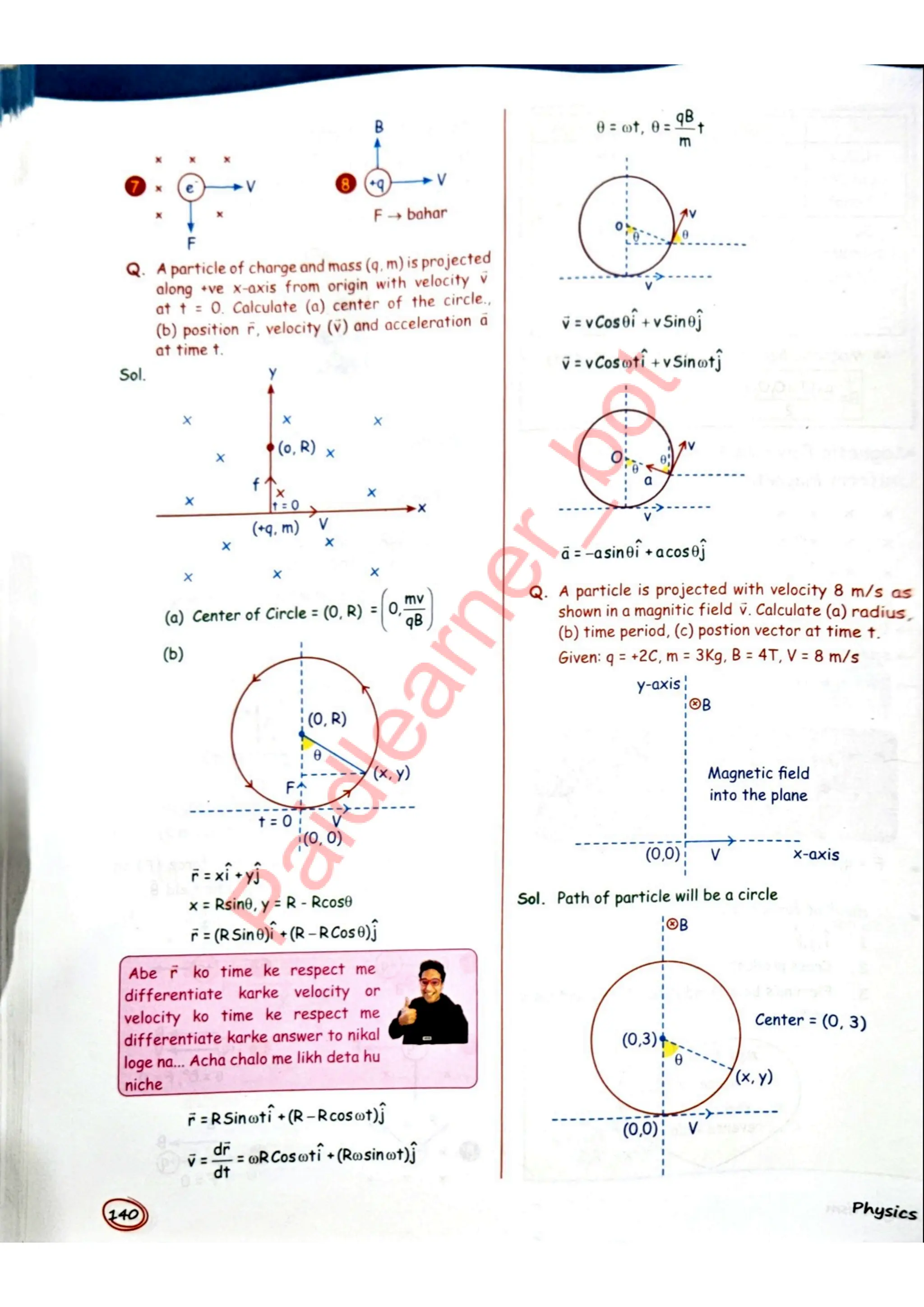
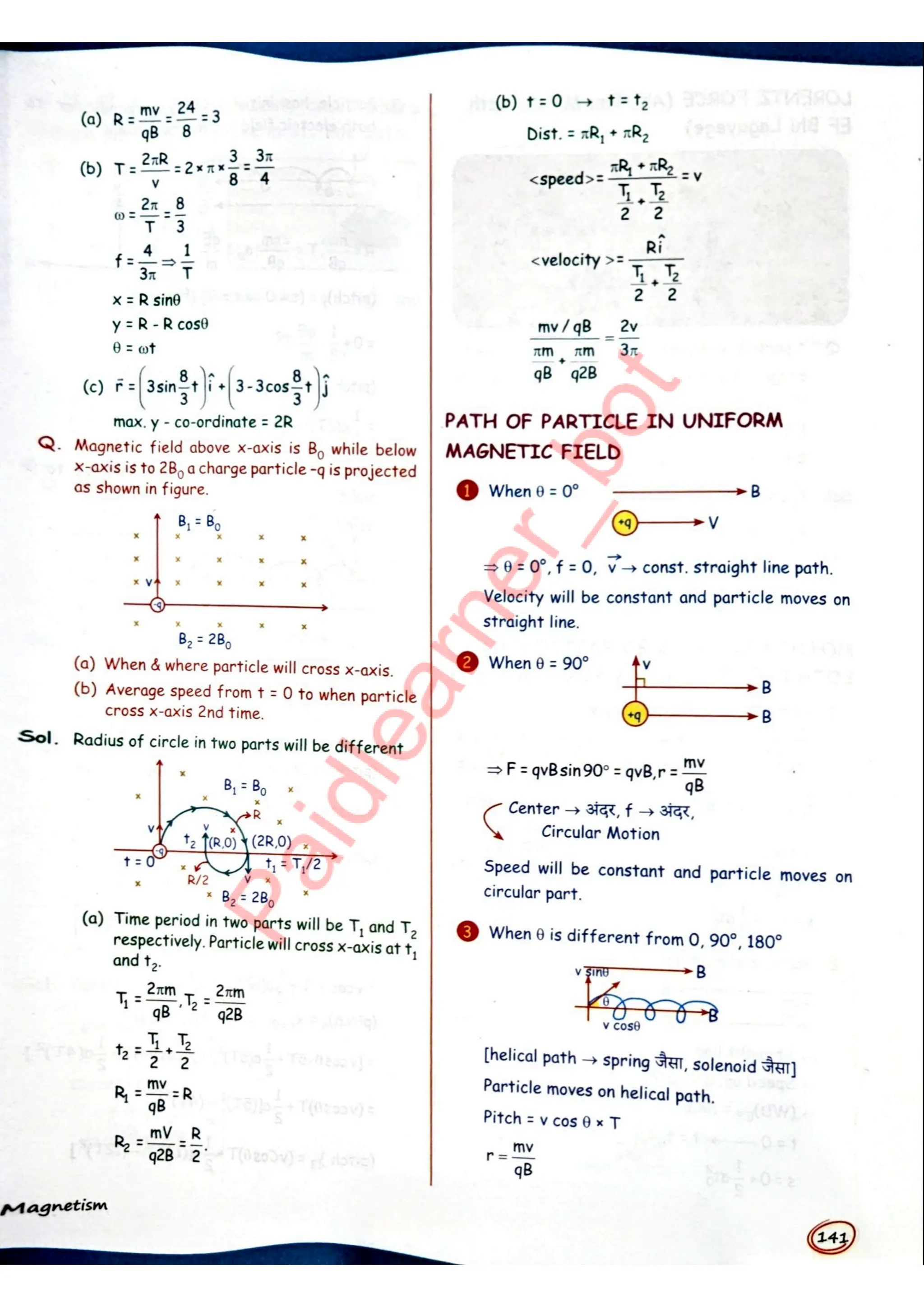
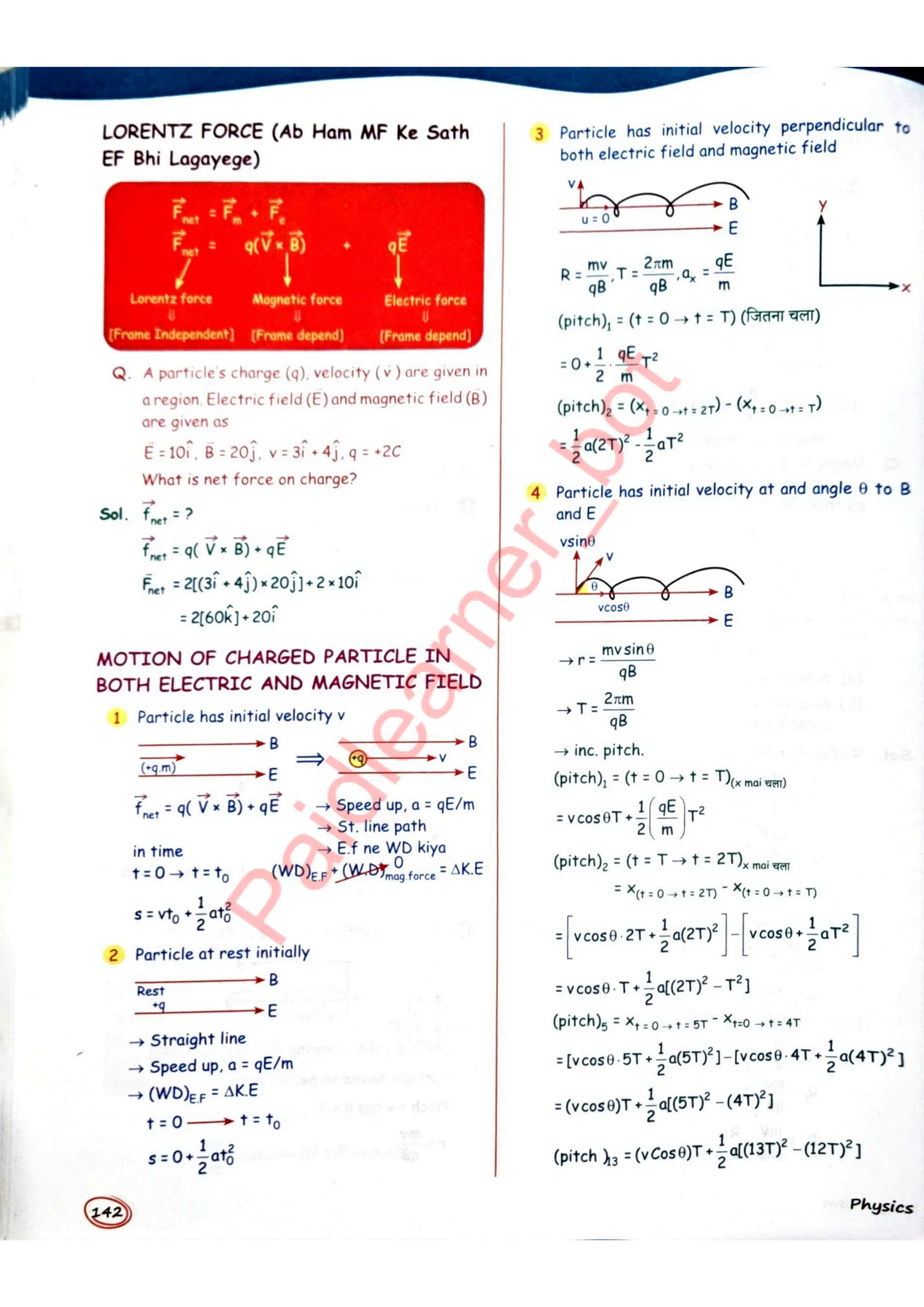
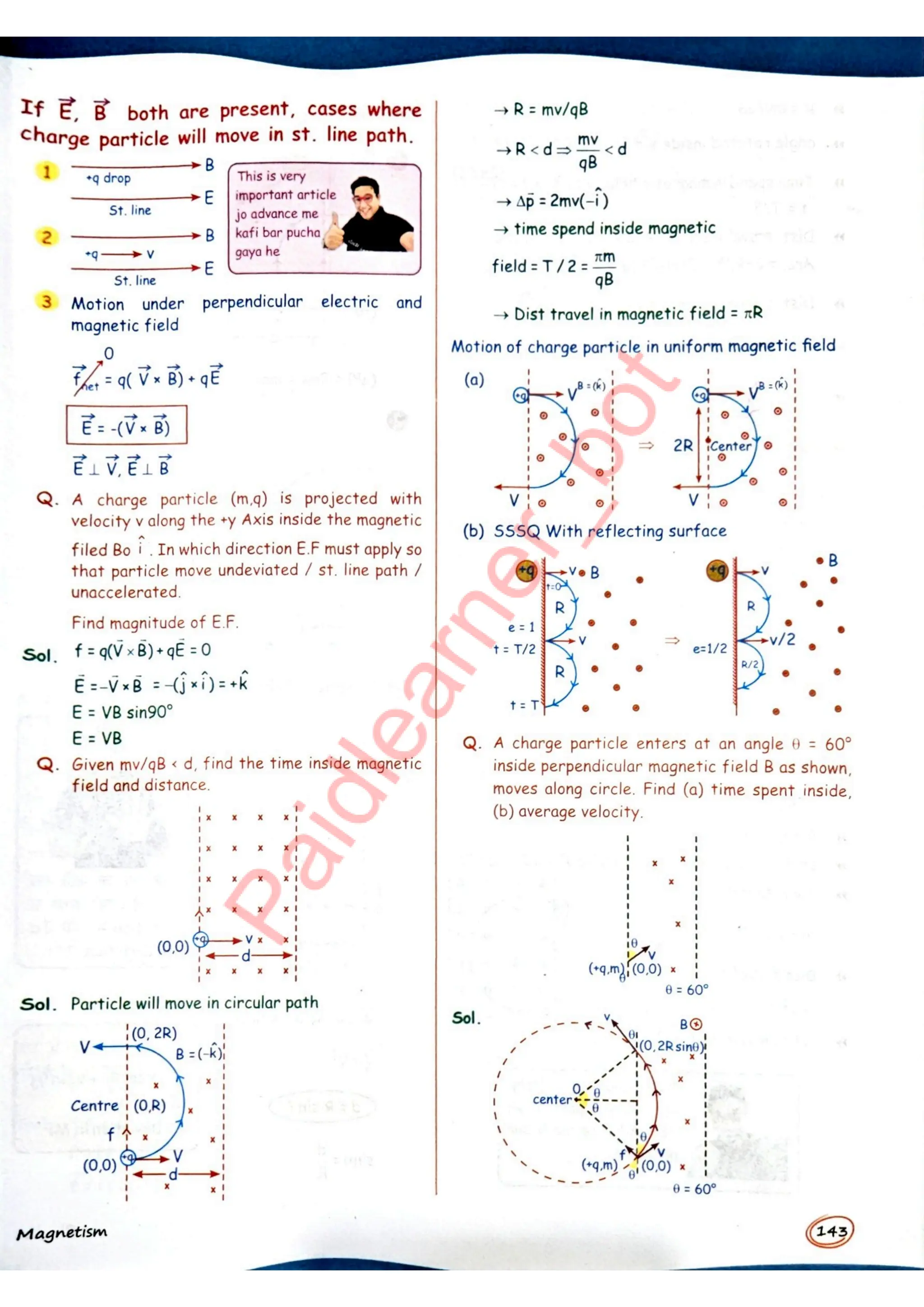
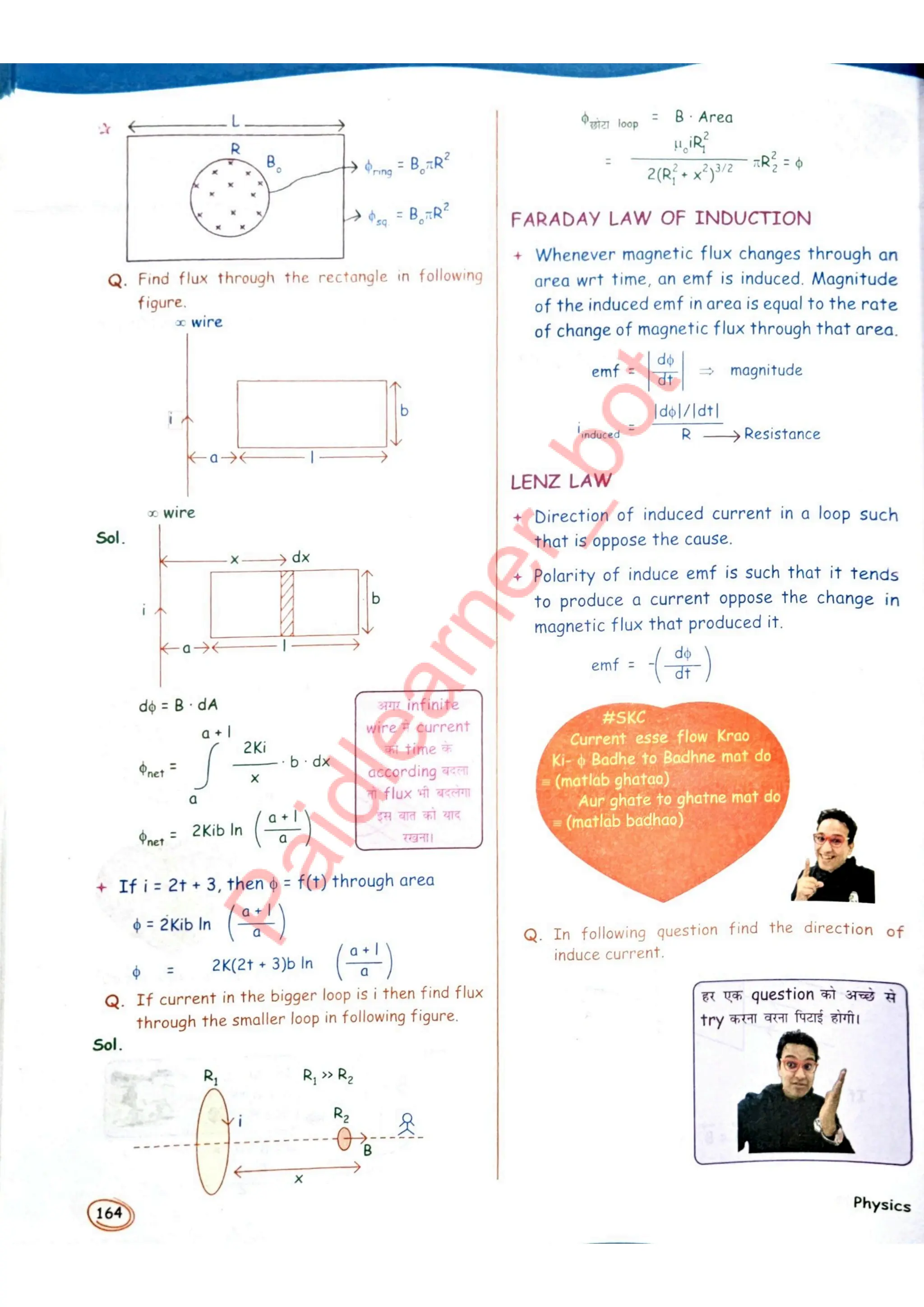
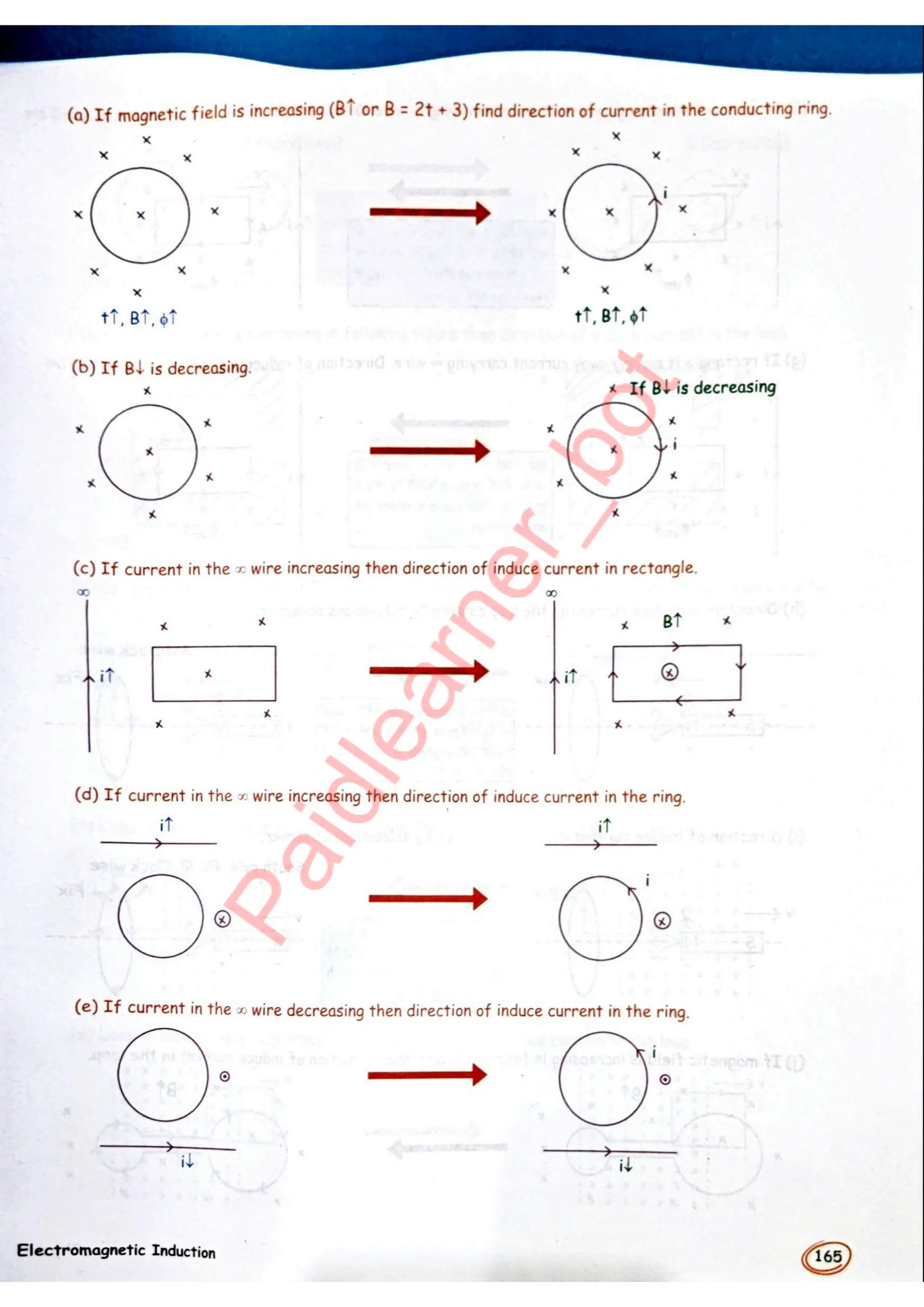
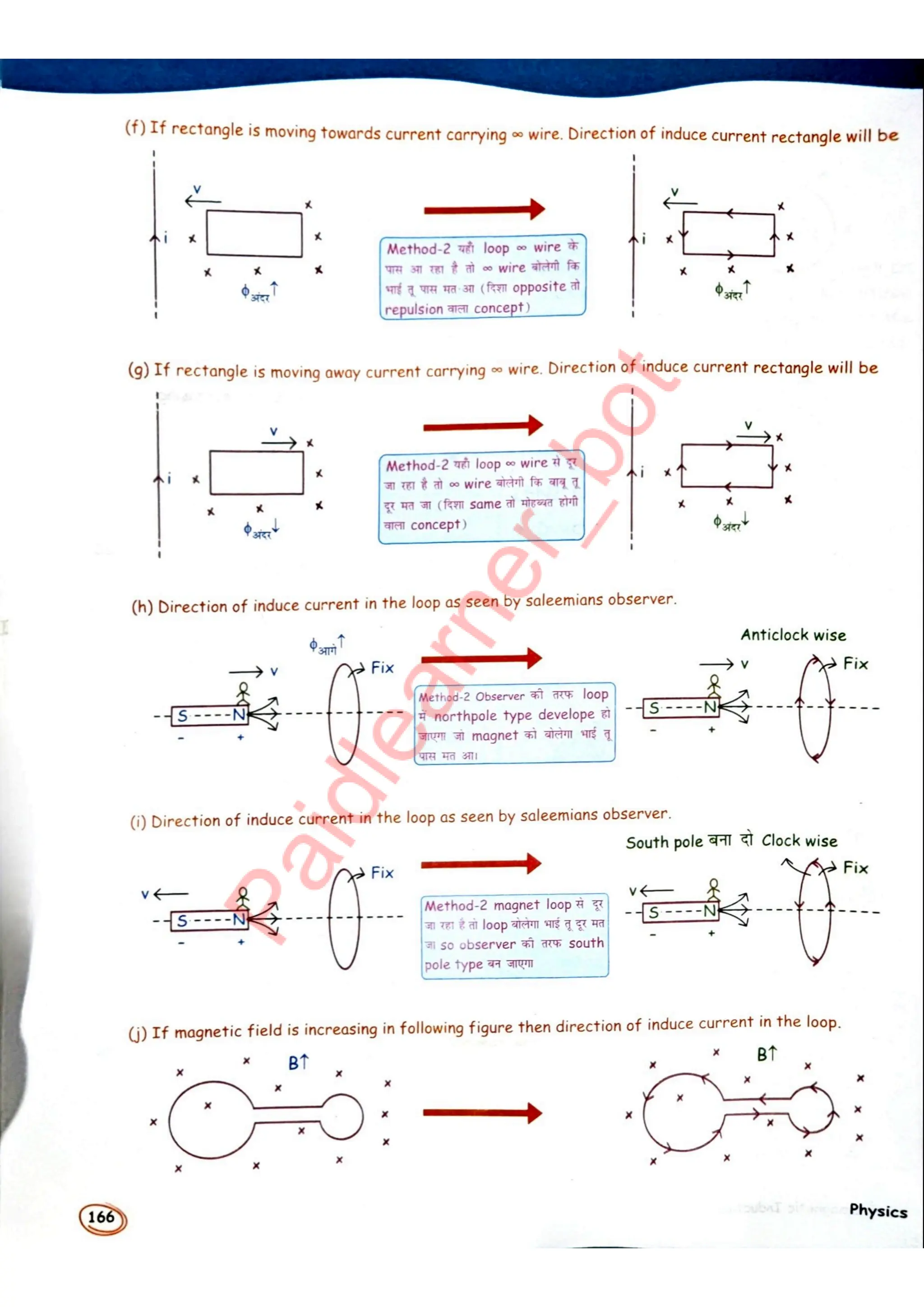
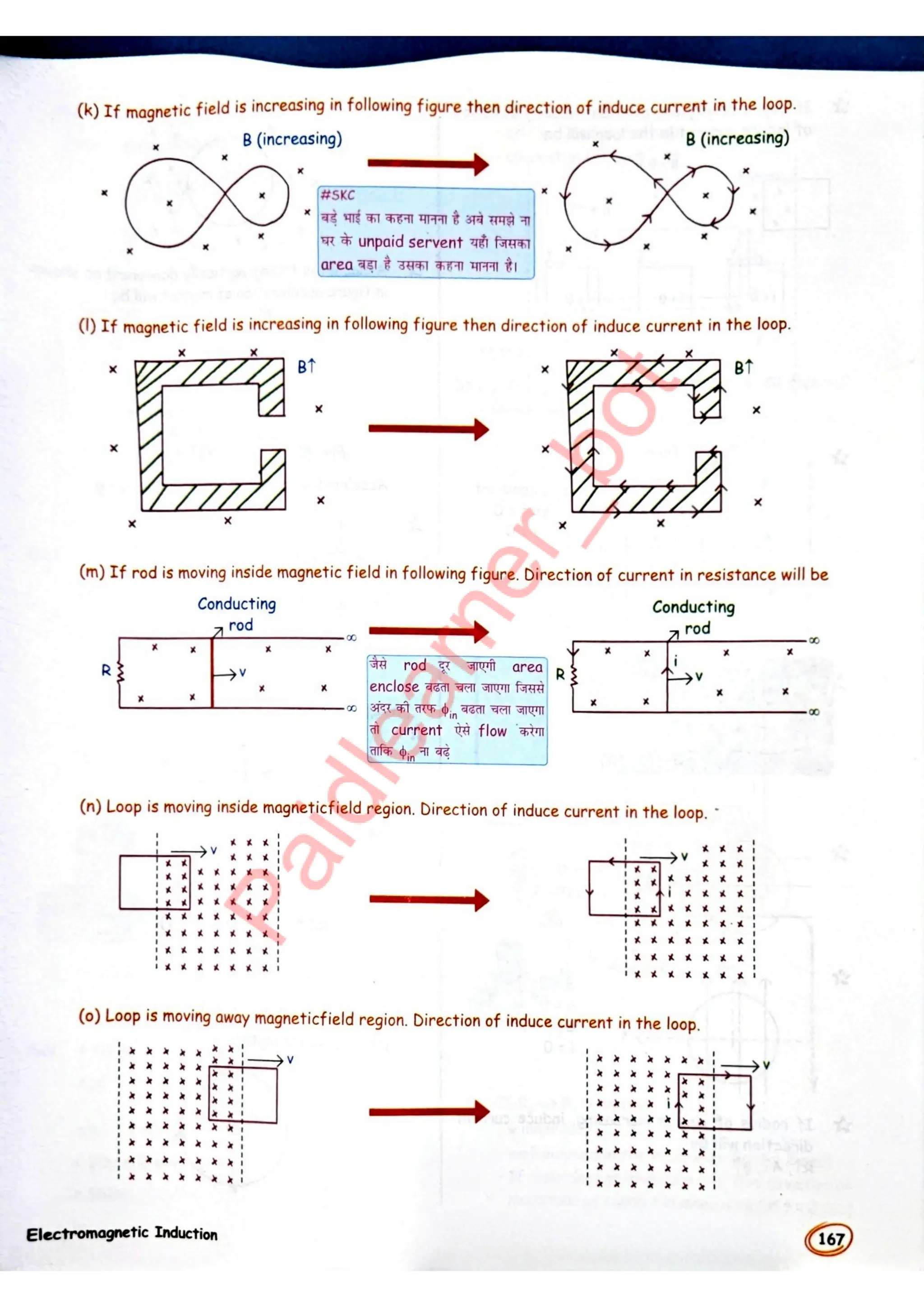
S K C
aleemians hopcha oncept
EDITION: FIRST
Published By: Physicswallah Limited
Physics Wallah Publication
ISBN: 978-93-6897-253-2
MRP: 549/-
Mobile App: Physics Wallah (Available on Play Store)
Author: Saleem Ahmed Sir
Website: www.pw.live
Youtube Channel: Physics Wallah - Alakh Pandey
JEE Wallah
Competition Wallah
NCERT Wallah
Email: publication@pw.live
SKU Code: 72058fcb-ef39-4d4c-a4bb-528f0eaf33fb
Rights:
All rights will be reserved by the Publisher and Author. No part of this book may be used or reproduced in any
manner whatsoever without the written permission from the author or publisher.
In the interest of students community:
Circulation of soft copy of Book(s) in PDF or other equivalent format(s) through any social media channels,
emails, etc. or any other channels through mobiles, laptops or desktop is a criminal offence. Anybody circulating,
downloading, storing, soft copy of the book on their device(s) is in breach of Copyright Act. Further Photocopying
of this book or any of its material is also illegal. Do not download or forward in case you come across any such
soft copy material.
Disclaimer:
Every effort has been made to avoid errors or omissions in this book. In spite of this, some errors might have
crept in. Any mistakes, errors or discrepancy found may be brought to our notice, would be taken care of in the
next edition.
For Feedback : publication@pw.live
(This Book shall only be Used for Educational Purpose.)
Physics Wallah (PW) strongly believes in conceptual and fun-based learning. PW provides highly
exam-oriented content to bring quality and clarity to the students.
A plethora of Competitive Exams Books is available in the market but PW professionals are continuously
working to provide the supreme book for Competitive Exams to our students.
Books adopt a multi-faceted approach to master and understanding the concepts by having a rich
diversity of questions asked in the examination and equip the students with the knowledge for the
competitive exam.
The main objective of the book is to provide a large number of quality problems with varying cognitive
levels to facilitate teaching-learning of concepts that are presented through the book.
It has become popular among aspirants because of its easy to understand language and clear illustrations
with diagrams, mnemonics, flow charts and tables.
Factor in the content that should be checked thoroughly including the quality of language or ease of
understanding or comprehension, coverage of topics and chapters from the Competitive Exams latest
syllabus by NTA.
Students can benefit themselves by attempting the exercise given in the book for the self-assessment
and also mastering the basic techniques of problem-solving.
Mastering the Physics Wallah (PW) study material curated by the PW team, the students can easily
qualify for the exam with a Top Rank in the Competitive Exams.
In each chapter, for better understanding, theory and examples are according to the latest syllabus
for Competitive Exams.
 To strengthen the concept of the topic at the zenith level
This Book Consists of
Complete class Notes content from basic to advance, SKC box which will help you to remember and
visualise the physics, All relevant illustrations which is very important for exams, summery box which
is very important for revision with special tips and tricks, concept explained in entertaining way.
Preface
Provide your
valuable feedback
or
Report the Error
View Errata
(Error Correction
from our end)
A step to make our book even better for our students:
Hello....... my loving warrior welcome to the 12th part of physics for JEE/NEET.
 I know it's very challenging task to prepare JEE/NEET because competition is very very tough
and vkidh bl journey dks vkSj T;knk impact full cukus osQ fy, here in this book i am trying to contribute
something with new ideas from my past 12 years teaching experience in Kota.
 bl book dks more affordable at lowest possible price cukus osQ fy, we have constrain in no. of pages
so I have tried my best dh bl constraint dks è;ku es j[krs gq, 350 pages es 12
th
portion dk eS vkidks vPNs
ls vPNk content provide dj lowQa from basic to advance. vxj bl book dk content vkius vPNs ls cover dj
fy;k rks Mains/NEET es almost 100% PYQ and upcoming papers vkSj more than 75% in JEE Advance
PYQ and it's upcoming paper vki solve dj ldrs gSA
 If you are preparing for JEE then viuh calculations, results, mixing of chapters osQ lkFk [ksyuk lh[ksa and
if you are from NEET bl ckr ij è;ku ns dh oSQls de ls de le; es ,d question dks tYnh ls i+ dj solve djosQ
accuracy osQ lkFk answer fudkyk tk ldrk gSA
 Class osQ ckn ;s cgqr important gksrk gS dh vki cgqr lkjs PYQ yxk, it will improve your skills, calculation,
concept application process. So I recommend you to solve as much questions as you can. vkSj oSls rks
bl book es already 1000+ question gSA
 Majority 12
th
dh physics 11
th
ls independent gS like Modern Physics, Semiconductor, Current
Electricity, Capacitor, Optics, Magnetism, EMI, AC and so on. fiQj Hkh I will recommend you dh 11
th
class dk Vector, Work Energy Theorem, Potential Energy, Basic SHM, Basic Mechanics Formula vPNs
ls dj ys blls vkidks Electrostatics, Magnetism, EMI es dkiQh help feysxhA
 ;s book JEE/NEET aspirants osQ lkFklkFk New aspiring physics teachers osQ fy, Hkh helpful gSA
 From my last 12 year experience I have seen tks cPpk last rd fVosQ jgrk gS mldk selection dh possibility
very high gksrh gSA So oqQN Hkh gks tk, cl last rd fVosQ jguk and just give your best.
 Try to solve all the question till the last and try to learn something from every question.
 Because syllabus is very vast and we have limited no. of pages if you found some article missing in
this book that means that's not important in JEE or removed from JEE.
Saleem Ahmed Sir sincerely thanks Alakh Pandey Sir, for creating a platform that makes quality
education accessible to millions. He also expresses gratitude to Sanyam Badola Sir, for his unwavering
support and guidance.
Their trust, encouragement, and shared vision have empowered him to continue inspiring students
and helping them achieve their dreams.
From the Author
Acknowledgment
Contents
1. Electrostatic ..................................................................................................................... 1-63
2. Current Electricity ..................................................................................................... 64-98
3. Capacitors ................................................................................................................... 99-125
4. Magnetism ................................................................................................................126-162
5. Electromagnetic Induction .................................................................................163-194
6. Alternating Current..............................................................................................195-217
7. Electromagnetic Waves........................................................................................218-224
8. Ray Optics and Optical Instruments..............................................................225-278
9. Wave Optics..............................................................................................................279-295
10. Modern Physics.......................................................................................................296-322
11. Semiconductor Electronics.................................................................................323-340
Lets
Start
Share your video review on Instagram and tag me! I'd love to see it!
Join my Telegram channel  Insta.
Saleem.nitt
This is very important
chapter in last 15 years more
than 40 questions has been
asked or advance 2024 esa rks
pkj question ;g¡k ls iwNs x, FksA
vxj ftruk content bl book es gS mruk rqeus dj fy;k
you can solve more than 80% of JEE advance
PYQ by yourself. Let's start from basic to
advance.....
CHARGE
Charge
Electromagnetic wave
At rest = produce electric
field only
→
E
Moving with having accelerations
⇒ EMW  radiats energy
Moving with const. velocity
⇒
→
E ,
→
B both [
→
B → magnetic field]
PROPERTIES OF CHARGE
 Invariant, scaler, two type positive and negative.
 For an isolated system total charge is conserve.
 Charge cannot exist without mass.
 Charges quantized Q = ±ne
(n is integer e = 1.6 × 10
–19
C)
COULOMB LAW
Electrostatic force of interaction b/w two point
charge at separation r is observed as
f a q1q2
f a
1
2
r
and f a
q q
r
1 2
2
f =
kq q
r
1 2
2
+q1
r
f f
+q2
K = 1/4pe0 = 9 × 10
9
Nm
2
/c
2
Permitivity of
free space
(e0)
 Two like charge repel each other and unlike charge
attract each other.
Ex.:
+q1
–q1
+q1
+q1 f
f
f
f
r
r
r
+q2
–q2
–q2
–q2
(magnitude)
f =
kq1q2
r
2
f =
kq1q2
r
2
f =
kq1q2
r
2
f =
kq1q2
r
2
1 This force always act along the line joining two
points
2 Central force
3 Electrostatic force b/w two charge particle are
action reaction pair
4 Conservative force
5 Force applied by one charge particle on another
charge particle is independent on presence or
absence of other charge
6 Net force on a given charge is the vector sum of
all the individuals forces exerted by each of other
charge [Principle of superposition]
Q. If natural length of spring is lo and blocks are in
equillibrium. Find elongation in spring.
m
m
k
+q1 +q2
Sol. Let elongation in spring is x
kx
f =
kq1q2
(lo + x)
2
1 2
2
0
kq q
kx =
(l x)
+
(vcs vc value put djosQ quadratic eqn. cukosQ dj yksxs uk )
1 Electrostatics
2
Physics
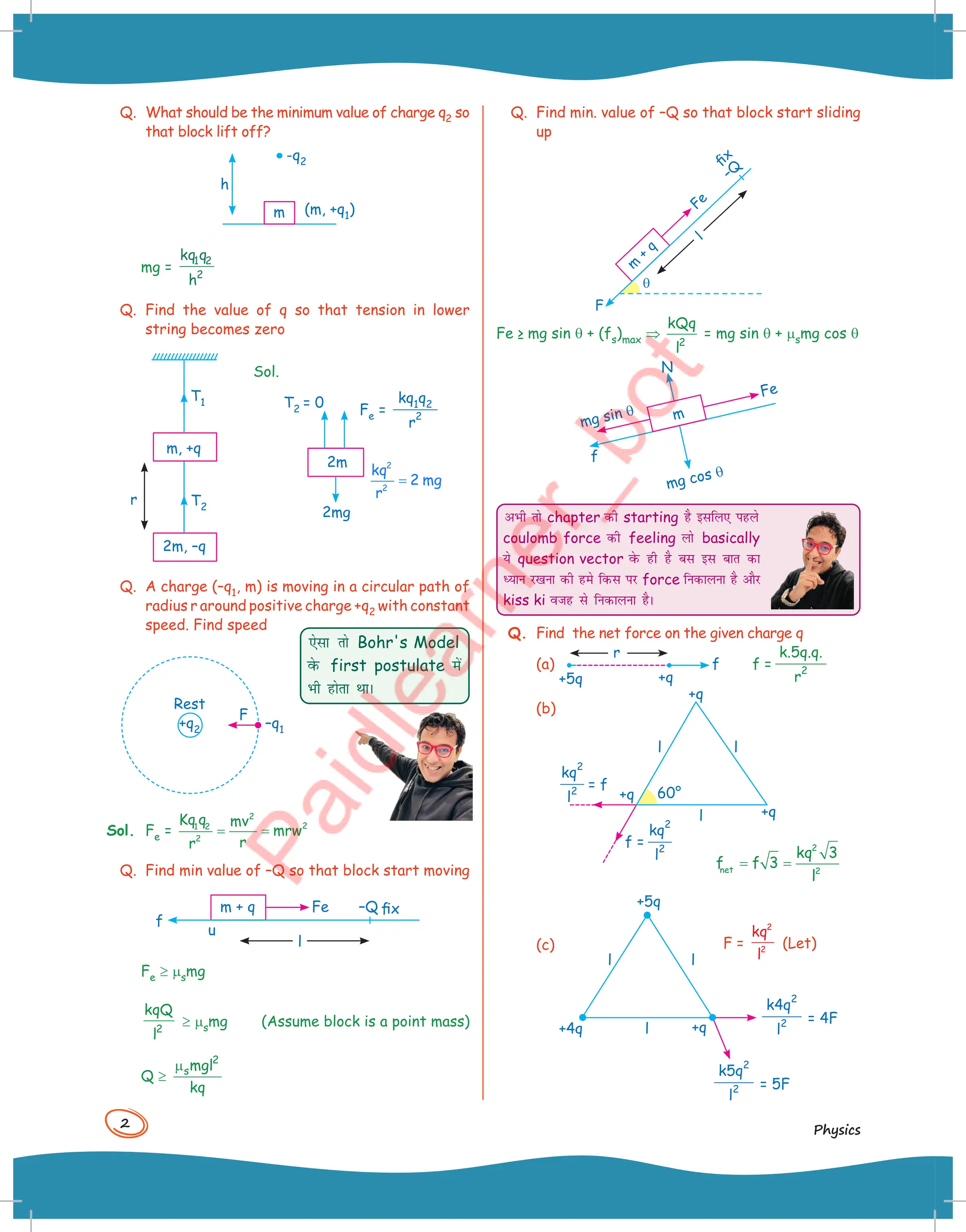
Q. What should be the minimum value of charge q2 so
that block lift off?
m (m, +q1)
-q2
h
mg =
kq q
h
1 2
2
Q. Find the value of q so that tension in lower
string becomes zero
Sol.
2m
2mg
T2 = 0 Fe =
kq1q2
r
2
2m, –q
m, +q
T2
r
T1
2
2
kq
2 mg
r
=
Q. A charge (–q1, m) is moving in a circular path of
radius r around positive charge +q2 with constant
speed. Find speed
+q2
Rest
–q1
F
Sol. Fe =
2
2
1 2
2
Kq q mv
mrw
r
r
= =
Q. Find min value of –Q so that block start moving
f
m + q Fe
u
–Q fix
l
Fe ≥ msmg
2
kqQ
l
≥ msmg (Assume block is a point mass)
Q ≥
2
smgl
kq
µ
,slk rks Bohr's Model
osQ first postulate esa
Hkh gksrk FkkA
Q. Find min. value of –Q so that block start sliding
up
m
+
q
Fe
F
–Q
q
fix
l
Fe ≥ mg sin q + (fs)max ⇒
2
kQq
l
= mg sin q + msmg cos q
Fe
f
N
m
mg sin q
mg cos q
vHkh rks chapter dh starting gS blfy, igys
coulomb force dh feeling yks basically
;s question vector osQ gh gS cl bl ckr dk
è;ku j[kuk dh ges fdl ij force fudkyuk gS vkSj
kiss ki otg ls fudkyuk gSA
Q. Find the net force on the given charge q
(a)
+5q +q
r
f f =
k.5q.q.
r
2
(b)
= =
2
net 2
kq 3
f f 3
l
60°
+q
l
l
l
+q
+q
= f
kq
2
l
2
f =
kq
2
l
2
(c)
+q
l
l
l
+4q
+5q
= 4F
k4q
2
l
2
= 5F
k5q
2
l
2
F =
kq
l
2
2
(Let)
3
Electrostatics
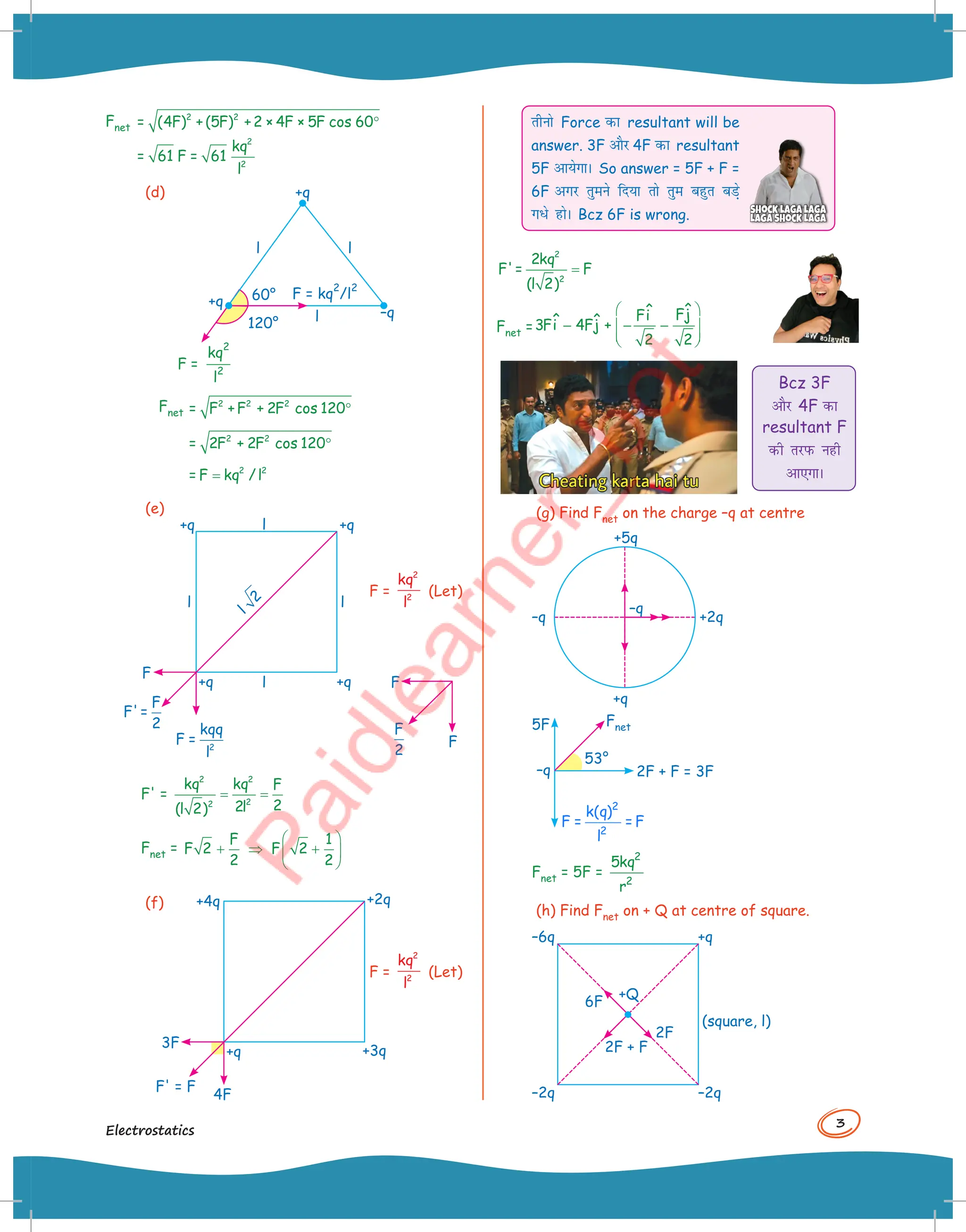
Fnet
2 2
2
2
= (4F) + (5F) +2 × 4F × 5F cos 60
kq
= 61 F = 61
l
°
(d)
60°
120°
F = kq
2
/l
2
–q
l
l
l
+q
+q
F =
kq
2
l
2
Fnet
2 2 2
2 2
2 2
= F +F + 2F cos 120
= 2F + 2F cos 120
= F kq /l
°
°
=
(e)
F =
kq
l
2
2
(Let)
F
kqq
l
= 2
F
F
'=
2
F
+q +q
+q
l
l
l
l
+q
l
2
F
2
F
F
F' =
2 2
2
2
kq kq F
2
2l
(l 2)
= =
Fnet =
F 1
F 2 F 2
2 2
 
+ ⇒ +
 
 
(f)
3F
4F
F' = F
+4q +2q
+3q
+q
F =
kq
l
2
2
(Let)
rhuks Force dk resultant will be
answer. 3F vkSj 4F dk resultant
5F vk;sxkA So answer = 5F + F =
6F vxj rqeus fn;k rks rqe cgqr cM+s
x/s gksA Bcz 6F is wrong.
2
2
2kq
F'= F
(l 2)
=
Fnet =
ˆ
ˆ Fj
Fi
ˆ ˆ
3Fi 4Fj +
2 2
 
− − −
 
 
 
Bcz 3F
vkSj 4F dk
resultant F
dh rjiQ ugh
vk,xkA
(g) Find Fnet on the charge –q at centre
+5q
+2q
+q
–q
–q
53°
–q
Fnet
5F
2F + F = 3F
2
2
k(q)
F = = F
l
Fnet = 5F =
2
2
5kq
r
(h) Find Fnet on + Q at centre of square.
+q
(square, l)
+Q
–2q
2F + F
6F
2F
–6q
–2q
4
Physics
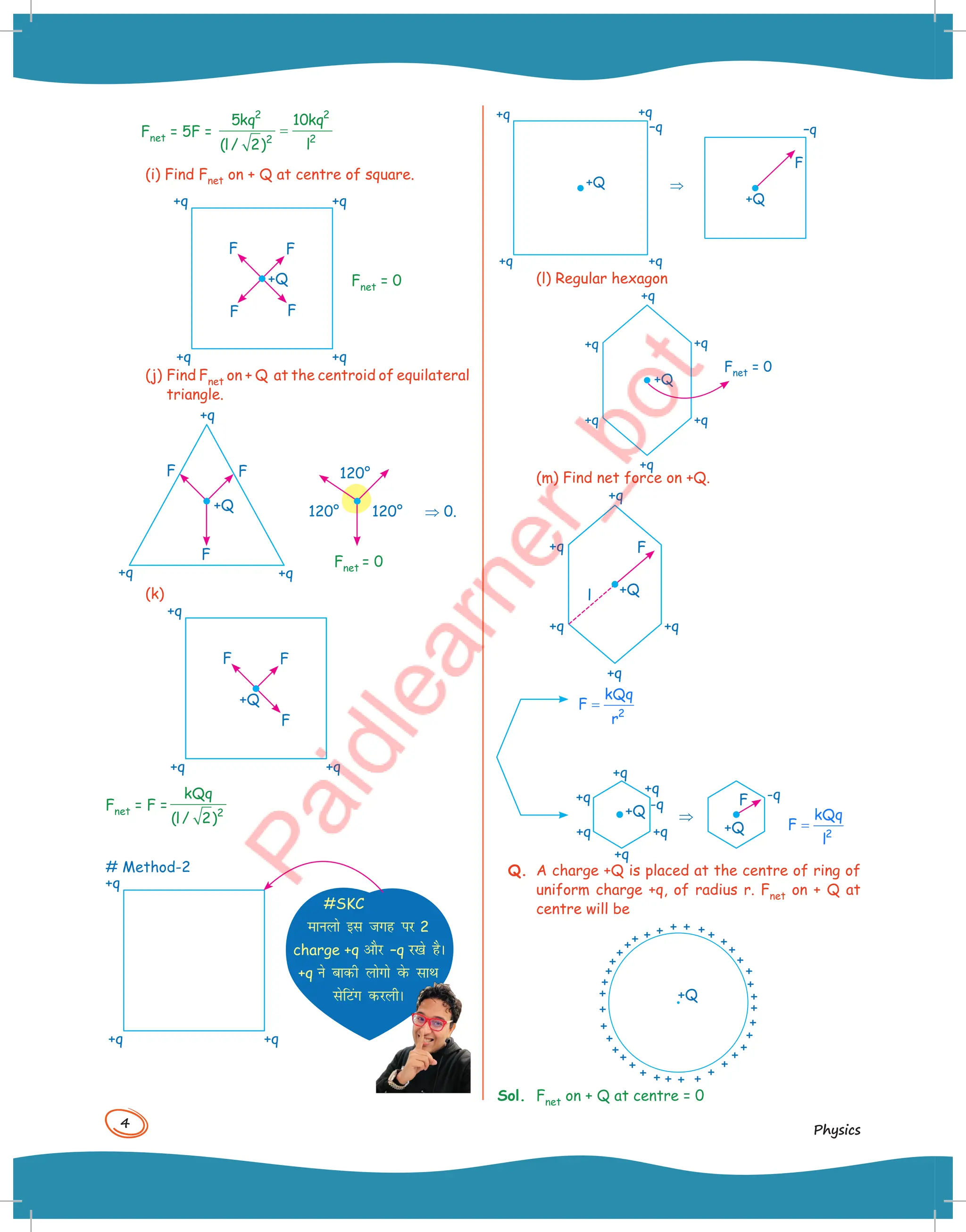
Fnet = 5F =
2 2
2
2
5kq 10kq
l
(l/ 2)
=
(i) Find Fnet on + Q at centre of square.
+q
+Q
+q
F
F F
F
+q
+q
Fnet = 0
(j) Find Fnet on + Q at the centroid of equilateral
triangle.
+q
+Q
+q
F F 120°
120° 120° ⇒ 0.
F
+q
Fnet = 0
(k)
+Q
+q
F F
F
+q
+q
Fnet = F = 2
kQq
(l/ 2)
# Method-2
+q
+q
+q
#SKC
ekuyks bl txg ij 2
charge +q vkSj –q j[ks gSA
+q us ckdh yksxks osQ lkFk
lsfVax djyhA
+Q
+Q
F
+q
+q
–q –q
⇒
+q
+q
(l) Regular hexagon
+q
+q
+q
+Q
+q
+q
+q
Fnet = 0
(m) Find net force on +Q.
+q
F
l
+q
+Q
+q
+q
+q
+q
⇒
-q
-q
+q
+q
F
+q
+Q
+Q
+q
+q
2
kQq
F
r
=
2
kQq
F
l
=
Q. A charge +Q is placed at the centre of ring of
uniform charge +q, of radius r. Fnet on + Q at
centre will be
+
+
+
+
+
+
+
+
+
+
+
+
+
+
+
+ + + + +
+ + + +
+
+
+
+
+
+
+
+
+
+
+
+
+
+Q
Sol. Fnet on + Q at centre = 0
5
Electrostatics
Q. In above question if small element dl from the
ring is remove now find the force on + Q at
centre
Sol.
+
+
+
+
+
+
+
+
+
+
+
+
+
+
+
+
+
+
+
+
+
+
+
+
+
+
+
+
+
+Q
dF
dl
dl
Fnet = dF = 2
k(dq)Q
r
(osQoy dl osQ charge dh otg ls
force vk;sxk ckdh lc cancel)
2pr → q (on ring)
1 → q/2pr
dl → q/2pr × dl = dq
⇒ net 2 3
q dl kqQ dl
Q
F k × =
2 r r 2 r
 
=  
 
π π
 
Q. A ring of radius R is made out of a thin wire
of cross section A ring has uniform charge Q
distributed in it. A charge q0 is placed at the
center of ring. If Y is young’s modulus for
material of the ring and DR is the change in
radius of ring then find tension develope in ring
and DR.
Sol.
dx
q
dq = ldx (where
l is charge per
unit length)
θ =
dx
R
d
2
θ d
2
θ
d
2
θ d
2
θ
T sin
d
2
θ
T cos
d
2
θ
T cos
d
2
θ
T T
T sin
d
2
θ
q0
2T sin 0
2
k dq. q
d
2 R
θ
=
2T . 0
2
k. (dx) q
d
2 R
λ
θ
=
q
dq dl dl
2 r
= = λ
π
T . dx k. dx
R
λ
= 0
2
q
R
T =
0
k q
R
λ
=
0
0
q
1 Q
4 2 R R
πε π
T R
Y
A R
∆
=
Q. Where we should place a charge Q so that it
remains in eqb
m
.
+q (fix) +4q (fix)
l
+q F2 F1 +4q
x
+Q
l - x
F1 =
2
kqQ
x
, F2 = 2
k4qQ
(l x)
−
F1 = F2 [in eqb
m
]
2 2
kqQ k4qQ
=
x (l x)
−
1 2
=
x l x
−
l - x = 2x
x = l/3 Ans.
Q. Where we should place a charge Q so that it
remains in eqb
m
.
Sol.
-q
F2 F1
+4q
x
+Q
l
-q +4q
l
F1 =
2
KQq
x
, F2 =
+ 2
kQ4q
(l x)
F1 = F2 [in eqb
m
]
1 4
2 2
x l x
=
+
( )
l + x = 2x
x = l Ans.
vcs ;kn gS uk
Do vector ka sum 0,
tbhi hoga jb vector
equal and opposite
ho!
6
Physics
#SKC
+Q हो या -Q हो [रखन(
)ाला charge] +ो Ans
same aaega. Ans is
independent on third
placing charge
#SKC
ल,-ा और ल,-ी -(
बीच में -भी नहींआना और
-म Magnitude wale
charge ke ikl में
रखना है।
Q. Find where we should placed +Q charge so that
it remains in eqb
m
.
-9q
+4q
Sol. yM+dk vkSj yM+dh osQ chp esa dHkh ugha vkuk js ckck cgqr
ykspk gSA blfy, ;g¡k charge dks ckgj j[ksaxsA
x
+4q -9q
+Q
l
k qQ
x
K qQ
x l
4 9
2 2
=
+
( )
4 9
2 2
x x l
=
+
( )
2 3
x x l
=
+
⇒ 3x = 2x + 2l
2l = x
EFFECT OF MEDIUM
In Vaccum
F F
+q2
+q1
Force applied by q1 on q2 =
1 2
2
0
q q
1
4 r
πε
= Fo
In Medium
+q2
+q1
If medium is upto ¥ then net force on the charge q2
will be
= =
πε πε
o
1 2 1 2
2 2
o
F
q q q q
1 1
4 4 k k
r r
k → Dieletric const.
Permittivity of that medium
e = e0 er
Q. Two Charges are suspended from a common
point through the string of length l as show in
figure. If charges are in equillibrium find
(a) Find q, tension etc.
q q
l
m
m
+q
+q
l
Sol.
q q
q
l
m
m
+q
+q
T sin q
T cos q
T
r = 2l sin q
Fe
mg
l
r
T sin q = Fe [q1 = q2]
T cos q = mg
tan q =
Fe
mg
q = tan
–1
 
 
 
Fe
mg
Fe = =
πε πε θ
2 2
0 0
q . q q . q
1 1
4 4
r (2l sin )
(b) If q1 ≠ q2 and m1 = m2 repeat above question
Sol. q1 = q2
Fe =
πε
1 2
2
0
q q
1
4 r
(same)
tan q =
Fe
mg
(same)
7
Electrostatics
(c) If q1 ≠ q2 and m1  m2
Sol. Then, q1  q2
q1
q2
m1 m2
(d) If whole system is dipped in water (upto ¥)
repeat the above question.
Sol.
q
q
m
Fe/k
mg
T
B
tan q =
−
Fe / k
mg B
T sin q = Fe/k
T cos q + B = mg
B = Buoyant force
(e) In (a) part find the rate dq/dt with which
the charge leaks off from each ball.
So that their approach velocity varies as
v =
a
x
where a is constant and x is distance
between sphere (x  l). (irodov Q. 3)
Sol. Homework
πε
=

o
2 mg
dq 3
dt 2a
Hint: θ = =
2
2
kq
Fe
tan
mg x .mg
...(i)
(x very small) tan q ≈ sin q =

x / 2
...(ii)
B = rL
Vg
Fe/k
T cos q
T sin q
mg
vxj iwjk sol. fy[kk rks
no. of page cus dh
otg ls Book dh price
c+ tk,xhA
Solve (i) and (ii) and differentiate smartly.
Q. Find force apply by rod on point charge [qo]
a
+qo
(+Q, L)
Sol. Directly columb law ugh yxk ldrs blfy, x ij tkdj
dx idM+ksA
a
x
+qo
dx
dF
(+Q, L)
dq
dF =
kq dq
x
o
2
This is a small
force due to charge dq.
Fnet =
+
∫ ∫
a L
o
2
a
kq dq
dF =
x
=
+
∫
a L
o
2
a
kq Qdx
Lx
=
 
−
 
+
 
kqQ 1 1
L a a L
¢
(After solving)
=
+
kqQ
a(a L)
¢
If a  L, Fnet
≈
kqQ
a2
(ns[kks ;s point charge tSlk
result vkx;k)
Q. If a charge (Q0, m) is slightly displaced from its
mean position along find time period of SHM.
l
+q fix
(+Q0, m)
fix +q
l
Sol.
l
+q
+q
+q
+Q
fix
mid Fnet = 0
(+Q0, m)
fix +q
l
l - x
l + x
x
L → Q
1 → Q
L
dx →
Q
dx dq
L
=
;s pht cgqr ckj
use gksxhA
8
Physics
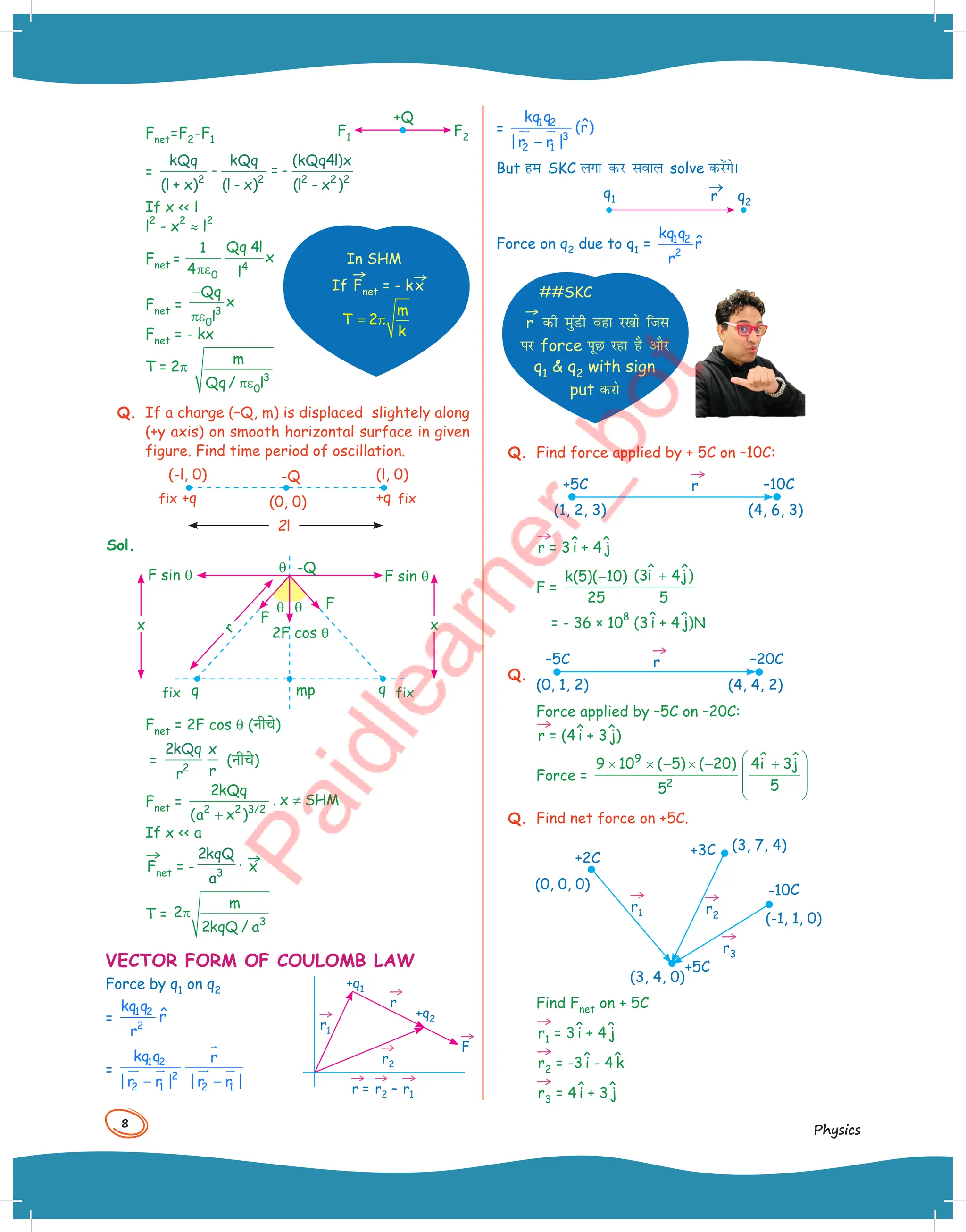
Fnet=F2-F1
+Q
F2
F1
=
kQq
l x
kQq
l x
kQq l x
l x
( ) ( )
( )
( )
+
-
-
= -
-
2 2 2 2 2
4
If x  l
l
2
- x
2
≈ l
2
Fnet =
πε 4
0
Qq 4l
1
x
4 l
Fnet =
−
πε 3
0
Qq
x
l
Fnet = - kx
T = 2p
3
0
m
Qq/ l
πε
Q. If a charge (–Q, m) is displaced slightely along
(+y axis) on smooth horizontal surface in given
figure. Find time period of oscillation.
+q
-Q
(0, 0)
(l, 0)
fix
fix
(-l, 0)
+q
2l
Sol.
F sin q
F
q q
mp fix
fix
F sin q
F
2F cos q
q
q q
-Q
r
x x
Fnet = 2F cos q (नीच()
=
2
2
kQq
r
x
r
(नीच()
Fnet = ≠
+
2 2 3/2
2kQq
. x SHM
(a x )
If x  a
→
Fnet = -
2
3
kqQ
a
. →
x
T = π
3
m
2
2kqQ / a
VECTOR FORM OF COULOMB LAW
Force by q1 on q2
=
1 2
2
kq q
r̂
r
=
1 2
2
2 1 2 1
kq q r
|r r | |r r |
− −

 
  

In SHM
If
→
Fnet = - k
→
x
m
T 2
k
= π
→
r1
→
r =
→
r2 –
→
r1
→
r2
→
r
→
F
+q1
+q2
=
1 2
3
2 1
kq q
ˆ
(r)
|r r |
−
 

But ge SKC yxk dj loky solve djsaxsA
q2
r
→
q1
Force on q2 due to q1 = 1 2
2
kq q
r̂
r
##SKC
→
r dh eqaMh ogk j[kks ftl
ij force iwN jgk gS vkSj
q1  q2 with sign
put djks
Q. Find force applied by + 5C on –10C:
+5C –10C
(1, 2, 3) (4, 6, 3)
→
r
→
r = 3^
i + 4^
j
F =
+
− ˆ ˆ
(3i 4j)
k(5)( 10)
25 5
= - 36 × 10
8
(3^
i + 4^
j)N
Q.
–5C
(0, 1, 2) (4, 4, 2)
–20C
→
r
Force applied by –5C on –20C:
→
r = (4^
i + 3^
j)
Force =
 
× × − × − +
 
 
 
9
2
ˆ ˆ
9 10 ( 5) ( 20) 4i 3j
5
5
Q. Find net force on +5C.
(3, 4, 0)
+2C
+3C
+5C
-10C
(-1, 1, 0)
(3, 7, 4)
(0, 0, 0)
→
r1
→
r2
→
r3
Find Fnet on + 5C
→
r1 = 3^
i + 4^
j
→
r2 = -3^
i - 4^
k
→
r3 = 4^
i + 3^
j
9
Electrostatics
Fnet =
 
× + × − −
 
+
 
 
2 2
ˆ
ˆ ˆ ˆ
k(2 5) (3i 4j) k(3 5) 3j 4k
5 5
5 5
+
− × +
2
ˆ ˆ
k( 10) 5 (4i 3j)
5
5
Q. Three charges (+q) are placed on the vertices
of a equilateral triangle of side a as shown in
diagram. Find net force on 4
th
identical charge
particle at a height h = a above the centroid of D.
q
h
q
q
q
Sol. D
o
q
A
B
C
r
tan q = =
OD h
OC OC
OC =
a
3
and tan q = = =
h a
3
OC a / 3
Hence q = 60°
F
F
F
120°
120° 120°
F cos q
F cos q
F cos q
[Fnet = 3F sin q]
Top view: F cos q - cancelled but
F sin q + F sin q + F sin q
Fnet = 3F sin q
where F =
2
2
kq
r
r2
= (OD)2
+ (OC)2
=
 
+  
 
 
2
2 a
h
3
= +
2
2 a
a
3
=
2
4a
3
A
B
a
O
30°
x
a
a
C
Q. Four charge (q) are placed on the corner of
square of side a. Find force on fifth charge Q
placed above at a height h =
a
2
from centre
of square as shown in figure.
q
q
q
h
Q
q
Sol.
r
q
q
45°
q
q
q
q
h = a / 2
= x
a /
2
tan q =
a / 2
a / 2
=1
sin q = 45°
r =
   
+ = + =
   
   
   
2 2
2 2
1
a a
x h a
2 2
Fnet = 4F sin q = 4 ×
2
2
kq
r
sin 45° = 4 × ×
2
2
kq 1
a 2
ELECTRIC FIELD
1 The region surrounding a charge (or charge
distribution)
2 Electric field strength or electric field intensity
→
E , it measure how strong is the electric field at
that particular point.
⇒ Electric field intensity is defined as force on
unit test charge.
Electric Field due to Point Charge
(E.F) at A due to + Q =
0
F
q

Force experimental per unit test charge.
10
Physics
+Q
Fix +q0
F
r
A
EA =
0
0
2 2
q 0 0 0
kQq
F kQ
lim = =
q r q r
®
It is the electric
field due to +Q at A
1C charge pr jitna
electrostatic force lag
rha h, utne magnitude
ki electric field
hogi.
1
→
E =
0
F
q

(unit ⇒ N/coulomb)
2 EF due to +ve point chare is radially outward and
due to –ve point charge its radially inward
+q –q
vc ge EF fudkyuk lh[ksaxs lgh ls ns[kks rks
;g coulomb law tSls gh question gSA
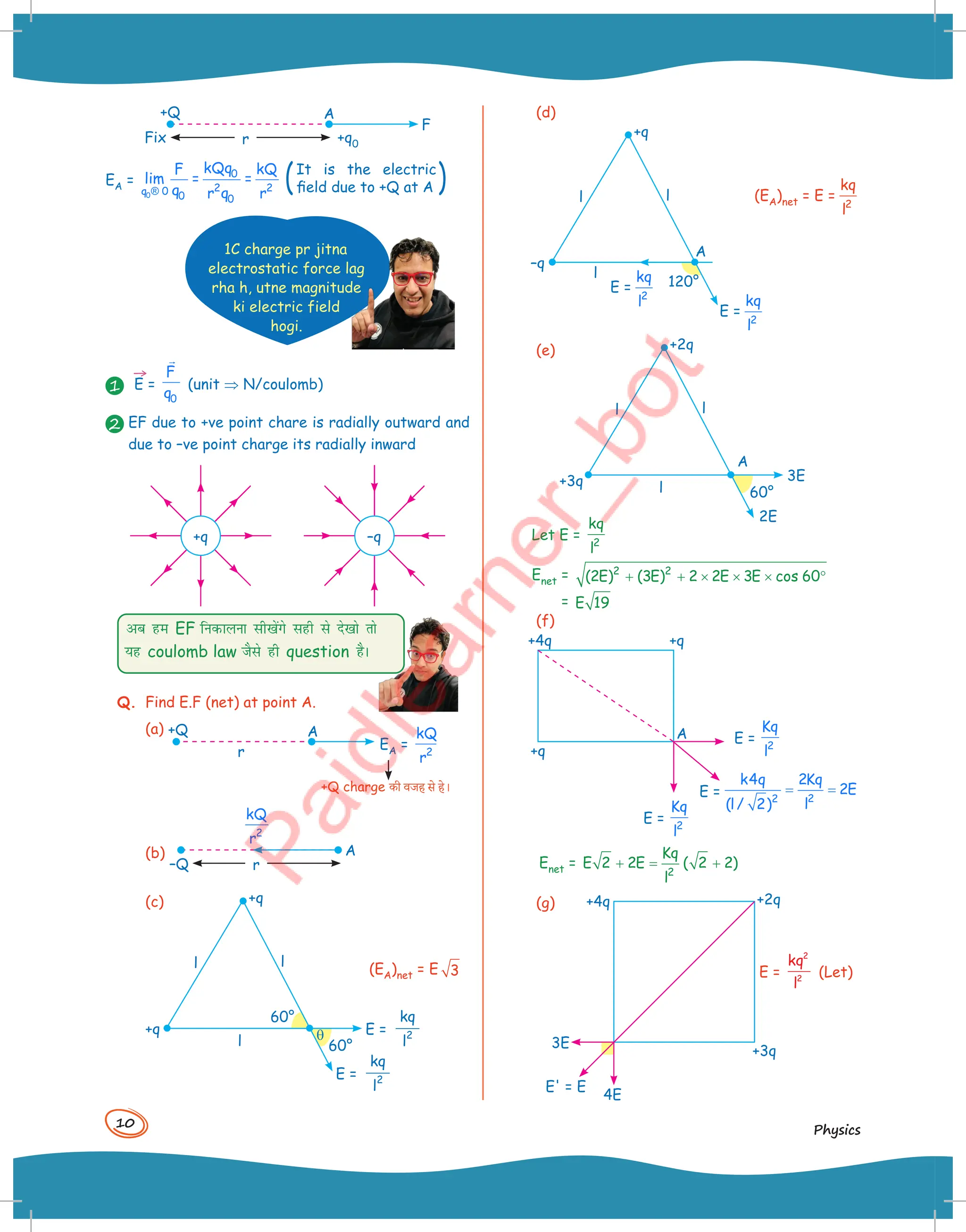
Q. Find E.F (net) at point A.
(a) +Q
r
A
+Q charge -ी )जह स( ह(।
EA = 2
kQ
r
(b)
–Q
A
r
2
kQ
r
(c)
(EA)net = E 3
60°
q
60°
l
l
l
+q
+q E =
kq
l
2
E =
kq
l
2
(d)
120°
l
l
l
+q
–q
A
E =
2
kq
l
E =
2
kq
l
(EA)net = E = 2
kq
l
(e)
A
60°
l
l
l
+2q
+3q
2E
3E
Let E = 2
kq
l
Enet = + + × × × °
2 2
(2E) (3E) 2 2E 3E cos 60
= E 19
(f)
+4q +q
+q
A E = 2
Kq
l
E = 2
2
k4q 2Kq
2E
l
(l/ 2)
= =
E = 2
Kq
l
Enet = + = +
2
Kq
E 2 2E ( 2 2)
l
(g)
3E
4E
E' = E
+4q +2q
+3q
E =
kq
l
2
2
(Let)
11
Electrostatics
rhuks dk resultant will be answer. 3E vkSj 4E dk
resultant 5E vk;sxkA So answer = 5E + E = 6E vxj
rqeus fn;k rks rqe vc rks vkSj Hkh cgqr gh T;knk cM+s x/s gksA
Bcz 6E is wrong.
Enet =
 
 
− − − −
 
 
ˆ
ˆ Ej
Ei
ˆ ˆ
3Ei 4Ej +
2 2
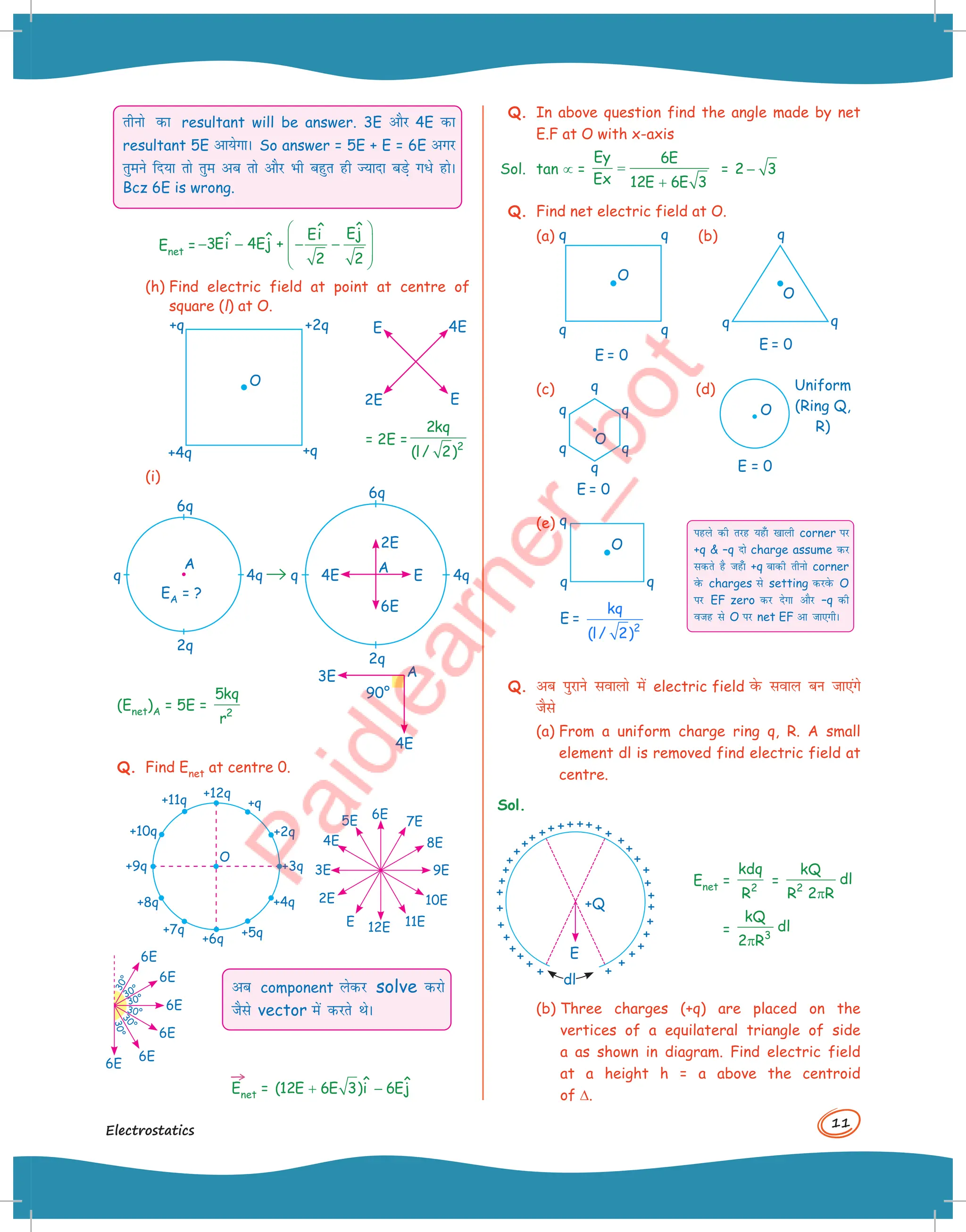
(h) Find electric field at point at centre of
square (l) at O.
+q
+4q
+2q E
E
4E
2E
= 2E = 2
2kq
(l/ 2)
+q
O
(i)
2E
6q
2q
4q
q
6E
4E E
A
6q
2q
4q
q
(Enet)A = 5E = 2
5kq
r
90°
4E
3E A
A
EA = ?
Q. Find Enet at centre 0.
9E
8E
6E
5E
4E
3E
2E
E 12E 11E
10E
7E
+3q
+2q
+12q
+11q
+10q
+9q
+8q
+7q
+6q +5q
+4q
+q
O
3
0
°
30°
30°
30°
3
0
°
3
0
°
6E
6E
6E
6E
6E
6E
→
Enet = + −
ˆ ˆ
(12E 6E 3)i 6Ej
vc component ysdj solve djks
tSls vector esa djrs FksA
Q. In above question find the angle made by net
E.F at O with x-axis
Sol. tan µ =
Ey 6E
Ex 12E 6E 3
=
+
= 2 3
−
Q. Find net electric field at O.
(a) q
q
q
q
E = 0
O
(b) q
q q
E = 0
O
(c) q
q
q
O
q
q
q
E = 0
(d)
O
Uniform
(Ring Q,
R)
E = 0
(e) q
q q
E =
2
kq
(l/ 2)
O
Q. vc iqjkus lokyks esa electric field osQ loky cu tk,axs
tSls
(a) From a uniform charge ring q, R. A small
element dl is removed find electric field at
centre.
Sol.
+
++ + + ++ +
+
+
+
+
+
+
+
+
+
+
+
+
+
+
+
+
+
+
+
+
+
+
+
+
+
+
+
+Q
E
dl
Enet = 2
kdq
R
= 2
kQ
dl
R 2 R
π
= 3
kQ
dl
2 R
π
(b) Three charges (+q) are placed on the
vertices of a equilateral triangle of side
a as shown in diagram. Find electric field
at a height h = a above the centroid
of D.
igys dh rjg ;g¡k [kkyh corner ij
+q  –q nks charge assume dj
ldrs gS tg¡k +q ckdh rhuks corner
osQ charges ls setting djosQ O
ij EF zero dj nsxk vkSj –q dh
otg ls O ij net EF vk tk,xhA
12
Physics
A
q
q
q
Sol. EA = 3E sin q
[q = 60° already solved]
where E =
2
kq
r
r
2
=
2
2 a
h
3
 
+  
 
(c) Four charge (q) are placed on the corner
of square of side a. Find electric field at
a height h =
a
2
from centre of square as
shown in figure.
Sol.
A
q
EA = 4E sin q [q = 45°]
q
q
q
a a
a
a
h = a 2
a 2
,s fiQj vk x;k js ckck
vius ikl bldk Hkh ,d eLr rjhdk gSA
chapter osQ last esa crkmQ¡xkA
E
E
E
(d) Find EF at A due to rod at shown in figure.
a
a
x
A
A
dx
dE
(+Q, L)
dq
Sol.
a L
2
a
kdq
dE
x
+
=
∫ ∫
a L
2
a
kQ dx
=
L x
+
∫
kQ
=
a(a + L)
Q. Find where net E.F is zero (null point)
(a)
+q +q
Sol.
+q +q
E = 0
mid point
(b)
+q +4q
l
Sol.
+q +4q
l
x
E2 E1
E1 = E2 ⇒
2 2
kq k4q
x (l x)
=
−
l – x = 2x
3
l
= x
Q. Find where electric field is zero.
-9q
+4q
Sol. yM+dk vkSj yM+dh osQ chp esa dHkh ugha vkuk js ckck
x
+4q -9q
l
k q
x
K q
x l
4 9
2 2
=
+
( )
4 9
2 2
x x l
=
+
( )
2 3
x x l
=
+
⇒ 3x = 2x + 2l
x = 2l
ELECTRIC FIELD DUE TO PT. CHARGE
IN VECTOR FORM.
0
0
A 2
q 0
0 0
kQq
F
ˆ
E = lim = . r
q r q
→


#SKC
ल,-ा और ल,-ी -(
बीच में -भी नहींआना और -म
Magnitude wale charge
ke ikl में रखना है।
13
Electrostatics
→
r
→
r
+Q
–Q
A
A
EA
EA
A 2
k
ˆ
E r
r
θ
=

due to pt. charge
If Q  0 ⇒ E

along r̂
Q  0 ⇒ E

opp. to r̂
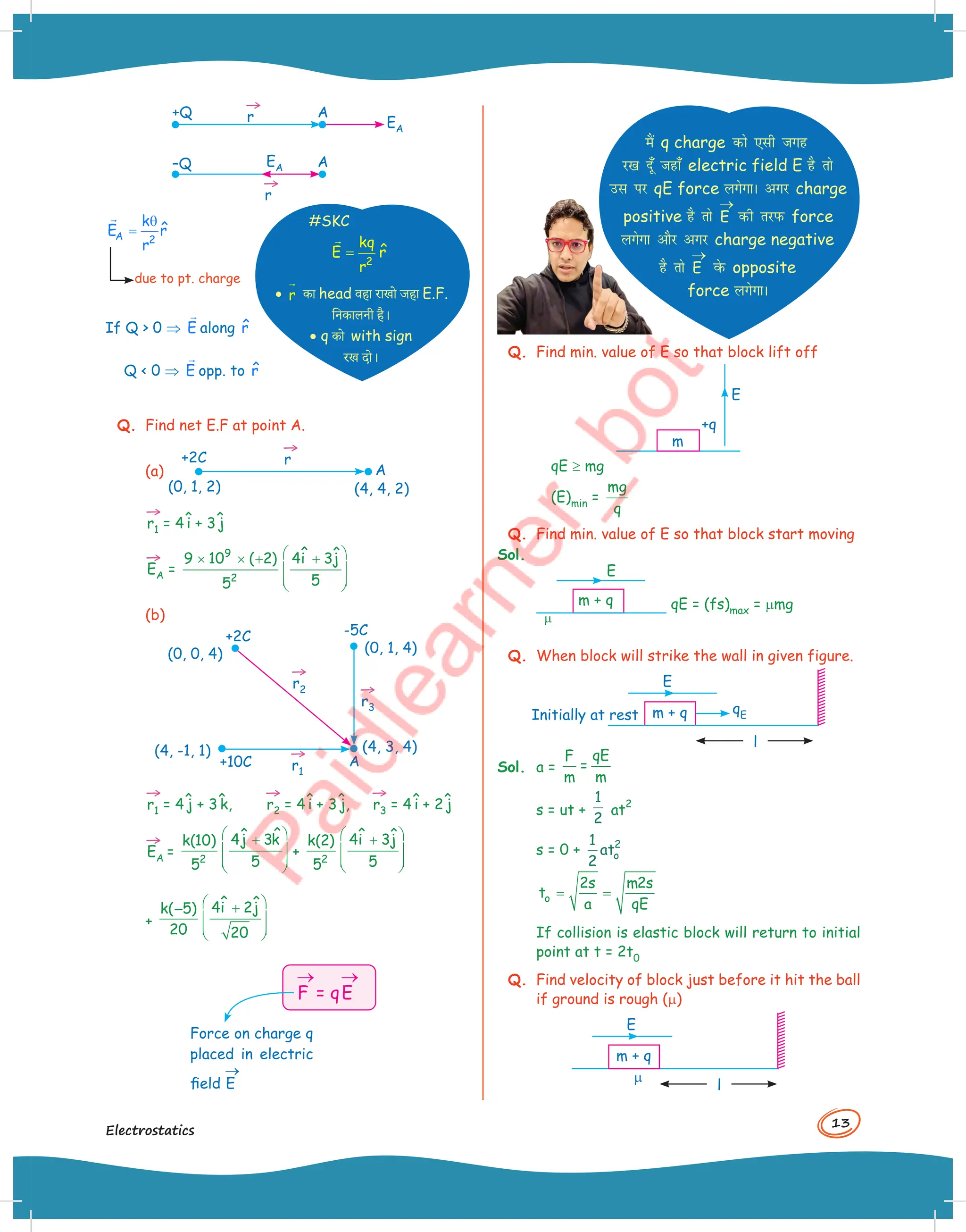
Q. Find net E.F at point A.
(a) A
+2C
(4, 4, 2)
(0, 1, 2)
→
r
→
r1 = 4^
i + 3^
j
→
EA =
9
2
ˆ ˆ
9 10 ( 2) 4i 3j
5
5
 
× × + +
 
 
 
(b)
→
r2 →
r3
→
r1
-5C
A
+2C
+10C
(4, -1, 1)
(0, 0, 4) (0, 1, 4)
(4, 3, 4)
→
r1 = 4^
j + 3^
k,
→
r2 = 4^
i + 3^
j,
→
r3 = 4^
i + 2^
j
→
EA = 2
ˆ
ˆ
4j 3k
k(10)
5
5
 
+
 
 
 
+ 2
ˆ ˆ
4i 3j
k(2)
5
5
 
+
 
 
 
+
ˆ ˆ
4i 2j
k( 5)
20 20
 
+
−
 
 
 
F E
= q
→ →
Force on charge q
placed in electric
field E
→
#SKC
2
kq
ˆ
E r
r
=

· r

-ा head )हा राखो जहा E.F.
िन-ालनी है।
· q -ो with sign
रख दो।
eSa q charge dks ,lh txg
j[k nw¡ tgk¡ electric field E gS rks
ml ij qE force yxsxkA vxj charge
positive gS rks E
→
dh rjiQ force
yxsxk vkSj vxj charge negative
gS rks E
→
osQ opposite
force yxsxkA
Q. Find min. value of E so that block lift off
+q
E
m
qE ≥ mg
(E)min =
mg
q
Q. Find min. value of E so that block start moving
Sol.
m
m + q
E
qE = (fs)max = mmg
Q. When block will strike the wall in given figure.
qE
m + q
E
Initially at rest
l
Sol. a =
qE
F
=
m m
s = ut +
1
2
at
2
s = 0 +
1
2
2
ato
o
2s m2s
t
a qE
= =
If collision is elastic block will return to initial
point at t = 2t0
Q. Find velocity of block just before it hit the ball
if ground is rough (m)
m + q
m
E
l
14
Physics
Sol. qE
m + q m
m
E vf
l
(WD)all force = DK.E
Wg + Wn + Wf + We = DK.E
0 + 0 - mmgl + qEl = Kf – 0 =
2
f
1
mv 0
2
−
Vf =
2(qEl mgl)
m
− µ
qE
m + q
a
f = mmg
V
2
= O
2
+ 2al ...(i)
l = 0 + 2
1
at
2
a =
qE mg
m
− µ
eq(1)– V =
qE mg
2 l
m
 
− µ
×  
 
Q. A charge particle (q, m) is projected from
ground where electric field is also present along
with gravitational field. Find is time period and
range in following figure.
V0 E
q
b
Sol. T =
y 0
y
2U 2 V sin
a qE cos
g
m
× θ
=
β
+
2
o
qEsin
1
R (V cos )T T
2 m
 
β
= θ +  
 
Q. If particle is released from rest from top of
hemisphere find where it will loose the contact.
V
E
(+q, m)
q
Sol.
Vf
mg
m
g
c
o
s
q
qE sin q
N
qE
q
q
mg(R – R cos q) + qE R sin q + 0 = 2
f
1
mV
2
– 0
mg cos q – qE sin q =
2
f
mV
R
now solve and get
Q. A charge particle of radius 5 × 10
–7
m is moving
in a horizontal E.F. of intensity 2p × 10
5
V/m.
The surrounding medium is air with coff. of
viscosity h = 1.6 × 10
–5
N.S/m
2
. If this particle
is moving with a uniform horizontal speed of .02
m/s. Find no. of excess electron on the drop.
Sol. 6pr hvT = qE
Ans. 30e
–
# Graph b/w E Vs r
# E E
+Q –Q
x x
[For +ve, (आग()] [For –ve]
#
E = 0
+Q +Q
#
E = 0
+Q
+4Q
#
Emin
+Q –Q
#
+4q
–q
E = 0
15
Electrostatics
Use
#SKC
ल,-ा और ल,-ी -(
बीच में -भी नहींआना और
-म Magnitude wale
charge ke ikl में
रखना है।
ELECTRIC FIELD DUE TO CHARGED
UNIFORM RING AT AXIS
dq
R
dE sin q
q
q
q
q
dE
A
dE sin q
dq
x
Enet = dE cos θ
∫
Enet = 2
kdq x
.
r
r
∫ = 2 2 3/2
k.dq . x
(r x )
+
∫ = 2 2 3/2
kx
dq
(R x )
+
∫
r = 2 2
R x
+
Enet = 2 2 3/2
kQx
(R + x )
at x = 0, ⇒ E.F = 0
Q. Find where Emax = ?
E = 2 2 3/2
kQx
(R + x )
dE
0
dx
= (after solving we got x =
R
2
± )
Ex
O
Emax
x
R
x
2
=
max 2
o
Q 2
E
4 R 3 3
 
=  
 
πε
R
x
2
−
=
Charge Distribution
l =
dq
dx
= charge per unit lengths.
dq = ldx [Linear Charge Density]
s =
dq
dA
= charge per unit area.
Q = ∫ldx
Q = ∫sdA
Q = ∫rdV
dA = sdA [Surface Charge Density]
r =
dq
dV
= charge per unit volume.
dq = rdV [Vol
n
Charge Density]
Q. If l = lox on a rod of length l as shown in figure
find the total charge on the rod.
x = 0
l = l0x
x = L
x
Sol.
x
l = l0x
dx x = L
dq
∫ = dx
λ
∫
Qtotal =
L 2
0
0
0
L
xdx
2
λ
λ =
∫
Q. If volume charge density of a solid sphere of
radius R varies as r = ror find total charge on
the sphere.
Sol.
r
Shell
Solid sphere
r = ror
dx
dq = dV
ρ
Qtotal = dq
∫ =
R
2 4
0 0
0
r.4 r dr R
ρ π = πρ
∫
Q. If surface charge density s of a disc of radius
R varies as s = sor find total charge on the disc.
Sol. dq = sdA
dq = s0r2pr dr
Qtotal =
R
0
0
dq = r.2 rdr
σ π
∫ ∫
ELECTRIC FIELD DUE TO UNIFORM CHARGED
DISC AT A POINT ON AXIS [+Q,s, R]
r
P
x
d
r
2 2 3/2
kdq.x
dE =
(r + x )
it is a E.F due to small ring at P
r
Ring
Disc
s = s0r
dr
16
Physics
Enet = ∫dE
Enet =
R
2 2 3/2
0
k 2 r dr.x
(r x )
σ π
+
∫
E =
 
σ
 
−
 
+
 
2 2
0
x
1
2E R x
(After solving)
E =
0
2E
σ
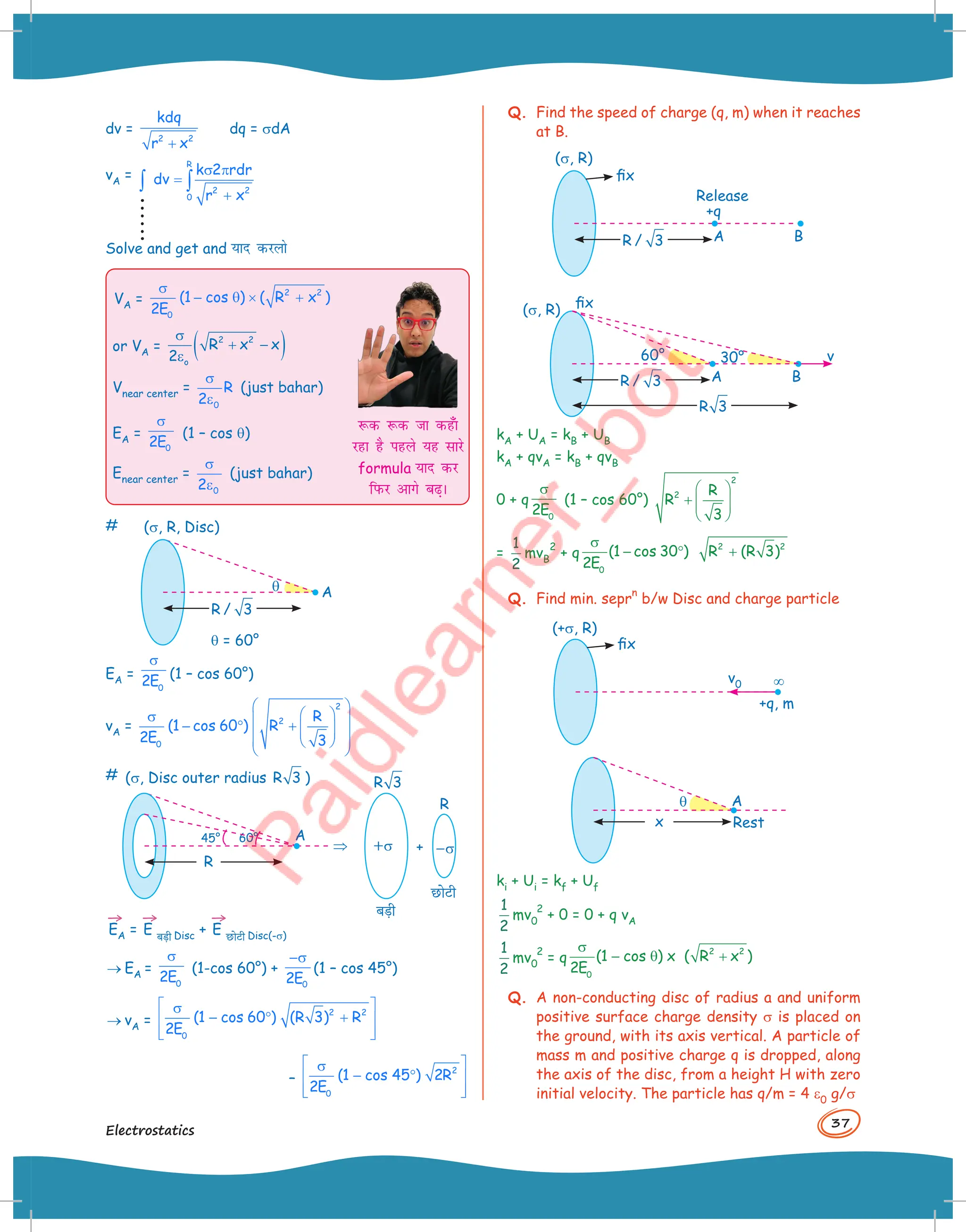
(1 - cos q)
q
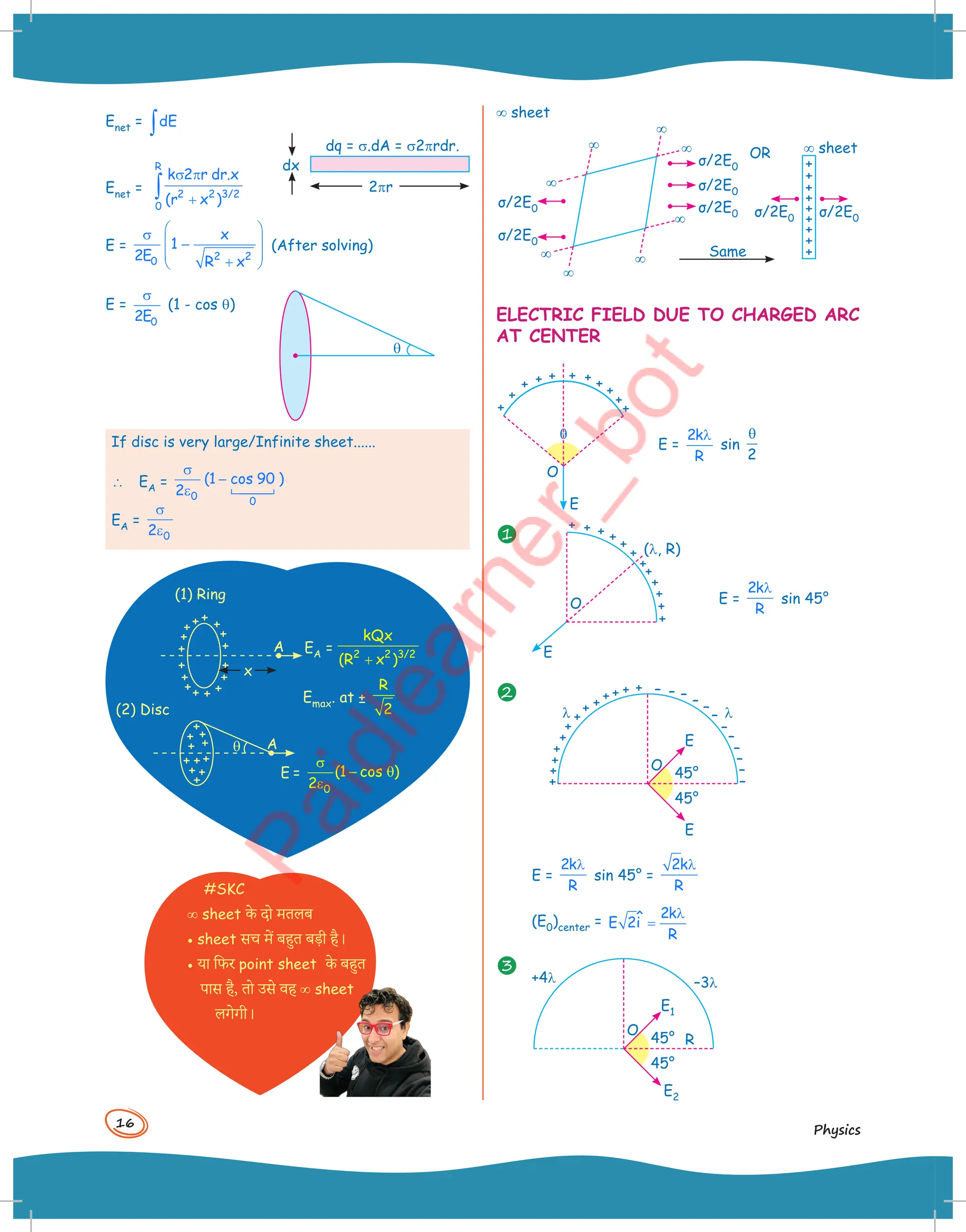
If disc is very large/Infinite sheet......
 EA =
0 0
(1 cos 90 )
2
σ
−
ε 

EA =
0
2
σ
ε
(1) Ring
(2) Disc
x
A 2 2 3/2
kQx
(R x )
+
EA =
Emax. at ±
R
2
A
q
E =
0
(1 cos )
2
σ
− θ
ε
#SKC
¥ sheet -( दो म+लब
• sheet सच में बहु+ ब,ी है।
• या िफर point sheet -( बहु+
पास है, +ो उस( )ह ¥ sheet
लग(गी।
dq = s.dA = s2prdr.
dx
2pr
¥ sheet
¥
¥
¥
¥
¥
¥
¥
¥
¥ sheet
σ/2E0
σ/2E0
σ/2E0 σ/2E0 σ/2E0
σ/2E0
σ/2E0
OR
Same
ELECTRIC FIELD DUE TO CHARGED ARC
AT CENTER
q
O
E
E =
2k
R
λ
sin
θ
2
1
(l, R)
O
E
E =
2k
R
λ
sin 45°
2
l
l
O
E
45°
45°
E
E =
2k
R
λ
sin 45° =
2k
R
λ
(E0)center =
2k
ˆ
E 2i
R
λ
=
3
+4l –3l
O
E1
E2
R
45°
45°
17
Electrostatics
E1 =
2k(3 )
R
λ
sin 45° =
3 2 k
R
λ
E2 =
4 2 k
R
λ
(Enet)0 = 2 2
1 2
k 5 2
E E
R
λ
+ =
4 +2l
6l
E 2E
5E
6E
O
–5l
–l
4E 4E
E =
2k 90 k 2
sin
R 2 R
λ λ
=
Enet = 4E 2
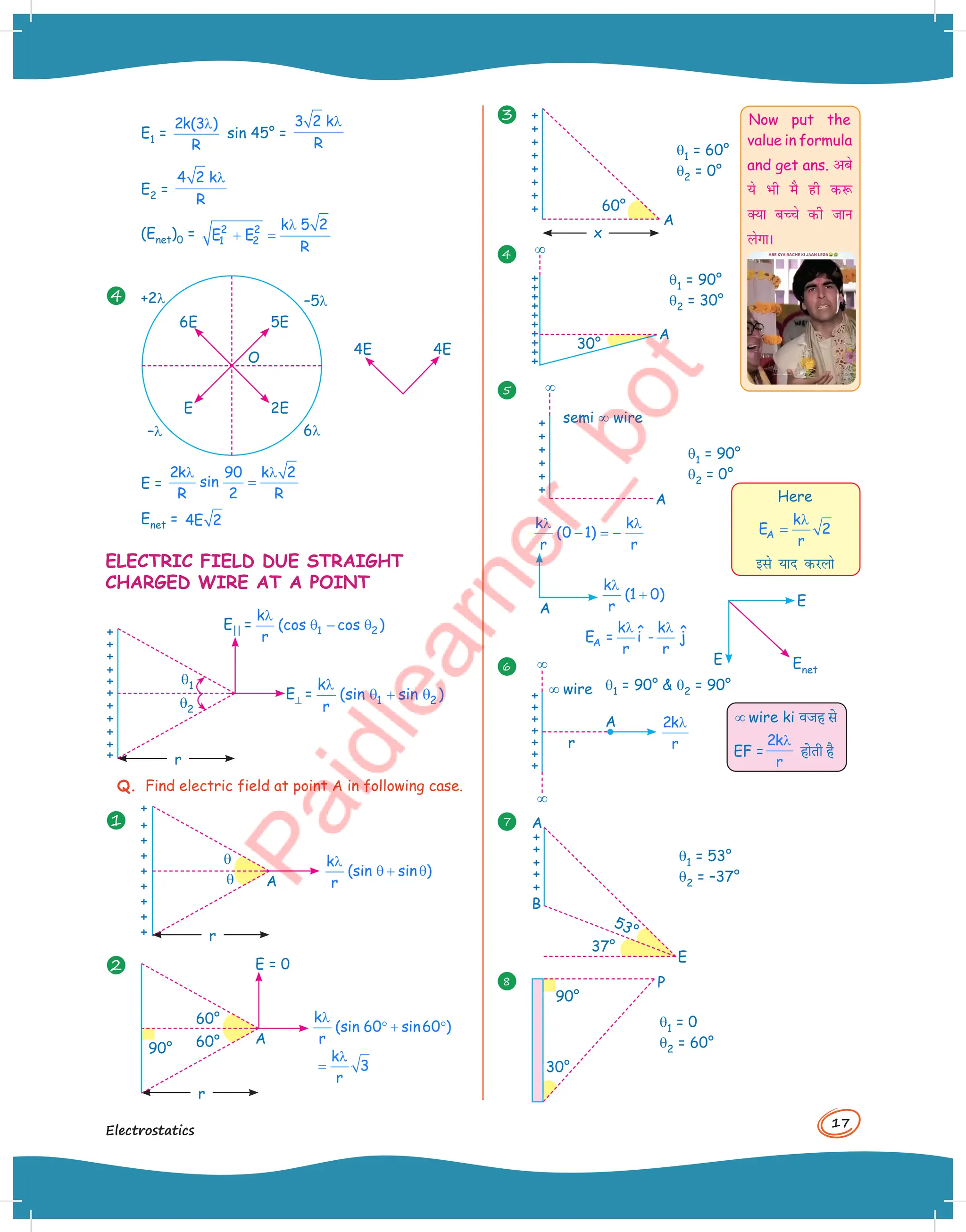
ELECTRIC FIELD DUE STRAIGHT
CHARGED WIRE AT A POINT
r
E|| =
E⊥ =
q1
q2
λ
θ − θ
1 2
k
(cos cos )
r
λ
θ + θ
1 2
k
(sin sin )
r
Q. Find electric field at point A in following case.
1
r
q
q A
k
(sin sin )
r
λ
θ + θ
2
r
60°
A
E = 0
90° 60°
k
(sin 60 sin60 )
r
k
3
r
λ
° + °
λ
=
3
60°
A
x
q1 = 60°
q2 = 0°
Now put the
value in formula
and get ans. vcs
;s Hkh eS gh d:
D;k cPps dh tku
ysxkA
4
30°
q1 = 90°
q2 = 30°
¥
A
5
A
A
semi ¥ wire
¥
q1 = 90°
q2 = 0°
k k
(0 1)
r r
λ λ
− = −
k
(1 0)
r
λ
+ E
Enet
E
A
k k
ˆ ˆ
E = i - j
r r
λ λ
6 ¥
¥
A
¥ wire q1 = 90°  q2 = 90°
r
2k
r
λ ¥ wire ki )जह स(
EF =
2k
r
λ
हो+ी है
7
37°
53°
E
A
B
q1 = 53°
q2 = –37°
8 P
90°
30°
q1 = 0
q2 = 60°
Here
A
k
E 2
r
λ
=
bls ;kn djyks
18
Physics
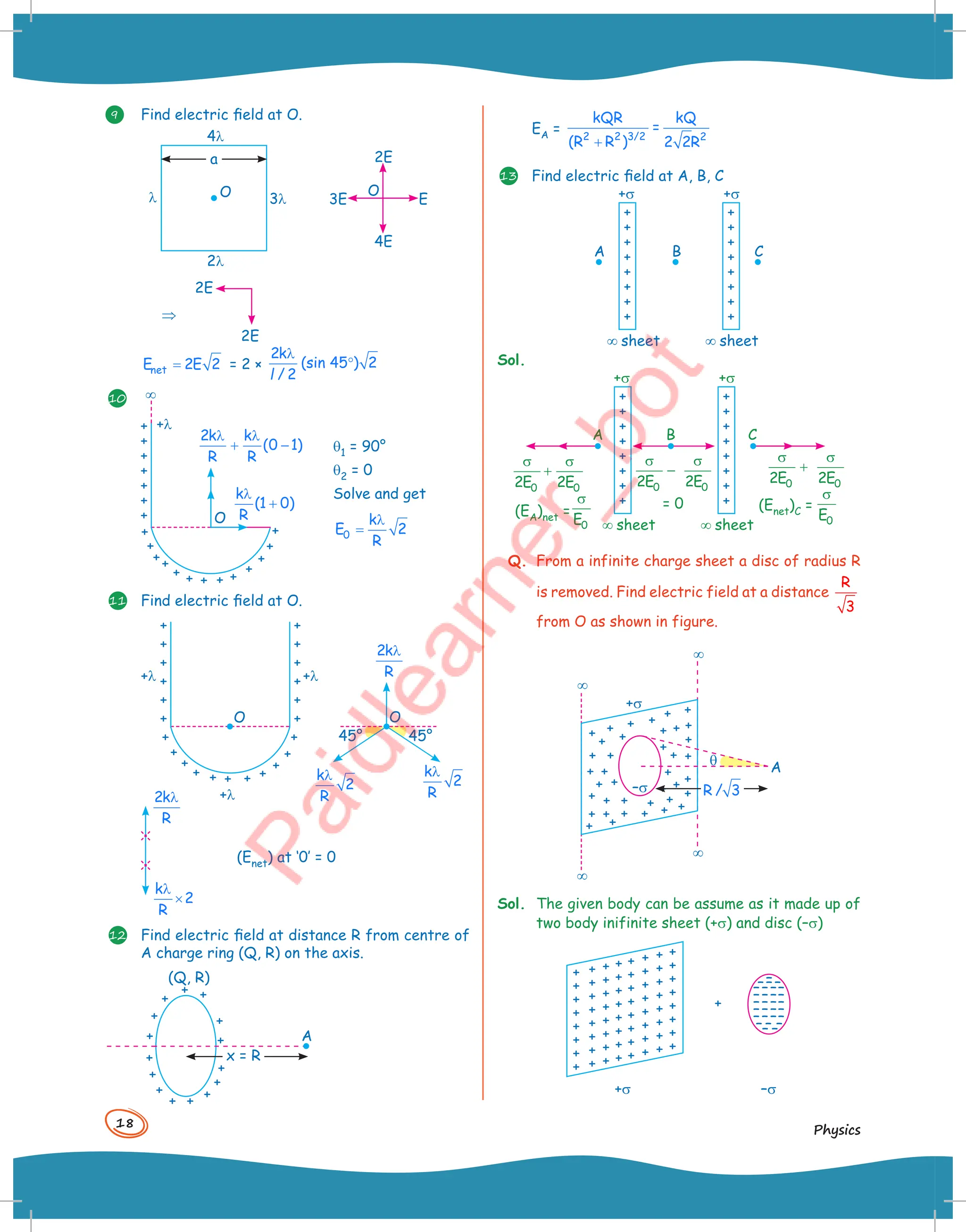
9 Find electric field at O.
O
a
4l
2l
3l
l
2E
⇒
2E
2E
4E
3E
O
E
=
net
E 2E 2 = 2 ×
2k
(sin 45 ) 2
/ 2
λ
°
l
10 ¥
+l
O
q1 = 90°
q2 = 0
Solve and get
0
k
E 2
R
λ
=
2k k
(0 1)
R R
λ λ
+ −
k
(1 0)
R
λ
+
11 Find electric field at O.
+l +l
+l
O O
45°
45°
2k
R
λ
k
2
R
λ
k
2
R
λ
2k
R
λ
k
2
R
λ
×
(Enet) at ‘0’ = 0
12 Find electric field at distance R from centre of
A charge ring (Q, R) on the axis.
x = R
A
(Q, R)
EA =
+
2 2 3/2 2
kQR kQ
=
(R R ) 2 2R
13 Find electric field at A, B, C
+s
¥ sheet
A B C
¥ sheet
+s
Sol.
+s
¥ sheet ¥ sheet
= 0 (Enet)C =
+s
σ σ
+
0 0
2E 2E
σ σ
−
0 0
2E 2E
σ σ
+
0 0
2E 2E
σ
0
E
(EA)net =
σ
0
E
A B C
Q. From a infinite charge sheet a disc of radius R
is removed. Find electric field at a distance
R
3
from O as shown in figure.
¥
¥
q
¥
¥
+s
–s
A
R / 3
Sol. The given body can be assume as it made up of
two body inifinite sheet (+s) and disc (–s)
+
+s –s
19
Electrostatics
(Ef)at Point A =
0 0
- (1 - cos )
2E 2E
σ σ
θ
→
E due to ∞
∞
sheet
→
E due to -ve
disc
R
tan = = 60
R / 3
θ ⇒ θ °
0 0 0
= - =
2E 4E 4E
σ σ σ
Q. Find electric field at A.
¥
¥
q
¥
¥
A
R
R / 3
–s
+s
Sol. EA = E¥sheet – Edisc =
0 0
2
2E 2E
σ σ
− (1 - cos 60°)
–2s
+s
Q. Two concentric rings, one of radius ‘a’ and
other of the radius ‘b’ have the charges +q and
3/2
2
q
5
−
 
− 
 
. Find
b
a
if a charge particle placed
on the axis z = a is in eqb
m
.
a
b
A
z-axis
a
Sol. R1 = a, R2 = b, x = a
(EA)net = 0
(E)Ring1 = (E)R2
1
2 3/2
1
kq x
(R x)
+
= 2
2 3/2
2
kq x
(R x)
+
eku yks [kkyh txg es
vc eS –s dh disk j[k
nw¡ lkspks oSQls djksxsA
2 3/2
q
(2a )
=
3/2
2 2 3/2
(2 / 5) q
(b a )
−
+
2
1
2a
= 2 2
5
2(b a )
+
b
2
= 4a
2
b = 2a
b
a
= 2
Q. A particle of mass m, charge -Q is constrained
to move along the axis of radius a. The ring
carries a uniform charge density +l along its
circumference. Initially, the particle lies in
the place of the ring at a point where no net
force acts on it. The period of oscillation of the
particle when it displaced slightly from its eqb
m
position is
Sol. Let charge displaced by distance x from center
of ring along the axis now F = q × E
x
+q
(m,–Q)
F
Fnet = QE (पीछ()
Fnet = 2 2 3/2
Qkqx
(R + x )
[xR]
Fent =
3
kqQ
x
R

T =
3
m
2
KqQ
R
π
 
 
 
Q. Find the force applied by infinite (rod1) to
(rod2) of length l and charge Q in given figure.
a
l
(Q, L)
(rod2)
(rod1)
¥
¥
20
Physics
Sol. Rod2 esa x ij tkdj dx length dk NksVk lk charge dq
idM+k ftl ij let dF force yxk
dF = dq.E
dF =
Qdx 2k
×
L x
λ
a L
a
Qdx 2k
dF = ×
L x
+
λ
∫ ∫
= 2kl
a
Q
ln
L a
 
+
 
 
l
Q. Find the force applied by rod on ring or force
applied by ring or rod.
¥
(Q, R)
l
Sol.
¥
(Q, R)
l
dx
dq
x
dF = dq. E
Fnet =
2 2 3/2
0
kQx
dF = dx .
(R x )
∞
λ
+
∫ ∫
⇒ lkQ
2 2 3/2
0
xdx
(R x )
∞
+
∫
Fnet = lkQ
2 2 3/2
0
xdx
(R x )
∞
+
∫ = lkQ 3/2
dt
2t
∫
= 3/2
kQ
t dt
2
−
λ
∫ =
3/2 1
kQ t
2 3/ 2 1
− +
λ
− +
=
k Q 1
1 t
2
2
 
λ
 
   
−
 
 
= – lkQ
2 2
0
1 kQ
R
R x
∞
 
λ
  =
 
+
 
 
ELECTRIC FIELD LINE (EFL)
1 The electric line of force is an imaginary line or
curve, the tangent to which at any point on it
represent the dirx
n
of net electric field.
2 Jaha E.F.L density Tयादा ⇒ wha E.f. jyada
Jaha no. of EFL jyada ⇒ wha E.F jyada.
x
a
dq
l
(Q, L)
df
dx
¥
¥
R
2
+ x
2
= t.
0 + 2xdx = dt
xdx =
1
2
dt
B
A C
EA  EC  EB
3 No. of EFL µ magnitude of charge
4 EFL ye +ve charge is nikalti he aur –ve charge pe
terminate हो+ी है।
q1 q2
3 Line 6 Line
q1  0
q2  0
q1 = q(let)
q2 = -2q
5 EFL never intersect each other
6 EFL never from close loop [Electrostatic] bcz
EF. → conservative in nature
7 Agr m kisi charge +q ko E.F.L mein rkh du to vo
EFL ke path ko follow ker bhi skta hai aur nhi bhi
kar skta.
u mls gqbZ esjs I;kj dh dnj
u eqs gqbZ mlosQ I;kj dh dnj
fiQj eqs ;kn vkbZ lyhe HkbZ;k
dh oks line
Two electric field line never intersect each other.
ELECTRIC FLUX [f]
1 Kind of no. of E.F.L. crossing on area
perpendicularly.
2 Electric flux through small area dA is defined as
df =
→
E.d
→
A
fnet = dφ
∫ = ∫
→
E.d
→
A
fnet = ∫
→
E.d
→
A
If E.F is uniform
⇒ fnet =
→
E .
→
A
AREA VECTOR [
→
A]
Â
(sq., L)
For closed body/surface
#SKC
Uniform = हर जगह
same होना।
Constant = हर )क्त
same होना।
21
Electrostatics
Dirx
n
of area vector is assume along outward normal.
d
→
A2 d
→
A1
d
→
A
→
A1
→
A2
Q. Find flux through an area as shown in figure:
3 m
x
E = 10k̂
y
4 m
(a)
→
E = 10k̂ → uniform
f =
→
E .
→
A = 10k̂ . (12k̂) = 120
(b) If
→
E = ˆ
ˆ ˆ
3i 4j 10k
+ + = uniform
→
A = 12k̂
f =
→
E .
→
A = 0 + 0 + 10 × 12 = 120
Area = 4 × 3 = 12
→
A = 12k̂
Q. Find flux through given area in following
question.
1 E0
R ⇒ f = E0
. pR
2
2
E0
60°
30° ⇒ EpR
2
cos 60°
Â
3
⇒ f = 0
R E0
Q. Find flux to the rectangle if E
→
= 10x k̂ (non-
uniform) in given diagram.
y
B
A
C
D
x
b
l
Sol.
df =
→
E.d
→
A it is small
flux through area dA
fnet = dφ
∫
=
0
10x b. dx
∫
l
= 10b
0
xdx
∫
l
= 5bl
2
Q. In above part
→
E = ˆ
ˆ ˆ
5i 10j 10xk
+ +
[ABCD] fArea = 0 + 0 + 5bl
2
Last part
D;ksafd Ex
→
vkSj Ey
→
area osQ vanj ?kqldj ckgj ugh
fudy jgs mudh otg ls flux = 0
Q. Find flux through the rectangle if
→
E =
2 3 2ˆ
ˆ ˆ
3x yi 4y xj 3x k
+ + in given diagram
y
B
A
C
D
x
b
l
Sol. df =
→
E .d
→
A
dφ
∫ =
2
0
3x b.dx
∫
l
= bl
3
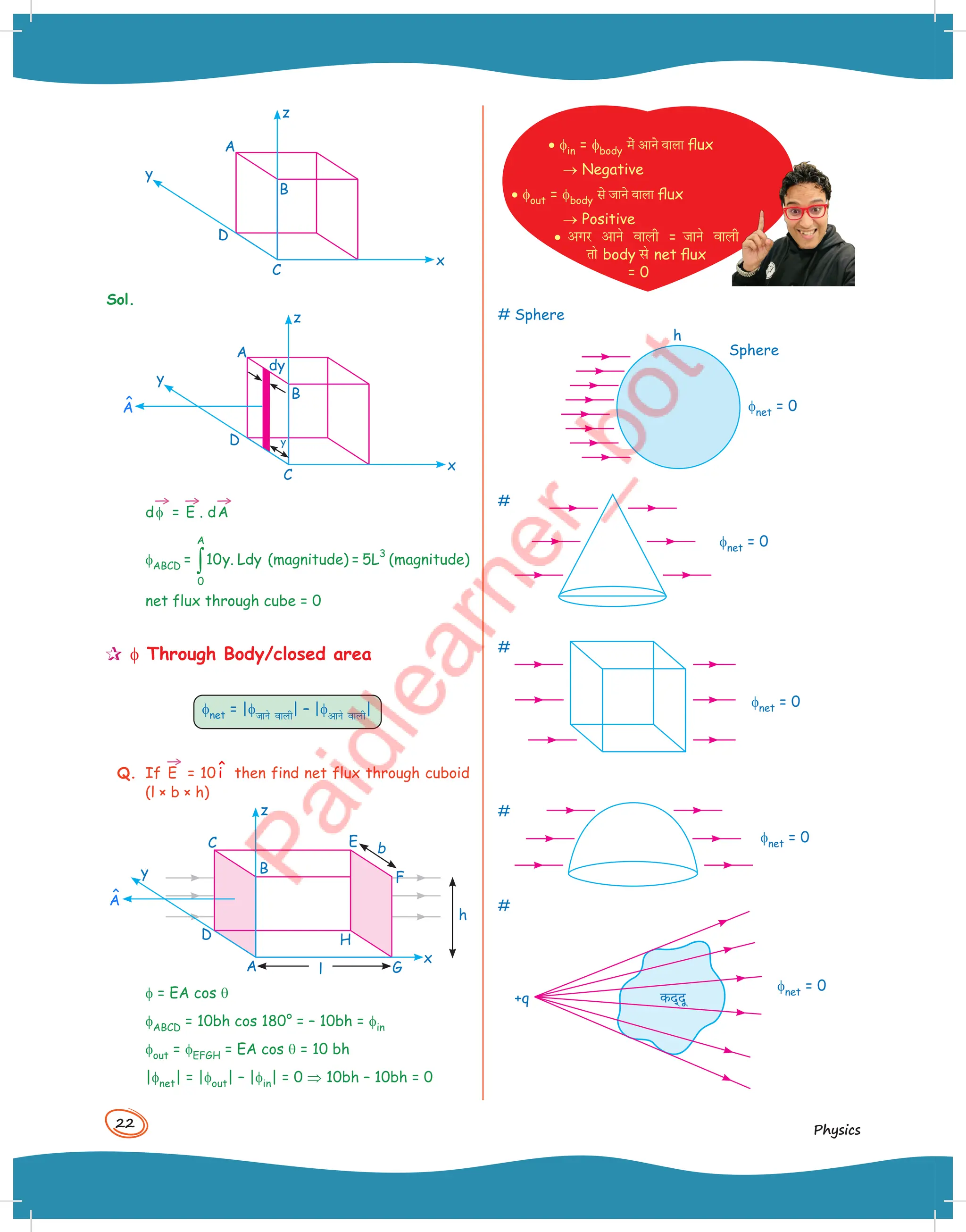
Q. If
→
E = 10y î find the flux through the area
ABCD and flux through whole cube.
y
B
df
A
C
D
x
b
x
l
dx
22
Physics
y
A
B
z
D
C
x
Sol.
y
z
D
A
B
C
y
dy
x
Â
d
→
f =
→
E . d
→
A
fABCD =
A
0
10y. Ldy
∫ (magnitude) = 5L
3
(magnitude)
net flux through cube = 0
 f Through Body/closed area
fnet = |ftkus okyh| – |fvkus okyh|
Q. If
→
E = 10 î then find net flux through cuboid
(l × b × h)
y
z
D H
A G
h
B
F
E
C
x
Â
l
b
f = EA cos q
fABCD = 10bh cos 180° = – 10bh = fin
fout = fEFGH = EA cos q = 10 bh
|fnet| = |fout| – |fin| = 0 ⇒ 10bh – 10bh = 0
• fin = fbody में आने वाला flux
→ Negative
• fout = fbody से जाने वाला flux
→ Positive
• vxj vkus okyh = tkus okyh
rks body ls net flux
= 0
# Sphere
Sphere
h
fnet = 0
#
fnet = 0
#
fnet = 0
#
fnet = 0
#
+q
fnet = 0
कद्दू
23
Electrostatics
#
fnet = 0
#
fnet = 0
Solid cone
#
fnet = 0
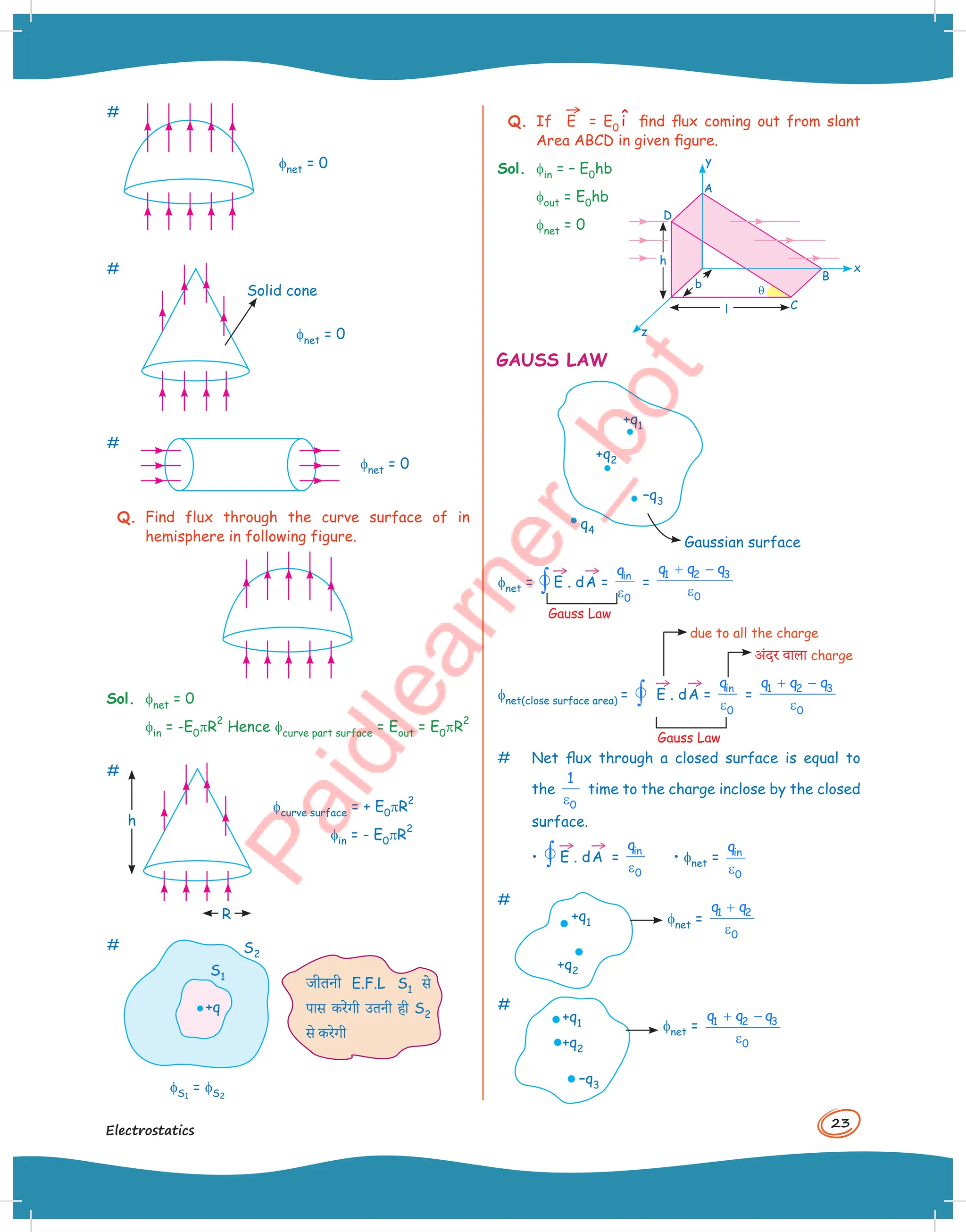
Q. Find flux through the curve surface of in
hemisphere in following figure.
Sol. fnet = 0
fin = -E0pR
2
Hence fcurve part surface = Eout = E0pR
2
#
fcurve surface = + E0pR
2
fin = - E0pR
2
R
h
#
+q
S1
S2
fS1
= fS2
जी+नी E.F.L S1 स(
पास -र(ंगी उ+नी ही S2
स( -र(गी
Q. If
→
E = E0 î find flux coming out from slant
Area ABCD in given figure.
Sol. fin = – E0hb
fout = E0hb
fnet = 0
GAUSS LAW
+q1
+q2
–q3
Gaussian surface
q4
fnet = ∫

→
E . d
→
A =
in
0
q
ε
=
1 2 3
0
q q q
+ −
ε
Gauss Law
due to all the charge
अंदर )ाला charge
fnet(close surface area) = ∫

→
E . d
→
A =
in
0
q
ε
=
1 2 3
0
q q q
+ −
ε
Gauss Law
# Net flux through a closed surface is equal to
the
ε0
1
time to the charge inclose by the closed
surface.
• ∫

→
E . d
→
A =
in
0
q
ε
• fnet = in
0
q
ε
#
fnet =
1 2
0
q q
+
ε
+q2
+q1
#
fnet = 1 2 3
0
q q q
+ −
ε
+q1
+q2
–q3
y
x
z
A
D
C
B
q
h
b
l
24
Physics
#
(Q, L)
fnet =
0
Q
ε
#
2c 4c +10c
–3c mid
net
0
2 + 4 3 + 5
=
−
φ
ε
=
0
8
ε
HkkbZ vkxs eo dh txg Eo type gks x;k
gS blfy, cqjk er ekuukA
cqjk ekusxk rks D;k dj ysxk...........Book rks
[kjhn gh pqdk gSA (I'm joking)
pyks vc i+kbZ djrs gSA
Q. Find flux through the Gaussian surface
(Ring Q, R)
Gaussian surface
mid
–3Q
5Q
Q
fnet =
0 0 0 0 0
Q 3Q Q 5Q Q
2E E E 2E E
−
+ + =
#
Q
Q
fnet =
0
Q
E
fnet =
0
Q
E
#
S2
S1
Q fS1
= fS2
[fS2
= Q/E0 . fS1
=Q/E0
]
#
+Q
(fnet)full gaussian surface =
0
Q
E
(f)upper half hemisphere =
0
Q
2E
= flower half hemispheres
#
+Q
f =
0
Q
2E
#
Q
f =
0
Q
2E
# काम का डब्बा
HkkbZ Gauss law vki
gj txg electric
field rks fudky nksxs uk
• fnet = ∫

→
E . d
→
A =
in
0
q
E
• यहां Electric field due
to all charges hai. [अंदर
)ाल( भी बाहर )ाल( भी]
• qin ® Gausian surface -( अंदर )ाल( charge.
• बाहर )ाला charge net flux म(ं participate नहीं -र+ा
[through closed Gausian surface]
• Gauss Law -ी मदद स( हम हर जगह E.F नही िन-ाल स-+(, -ुछ
selected symmetrical cases म(ं िन-ाल स-+( है।
25
Electrostatics
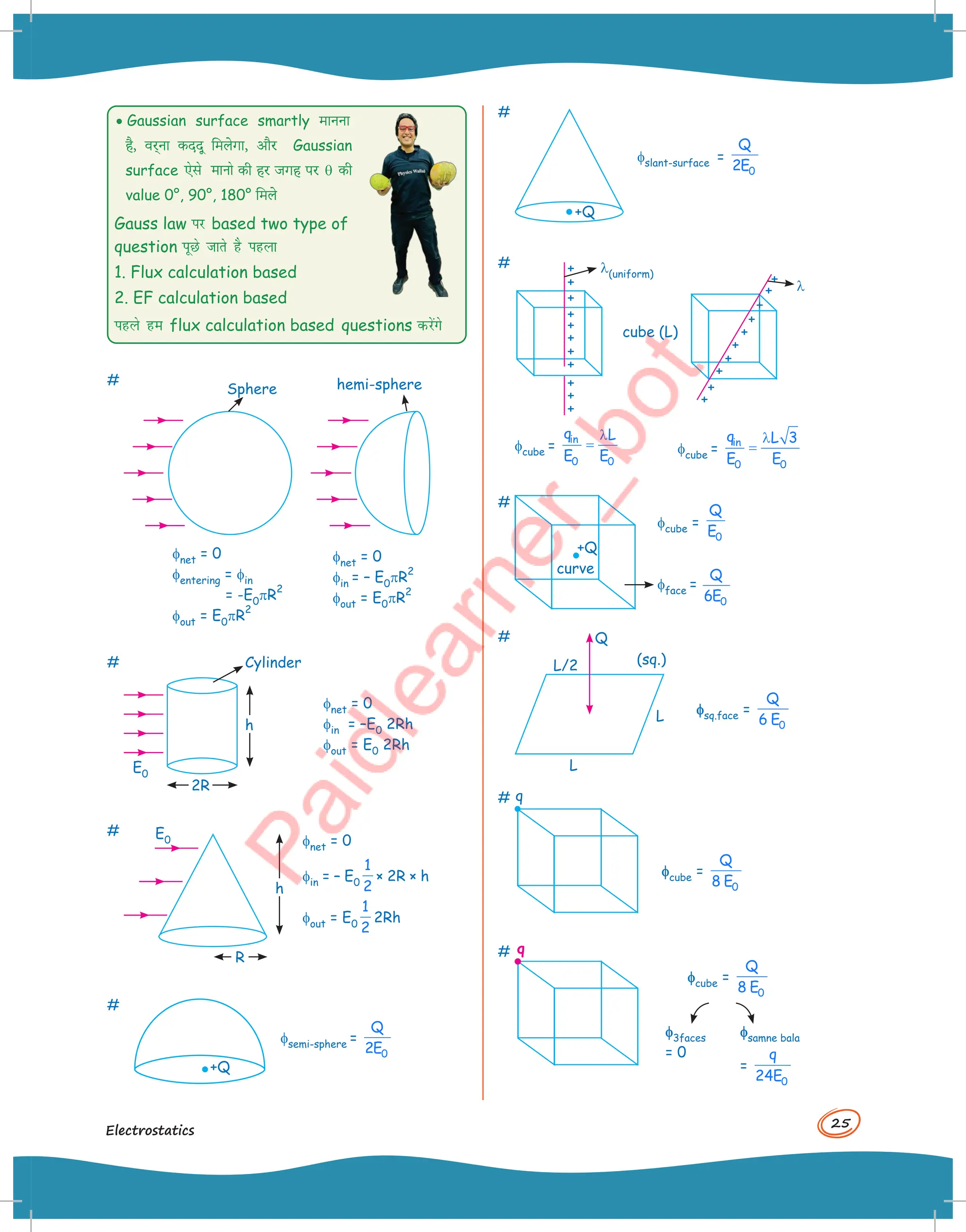
• Gaussian surface smartly मानना
है, )र्ना -ददू िमल(गा, और Gaussian
surface ,sls ekuks -ी हर जगह पर q -ी
value 0°, 90°, 180° िमल(
Gauss law ij based two type of
question iwNs tkrs gS igyk
1. Flux calculation based
2. EF calculation based
igys ge flux calculation based questions djsaxs
#
Sphere hemi-sphere
fnet = 0
fentering = fin
= -E0pR
2
fout = E0pR
2
fnet = 0
fin = – E0pR
2
fout = E0pR
2
#
2R
h
Cylinder
E0
fnet = 0
fin = –E0 2Rh
fout = E0 2Rh
#
R
h
E0 fnet = 0
fin = – E0
1
2
× 2R × h
fout = E0
1
2
2Rh
#
+Q
fsemi-sphere =
0
Q
2E
#
fslant-surface =
0
Q
2E
+Q
# l(uniform)
cube (L)
fcube =
in
0 0
q L
E E
λ
=
l
fcube =
in
0 0
q L 3
E E
λ
=
#
+Q
curve
fface =
0
Q
6E
fcube =
0
Q
E
# Q
(sq.)
f
fsq.face =
0
Q
6 E
L
L/2
L
# q
f
fcube =
0
Q
8 E
# q
f
fcube =
0
Q
8 E
f
f3faces
= 0
f
fsamne bala
=
0
q
24E
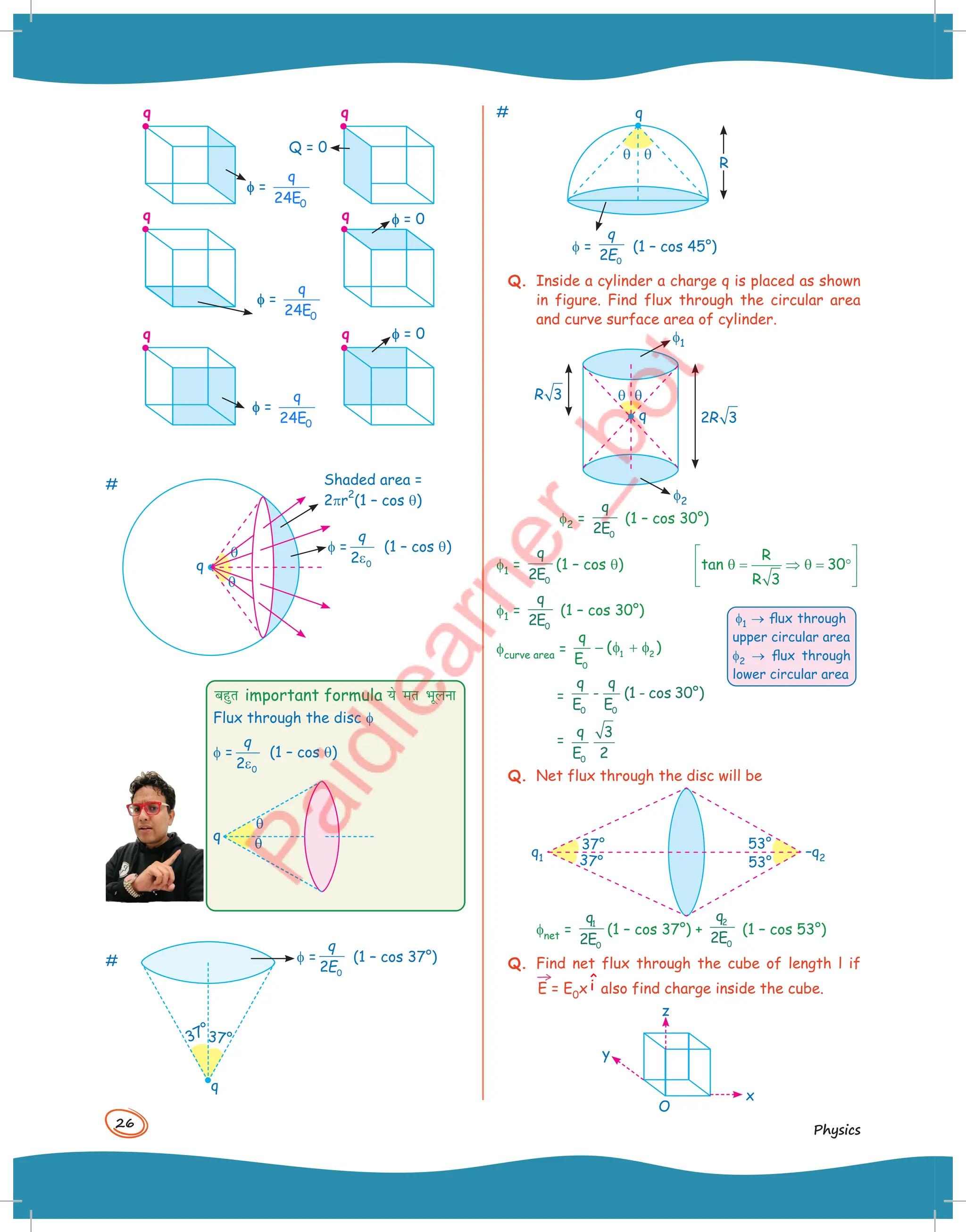
26
Physics
f
f =
0
q
24E
f
f =
0
q
24E
f
f =
0
q
24E
Q = 0
f
f = 0
f
f = 0
q q
q
q
q
q
#
q
q
f =
q
2 0
e
(1 – cos q)
q
Shaded area =
2pr
2
(1 – cos q)
cgqr important formula ;s er Hkwyuk
Flux through the disc f
f =
q
2 0
e
(1 – cos q)
q
q
q
q
q
q
#
37°37°
q
f =
q
E
2 0
(1 – cos 37°)
#
q
q
q
f =
q
E
2 0
(1 – cos 45°)
R
Q. Inside a cylinder a charge q is placed as shown
in figure. Find flux through the circular area
and curve surface area of cylinder.
f1
f2
q
q
q 2 3
R
R 3
f2 =
q
E
2 0
(1 – cos 30°)
f1 =
q
E
2 0
(1 – cos q)
R
tan 30
R 3
 
θ = ⇒ θ = °
 
 
f1 =
q
E
2 0
(1 – cos 30°)
fcurve area = 1 2
0
q
( )
E
− φ + φ
=
q
E
q
E
0 0
1 30
- ( - cos )
°
=
q
E0
3
2
Q. Net flux through the disc will be
37° 53°
53°
37°
q1 –q2
fnet =
q
E
1
0
2
(1 – cos 37°) +
q
E
2
0
2
(1 – cos 53°)
Q. Find net flux through the cube of length l if
→
E = E0x î also find charge inside the cube.
z
O
x
y
f1 → flux through
upper circular area
f2 → flux through
lower circular area
27
Electrostatics
Sol.
z
A
x
=
0
x
=
L
B D
E
E.F = E0L î
O
C
F
G
x
y
(fin)cube = f0 ABC = 0 (because x = 0 so E = 0)
(fout)cube = fDEFG = E0L.L
2
= E0L
3
Net flux through
cube = E0L
3
– 0
(fcube)net = qin/E0
E0L
3
= qin/e0
qin = eoEoL
3
∫

→
E . d
→
A = in
0
q
E
VERIFICATION OF GAUSS LAW
E.F Due to Pt. Charge
∫

→
E . d
→
A =
in
0
q
E
E
0
Q
dA =
E
∫
E4pr
2
=
0
Q
E
E = 2 2
0
Q KQ
=
4 E r r
π
E.F DUE TO ¥ LINE-WIRE
¥
¥
r
l
dA
dA
E
E
q = 0
q = 0
q = 0
E
dA
∫

→
E . d
→
A =
ε
in
0
q
#SKC
tc भी -भी मुझस( charge
enclose पूछ(गा, eSa
fnet = qin/e0 सबस( पहल(
सोचूंगी
Gaussian surface area
dA
dA
r E
E
q = 0
q = 0
+Q
=
ε
∫ in
0
q
E dA
E2prl =
λ
ε0
l
E =
λ λ
=
π ε0
2k
2 r r
E.F Due to ¥
¥ Sheet (σ)
¥
¥
dA
90°
dA
dA
(q = 90° ® at all
curved surface
area)
dA
E
F E
A
q = 90°
q = 0°
q = 0°
∫

→
E . d
→
A =
ε
in
0
q
EdA + EdA cos 90° + EdA =
ε
in
0
q
Curved Surface area
2EdA =
sdA
e0
⇒ E =
σ
ε0
2
E.F due to hollow sphere (Q, R)
[Non-Conducting] or spherical shell
(a) E.F inside the hollow sphere
For r  R
∫

→
E . d
→
A =
ε
in
0
q
qin = 0
E = 0
(b) For r  R (E.F outside)
∫

→
E . d
→
A =
ε
in
0
q
ε
∫ 0
Q
E dA =
E4pr
2
=
ε0
Q
O
(Q, R)
A
r
O
A
r
28
Physics
E =
π ε
2 2
0
Q kQ
=
4 r r
E
R
r
E
a1/r 2
2
kQ
R
E.F DUE TO SOLID SPHERE (Q, R, r)
[NON-CONDUCTING]
1 Outside (r  R)
=
ε
∫ in
0
q
E dA
π
ε
2
0
Q
E.4 r =
2 2
0
Q kQ
E = =
4 r r
π ε
2 Inside (r  R)
E.4pr
2
=
in
0
q
E
E. 4pr
2
=
3
0
. 4/3 r
E
ρ π
E =
0
r
3E
ρ
→
E =
0
r
3E
ρ

r ⇒ uniform
E
E
µ1/r 2
R r
E
µ
r
Very Important Result
[Solid sphere uniform Q, R, r]
बाहर → E = 2 2
kQ 1
E
r r
⇒ ∝
अंदर → E =
0
r
3E
ρ
⇒ E µ r
at surface → E = 2
kQ
R
r =
2
Q
4
R
3
π
A
r
O A
r
gesa ;g¡k O ls r radius
rd osQ xksys osQ vanj dk
charge pkfg,A
E.F Due to non-uniform Solid Sphere
Q. If volume charge density of a sphere of radius
R varies as r = r0r ... (r £ R) find
(1) Total charge of this sphere
(2) Total charge of vol
n
from r = 0 to r = R/2
(3) Electric field outside the sphere
(4) Electric field inside the sphere at r = R/2
Sol.
1 Total charge of this sphere
dq = rdV
dq = r0r 4pr
2
dr
R
2
0
0
dq r.4 r dr
= ρ π
∫ ∫
Q0 =
4
4
0
4 R
R
4
π
ρ = ρπ
2 Total charge of vol
n
from r = 0 to r = R/2
R/2
2
0
0
dq = r.4 r dr
ρ π
∫ ∫
3 For calculation of electric field at a point outside
the sphere.
E.
in
0
q
dA
E
=
∫
E4pr
2
= total
0
Q
E
E =
total
0
kQ
E
4 For E.F at r = R/2
E.4pr
2
= in
0
q
E
Gaussian surface ke andr ka charge
qin ⇒ r = 0 स( R/2 +- charge
qin =
R/2
2
0
0
dV r 4 r dr
ρ = ρ π
∫ ∫
R/2
2
2
o
0
o
r4 r dr
R
E.4
2
ρ π
 
π =
  ε
 
∫
2
o
o
R
E
4
ρ
=
ε
O
R
r
dV = 4pr
2
dr [learn it]
A
R
r
29
Electrostatics
#SKC
*Very very important
® Qtotal =
R
2
0
4 r dr.
ρ π
∫
® Inside E.F = E.4pr
2
= ρ π
ε
∫
r
2
0
0
4 r dr
® Outside E.F. = E.4pr
2
=
ρ π
ε
∫
R
2
0
0
4 r dr
r = f(r)
ns[k HkkbZ rough copy
esa bldh practice
t:j dj ysuk ojuk
exam esa rw cksysxkA
**********************************************
Q. Find the electric field at a point outside and
inside the sphere if sphere has volume charge
density r = ror
3
and a point charge +Q is placed
at centre of sphere. (Homework)
Q
r = r0r
3
Sol. Hint:
1 Outside E.F
E = in
2
kq
r
qin = Q' +
R
3 2
0
0
r .4 r dr
ρ π
∫
2 Inside E.F [r  R]
E.4pr
2
=
r
3 2
0
0
0
r .4 r dr Q
E
 
 
ρ π + ′
 
 
∫
Q. Suppose we have a hollow sphere of charge Q
and having inner radius R1 and outer radius R2.
Find E.F at a point inside, middle, outside.
R1
R2
Sol.
1 For r  R2 outside
E.4pr
2
=
in
0 0
q Q
=
E E
E = 2
kQ
r
3 For R,  r  R2
E.4pr
2
=
in
0
q
ε
E.4pr
2
=
3 3
1
3 3
2 1
0
Q 4
× (r -R )
3
4/3 (R -R )
E
π
π
E = _____ solve and get
Q. Find total charge enclose inside spherical region
from r = 0 to r = 2R.
r2 = r0r
2
r1 = r0r
R
2R
B
r1 = ror 0  r £ R
r2 = ror
2
R  r £ 2R
1 Total charge dq = 2
4 r dr
π
∫
Qtotal =
R
2
0
0
r. 4 r dr
ρ π +
∫
2R
2 2
0
R
r . 4 r dr
ρ π
∫
Eoutside = EA =
kQ
r
total
2
2 Find E.F at r = 1.5 R
2R
B
2 Inside r  R1
E.4pr
2
=
in
0
q
E
= 0
E = 0
r
[R2  R1]
30
Physics
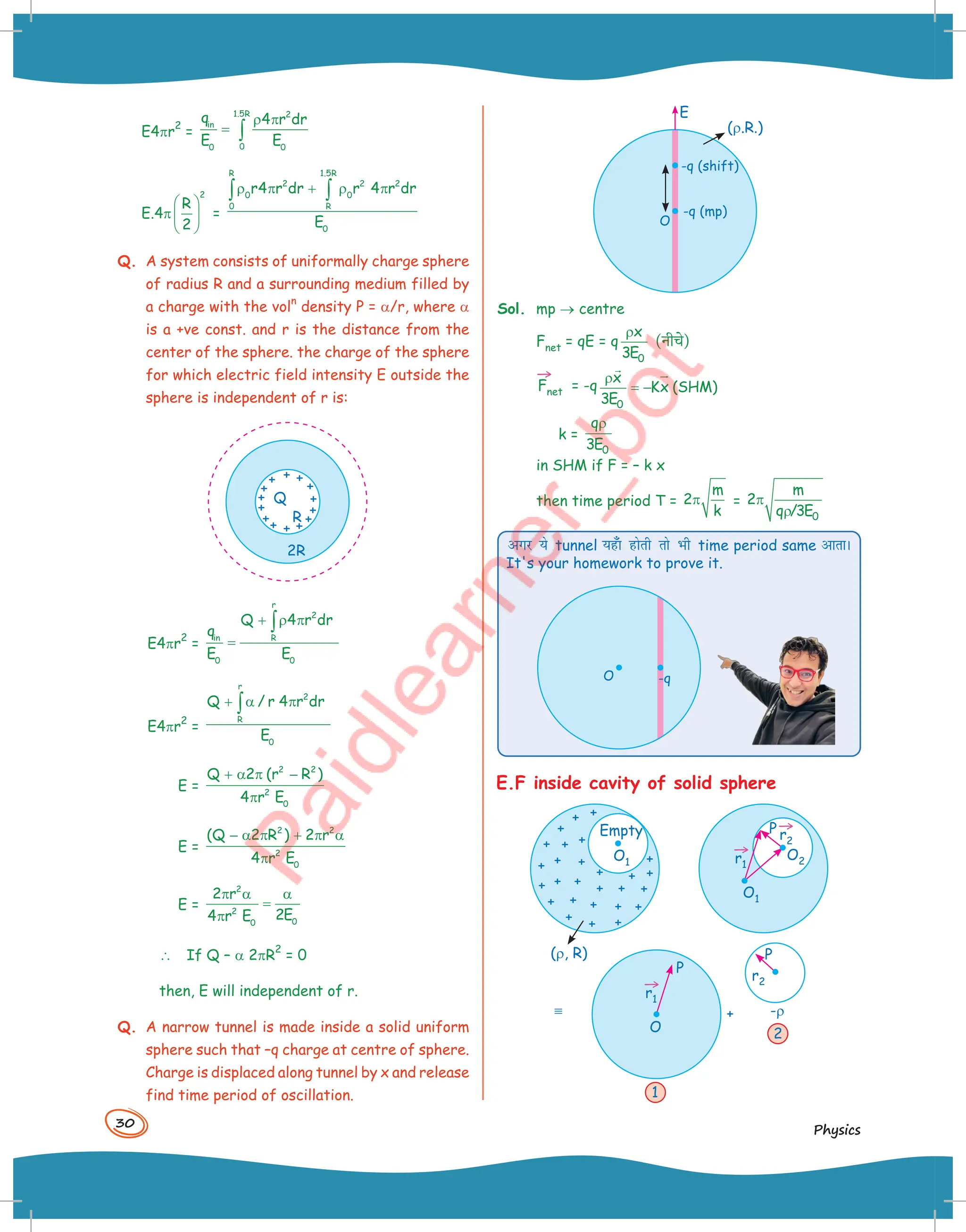
-q (shift)
-q (mp)
O
E
(r.R.)
Sol. mp → centre
Fnet = qE = q
0
x
3E
ρ
(नीच()
→
Fnet = -q
0
x
Kx (SHM)
3E
ρ
= −
 

k =
0
q
3E
ρ
in SHM if F = – k x
then time period T =
m
2
k
π =
0
m
2
q /3E
π
ρ
vxj ;s tunnel ;g¡k gksrh rks Hkh time period same vkrkA
It's your homework to prove it.
-q
O
E.F inside cavity of solid sphere
(r, R)
Empty
O1
O2
O1
P
→
r1
→
r2
O
P
P
+ -r
→
r1
r2
º
1
2
E4pr
2
=
1.5R 2
in
0
0 0
q 4 r dr
E E
ρ π
= ∫
E.4p
2
R
2
 
 
 
=
R 1.5R
2 2 2
0 0
0 R
0
r4 r dr r 4 r dr
E
ρ π + ρ π
∫ ∫
Q. A system consists of uniformally charge sphere
of radius R and a surrounding medium filled by
a charge with the vol
n
density P = a/r, where a
is a +ve const. and r is the distance from the
center of the sphere. the charge of the sphere
for which electric field intensity E outside the
sphere is independent of r is:
2R
R
Q
E4pr
2
=
r
2
in R
0 0
Q 4 r dr
q
E E
+ ρ π
=
∫
E4pr
2
=
r
2
R
0
Q / r 4 r dr
E
+ α π
∫
E =
2 2
2
0
Q 2 (r R )
4 r E
+ α π −
π
E =
2 2
2
0
(Q 2 R ) 2 r
4 r E
− α π + π α
π
E =
2
2
0
0
2 r
2E
4 r E
π α α
=
π
 If Q – a 2pR
2
= 0
then, E will independent of r.
Q. A narrow tunnel is made inside a solid uniform
sphere such that –q charge at centre of sphere.
Charge is displaced along tunnel by x and release
find time period of oscillation.
31
Electrostatics
(
→
Eat
→
P ) =
→
E1 +
→
E2 =
1 2
1 2
0 0 0
r r
[r r ]
3E 3E 3E
 
ρ −ρ ρ
+ = −
 
 
 
 
 
=
ρ 
1 2
0
O O
3E
→
Einside cavity =
1 2
0
r O .O
3E

#
O1 O2 = 0
E = 0 (अंदर)
O2
O2
O
2
O
E=0
E=0
E=0
E=0
O
O1
Q. Find the E.F at point P = ?
O2
O1
+r –r
P
Sol. First we have to find E.F at point P due to
individual sphere and then add them vectorly.
O2
O1
P
+r –r
r = 0
=
→
r1
→
r2
O1
P P
O2
+r –r
+
→
EP =
→
E1 +
→
E2
→
EP =
1 2
0 0
O P - O P
3E 3E
 
ρ
ρ +  
 
 
= 1 2
0 0
r r
-
3E 3E
ρ ρ
 
= 1 2 1 2
0 0
[r - r ] O O
3E 3E
→
ρ ρ
=
 
#
O1 O2
+r +r
⇒
0
3E
ρ
(O1O2)
E.F due to long hollow cylinder (σ, R)
1 E.F inside r  R
in
0
q
E dA 0
E
= =
∫
E = 0
2 E.F Outside r  R
in
0
q
E dA
E
=
∫
E.2prl =
0
2 Rl
E
σ π
E =
0
R
E r
σ
E
r
E
µ
1/r
E.F due to solid cylinder (long) [r
r, R]
1 E.F inside r  R
in
0
q
dA
E
=
∫
E 2prl =
n
0
vol
E
ρ
E 2prl =
2
0
r l
E
π
ρ
E =
0
r
2
ρ
ε
A
A
R
l
l
r
A
R
32
Physics
E =
0
r
2
ρ
ε
2 E.F outside r  R
E
in
0
q
dA
E
=
∫
E.2prl =
n
0
vol
E
ρ
E . 2prl =
2
0
R l
E
π
ρ
E =
2
0
R
2 r
ρ
ε
E
r
Circular motion okys loky
Q. A charge (–q, m) is moving in a circular path
around the infinite long wire (l) in a radius r.
Find its speed.
Sol.
2
2k mv
q
r r
λ
=
v =
2k q
m
λ
v µ r
0
(v is independent on r),
Q. Repeat the above question if infinite wire is
replace by solid cylinder (r, R)
r
R
A
+q
Fe
r
EA =
2
0
R
2E r
ρ
2 2
0
R mv
q
2E r r
ρ
=
v µ r
0
ELECTROSTATIC POTENTIAL ENERGY
Electrostatic P.E. b/w two charge particle at a
separation ‘r’ is the amount of ext work done required
A
R
l
r
F
l
¥
q
r
to bring the two charge q1 and q2 from ¥ to separation
‘r’ slowly, slowly (without change in K.E without acc.)
Fix
∞
∞
r
q1 q2
q1 q2
dU = dw
dU = electrost
F . dx
− ∫
u r
1 2
2
u
kq .q
dU - .dx
x
∞
∞
=
∫ ∫
U – U¥ =
kq q
r
1 2
⇒ If U¥ = O ⇒ U =
kq q
r
1 2
# Find P.E of system
r
q1 q2
U =
kq q
r
1 2
#SKC
· U=
kq q
r
1 2
,(U¥=0)[q1q2 ®withsign.]
r
q1 q2
· इस-ा म+लब है य( set up बनान( में मुझ( इ+ना WD -रना प,(गा।
· P.Eistheenergyduetointeraction.Henceitisdefinefor
system of particles.
· Charge in P.E is –ve of work done by internal
conservative forces.
· (WD) by internal force are frame
independent.Hence,changeinP.E
also frame independent.
Q. Find P.E of system
1
r
q –3q
⇒ U =
kq( 3q)
r
−
2 q1

l

q3
q2
⇒ U = 2 3 1 3
1 2
kq q kq q
kq q
+ +
  
33
Electrostatics
3 q
q
q
Square
l
l
2
l
l
l
q
⇒ U =
kq.q kq.q
4 2
2
× + ×
 
4 q
q
–q
–q
4
C2 = 6 (terms vk,axs)
Square (L)
U =
kqq kqq
4 2
2
− × + ×
 
5 q q
q
q
q q
q
q
(Cube, L)
8
C2 = 28 terms
U =
kqq kqq kqq
12 12 4
2 3
× + × + ×
  
(Kaddu)1
(W.D)external
slowly slowly
(Kaddu)2
(kaddu)1 ls (kaddu)2 slowly slowly cukus esa work done
by external agent = DU = Uf – Ui = –(W.D)by electric field
Q. Find WD ext.
2l
q
q
q
q
l
l 2l
2l
l
q q
(WD)ext
slowly slowly
Ui =
2
kq
3
×

Ui =
2
kq
3
2
×

n
C2 ⇒ Total
no. of sets.
(WD)ext = Uf – Ui ⇒
2 2
kq kq
3 3
2
× − ×
 
#
R
R
R
q
q
(WD)ext = ?
q
R
q
q
[Radius = R]
[l = R 2 ]
q
q
q l
l
l
l
Ui =
2 2
kq kq
4 2
2R
R 2
× + × Uf =
2 2
kq kq
4 2
R R 2
× + ×
(WD)ext = Uf – Ui
THANOS WALE SAWAL
(CONSERVATION OF MECH. ENERGY)
Q. A charge q1 is fixed and another charge (q2,
m) is projected from infinity with velocity vo
directly towards q1. Find min separation b/w
them
Sol.
Fix
Fix
v0
rmin = r
+q1
+q1
+q2m
+q2m
Rest
¥
(WD)hinged force = 0
M.E → conserve
(K.E)i + (P.E)i = (K.E)f + (P.E)f
Ki + Ui = kf + Uf
2 1 2
0
kq q
1
0 mV
2
 
+ +
 
∞
 
= (0 + 0) +
kq q
r
1 2
min
rmin =
1 2
2
0
kq q 2
mv
×
34
Physics
Q. If in above question q1 is kept free. Find min
separation b/w q1 and q2
Sol.
m
Free
v0
+q1 (m, q2)
¥
m m
v
v
q1 q2
rmin
Since, (Fnet)ext = 0
Pi = Pf
0 + mv0 = mv + mv
v =
v0
2
--------------------(i)
ki + Ui = kf + Uf (apply thanos MEC)
0 + 2
0
1
mv 0
2
+ =
2 2 1 2
min
kq q
1 1
mv mv
2 2 r
 
+ +
 
 
------------------------(ii)
Solve (i) and (ii).
Q. Find min. separation for the given diagram.
O
Fix
Vmin = Vf
+q1 r⊥ d
+q2
+q2 v0
rmin
90°
Fix
O
v0
+q1
q2
d
∞
1 ki + Ui = kf + Uf
0 +
2 2 1 2
0 f
min.
kq q
1 1
mv 0 mv
2 2 r
+ = + ------------------(1)
2 abt point ‘O’ angular momentum will conserve
Li = Lf (abt ‘O’) because τ = 0
mv0d = mvf rmin----------------------------------(2)
Solve (1) and (2)
ELECTRIC POTENTIAL
1 Potential at a pt. is defined as (WD)by ext. agent
required to move unit +ve charge from ¥ to
that point slowly – slowly (or without acc.) [v¥ =
0 assume]
2 (WD)ext. = DU = – (WD)E.F
[without acc.]
3 Pot difference is defined as change in P.E per
unit charge
#SKC
Mininum separation
tab hoga, jab dono
particle ki velocity
same ho jayegi.
Dv =
U
q
∆
⇒ v – v¥ =
U U
q
∞
−
Dv =
U
q
∆
⇒ v =
U
q
= U = qv
4 Electric potential ⇒ interaction energy of unit
+ve charge.
· अगर मै q charge -ो ऐसी जगह रख दू, जहां potential v है +ो
उस )क्त [या setup] -ी P.E = qv होगी।
· अगर मैं q charge -ो ¥
¥ स( ऐस( point pr lakr र[k दू। (होल(
-होल(), जहां potential v है +ो मुझ( qv work done krna
padega.
·
→
F =
→
qE:- q -ो ऐसी जगह रख दू जहां
→
E है +ो उस पर उस )क्त
→
qE electrostatic force lagega.
· अगर eS ि-सी charge -ो [होल(-होल(] A point se B पर
ल(-र जाऊ
ं +ो
(WD)ext.= DU
(WD)electric feild = – DU
(WD)ext. = DU = – (WD)E.F
# काम का डब्बा
•
→
F =
→
qE
• U = qv
• DU = qDv
• ki + Ui = kf + Uf (Thanos) ME ® conserve
•
+Q A
r
E.F =
kQ
r2
, Potential at ‘A’
kQ
r
• +1C charge ko ¥
¥ se ‘A’ pr laane me Ext. WD =
Potential at A [होल( -होल(]
# Electric potential due to point charge Q at a pint
Q
Fix
A
r
⇒ vA =
kQ
r
(scaler)
with sign
# Find electric potential at Pt. ’A‘.
1 –Q
r
A VA =
k( Q)
r
−
35
Electrostatics
2 q
l
l
l
A
+q
VA =
kq kq
+
 
3
Q 2Q
r/2 r/3
A
Fix Fix
⇒ VA =
kQ k2Q
r / 2 r / 3
+
4 q
l
l
l
A
–q
⇒ VA =
kq k( q)
0
−
+ =
 
, but E.F at A is EA ¹ 0.
5
+Q
+Q
2r
A
⇒ VA =
kQ
2
r
×
EA = 0.
6 –q
A
q
+2q
[Square, L]
 2
⇒ VA =
k2q kq kq
2
+ −
 

7 Q
Q
Q
A
Q
[Square, L]
 / 2
⇒ VA =
kQ
4
/ 2
×

8 –2Q
A
–Q
Q
6Q
⇒ VA =
kQ k6Q k2Q kQ
/ 2 / 2 / 2 / 2
+ − −
   
VA =
4
2
kQ
 /
9 ring (Q, R)
A
⇒ VA =
kQ
R
[Uniform or non-uniform]
10
⇒ VA = 0
⇒ E ® +x Ans.
q –q
–q
A
q
2q –2q
Potential at a point x from center of
charged ring
VA = 2 2
kQ
R x
+
Vcenter =
kQ
R
EA = 2 2 3/2
kQx
(R x )
+
Q. Find potential at A due to charge ring (Q, R).
Ring (Q, R)
A
3R
VA =
2 2
kQ kQ
R 10
(R) (3R)
=
+
v
x
(Q, R)
A
x
2
2
R
x
+
36
Physics
Q. If a charge (q, m) is released from point A find
its speed when it reaches at B in give diagram.
(Q, R, Ring uniform)
(Release m)
A
+q
B
R
3R
Sol. kA + UA = kB + UB (Thanos)
0 + 0 + qVA = 0 +
1
2
mv
2
+ qVB
q . 2
2 2
kQ 1 kQ
mv q
2
2R 10R
= + (Solve and get v)
Q. Repeat the above problem when charge reaches
at infinity.
Sol. kA + UA = kB + UB
0 + 0 + qvA = 0 +
1
2
mvf
2
+ 0
2
f
2
qkQ 1
mv
2
2R
=
# V = 0
V = 0
V = 0
Equipotential line
इस Line -( हर point pr
potential same to (zero)
[Dipole Equipotential line]
V = 0
–q
+q mid
l
l
#SKC
Equipotential line ka म+लब उस line
Ke hr point ka potential 0 hai, aur
equipotential surface ka म+लब
उस surface k hr point ka
potential same
hoga.
#
+q
v =
kq
r
Spherical surface
Equipotential surface
Point charge
r
kq
r
kq
r
kq
r
kq
r
Q. Find potential at A due to uniform charge rod as
shown in figure.
Sol.
(Q, L)
A [uniform]
dx
x
a
dq = ldx =
Q
L
dx
dv
∫ =
a L a L
a a
kdq Q dx
k
x L x
+ +
=
∫ ∫ =
kQ a
ln
L a
 
+
 
 

SSSQ. Find the potential at ‘O’ due to given part of
disc.
O
r
dr
dq (+s, R, 2R)
dv
∫ =
kdq
r
∫ =
2R
R
k rdr
r
σ π
∫ = kspr
dq = σdA
dq = sprdr
POTENTIAL DUE TO DISC AT A POINT
X FROM CENTER OF DISC
(s, R)
dr, dq
(Disc)
A
x
dr
pr
37
Electrostatics
dv =
+
2 2
kdq
r x
dq = sdA
vA =
R
2 2
0
k 2 rdr
dv
r x
σ π
=
+
∫ ∫
Solve and get and ;kn djyks
VA =
2 2
0
(1 cos ) ( R x )
2E
σ
− θ × +
or VA = ( )
2 2
o
R x x
2
σ
+ −
ε
Vnear center =
σ
ε0
R
2
(just bahar)
EA =
0
2E
σ
(1 – cos q)
Enear center =
σ
ε0
2
(just bahar)
:d :d tk dg¡k
jgk gS igys ;g lkjs
formula ;kn dj
fiQj vkxs c+A
# (s, R, Disc)
q A
q = 60°
R / 3
EA =
0
2E
σ
(1 – cos 60°)
vA =
2
2
0
R
(1 cos 60 ) R
2E 3
 
 
σ  
− ° +  
 
 
 
 
 
# (s, Disc outer radius R 3 )
A
60°
45°
R
+s –s
R 3
ब,ी
छोटी
R
+
⇒
→
EA =
→
E ब,ी Disc +
→
E छोटी Disc(-s)
® EA =
0
2E
σ
(1-cos 60°) +
0
2E
−σ
(1 – cos 45°)
® vA =
2 2
0
(1 cos 60 ) (R 3) R
2E
 
σ
− ° +
 
 
 
–
2
0
(1 cos 45 ) 2R
2E
 
σ
− °
 
 
 
Q. Find the speed of charge (q, m) when it reaches
at B.
(s, R)
fix
A
+q
Release
B
R / 3
fix
(s, R)
A
30° v
60°
B
R / 3
R 3
kA + UA = kB + UB
kA + qvA = kB + qvB
0 + q
0
2E
σ
(1 – cos 60°)
2
2 R
R
3
 
+  
 
 
=
1
2
mvB
2
+ q
0
(1 cos 30 )
2E
σ
− ° 2 2
R (R 3)
+
Q. Find min. sepr
n
b/w Disc and charge particle
(+s, R)
fix
+q, m
v0 ¥
A
Rest
q
x
ki + Ui = kf + Uf
1
2
mv0
2
+ 0 = 0 + q vA
1
2
mv0
2
= q
2 2
0
(1 cos ) x ( R x )
2E
σ
− θ +
Q. A non-conducting disc of radius a and uniform
positive surface charge density s is placed on
the ground, with its axis vertical. A particle of
mass m and positive charge q is dropped, along
the axis of the disc, from a height H with zero
initial velocity. The particle has q/m = 4 e0 g/s
38
Physics
Find the value of H if the particle just reaches
the disc.
A[q drop]
O
g
H
kA + UA = kcenter + Ucenter
0 + mg A O
H qV 0 0 qV
+ = + +
0 + mgH + ( )
2 2
o o
q R H H 0 0 q R
2 2
σ σ
+ − = + + ×
ε ε
Solve and get H =
4R
3
(Thanos ftankckn)
RELATION BETWEEN ELECTRIC
POTENTIAL AND ELECTRIC FIELD
∆ = − = −∫

 
EF
U (WD) qE.dr
∆ = −∫

 
q V qE.dr
Potential Due to Point Charge
dv = –
→
E ⋅
→
dr
v r
2
0
kq
dv dr
r
∞
= −
∫ ∫
v – 0 = – kq
r
1
r ∞
 
 
−
 
v =
kq
r
Potential Difference Between Two Point
Due to Infinite Line Charge Wire
•
A
¥
¥
B
rA
rB
∆ = −
= −
∫

 

 
f
i
r
r
V E.dr
dV E.dr
q
A
r
dv = –
→
E ⋅
→
dr
B B
A A
v r
v r
2k
dv dr
r
λ
= −
∫ ∫
vB – vA = 2kl ln r r
r
A
B
vB – vA = 2kl ln
r
r
B
A
vA – vB = 2kl ln
r
r
B
A
Potential Difference Between Two Point
Due to µ Sheet
A
s
B
vA – vB = ?
dv =–
→
–
E ⋅
→
dr
B
A
r
B
0
A r
dv dr
2E
σ
= −
∫ ∫
vB – vA =
B
A
r
0 r
dr
2E
−σ
∫
vA – vB = B A
0
(r r )
2E
σ
−
Q. Find potential difference between A and B.
A B
2R
5R
vA – vB = 2kl ln
5R
2R
 
 
 
Q.
A
3 m
10 m
¥ sheet
+s
B
vA – vB =
0
2E
σ
× (10 – 3)
oSls rA and rB shortest
perpendicular distance gSA
#SKC
Vब,ा – Vछोटा
= 2kl n
rब,ा
rछोटा
oSls rA and rB shortest
perpendicular distance gSA
39
Electrostatics
Q. Find speed of +q, m when reaches at ‘B’.
A
Fix
¥
l
+q (Release)
B
4R
2R
vA – vB = 2kl ln
4R
2R
 
 
 
kA + UA = kB + UB
0 + qvA =
1
2
mvB
2
+ qvB
q(vA – vB) =
1
2
mvB
2
q2kl ln2 =
1
2
mvB
2
vkokt vk jgh gS uk lHkh dks..........
ring disk infinite sheet, infinite
wire etc. esa thanos okys loky cuk,
tk ldrs gS cl vPNs ls mech energy
conservation lh[k ysukA
Q. Find VA – VB if distance btw center of ring is 4R.
A
Ring (Q, 2R) Ring (Q, 3R)
B
4R
vA = 2 2
kQ kQ
2R (3R) (4R)
+
+
vB = 2 2
kQ kQ
3R (2R) (4R)
+
+
Now find VA – VB
# DV =
E.F
(WD)
U
q q
∆
= − = − ∫
→
F . d
→
r
q
= – ∫
q
→
E . d
→
r
q
= – ∫
→
E . d
→
r
# DV = – ∫
→
E . d
→
r
# If E = 0 ⇒ DV = 0 ⇒ V ® const.
ELECTRIC POTENTIAL DUE TO
HOLLOW SPHERE/SHELL/SPHERICAL
CONDUCTOR
1 r  R [outside]
A
r
dv = −
∫ ∫
→
E . d
→
r
v r
2
0
kQ
dv dr
r
∞
= −
∫ ∫
v - 0 =
r
kQ
r ∞
⇒ v = outside
kQ
V
r
⇒ ⇒ vsurface =
kQ
R
· v =
kQ
R
[अंदर ]
· v =
kQ
r
[बाहर]
Radius
Distance
2 r  R [inside]
E = 0
v = const.
v =
kQ
R
= vsurface = vcentre = vअंदर
A
r
40
Physics
v
r
E
r
R
kQ
R
Q. Find potential at O, A, B, C due to shell as shown
in figure.
R
O
A B
(Q, R)
C
vO =
kQ
R
, vA =
kQ
R
, vB =
kQ
R
, vC =
kQ
R
2
Q. Suppose we have to cosentric shell (Q, R) and
(3Q, 2R) as shown in figure. Find potential at O,
A, B, C, D, E points.
OA = R/2, OB = R, OC = 1.5 R, OD = 2R, OE = 3R
Sol.
(3Q, 2R)
(Q, R)
E
D
B
C
A
O
v0 = kQ
R
+
k Q
R
3
2
= vA = vB
vC =
kQ k3Q
1.5R 2R
+
vD =
kQ 3kQ
2R 2R
+
vE =
kQ k3Q
3R 3R
+
Q. Find potential at given point.
O
A
C
D
B
(5Q, 3R)
(3Q, 2R)
(Q, R)
E
v0 =
kQ k3Q k5Q
R 2R 2R
+ + = vA = vB
vC =
kQ k3Q k5Q
OC 2R 3R
+ +
vD =
kQ k3Q k5Q
OD OD 3R
+ +
vE =
kQ k3Q k5Q
OE OE OE
+ +
Electric Potential Due to Solid Sphere
1 Outside [R  r]
A
v = 0
¥
r
v r
0
dv
∞
= −
∫ ∫
→
E . d
→
r
v – 0 = –
r
2
0
kq
dr
r
∫
v =
kQ
r
2 Inside [r  R]
A
O ¥
r
A
v A
0
dv
∞
= −
∫ ∫
→
E . d
→
r
vA – 0 = –
R r
2 3
R
kQ kQR
dr dr
r R
∞
 
+
 
 
 
∫ ∫
vA = vinside =
2 2
3
kQ
(3R r )
2R
−
pqM+Sy okyk formula
3 vsurface =
kQ
R
4 vcentre =
3
2
kQ
R
;g¡k ij distances cgqr
è;ku ls ysus gS vdlj cPpks ls
xyrh gks tkrh gSA
v
r
41
Electrostatics
Q. We have a solid charge sphere uniform density
r total charge Q and radius R.
1 Find E.F and potential at a distance 3R from
centre of sphere.
R/3
O
B
(r, Q, R)
A
EA = E = 2
kQ kQ
, v
3R
(3R)
=
2 Find E.F and potential at centre of sphere
E0 = 0, v0 =
3
2
kQ
R
3 Find E.F and potential at a distance R/3 from
centre of sphere.
EB =
0
0 0
R/3
r
3E 3E
ρ
ρ
= or EB = 3 3
kQR/3
kQr
R R
=
VB =
2 2
3
kQ(3R (R/3)
2R
−
Q. Find speed of particle when reaches at centre
and vmax? [Vel at centre]
A
O
Fix
(Release)
-q, m
Solid sphere +Q, R
Sol. kA + UA = k0 + U0
0 + (–qvA) =
1
2
mv0
2
+ (–q vcentre)
– q 2
0
kQ 1 3 kQ
mv q
R 2 2 R
= −
v0 =
kQq
Rm
⇒ vmax.
#SKC
य( particle SHM
krega, jiska time period
hm nikal chuke hai, aur
amplitude R hoga and
vmax = Aw
Q. Find speed of charge –q where reaches at
centre
R
drop (-q, m)
O
Fix
v0
(+Q, R)
ki + Ui = kf + Uf
0 +
2
0
kQ 1 3 kQ
q mv q
2R 2 2 R
   
− = + −
   
   
Q. Find vel. of particle when reaches at B.
A(H.P) A(L.P)
+q (drop)
100 V
40 V
ki + Ui = kf + Uf
0 + qvA = 2
B
1
mv q 40
2
+ ×
q × 100 =
2
B
1
mv q 40
2
+ ×
B
120
v q
m
=
Important Point (H.P eryc High Potential,
L.P eryc Low Potential)
1 If a +ve charge is released from rest in a E.F it
move from H.P to L.P
2 If a –ve charge is released from rest in a E.F it
moves from L.P to H.P.
A B
Release (-q)
Release (+q)
C
⇒ vA  vB  vC (potential)
3 If a +ve charge is released from rest in E.F it
move high potential energy state to low potential
energy state
4 If a –ve charge is released from rest in E.F it
move high potential energy state to low potential
energy state
 Dirx
n
of E.F is from H.P to L.P
42
Physics
Agar main a charge ko rest
se potential difference Dv
se accelerate karu to uski
kf = qDv hogi.
;g cgqr important gS magnetism, modern physics
es ckj ckj use gksxk vPNs ls ;kn djyks
drop
E
+q
v1 v2
ki + Ui = kf + Uf
0 + qU1 = kf + qU2
q(v1 – v2) = kf
qDv = kf
EQUIPOTENTIAL SURFACE
1 Locus of all point havig same potential. Surface
of all point of which potential is ame.
dv = –
→
E . d
→
r = – Edr cos q
v ® same
dv = 0 ⇒ E = 0 or q = 90°
i.e., E.F is ^
ar
to equipotential surface.
+Q
Point
charge
Equipotential surface spherical
2 If a charge is moved from one point to the over
an equipotential surface
then, WAB = – UAB = q(vB – vA) = 0 [Q vB = vA]
3 Equipotential surfaces can never cross each
other.
Equipotential
surface planner
Cylinderical surface/
Equipotential surface
¥ wire
+l
Top view
4 E.F.L ki trf chaloge to H.P to low potential jaoge
5 E.FL ke ^
ar
jaoge to no charge in potential
A
B
Same potential
Uniform
E.F
dv =
→
E . d
→
r
dv = – Edr cos q
q = 90° ⇒ dv = 0
v ® const.
¥
¥ Equipotential line
Dv = 0
vA – vB = 0
B
A
¥
¥
(Same for ¥-sheet)
B
A
vA = vB
43
Electrostatics
B
A
¥ wire
r1
r2
vA – vB = 2kl ln
B
A
r
r
[rB, rA ® ^
ar
dist.]
#SKC
¥ sheet, ¥ wire ke ||rl
chloge to potential main koi
bhi change nhi aayega
Q. Find potential different A and B.
B
10 m
20 m
A
¥
¥
r1
37°
60°
r2
vA – vB = 2kl ln
2
1
r
r
 
 
 
r1 = 10 sin 37°
r2 = 20 sin 60°
# A
B
C
D
E
H.P L.P
(A, B, C, D, E ® same potential)

A
rA
rB
B
¥ sheet
perpendicular distance
vA – vB =
0
2E
σ
(rB – rA)
A
q1
q2
B
¥ sheet
r1
r2
vA – vB =
0
2E
σ
[(r2 cos q2) – (r1 cos q1)]
Electricla field vkSj electric
potential osQ relation ij
based question maximum
mathematicaly gksrs gS so vc
mathematics dk fnekx ON djnks
xyrh ls Hkh defination okyk
minus er HkwyukA Let's practice it.
Q. If
→
E = 2 3 ˆ
ˆ ˆ
2xi 3y j 4z k
+ + if pot at (0, 0, 0) is 10
volt. Find pot at (1, 2, 3)
v
10
dv
∫ = –
1 2 3
2 3
0 0 0
2xdx 3y dy 4z dx
 
+ +
 
 
 
∫ ∫ ∫
v – 10 = – [1 + 2
3
+ 3
4
]
v = 10 – 90 = – 80
Q.
→
E =
ˆ
ˆ ˆ
2xi 10j 4zk
+ + if pot at (1, 2, 3) is 20 v.
Find pot at (2, 3, 4)
v 2 3 4
20 1 2 3
dv 2xdx 10ydy 4zdz
 
= − + +
 
 
 
∫ ∫ ∫ ∫
v = – 7 solve and get
Q. If
→
E = ˆ
ˆ ˆ
3i 4j 5k
+ + . If pot diff. at (0, 0, 0) is
10 v. Find potential at (2, 2, 2)
v 2 2 2
10 0 0 0
dv 3dx 4dy 5dz
 
= − + +
 
 
 
∫ ∫ ∫ ∫
v = – 14 solve and get
or
E ® uniform
∫ dv = –
→
E ⋅
→
dr D
→
r = ˆ
ˆ ˆ
2i 2j 2k
+ +
Dv =
→
E ⋅
→
r
vf – 10 = –[6 + 8 + 10]
vf = –14

A B
6 m E = 100 volt / m
44
Physics
#SKC
अगर uniform E.F है और
E.F -ी िदशा म( हम d चल( +ो pot. में
Ed -ा drop aa jayega ⇒ pot.
Ed -म हो जाय(गा
H.P ® A
DV = – ˆ ˆ
100i . 6i
VB – VA = – 600
VA – VB = 600
A B
6 m E = 100
A ® B चलोग( +ो pot. -म 100 × 6 = 600
VA – VB = 600
Q. Find VA – VB
l
A
q
B
E0
C
x
Sol. E = 0
ˆ
E i
→
d = ˆ ˆ
cos i sin j
θ + θ
 
Dv = –
→
E .
→
d = –E0 lcos q + 0
vB - vA = – E0x.
Pot. at B = pot at C
vA – vC = Ex
vA – vB = Ex
vC – vA = –E0x
 vB – vA = –E0x
#
A (70 V)
B
C
E = 10
37°
10
m
⇒ VB = VC
VB = 70 – 10 × 8 = –10
#
→
E = ˆ
ˆ ˆ
10i 20j 5k
+ +
A
(1, 3, 4)
vA = 10 V vB = ?
(7, 8, 9)
B
→
r
Dv = –
→
E .
→
d
→
d = ˆ
ˆ ˆ
6i 5j 5k
+ +
vB – 10 = – [60 + 100 + 25]
vB = – 175
Q. If v = 4x
2
find E.F at (2, 3, 4)
Ex = –
v
x
∂
∂
= – 8x
at x = 2,
→
E = –8 × 2 = – ˆ
16i
Q. If v = 4x
2
y
3
z (let) find E.F at and E.F at (1, 1, 1)
→
Ex = - 3
v ˆ ˆ
i [4 2xy z]i
x
∂
= − ×
∂
→
Ex =
3 ˆ
8xy zi
→
Ey = –
2 2 2 2
v ˆ ˆ
j [4x z 3y ] [12x y z]j
y
∂
= − = −
∂
→
Ek =
2 3 ˆ
4x y k
−
→
E =
2 2 2 2 3 ˆ
ˆ ˆ
8xy zi 12x y zj 4x y k
− − −
at (1, 1, 1) = – ˆ
ˆ ˆ
8i 12j 4k
− −
#SKC#
dV = –
→
E ⋅
→
dr
*
→
Ex = –
v
î
x
∂
∂
⇒ partial diff. of v wrt. x
*
→
Ey = –
v
ĵ
y
∂
∂
⇒ diff of v wrt x by assuming y, z,
constant
*
→
Ez = –
v
k̂
z
∂
∂
⇒ const.
Q. If v = x
2
yz find E.F at (1, 2, 3)
→
E = –
v v v ˆ
ˆ ˆ
i j k
x y z
 
∂ ∂ ∂
+ +
 
∂ ∂ ∂
 
= –
2 2 ˆ
ˆ ˆ
2xyzi x zj x yk
 
+ +
 
 
at (1, 2, 3) put x = 1, y = 2, z = 3
→
E = –
ˆ
ˆ ˆ
12i 3j 2k
 
+ +
 
 
Q. Some equipotential lines are shown in the
diagram. Write down the corresponding E.F in
vector form?
45
Electrostatics
40
V
10 cm
B
E
60°
20 = Ed
20 =
E 10 sin 60
100
°
E =
400
3
→
E = ˆ ˆ
E(cos 30i E sin 30j)
−
60°
30°
20
V
0
V
Q. Equipotential surfaces are shown in figure.
Then the electric field strength will be:
30°
10 V
20 V
30 V
y
O 10 20 30
x
(cm)
(Line)
Sol.
30°
10 V
20 V
30 V
y
O 10 20 30
x
(cm)
(Line)
d = 10 sin 30 cm = 5 cm
10 = Ed
10 = E ×
5
100
E = 200 v/m
DIPOLE
System of 2 equal and opposite charge separated by
a small distance d.
–q +q
→
d
Dirx
n
moment =
→
Q = q
→
d
Direx
n
is -ve
+ve charge
magnitude = qd
#
–2C
(1, 2, 3) (4, 5, 7)
+2C
→
d
→
P = ˆ
ˆ ˆ
2 (3i 3j 4k)
× + +
ELECTRIC FIELD DUE TO SHORT
DIPOLE AT A POINT ON AXIS.
–q +q
r
2l E2
E1
A
EA = E1 – E2
[P = q2l magnitude]
EA = E1 – E2 = 2 2
kq kq
(r ) (r )
−
− +
 
= kq
2 2
2 2
(r ) (r )
(r ) (r )
 
+ − −
 
− +
 
 
 
 
= 2 2 2 2 2 2
kq. 2r 2 2kq 2 r
(r ) (r )
=
− −
 
 
If l    r
EA = 4 3
2kq 2 r 2k (q2 ) 2kP
r
r r
= =
 
→
Eaxis =
2k
→
P
r
3
Potential at A
vA = 2 2
(r ) (r )
kq k( q)
kq
(r ) (r ) (r )
+ − −
−
+ =
− + −
 
  
vA = 2 2
kq2
r −


[l  r]
vA = 2
kP
r
E.F AT A POINT ON A EQUITORIAL
LINE DUE TO SHORT DIPOLE
–q +q
B
Equitorial line
2l
46
Physics
–q +q
B
E
E
q
q
q q
2l
r
Eat B = 2E cos q (पीछ()
= 2 2 2 2 2
2kq l
( r ) r
+ +
 
= 2 2 3/2
kq2
(r )
+


If l  r = Eequit = 3
kP
r
(पीछ()
→
Eequit = -
k
→
P
r
3
→
P
E = 3
kP
r
E =
2
3
kP
1 3cos
r
+ θ
EA = 3
2kP
r
A
r
r
Electric Potential due to Short Dipole at
Equitorial line = zero.
–q +q
v = 0
v = 0
v = 0
v = 0
•Axis wale pt pr EF 3
2kP
r
dipole -ीिदशामें।
• Equitarial )ाल( point pr E.F 3
kP
r
,
dipole -( opposite िदशा
में।
Q. Two short dipole P1 and P2 at (3, 0) and
(0, 4) respectively are placed along + x-axis and
+ y-axis as shown in figure find net electric
field at (3, 4).
P2
P1
E2
E1
A (3, 4)
(3, 0)
(0, 4)
E.F at A due to P1 =
1
3
kP ˆ
( i )
4
−
E.F at A due to P2 =
2
3
kP ˆ
( j)
3
−
→
Enet =
1 2
kP kP
ˆ ˆ
( i ) j
64 27
+ − −
Q. Find E.F at A.
P2
P1
E2
E1
A (a, b)
(a, 0)
(O, b)
Pot at A = 0 +
2
2
kP
a
→
E1 =
1
3
kP ˆ
( i )
b
−
→
E2 =
2
3
2kP ˆ
(i )
a
(
→
Enet) at ‘A‘ = 1 2
3 3
kP 2kP
ˆ ˆ
(–i ) (i )
b a
+
E.F at a general point due to short
Dipole
→
P
P
c
o
s
q
P sin q
r
C
Enet
a
q
3
kP
sin
r
θ 3
2kP cos
r
θ
47
Electrostatics
tan a =
3
3
kP sin
tan
r
2kP cos 2
r
θ
θ
=
θ
EC =
2 2
3 3
2kP cos kP sin
r r
   
θ θ
+
   
   
   
= 2 2
3
kP
4 cos sin
r
θ + θ
E =
2
3
kP
1 3 cos
r
+ θ ⇒ E.F kabhi zero nhi hogi
Emax ⇒ q = 0° ⇒ E = 3
2kP
r
(Axis)
Emax ⇒ q = 90° ⇒ E = 3
kP
r
(Equitorial)
# Find dipole moment of following cases
1 +q
⇒
⇒
–2q +q –q +q
+q
P = ql
P = ql
l
l
l
l
l
–q
→
Pnet
60°
2 +q
+q
–2q 4r
3r ⇒
P2 = q3r
Pnet = 2 2
1 2
P P
+
P1 = q4r
3
–q
Sol.
–q
dq = ldx
d
q
–
d
q
q
dP sin q
dP
dP cos q
Pnet = ∫ dP sin q = ∫dq.R.sin q
Pnet =
0
π
∫ lRdq.R sin q =
0
π
∫ lR
2
sin q dq
= lR
2.2 =
2
q .
R 2
R
π
= q ×
2R
π
–q
q
+q
–q
= 2R
π
→
P = q
2R
ĵ
π
4
+q
–q
(–q, R)
(+q, R)
2R
π
2R
π
→
P = q
4R
ĵ
π
5
–Q
–Q
+Q
+Q
4R
3π
4R
3π
6
d
P = Qd
+Q
–Q
DIPOLE IN UNIFORM E.F
→
t =
→
P ×
→
E U = -
→
P
→
E Fnet = 0
48
Physics
#SKC
Agar system pr net force
zero hai, to hr point ke about
torque same aayega.
q
q
q
qE cos q
qE sin q
O
qE sin q
qE cos q
qE –q
+q qE
l
Fnet = 0
t0 = qE sin q ×
L
2
+ qE sin q
L
2
t0 = qE sin q L
t = PE sin q
→
t =
→
P ×
→
E
If q = 0, t = 0 q = 180°, t = 0
E
P
Potential Energy of Dipole in Uniform E.F
(WD)ext. to rotate dipole from q1 to q2 [slowly - slowly]
E
P
P
q2
q1
dW = d
τ θ
∫
dW =
2
1
θ
θ
∫ PE sin q dq
⇒ (WD)ext. DU = – PE (cos q2 – cos q1)
= (– PE cos q2) – (– PE cos q1)
= Uf – Ui
#SKC
Uniform
electric field
चाह+ी है -ी,
→
P
electric field
-( parallel
rhe
Uf = – PE cos q2
Ui = – PE cos q1
Uf = -
→
P .
→
E
Uf = -
→
P .
→
E
Q. Let E.F is along + x-axis and dipole is making
angle 30° with x-axis as shown in figure. Find
E
P
30°
Sol.
1 t = PE sin q = PE sin 30° =
PE
2
2 P.E = –
→
P .
→
E = – PE cos q = – PE cos 30°
3 Find (WD)ext. agent to rotate dipole so that
angle b/w dipole and E.F become 45°
E
P
30°
E
P
45°
WD = ?
Ui = –PE cos 30° Uf = –PE cos 45°
(WD)ext. = Uf – Ui = – PE(cos 45° – cos 30°)
VV Imp gj lky JEE Mains es ;g
vkrk gSA
(WD)by ext. agent to rotate a dipole
from q1 to q2
= – PE (cos q2 – cos q1)
= PE (cos q1 – cos q2)
Q. Initially dipole is placed in a E.F st. it is parallel
to E.F
P
E
(a) Find F, t, U
F = 0
t = 0 [t = PE sin 0 = 0]
Ui = – PE cos 0° = – PE
49
Electrostatics
(b) (WD)ext. required to rotate st dipole
become ^
ar
to E.F = – PE (cos 90° – cos 0°)
= + PE
(c) (WD)ext. require to totate st dipole become
antiparallel to E.F [from q1 = 0]
= – PE [cos 180° – cos 0°] = 2PE
P P
E
q1 = 0 q2 = 180°
E
#SKC
Dipole
Uniform E.F →
t =
→
P ×
→
E
Fnet = 0
t = 0, t ¹ 0
F = 0, F ¹ 0
non-uniform E.F
[-ुछ भी हो स-+ा है]
 q = 0 →
P
→
E
→
t = 0
U = – PE
U ® min
Eqb
m
stable
 P
t = PE
U = 0
E
90°

q = 180°
E
P
t = 0
P.E = + PE
U ® max
unstable equilibrium
 11
th
class
x
U
F = 0
F = 0
F = 0
stable
unstable
# काम का डब्बा
U = –
→
P .
→
E
→
t =
→
P ×
→
E
t = PE sin q
U = – PE cos q
· q = 0°, t = 0, Umin, (Umin = –PE), stable eq
m
,
→
Fnet = 0
·q=180°,t=0,Umax,(Umax=+PE),unstableeq
m
,
→
Fnet =0
· q = 90°, tmax U = 0 No equillibrium
# Initially a dipole is in eqb
m
st it is parallel to
E.F E (uniform). Time period of oscillation if it
rotated by small angle q
q is:
Sol. If θ is very small
→
t = -PE .
→
θ
E
P
q
E
P
º
t = 0
t = PE sin q
t = PE sin q = PE q (Approx because q is very
small) Hence
I
T = 2
PE
π
I = moment of inertia
Q. Initially dipole makes angle 53° with E.f as
shown is diagram and release. Find K.E of dipole
when it become parallel to E.
E
53°
O
O w
P
Relese
E
P
º
Fix axis
Ki + Ui = Kf + Uf
0 – PEcos53° = Kf – PE cos 0°
2
f
2 1
K = PE = I
5 2
ω
E
P
q
50
Physics
Q. If a Dipole

ˆ ˆ
P = 2i +3j is placed at (1, 2) and
electric field in non uniform ˆ ˆ
E = 3xi + 4yj


. Find
force on the dipole
Sol. U = -P E = - 6x +12y
 
⋅  


x
U
f = - = - -6 + 0 = 6
x
∂
 
 
∂
y
U
f = - = - 0 +12 = -12
y
∂
 
 
∂
Q. If a short dipole 0
ˆ
p = r
ρ

is placed in non-
uniform E.f. E =

E0r
2 ˆ
(r) find force on dipole
Sol. 2 2
0 0 0 0
ˆ ˆ
U = -P E = -[P E r r r] = -P E r
⋅ ⋅


0 0 0 0
dU
F = - = -[-P E 2r] = P E 2r
dr
Q. Force by ∞
∞-wire on short dipole
60°
P
E
¥
r
Sol. U = -P E = -P Ecos60
⋅ ⋅ °
  
P2k
U = - Cos60
r
λ
°
2
du P2k cos60
F = - = -
dr r
λ
2
P2K cos60
ˆ
F = - r
r
λ

vcs infinite wire dh txg vxj ring ns
nw¡ rks mldh EF dk formula rwEgsa ;kn gS
gh rks dipole ij force fudky yksxs ukA
Q. Force b/w them [short dipole]
r
P2
P1
Sol. 2 due 2
U = -P . (Ef) toP, on P


1
2 3
2KP
= -P
r
⋅


1 2
3
2kPP
U = -
r
1 2
4
6KPP
dU
f = - = -
dr r
Q. Two short dipole are placed as shown. The
energy of electric field interaction b/w these
dipoles will be:-
r
P2
P1
q
Sol.
r
E2
P2
P2 sinθ
P
2
c
o
s
θ
P1
x
y
E1
q
1
U = -P E
 
1 1 2
ˆ ˆ ˆ
U = -Pi (E i E j)
+

U = –P1E1
2
1 3
2KP cos
U = -P
r
θ
Q. Find force of interaction b/w P1  P2 or find
force P1 on P2 [short dipole
P1
P2
r
2 2
U = -P E = -P E Cos180
⋅ °


51
Electrostatics
1
2 3
KP
U = -P ×( 1)
r
−
1 2
3
kPP
U =
r
1 2 4
dU ( 3)
f = - = -KPP
dr r
−
1 2
4
3KPP
f =
r
Conductor → Free e
-
bahut saare.
Semi-Conductor → Bahut Kam free e
–
[12
th
last]
Insulator → No free e
–
CONDUCTOR
→
→ They have free e
–
. Which are free to move inside
conductor.
→
→ Inside the conductor, E.F = 0 [jha jha maal bhra
hua h] [In Electrostatic]
→
→ Metals are good conductor
→
→ Agar m kisi conductor ko E.F mein rakh du to,
conductor Ke ander free e– ke motion ki vajah se
charge seprate ho jayenge, mtlb induce ho jayenge, or
ye to tab tak hota rahega, jab tak ander net electric
field zero na ho jaye. Mtlb, jitne External E.F ho utni
hi opposite dirx
n
me charge sepr
n
ki vajah se induce
ho gyi.
e
–
–
E0
E0
E0
Einduce
Enet = E0 – Einduce
⇓
0 Einduce = E0
→
→ Agr kisi conductor ko charge dedu to,
1
,r ,
r
σ ∝ ↓ σ ↑
Perfect गोला
+Q
• E = 0
• E = 0
• E = 0
• E = 0
• E = 0
R → same
σ → same uniform
+Q
σ α 1/r
r↓, σ↑
→
→ Potential of every point of conductor are same.
→
→ Hence, we can say that surface of conductor is
Equipotential surface
→
→ Since E.F is always ⊥
ar
to Equipotential surface
Hence E.F is always ⊥
ar
to conducting surface
dv = -E dr = -EdrCos
⋅ θ
 
V → same
dv = 0 ⇒ E = 0 or
θ = 90°
E dr
⊥
 
E2
A
B
E1
Q. Which of the following diagram is not possible
for a conductor?
θ
52
Physics
SPHERICAL CONDUCTOR OF ‘R', +Q.
→ Einside = 0
inside
KQ
V =
R
→ Eoutside 2
KQ
=
r
Voutside
KQ
=
r
Results are same as non conducting shell.
E
r
V
r
Q. In following diagram we have two conducting
sphere. Find potential at A, B, C, D, E.
O
(Q,R)
(3Q, 2R)
A
B
C
D
E
0 A B
KQ K3Q
V = + = V = V
R 2R
C
KQ K3Q
V = +
OC 2R
D
KQ K3Q
V = +
2R 2R
E
KQ K3Q
V = +
OE OE
Q. A charge q is placed at P outside at a distance r
from the center of a conducting neutral sphere
of radius R (r  R). Find EF and EP at A due to
induce charge.
A
+q
P
d
Conducting
[Neutral R]
r
O
Sol.
E1
E2
d
A
fix
+q
P
r
Conducting
[Neutral R]
O
E.F at Pt. A = 0
E.F at pt. A due to pt. charge q = 1
2
Kq
= E
d
E.F at pt. A due to induce charge = E2
2 2
Kq
E =
d
(opposite to E1)
VA = V0
VA = Vat A due to q + Vat A due to induce charge
Kq Kq
=
r d
+ Vat A due to induce charge
Vat A due to induce charge =
Kq Kq
–
r d
Q. Repeat the last all parts if conducting sphere
is given + Q charge. Find potential at A due to
induce charge.
+Q
r q
A
O
Sol.
+Q
r
+q
P
O
–q′
d
′ ′
p 0
Kq K(Q + q - q )
V = V = +
r R
p 0
Kq KQ
V = V = +
r R
Pot. at ‘P’ due to induce charge = -द्दू
Vp = Vdue to 'q. + Vinduce charge
due toinduce charge
Kq Kq
KQ
+ = +V
r R d
53
Electrostatics
IDEA OF EARTHING
A
VA = 0 -र िदया
#SKC
िजस-ो Earth Kiya
hai, uska potential zero
Krna. hai.
Q. Suppose we have two concentric conductor
as shown in figure. Find the charge on inner
conducting sphere after switch close.
(q, 2R)
(2q, R)
A
Sol.
(q, 2R)
(x, R)
A
A
Kq
Kx
V = + = 0
R 2R
x = –q/2
Q. Find the charge on outer sphere
(q, R)
(x, 2R)
A
A
kq kx
V = + = 0
2R 2R
x = –q
#SKC
िजस-ो Earth Kiya
hai, uska potential
zero Krna.
hai.
Q.
(4Q,2R)
(Q, R)
A
S
→ Find charge flow through switch after switch
closed
VA = 0
Kx KQ
+ = 0
2R 2R
x = –Q
∴ + 5Q charge flow.
→ find no. of e
–
supply by earth.
5Q = ne
Q. Find charge on inner sphere  outer sphere
after switch closed
(4Q,2R)
(Q, R)
Sol. Suppose inner sphere has
charge x
VA = VB
Kx K(5Q - x) Kx K(5Q - x)
+ = +
R R 2R 2R
Kx Kx
=
R 2R
x
x =
2
x
x - = 0
2
[inner] x = 0
Q. Find net charge on conductor after switch is
closed.
A
2R
O 2Q
(Q, R)
(x, 2R)
A
5Q – x
x
B
A
#SKC
ftu nks conducting
surface dks rkjks ls tksM+k gS
mudk potential cjkcj
djnks
lkjk dk lkjk charge ckgj pyk x;k
Sorry Shubham* Bhaiya
54
Physics
Sol. Let charge on the sphere is x after switches
close
VA = 0 = V0
K2Q Kx
+ = 0
2R R
x = –Q
Q. Find charge on each sphere after S1 and S2
closed [conducting]
(Q,R)
S1
(4Q,2R)
(5Q,4R) (6Q – y)
(y,R)
A
B
C
(x, 2R)
S2
Sol. VB = 0
Ky K(6Q - y)
Kx
+ + = 0
2R 2R 4R
...(1)
VA = VC
Ky K(6Q - y) Ky K(6Q - y)
Kx Kx
+ + = + +
R R 4R 4R 4R 4R
...(2)
By Solving (1) and (2) we can get the answer
focus on concept.
#SKC
Jb bhi, kisiko
earth Kroge, uska
charge x maan
lo!
Q. Find charge on each sphere after S1, S2 is
closed.
(2Q, 2R)
(3Q, 2R)
(Q, R)
far
away
S2
S1
Sol. (x, 2R)
(4Q, –y), 2R
(y, R)
C
A
B
VA = 0
Ky Kx
+ + 0 = 0
2R 2R
x + y = 0 ....(1)
VB = VC
Ky K(4Q - y)
Kx
+ + 0 =
R 2R 2R
x + 3y = 4Q ....(2)
Solve (1) and (2)
∴ y = +2Q
x = -2Q
Q. Find charge on small sphere after switch close
(Q, R)
far
away
(Q, 2R)
Sol. (x, R)
far
away
(2Q –x), 2R
B
A
VA = VB
Kx K(2Q - x)
+ 0 = 0 +
R 2R
2Q
x =
3
q1 = 2Q/3
2
2Q 4Q
q = 2Q - =
3 3
Q. Suppose we have a neutral hollow conducting
sphere of inner radius R1 and outer radius R2.
A point charge +Qo is placed at center. Find
charge density inner and outer surface
Sol.
Conductor
hollow sphere
R2  R1
Two shells
+Q0 A
+
+
+
+
+
+
+
+
+
+
+x
Q
x
in
0
Q
E dA
E
⋅ =
∫

 

0
Q - x
0 =
E
Q = x
inner 2
1
-Q
=
4 R
σ
π
+
+
+
+
+
+
+
+
+
+
+Q
+Q
Q
A
55
Electrostatics
outer 2
2
Q
=
4 R
σ
π
Inner surface pr charge -x h, mtlb -Q h
#SKC
इसम(ं 2 shell हैं
→ –Q . R1
→ +Q . R2
→Last Quesn म(ं
#SKC
Chore Ka samne. barabar
Ki age ki chori Ko bitha K setting
Kr do and mlh izdkj vxj Nksjh gS rks lkeus
cjkcj age dk Nksjk cSBk nksA mlosQ
ckn D;k gksxk vidks irk
gh gSA
Q. Find charges  σ on inner and Outer surface
after proper induction
+Q
+Q
-Q
+6Q
+Q
+5Q
Conducting
hollow
sphere
inner 2
1
-Q
=
4 R
σ
π
outer 2
2
+6Q
=
4 R
σ
π
Q. If 2Q, 4Q, 7Q charge is given to A, B, C
respectively. Find charges  σ on inner and
Outer surface after proper induction.
C
B
A
Q Q
–Q
–3Q
+7Q
–7Q
+14Q
+3Q
Sol.
Q. Suppose we have a thin conductor of inner
radius R and thickness t and charge +7Q. If +Q
charge is placed at center. Find sinner and souter.
Sol. inside 2
-Q
=
4 R
σ
π
outside 2
8Q
=
4 (R + t)
σ
π
 Draw E.F pattern.
-Q
+Q
O
C
+2Q
+Q
+3Q
A B
H.P L.P
C
→ Electric field and potential at A.
A 2 2 2
KQ K( Q) K3Q
E = + +
(OA) (OA) (OA)
−

A
KQ K(-Q) K3Q
V = + +
OA OA OA
→ E.F at point C inside खाली जगाह -
→
EC =
→
Edue to point charge +
→
Einner shell +
→
Eouter shell
2
KQ
= + 0 + 0
(OC)
c 2
KQ
E =
(OC)
CONDUCTING PLATE VERY CLOSE TO
EACH OTHER / (LIKE ∞ PLATE)
Q. Suppose we have two
conducting plate very close
to each other and charge +Q,
+7Q is given to both the plate
as shown in figure. Find
charge on every surface of
both plates.
-Q
+Q
–Q
+7Q
+8Q
7Q
Q
56
Physics
Sol. ABCD osQ fy, gauss law yxkdj vkSj
EA = 0 oQjosQ we
found
Plate osQ vkeus lkeus
equal  opposite
charge gksxk vkSj
nksuks outer surface
ij total dk half charge gksxkA
7Q
Q
+
= = =
total
outer
Q Q 7Q
Q 4Q
2 2
4Q 4Q
x – x –3Q 4Q
4Q
⇒
+3Q
Total charge on
this plate = Q
So x = –3Q
So final charge distribution and E.F pattern will be
4Q –3Q +3Q 4Q
Q.
+7Q
–3Q
⇒ -5Q
+5Q
2Q +2Q
Qouter =
− +
= =
total
Q 3Q 7Q
2Q
2 2
x y
Q – x A
D
B
C
7Q – y
#SKC
Total charge ko
आधा आधा -र-( outer
suface ko de do,
fir setting kr
do.
 +6Q –5Q
–2Q
2Q
+5Q
+6Q
Q 7Q 4Q
Q. Charge 5Q and 3Q are given to two conducting
plate very close to each other find charge on
each face and Find E.F at A, B, C, D, E.
5Q 3Q
E
D
C
B
A
Sol.
5Q 3Q
4Q
4Q
E
D
C
B
A
Q –Q
EB = ED = 0
c
0 0 0 0
4Q / A 4Q / A Q / A Q / A
E = - + +
2E 2E 2E 2E
EC = Eबीच में = =
Q Qअंदर )ाला
AE0 AE0
=
sअंदर )ाला
E0
A
0 0 0 0
-4Q / A Q / A Q / A 4Q / A
E = - + -
2E 2E 2E 2E
0 0
-8Q / A -4Q / A
= =
2E E
E
0 0
4Q / A 4Q / A
E = ×2 =
2E E
57
Electrostatics
#SKC
यहा पर dono conducting
plate ke beech mein jo
electric field aayi hai, wo amne
samne )ाल( charge Ki )जह स( आई
है, Outer charge -( surface
-ी )जह स( cancellout ho
gyi.
GRAPH-
d
V
Vo (let)
x
x
N
–Q
4Q
(0,0)
LP HP
A
+4Q
Q
C
+
+
+
+
+
+
+
+
+
+
+
+
+
+
+
+
+ –
–
–
–
–
–
–
–
+
+
+
+
M
q2
q1
tan θ1 = EA (magn.)
tan θ2 = EC (magn.)
SELF-POTENTIAL ENERGY
 Self-potential energy of a charge system is
the total electrostatic potential energy due to
interactions between the charges in the system.
 For a system of point charges, it is the sum of
the potential energies of all distinct pairs of
charges.
→ S.P.E of a pt. charge = 0
→ S.P.E of a shell, conducting sphere
2
KQ
=
2R
→ S.P. E of a solid sphere
2
3 KQ
=
5 R
Q. A spherical shell of radius R1 with uniform
charge q is expanded to a radius R2. Find the
work performed by the electric forces in this
process.
Sol. (WD) = Uf – Ui
= −
2 2
2 1
Kq Kq
2R 2R
E.F IN THE VICINITY OF CONDUCTOR
A
σ
Proof:
A
E = 0
φ = q
dA
E
E = 0
f = 0
f = 0
f = 0
dA
dA
E
EdA + 0 + 0 + 0
in
0 0
q dA
= =
σ
ε ε
E = s/e0
EA = s/e0
58
Physics
Q. Find charge on each surface after switch closed.
-2Q
+3Q
d d
Q
A
Q –x
x 3Q+x Q
–3Q–x
B C
Qtotal = Q + 3Q - 2Q
VA = VC
(VA – VB) + (VB – VC) = 0
E1 d + E2d = 0
 
 
 
 
0 0
x / A (3Q + x) / A
+ = 0
2E 2E
x + 3Q + x = 0
-3Q
x =
2
ELECTROSTATIC PRESSURE
Suppose a conductor is given some charge. Due to
repulsion, all the charges will reach the surface of
the conductor. But the charges will still repel each
other. So an outward force will be felt by each charge
due to others. Due to this force, there will be some
pressure at the surface, which is called electrostatic
pressure.
+ +
+
+
+
+
+
+
+
+
+
+
+
+
+
+ +
+
To find the electrostatic pressure, lets take a small
surface element having area ‘ds’ and elemental charge
dq.
Force on this element due to the remaining charges:
dF = E (dq)
r
ds
  
  
=   
  
  
electric field at charge of
that place due to the small
remaining charges element
dF
dF = E2 × dq ...(i)
At a point just outside the surface, electric field due
to the small element (Es) will be normally outwards,
and electric field due to the remaining part (Er) will
also be normally outwards.
ds
Es
Er
So net electric field just outside the surface = Es + Er.
We have already proved that electric field just outside
the conductor surface
0
σ
=
ε
s r
0
E E
σ
⇒ + =
ε
...(ii)
Electric field just inside the metal surface. Due to the
remaining charges (Er) will be in the same direction
(normally outward), but the electric field due to the
small element will be in opposite direction (normally
inward)
So net electric field just inside the metal surface =
Er – Es and electric field inside a conductor = 0
So, r s r s
E E 0 E E
− = ⇒ = ...(iii)
From eqn. (ii) and eqn. (iii), we can say that:
r r
0 0
2E E
2
σ σ
= ⇒ =
ε ε
r
0
dq.E
dF .
P = = =
dA dA 2E
σ σ
59
Electrostatics
Electrost. Pressure =
σ2
0
2E
Q. Hemisphere are in equillibrium find compression
in string.
t→0
R R
s s
Equilibrium
σ
π
2
2
0
× R =Kx
2E
IMPORTANT QUESTIONS
q charge dks EF es j[kus ij mlosQ force
qE yxrk gS bl concept dks iwjh mechanics
es use djosQ loky cuk, tk ldrs gSA
Q. If TA = 15 mg
What should be velocity at C
C
B E
A (m, q)
OR
What horizontal velocity must be impart to ball
at C so that tension at A become 15 times of
weight.
Sol.
V1
TA
V2
(1) TA + qE – mg =
2
A
mV
R
15mg + qE – mg =
2
A
mV
R
(2) –mg 2R + 0 + qE 2R =
2 2
2 1
1 1
mV - mV
2 2
Q. n droper second m → mass of each drop.
E0
m0, Q
n drops/sec
m mass of each drop
Find velocity of car/tank as fxn of time.
Sol. At any time ‘t’ mass of car = M0 + n t m
Impulse momentum
theorem J = DP
QE0t = (M0 + n t m)Vf – 0
Vf =
+
0
0
QE t
M mnt
Q. Find time period of SHM
if –q charge is slightly displaced in following
figure along x-axis.
–q

+Q fix
x Shift
Small displacement
Sol. Fnet = F cos q
= 2 2 2 2
Kq x
(L x ) L x
θ
+ +
–q
q
+q fix
F
L
x
60
Physics
Q. Suddenly E0 apply St. rod rotated max angle
90°. E = ?
Rod AB of length (L, Q, m)
E
Sol. WET
Wg + WEF = DK.E.
–mg
L L
qE
2 2
+ = 0-0 E =
mg
q
SSSQ. A long non conducting solid cylinder of radius
13R has charge density s. Find flux through
shaded ractangle. PQRS
Radius 13R
PQ = 24 R
Q
S
R
R
P
Radius 13R
Top view
dA
O
rcosθ
θ
x
p
Q
S
R
R
P
r
E
θ
Sol. net
0
r
d E.dA EdAcos dAcos
2
ρ
φ = φ = = θ = θ
ε
∫ ∫ ∫ ∫
 
ρ
= θ
ε ∫
0
rcos dA
2
(OP = 5R after solving)
 
ρ ρ
= =
 
 
ε ε
 
∫
0 0
(op) dA .5R(24R.R)
2 2
Q. A disc of radius R is kept such that its axis
coincide with the x-axis and its centre is at
(d,0,0). The thickness of disc is t and it carries
a uniform volume charge density ρ. The external
electric field in the space is given by E = K r
where K = Constant and r is position vector of
any point in space with respect to the origin of
the coordinate system. Find the electric force
on the disc.
Sol. net
F dFcos
= θ
∫
(dq) Ecos
= θ
∫
( )
2 ydyt krcos
= ρ π θ
∫
r
θ
θ
net
F 2 tk rcos .y dy
= ρ π θ
∫
R
net
o
F 2 tkd ydy
= ρ π ∫
2
net
R
F 2 tkd
2
= ρ π
θ
θ
Y
0, 0
d
dq
Q. E.F is normal to Disc 0
r ˆ
E E 1 i
R
 
= −
 
 

Where r is
distance from center of Disc, Find disc ?
φ =
Sol.
R
dr
r
d E.dAcoso
φ =
∫ ∫
R
net o
o
r
E 1 2 rdr
R
 
φ = − π
 
 
∫
net
φ
Q. A cone made of insulating material has a total
charge Q spread uniformly over its sloping
surface. Calculate the energy required to take
a test charge q from infinity to apex A of cone.
The slant length is L.
Sol.
2 2
kdq kdq
dv
r
y x
= =
+
y R Rr
sin ,y
r L L
θ = = =
61
Electrostatics
dr
B
A
AB = L
y θ
r
L L
o o
k 2 ydr Rr dr R
dv k 2 k 2 .L
r L r RL L
σ π θ
= = σ π = π
π
∫ ∫ ∫
2K
L
θ
=
Q. A point charge q is located at the centre O of a
spherical uncharged conducting layer provided
with a small orifice. The inside and outside radii
of the layer are equal to a and b respectively.
What amount of work has to be performed to
slowly transfer the charge q from the point O
through the orifice and into infinity?
b a
q
O
Sol. q
–q
+q
⇒
T.P.E = (SPE)1 + (SPE)2 + (SPE)3 + U12 + U31 + U23
( )
2 2
i
k( q) kq kq kq kq
U O .q .q q
2a 2b a b b
   
− −
= + + + + + −
   
   
Uf = 0. Ans. = Uf – Ui
Q. A cavity of radius r is present inside a solid
dielectric sphere of radius R, having a volume
charge density of ρ. The distance between the
centres of the sphere and the cavity is a. An
electron e is kept inside the cavity at an angle
thet θ = 45° as shown. How long will it take to
touch the sphere again?
a
r
e
θ
Sol.
R
e
–
a
r
o1
θ θ
θ
2
1 eE
2rcos 0 .t
2 m
θ = + −
2
0
1 e a
2rcos t
2 3 m
ρ
θ =
ε
0
12 m rcos
t , 45
e a
ε θ
= θ = °
ρ
Q. Thin long strip whose cross-section is a semicircle
find EF at 'O' located midway on the axis
Top view
(s)
O
Sol.
/2
0
o
E 2dEcos
π
= θ
∫
dE
dx
dq
dx = Rdθ
da
dE
dθ
θ θ
O
θ
/2
o
2k Rd cos
2.
R
π
σ θ θ
= ∫
/2
o
4k cos d
π
= σ θ θ
∫
o
σ
=
πε
62
Physics
Q. A conducting sphere of radius R and charge Q is
placed near a uniformly charged nonconducting
infinitely large thin plate having surface charge
density σ. Then find the potential at point A (on
the surface of sphere) due to charge on sphere
0
1
(here K , )
4 3
π
= θ =
π ∈
+
+ A
θ
+Q
4R
σ
O
+
+
+
+
Sol. Vp = VO
p due to sheet p gola o Sheet o Gola
(V ) (V ) (V ) (V )
+ = +
Q due to sheet o sheet p gola o Gola
(V ) (V ) (V ) (V )
− + =
Sheet
+
+
+
+
+
+
+
+ P
θ
+Q
4R
O
Q
+
+
+
+
( ) ( )
p
gola
0
kQ
4R (4R Rcos ) V
2 R
σ
− − θ + =
ε
p Gola
0
kQ Rcos
(V )
R 2
σ θ
= =
ε
Q. The electric potential in a region is given by
V(x, y, z) = ax
2
+ ay
2
+ abz
2
'a' is a positive
constant of appropriate dimensions and b, a
positive constant such that V is volts when x,
y, z are in m Let b = 2 The work done by the
electric field when a point charge +4μC moves
from the point (0, 0, 0.1m) to the origin is 50μJ.
The radius of the circle of the equipotential
curve corresponding to V = 6250 volts and
z = √2 m is α m. Fill 2
α in OMR sheet.
Sol. ext
aq
a
(WD) V q V q 0
50 50
 
= −∆ = − ∆ = − − =
 
 
6
–6 a 4 10
50 10
50
−
× ×
× =
50 50
a 625
4
×
= =
2 2
V 6250 625x 625y 625 2 2
= = + + × ×
2 2
10 x y 4
= + +
2 2 2
x y ( 6)
+ =
Q. Three charges (+q) are placed on the
vertices of a equilateral triangle of side
a as shown in diagram. Find electric field
at a height h = a above the centroid
of D.
A
q
q
q
Sol. EA = 3E sin q
[q = 60° already solved]
where E = 2
kq
r
r
2
=
2
2 a
h
3
 
+  
 
Q. Four charge (q) are placed on the corner of
square of side a. Find electric field at a height h
=
a
2
from centre of square as shown in figure.
q
q
q
h
A
q
E
E
E
63
Electrostatics
Sol.
A
q
EA = 4E sin q [q = 45°]
q
q
q
a a
a
a
h = a 2
a 2
,s fiQj vk x;k js ckck
q
q
q
A A
h
q
h
q
q
q
q
,sls symmetric lokyks es ge 4q
charge dh ,d ring eku ldrs gS
ftldh radius center ls fdlh Hkh ,d
charge osQ chp dh nwjh gksxh ;g¡k ij
A
R
2
 
=  
 
 
vkSj x = h.
( )
3/2 3/2
2
2 2
2
K(4q)h
KQx
E
R x a
h
2
= =
 
+  
 
+
 
 
 
 
 
vc ;s er cksyuk dh ;s igys D;ksa ugh crk;k vxj igys crk
nsrk rks rqEgkjh physics and visualisation develop ugh
gks ikrk vc cksyks thank you saleem HkbZ;kA
A
q
q
q
A
q
q
q
h
h
bldks Hkh 3q charge dk ring ekudj ftldh radius
a
3
gS, A ij EF fudky ldrs gSA It's your homework verify
the result. tc verify gks tk, rks eqs insta ij [kq'kh
[kq'kh crkukA (Saleem.nitt) vxj vki insta ij ugh gks rks
account er cukukA
 Current (i) ⇒ Rate of flow of charge, scalar
quantity
i =
dq
dt
 Inst Current = i =
dq
dt
 Average Current = i =
i.dt
dt
=
∆q
∆t
 V
→
 = Average velocity =
vdt
dt
Q. Given i = 3t
2
(a) Find current at t = 2 sec
Sol. i = 3 × 2
2
= 12
(b) Finds average current from t = 0 → t = 2
i =
2
0
idt
2
0
dt
=
2
0
3t
2
dt
2
0
dt
=
8
2 = 4
(c) i = 3t
2
Find the charge flow from
t = 0 → t = 2sec
∆q = idt =
0
2
3t
2
dt = 8
 i =
dq
dt
dq = idt
∆q = idt = Area
vcs lquks Current electricity esa
lcls t:jh gksrk gS circuit analysis
rks sequence change djosQ saleem
bhaiya osQ sequence esa i+rs gS from
basic to advance.
dt
=
∫
∫
dnnw dt
dnnw
i
t
Area
= charge flow
↓
charge flow
 Ideal battery
A
10V
HP LP
B
VA – VB = 10
10V
VA VB
0V
5V
20V
10V
15V
30V
 Ohm's Law (derivation ckn esa ns[ksaxs)
CE esa cgqr t:jh gS V = iR yxkuk lh[kuk
let's start it.
i
A B
∆V = iR
VA – VB = iR or V = iR
i → Resist es H.P to L.P
pot. diff.
Q. Find current in the resistance in following cases.
(a)
R=10Ω
4A
40V 0V
Sol. i =
40 – 0
10
= 4
(b)
10Ω
70V 20V
Sol. i =
50
10 = 5
(c) i 10Ω
+50V –10V
Sol. i =
50 – (–10)
10
=
60
10 = 6
2 Current Electricity
65
Current Electricity
#SKC
R
A B
i
Pot. esa iR dk
drop vk tk,Xkk
i =
V
R
=
VA – VB
R
direction of current
⇒ HP to LP (Resistance)
(d) Find VB.
10Ω
70V
5A
B
Pot. esa Drop
=iR=50
Sol. VB = 70 – 50 = 20V
#SKC
Resistance es current
H.P to L.P flow djsxk but
Battery es dSls Hkh dj
ldrk gS
Q. Find current through each resistors.
20V
10V 30V
10Ω 10Ω 10Ω
80V
Sol.
80
80
80
80
10
10Ω 10Ω 10Ω
0 0 0 0
20
20V 30V
30
10V
80
80V
7A 6A 5A
wire dk resist = 0
Q. Find current and potential at A  B.
3Ω 2Ω
5Ω
100V=Emf
A B
i = 10
Sol.
3Ω 2Ω
5Ω
10A
100V
100V
100V=Emf
100V
A
V A
=100–50=50
B
0V
0V
0V
i
Drop=50
VB =20
Drop=30
i =
E
Req
=
100
10 = 10A
Req = 5 + 3 + 2 = 10Ω
Q. Find current through each resistors (R = 10Ω each)
30V
10V
40V
20V
10Ω 10Ω 10Ω 10Ω
80V
Sol.
80V 80V 80V 80V
30V
10V
40V
20V
80V
80V
20 40 10 30
0
0
0
0
0
B
6A 4A 7A 5A
10Ω 10Ω 10Ω 10Ω
66
Physics
Q. If pot. at A is 100V, find VB  Current. (R = 10Ω each)
30V
10V
10Ω 10Ω 10Ω 10Ω
40V
20V
80V
A
B
Sol. 10Ω 10Ω 10Ω 10Ω
Given
100
6A 4A 7A 5A
100 100 100
30V
10V
40V
20V
20V
B
20V 20V 20V 20V
A
100V
80V
40 60 30 50V
VB = 20V
Q. Find i in each resistance
30V
20V
10Ω 10Ω 10Ω 10Ω
8
0
V
40V
50V
Sol.
80
0
80 80 80
30V
20V
6A 5A 4A 3A
8
0
V
0
0
0
20 30 40 50
40V
50V
10Ω 10Ω 10Ω 10Ω
20V
10V 40V
10V
30V
10Ω 10Ω 10Ω 10Ω Sol.
40 40
0
40 40
20V
10V
3A 6A 5A 1A
40V
40V
0
0
0
10 –20 –10 30
10V
30V
10Ω 10Ω 10Ω 10Ω
50V
10Ω
20Ω
30Ω
20V
30V
Sol.
0A
8A
2A
0
0
80
20
30
50V
20V
30V
0V
0V
10Ω
10Ω
Q. What is ammeter reading?
20V
10Ω
10Ω
10Ω
40V
50V
30V
A
Sol.
4A
4A
4A
4A
2A
2A
2A
2A 0
40
80
20
20
30
40V
50V
30V
0V
0V A
Ammeter Reading=2
10Ω
10Ω
10Ω
;g¡k 10 Ω short
circuit gks x;k
67
Current Electricity
ekuk dh no. of pages of book dks
de ls de j[kus dk pressure gS to
minimise the MRP/- ysfdu circuit
analysis osQ loky ge HkjHkj oQj
practice djsaxsA (Bcz it's vry imp)
vcs ready gks uk eqs ,slk yx jgk gS ;s rqeh
gks.............uhps osQ left side osQ lkjs loky
[kqn ls solve djks vkSj right side ls match
djkvks....... vkSj tc lkjs loky gks tk, eqs insta
ij confirmation nksA (ID: saleem.nitt)
Q. Find current in each resistors.
20V
30V
20V
10Ω
10Ω
10Ω
Sol.
10Ω
10Ω
10Ω
5A
5A i=0
0
20
20 20
30
50V
20V
20V
0V
Q. Find current in each resistors.
50V
40V
10V 20V
10Ω
10Ω 10Ω
Sol.
0 0 0 0
50V
40V
10V
50
50 40
4A 2A
1A
20V
10Ω
10Ω
10Ω
Q. Find current in each resistors.
20V
10V
10V
50V
10Ω
10Ω Sol.
(R=10Ω each)
0
0
20V
10V
10V 50V
50
50
20
3A
4A
Q. Find current in each resistors.
20V 30V
100V
10Ω
10Ω
10Ω Sol.
20V 30V
30V
100V
8A 7A
10A
10A
100
100 100
20
0
100
100
68
Physics
20V
40V
10Ω 10Ω Sol.
20V
20
20
2A 2A
40V
0
0
0
40
40
40V
10Ω
10Ω
10Ω
Sol.
40V
40V
0
0
0
4A
4A
4A
60V
10Ω
10Ω
10Ω
20V
Sol.
–40
20
60V
20V
0
0
0
0
4A
2A
2A
40V
60V
10Ω
10Ω
10Ω
Sol.
40
40
60V
60 0
0
0
6A
6A
4A
10Ω
10Ω
10Ω
20V
40V
10V
10Ω
10Ω
10Ω Sol.
20V
4A
3A
1A
0
40
40
10 30
40V
10V
10Ω
10Ω
10Ω
69
Current Electricity
JUNCTION LAW
i1
i2 i3
i4
i1 + i2 = i3 + i4 (vkus okyh = tkus okyh)
4A
2A
3A
9A
OR
#SKC
fdlh Hkh junction ls total tkus okyk
current dk sum = 0
i1
i2 i3
i4
i1 + i2 + i3 + i4 = 0 (junction
law)
Q. Find current in each resistance
40V
A
B C
20V
10Ω
10Ω
10Ω
Sol.
(R=10Ω each)
i1
i2
i3
x
40V
20V
20
0 60
10Ω
10Ω
10Ω
i1 + i2 + i3 = 0
x – 0
10
+
x – 20
10 +
x – 60
10 = 0
x =
80
3
Q. Find current through each resistance.
20V
10V
10Ω 10Ω 10Ω
30V
Sol.
X X X
0
20V
10V
i1 i2 i3
i1
0
0
10
10Ω 10Ω 10Ω
20 30
30V
i1 + i2 + i3 = 0
x – 10
10 +
x – 20
10 +
x – 30
10 = 0
x = 20
now we can find current though any wire
i1 =
x – 10
10 = 1A and i2 =
x – 20
10 = 0
#SKC
vxj B dk potential 0 ekuw rks C dk
potential will be 60 volt ysfdu ge A dk
potential ugh crk ldrs, ge iQ¡l x,.......
tg¡k iQ¡l tkvks og¡k EX dks ;kn djks........
vcs emotional er gks I mean tg¡k iQ¡ls og¡k
potential X eku yks vkSj junction
law yxknks
70
Physics
Q. Find current through each resistors.
10 Ω
10 Ω
10 Ω
x
20V 40V
20
Sol.
10 Ω
10 Ω
10 Ω
0 x
0
20V 40V
20 60
60
i1 + i2 + i3 = 0
x – 0
10 +
x – 20
10 +
x – 60
10
x =
80
3
Q. Find potential (x).
10 Ω
10 Ω 20 Ω
10 Ω 20 Ω
20 40
10
Sol.
10 Ω
10 Ω 20 Ω
10 Ω 20 Ω
0
0 x y
20 40
70
70
20 30
10
x – 0
10 +
x – 20
10 +
x – y
10 = 0
3x – y = 20 ...(1)
y – x
10 +
y – 30
20 +
y – 70
20 = 0
4y – 2x = 100 ...(2)
Now we solve both eqn. and get answer
Q. Find Vx – Vy = ?
20 V
20 Ω
20 Ω
10 Ω
30 Ω
10 Ω
x
y
Sol.
20 V
20
20
0
0
y
x
20 Ω
20 Ω
10 Ω
30 Ω
10 Ω
x – 20
10
+
x – y
10
+
x – 0
20
= 0
y – 20
20
+
y – x
10
+
y – 0
30
= 0
71
Current Electricity
Q. Find current through each resistors.
50V
10V
10Ω
10Ω
30V
40V
50V
10V
10Ω
10Ω
30V
50
50 50
20
20 40
40
40
i = 0
40V
40
2A
0
0
v = iR
Q. Find current through each resistors.
30V
10Ω
10Ω
10Ω
50V
20V
Sol.
0
20
50
x
30V
10Ω
10Ω
10Ω
50V
20V
–30
x – 20
10 +
x – 50
10 +
x + 30
10 = 0
x =
40
3
Q. Find current through each resistors.
10Ω
10Ω
10Ω
10Ω
20V
Sol.
(R = 10 Ω) each
10Ω
10Ω
10Ω
10Ω
20
20
20
0
20 2A
20 v
x
x – 20
10 +
x – 20
10 +
x – 20
10 = 0
x = 20
i1 = i2 = i3 = 0
Sol.
72
Physics
Q. Find current through each resistors.
10 Ω
10 Ω 10 Ω 10 Ω 10 Ω 10 Ω
10V 20V
0 0 0
y
y
0
x x
10
10 Ω 10 Ω 10 Ω
10 Ω
10 Ω 10 Ω
x
10V 20V
20
Apply junction law at x
x – 0
10 +
x – 10
10 +
x – 0
10 +
x – y
10 = 0
Apply junction law at y
y – x
10 +
y – 20
10 +
y – 0
10 = 0
Q. Find current through each resistors.
2 Ω
2 Ω 2 Ω
1Ω
2Ω
10V
10V
10V
5V
5V
2 Ω
2 Ω 2 Ω
1Ω
2Ω
0
10
–10
10V i3
i1 i2
10V
10V
x – 10
x 0
5V
5V
5V
x – 10 – 10
2 +
x – 5
1 +
x – 0
2 = 0
x – 20 + 2x – 10 + x = 0
4x = 30 = 7.5
i2 =
x – 5
1 = 7.5 – 5 = 2.5
Sol.
Sol.
 Ideal Ammeter
i
A
R=0
Reading = i
#SKC
ideal Amm dk Resistance
⇒ Zero
ideal Voltmeter dk Resistance ⇒ ∞
D;ksadh ge pgrs gS A V dk
bLrseky djrs oDr circuit
uk cnys
 Ideal Voltmeter
A B
V
R=∞
|VA - VB| = Reading
Q. Find the reading of ideal V  A
6Ω 4Ω
50V
V
A
Sol.
Reading=5A
ideal
A B
6Ω 4Ω
50V
5A
5A
V
A
VA – VB = 5 × 6 = Reading of voltmeter
73
Current Electricity
Q. Find the reading of A  V
5Ω
20Ω
10Ω 40V
10V
20V
10V
20
A1
A2 A3
V Sol.
5Ω
20Ω
10Ω 40V
10V
20V
10V
0
18A
3A
5A
50
70
10A
20
20
60
60
Reading of A1 = 5A
Reading of A2 = 8A
Reading of A3 = 18A
Reading of Voltmeter = 50
Q. Find the reading of A
10Ω
10Ω
40V
60V 100V
A
Sol.
30Ω
10Ω
40V
60V
40 60
0 0 0
6A
4A
6A
2A
4A
4A
100V
100 100 100
Ans. 4 A
Q. What is the reading of non-ideal ammeter?
10Ω
10Ω
10Ω
40V
60V 100V
A
vc ;s ideal ugh jgk
Ammeter wallah resistance
40
10Ω
6A
10Ω
10Ω
40V
60
60V
0 0
0 2A
2A
100V
100 100 100
Q. What will be the readings?
6Ω
10Ω
5Ω
60V
A3
A2
A1
V
Sol.
6Ω
10Ω
5Ω
i = 0
12A
6A
10A
0
0
0
0
60
60V
60
60
60 A3
A2
A1
V
If two resistance R1 and R2 are in parallel then
Ammeter dh reading eryc mlls fdruk current pass
dj jgk gS vxj ammeter ideal gS rks mls wire eku yksA
voltmeter dh reading eryc ftu nks point osQ chp mls
connect fd;k gS muosQ chp potential difference vxj
voltmeter ideal gS rks mlosQ through i = 0
Sol.
#SKC
vxj A V
dk Resistance given gks rks
;s Non-ideal gSA
rks A V dks
gVkvks vkSj Resistance
j[knks
All are ideal:
Reading of V = 60V
Reading of A1 = 12A
Reading of A2 = 6A
Reading of A3 = 10A
74
Physics
Parallel
∆V → same
R2
R1
1
Req
=
1
R1
+
1
R2
=
R2 + R1
R1R2
Req =
R1R2
R2 + R2
=
multiply
sum
Q.
10Ω
6Ω
Sol. Req =
10 × 6
10 + 6 =
60
16
#SKC
R2
i2
i0
R1
i1
IMP
i1 = lkeus okyk 'R' × total current/total R
i1 =
R2
R1 + R2
× i0
i2 =
R1
R1 + R2
× i0
Q. Find i1 and i2
6Ω
3Ω
12A i2
i1
i1 =
3
9
× 12 = 4A
i2 =
6
9
× 12 = 8A
Q. Find current through each resistors.
3Ω
200V
6Ω
3Ω
10Ω
10Ω
Sol.
20A
3Ω
200V
6Ω
3Ω
20A 20A
20A
20A
i
i2
i1
10Ω
10Ω
10A
10A
0
0
200V
200
200 3Ω
5Ω
2Ω
0
0
200V
200
200 10Ω
Multiply
sum
Req =
Req = 2 + 5 + 3 = 10Ω
i =
V
Req
=
200
10 = 20A
i1 =
3
3 + 6 × 20 =
20
3
i2 =
6
3 + 6 × 20 =
120
9
SSSQ. What will be reading of A1 A2 A3 A4 and V?
10Ω 10Ω
10Ω
5Ω
5Ω
15Ω
15Ω
20Ω
20Ω
40Ω
300V
A1
A2
A5
A3
A4
V
Sol.
6A 6A 3A
3A
4A
2A 6A
6A 6A
300V
5Ω
5Ω
20Ω
40Ω 20Ω
10Ω 10Ω 10Ω
15Ω
15Ω
A5
Reading of A1 → 4A
Reading of A2 → 2A
6A
A B
V
Reading of A3 → 3A
Reading of A4 → 3A
Reading of A5 → 6A
Reading of voltmeter = 6 × 5 = 30
75
Current Electricity
SSSQ. Saleem Sir Special Question
Q.
180V
30Ω 60Ω
60Ω
10Ω
10Ω
50Ω
V A2
A1
If reading A1 A2  V
are x, y, z, find
z
xy
Sol.
1.5
1.5
A
3A
3A
20Ω
10Ω
10Ω
180V
60Ω
50Ω
Req = 20 + 10 + 30 = 60Ω
A1 3A = x
A2 1.5A = y
V = 75 volt = z
z
xy =
75
3 × 1.5
= 16.6
vc ge Req fudkyuk lh[ksaxs
 If resistance are in series then
Req = R1 + R2 + R3 + ........
 If resistance in parallel
Req =
1 2 3
1 1 1
......
R R R
+ + +
 If R1 and R2 are in parallel then Req =
1 2
1 2
R R
R R
+
Q. Find Req
6Ω
6Ω
3Ω
4Ω
4Ω
B
A
Req = 2 + 6 + 2 = 10Ω
Q. Find Req between A and B.
B
A
R R R
Sol.
B
B B
B
B
A
A
A A
A
R R R
B
A
R
R
R
1
Req
=
1
R +
1
R +
1
R =
3
R
Q. Find Req between A and B.
B
A
R
R
R
R
Sol. tg¡k iQlks og¡k x dks ;kn djks vkSj
mlosQ [kjkc] csdkj] Mjkouh lwjr
dks lw/kj yks........ vcs eryc u;k
circuit diagram cukvksA
B
B
x
x
B
B B
A
A
A
R R
R
R
B
x
A
R
R
R
R
B
A R
R
R/2
R
3R/2
Ans. Req = 0.6R
Req = R/3
76
Physics
Q. Find the Req between A and B.
R
R
B
R
R
R
A
Sol.
Resistance
RΩ each
x
x
B
B
A
A
A
B
B
B
B
All resistance are equal (RΩ)
RAB = ?
B
A
A
x
B
A
R
R
/
2
R
/
4
Req =
3R
4 × R
3R
4 + R
=
3
7 R
Homework
Q. In the given network, the equivalent resistance
between A and B is
4 !
6 !
12 !
3 !
Ans. 5
Q. In the circuit shown in figure, equivalent
resistance between A and B is
1 !
2 !
2 !
4 !
4 !
2 !
Ans. 1.5
Wheatstone Bridge
 In following circuit
R2
R4
R3
R5
R1
A
C
D
E
B
A
If
R1
R2
=
R3
R4
then be observed
that VC = VD and current
through R5 is zero rks R5 dks
circuit ls mM+k nks such type
of circuit called balance
wheatstone bridge
⇒
R2
R4
R3
R1
E
Q. Find Req between A  B
40Ω
100Ω
50Ω
20Ω
B
A 5Ω
Sol.
40Ω
100Ω
50Ω
20Ω
B
A
B
A
150
60
RAB =
60 × 150
210
77
Current Electricity
Q. Find value of R for which ammeter reading is zero
1
0
Ω
3
0
Ω
4
0
Ω
8
0
Ω
100V
R
A
Q. Find equivalent resistance.
60Ω
60Ω 120Ω
30Ω
20Ω
20Ω
10Ω
10Ω
bles wheatstone Bridge Nqik gS
Sol.
60Ω
60Ω 120Ω
30Ω
20Ω
10Ω
R = 60
3
0
R
⇒ 20 Ω gksuk pkfg,
Sol.
Q. find RAB = ?
A
A
A y
y
10 Ω
6 Ω
2 Ω
12 Ω
4 Ω
x B
B
B
y
Sol.
2
Ω
1
2
Ω
4
Ω
6
Ω
A B
x
y
10Ω ⇒
2
Ω
1
2
Ω
4
Ω
6
Ω
A B
x
y
Req =
6 × 18
6 + 18 =
6 × 18
24 = 4.5
Kirchhoff Voltage Law (KVL)
A B
10V
VA – VB = 10
R
+
i – B
VA – VB = iR
VA – iR = VB
50V + –
B
A
10A
2Ω
drop=20
VA – iR = VB
50 – 10 × 2 = VB
VB = 30
Meter Bridge
 It is used to find unknown resistance.
 Its concept based on balance wheat stone bridge.
 When current through galvanometer is Zero.
R1
R2
=
RAD
RDB
=
x
l – x
(l = 100 cm)
R1
R2
=
x
l – x
R2
R1
B
x
B
A
A
C
(l,R)
null point
l – x
G
R =
ρl
A
R ∝ length
78
Physics
Q. In a meter bridge (as shown in fig), if null point is
found at a distance of 40 cm from A. Find shift
in the null point if R1R2 interchanged
B
A
R1 = 100 Ω
l = 100cm
60 cm
40 cm
G
R2
Sol.
R1
R2
=
40
60
100
R2
=
40
60 ⇒ R2 = 150
ig = 0
B
A
R = 150 R = 100
l = 100cm
100 -x
x
G
150
100 =
x
100 – x
3
2 =
x
100 – x
300 – 3x = 2x
x = 60
Ans. shift = 60 – 40 = 20cm
Q. When galvanometer is connected to point P, null
point at a distance 40cm. From point A when
galvanometer is connected to point Q, null point
is found at a distance 30cm from end B. Find
R1R2.
Q
B
A
P
10 Ω R1 R2
100cm
G
Sol.
10
R1 + R2
=
40
60
...(1)
10 + R1
R2
=
70
30
...(2)
Solve and get R1 = R2 = 7.5Ω
Q. In a meter Bridge find value of R if end
correction are 1cm  3cm at end A 
end B
Sol.
A B
R 90
40 60
G
R
90
=
40 + 1
60 + 3
POWER DISSIPATED ACROSS
RESISTANCE
R
i
i
 Power dissipated across the resistance = i
2
R
 P = V.i = iR.i = i
2
R =
V
2
R
 H =
0
t
i
2
Rdt
 If current is constant heat = i
2
Rt
Q. Find the order of power dissipated across the
resistance in following question.
(a) R
i
2R 3R
2 3
1
Sol. P = i
2
R
R↑ = P↑ Power loss↑
P3  P2  P1
(b)
A
A
A
B
i
i
B
B
2R
R
3R
1
2
3
Sol. V → same
P =
V
2
R
R↑ = P↓
P3  P2 P1
79
Current Electricity
Student: sir ;s crkvks fd
dc P = i
2
R yxkuk gS dc
P = v
2
/R yxkuk gSA
fiQj Hkh vxj resistance series esa gS rks P = i
2
R try djks
vkSj vxj resistance parallel esa gS rks P = V
2
/R try djks
calculation vklku jgsxhA
nksuks es ls tks pkgs formula
yxk nks ans. same vk;sxkA
Saleem
sir be
like
Q. Three different bulb of resistance R, 2R, 3R
are in series as shown in figure. Find order of
their brightness.
1 2 3
i
2R
R 3R
Sol. i → same P = i
2
R
P → P3  P2  P1
Brig → B3  B2  B1
Bulb ds case es ftlds across power
↑ rks Brightness ↑
Q. Repeat the above problem in following case.
2Ω 3Ω
2A
4A 3Ω
6Ω
6A
1 2
3 4
Sol. P1 = 6
2
× 2 = 72
P2 = 6
2
× 3 = 108
P3 = 2
2
× 6 = 24
P4 = 4
2
× 3 = 48
P2  P1  P4  P3
Brightness B2  B1  B4  B3
Q. Compare brighten of bulb
All are identical bulb
R → same
1 2 3
4
5
Sol.
i i i
i/2
i/2
B1 = B2 = B5  B4 = B3
Q. All bulbs are indentical having same resistance
10Ω Find order of brightness
60
1 2
5
4
3
6
Sol. B6  B1 = B2  B3 = B4 = B5
ide
iT;knk
RcMk
RNksVk
V = iR
Q. All are identical
(a)
i
1
2 5
4
3
6
8 10
9
7
Sol. B1  B6 = B7  B8 = B9 = B10  B2 = B3 = B4 = B5
same
80
Physics
(b) All bulbs are identical
1
2 3
4
i
Sol. B4  B1  B2 = B3
(c)
4
5
6
2 3
1
Sol. B6  B1  B2 = B3  B4 = B5
# Bulb
Rated (P,V)
R
Suppose it's given that rated voltage of bulb is V and
rated power is P it means ;g bulb dk resistance nsus
dk rjhdk gS
Resistance of bulb =
V
2
P
Q. Compare brighter of bulbs.
P1 =10watt
20Volt
P2 =10watt
30Volt
10V
R2 =90Ω
R1 =40Ω
i
10V
Sol. R =
V
2
P
⇒ R1 =
(20)
2
10
= 40Ω
i =
10
130
R2 =
(30)
2
10
= 90Ω
Power across B1 = i
2
R1 = (1/13)
2
× 40
B2 = i
2
R2 = (1/13)
2
× 90
B2  B1 (or i → same ⇒ ftldk R↑ mldh P↑B↑).
Q. B1 and B2 are bulbs. What happens to brightness
of bulbs after switch close?
B2
B1
12Ω
6Ω
12V 12V
1. Brightness of B1 inc
2. Brightness of B1 dec
3. Brightness of B2 inc
4. Brightness of B2 dec
Sol. Before switch is close
B2
B1
12Ω
6Ω
12V 12V
i1 i2
i1 = i2 = 1.33
Now after switch is closed.
2A
12Ω
6Ω
12V 12V
24
24 12
12
0
0
i1 = 2 and i2 = 1
We observed that after switch is closed current
through B1 increased hence power across bulb
B1 increased similarly current across bulb 2
decrease. Hence power across bulb 2 decrease.
Ans: 1  4
81
Current Electricity
 When connected voltage and rated voltage
are same then total power dissipated for n
number of bulbs in series,
T 1 2 3 n
1 1 1 1 1
..
P P P P P
= + + +… +
 When connected voltage and rated voltage are
same then total power dissipated for n number
of bulbs in parallel,
T 1 2 3 n
P P P P P
= + + +……+
 Max Power Theorem
(E1r)
R
i
i
R
E
r
Power dessipited across R = i
2
R =
E
R + r
2
R
P =
E
2
R
(R + r)
2
At what condition P → max
Do
dP
dR
= 0 ⇒ Solve and get R = r
So maximum power will be delivered to load R if value
is equal to that of internal resistance of cell. In above
case Pmax = E
2
/4R (after solve).
vc ge KVL fy[kuk fl[ksaxs ftldk vkidks
cgqr nsj ls bartkj gS cl uhps dh ckrs ;kn
j[kksA
(irrespective of dir
n
of
current)
VA – VB = E
A B
E
(pkgs current gks ;k uk gks ;k
dgh Hkh gks)
VB – VA = E
A B
E
VA – iR = VB
(Resistance esa current
dh fn'kk es iR dk drop)
R B
A
i
+ –
Q. Find VA – VB
(a)
30V
B
A
10A 2Ω
drop=20
#SKC
+
–
+
i
–
–
i
+
Sol.
+
+ –
–
30V
B
A
10A R=2Ω
VA – iR + E = VB
VA – 20 + 30 = VB
VA – VB = -10
(b)
i
B
A
+ +
R2 R3
R1
E1 E2 E3
– – +
– + – + – + –
Sol. VA – E1 – iR1 + E2 – iR2 – E3 – iR3 = VB
VA – VB = 
Q. Find (1) VA - VC (2) VA - VB (3) VB - VC
10Ω
2Ω
5Ω
4A
6A
30V
A C
B
20V
40V
3Ω
Sol.
10Ω
10A
B
2Ω
4A 5Ω
6A
4A
A
30V 20V
40V
+ – +
–
+ –
+
–
+
–
+
–
+ –
3Ω
C
(1) VA – VC = ?
VA – 20 + 30 – 10 × 2 + 20 – 30 = +VC
VA – VC = 20
82
Physics
(2) VA – VB = ?
VA – 20 + 30 – 40 + 6 × 10 = VB
VA – VB = –30
(3) VB – VC = ?
VB – 60 + 40 – 20 + 20 – 30 = VC
VB – VC = 50
Q. Find current in the circuit.
R2
E1
R1
Sol. i
R2
E1
A
A A
A
R1
+ – + –
+
–
VA – iR1 + E1 – iR2 = VA
E1 = iR1 + iR2
Q. Find current in the circuit.
4Ω
6Ω
20V
10V
Sol.
A
4Ω
6Ω
20V
10V
i
i
i i i
i
i
i
+
–
+ –
+ –
–
+
VA – 10 – 6i – i × 4 + 20 = VA
–10 – 10i + 20 = 0
i = 1A
#SKC
i→ loop esa Cω/Acω
tks fny pkgs eku yks vxj
xyr direction ekuh rks
current negative
vk tk,xk
i =
E1
R1 + R2
FkksM+h nsj osQ ckn ge
ns[ksaxs 20 V battery
is discharging and
10 V batter is
charging in this
case.
Q. (1) Find current in circuit
(2) VA – VB = ?
2Ω
5Ω
3Ω
20V 30V
40V
A B
Sol. 2Ω
5Ω
3Ω
A B
20V 30V
40V
i i
i
i
+
+
– +
–
+ –
–
–
–
+
+
(1) i→ Acw eku yks (let)
VA + 40 – 5i – 3i – 30 – 2i + 20 = VA
i = 3A
(2) VA + 40 – 3 × 5 = VB
VA – VB = –25
 2A
10Ω
+
+ –
–
A B
30V
1. A ls B pyrs gS
VA – 30 + 2 × 10 = VB
VA – VB = 10V
2. B ls A pyrs gS
VB – 2 × 10 + 30 = VA
VA –VB = 10
Q. Find current in each in each resistors
20Ω
5Ω
15Ω
10Ω
20V
60V
40V
30V
Sol.
20Ω
+
+
+
+
–
–
– –
i2
i2
i2
i2
i1
i1
i1
i1+i2
5Ω
15Ω
10Ω
20V
A
i
B
60V
40V
30V
–
–
–
–
+
+ +
+
83
Current Electricity
VA – 10i + 30 – (i1 + i2) × 20 + 20 = VA
–10i1 + 30 – (i1 + i2) × 20 + 20 = 0 ...(1)
VB + 40 – 15i2 + 60 – 5i2 – (i1 + i2) × 20 = VB
40 – 15i2 + 60 – 5i2 – (i1 + i2) × 20 = 0 ...(2)
Solve (1)  (2) And get Ans:
Charging  Discharging of Batteries
#SKC
vxj battery osQ cM+s MaMs ls ckgj
current fudy jgk gS rks battery discharge
gks jgh gS vkSj cM+s MaMs osQ vanj current vk jgk gS rks
battery charge gks jgh gS
i
Discharge of battery
i
Charging of
battery
Charging of battery
+
+
B
E
r
A
–
–
VA – E – ir = VB
VA – VB = E + ir
(Pot diff across battery, terminal voltage)
Discharging of battery
–
+
B
E
r
A
+
–
VA – E + ir = VB
VA – VB = E – ir
(Pot diff across battery, terminal voltage)
vc fiNys page esa SKC osQ ikl okys questions solve
djks vkSj ns[kks dkSulh battery charge gks jgh gS vkSj dkSulh
discharge.
Q. Find potential difference across each battery
10Ω
(10V,2Ω)
A
E
B C
D
(20V,3Ω)
(50V,5Ω)
3
1 2
Sol.
10Ω
5Ω
20
50
2Ω
i(let)
3Ω
10
VA – 10 – 2i + 20V – 3i – 10i – 5i + 50 = VA
60 = 2i
i = 3A
(1) → Charging 2, 3 → discharge
Potential diff across each battery
|VAB| = E + ir = 10 + 3 × 2 = 16V
|VBC| = |E – ir| = |20 – 3 × 3| = 11V
|VED| = |50 – 3 × 5| = 35
#SKC
Battery osQ internal resistance ls
fcyoqQy ugh Mjuk gS cl battery osQ cktw es mruk
resistance yxk nsuk gS
Q. Find current in circuit
R
E3, r3
E2, r2
E1, r1
Sol.
R
+
+ +
– – –
E2 E3
E1
–
– – –
+
+ + +
r1 r2 r3
i
–iR – iR3 + E3 – iR2 + E2 – iR1 + E1 = 0
i =
E1 + E2 + E3
r1 + r2 + r3 + R
i =
E1 + E2 + ...
(r1 + r2 +...)+ R
84
Physics
Q. Find current in circuit
11Ω
20V 30V
10V
A
A B
B
2Ω 3Ω 4Ω
Sol. i =
10 + 20 + 30
2 + 3 + 4 + 11
VAB = 
Q. Find current in circuit
11Ω
20V 30V
10V
A
A B
B
2Ω 3Ω 4Ω
Sol. i =
10 – 20 + 30
2 + 3 + 4 + 11
Q. (a) n indentical cells are connected in series as
shown in diagram. Find i through R
11Ω
i
Sol. i =
E + E + ...
(r + r + r ...)R
=
nE
nr + R
(b) If one cell is reversed find current in R
Sol. i =
nE – 2E
nr + R
(c) If m battery reversed
Sol. i =
nE – 2mE
nr + R =
(n – 2m)E
nr + R
Results
(i) Series Combination
If n sources of emf are connected in series with same
polarity, then the equivalent emf is given by
E = E1 + E2 + E3 +……… + En
And, total internal resistance is
r = r1 + r2 + r3 + ………….. + rn
r3
E3
r2
E2
r1
E1
R
º
R
E r
 If there are ‘n’ identical cells with emf E and
internal resistance ‘r’ and they are connected in
such a way that p cells are connected in opposite
polarity then,
( )
net net
E n 2p E and r nr
= − =
(ii) Parallel Combination
r1
E1
R
E3
E2
r2
r3
º
R
E r
The emf and internal resistance of the equivalent
battery are given by
E =
3
1 2
1 2 3
1 2 3
E
E E
+ +
r r r
1 1 1
+ +
r r r
and
1 2 3
1 1 1 1
= + +
r r r r
esjs lius esa vkbZ lqUnj ijh...........
And uhps okyk questions is
compulsory
Q. Two batteries having the same emf ε but
different internal resistances r1 and r2 are
connected in series in same polarity with an
external resistor R. For what value of R does
the potential difference between the terminals
of the first battery become zero?
Sol.
A B C
R
(e, )
r1 (e, )
r2
I
Net resistance in the circuit is (r1 + r2 + R).
Current in the circuit
1 2
2
I =
(r + r + R)
ε
85
Current Electricity
The potential difference between the terminals
of first battery is (VA – VB). Terminal potential
difference is given by
(VA – VB) = ε –Ir1
1
A B
1 2
2 r
V V =
r + r + R
ε
− ε − 2 1
2 1
(R + r r )
=
(R + r + r )
−
ε
For (VA – VB) to be zero, we must have
R = (r1 – r2)
This gives meaningful result only if r1  r2.
Otherwise, if r2  r1, then R = r2 – r1 will produce
terminal voltage across second cell to be zero
(VBC = 0).
 If n identical (E, r) cells are in parallel
R
⇒
req =r/n
Eeq =E
R
i =
E
r
n + R
Eeq =
E/r + E/r + ... n times
1/r + 1/r + ... n times
Eeq = E
1
Req =
1
r +
1
r + ... n times
req =
r
n
 Mixed Grouping
n identical cell in row in series
m → no of row
nE nr
nr
nE
m
i
n
R
R
R
Eeq Req
net emf = nE
Total internal resistance =
nr
m
i =
nE
nr
m + R
vc ge i+saxs oks
pht tks lkjh nqfu;k
bl chapter es lcls
igys i+rh gSA
Current Electricity
Current = i =
dq
dt = Rate of flow of charge
∆q = idt
i
t
Area
= charge flow
# Conventionally direction of flow of current is taken
to be in direction of flow of +ve charge
# If moving charge is negative (tSls electron) current
direction is opposite to direction of motion of charge.
i
e
–
Current Density
 It is the current flowing per unit area normal to
the surface
 vector quantity
 Flux of current density is current
 It's direction is same as direction of current
J
A
θ
i = J
→
.A
→
= JAcosθ
⇒ J =
i
Acosθ
For special case
θ = 0
J
A
i = JA ⇒ J =
i
A
i = J
→
. d A
→
vxj J cnyk rks we will use this
86
Physics
Q.
2m
10A
J
→
=
10
π22 i
φ = E⋅dA
→
Current density
dk flux = J
→
⋅dA
→
= i
Q. If J = J0r, Find total current flowing through
long cylindrical wire
Sol. r ij tkosQ dr thickness dk ,d
hollow cylinder idM+k suppose
blls di current ikl fd;kA
di = J
→
⋅dA
→
di =
0
R
J0r2πr.dr
i = J02π
R
3
3
MOTION OF ELECTRON
INSIDE CONDUCTOR
In absence of applied potential difference electrons
have random motion.
All the free electrons are in random motion due to
the thermal energy and follow the relationship given
by
2
B
3 1
k T mv
2 2
=
where, kB = Boltzmann's constant
At room temperature their speed is around
10
6
m/s but the average velocity is zero, so net
current is also zero.
Mean Free Path
The average distance travelled by a free electron
between two consecutive collisions is called as mean
free path λ.
Sol.
Top view
dr
r
dr
Mean free path
total distance travelled
number of collisions
λ =
Relaxation Time
The time taken by an electron between two
successive collisions is called as relaxation
time τ. (τ ~ 10
–14
s)
Relaxation time
total time taken
number of collisions
τ =
The thermal speed can be written as T
v
λ
=
τ
Thermal energy Random direct, zigzag path
e
e
e e
e
u1
→
+ u2
→
+ u3
→
+ ... uA
→
= 0
Now battery is applied due which potential different
created across conductor result into electric field.
Drift Velocity
 Rate at which random motion of free electron
drift in the presence of applied electric field is
called velocity (mm/sec order).
 It is the average of velocity of charge carries
over the no of charge carrier.
 Drift velocity is v with which the free electron
get drifted toward the positive terminal under
the effect of applied external Electric field.
Let n → no of electron per unit vol
m
i
x
i =
∆q
∆t
∆q = nAxe
i =
nAxe
x/vd
= nAevd
Area of cross section
No. of free
e
–
per unit vol
m
Drift velocity
Charge on electron
i = neAVd
87
Current Electricity
Derivation for Drift Velocity, J
1 1 1
v u a
= + τ
  
where, a

= acceleration of electron =
e
eE
m
−

τ = Relaxation time
Similarly for other electrons:
2 2 2
v u a
= + τ
  
n n n
v u a
= + τ
  
Average velocity of all the free electrons in the
conductor is equal to the drift velocity d
v

of the
free electrons.
( )
1 2 3 n
d
1 1 2 2 n n
1 2 3 n 1 2 3 n
v v v .v
v
n
(u a ) (u a ) .. u a
n
u u u u
a
n n
+ + ………
=
+ τ + + τ +… + τ
=
   
+ + +… τ + τ + τ +…τ
= +
   
   
   
   

     
   

Since average thermal speed = 0
So, 1 2 3 n
u u u u
0
n
+ + +…
=
   
and
1 2 3 n
n
τ + τ + τ +…τ
= τ = average relaxation time.
So, d
v a
= τ
 
⇒ ( )
d
e
eE
v
m
−
= τ


Where,
d
v

= Drift velocity of electrons
E

= Electric field applied
me = Mass of electron
τ = Average relaxation time
The direction of drift velocity for electrons in
a metal is opposite to that of applied field E

.
i = VdenA =
eE
m τ enA =
eV
ml τ enA
i =
e
2
τnvA
ml
=
v
ml
τe
2
nA
=
V
R
=
∆V
R
E =
V
l
=
Pot. diff
length
∆V = iR
Ohm's Law
and
i = VdenA
i
A = Vden =
eE
m τen
J =
e
2
τn
m
E = σE
J
→
= σ E
→
mobility = µ =
Drift velocity
E.F
µ =
Vd
E
∆V = iR (ohm's law)
substance which follow ohm's law called ohmic
structure.
1
ρ = σ =
τe
2
n
m
= conductivity
R =
ρl
A
=
l
σA
 V = iR
 i = VdenA
 vd =
eE
m τ
 J
→
= σ E
→
 R = ρ
l
A =
l
σA

1
ρ = σ =
τe
2
n
m
= conductivity
 mobility = µ =
Drift velocity
E.F
=
Vd
E
ρ = resistivity
σ = conductivity
loky vk,xk rks
blh BOX ls
vk,sxkA
 Ohm's law i ∝ V
V
i
θ
V = iR
y = mn
88
Physics
i =
V
R Electric Resistance
tanθ =
V
i = Resistance
As T↑ ⇒ R↑ ⇒ slope↑
For a given material graph between ∆V  i is plotted
at diff temp T1T2
V
i
T1
T2
(Slope)1  (Slope)2
(T↑, R↑, slope↑) ⇒ T1  T2
Q. As we move from right to left A to B analyse
the question.
A
V
e
–
e
–
B
Sol. A to B ⇒ Area of cross section decrease
i = VdenA
1. Current → same
2. Current density =
i
A = J↑ (increase)
3. Electric field = E↑ (increase bcz J
→
= σ E
→
)
4. Drift velocity Vd↑ (increase bcz Vd =
i
enA
)
TEMP DEPENDENCY OF ρ  R
 ρ = ρ0 (1 + α∆T)
 R = R0(1 + α∆T)
 R = R0[1 + α(T – Ti)]
 R0 is the resistance at Temp T1
 T1 = 0°C ⇒ R0 is resistance at 0ºC
 For metal/conductor ⇒ α  0 T↑, R↑
 For semi conductor ⇒ α  0 T↑, R↓
Q. Value of resistance at 10º c is 50Ω and at 30ºc
is 60Ω Find resistance at 50ºc
Sol. R = R0(1 + α∆T)
50 = R0[(1 + α(10 – 0)]
60 = R0[(1 + α(30 – 0)]
60 + 600α = 50 + 1500α
α =
1
90
50 = R0(1 + 1/90 × 10)
R0 = 45
Rf = R0(1 + α∆T)
= 45(1 + 1/90 × (50 – 0))
= 45(1 + 5/9) =
45 × 14
9
vc in following case esa Req dh
vPNs ls practice djyks (apply
smartly R = ρl/A)
1. i
A = π r
2
i
Solid Cylinder R = ρ
l
πr
2
2.
a
cb
R = ρ
b
i
i
c
a
3.
a
b
c
R = ρ
c
ab
4.
l
R = ρ
l
A
= ρ
l
πr
2
5. [kkyh
R = ρ l
π (R2
2
– R1
2
)
(R1 is inner radius R2 is outer radius)
89
Current Electricity
6.
ρ1
ρ2
R1 = R vnj = ρ1
l
πR1
2
R2 = R ckgj = ρ2
l
π(R2
2
– R1
2
)
Req =
R1 R2
R1 + R2
Q. Req between A  B
A
x
X = 0
X = 10
dx
B
σ = 2x + 3
Sol. = dR = ρ
dx
πr
2 =
l
σ
dx
πr
2
dR =
1
2x + 3 ×
dx
πr
2
Req =
1
πr
2 0
10
dx
2x + 3
Ans: R =
1
πr
2
×2
ln
23
3
7. Hollow sphere
R2
 R1
B
B
B
B
A
A
A
A
2 1
eq
1 2
(R R )
R
4 (R R )
−
= ρ
π
2
1
R
2
R
dr
dR
4 r
= ρ
π
∫ ∫
net
1 2
1 1
R
4 R R
 
ρ
= −
 
π  
2 1
net
1 2
ñ(R R )
R
4
ðR R
−
=
dr
r
8. Hollow cylinder
(a)
( )
2 2
2 1
l
R
r r
= ρ
π −
(b)
A B
R1
R2
R2  R1
2
1
R
R
dr
dR
2 rl
= ρ
π
∫ ∫
2
eq
1
R
R ln
2 l R
 
ρ
=  
π  
9.
l
R
.ab
= ρ
π
a
b
l
Q. If length of resistance is increase by 5% Find
% increase in resistance.
Sol. R = ρ
l
A
= ρ
l
2
Al (V → const)
R ∝ l
2 ∆l
l × 100 = 5
∆R
R =
2∆l
l
∆R
R × 100 = 2
∆l × 100
l
= 2 × 5 = 10%
Q. A cylindrical wire is increased double its original
length the % increase in the Resistance of wire
Sol. R =
ρl
A =
ρl
2
Al =
2l
2
vol
n
R ∝ l
2
l → double
90
Physics
R → 4 times
%
∆R
R
=
Rf – Ri
R × 100
Ans. 300%
Q.
A
(ρ1, α1l) (ρ1, α2l)
i A
Find the condition for which this combination
Req is independent on the Temp
Sol. Ri = R1 + R2 = ρ1
l
A
+ ρ2
l
A
Rf = (R1u;k) + (R2u;k) = R1(1 + α1∆T) + R2(1 + α2∆T)
Ri = Rf
ρ1
l
A
+ ρ2
l
A
= ρ1
l
A
(1 + α1∆T) + ρ2
l
A
(1 + α2∆T)
Solve and get ρ1 α1 + ρ2 α2 = 0
(vc ;g er lkspuk ,slk oSQls gqvk bldk eryc gS dksbZ
,d α negative gS)
CONVERSION OF
GALVANOMETER INTO
AMMETER/VOLTMETER.
rhuks fn[kus esa ,d tSls gh gksrs gS cl
labelling dk varj gS ;dhu ugh vkrk
mQij osQ image dks Bhd ls ns[kkA
cl bruk ;kn j[kks galvanometer
osQ parallel esa NksVk lk resistance
yxkus ij ;g ammeter cu tkrk
gS vkSj galvaometer osQ cktw esa
cgqr cM+k resistance yxkus ij ;s
voltmeter cu tkrk gSA
Ideal ammeter dk resistance zero or ideal voltmeter
dk resistance infinity gksrk gSA
Conversion of Galvanometer into Ammeter
G
ig
S
i0
i0 – ig
G
ig Rg
A
R MCck =
S. Rg
S + Rg
ig =
S
S + Rg
× i0
10V
2Ω
A
G
10V
2Ω
S
Ammeter
Q. A Galvanometer of resistance 40Ω can read max
current of 50mA. Find the resistance require
to that it converted into ammeter which can
measure the current upto 2A.
G
2A ig Rg = 40 Ω
S
Sol. ig =
S
S + G × i total
50 × 10
–3
=
S
S + 40
× 2
50 (S + 40) = 2000S
50S + 2000 = 2000S
2000 = 1950S
S =
2000
1950
Conversion of Galvanometer into Voltmeter
G
V
20V
Req R
Voltmeter
2Ω
Rg
A A
B
B
ig R
G V
VAB = ig(R + Rg) (ideally V Resist infinity)
91
Current Electricity
Q. A galvanometer has coil of resistance 40Ω
showing full scale deflection of 80mA what
resistance should be added and how so that
1. It become Ammeter of range 40A
Sol.
G
i0 = 40A ig
S
i =
S
S + g
× i0
80 × 10
–3
=
S
S + 40
× 40
80S + 3200 = 40000 ‘S’
S =
3200
39920
2. It become voltmeter of range 40 volt
A B
R
ig
G
VAB = ig(Rg + R)
40 = 80 × 10
–3
(40 + R)
R = 460Ω
Now few important questions practice them sincerly
Q. In following case find req  ρeq if rods A  B are
connected in series of length 3l0.
Rod A: ρ0, l0, 3α, A
Rod B ⇒ 2ρ0, 2l0, 2α, A
Sol.
R1 = ρ0(1 + 3α∆T)
l0
A
at only temp
R2 = 2ρ0(1 + 2α∆T)
2l0
A
Req = R1 + R2 = ρ0
l
A
(1 + 3α∆T) + 4ρ0
l
A
(1 + 2α∆T)
ρeq(1 + αeq∆T)
3l0
A
= Req = ρ0
l0
A
(1 + 3α∆T)
+ 4ρ0
l
A
(1 + 2α∆T)
3ρeq(1 + αeq∆T) = ρ0 + 3αρ0∆T + 4ρ0 + 8αρ0α∆T
3ρeq + (3ρeqαeq)∆T = 5ρ0 + 11αρ0∆T
3ρeq = 5ρ0 ρeq = 5/3ρ0
3ρeq αeq = 11αρ0 5ρ0 αeq = 11αρ0 αeq =
11
5
α
 ∞ ladder question
Q. Find RAB ?
A
B
x
R R R
R R
R ∞
Sol.
A
B
R
x
R
Circuit dks 'kqjQ es fdruk
feVk nw dh mldh 'kDy
lwjr oSlh dh oSlh gh jgs
RAB = x
RAB = x = R +
R x
R + x
x =
R(R + x)+ Rx
R + x
xR + x
2
= R
2
+ Rx + Rx
x
2
– Rx – R
2
= 0
x = solve  get, x =
R + 5 R
2
Q. RAB = ?
x
A
B
R R R
R R
R R ∞–
Sol.
A
B
R
x
R
A
B
R + x
R
RAB =
R(R + x)
R + R + x = x =
R
2
+ Rx
2R + x
= x
R
2
+ Rx = 2Rx + x
2
x
2
– Rx – R
2
= 0
x =
–R + R
2
+ 4R
2
2
x = R
5 –1
2
Q. RAB = ?
A
B
– – ∞
1Ω
2Ω 2Ω 2Ω 2Ω
1Ω 1Ω 1Ω
92
Physics
Sol.
A
B
x
2Ω
1Ω
RAB = x = 1 +
2x
x + 2
x – 1 =
2x
x + 2
(x – 1) (x +2) = 2x
x
2
+ 2x – x – 2 = 2x
x =
1 – 1 + 8
2
= 2
Q. Find RAB = ?
R
R
2R 4R 8R
8R
4R
2R
A
B
∞
Sol.
A
B
R
2x
R
RAB = x =
R 2x
R + 2x + R
Solve  get
Grouping of Cell
R2
R3
R1
A B
x
x o
o
o
x
E3
E2
E1
#SKC
E1
r1
+
E2
r2
+
E3
r3
1
r1
+
1
r2
+
1
r3
x = VAB =
vxj bl rjg osQ loky esa direct x iqNs rks
fcankl SKC yxkvksA
Q. Find reading of ideal voltmeter.
10V
30V
18V
20V
V
ideal
1Ω
6Ω
3Ω
2Ω
Sol.
10V
30V
18V
20V
V
ideal
1Ω
6Ω
3Ω
2Ω
0
x
0
x
0
x
0
x
0
x
x =
10/2 + 30/3 + 18/6 + 20/1
1/2 + 1/3 + 1/6 + 1/1
=
5 + 10 + 3 + 20
2
x = VAB = 19
SSSQ. Find volt meter and ammeter reading
20V
30V
30V 3Ω
2Ω
6Ω
2Ω
V
A
Reading of A
Sol. x =
20/2 – 30/6 + 30/3 + 0/2
1/2 + 1/6 + 1/3 + 1/2
= 10
= 10 V Voltmeter Reading
i =
x – 0
2 =
10 – 0
2
= 5 = Ammeter reading
93
Current Electricity
Q. Compare brighter of bulbs.
2
1 3
10 watt
volt60 volt60 volt60
20 watt 30watt
100V
Sol. R =
V
2
P
=
60 × 60
10
= 360
360Ω 180Ω 120Ω
i 10V
B1  B2  B3
i =
10
360 + 180 + 120
Q. Findthetotalaveragemomentumofelectronsina
straightwireoflengthl=1000mcarryingcurrent
I = 704 A.
Sol. Let n be no. of electrons per unit volume.
No. of electrons in length l
N = nSl (S is cross-sectional area)
Momentum of one electron = mvd
Total momentum P = (nSl)mvd
As d
I
v =
neS
I mlI
P = (nSl)m =
(neS) e
On substituting numerical values, we get
P = 4µ Ns
Q. The temperature coefficient of resistivity α is
given by
1 d
=
dT
  ρ
α  
ρ
 
, where ρ is the resistivity
at temperature T. Assume that α is not constant
and follows the relation
a
=
T
α − , where T is the
absolute temperature and a is a constant. Show
that the resistivity ρ is given by
a
b
=
T
ρ , where
b is another constant.
Sol.
1 d
=
dT
ρ
α
ρ
d dT
= dT = a
T
ρ
⇒ α −
ρ
Let 0
=
ρ ρ at 0
T = T , then
0
0
T
T
d dT
= a
T
ρ
ρ
ρ
∫ − ∫
ρ
a
0
e e e
0 0
T
T
log = alog =log
T T
     
ρ
⇒ −
     
     
ρ
     
a
0 0 a a
1 b
= ( T ) =
T T
⇒ ρ ρ
Here,
a
0 0
b = T
ρ
Q. Find the equivalent resistance across terminals
A and B.
1W 2W
2W 2W
2W
A B
Sol. This is a case of unbalanced Wheatstone bridge.
Step 1: Connect a battery across the terminal.
1 2
W W
2 2
W W
2W
–
+
V
Step 2: Mark the voltages of nodes.
1 2
W W
2 2
W W
2W
–
+
V
y
x
I1
I
4
I
0
V
I2
I3
Step 3: Calculate eq
V
R =
I
Apply KCL at node ‘x’
x y
x V x 0
+ + = 0
1 2 2
−
− −
⇒
2x 2V + x + x y = 0
⇒ − − 4x 2V = y
⇒ − … (i)
Apply KCL at node ‘y’
y x y V y
+ + = 0
2 2 2
− −
3y V = x
⇒ − … (ii)
Solve equations (i) and (ii),
6 V
7V
x = ,y =
11 11
94
Physics
Now calculate: 1
x 0 7V
I = =
2 22
−
2
y 6V
and I = =
2 22
So, equivalent resistance
Req = eq
1 2
V V V V 22
= = = R =
I I + I 7V 6V 13V 13
+
22 22 22
⇒ Ω
SYMMETRY (Not much important
for jee mains)
Perpendicular Bisector symm
Folding symm
input output symm
Perpendicular Bisector symmetry
example
Equipotential line
A
R R
R
R R
R
R R
B
A B
2R
2R
A B
2R
#SKC
A dks B ls connect djks vkSj AB ds
⊥
ar
Bisector yks
mlds vktw-cktw vxj circuit mirror
image gS rks bisector line osQ
resistance mM+k nks
Q. All resisters have same value 'R'. Find RAB
A B
Sol.
A
B
All resistance have same ‘R’
A B
R R
2R
2R
2R
2R
R
3R
3R
4 = RAB
 Input output symmetry
If current has similar path in entering side to exit
 vice versa then circuit is said to be input output
symmetry.
Under such condition for entry side  exit side are
same
Q. Each resistance = R, Find RAB
i1
i2
i2
i2
i1
i 10V
R R
R R
R
A B
R
R
95
Current Electricity
Sol.
i1
i2
i2
i2
i1
i 10V
R R
R R
R
R
R
i1
i1
i2
i2
i 10V
2R
R
R
2R/3
2R
A B
Folding Symmetry
#SKC
vxj AB line ds mij uhps circuit
ek tSlk gks rks uhps okys dks mij okys
ij fold djnks eryc mQij osQ lkjs
resistance vk/s djnk
Q. Each resistance = R, Find RAB
R
R
P
A B
P
R/2
R/2
R R
R/2
R/2
By Folding
R
2
R
R
R R B
A
RAB = R
Q. Find RAB
R
R
R
R
R
R
R
R
R
R
A B
R
R
R R
Sol.
R/2
R/2
R/2 R/2
R/2
R/2
R
A B
R
R/2
R
R/2 R/2
R/2
R
A B
R
Now you can solve.
 Cube each of length l, Resistance R(each)
A B
H
D
G
E
F
C
7R
12 ⋅
3R
4 ⋅
5R
6
RAB RAC RAD
ikl-ikl FkksMk-nwj nwj-nwj
Folding
96
Physics
 If two appliances with rating (W1, v) (W1, v) are
connected to V.
1. In Parallel
Total power dissipated = ω1 + ω2
2. In series
Total power dissipated = ωnet
1
ωnet
=
1
ω1
+
1
ω2
Q. A wire is in a circular shape connected to a
battery as shown in figure. Find value of radial
electric field.
eEt =
mvd
2
r
Very law value
(vDlj neglect
dj nsrs gS)
–
e
#SKC
;g è;ku ls ns[kuk Current
fdldh otg ls vk;k e
–
dh otg
;k +ve charge osQ motion dh
otg ls
O
–
e
E r
=
e
E
r
m
v
2
r
LP
HP
++ +
– – –
Q.
10Ω 10Ω
i=0
6Ω
4Ω
2Ω
20V
10V
Same
Two different
independent
circuits
Now solve and get
10Ω 10Ω
6Ω
4Ω
20V
10V
POTENTIOMETER (Not in Jee
Mains 2025)
Working Principle of Potentiometer
Any unknown potential difference is balanced on
a known potential difference which is uniformly
distributed over entire length of potentiometer
wire. This process is named as zero deflection or null
deflection method.
Circuit of Potentiometer
r
E
Primary circuit
L
E E
¢
Wire
B
A
Secondary circuit
E¢ G
Rh( – )
0 R1
97
Current Electricity
Primary circuit contains constant source of voltage
and a rheostat (a resistance box).
Secondary, unknown or galvanometer circuit contains
components with unknown parameters.
Q. Find emf of the battery if galvanometer show
null deflection at C.
G
C
C
A
A B
ig = 0
E2
100 Ω
50 cm
20 cm
C
i = 4A
Primary Battery
400 V
VAB = 400 V
50 cm 400 V
1 cm
400
50
20 cm
400
50
× 20
= 160 = VAC = E2
Q. Find emf of the battery if galvanometer show
null deflection at C.
G
C
C
A
A B
ig = 0
r
E=?
100 Ω
50 cm
10 Ω
40 cm
C
i = 4A
i = 0
440 V
VAB = 400 V
50 cm 400 V
40 cm
400
50
× 40 = 320 V
Q. Find internal resistance of the battery if
galvanometer show null deflection at C.
G
A
A C
C
A B
ig = 0
C
300 V
i2
r
100 Ω
50 cm
10 Ω
10 Ω
30 cm
C
i = 4
i = 0
440 V
2
300
i
10 r
=
+
VAB = 400
AC
400
V 30 240
50
= × =
AC
300
V = ×10
10 + r
3000
240 =
10 r
+
r = 2.5 Ω
 Comparison of emf of two cells
G
B
A
J J¢
E1
E2
1
2
3
Plug only in (1– 2): Balance length AJ = l1
Plug only in (2 – 3): Balance length AJ’ = l2
E1 = xl1 and E2 = xl2
⇒ 1
2
E
E
=
1
2


98
Physics
COLOUR CODE FOR CARBON RESISTORS (Removed from Mains
2025 and in Advance also)
A B C D
Strip A Strip B Strip C Strip D
Colour (digit 1) (digit 2) (Multiplier) (Tolerance)
Black 0 0 10
0
Brown 1 1 10
1
Red 2 2 10
2
Orange 3 3 10
3
Yellow 4 4 10
4
Green 5 5 10
5
Blue 6 6 10
6
Violet 7 7 10
7
Grey 8 8 10
8
White 9 9 10
9
Gold - - 10
–1
±5%
Silver - - 10
–2
±10%
No Colour - - - ±20%
 Aid to memory BBROY of Great Britain does a Very Good Work.
Q. What is the resistance of the following resistor?
violet gold
yellow brown
Sol. Number for yellow is 4. Number for violet is 7.
Brown colour gives multiplier 10
1
, Gold gives a tolerance of ± 5%
So, resistance of resistor is
47 × 10
1
Ω ± 5% = (470 ± 5%) Ω
SKC Physics Crush Class 12 Handwritten Format Notes

SKC Physics Crush Class 12 Handwritten Format Notes

  • 2.
    S K C aleemianshopcha oncept
  • 3.
    EDITION: FIRST Published By:Physicswallah Limited Physics Wallah Publication ISBN: 978-93-6897-253-2 MRP: 549/- Mobile App: Physics Wallah (Available on Play Store) Author: Saleem Ahmed Sir Website: www.pw.live Youtube Channel: Physics Wallah - Alakh Pandey JEE Wallah Competition Wallah NCERT Wallah Email: publication@pw.live SKU Code: 72058fcb-ef39-4d4c-a4bb-528f0eaf33fb Rights: All rights will be reserved by the Publisher and Author. No part of this book may be used or reproduced in any manner whatsoever without the written permission from the author or publisher. In the interest of students community: Circulation of soft copy of Book(s) in PDF or other equivalent format(s) through any social media channels, emails, etc. or any other channels through mobiles, laptops or desktop is a criminal offence. Anybody circulating, downloading, storing, soft copy of the book on their device(s) is in breach of Copyright Act. Further Photocopying of this book or any of its material is also illegal. Do not download or forward in case you come across any such soft copy material. Disclaimer: Every effort has been made to avoid errors or omissions in this book. In spite of this, some errors might have crept in. Any mistakes, errors or discrepancy found may be brought to our notice, would be taken care of in the next edition. For Feedback : publication@pw.live (This Book shall only be Used for Educational Purpose.)
  • 4.
    Physics Wallah (PW)strongly believes in conceptual and fun-based learning. PW provides highly exam-oriented content to bring quality and clarity to the students. A plethora of Competitive Exams Books is available in the market but PW professionals are continuously working to provide the supreme book for Competitive Exams to our students. Books adopt a multi-faceted approach to master and understanding the concepts by having a rich diversity of questions asked in the examination and equip the students with the knowledge for the competitive exam. The main objective of the book is to provide a large number of quality problems with varying cognitive levels to facilitate teaching-learning of concepts that are presented through the book. It has become popular among aspirants because of its easy to understand language and clear illustrations with diagrams, mnemonics, flow charts and tables. Factor in the content that should be checked thoroughly including the quality of language or ease of understanding or comprehension, coverage of topics and chapters from the Competitive Exams latest syllabus by NTA. Students can benefit themselves by attempting the exercise given in the book for the self-assessment and also mastering the basic techniques of problem-solving. Mastering the Physics Wallah (PW) study material curated by the PW team, the students can easily qualify for the exam with a Top Rank in the Competitive Exams. In each chapter, for better understanding, theory and examples are according to the latest syllabus for Competitive Exams. To strengthen the concept of the topic at the zenith level This Book Consists of Complete class Notes content from basic to advance, SKC box which will help you to remember and visualise the physics, All relevant illustrations which is very important for exams, summery box which is very important for revision with special tips and tricks, concept explained in entertaining way. Preface Provide your valuable feedback or Report the Error View Errata (Error Correction from our end) A step to make our book even better for our students:
  • 5.
    Hello....... my lovingwarrior welcome to the 12th part of physics for JEE/NEET. I know it's very challenging task to prepare JEE/NEET because competition is very very tough and vkidh bl journey dks vkSj T;knk impact full cukus osQ fy, here in this book i am trying to contribute something with new ideas from my past 12 years teaching experience in Kota. bl book dks more affordable at lowest possible price cukus osQ fy, we have constrain in no. of pages so I have tried my best dh bl constraint dks è;ku es j[krs gq, 350 pages es 12 th portion dk eS vkidks vPNs ls vPNk content provide dj lowQa from basic to advance. vxj bl book dk content vkius vPNs ls cover dj fy;k rks Mains/NEET es almost 100% PYQ and upcoming papers vkSj more than 75% in JEE Advance PYQ and it's upcoming paper vki solve dj ldrs gSA If you are preparing for JEE then viuh calculations, results, mixing of chapters osQ lkFk [ksyuk lh[ksa and if you are from NEET bl ckr ij è;ku ns dh oSQls de ls de le; es ,d question dks tYnh ls i+ dj solve djosQ accuracy osQ lkFk answer fudkyk tk ldrk gSA Class osQ ckn ;s cgqr important gksrk gS dh vki cgqr lkjs PYQ yxk, it will improve your skills, calculation, concept application process. So I recommend you to solve as much questions as you can. vkSj oSls rks bl book es already 1000+ question gSA Majority 12 th dh physics 11 th ls independent gS like Modern Physics, Semiconductor, Current Electricity, Capacitor, Optics, Magnetism, EMI, AC and so on. fiQj Hkh I will recommend you dh 11 th class dk Vector, Work Energy Theorem, Potential Energy, Basic SHM, Basic Mechanics Formula vPNs ls dj ys blls vkidks Electrostatics, Magnetism, EMI es dkiQh help feysxhA ;s book JEE/NEET aspirants osQ lkFklkFk New aspiring physics teachers osQ fy, Hkh helpful gSA From my last 12 year experience I have seen tks cPpk last rd fVosQ jgrk gS mldk selection dh possibility very high gksrh gSA So oqQN Hkh gks tk, cl last rd fVosQ jguk and just give your best. Try to solve all the question till the last and try to learn something from every question. Because syllabus is very vast and we have limited no. of pages if you found some article missing in this book that means that's not important in JEE or removed from JEE. Saleem Ahmed Sir sincerely thanks Alakh Pandey Sir, for creating a platform that makes quality education accessible to millions. He also expresses gratitude to Sanyam Badola Sir, for his unwavering support and guidance. Their trust, encouragement, and shared vision have empowered him to continue inspiring students and helping them achieve their dreams. From the Author Acknowledgment
  • 6.
    Contents 1. Electrostatic .....................................................................................................................1-63 2. Current Electricity ..................................................................................................... 64-98 3. Capacitors ................................................................................................................... 99-125 4. Magnetism ................................................................................................................126-162 5. Electromagnetic Induction .................................................................................163-194 6. Alternating Current..............................................................................................195-217 7. Electromagnetic Waves........................................................................................218-224 8. Ray Optics and Optical Instruments..............................................................225-278 9. Wave Optics..............................................................................................................279-295 10. Modern Physics.......................................................................................................296-322 11. Semiconductor Electronics.................................................................................323-340 Lets Start Share your video review on Instagram and tag me! I'd love to see it! Join my Telegram channel Insta. Saleem.nitt
  • 8.
    This is veryimportant chapter in last 15 years more than 40 questions has been asked or advance 2024 esa rks pkj question ;g¡k ls iwNs x, FksA vxj ftruk content bl book es gS mruk rqeus dj fy;k you can solve more than 80% of JEE advance PYQ by yourself. Let's start from basic to advance..... CHARGE Charge Electromagnetic wave At rest = produce electric field only → E Moving with having accelerations ⇒ EMW radiats energy Moving with const. velocity ⇒ → E , → B both [ → B → magnetic field] PROPERTIES OF CHARGE  Invariant, scaler, two type positive and negative.  For an isolated system total charge is conserve.  Charge cannot exist without mass.  Charges quantized Q = ±ne (n is integer e = 1.6 × 10 –19 C) COULOMB LAW Electrostatic force of interaction b/w two point charge at separation r is observed as f a q1q2 f a 1 2 r and f a q q r 1 2 2 f = kq q r 1 2 2 +q1 r f f +q2 K = 1/4pe0 = 9 × 10 9 Nm 2 /c 2 Permitivity of free space (e0)  Two like charge repel each other and unlike charge attract each other. Ex.: +q1 –q1 +q1 +q1 f f f f r r r +q2 –q2 –q2 –q2 (magnitude) f = kq1q2 r 2 f = kq1q2 r 2 f = kq1q2 r 2 f = kq1q2 r 2 1 This force always act along the line joining two points 2 Central force 3 Electrostatic force b/w two charge particle are action reaction pair 4 Conservative force 5 Force applied by one charge particle on another charge particle is independent on presence or absence of other charge 6 Net force on a given charge is the vector sum of all the individuals forces exerted by each of other charge [Principle of superposition] Q. If natural length of spring is lo and blocks are in equillibrium. Find elongation in spring. m m k +q1 +q2 Sol. Let elongation in spring is x kx f = kq1q2 (lo + x) 2 1 2 2 0 kq q kx = (l x) + (vcs vc value put djosQ quadratic eqn. cukosQ dj yksxs uk ) 1 Electrostatics
  • 9.
    2 Physics Q. What shouldbe the minimum value of charge q2 so that block lift off? m (m, +q1) -q2 h mg = kq q h 1 2 2 Q. Find the value of q so that tension in lower string becomes zero Sol. 2m 2mg T2 = 0 Fe = kq1q2 r 2 2m, –q m, +q T2 r T1 2 2 kq 2 mg r = Q. A charge (–q1, m) is moving in a circular path of radius r around positive charge +q2 with constant speed. Find speed +q2 Rest –q1 F Sol. Fe = 2 2 1 2 2 Kq q mv mrw r r = = Q. Find min value of –Q so that block start moving f m + q Fe u –Q fix l Fe ≥ msmg 2 kqQ l ≥ msmg (Assume block is a point mass) Q ≥ 2 smgl kq µ ,slk rks Bohr's Model osQ first postulate esa Hkh gksrk FkkA Q. Find min. value of –Q so that block start sliding up m + q Fe F –Q q fix l Fe ≥ mg sin q + (fs)max ⇒ 2 kQq l = mg sin q + msmg cos q Fe f N m mg sin q mg cos q vHkh rks chapter dh starting gS blfy, igys coulomb force dh feeling yks basically ;s question vector osQ gh gS cl bl ckr dk è;ku j[kuk dh ges fdl ij force fudkyuk gS vkSj kiss ki otg ls fudkyuk gSA Q. Find the net force on the given charge q (a) +5q +q r f f = k.5q.q. r 2 (b) = = 2 net 2 kq 3 f f 3 l 60° +q l l l +q +q = f kq 2 l 2 f = kq 2 l 2 (c) +q l l l +4q +5q = 4F k4q 2 l 2 = 5F k5q 2 l 2 F = kq l 2 2 (Let)
  • 10.
    3 Electrostatics Fnet 2 2 2 2 = (4F)+ (5F) +2 × 4F × 5F cos 60 kq = 61 F = 61 l ° (d) 60° 120° F = kq 2 /l 2 –q l l l +q +q F = kq 2 l 2 Fnet 2 2 2 2 2 2 2 = F +F + 2F cos 120 = 2F + 2F cos 120 = F kq /l ° ° = (e) F = kq l 2 2 (Let) F kqq l = 2 F F '= 2 F +q +q +q l l l l +q l 2 F 2 F F F' = 2 2 2 2 kq kq F 2 2l (l 2) = = Fnet = F 1 F 2 F 2 2 2   + ⇒ +     (f) 3F 4F F' = F +4q +2q +3q +q F = kq l 2 2 (Let) rhuks Force dk resultant will be answer. 3F vkSj 4F dk resultant 5F vk;sxkA So answer = 5F + F = 6F vxj rqeus fn;k rks rqe cgqr cM+s x/s gksA Bcz 6F is wrong. 2 2 2kq F'= F (l 2) = Fnet = ˆ ˆ Fj Fi ˆ ˆ 3Fi 4Fj + 2 2   − − −       Bcz 3F vkSj 4F dk resultant F dh rjiQ ugh vk,xkA (g) Find Fnet on the charge –q at centre +5q +2q +q –q –q 53° –q Fnet 5F 2F + F = 3F 2 2 k(q) F = = F l Fnet = 5F = 2 2 5kq r (h) Find Fnet on + Q at centre of square. +q (square, l) +Q –2q 2F + F 6F 2F –6q –2q
  • 11.
    4 Physics Fnet = 5F= 2 2 2 2 5kq 10kq l (l/ 2) = (i) Find Fnet on + Q at centre of square. +q +Q +q F F F F +q +q Fnet = 0 (j) Find Fnet on + Q at the centroid of equilateral triangle. +q +Q +q F F 120° 120° 120° ⇒ 0. F +q Fnet = 0 (k) +Q +q F F F +q +q Fnet = F = 2 kQq (l/ 2) # Method-2 +q +q +q #SKC ekuyks bl txg ij 2 charge +q vkSj –q j[ks gSA +q us ckdh yksxks osQ lkFk lsfVax djyhA +Q +Q F +q +q –q –q ⇒ +q +q (l) Regular hexagon +q +q +q +Q +q +q +q Fnet = 0 (m) Find net force on +Q. +q F l +q +Q +q +q +q +q ⇒ -q -q +q +q F +q +Q +Q +q +q 2 kQq F r = 2 kQq F l = Q. A charge +Q is placed at the centre of ring of uniform charge +q, of radius r. Fnet on + Q at centre will be + + + + + + + + + + + + + + + + + + + + + + + + + + + + + + + + + + + + + +Q Sol. Fnet on + Q at centre = 0
  • 12.
    5 Electrostatics Q. In abovequestion if small element dl from the ring is remove now find the force on + Q at centre Sol. + + + + + + + + + + + + + + + + + + + + + + + + + + + + + +Q dF dl dl Fnet = dF = 2 k(dq)Q r (osQoy dl osQ charge dh otg ls force vk;sxk ckdh lc cancel) 2pr → q (on ring) 1 → q/2pr dl → q/2pr × dl = dq ⇒ net 2 3 q dl kqQ dl Q F k × = 2 r r 2 r   =     π π   Q. A ring of radius R is made out of a thin wire of cross section A ring has uniform charge Q distributed in it. A charge q0 is placed at the center of ring. If Y is young’s modulus for material of the ring and DR is the change in radius of ring then find tension develope in ring and DR. Sol. dx q dq = ldx (where l is charge per unit length) θ = dx R d 2 θ d 2 θ d 2 θ d 2 θ T sin d 2 θ T cos d 2 θ T cos d 2 θ T T T sin d 2 θ q0 2T sin 0 2 k dq. q d 2 R θ = 2T . 0 2 k. (dx) q d 2 R λ θ = q dq dl dl 2 r = = λ π T . dx k. dx R λ = 0 2 q R T = 0 k q R λ = 0 0 q 1 Q 4 2 R R πε π T R Y A R ∆ = Q. Where we should place a charge Q so that it remains in eqb m . +q (fix) +4q (fix) l +q F2 F1 +4q x +Q l - x F1 = 2 kqQ x , F2 = 2 k4qQ (l x) − F1 = F2 [in eqb m ] 2 2 kqQ k4qQ = x (l x) − 1 2 = x l x − l - x = 2x x = l/3 Ans. Q. Where we should place a charge Q so that it remains in eqb m . Sol. -q F2 F1 +4q x +Q l -q +4q l F1 = 2 KQq x , F2 = + 2 kQ4q (l x) F1 = F2 [in eqb m ] 1 4 2 2 x l x = + ( ) l + x = 2x x = l Ans. vcs ;kn gS uk Do vector ka sum 0, tbhi hoga jb vector equal and opposite ho!
  • 13.
    6 Physics #SKC +Q हो या-Q हो [रखन( )ाला charge] +ो Ans same aaega. Ans is independent on third placing charge #SKC ल,-ा और ल,-ी -( बीच में -भी नहींआना और -म Magnitude wale charge ke ikl में रखना है। Q. Find where we should placed +Q charge so that it remains in eqb m . -9q +4q Sol. yM+dk vkSj yM+dh osQ chp esa dHkh ugha vkuk js ckck cgqr ykspk gSA blfy, ;g¡k charge dks ckgj j[ksaxsA x +4q -9q +Q l k qQ x K qQ x l 4 9 2 2 = + ( ) 4 9 2 2 x x l = + ( ) 2 3 x x l = + ⇒ 3x = 2x + 2l 2l = x EFFECT OF MEDIUM In Vaccum F F +q2 +q1 Force applied by q1 on q2 = 1 2 2 0 q q 1 4 r πε = Fo In Medium +q2 +q1 If medium is upto ¥ then net force on the charge q2 will be = = πε πε o 1 2 1 2 2 2 o F q q q q 1 1 4 4 k k r r k → Dieletric const. Permittivity of that medium e = e0 er Q. Two Charges are suspended from a common point through the string of length l as show in figure. If charges are in equillibrium find (a) Find q, tension etc. q q l m m +q +q l Sol. q q q l m m +q +q T sin q T cos q T r = 2l sin q Fe mg l r T sin q = Fe [q1 = q2] T cos q = mg tan q = Fe mg q = tan –1       Fe mg Fe = = πε πε θ 2 2 0 0 q . q q . q 1 1 4 4 r (2l sin ) (b) If q1 ≠ q2 and m1 = m2 repeat above question Sol. q1 = q2 Fe = πε 1 2 2 0 q q 1 4 r (same) tan q = Fe mg (same)
  • 14.
    7 Electrostatics (c) If q1≠ q2 and m1 m2 Sol. Then, q1 q2 q1 q2 m1 m2 (d) If whole system is dipped in water (upto ¥) repeat the above question. Sol. q q m Fe/k mg T B tan q = − Fe / k mg B T sin q = Fe/k T cos q + B = mg B = Buoyant force (e) In (a) part find the rate dq/dt with which the charge leaks off from each ball. So that their approach velocity varies as v = a x where a is constant and x is distance between sphere (x l). (irodov Q. 3) Sol. Homework πε =  o 2 mg dq 3 dt 2a Hint: θ = = 2 2 kq Fe tan mg x .mg ...(i) (x very small) tan q ≈ sin q =  x / 2 ...(ii) B = rL Vg Fe/k T cos q T sin q mg vxj iwjk sol. fy[kk rks no. of page cus dh otg ls Book dh price c+ tk,xhA Solve (i) and (ii) and differentiate smartly. Q. Find force apply by rod on point charge [qo] a +qo (+Q, L) Sol. Directly columb law ugh yxk ldrs blfy, x ij tkdj dx idM+ksA a x +qo dx dF (+Q, L) dq dF = kq dq x o 2 This is a small force due to charge dq. Fnet = + ∫ ∫ a L o 2 a kq dq dF = x = + ∫ a L o 2 a kq Qdx Lx =   −   +   kqQ 1 1 L a a L ¢ (After solving) = + kqQ a(a L) ¢ If a L, Fnet ≈ kqQ a2 (ns[kks ;s point charge tSlk result vkx;k) Q. If a charge (Q0, m) is slightly displaced from its mean position along find time period of SHM. l +q fix (+Q0, m) fix +q l Sol. l +q +q +q +Q fix mid Fnet = 0 (+Q0, m) fix +q l l - x l + x x L → Q 1 → Q L dx → Q dx dq L = ;s pht cgqr ckj use gksxhA
  • 15.
    8 Physics Fnet=F2-F1 +Q F2 F1 = kQq l x kQq l x kQql x l x ( ) ( ) ( ) ( ) + - - = - - 2 2 2 2 2 4 If x l l 2 - x 2 ≈ l 2 Fnet = πε 4 0 Qq 4l 1 x 4 l Fnet = − πε 3 0 Qq x l Fnet = - kx T = 2p 3 0 m Qq/ l πε Q. If a charge (–Q, m) is displaced slightely along (+y axis) on smooth horizontal surface in given figure. Find time period of oscillation. +q -Q (0, 0) (l, 0) fix fix (-l, 0) +q 2l Sol. F sin q F q q mp fix fix F sin q F 2F cos q q q q -Q r x x Fnet = 2F cos q (नीच() = 2 2 kQq r x r (नीच() Fnet = ≠ + 2 2 3/2 2kQq . x SHM (a x ) If x a → Fnet = - 2 3 kqQ a . → x T = π 3 m 2 2kqQ / a VECTOR FORM OF COULOMB LAW Force by q1 on q2 = 1 2 2 kq q r̂ r = 1 2 2 2 1 2 1 kq q r |r r | |r r | − −        In SHM If → Fnet = - k → x m T 2 k = π → r1 → r = → r2 – → r1 → r2 → r → F +q1 +q2 = 1 2 3 2 1 kq q ˆ (r) |r r | −    But ge SKC yxk dj loky solve djsaxsA q2 r → q1 Force on q2 due to q1 = 1 2 2 kq q r̂ r ##SKC → r dh eqaMh ogk j[kks ftl ij force iwN jgk gS vkSj q1 q2 with sign put djks Q. Find force applied by + 5C on –10C: +5C –10C (1, 2, 3) (4, 6, 3) → r → r = 3^ i + 4^ j F = + − ˆ ˆ (3i 4j) k(5)( 10) 25 5 = - 36 × 10 8 (3^ i + 4^ j)N Q. –5C (0, 1, 2) (4, 4, 2) –20C → r Force applied by –5C on –20C: → r = (4^ i + 3^ j) Force =   × × − × − +       9 2 ˆ ˆ 9 10 ( 5) ( 20) 4i 3j 5 5 Q. Find net force on +5C. (3, 4, 0) +2C +3C +5C -10C (-1, 1, 0) (3, 7, 4) (0, 0, 0) → r1 → r2 → r3 Find Fnet on + 5C → r1 = 3^ i + 4^ j → r2 = -3^ i - 4^ k → r3 = 4^ i + 3^ j
  • 16.
    9 Electrostatics Fnet =   ×+ × − −   +     2 2 ˆ ˆ ˆ ˆ k(2 5) (3i 4j) k(3 5) 3j 4k 5 5 5 5 + − × + 2 ˆ ˆ k( 10) 5 (4i 3j) 5 5 Q. Three charges (+q) are placed on the vertices of a equilateral triangle of side a as shown in diagram. Find net force on 4 th identical charge particle at a height h = a above the centroid of D. q h q q q Sol. D o q A B C r tan q = = OD h OC OC OC = a 3 and tan q = = = h a 3 OC a / 3 Hence q = 60° F F F 120° 120° 120° F cos q F cos q F cos q [Fnet = 3F sin q] Top view: F cos q - cancelled but F sin q + F sin q + F sin q Fnet = 3F sin q where F = 2 2 kq r r2 = (OD)2 + (OC)2 =   +       2 2 a h 3 = + 2 2 a a 3 = 2 4a 3 A B a O 30° x a a C Q. Four charge (q) are placed on the corner of square of side a. Find force on fifth charge Q placed above at a height h = a 2 from centre of square as shown in figure. q q q h Q q Sol. r q q 45° q q q q h = a / 2 = x a / 2 tan q = a / 2 a / 2 =1 sin q = 45° r =     + = + =             2 2 2 2 1 a a x h a 2 2 Fnet = 4F sin q = 4 × 2 2 kq r sin 45° = 4 × × 2 2 kq 1 a 2 ELECTRIC FIELD 1 The region surrounding a charge (or charge distribution) 2 Electric field strength or electric field intensity → E , it measure how strong is the electric field at that particular point. ⇒ Electric field intensity is defined as force on unit test charge. Electric Field due to Point Charge (E.F) at A due to + Q = 0 F q  Force experimental per unit test charge.
  • 17.
    10 Physics +Q Fix +q0 F r A EA = 0 0 22 q 0 0 0 kQq F kQ lim = = q r q r ® It is the electric field due to +Q at A 1C charge pr jitna electrostatic force lag rha h, utne magnitude ki electric field hogi. 1 → E = 0 F q  (unit ⇒ N/coulomb) 2 EF due to +ve point chare is radially outward and due to –ve point charge its radially inward +q –q vc ge EF fudkyuk lh[ksaxs lgh ls ns[kks rks ;g coulomb law tSls gh question gSA Q. Find E.F (net) at point A. (a) +Q r A +Q charge -ी )जह स( ह(। EA = 2 kQ r (b) –Q A r 2 kQ r (c) (EA)net = E 3 60° q 60° l l l +q +q E = kq l 2 E = kq l 2 (d) 120° l l l +q –q A E = 2 kq l E = 2 kq l (EA)net = E = 2 kq l (e) A 60° l l l +2q +3q 2E 3E Let E = 2 kq l Enet = + + × × × ° 2 2 (2E) (3E) 2 2E 3E cos 60 = E 19 (f) +4q +q +q A E = 2 Kq l E = 2 2 k4q 2Kq 2E l (l/ 2) = = E = 2 Kq l Enet = + = + 2 Kq E 2 2E ( 2 2) l (g) 3E 4E E' = E +4q +2q +3q E = kq l 2 2 (Let)
  • 18.
    11 Electrostatics rhuks dk resultantwill be answer. 3E vkSj 4E dk resultant 5E vk;sxkA So answer = 5E + E = 6E vxj rqeus fn;k rks rqe vc rks vkSj Hkh cgqr gh T;knk cM+s x/s gksA Bcz 6E is wrong. Enet =     − − − −     ˆ ˆ Ej Ei ˆ ˆ 3Ei 4Ej + 2 2 (h) Find electric field at point at centre of square (l) at O. +q +4q +2q E E 4E 2E = 2E = 2 2kq (l/ 2) +q O (i) 2E 6q 2q 4q q 6E 4E E A 6q 2q 4q q (Enet)A = 5E = 2 5kq r 90° 4E 3E A A EA = ? Q. Find Enet at centre 0. 9E 8E 6E 5E 4E 3E 2E E 12E 11E 10E 7E +3q +2q +12q +11q +10q +9q +8q +7q +6q +5q +4q +q O 3 0 ° 30° 30° 30° 3 0 ° 3 0 ° 6E 6E 6E 6E 6E 6E → Enet = + − ˆ ˆ (12E 6E 3)i 6Ej vc component ysdj solve djks tSls vector esa djrs FksA Q. In above question find the angle made by net E.F at O with x-axis Sol. tan µ = Ey 6E Ex 12E 6E 3 = + = 2 3 − Q. Find net electric field at O. (a) q q q q E = 0 O (b) q q q E = 0 O (c) q q q O q q q E = 0 (d) O Uniform (Ring Q, R) E = 0 (e) q q q E = 2 kq (l/ 2) O Q. vc iqjkus lokyks esa electric field osQ loky cu tk,axs tSls (a) From a uniform charge ring q, R. A small element dl is removed find electric field at centre. Sol. + ++ + + ++ + + + + + + + + + + + + + + + + + + + + + + + + + + + + +Q E dl Enet = 2 kdq R = 2 kQ dl R 2 R π = 3 kQ dl 2 R π (b) Three charges (+q) are placed on the vertices of a equilateral triangle of side a as shown in diagram. Find electric field at a height h = a above the centroid of D. igys dh rjg ;g¡k [kkyh corner ij +q –q nks charge assume dj ldrs gS tg¡k +q ckdh rhuks corner osQ charges ls setting djosQ O ij EF zero dj nsxk vkSj –q dh otg ls O ij net EF vk tk,xhA
  • 19.
    12 Physics A q q q Sol. EA =3E sin q [q = 60° already solved] where E = 2 kq r r 2 = 2 2 a h 3   +     (c) Four charge (q) are placed on the corner of square of side a. Find electric field at a height h = a 2 from centre of square as shown in figure. Sol. A q EA = 4E sin q [q = 45°] q q q a a a a h = a 2 a 2 ,s fiQj vk x;k js ckck vius ikl bldk Hkh ,d eLr rjhdk gSA chapter osQ last esa crkmQ¡xkA E E E (d) Find EF at A due to rod at shown in figure. a a x A A dx dE (+Q, L) dq Sol. a L 2 a kdq dE x + = ∫ ∫ a L 2 a kQ dx = L x + ∫ kQ = a(a + L) Q. Find where net E.F is zero (null point) (a) +q +q Sol. +q +q E = 0 mid point (b) +q +4q l Sol. +q +4q l x E2 E1 E1 = E2 ⇒ 2 2 kq k4q x (l x) = − l – x = 2x 3 l = x Q. Find where electric field is zero. -9q +4q Sol. yM+dk vkSj yM+dh osQ chp esa dHkh ugha vkuk js ckck x +4q -9q l k q x K q x l 4 9 2 2 = + ( ) 4 9 2 2 x x l = + ( ) 2 3 x x l = + ⇒ 3x = 2x + 2l x = 2l ELECTRIC FIELD DUE TO PT. CHARGE IN VECTOR FORM. 0 0 A 2 q 0 0 0 kQq F ˆ E = lim = . r q r q →   #SKC ल,-ा और ल,-ी -( बीच में -भी नहींआना और -म Magnitude wale charge ke ikl में रखना है।
  • 20.
    13 Electrostatics → r → r +Q –Q A A EA EA A 2 k ˆ E r r θ =  dueto pt. charge If Q 0 ⇒ E  along r̂ Q 0 ⇒ E  opp. to r̂ Q. Find net E.F at point A. (a) A +2C (4, 4, 2) (0, 1, 2) → r → r1 = 4^ i + 3^ j → EA = 9 2 ˆ ˆ 9 10 ( 2) 4i 3j 5 5   × × + +       (b) → r2 → r3 → r1 -5C A +2C +10C (4, -1, 1) (0, 0, 4) (0, 1, 4) (4, 3, 4) → r1 = 4^ j + 3^ k, → r2 = 4^ i + 3^ j, → r3 = 4^ i + 2^ j → EA = 2 ˆ ˆ 4j 3k k(10) 5 5   +       + 2 ˆ ˆ 4i 3j k(2) 5 5   +       + ˆ ˆ 4i 2j k( 5) 20 20   + −       F E = q → → Force on charge q placed in electric field E → #SKC 2 kq ˆ E r r =  · r  -ा head )हा राखो जहा E.F. िन-ालनी है। · q -ो with sign रख दो। eSa q charge dks ,lh txg j[k nw¡ tgk¡ electric field E gS rks ml ij qE force yxsxkA vxj charge positive gS rks E → dh rjiQ force yxsxk vkSj vxj charge negative gS rks E → osQ opposite force yxsxkA Q. Find min. value of E so that block lift off +q E m qE ≥ mg (E)min = mg q Q. Find min. value of E so that block start moving Sol. m m + q E qE = (fs)max = mmg Q. When block will strike the wall in given figure. qE m + q E Initially at rest l Sol. a = qE F = m m s = ut + 1 2 at 2 s = 0 + 1 2 2 ato o 2s m2s t a qE = = If collision is elastic block will return to initial point at t = 2t0 Q. Find velocity of block just before it hit the ball if ground is rough (m) m + q m E l
  • 21.
    14 Physics Sol. qE m +q m m E vf l (WD)all force = DK.E Wg + Wn + Wf + We = DK.E 0 + 0 - mmgl + qEl = Kf – 0 = 2 f 1 mv 0 2 − Vf = 2(qEl mgl) m − µ qE m + q a f = mmg V 2 = O 2 + 2al ...(i) l = 0 + 2 1 at 2 a = qE mg m − µ eq(1)– V = qE mg 2 l m   − µ ×     Q. A charge particle (q, m) is projected from ground where electric field is also present along with gravitational field. Find is time period and range in following figure. V0 E q b Sol. T = y 0 y 2U 2 V sin a qE cos g m × θ = β + 2 o qEsin 1 R (V cos )T T 2 m   β = θ +     Q. If particle is released from rest from top of hemisphere find where it will loose the contact. V E (+q, m) q Sol. Vf mg m g c o s q qE sin q N qE q q mg(R – R cos q) + qE R sin q + 0 = 2 f 1 mV 2 – 0 mg cos q – qE sin q = 2 f mV R now solve and get Q. A charge particle of radius 5 × 10 –7 m is moving in a horizontal E.F. of intensity 2p × 10 5 V/m. The surrounding medium is air with coff. of viscosity h = 1.6 × 10 –5 N.S/m 2 . If this particle is moving with a uniform horizontal speed of .02 m/s. Find no. of excess electron on the drop. Sol. 6pr hvT = qE Ans. 30e – # Graph b/w E Vs r # E E +Q –Q x x [For +ve, (आग()] [For –ve] # E = 0 +Q +Q # E = 0 +Q +4Q # Emin +Q –Q # +4q –q E = 0
  • 22.
    15 Electrostatics Use #SKC ल,-ा और ल,-ी-( बीच में -भी नहींआना और -म Magnitude wale charge ke ikl में रखना है। ELECTRIC FIELD DUE TO CHARGED UNIFORM RING AT AXIS dq R dE sin q q q q q dE A dE sin q dq x Enet = dE cos θ ∫ Enet = 2 kdq x . r r ∫ = 2 2 3/2 k.dq . x (r x ) + ∫ = 2 2 3/2 kx dq (R x ) + ∫ r = 2 2 R x + Enet = 2 2 3/2 kQx (R + x ) at x = 0, ⇒ E.F = 0 Q. Find where Emax = ? E = 2 2 3/2 kQx (R + x ) dE 0 dx = (after solving we got x = R 2 ± ) Ex O Emax x R x 2 = max 2 o Q 2 E 4 R 3 3   =     πε R x 2 − = Charge Distribution l = dq dx = charge per unit lengths. dq = ldx [Linear Charge Density] s = dq dA = charge per unit area. Q = ∫ldx Q = ∫sdA Q = ∫rdV dA = sdA [Surface Charge Density] r = dq dV = charge per unit volume. dq = rdV [Vol n Charge Density] Q. If l = lox on a rod of length l as shown in figure find the total charge on the rod. x = 0 l = l0x x = L x Sol. x l = l0x dx x = L dq ∫ = dx λ ∫ Qtotal = L 2 0 0 0 L xdx 2 λ λ = ∫ Q. If volume charge density of a solid sphere of radius R varies as r = ror find total charge on the sphere. Sol. r Shell Solid sphere r = ror dx dq = dV ρ Qtotal = dq ∫ = R 2 4 0 0 0 r.4 r dr R ρ π = πρ ∫ Q. If surface charge density s of a disc of radius R varies as s = sor find total charge on the disc. Sol. dq = sdA dq = s0r2pr dr Qtotal = R 0 0 dq = r.2 rdr σ π ∫ ∫ ELECTRIC FIELD DUE TO UNIFORM CHARGED DISC AT A POINT ON AXIS [+Q,s, R] r P x d r 2 2 3/2 kdq.x dE = (r + x ) it is a E.F due to small ring at P r Ring Disc s = s0r dr
  • 23.
    16 Physics Enet = ∫dE Enet= R 2 2 3/2 0 k 2 r dr.x (r x ) σ π + ∫ E =   σ   −   +   2 2 0 x 1 2E R x (After solving) E = 0 2E σ (1 - cos q) q If disc is very large/Infinite sheet...... EA = 0 0 (1 cos 90 ) 2 σ − ε   EA = 0 2 σ ε (1) Ring (2) Disc x A 2 2 3/2 kQx (R x ) + EA = Emax. at ± R 2 A q E = 0 (1 cos ) 2 σ − θ ε #SKC ¥ sheet -( दो म+लब • sheet सच में बहु+ ब,ी है। • या िफर point sheet -( बहु+ पास है, +ो उस( )ह ¥ sheet लग(गी। dq = s.dA = s2prdr. dx 2pr ¥ sheet ¥ ¥ ¥ ¥ ¥ ¥ ¥ ¥ ¥ sheet σ/2E0 σ/2E0 σ/2E0 σ/2E0 σ/2E0 σ/2E0 σ/2E0 OR Same ELECTRIC FIELD DUE TO CHARGED ARC AT CENTER q O E E = 2k R λ sin θ 2 1 (l, R) O E E = 2k R λ sin 45° 2 l l O E 45° 45° E E = 2k R λ sin 45° = 2k R λ (E0)center = 2k ˆ E 2i R λ = 3 +4l –3l O E1 E2 R 45° 45°
  • 24.
    17 Electrostatics E1 = 2k(3 ) R λ sin45° = 3 2 k R λ E2 = 4 2 k R λ (Enet)0 = 2 2 1 2 k 5 2 E E R λ + = 4 +2l 6l E 2E 5E 6E O –5l –l 4E 4E E = 2k 90 k 2 sin R 2 R λ λ = Enet = 4E 2 ELECTRIC FIELD DUE STRAIGHT CHARGED WIRE AT A POINT r E|| = E⊥ = q1 q2 λ θ − θ 1 2 k (cos cos ) r λ θ + θ 1 2 k (sin sin ) r Q. Find electric field at point A in following case. 1 r q q A k (sin sin ) r λ θ + θ 2 r 60° A E = 0 90° 60° k (sin 60 sin60 ) r k 3 r λ ° + ° λ = 3 60° A x q1 = 60° q2 = 0° Now put the value in formula and get ans. vcs ;s Hkh eS gh d: D;k cPps dh tku ysxkA 4 30° q1 = 90° q2 = 30° ¥ A 5 A A semi ¥ wire ¥ q1 = 90° q2 = 0° k k (0 1) r r λ λ − = − k (1 0) r λ + E Enet E A k k ˆ ˆ E = i - j r r λ λ 6 ¥ ¥ A ¥ wire q1 = 90° q2 = 90° r 2k r λ ¥ wire ki )जह स( EF = 2k r λ हो+ी है 7 37° 53° E A B q1 = 53° q2 = –37° 8 P 90° 30° q1 = 0 q2 = 60° Here A k E 2 r λ = bls ;kn djyks
  • 25.
    18 Physics 9 Find electricfield at O. O a 4l 2l 3l l 2E ⇒ 2E 2E 4E 3E O E = net E 2E 2 = 2 × 2k (sin 45 ) 2 / 2 λ ° l 10 ¥ +l O q1 = 90° q2 = 0 Solve and get 0 k E 2 R λ = 2k k (0 1) R R λ λ + − k (1 0) R λ + 11 Find electric field at O. +l +l +l O O 45° 45° 2k R λ k 2 R λ k 2 R λ 2k R λ k 2 R λ × (Enet) at ‘0’ = 0 12 Find electric field at distance R from centre of A charge ring (Q, R) on the axis. x = R A (Q, R) EA = + 2 2 3/2 2 kQR kQ = (R R ) 2 2R 13 Find electric field at A, B, C +s ¥ sheet A B C ¥ sheet +s Sol. +s ¥ sheet ¥ sheet = 0 (Enet)C = +s σ σ + 0 0 2E 2E σ σ − 0 0 2E 2E σ σ + 0 0 2E 2E σ 0 E (EA)net = σ 0 E A B C Q. From a infinite charge sheet a disc of radius R is removed. Find electric field at a distance R 3 from O as shown in figure. ¥ ¥ q ¥ ¥ +s –s A R / 3 Sol. The given body can be assume as it made up of two body inifinite sheet (+s) and disc (–s) + +s –s
  • 26.
    19 Electrostatics (Ef)at Point A= 0 0 - (1 - cos ) 2E 2E σ σ θ → E due to ∞ ∞ sheet → E due to -ve disc R tan = = 60 R / 3 θ ⇒ θ ° 0 0 0 = - = 2E 4E 4E σ σ σ Q. Find electric field at A. ¥ ¥ q ¥ ¥ A R R / 3 –s +s Sol. EA = E¥sheet – Edisc = 0 0 2 2E 2E σ σ − (1 - cos 60°) –2s +s Q. Two concentric rings, one of radius ‘a’ and other of the radius ‘b’ have the charges +q and 3/2 2 q 5 −   −    . Find b a if a charge particle placed on the axis z = a is in eqb m . a b A z-axis a Sol. R1 = a, R2 = b, x = a (EA)net = 0 (E)Ring1 = (E)R2 1 2 3/2 1 kq x (R x) + = 2 2 3/2 2 kq x (R x) + eku yks [kkyh txg es vc eS –s dh disk j[k nw¡ lkspks oSQls djksxsA 2 3/2 q (2a ) = 3/2 2 2 3/2 (2 / 5) q (b a ) − + 2 1 2a = 2 2 5 2(b a ) + b 2 = 4a 2 b = 2a b a = 2 Q. A particle of mass m, charge -Q is constrained to move along the axis of radius a. The ring carries a uniform charge density +l along its circumference. Initially, the particle lies in the place of the ring at a point where no net force acts on it. The period of oscillation of the particle when it displaced slightly from its eqb m position is Sol. Let charge displaced by distance x from center of ring along the axis now F = q × E x +q (m,–Q) F Fnet = QE (पीछ() Fnet = 2 2 3/2 Qkqx (R + x ) [xR] Fent = 3 kqQ x R  T = 3 m 2 KqQ R π       Q. Find the force applied by infinite (rod1) to (rod2) of length l and charge Q in given figure. a l (Q, L) (rod2) (rod1) ¥ ¥
  • 27.
    20 Physics Sol. Rod2 esax ij tkdj dx length dk NksVk lk charge dq idM+k ftl ij let dF force yxk dF = dq.E dF = Qdx 2k × L x λ a L a Qdx 2k dF = × L x + λ ∫ ∫ = 2kl a Q ln L a   +     l Q. Find the force applied by rod on ring or force applied by ring or rod. ¥ (Q, R) l Sol. ¥ (Q, R) l dx dq x dF = dq. E Fnet = 2 2 3/2 0 kQx dF = dx . (R x ) ∞ λ + ∫ ∫ ⇒ lkQ 2 2 3/2 0 xdx (R x ) ∞ + ∫ Fnet = lkQ 2 2 3/2 0 xdx (R x ) ∞ + ∫ = lkQ 3/2 dt 2t ∫ = 3/2 kQ t dt 2 − λ ∫ = 3/2 1 kQ t 2 3/ 2 1 − + λ − + = k Q 1 1 t 2 2   λ       −     = – lkQ 2 2 0 1 kQ R R x ∞   λ   =   +     ELECTRIC FIELD LINE (EFL) 1 The electric line of force is an imaginary line or curve, the tangent to which at any point on it represent the dirx n of net electric field. 2 Jaha E.F.L density Tयादा ⇒ wha E.f. jyada Jaha no. of EFL jyada ⇒ wha E.F jyada. x a dq l (Q, L) df dx ¥ ¥ R 2 + x 2 = t. 0 + 2xdx = dt xdx = 1 2 dt B A C EA EC EB 3 No. of EFL µ magnitude of charge 4 EFL ye +ve charge is nikalti he aur –ve charge pe terminate हो+ी है। q1 q2 3 Line 6 Line q1 0 q2 0 q1 = q(let) q2 = -2q 5 EFL never intersect each other 6 EFL never from close loop [Electrostatic] bcz EF. → conservative in nature 7 Agr m kisi charge +q ko E.F.L mein rkh du to vo EFL ke path ko follow ker bhi skta hai aur nhi bhi kar skta. u mls gqbZ esjs I;kj dh dnj u eqs gqbZ mlosQ I;kj dh dnj fiQj eqs ;kn vkbZ lyhe HkbZ;k dh oks line Two electric field line never intersect each other. ELECTRIC FLUX [f] 1 Kind of no. of E.F.L. crossing on area perpendicularly. 2 Electric flux through small area dA is defined as df = → E.d → A fnet = dφ ∫ = ∫ → E.d → A fnet = ∫ → E.d → A If E.F is uniform ⇒ fnet = → E . → A AREA VECTOR [ → A] Â (sq., L) For closed body/surface #SKC Uniform = हर जगह same होना। Constant = हर )क्त same होना।
  • 28.
    21 Electrostatics Dirx n of area vectoris assume along outward normal. d → A2 d → A1 d → A → A1 → A2 Q. Find flux through an area as shown in figure: 3 m x E = 10k̂ y 4 m (a) → E = 10k̂ → uniform f = → E . → A = 10k̂ . (12k̂) = 120 (b) If → E = ˆ ˆ ˆ 3i 4j 10k + + = uniform → A = 12k̂ f = → E . → A = 0 + 0 + 10 × 12 = 120 Area = 4 × 3 = 12 → A = 12k̂ Q. Find flux through given area in following question. 1 E0 R ⇒ f = E0 . pR 2 2 E0 60° 30° ⇒ EpR 2 cos 60° Â 3 ⇒ f = 0 R E0 Q. Find flux to the rectangle if E → = 10x k̂ (non- uniform) in given diagram. y B A C D x b l Sol. df = → E.d → A it is small flux through area dA fnet = dφ ∫ = 0 10x b. dx ∫ l = 10b 0 xdx ∫ l = 5bl 2 Q. In above part → E = ˆ ˆ ˆ 5i 10j 10xk + + [ABCD] fArea = 0 + 0 + 5bl 2 Last part D;ksafd Ex → vkSj Ey → area osQ vanj ?kqldj ckgj ugh fudy jgs mudh otg ls flux = 0 Q. Find flux through the rectangle if → E = 2 3 2ˆ ˆ ˆ 3x yi 4y xj 3x k + + in given diagram y B A C D x b l Sol. df = → E .d → A dφ ∫ = 2 0 3x b.dx ∫ l = bl 3 Q. If → E = 10y î find the flux through the area ABCD and flux through whole cube. y B df A C D x b x l dx
  • 29.
    22 Physics y A B z D C x Sol. y z D A B C y dy x  d → f = → E .d → A fABCD = A 0 10y. Ldy ∫ (magnitude) = 5L 3 (magnitude) net flux through cube = 0  f Through Body/closed area fnet = |ftkus okyh| – |fvkus okyh| Q. If → E = 10 î then find net flux through cuboid (l × b × h) y z D H A G h B F E C x  l b f = EA cos q fABCD = 10bh cos 180° = – 10bh = fin fout = fEFGH = EA cos q = 10 bh |fnet| = |fout| – |fin| = 0 ⇒ 10bh – 10bh = 0 • fin = fbody में आने वाला flux → Negative • fout = fbody से जाने वाला flux → Positive • vxj vkus okyh = tkus okyh rks body ls net flux = 0 # Sphere Sphere h fnet = 0 # fnet = 0 # fnet = 0 # fnet = 0 # +q fnet = 0 कद्दू
  • 30.
    23 Electrostatics # fnet = 0 # fnet= 0 Solid cone # fnet = 0 Q. Find flux through the curve surface of in hemisphere in following figure. Sol. fnet = 0 fin = -E0pR 2 Hence fcurve part surface = Eout = E0pR 2 # fcurve surface = + E0pR 2 fin = - E0pR 2 R h # +q S1 S2 fS1 = fS2 जी+नी E.F.L S1 स( पास -र(ंगी उ+नी ही S2 स( -र(गी Q. If → E = E0 î find flux coming out from slant Area ABCD in given figure. Sol. fin = – E0hb fout = E0hb fnet = 0 GAUSS LAW +q1 +q2 –q3 Gaussian surface q4 fnet = ∫  → E . d → A = in 0 q ε = 1 2 3 0 q q q + − ε Gauss Law due to all the charge अंदर )ाला charge fnet(close surface area) = ∫  → E . d → A = in 0 q ε = 1 2 3 0 q q q + − ε Gauss Law # Net flux through a closed surface is equal to the ε0 1 time to the charge inclose by the closed surface. • ∫  → E . d → A = in 0 q ε • fnet = in 0 q ε # fnet = 1 2 0 q q + ε +q2 +q1 # fnet = 1 2 3 0 q q q + − ε +q1 +q2 –q3 y x z A D C B q h b l
  • 31.
    24 Physics # (Q, L) fnet = 0 Q ε # 2c4c +10c –3c mid net 0 2 + 4 3 + 5 = − φ ε = 0 8 ε HkkbZ vkxs eo dh txg Eo type gks x;k gS blfy, cqjk er ekuukA cqjk ekusxk rks D;k dj ysxk...........Book rks [kjhn gh pqdk gSA (I'm joking) pyks vc i+kbZ djrs gSA Q. Find flux through the Gaussian surface (Ring Q, R) Gaussian surface mid –3Q 5Q Q fnet = 0 0 0 0 0 Q 3Q Q 5Q Q 2E E E 2E E − + + = # Q Q fnet = 0 Q E fnet = 0 Q E # S2 S1 Q fS1 = fS2 [fS2 = Q/E0 . fS1 =Q/E0 ] # +Q (fnet)full gaussian surface = 0 Q E (f)upper half hemisphere = 0 Q 2E = flower half hemispheres # +Q f = 0 Q 2E # Q f = 0 Q 2E # काम का डब्बा HkkbZ Gauss law vki gj txg electric field rks fudky nksxs uk • fnet = ∫  → E . d → A = in 0 q E • यहां Electric field due to all charges hai. [अंदर )ाल( भी बाहर )ाल( भी] • qin ® Gausian surface -( अंदर )ाल( charge. • बाहर )ाला charge net flux म(ं participate नहीं -र+ा [through closed Gausian surface] • Gauss Law -ी मदद स( हम हर जगह E.F नही िन-ाल स-+(, -ुछ selected symmetrical cases म(ं िन-ाल स-+( है।
  • 32.
    25 Electrostatics • Gaussian surfacesmartly मानना है, )र्ना -ददू िमल(गा, और Gaussian surface ,sls ekuks -ी हर जगह पर q -ी value 0°, 90°, 180° िमल( Gauss law ij based two type of question iwNs tkrs gS igyk 1. Flux calculation based 2. EF calculation based igys ge flux calculation based questions djsaxs # Sphere hemi-sphere fnet = 0 fentering = fin = -E0pR 2 fout = E0pR 2 fnet = 0 fin = – E0pR 2 fout = E0pR 2 # 2R h Cylinder E0 fnet = 0 fin = –E0 2Rh fout = E0 2Rh # R h E0 fnet = 0 fin = – E0 1 2 × 2R × h fout = E0 1 2 2Rh # +Q fsemi-sphere = 0 Q 2E # fslant-surface = 0 Q 2E +Q # l(uniform) cube (L) fcube = in 0 0 q L E E λ = l fcube = in 0 0 q L 3 E E λ = # +Q curve fface = 0 Q 6E fcube = 0 Q E # Q (sq.) f fsq.face = 0 Q 6 E L L/2 L # q f fcube = 0 Q 8 E # q f fcube = 0 Q 8 E f f3faces = 0 f fsamne bala = 0 q 24E
  • 33.
    26 Physics f f = 0 q 24E f f = 0 q 24E f f= 0 q 24E Q = 0 f f = 0 f f = 0 q q q q q q # q q f = q 2 0 e (1 – cos q) q Shaded area = 2pr 2 (1 – cos q) cgqr important formula ;s er Hkwyuk Flux through the disc f f = q 2 0 e (1 – cos q) q q q q q q # 37°37° q f = q E 2 0 (1 – cos 37°) # q q q f = q E 2 0 (1 – cos 45°) R Q. Inside a cylinder a charge q is placed as shown in figure. Find flux through the circular area and curve surface area of cylinder. f1 f2 q q q 2 3 R R 3 f2 = q E 2 0 (1 – cos 30°) f1 = q E 2 0 (1 – cos q) R tan 30 R 3   θ = ⇒ θ = °     f1 = q E 2 0 (1 – cos 30°) fcurve area = 1 2 0 q ( ) E − φ + φ = q E q E 0 0 1 30 - ( - cos ) ° = q E0 3 2 Q. Net flux through the disc will be 37° 53° 53° 37° q1 –q2 fnet = q E 1 0 2 (1 – cos 37°) + q E 2 0 2 (1 – cos 53°) Q. Find net flux through the cube of length l if → E = E0x î also find charge inside the cube. z O x y f1 → flux through upper circular area f2 → flux through lower circular area
  • 34.
    27 Electrostatics Sol. z A x = 0 x = L B D E E.F =E0L î O C F G x y (fin)cube = f0 ABC = 0 (because x = 0 so E = 0) (fout)cube = fDEFG = E0L.L 2 = E0L 3 Net flux through cube = E0L 3 – 0 (fcube)net = qin/E0 E0L 3 = qin/e0 qin = eoEoL 3 ∫  → E . d → A = in 0 q E VERIFICATION OF GAUSS LAW E.F Due to Pt. Charge ∫  → E . d → A = in 0 q E E 0 Q dA = E ∫ E4pr 2 = 0 Q E E = 2 2 0 Q KQ = 4 E r r π E.F DUE TO ¥ LINE-WIRE ¥ ¥ r l dA dA E E q = 0 q = 0 q = 0 E dA ∫  → E . d → A = ε in 0 q #SKC tc भी -भी मुझस( charge enclose पूछ(गा, eSa fnet = qin/e0 सबस( पहल( सोचूंगी Gaussian surface area dA dA r E E q = 0 q = 0 +Q = ε ∫ in 0 q E dA E2prl = λ ε0 l E = λ λ = π ε0 2k 2 r r E.F Due to ¥ ¥ Sheet (σ) ¥ ¥ dA 90° dA dA (q = 90° ® at all curved surface area) dA E F E A q = 90° q = 0° q = 0° ∫  → E . d → A = ε in 0 q EdA + EdA cos 90° + EdA = ε in 0 q Curved Surface area 2EdA = sdA e0 ⇒ E = σ ε0 2 E.F due to hollow sphere (Q, R) [Non-Conducting] or spherical shell (a) E.F inside the hollow sphere For r R ∫  → E . d → A = ε in 0 q qin = 0 E = 0 (b) For r R (E.F outside) ∫  → E . d → A = ε in 0 q ε ∫ 0 Q E dA = E4pr 2 = ε0 Q O (Q, R) A r O A r
  • 35.
    28 Physics E = π ε 22 0 Q kQ = 4 r r E R r E a1/r 2 2 kQ R E.F DUE TO SOLID SPHERE (Q, R, r) [NON-CONDUCTING] 1 Outside (r R) = ε ∫ in 0 q E dA π ε 2 0 Q E.4 r = 2 2 0 Q kQ E = = 4 r r π ε 2 Inside (r R) E.4pr 2 = in 0 q E E. 4pr 2 = 3 0 . 4/3 r E ρ π E = 0 r 3E ρ → E = 0 r 3E ρ  r ⇒ uniform E E µ1/r 2 R r E µ r Very Important Result [Solid sphere uniform Q, R, r] बाहर → E = 2 2 kQ 1 E r r ⇒ ∝ अंदर → E = 0 r 3E ρ ⇒ E µ r at surface → E = 2 kQ R r = 2 Q 4 R 3 π A r O A r gesa ;g¡k O ls r radius rd osQ xksys osQ vanj dk charge pkfg,A E.F Due to non-uniform Solid Sphere Q. If volume charge density of a sphere of radius R varies as r = r0r ... (r £ R) find (1) Total charge of this sphere (2) Total charge of vol n from r = 0 to r = R/2 (3) Electric field outside the sphere (4) Electric field inside the sphere at r = R/2 Sol. 1 Total charge of this sphere dq = rdV dq = r0r 4pr 2 dr R 2 0 0 dq r.4 r dr = ρ π ∫ ∫ Q0 = 4 4 0 4 R R 4 π ρ = ρπ 2 Total charge of vol n from r = 0 to r = R/2 R/2 2 0 0 dq = r.4 r dr ρ π ∫ ∫ 3 For calculation of electric field at a point outside the sphere. E. in 0 q dA E = ∫ E4pr 2 = total 0 Q E E = total 0 kQ E 4 For E.F at r = R/2 E.4pr 2 = in 0 q E Gaussian surface ke andr ka charge qin ⇒ r = 0 स( R/2 +- charge qin = R/2 2 0 0 dV r 4 r dr ρ = ρ π ∫ ∫ R/2 2 2 o 0 o r4 r dr R E.4 2 ρ π   π =   ε   ∫ 2 o o R E 4 ρ = ε O R r dV = 4pr 2 dr [learn it] A R r
  • 36.
    29 Electrostatics #SKC *Very very important ®Qtotal = R 2 0 4 r dr. ρ π ∫ ® Inside E.F = E.4pr 2 = ρ π ε ∫ r 2 0 0 4 r dr ® Outside E.F. = E.4pr 2 = ρ π ε ∫ R 2 0 0 4 r dr r = f(r) ns[k HkkbZ rough copy esa bldh practice t:j dj ysuk ojuk exam esa rw cksysxkA ********************************************** Q. Find the electric field at a point outside and inside the sphere if sphere has volume charge density r = ror 3 and a point charge +Q is placed at centre of sphere. (Homework) Q r = r0r 3 Sol. Hint: 1 Outside E.F E = in 2 kq r qin = Q' + R 3 2 0 0 r .4 r dr ρ π ∫ 2 Inside E.F [r R] E.4pr 2 = r 3 2 0 0 0 r .4 r dr Q E     ρ π + ′     ∫ Q. Suppose we have a hollow sphere of charge Q and having inner radius R1 and outer radius R2. Find E.F at a point inside, middle, outside. R1 R2 Sol. 1 For r R2 outside E.4pr 2 = in 0 0 q Q = E E E = 2 kQ r 3 For R, r R2 E.4pr 2 = in 0 q ε E.4pr 2 = 3 3 1 3 3 2 1 0 Q 4 × (r -R ) 3 4/3 (R -R ) E π π E = _____ solve and get Q. Find total charge enclose inside spherical region from r = 0 to r = 2R. r2 = r0r 2 r1 = r0r R 2R B r1 = ror 0 r £ R r2 = ror 2 R r £ 2R 1 Total charge dq = 2 4 r dr π ∫ Qtotal = R 2 0 0 r. 4 r dr ρ π + ∫ 2R 2 2 0 R r . 4 r dr ρ π ∫ Eoutside = EA = kQ r total 2 2 Find E.F at r = 1.5 R 2R B 2 Inside r R1 E.4pr 2 = in 0 q E = 0 E = 0 r [R2 R1]
  • 37.
    30 Physics -q (shift) -q (mp) O E (r.R.) Sol.mp → centre Fnet = qE = q 0 x 3E ρ (नीच() → Fnet = -q 0 x Kx (SHM) 3E ρ = −    k = 0 q 3E ρ in SHM if F = – k x then time period T = m 2 k π = 0 m 2 q /3E π ρ vxj ;s tunnel ;g¡k gksrh rks Hkh time period same vkrkA It's your homework to prove it. -q O E.F inside cavity of solid sphere (r, R) Empty O1 O2 O1 P → r1 → r2 O P P + -r → r1 r2 º 1 2 E4pr 2 = 1.5R 2 in 0 0 0 q 4 r dr E E ρ π = ∫ E.4p 2 R 2       = R 1.5R 2 2 2 0 0 0 R 0 r4 r dr r 4 r dr E ρ π + ρ π ∫ ∫ Q. A system consists of uniformally charge sphere of radius R and a surrounding medium filled by a charge with the vol n density P = a/r, where a is a +ve const. and r is the distance from the center of the sphere. the charge of the sphere for which electric field intensity E outside the sphere is independent of r is: 2R R Q E4pr 2 = r 2 in R 0 0 Q 4 r dr q E E + ρ π = ∫ E4pr 2 = r 2 R 0 Q / r 4 r dr E + α π ∫ E = 2 2 2 0 Q 2 (r R ) 4 r E + α π − π E = 2 2 2 0 (Q 2 R ) 2 r 4 r E − α π + π α π E = 2 2 0 0 2 r 2E 4 r E π α α = π If Q – a 2pR 2 = 0 then, E will independent of r. Q. A narrow tunnel is made inside a solid uniform sphere such that –q charge at centre of sphere. Charge is displaced along tunnel by x and release find time period of oscillation.
  • 38.
    31 Electrostatics ( → Eat → P ) = → E1+ → E2 = 1 2 1 2 0 0 0 r r [r r ] 3E 3E 3E   ρ −ρ ρ + = −           = ρ  1 2 0 O O 3E → Einside cavity = 1 2 0 r O .O 3E  # O1 O2 = 0 E = 0 (अंदर) O2 O2 O 2 O E=0 E=0 E=0 E=0 O O1 Q. Find the E.F at point P = ? O2 O1 +r –r P Sol. First we have to find E.F at point P due to individual sphere and then add them vectorly. O2 O1 P +r –r r = 0 = → r1 → r2 O1 P P O2 +r –r + → EP = → E1 + → E2 → EP = 1 2 0 0 O P - O P 3E 3E   ρ ρ +       = 1 2 0 0 r r - 3E 3E ρ ρ   = 1 2 1 2 0 0 [r - r ] O O 3E 3E → ρ ρ =   # O1 O2 +r +r ⇒ 0 3E ρ (O1O2) E.F due to long hollow cylinder (σ, R) 1 E.F inside r R in 0 q E dA 0 E = = ∫ E = 0 2 E.F Outside r R in 0 q E dA E = ∫ E.2prl = 0 2 Rl E σ π E = 0 R E r σ E r E µ 1/r E.F due to solid cylinder (long) [r r, R] 1 E.F inside r R in 0 q dA E = ∫ E 2prl = n 0 vol E ρ E 2prl = 2 0 r l E π ρ E = 0 r 2 ρ ε A A R l l r A R
  • 39.
    32 Physics E = 0 r 2 ρ ε 2 E.Foutside r R E in 0 q dA E = ∫ E.2prl = n 0 vol E ρ E . 2prl = 2 0 R l E π ρ E = 2 0 R 2 r ρ ε E r Circular motion okys loky Q. A charge (–q, m) is moving in a circular path around the infinite long wire (l) in a radius r. Find its speed. Sol. 2 2k mv q r r λ = v = 2k q m λ v µ r 0 (v is independent on r), Q. Repeat the above question if infinite wire is replace by solid cylinder (r, R) r R A +q Fe r EA = 2 0 R 2E r ρ 2 2 0 R mv q 2E r r ρ = v µ r 0 ELECTROSTATIC POTENTIAL ENERGY Electrostatic P.E. b/w two charge particle at a separation ‘r’ is the amount of ext work done required A R l r F l ¥ q r to bring the two charge q1 and q2 from ¥ to separation ‘r’ slowly, slowly (without change in K.E without acc.) Fix ∞ ∞ r q1 q2 q1 q2 dU = dw dU = electrost F . dx − ∫ u r 1 2 2 u kq .q dU - .dx x ∞ ∞ = ∫ ∫ U – U¥ = kq q r 1 2 ⇒ If U¥ = O ⇒ U = kq q r 1 2 # Find P.E of system r q1 q2 U = kq q r 1 2 #SKC · U= kq q r 1 2 ,(U¥=0)[q1q2 ®withsign.] r q1 q2 · इस-ा म+लब है य( set up बनान( में मुझ( इ+ना WD -रना प,(गा। · P.Eistheenergyduetointeraction.Henceitisdefinefor system of particles. · Charge in P.E is –ve of work done by internal conservative forces. · (WD) by internal force are frame independent.Hence,changeinP.E also frame independent. Q. Find P.E of system 1 r q –3q ⇒ U = kq( 3q) r − 2 q1  l  q3 q2 ⇒ U = 2 3 1 3 1 2 kq q kq q kq q + +   
  • 40.
    33 Electrostatics 3 q q q Square l l 2 l l l q ⇒ U= kq.q kq.q 4 2 2 × + ×   4 q q –q –q 4 C2 = 6 (terms vk,axs) Square (L) U = kqq kqq 4 2 2 − × + ×   5 q q q q q q q q (Cube, L) 8 C2 = 28 terms U = kqq kqq kqq 12 12 4 2 3 × + × + ×    (Kaddu)1 (W.D)external slowly slowly (Kaddu)2 (kaddu)1 ls (kaddu)2 slowly slowly cukus esa work done by external agent = DU = Uf – Ui = –(W.D)by electric field Q. Find WD ext. 2l q q q q l l 2l 2l l q q (WD)ext slowly slowly Ui = 2 kq 3 ×  Ui = 2 kq 3 2 ×  n C2 ⇒ Total no. of sets. (WD)ext = Uf – Ui ⇒ 2 2 kq kq 3 3 2 × − ×   # R R R q q (WD)ext = ? q R q q [Radius = R] [l = R 2 ] q q q l l l l Ui = 2 2 kq kq 4 2 2R R 2 × + × Uf = 2 2 kq kq 4 2 R R 2 × + × (WD)ext = Uf – Ui THANOS WALE SAWAL (CONSERVATION OF MECH. ENERGY) Q. A charge q1 is fixed and another charge (q2, m) is projected from infinity with velocity vo directly towards q1. Find min separation b/w them Sol. Fix Fix v0 rmin = r +q1 +q1 +q2m +q2m Rest ¥ (WD)hinged force = 0 M.E → conserve (K.E)i + (P.E)i = (K.E)f + (P.E)f Ki + Ui = kf + Uf 2 1 2 0 kq q 1 0 mV 2   + +   ∞   = (0 + 0) + kq q r 1 2 min rmin = 1 2 2 0 kq q 2 mv ×
  • 41.
    34 Physics Q. If inabove question q1 is kept free. Find min separation b/w q1 and q2 Sol. m Free v0 +q1 (m, q2) ¥ m m v v q1 q2 rmin Since, (Fnet)ext = 0 Pi = Pf 0 + mv0 = mv + mv v = v0 2 --------------------(i) ki + Ui = kf + Uf (apply thanos MEC) 0 + 2 0 1 mv 0 2 + = 2 2 1 2 min kq q 1 1 mv mv 2 2 r   + +     ------------------------(ii) Solve (i) and (ii). Q. Find min. separation for the given diagram. O Fix Vmin = Vf +q1 r⊥ d +q2 +q2 v0 rmin 90° Fix O v0 +q1 q2 d ∞ 1 ki + Ui = kf + Uf 0 + 2 2 1 2 0 f min. kq q 1 1 mv 0 mv 2 2 r + = + ------------------(1) 2 abt point ‘O’ angular momentum will conserve Li = Lf (abt ‘O’) because τ = 0 mv0d = mvf rmin----------------------------------(2) Solve (1) and (2) ELECTRIC POTENTIAL 1 Potential at a pt. is defined as (WD)by ext. agent required to move unit +ve charge from ¥ to that point slowly – slowly (or without acc.) [v¥ = 0 assume] 2 (WD)ext. = DU = – (WD)E.F [without acc.] 3 Pot difference is defined as change in P.E per unit charge #SKC Mininum separation tab hoga, jab dono particle ki velocity same ho jayegi. Dv = U q ∆ ⇒ v – v¥ = U U q ∞ − Dv = U q ∆ ⇒ v = U q = U = qv 4 Electric potential ⇒ interaction energy of unit +ve charge. · अगर मै q charge -ो ऐसी जगह रख दू, जहां potential v है +ो उस )क्त [या setup] -ी P.E = qv होगी। · अगर मैं q charge -ो ¥ ¥ स( ऐस( point pr lakr र[k दू। (होल( -होल(), जहां potential v है +ो मुझ( qv work done krna padega. · → F = → qE:- q -ो ऐसी जगह रख दू जहां → E है +ो उस पर उस )क्त → qE electrostatic force lagega. · अगर eS ि-सी charge -ो [होल(-होल(] A point se B पर ल(-र जाऊ ं +ो (WD)ext.= DU (WD)electric feild = – DU (WD)ext. = DU = – (WD)E.F # काम का डब्बा • → F = → qE • U = qv • DU = qDv • ki + Ui = kf + Uf (Thanos) ME ® conserve • +Q A r E.F = kQ r2 , Potential at ‘A’ kQ r • +1C charge ko ¥ ¥ se ‘A’ pr laane me Ext. WD = Potential at A [होल( -होल(] # Electric potential due to point charge Q at a pint Q Fix A r ⇒ vA = kQ r (scaler) with sign # Find electric potential at Pt. ’A‘. 1 –Q r A VA = k( Q) r −
  • 42.
    35 Electrostatics 2 q l l l A +q VA = kqkq +   3 Q 2Q r/2 r/3 A Fix Fix ⇒ VA = kQ k2Q r / 2 r / 3 + 4 q l l l A –q ⇒ VA = kq k( q) 0 − + =   , but E.F at A is EA ¹ 0. 5 +Q +Q 2r A ⇒ VA = kQ 2 r × EA = 0. 6 –q A q +2q [Square, L]  2 ⇒ VA = k2q kq kq 2 + −    7 Q Q Q A Q [Square, L]  / 2 ⇒ VA = kQ 4 / 2 ×  8 –2Q A –Q Q 6Q ⇒ VA = kQ k6Q k2Q kQ / 2 / 2 / 2 / 2 + − −     VA = 4 2 kQ  / 9 ring (Q, R) A ⇒ VA = kQ R [Uniform or non-uniform] 10 ⇒ VA = 0 ⇒ E ® +x Ans. q –q –q A q 2q –2q Potential at a point x from center of charged ring VA = 2 2 kQ R x + Vcenter = kQ R EA = 2 2 3/2 kQx (R x ) + Q. Find potential at A due to charge ring (Q, R). Ring (Q, R) A 3R VA = 2 2 kQ kQ R 10 (R) (3R) = + v x (Q, R) A x 2 2 R x +
  • 43.
    36 Physics Q. If acharge (q, m) is released from point A find its speed when it reaches at B in give diagram. (Q, R, Ring uniform) (Release m) A +q B R 3R Sol. kA + UA = kB + UB (Thanos) 0 + 0 + qVA = 0 + 1 2 mv 2 + qVB q . 2 2 2 kQ 1 kQ mv q 2 2R 10R = + (Solve and get v) Q. Repeat the above problem when charge reaches at infinity. Sol. kA + UA = kB + UB 0 + 0 + qvA = 0 + 1 2 mvf 2 + 0 2 f 2 qkQ 1 mv 2 2R = # V = 0 V = 0 V = 0 Equipotential line इस Line -( हर point pr potential same to (zero) [Dipole Equipotential line] V = 0 –q +q mid l l #SKC Equipotential line ka म+लब उस line Ke hr point ka potential 0 hai, aur equipotential surface ka म+लब उस surface k hr point ka potential same hoga. # +q v = kq r Spherical surface Equipotential surface Point charge r kq r kq r kq r kq r Q. Find potential at A due to uniform charge rod as shown in figure. Sol. (Q, L) A [uniform] dx x a dq = ldx = Q L dx dv ∫ = a L a L a a kdq Q dx k x L x + + = ∫ ∫ = kQ a ln L a   +      SSSQ. Find the potential at ‘O’ due to given part of disc. O r dr dq (+s, R, 2R) dv ∫ = kdq r ∫ = 2R R k rdr r σ π ∫ = kspr dq = σdA dq = sprdr POTENTIAL DUE TO DISC AT A POINT X FROM CENTER OF DISC (s, R) dr, dq (Disc) A x dr pr
  • 44.
    37 Electrostatics dv = + 2 2 kdq rx dq = sdA vA = R 2 2 0 k 2 rdr dv r x σ π = + ∫ ∫ Solve and get and ;kn djyks VA = 2 2 0 (1 cos ) ( R x ) 2E σ − θ × + or VA = ( ) 2 2 o R x x 2 σ + − ε Vnear center = σ ε0 R 2 (just bahar) EA = 0 2E σ (1 – cos q) Enear center = σ ε0 2 (just bahar) :d :d tk dg¡k jgk gS igys ;g lkjs formula ;kn dj fiQj vkxs c+A # (s, R, Disc) q A q = 60° R / 3 EA = 0 2E σ (1 – cos 60°) vA = 2 2 0 R (1 cos 60 ) R 2E 3     σ   − ° +             # (s, Disc outer radius R 3 ) A 60° 45° R +s –s R 3 ब,ी छोटी R + ⇒ → EA = → E ब,ी Disc + → E छोटी Disc(-s) ® EA = 0 2E σ (1-cos 60°) + 0 2E −σ (1 – cos 45°) ® vA = 2 2 0 (1 cos 60 ) (R 3) R 2E   σ − ° +       – 2 0 (1 cos 45 ) 2R 2E   σ − °       Q. Find the speed of charge (q, m) when it reaches at B. (s, R) fix A +q Release B R / 3 fix (s, R) A 30° v 60° B R / 3 R 3 kA + UA = kB + UB kA + qvA = kB + qvB 0 + q 0 2E σ (1 – cos 60°) 2 2 R R 3   +       = 1 2 mvB 2 + q 0 (1 cos 30 ) 2E σ − ° 2 2 R (R 3) + Q. Find min. sepr n b/w Disc and charge particle (+s, R) fix +q, m v0 ¥ A Rest q x ki + Ui = kf + Uf 1 2 mv0 2 + 0 = 0 + q vA 1 2 mv0 2 = q 2 2 0 (1 cos ) x ( R x ) 2E σ − θ + Q. A non-conducting disc of radius a and uniform positive surface charge density s is placed on the ground, with its axis vertical. A particle of mass m and positive charge q is dropped, along the axis of the disc, from a height H with zero initial velocity. The particle has q/m = 4 e0 g/s
  • 45.
    38 Physics Find the valueof H if the particle just reaches the disc. A[q drop] O g H kA + UA = kcenter + Ucenter 0 + mg A O H qV 0 0 qV + = + + 0 + mgH + ( ) 2 2 o o q R H H 0 0 q R 2 2 σ σ + − = + + × ε ε Solve and get H = 4R 3 (Thanos ftankckn) RELATION BETWEEN ELECTRIC POTENTIAL AND ELECTRIC FIELD ∆ = − = −∫    EF U (WD) qE.dr ∆ = −∫    q V qE.dr Potential Due to Point Charge dv = – → E ⋅ → dr v r 2 0 kq dv dr r ∞ = − ∫ ∫ v – 0 = – kq r 1 r ∞     −   v = kq r Potential Difference Between Two Point Due to Infinite Line Charge Wire • A ¥ ¥ B rA rB ∆ = − = − ∫       f i r r V E.dr dV E.dr q A r dv = – → E ⋅ → dr B B A A v r v r 2k dv dr r λ = − ∫ ∫ vB – vA = 2kl ln r r r A B vB – vA = 2kl ln r r B A vA – vB = 2kl ln r r B A Potential Difference Between Two Point Due to µ Sheet A s B vA – vB = ? dv =– → – E ⋅ → dr B A r B 0 A r dv dr 2E σ = − ∫ ∫ vB – vA = B A r 0 r dr 2E −σ ∫ vA – vB = B A 0 (r r ) 2E σ − Q. Find potential difference between A and B. A B 2R 5R vA – vB = 2kl ln 5R 2R       Q. A 3 m 10 m ¥ sheet +s B vA – vB = 0 2E σ × (10 – 3) oSls rA and rB shortest perpendicular distance gSA #SKC Vब,ा – Vछोटा = 2kl n rब,ा rछोटा oSls rA and rB shortest perpendicular distance gSA
  • 46.
    39 Electrostatics Q. Find speedof +q, m when reaches at ‘B’. A Fix ¥ l +q (Release) B 4R 2R vA – vB = 2kl ln 4R 2R       kA + UA = kB + UB 0 + qvA = 1 2 mvB 2 + qvB q(vA – vB) = 1 2 mvB 2 q2kl ln2 = 1 2 mvB 2 vkokt vk jgh gS uk lHkh dks.......... ring disk infinite sheet, infinite wire etc. esa thanos okys loky cuk, tk ldrs gS cl vPNs ls mech energy conservation lh[k ysukA Q. Find VA – VB if distance btw center of ring is 4R. A Ring (Q, 2R) Ring (Q, 3R) B 4R vA = 2 2 kQ kQ 2R (3R) (4R) + + vB = 2 2 kQ kQ 3R (2R) (4R) + + Now find VA – VB # DV = E.F (WD) U q q ∆ = − = − ∫ → F . d → r q = – ∫ q → E . d → r q = – ∫ → E . d → r # DV = – ∫ → E . d → r # If E = 0 ⇒ DV = 0 ⇒ V ® const. ELECTRIC POTENTIAL DUE TO HOLLOW SPHERE/SHELL/SPHERICAL CONDUCTOR 1 r R [outside] A r dv = − ∫ ∫ → E . d → r v r 2 0 kQ dv dr r ∞ = − ∫ ∫ v - 0 = r kQ r ∞ ⇒ v = outside kQ V r ⇒ ⇒ vsurface = kQ R · v = kQ R [अंदर ] · v = kQ r [बाहर] Radius Distance 2 r R [inside] E = 0 v = const. v = kQ R = vsurface = vcentre = vअंदर A r
  • 47.
    40 Physics v r E r R kQ R Q. Find potentialat O, A, B, C due to shell as shown in figure. R O A B (Q, R) C vO = kQ R , vA = kQ R , vB = kQ R , vC = kQ R 2 Q. Suppose we have to cosentric shell (Q, R) and (3Q, 2R) as shown in figure. Find potential at O, A, B, C, D, E points. OA = R/2, OB = R, OC = 1.5 R, OD = 2R, OE = 3R Sol. (3Q, 2R) (Q, R) E D B C A O v0 = kQ R + k Q R 3 2 = vA = vB vC = kQ k3Q 1.5R 2R + vD = kQ 3kQ 2R 2R + vE = kQ k3Q 3R 3R + Q. Find potential at given point. O A C D B (5Q, 3R) (3Q, 2R) (Q, R) E v0 = kQ k3Q k5Q R 2R 2R + + = vA = vB vC = kQ k3Q k5Q OC 2R 3R + + vD = kQ k3Q k5Q OD OD 3R + + vE = kQ k3Q k5Q OE OE OE + + Electric Potential Due to Solid Sphere 1 Outside [R r] A v = 0 ¥ r v r 0 dv ∞ = − ∫ ∫ → E . d → r v – 0 = – r 2 0 kq dr r ∫ v = kQ r 2 Inside [r R] A O ¥ r A v A 0 dv ∞ = − ∫ ∫ → E . d → r vA – 0 = – R r 2 3 R kQ kQR dr dr r R ∞   +       ∫ ∫ vA = vinside = 2 2 3 kQ (3R r ) 2R − pqM+Sy okyk formula 3 vsurface = kQ R 4 vcentre = 3 2 kQ R ;g¡k ij distances cgqr è;ku ls ysus gS vdlj cPpks ls xyrh gks tkrh gSA v r
  • 48.
    41 Electrostatics Q. We havea solid charge sphere uniform density r total charge Q and radius R. 1 Find E.F and potential at a distance 3R from centre of sphere. R/3 O B (r, Q, R) A EA = E = 2 kQ kQ , v 3R (3R) = 2 Find E.F and potential at centre of sphere E0 = 0, v0 = 3 2 kQ R 3 Find E.F and potential at a distance R/3 from centre of sphere. EB = 0 0 0 R/3 r 3E 3E ρ ρ = or EB = 3 3 kQR/3 kQr R R = VB = 2 2 3 kQ(3R (R/3) 2R − Q. Find speed of particle when reaches at centre and vmax? [Vel at centre] A O Fix (Release) -q, m Solid sphere +Q, R Sol. kA + UA = k0 + U0 0 + (–qvA) = 1 2 mv0 2 + (–q vcentre) – q 2 0 kQ 1 3 kQ mv q R 2 2 R = − v0 = kQq Rm ⇒ vmax. #SKC य( particle SHM krega, jiska time period hm nikal chuke hai, aur amplitude R hoga and vmax = Aw Q. Find speed of charge –q where reaches at centre R drop (-q, m) O Fix v0 (+Q, R) ki + Ui = kf + Uf 0 + 2 0 kQ 1 3 kQ q mv q 2R 2 2 R     − = + −         Q. Find vel. of particle when reaches at B. A(H.P) A(L.P) +q (drop) 100 V 40 V ki + Ui = kf + Uf 0 + qvA = 2 B 1 mv q 40 2 + × q × 100 = 2 B 1 mv q 40 2 + × B 120 v q m = Important Point (H.P eryc High Potential, L.P eryc Low Potential) 1 If a +ve charge is released from rest in a E.F it move from H.P to L.P 2 If a –ve charge is released from rest in a E.F it moves from L.P to H.P. A B Release (-q) Release (+q) C ⇒ vA vB vC (potential) 3 If a +ve charge is released from rest in E.F it move high potential energy state to low potential energy state 4 If a –ve charge is released from rest in E.F it move high potential energy state to low potential energy state  Dirx n of E.F is from H.P to L.P
  • 49.
    42 Physics Agar main acharge ko rest se potential difference Dv se accelerate karu to uski kf = qDv hogi. ;g cgqr important gS magnetism, modern physics es ckj ckj use gksxk vPNs ls ;kn djyks drop E +q v1 v2 ki + Ui = kf + Uf 0 + qU1 = kf + qU2 q(v1 – v2) = kf qDv = kf EQUIPOTENTIAL SURFACE 1 Locus of all point havig same potential. Surface of all point of which potential is ame. dv = – → E . d → r = – Edr cos q v ® same dv = 0 ⇒ E = 0 or q = 90° i.e., E.F is ^ ar to equipotential surface. +Q Point charge Equipotential surface spherical 2 If a charge is moved from one point to the over an equipotential surface then, WAB = – UAB = q(vB – vA) = 0 [Q vB = vA] 3 Equipotential surfaces can never cross each other. Equipotential surface planner Cylinderical surface/ Equipotential surface ¥ wire +l Top view 4 E.F.L ki trf chaloge to H.P to low potential jaoge 5 E.FL ke ^ ar jaoge to no charge in potential A B Same potential Uniform E.F dv = → E . d → r dv = – Edr cos q q = 90° ⇒ dv = 0 v ® const. ¥ ¥ Equipotential line Dv = 0 vA – vB = 0 B A ¥ ¥ (Same for ¥-sheet) B A vA = vB
  • 50.
    43 Electrostatics B A ¥ wire r1 r2 vA –vB = 2kl ln B A r r [rB, rA ® ^ ar dist.] #SKC ¥ sheet, ¥ wire ke ||rl chloge to potential main koi bhi change nhi aayega Q. Find potential different A and B. B 10 m 20 m A ¥ ¥ r1 37° 60° r2 vA – vB = 2kl ln 2 1 r r       r1 = 10 sin 37° r2 = 20 sin 60° # A B C D E H.P L.P (A, B, C, D, E ® same potential)  A rA rB B ¥ sheet perpendicular distance vA – vB = 0 2E σ (rB – rA) A q1 q2 B ¥ sheet r1 r2 vA – vB = 0 2E σ [(r2 cos q2) – (r1 cos q1)] Electricla field vkSj electric potential osQ relation ij based question maximum mathematicaly gksrs gS so vc mathematics dk fnekx ON djnks xyrh ls Hkh defination okyk minus er HkwyukA Let's practice it. Q. If → E = 2 3 ˆ ˆ ˆ 2xi 3y j 4z k + + if pot at (0, 0, 0) is 10 volt. Find pot at (1, 2, 3) v 10 dv ∫ = – 1 2 3 2 3 0 0 0 2xdx 3y dy 4z dx   + +       ∫ ∫ ∫ v – 10 = – [1 + 2 3 + 3 4 ] v = 10 – 90 = – 80 Q. → E = ˆ ˆ ˆ 2xi 10j 4zk + + if pot at (1, 2, 3) is 20 v. Find pot at (2, 3, 4) v 2 3 4 20 1 2 3 dv 2xdx 10ydy 4zdz   = − + +       ∫ ∫ ∫ ∫ v = – 7 solve and get Q. If → E = ˆ ˆ ˆ 3i 4j 5k + + . If pot diff. at (0, 0, 0) is 10 v. Find potential at (2, 2, 2) v 2 2 2 10 0 0 0 dv 3dx 4dy 5dz   = − + +       ∫ ∫ ∫ ∫ v = – 14 solve and get or E ® uniform ∫ dv = – → E ⋅ → dr D → r = ˆ ˆ ˆ 2i 2j 2k + + Dv = → E ⋅ → r vf – 10 = –[6 + 8 + 10] vf = –14  A B 6 m E = 100 volt / m
  • 51.
    44 Physics #SKC अगर uniform E.Fहै और E.F -ी िदशा म( हम d चल( +ो pot. में Ed -ा drop aa jayega ⇒ pot. Ed -म हो जाय(गा H.P ® A DV = – ˆ ˆ 100i . 6i VB – VA = – 600 VA – VB = 600 A B 6 m E = 100 A ® B चलोग( +ो pot. -म 100 × 6 = 600 VA – VB = 600 Q. Find VA – VB l A q B E0 C x Sol. E = 0 ˆ E i → d = ˆ ˆ cos i sin j θ + θ   Dv = – → E . → d = –E0 lcos q + 0 vB - vA = – E0x. Pot. at B = pot at C vA – vC = Ex vA – vB = Ex vC – vA = –E0x vB – vA = –E0x # A (70 V) B C E = 10 37° 10 m ⇒ VB = VC VB = 70 – 10 × 8 = –10 # → E = ˆ ˆ ˆ 10i 20j 5k + + A (1, 3, 4) vA = 10 V vB = ? (7, 8, 9) B → r Dv = – → E . → d → d = ˆ ˆ ˆ 6i 5j 5k + + vB – 10 = – [60 + 100 + 25] vB = – 175 Q. If v = 4x 2 find E.F at (2, 3, 4) Ex = – v x ∂ ∂ = – 8x at x = 2, → E = –8 × 2 = – ˆ 16i Q. If v = 4x 2 y 3 z (let) find E.F at and E.F at (1, 1, 1) → Ex = - 3 v ˆ ˆ i [4 2xy z]i x ∂ = − × ∂ → Ex = 3 ˆ 8xy zi → Ey = – 2 2 2 2 v ˆ ˆ j [4x z 3y ] [12x y z]j y ∂ = − = − ∂ → Ek = 2 3 ˆ 4x y k − → E = 2 2 2 2 3 ˆ ˆ ˆ 8xy zi 12x y zj 4x y k − − − at (1, 1, 1) = – ˆ ˆ ˆ 8i 12j 4k − − #SKC# dV = – → E ⋅ → dr * → Ex = – v î x ∂ ∂ ⇒ partial diff. of v wrt. x * → Ey = – v ĵ y ∂ ∂ ⇒ diff of v wrt x by assuming y, z, constant * → Ez = – v k̂ z ∂ ∂ ⇒ const. Q. If v = x 2 yz find E.F at (1, 2, 3) → E = – v v v ˆ ˆ ˆ i j k x y z   ∂ ∂ ∂ + +   ∂ ∂ ∂   = – 2 2 ˆ ˆ ˆ 2xyzi x zj x yk   + +     at (1, 2, 3) put x = 1, y = 2, z = 3 → E = – ˆ ˆ ˆ 12i 3j 2k   + +     Q. Some equipotential lines are shown in the diagram. Write down the corresponding E.F in vector form?
  • 52.
    45 Electrostatics 40 V 10 cm B E 60° 20 =Ed 20 = E 10 sin 60 100 ° E = 400 3 → E = ˆ ˆ E(cos 30i E sin 30j) − 60° 30° 20 V 0 V Q. Equipotential surfaces are shown in figure. Then the electric field strength will be: 30° 10 V 20 V 30 V y O 10 20 30 x (cm) (Line) Sol. 30° 10 V 20 V 30 V y O 10 20 30 x (cm) (Line) d = 10 sin 30 cm = 5 cm 10 = Ed 10 = E × 5 100 E = 200 v/m DIPOLE System of 2 equal and opposite charge separated by a small distance d. –q +q → d Dirx n moment = → Q = q → d Direx n is -ve +ve charge magnitude = qd # –2C (1, 2, 3) (4, 5, 7) +2C → d → P = ˆ ˆ ˆ 2 (3i 3j 4k) × + + ELECTRIC FIELD DUE TO SHORT DIPOLE AT A POINT ON AXIS. –q +q r 2l E2 E1 A EA = E1 – E2 [P = q2l magnitude] EA = E1 – E2 = 2 2 kq kq (r ) (r ) − − +   = kq 2 2 2 2 (r ) (r ) (r ) (r )   + − −   − +         = 2 2 2 2 2 2 kq. 2r 2 2kq 2 r (r ) (r ) = − −     If l r EA = 4 3 2kq 2 r 2k (q2 ) 2kP r r r = =   → Eaxis = 2k → P r 3 Potential at A vA = 2 2 (r ) (r ) kq k( q) kq (r ) (r ) (r ) + − − − + = − + −      vA = 2 2 kq2 r −   [l r] vA = 2 kP r E.F AT A POINT ON A EQUITORIAL LINE DUE TO SHORT DIPOLE –q +q B Equitorial line 2l
  • 53.
    46 Physics –q +q B E E q q q q 2l r EatB = 2E cos q (पीछ() = 2 2 2 2 2 2kq l ( r ) r + +   = 2 2 3/2 kq2 (r ) +   If l r = Eequit = 3 kP r (पीछ() → Eequit = - k → P r 3 → P E = 3 kP r E = 2 3 kP 1 3cos r + θ EA = 3 2kP r A r r Electric Potential due to Short Dipole at Equitorial line = zero. –q +q v = 0 v = 0 v = 0 v = 0 •Axis wale pt pr EF 3 2kP r dipole -ीिदशामें। • Equitarial )ाल( point pr E.F 3 kP r , dipole -( opposite िदशा में। Q. Two short dipole P1 and P2 at (3, 0) and (0, 4) respectively are placed along + x-axis and + y-axis as shown in figure find net electric field at (3, 4). P2 P1 E2 E1 A (3, 4) (3, 0) (0, 4) E.F at A due to P1 = 1 3 kP ˆ ( i ) 4 − E.F at A due to P2 = 2 3 kP ˆ ( j) 3 − → Enet = 1 2 kP kP ˆ ˆ ( i ) j 64 27 + − − Q. Find E.F at A. P2 P1 E2 E1 A (a, b) (a, 0) (O, b) Pot at A = 0 + 2 2 kP a → E1 = 1 3 kP ˆ ( i ) b − → E2 = 2 3 2kP ˆ (i ) a ( → Enet) at ‘A‘ = 1 2 3 3 kP 2kP ˆ ˆ (–i ) (i ) b a + E.F at a general point due to short Dipole → P P c o s q P sin q r C Enet a q 3 kP sin r θ 3 2kP cos r θ
  • 54.
    47 Electrostatics tan a = 3 3 kPsin tan r 2kP cos 2 r θ θ = θ EC = 2 2 3 3 2kP cos kP sin r r     θ θ +             = 2 2 3 kP 4 cos sin r θ + θ E = 2 3 kP 1 3 cos r + θ ⇒ E.F kabhi zero nhi hogi Emax ⇒ q = 0° ⇒ E = 3 2kP r (Axis) Emax ⇒ q = 90° ⇒ E = 3 kP r (Equitorial) # Find dipole moment of following cases 1 +q ⇒ ⇒ –2q +q –q +q +q P = ql P = ql l l l l l –q → Pnet 60° 2 +q +q –2q 4r 3r ⇒ P2 = q3r Pnet = 2 2 1 2 P P + P1 = q4r 3 –q Sol. –q dq = ldx d q – d q q dP sin q dP dP cos q Pnet = ∫ dP sin q = ∫dq.R.sin q Pnet = 0 π ∫ lRdq.R sin q = 0 π ∫ lR 2 sin q dq = lR 2.2 = 2 q . R 2 R π = q × 2R π –q q +q –q = 2R π → P = q 2R ĵ π 4 +q –q (–q, R) (+q, R) 2R π 2R π → P = q 4R ĵ π 5 –Q –Q +Q +Q 4R 3π 4R 3π 6 d P = Qd +Q –Q DIPOLE IN UNIFORM E.F → t = → P × → E U = - → P → E Fnet = 0
  • 55.
    48 Physics #SKC Agar system prnet force zero hai, to hr point ke about torque same aayega. q q q qE cos q qE sin q O qE sin q qE cos q qE –q +q qE l Fnet = 0 t0 = qE sin q × L 2 + qE sin q L 2 t0 = qE sin q L t = PE sin q → t = → P × → E If q = 0, t = 0 q = 180°, t = 0 E P Potential Energy of Dipole in Uniform E.F (WD)ext. to rotate dipole from q1 to q2 [slowly - slowly] E P P q2 q1 dW = d τ θ ∫ dW = 2 1 θ θ ∫ PE sin q dq ⇒ (WD)ext. DU = – PE (cos q2 – cos q1) = (– PE cos q2) – (– PE cos q1) = Uf – Ui #SKC Uniform electric field चाह+ी है -ी, → P electric field -( parallel rhe Uf = – PE cos q2 Ui = – PE cos q1 Uf = - → P . → E Uf = - → P . → E Q. Let E.F is along + x-axis and dipole is making angle 30° with x-axis as shown in figure. Find E P 30° Sol. 1 t = PE sin q = PE sin 30° = PE 2 2 P.E = – → P . → E = – PE cos q = – PE cos 30° 3 Find (WD)ext. agent to rotate dipole so that angle b/w dipole and E.F become 45° E P 30° E P 45° WD = ? Ui = –PE cos 30° Uf = –PE cos 45° (WD)ext. = Uf – Ui = – PE(cos 45° – cos 30°) VV Imp gj lky JEE Mains es ;g vkrk gSA (WD)by ext. agent to rotate a dipole from q1 to q2 = – PE (cos q2 – cos q1) = PE (cos q1 – cos q2) Q. Initially dipole is placed in a E.F st. it is parallel to E.F P E (a) Find F, t, U F = 0 t = 0 [t = PE sin 0 = 0] Ui = – PE cos 0° = – PE
  • 56.
    49 Electrostatics (b) (WD)ext. requiredto rotate st dipole become ^ ar to E.F = – PE (cos 90° – cos 0°) = + PE (c) (WD)ext. require to totate st dipole become antiparallel to E.F [from q1 = 0] = – PE [cos 180° – cos 0°] = 2PE P P E q1 = 0 q2 = 180° E #SKC Dipole Uniform E.F → t = → P × → E Fnet = 0 t = 0, t ¹ 0 F = 0, F ¹ 0 non-uniform E.F [-ुछ भी हो स-+ा है]  q = 0 → P → E → t = 0 U = – PE U ® min Eqb m stable  P t = PE U = 0 E 90°  q = 180° E P t = 0 P.E = + PE U ® max unstable equilibrium  11 th class x U F = 0 F = 0 F = 0 stable unstable # काम का डब्बा U = – → P . → E → t = → P × → E t = PE sin q U = – PE cos q · q = 0°, t = 0, Umin, (Umin = –PE), stable eq m , → Fnet = 0 ·q=180°,t=0,Umax,(Umax=+PE),unstableeq m , → Fnet =0 · q = 90°, tmax U = 0 No equillibrium # Initially a dipole is in eqb m st it is parallel to E.F E (uniform). Time period of oscillation if it rotated by small angle q q is: Sol. If θ is very small → t = -PE . → θ E P q E P º t = 0 t = PE sin q t = PE sin q = PE q (Approx because q is very small) Hence I T = 2 PE π I = moment of inertia Q. Initially dipole makes angle 53° with E.f as shown is diagram and release. Find K.E of dipole when it become parallel to E. E 53° O O w P Relese E P º Fix axis Ki + Ui = Kf + Uf 0 – PEcos53° = Kf – PE cos 0° 2 f 2 1 K = PE = I 5 2 ω E P q
  • 57.
    50 Physics Q. If aDipole  ˆ ˆ P = 2i +3j is placed at (1, 2) and electric field in non uniform ˆ ˆ E = 3xi + 4yj   . Find force on the dipole Sol. U = -P E = - 6x +12y   ⋅     x U f = - = - -6 + 0 = 6 x ∂     ∂ y U f = - = - 0 +12 = -12 y ∂     ∂ Q. If a short dipole 0 ˆ p = r ρ  is placed in non- uniform E.f. E =  E0r 2 ˆ (r) find force on dipole Sol. 2 2 0 0 0 0 ˆ ˆ U = -P E = -[P E r r r] = -P E r ⋅ ⋅   0 0 0 0 dU F = - = -[-P E 2r] = P E 2r dr Q. Force by ∞ ∞-wire on short dipole 60° P E ¥ r Sol. U = -P E = -P Ecos60 ⋅ ⋅ °    P2k U = - Cos60 r λ ° 2 du P2k cos60 F = - = - dr r λ 2 P2K cos60 ˆ F = - r r λ  vcs infinite wire dh txg vxj ring ns nw¡ rks mldh EF dk formula rwEgsa ;kn gS gh rks dipole ij force fudky yksxs ukA Q. Force b/w them [short dipole] r P2 P1 Sol. 2 due 2 U = -P . (Ef) toP, on P   1 2 3 2KP = -P r ⋅   1 2 3 2kPP U = - r 1 2 4 6KPP dU f = - = - dr r Q. Two short dipole are placed as shown. The energy of electric field interaction b/w these dipoles will be:- r P2 P1 q Sol. r E2 P2 P2 sinθ P 2 c o s θ P1 x y E1 q 1 U = -P E   1 1 2 ˆ ˆ ˆ U = -Pi (E i E j) +  U = –P1E1 2 1 3 2KP cos U = -P r θ Q. Find force of interaction b/w P1 P2 or find force P1 on P2 [short dipole P1 P2 r 2 2 U = -P E = -P E Cos180 ⋅ °  
  • 58.
    51 Electrostatics 1 2 3 KP U =-P ×( 1) r − 1 2 3 kPP U = r 1 2 4 dU ( 3) f = - = -KPP dr r − 1 2 4 3KPP f = r Conductor → Free e - bahut saare. Semi-Conductor → Bahut Kam free e – [12 th last] Insulator → No free e – CONDUCTOR → → They have free e – . Which are free to move inside conductor. → → Inside the conductor, E.F = 0 [jha jha maal bhra hua h] [In Electrostatic] → → Metals are good conductor → → Agar m kisi conductor ko E.F mein rakh du to, conductor Ke ander free e– ke motion ki vajah se charge seprate ho jayenge, mtlb induce ho jayenge, or ye to tab tak hota rahega, jab tak ander net electric field zero na ho jaye. Mtlb, jitne External E.F ho utni hi opposite dirx n me charge sepr n ki vajah se induce ho gyi. e – – E0 E0 E0 Einduce Enet = E0 – Einduce ⇓ 0 Einduce = E0 → → Agr kisi conductor ko charge dedu to, 1 ,r , r σ ∝ ↓ σ ↑ Perfect गोला +Q • E = 0 • E = 0 • E = 0 • E = 0 • E = 0 R → same σ → same uniform +Q σ α 1/r r↓, σ↑ → → Potential of every point of conductor are same. → → Hence, we can say that surface of conductor is Equipotential surface → → Since E.F is always ⊥ ar to Equipotential surface Hence E.F is always ⊥ ar to conducting surface dv = -E dr = -EdrCos ⋅ θ   V → same dv = 0 ⇒ E = 0 or θ = 90° E dr ⊥   E2 A B E1 Q. Which of the following diagram is not possible for a conductor? θ
  • 59.
    52 Physics SPHERICAL CONDUCTOR OF‘R', +Q. → Einside = 0 inside KQ V = R → Eoutside 2 KQ = r Voutside KQ = r Results are same as non conducting shell. E r V r Q. In following diagram we have two conducting sphere. Find potential at A, B, C, D, E. O (Q,R) (3Q, 2R) A B C D E 0 A B KQ K3Q V = + = V = V R 2R C KQ K3Q V = + OC 2R D KQ K3Q V = + 2R 2R E KQ K3Q V = + OE OE Q. A charge q is placed at P outside at a distance r from the center of a conducting neutral sphere of radius R (r R). Find EF and EP at A due to induce charge. A +q P d Conducting [Neutral R] r O Sol. E1 E2 d A fix +q P r Conducting [Neutral R] O E.F at Pt. A = 0 E.F at pt. A due to pt. charge q = 1 2 Kq = E d E.F at pt. A due to induce charge = E2 2 2 Kq E = d (opposite to E1) VA = V0 VA = Vat A due to q + Vat A due to induce charge Kq Kq = r d + Vat A due to induce charge Vat A due to induce charge = Kq Kq – r d Q. Repeat the last all parts if conducting sphere is given + Q charge. Find potential at A due to induce charge. +Q r q A O Sol. +Q r +q P O –q′ d ′ ′ p 0 Kq K(Q + q - q ) V = V = + r R p 0 Kq KQ V = V = + r R Pot. at ‘P’ due to induce charge = -द्दू Vp = Vdue to 'q. + Vinduce charge due toinduce charge Kq Kq KQ + = +V r R d
  • 60.
    53 Electrostatics IDEA OF EARTHING A VA= 0 -र िदया #SKC िजस-ो Earth Kiya hai, uska potential zero Krna. hai. Q. Suppose we have two concentric conductor as shown in figure. Find the charge on inner conducting sphere after switch close. (q, 2R) (2q, R) A Sol. (q, 2R) (x, R) A A Kq Kx V = + = 0 R 2R x = –q/2 Q. Find the charge on outer sphere (q, R) (x, 2R) A A kq kx V = + = 0 2R 2R x = –q #SKC िजस-ो Earth Kiya hai, uska potential zero Krna. hai. Q. (4Q,2R) (Q, R) A S → Find charge flow through switch after switch closed VA = 0 Kx KQ + = 0 2R 2R x = –Q ∴ + 5Q charge flow. → find no. of e – supply by earth. 5Q = ne Q. Find charge on inner sphere outer sphere after switch closed (4Q,2R) (Q, R) Sol. Suppose inner sphere has charge x VA = VB Kx K(5Q - x) Kx K(5Q - x) + = + R R 2R 2R Kx Kx = R 2R x x = 2 x x - = 0 2 [inner] x = 0 Q. Find net charge on conductor after switch is closed. A 2R O 2Q (Q, R) (x, 2R) A 5Q – x x B A #SKC ftu nks conducting surface dks rkjks ls tksM+k gS mudk potential cjkcj djnks lkjk dk lkjk charge ckgj pyk x;k Sorry Shubham* Bhaiya
  • 61.
    54 Physics Sol. Let chargeon the sphere is x after switches close VA = 0 = V0 K2Q Kx + = 0 2R R x = –Q Q. Find charge on each sphere after S1 and S2 closed [conducting] (Q,R) S1 (4Q,2R) (5Q,4R) (6Q – y) (y,R) A B C (x, 2R) S2 Sol. VB = 0 Ky K(6Q - y) Kx + + = 0 2R 2R 4R ...(1) VA = VC Ky K(6Q - y) Ky K(6Q - y) Kx Kx + + = + + R R 4R 4R 4R 4R ...(2) By Solving (1) and (2) we can get the answer focus on concept. #SKC Jb bhi, kisiko earth Kroge, uska charge x maan lo! Q. Find charge on each sphere after S1, S2 is closed. (2Q, 2R) (3Q, 2R) (Q, R) far away S2 S1 Sol. (x, 2R) (4Q, –y), 2R (y, R) C A B VA = 0 Ky Kx + + 0 = 0 2R 2R x + y = 0 ....(1) VB = VC Ky K(4Q - y) Kx + + 0 = R 2R 2R x + 3y = 4Q ....(2) Solve (1) and (2) ∴ y = +2Q x = -2Q Q. Find charge on small sphere after switch close (Q, R) far away (Q, 2R) Sol. (x, R) far away (2Q –x), 2R B A VA = VB Kx K(2Q - x) + 0 = 0 + R 2R 2Q x = 3 q1 = 2Q/3 2 2Q 4Q q = 2Q - = 3 3 Q. Suppose we have a neutral hollow conducting sphere of inner radius R1 and outer radius R2. A point charge +Qo is placed at center. Find charge density inner and outer surface Sol. Conductor hollow sphere R2 R1 Two shells +Q0 A + + + + + + + + + + +x Q x in 0 Q E dA E ⋅ = ∫     0 Q - x 0 = E Q = x inner 2 1 -Q = 4 R σ π + + + + + + + + + + +Q +Q Q A
  • 62.
    55 Electrostatics outer 2 2 Q = 4 R σ π Innersurface pr charge -x h, mtlb -Q h #SKC इसम(ं 2 shell हैं → –Q . R1 → +Q . R2 →Last Quesn म(ं #SKC Chore Ka samne. barabar Ki age ki chori Ko bitha K setting Kr do and mlh izdkj vxj Nksjh gS rks lkeus cjkcj age dk Nksjk cSBk nksA mlosQ ckn D;k gksxk vidks irk gh gSA Q. Find charges σ on inner and Outer surface after proper induction +Q +Q -Q +6Q +Q +5Q Conducting hollow sphere inner 2 1 -Q = 4 R σ π outer 2 2 +6Q = 4 R σ π Q. If 2Q, 4Q, 7Q charge is given to A, B, C respectively. Find charges σ on inner and Outer surface after proper induction. C B A Q Q –Q –3Q +7Q –7Q +14Q +3Q Sol. Q. Suppose we have a thin conductor of inner radius R and thickness t and charge +7Q. If +Q charge is placed at center. Find sinner and souter. Sol. inside 2 -Q = 4 R σ π outside 2 8Q = 4 (R + t) σ π  Draw E.F pattern. -Q +Q O C +2Q +Q +3Q A B H.P L.P C → Electric field and potential at A. A 2 2 2 KQ K( Q) K3Q E = + + (OA) (OA) (OA) −  A KQ K(-Q) K3Q V = + + OA OA OA → E.F at point C inside खाली जगाह - → EC = → Edue to point charge + → Einner shell + → Eouter shell 2 KQ = + 0 + 0 (OC) c 2 KQ E = (OC) CONDUCTING PLATE VERY CLOSE TO EACH OTHER / (LIKE ∞ PLATE) Q. Suppose we have two conducting plate very close to each other and charge +Q, +7Q is given to both the plate as shown in figure. Find charge on every surface of both plates. -Q +Q –Q +7Q +8Q 7Q Q
  • 63.
    56 Physics Sol. ABCD osQfy, gauss law yxkdj vkSj EA = 0 oQjosQ we found Plate osQ vkeus lkeus equal opposite charge gksxk vkSj nksuks outer surface ij total dk half charge gksxkA 7Q Q + = = = total outer Q Q 7Q Q 4Q 2 2 4Q 4Q x – x –3Q 4Q 4Q ⇒ +3Q Total charge on this plate = Q So x = –3Q So final charge distribution and E.F pattern will be 4Q –3Q +3Q 4Q Q. +7Q –3Q ⇒ -5Q +5Q 2Q +2Q Qouter = − + = = total Q 3Q 7Q 2Q 2 2 x y Q – x A D B C 7Q – y #SKC Total charge ko आधा आधा -र-( outer suface ko de do, fir setting kr do.  +6Q –5Q –2Q 2Q +5Q +6Q Q 7Q 4Q Q. Charge 5Q and 3Q are given to two conducting plate very close to each other find charge on each face and Find E.F at A, B, C, D, E. 5Q 3Q E D C B A Sol. 5Q 3Q 4Q 4Q E D C B A Q –Q EB = ED = 0 c 0 0 0 0 4Q / A 4Q / A Q / A Q / A E = - + + 2E 2E 2E 2E EC = Eबीच में = = Q Qअंदर )ाला AE0 AE0 = sअंदर )ाला E0 A 0 0 0 0 -4Q / A Q / A Q / A 4Q / A E = - + - 2E 2E 2E 2E 0 0 -8Q / A -4Q / A = = 2E E E 0 0 4Q / A 4Q / A E = ×2 = 2E E
  • 64.
    57 Electrostatics #SKC यहा पर donoconducting plate ke beech mein jo electric field aayi hai, wo amne samne )ाल( charge Ki )जह स( आई है, Outer charge -( surface -ी )जह स( cancellout ho gyi. GRAPH- d V Vo (let) x x N –Q 4Q (0,0) LP HP A +4Q Q C + + + + + + + + + + + + + + + + + – – – – – – – – + + + + M q2 q1 tan θ1 = EA (magn.) tan θ2 = EC (magn.) SELF-POTENTIAL ENERGY  Self-potential energy of a charge system is the total electrostatic potential energy due to interactions between the charges in the system.  For a system of point charges, it is the sum of the potential energies of all distinct pairs of charges. → S.P.E of a pt. charge = 0 → S.P.E of a shell, conducting sphere 2 KQ = 2R → S.P. E of a solid sphere 2 3 KQ = 5 R Q. A spherical shell of radius R1 with uniform charge q is expanded to a radius R2. Find the work performed by the electric forces in this process. Sol. (WD) = Uf – Ui = − 2 2 2 1 Kq Kq 2R 2R E.F IN THE VICINITY OF CONDUCTOR A σ Proof: A E = 0 φ = q dA E E = 0 f = 0 f = 0 f = 0 dA dA E EdA + 0 + 0 + 0 in 0 0 q dA = = σ ε ε E = s/e0 EA = s/e0
  • 65.
    58 Physics Q. Find chargeon each surface after switch closed. -2Q +3Q d d Q A Q –x x 3Q+x Q –3Q–x B C Qtotal = Q + 3Q - 2Q VA = VC (VA – VB) + (VB – VC) = 0 E1 d + E2d = 0         0 0 x / A (3Q + x) / A + = 0 2E 2E x + 3Q + x = 0 -3Q x = 2 ELECTROSTATIC PRESSURE Suppose a conductor is given some charge. Due to repulsion, all the charges will reach the surface of the conductor. But the charges will still repel each other. So an outward force will be felt by each charge due to others. Due to this force, there will be some pressure at the surface, which is called electrostatic pressure. + + + + + + + + + + + + + + + + + + To find the electrostatic pressure, lets take a small surface element having area ‘ds’ and elemental charge dq. Force on this element due to the remaining charges: dF = E (dq) r ds       =          electric field at charge of that place due to the small remaining charges element dF dF = E2 × dq ...(i) At a point just outside the surface, electric field due to the small element (Es) will be normally outwards, and electric field due to the remaining part (Er) will also be normally outwards. ds Es Er So net electric field just outside the surface = Es + Er. We have already proved that electric field just outside the conductor surface 0 σ = ε s r 0 E E σ ⇒ + = ε ...(ii) Electric field just inside the metal surface. Due to the remaining charges (Er) will be in the same direction (normally outward), but the electric field due to the small element will be in opposite direction (normally inward) So net electric field just inside the metal surface = Er – Es and electric field inside a conductor = 0 So, r s r s E E 0 E E − = ⇒ = ...(iii) From eqn. (ii) and eqn. (iii), we can say that: r r 0 0 2E E 2 σ σ = ⇒ = ε ε r 0 dq.E dF . P = = = dA dA 2E σ σ
  • 66.
    59 Electrostatics Electrost. Pressure = σ2 0 2E Q.Hemisphere are in equillibrium find compression in string. t→0 R R s s Equilibrium σ π 2 2 0 × R =Kx 2E IMPORTANT QUESTIONS q charge dks EF es j[kus ij mlosQ force qE yxrk gS bl concept dks iwjh mechanics es use djosQ loky cuk, tk ldrs gSA Q. If TA = 15 mg What should be velocity at C C B E A (m, q) OR What horizontal velocity must be impart to ball at C so that tension at A become 15 times of weight. Sol. V1 TA V2 (1) TA + qE – mg = 2 A mV R 15mg + qE – mg = 2 A mV R (2) –mg 2R + 0 + qE 2R = 2 2 2 1 1 1 mV - mV 2 2 Q. n droper second m → mass of each drop. E0 m0, Q n drops/sec m mass of each drop Find velocity of car/tank as fxn of time. Sol. At any time ‘t’ mass of car = M0 + n t m Impulse momentum theorem J = DP QE0t = (M0 + n t m)Vf – 0 Vf = + 0 0 QE t M mnt Q. Find time period of SHM if –q charge is slightly displaced in following figure along x-axis. –q  +Q fix x Shift Small displacement Sol. Fnet = F cos q = 2 2 2 2 Kq x (L x ) L x θ + + –q q +q fix F L x
  • 67.
    60 Physics Q. Suddenly E0apply St. rod rotated max angle 90°. E = ? Rod AB of length (L, Q, m) E Sol. WET Wg + WEF = DK.E. –mg L L qE 2 2 + = 0-0 E = mg q SSSQ. A long non conducting solid cylinder of radius 13R has charge density s. Find flux through shaded ractangle. PQRS Radius 13R PQ = 24 R Q S R R P Radius 13R Top view dA O rcosθ θ x p Q S R R P r E θ Sol. net 0 r d E.dA EdAcos dAcos 2 ρ φ = φ = = θ = θ ε ∫ ∫ ∫ ∫   ρ = θ ε ∫ 0 rcos dA 2 (OP = 5R after solving)   ρ ρ = =     ε ε   ∫ 0 0 (op) dA .5R(24R.R) 2 2 Q. A disc of radius R is kept such that its axis coincide with the x-axis and its centre is at (d,0,0). The thickness of disc is t and it carries a uniform volume charge density ρ. The external electric field in the space is given by E = K r where K = Constant and r is position vector of any point in space with respect to the origin of the coordinate system. Find the electric force on the disc. Sol. net F dFcos = θ ∫ (dq) Ecos = θ ∫ ( ) 2 ydyt krcos = ρ π θ ∫ r θ θ net F 2 tk rcos .y dy = ρ π θ ∫ R net o F 2 tkd ydy = ρ π ∫ 2 net R F 2 tkd 2 = ρ π θ θ Y 0, 0 d dq Q. E.F is normal to Disc 0 r ˆ E E 1 i R   = −      Where r is distance from center of Disc, Find disc ? φ = Sol. R dr r d E.dAcoso φ = ∫ ∫ R net o o r E 1 2 rdr R   φ = − π     ∫ net φ Q. A cone made of insulating material has a total charge Q spread uniformly over its sloping surface. Calculate the energy required to take a test charge q from infinity to apex A of cone. The slant length is L. Sol. 2 2 kdq kdq dv r y x = = + y R Rr sin ,y r L L θ = = =
  • 68.
    61 Electrostatics dr B A AB = L yθ r L L o o k 2 ydr Rr dr R dv k 2 k 2 .L r L r RL L σ π θ = = σ π = π π ∫ ∫ ∫ 2K L θ = Q. A point charge q is located at the centre O of a spherical uncharged conducting layer provided with a small orifice. The inside and outside radii of the layer are equal to a and b respectively. What amount of work has to be performed to slowly transfer the charge q from the point O through the orifice and into infinity? b a q O Sol. q –q +q ⇒ T.P.E = (SPE)1 + (SPE)2 + (SPE)3 + U12 + U31 + U23 ( ) 2 2 i k( q) kq kq kq kq U O .q .q q 2a 2b a b b     − − = + + + + + −         Uf = 0. Ans. = Uf – Ui Q. A cavity of radius r is present inside a solid dielectric sphere of radius R, having a volume charge density of ρ. The distance between the centres of the sphere and the cavity is a. An electron e is kept inside the cavity at an angle thet θ = 45° as shown. How long will it take to touch the sphere again? a r e θ Sol. R e – a r o1 θ θ θ 2 1 eE 2rcos 0 .t 2 m θ = + − 2 0 1 e a 2rcos t 2 3 m ρ θ = ε 0 12 m rcos t , 45 e a ε θ = θ = ° ρ Q. Thin long strip whose cross-section is a semicircle find EF at 'O' located midway on the axis Top view (s) O Sol. /2 0 o E 2dEcos π = θ ∫ dE dx dq dx = Rdθ da dE dθ θ θ O θ /2 o 2k Rd cos 2. R π σ θ θ = ∫ /2 o 4k cos d π = σ θ θ ∫ o σ = πε
  • 69.
    62 Physics Q. A conductingsphere of radius R and charge Q is placed near a uniformly charged nonconducting infinitely large thin plate having surface charge density σ. Then find the potential at point A (on the surface of sphere) due to charge on sphere 0 1 (here K , ) 4 3 π = θ = π ∈ + + A θ +Q 4R σ O + + + + Sol. Vp = VO p due to sheet p gola o Sheet o Gola (V ) (V ) (V ) (V ) + = + Q due to sheet o sheet p gola o Gola (V ) (V ) (V ) (V ) − + = Sheet + + + + + + + + P θ +Q 4R O Q + + + + ( ) ( ) p gola 0 kQ 4R (4R Rcos ) V 2 R σ − − θ + = ε p Gola 0 kQ Rcos (V ) R 2 σ θ = = ε Q. The electric potential in a region is given by V(x, y, z) = ax 2 + ay 2 + abz 2 'a' is a positive constant of appropriate dimensions and b, a positive constant such that V is volts when x, y, z are in m Let b = 2 The work done by the electric field when a point charge +4μC moves from the point (0, 0, 0.1m) to the origin is 50μJ. The radius of the circle of the equipotential curve corresponding to V = 6250 volts and z = √2 m is α m. Fill 2 α in OMR sheet. Sol. ext aq a (WD) V q V q 0 50 50   = −∆ = − ∆ = − − =     6 –6 a 4 10 50 10 50 − × × × = 50 50 a 625 4 × = = 2 2 V 6250 625x 625y 625 2 2 = = + + × × 2 2 10 x y 4 = + + 2 2 2 x y ( 6) + = Q. Three charges (+q) are placed on the vertices of a equilateral triangle of side a as shown in diagram. Find electric field at a height h = a above the centroid of D. A q q q Sol. EA = 3E sin q [q = 60° already solved] where E = 2 kq r r 2 = 2 2 a h 3   +     Q. Four charge (q) are placed on the corner of square of side a. Find electric field at a height h = a 2 from centre of square as shown in figure. q q q h A q E E E
  • 70.
    63 Electrostatics Sol. A q EA = 4Esin q [q = 45°] q q q a a a a h = a 2 a 2 ,s fiQj vk x;k js ckck q q q A A h q h q q q q ,sls symmetric lokyks es ge 4q charge dh ,d ring eku ldrs gS ftldh radius center ls fdlh Hkh ,d charge osQ chp dh nwjh gksxh ;g¡k ij A R 2   =       vkSj x = h. ( ) 3/2 3/2 2 2 2 2 K(4q)h KQx E R x a h 2 = =   +     +           vc ;s er cksyuk dh ;s igys D;ksa ugh crk;k vxj igys crk nsrk rks rqEgkjh physics and visualisation develop ugh gks ikrk vc cksyks thank you saleem HkbZ;kA A q q q A q q q h h bldks Hkh 3q charge dk ring ekudj ftldh radius a 3 gS, A ij EF fudky ldrs gSA It's your homework verify the result. tc verify gks tk, rks eqs insta ij [kq'kh [kq'kh crkukA (Saleem.nitt) vxj vki insta ij ugh gks rks account er cukukA
  • 71.
     Current (i)⇒ Rate of flow of charge, scalar quantity i = dq dt  Inst Current = i = dq dt  Average Current = i = i.dt dt = ∆q ∆t  V → = Average velocity = vdt dt Q. Given i = 3t 2 (a) Find current at t = 2 sec Sol. i = 3 × 2 2 = 12 (b) Finds average current from t = 0 → t = 2 i = 2 0 idt 2 0 dt = 2 0 3t 2 dt 2 0 dt = 8 2 = 4 (c) i = 3t 2 Find the charge flow from t = 0 → t = 2sec ∆q = idt = 0 2 3t 2 dt = 8  i = dq dt dq = idt ∆q = idt = Area vcs lquks Current electricity esa lcls t:jh gksrk gS circuit analysis rks sequence change djosQ saleem bhaiya osQ sequence esa i+rs gS from basic to advance. dt = ∫ ∫ dnnw dt dnnw i t Area = charge flow ↓ charge flow  Ideal battery A 10V HP LP B VA – VB = 10 10V VA VB 0V 5V 20V 10V 15V 30V  Ohm's Law (derivation ckn esa ns[ksaxs) CE esa cgqr t:jh gS V = iR yxkuk lh[kuk let's start it. i A B ∆V = iR VA – VB = iR or V = iR i → Resist es H.P to L.P pot. diff. Q. Find current in the resistance in following cases. (a) R=10Ω 4A 40V 0V Sol. i = 40 – 0 10 = 4 (b) 10Ω 70V 20V Sol. i = 50 10 = 5 (c) i 10Ω +50V –10V Sol. i = 50 – (–10) 10 = 60 10 = 6 2 Current Electricity
  • 72.
    65 Current Electricity #SKC R A B i Pot.esa iR dk drop vk tk,Xkk i = V R = VA – VB R direction of current ⇒ HP to LP (Resistance) (d) Find VB. 10Ω 70V 5A B Pot. esa Drop =iR=50 Sol. VB = 70 – 50 = 20V #SKC Resistance es current H.P to L.P flow djsxk but Battery es dSls Hkh dj ldrk gS Q. Find current through each resistors. 20V 10V 30V 10Ω 10Ω 10Ω 80V Sol. 80 80 80 80 10 10Ω 10Ω 10Ω 0 0 0 0 20 20V 30V 30 10V 80 80V 7A 6A 5A wire dk resist = 0 Q. Find current and potential at A B. 3Ω 2Ω 5Ω 100V=Emf A B i = 10 Sol. 3Ω 2Ω 5Ω 10A 100V 100V 100V=Emf 100V A V A =100–50=50 B 0V 0V 0V i Drop=50 VB =20 Drop=30 i = E Req = 100 10 = 10A Req = 5 + 3 + 2 = 10Ω Q. Find current through each resistors (R = 10Ω each) 30V 10V 40V 20V 10Ω 10Ω 10Ω 10Ω 80V Sol. 80V 80V 80V 80V 30V 10V 40V 20V 80V 80V 20 40 10 30 0 0 0 0 0 B 6A 4A 7A 5A 10Ω 10Ω 10Ω 10Ω
  • 73.
    66 Physics Q. If pot.at A is 100V, find VB Current. (R = 10Ω each) 30V 10V 10Ω 10Ω 10Ω 10Ω 40V 20V 80V A B Sol. 10Ω 10Ω 10Ω 10Ω Given 100 6A 4A 7A 5A 100 100 100 30V 10V 40V 20V 20V B 20V 20V 20V 20V A 100V 80V 40 60 30 50V VB = 20V Q. Find i in each resistance 30V 20V 10Ω 10Ω 10Ω 10Ω 8 0 V 40V 50V Sol. 80 0 80 80 80 30V 20V 6A 5A 4A 3A 8 0 V 0 0 0 20 30 40 50 40V 50V 10Ω 10Ω 10Ω 10Ω 20V 10V 40V 10V 30V 10Ω 10Ω 10Ω 10Ω Sol. 40 40 0 40 40 20V 10V 3A 6A 5A 1A 40V 40V 0 0 0 10 –20 –10 30 10V 30V 10Ω 10Ω 10Ω 10Ω 50V 10Ω 20Ω 30Ω 20V 30V Sol. 0A 8A 2A 0 0 80 20 30 50V 20V 30V 0V 0V 10Ω 10Ω Q. What is ammeter reading? 20V 10Ω 10Ω 10Ω 40V 50V 30V A Sol. 4A 4A 4A 4A 2A 2A 2A 2A 0 40 80 20 20 30 40V 50V 30V 0V 0V A Ammeter Reading=2 10Ω 10Ω 10Ω ;g¡k 10 Ω short circuit gks x;k
  • 74.
    67 Current Electricity ekuk dhno. of pages of book dks de ls de j[kus dk pressure gS to minimise the MRP/- ysfdu circuit analysis osQ loky ge HkjHkj oQj practice djsaxsA (Bcz it's vry imp) vcs ready gks uk eqs ,slk yx jgk gS ;s rqeh gks.............uhps osQ left side osQ lkjs loky [kqn ls solve djks vkSj right side ls match djkvks....... vkSj tc lkjs loky gks tk, eqs insta ij confirmation nksA (ID: saleem.nitt) Q. Find current in each resistors. 20V 30V 20V 10Ω 10Ω 10Ω Sol. 10Ω 10Ω 10Ω 5A 5A i=0 0 20 20 20 30 50V 20V 20V 0V Q. Find current in each resistors. 50V 40V 10V 20V 10Ω 10Ω 10Ω Sol. 0 0 0 0 50V 40V 10V 50 50 40 4A 2A 1A 20V 10Ω 10Ω 10Ω Q. Find current in each resistors. 20V 10V 10V 50V 10Ω 10Ω Sol. (R=10Ω each) 0 0 20V 10V 10V 50V 50 50 20 3A 4A Q. Find current in each resistors. 20V 30V 100V 10Ω 10Ω 10Ω Sol. 20V 30V 30V 100V 8A 7A 10A 10A 100 100 100 20 0 100 100
  • 75.
    68 Physics 20V 40V 10Ω 10Ω Sol. 20V 20 20 2A2A 40V 0 0 0 40 40 40V 10Ω 10Ω 10Ω Sol. 40V 40V 0 0 0 4A 4A 4A 60V 10Ω 10Ω 10Ω 20V Sol. –40 20 60V 20V 0 0 0 0 4A 2A 2A 40V 60V 10Ω 10Ω 10Ω Sol. 40 40 60V 60 0 0 0 6A 6A 4A 10Ω 10Ω 10Ω 20V 40V 10V 10Ω 10Ω 10Ω Sol. 20V 4A 3A 1A 0 40 40 10 30 40V 10V 10Ω 10Ω 10Ω
  • 76.
    69 Current Electricity JUNCTION LAW i1 i2i3 i4 i1 + i2 = i3 + i4 (vkus okyh = tkus okyh) 4A 2A 3A 9A OR #SKC fdlh Hkh junction ls total tkus okyk current dk sum = 0 i1 i2 i3 i4 i1 + i2 + i3 + i4 = 0 (junction law) Q. Find current in each resistance 40V A B C 20V 10Ω 10Ω 10Ω Sol. (R=10Ω each) i1 i2 i3 x 40V 20V 20 0 60 10Ω 10Ω 10Ω i1 + i2 + i3 = 0 x – 0 10 + x – 20 10 + x – 60 10 = 0 x = 80 3 Q. Find current through each resistance. 20V 10V 10Ω 10Ω 10Ω 30V Sol. X X X 0 20V 10V i1 i2 i3 i1 0 0 10 10Ω 10Ω 10Ω 20 30 30V i1 + i2 + i3 = 0 x – 10 10 + x – 20 10 + x – 30 10 = 0 x = 20 now we can find current though any wire i1 = x – 10 10 = 1A and i2 = x – 20 10 = 0 #SKC vxj B dk potential 0 ekuw rks C dk potential will be 60 volt ysfdu ge A dk potential ugh crk ldrs, ge iQ¡l x,....... tg¡k iQ¡l tkvks og¡k EX dks ;kn djks........ vcs emotional er gks I mean tg¡k iQ¡ls og¡k potential X eku yks vkSj junction law yxknks
  • 77.
    70 Physics Q. Find currentthrough each resistors. 10 Ω 10 Ω 10 Ω x 20V 40V 20 Sol. 10 Ω 10 Ω 10 Ω 0 x 0 20V 40V 20 60 60 i1 + i2 + i3 = 0 x – 0 10 + x – 20 10 + x – 60 10 x = 80 3 Q. Find potential (x). 10 Ω 10 Ω 20 Ω 10 Ω 20 Ω 20 40 10 Sol. 10 Ω 10 Ω 20 Ω 10 Ω 20 Ω 0 0 x y 20 40 70 70 20 30 10 x – 0 10 + x – 20 10 + x – y 10 = 0 3x – y = 20 ...(1) y – x 10 + y – 30 20 + y – 70 20 = 0 4y – 2x = 100 ...(2) Now we solve both eqn. and get answer Q. Find Vx – Vy = ? 20 V 20 Ω 20 Ω 10 Ω 30 Ω 10 Ω x y Sol. 20 V 20 20 0 0 y x 20 Ω 20 Ω 10 Ω 30 Ω 10 Ω x – 20 10 + x – y 10 + x – 0 20 = 0 y – 20 20 + y – x 10 + y – 0 30 = 0
  • 78.
    71 Current Electricity Q. Findcurrent through each resistors. 50V 10V 10Ω 10Ω 30V 40V 50V 10V 10Ω 10Ω 30V 50 50 50 20 20 40 40 40 i = 0 40V 40 2A 0 0 v = iR Q. Find current through each resistors. 30V 10Ω 10Ω 10Ω 50V 20V Sol. 0 20 50 x 30V 10Ω 10Ω 10Ω 50V 20V –30 x – 20 10 + x – 50 10 + x + 30 10 = 0 x = 40 3 Q. Find current through each resistors. 10Ω 10Ω 10Ω 10Ω 20V Sol. (R = 10 Ω) each 10Ω 10Ω 10Ω 10Ω 20 20 20 0 20 2A 20 v x x – 20 10 + x – 20 10 + x – 20 10 = 0 x = 20 i1 = i2 = i3 = 0 Sol.
  • 79.
    72 Physics Q. Find currentthrough each resistors. 10 Ω 10 Ω 10 Ω 10 Ω 10 Ω 10 Ω 10V 20V 0 0 0 y y 0 x x 10 10 Ω 10 Ω 10 Ω 10 Ω 10 Ω 10 Ω x 10V 20V 20 Apply junction law at x x – 0 10 + x – 10 10 + x – 0 10 + x – y 10 = 0 Apply junction law at y y – x 10 + y – 20 10 + y – 0 10 = 0 Q. Find current through each resistors. 2 Ω 2 Ω 2 Ω 1Ω 2Ω 10V 10V 10V 5V 5V 2 Ω 2 Ω 2 Ω 1Ω 2Ω 0 10 –10 10V i3 i1 i2 10V 10V x – 10 x 0 5V 5V 5V x – 10 – 10 2 + x – 5 1 + x – 0 2 = 0 x – 20 + 2x – 10 + x = 0 4x = 30 = 7.5 i2 = x – 5 1 = 7.5 – 5 = 2.5 Sol. Sol.  Ideal Ammeter i A R=0 Reading = i #SKC ideal Amm dk Resistance ⇒ Zero ideal Voltmeter dk Resistance ⇒ ∞ D;ksadh ge pgrs gS A V dk bLrseky djrs oDr circuit uk cnys  Ideal Voltmeter A B V R=∞ |VA - VB| = Reading Q. Find the reading of ideal V A 6Ω 4Ω 50V V A Sol. Reading=5A ideal A B 6Ω 4Ω 50V 5A 5A V A VA – VB = 5 × 6 = Reading of voltmeter
  • 80.
    73 Current Electricity Q. Findthe reading of A V 5Ω 20Ω 10Ω 40V 10V 20V 10V 20 A1 A2 A3 V Sol. 5Ω 20Ω 10Ω 40V 10V 20V 10V 0 18A 3A 5A 50 70 10A 20 20 60 60 Reading of A1 = 5A Reading of A2 = 8A Reading of A3 = 18A Reading of Voltmeter = 50 Q. Find the reading of A 10Ω 10Ω 40V 60V 100V A Sol. 30Ω 10Ω 40V 60V 40 60 0 0 0 6A 4A 6A 2A 4A 4A 100V 100 100 100 Ans. 4 A Q. What is the reading of non-ideal ammeter? 10Ω 10Ω 10Ω 40V 60V 100V A vc ;s ideal ugh jgk Ammeter wallah resistance 40 10Ω 6A 10Ω 10Ω 40V 60 60V 0 0 0 2A 2A 100V 100 100 100 Q. What will be the readings? 6Ω 10Ω 5Ω 60V A3 A2 A1 V Sol. 6Ω 10Ω 5Ω i = 0 12A 6A 10A 0 0 0 0 60 60V 60 60 60 A3 A2 A1 V If two resistance R1 and R2 are in parallel then Ammeter dh reading eryc mlls fdruk current pass dj jgk gS vxj ammeter ideal gS rks mls wire eku yksA voltmeter dh reading eryc ftu nks point osQ chp mls connect fd;k gS muosQ chp potential difference vxj voltmeter ideal gS rks mlosQ through i = 0 Sol. #SKC vxj A V dk Resistance given gks rks ;s Non-ideal gSA rks A V dks gVkvks vkSj Resistance j[knks All are ideal: Reading of V = 60V Reading of A1 = 12A Reading of A2 = 6A Reading of A3 = 10A
  • 81.
    74 Physics Parallel ∆V → same R2 R1 1 Req = 1 R1 + 1 R2 = R2+ R1 R1R2 Req = R1R2 R2 + R2 = multiply sum Q. 10Ω 6Ω Sol. Req = 10 × 6 10 + 6 = 60 16 #SKC R2 i2 i0 R1 i1 IMP i1 = lkeus okyk 'R' × total current/total R i1 = R2 R1 + R2 × i0 i2 = R1 R1 + R2 × i0 Q. Find i1 and i2 6Ω 3Ω 12A i2 i1 i1 = 3 9 × 12 = 4A i2 = 6 9 × 12 = 8A Q. Find current through each resistors. 3Ω 200V 6Ω 3Ω 10Ω 10Ω Sol. 20A 3Ω 200V 6Ω 3Ω 20A 20A 20A 20A i i2 i1 10Ω 10Ω 10A 10A 0 0 200V 200 200 3Ω 5Ω 2Ω 0 0 200V 200 200 10Ω Multiply sum Req = Req = 2 + 5 + 3 = 10Ω i = V Req = 200 10 = 20A i1 = 3 3 + 6 × 20 = 20 3 i2 = 6 3 + 6 × 20 = 120 9 SSSQ. What will be reading of A1 A2 A3 A4 and V? 10Ω 10Ω 10Ω 5Ω 5Ω 15Ω 15Ω 20Ω 20Ω 40Ω 300V A1 A2 A5 A3 A4 V Sol. 6A 6A 3A 3A 4A 2A 6A 6A 6A 300V 5Ω 5Ω 20Ω 40Ω 20Ω 10Ω 10Ω 10Ω 15Ω 15Ω A5 Reading of A1 → 4A Reading of A2 → 2A 6A A B V Reading of A3 → 3A Reading of A4 → 3A Reading of A5 → 6A Reading of voltmeter = 6 × 5 = 30
  • 82.
    75 Current Electricity SSSQ. SaleemSir Special Question Q. 180V 30Ω 60Ω 60Ω 10Ω 10Ω 50Ω V A2 A1 If reading A1 A2 V are x, y, z, find z xy Sol. 1.5 1.5 A 3A 3A 20Ω 10Ω 10Ω 180V 60Ω 50Ω Req = 20 + 10 + 30 = 60Ω A1 3A = x A2 1.5A = y V = 75 volt = z z xy = 75 3 × 1.5 = 16.6 vc ge Req fudkyuk lh[ksaxs  If resistance are in series then Req = R1 + R2 + R3 + ........  If resistance in parallel Req = 1 2 3 1 1 1 ...... R R R + + +  If R1 and R2 are in parallel then Req = 1 2 1 2 R R R R + Q. Find Req 6Ω 6Ω 3Ω 4Ω 4Ω B A Req = 2 + 6 + 2 = 10Ω Q. Find Req between A and B. B A R R R Sol. B B B B B A A A A A R R R B A R R R 1 Req = 1 R + 1 R + 1 R = 3 R Q. Find Req between A and B. B A R R R R Sol. tg¡k iQlks og¡k x dks ;kn djks vkSj mlosQ [kjkc] csdkj] Mjkouh lwjr dks lw/kj yks........ vcs eryc u;k circuit diagram cukvksA B B x x B B B A A A R R R R B x A R R R R B A R R R/2 R 3R/2 Ans. Req = 0.6R Req = R/3
  • 83.
    76 Physics Q. Find theReq between A and B. R R B R R R A Sol. Resistance RΩ each x x B B A A A B B B B All resistance are equal (RΩ) RAB = ? B A A x B A R R / 2 R / 4 Req = 3R 4 × R 3R 4 + R = 3 7 R Homework Q. In the given network, the equivalent resistance between A and B is 4 ! 6 ! 12 ! 3 ! Ans. 5 Q. In the circuit shown in figure, equivalent resistance between A and B is 1 ! 2 ! 2 ! 4 ! 4 ! 2 ! Ans. 1.5 Wheatstone Bridge  In following circuit R2 R4 R3 R5 R1 A C D E B A If R1 R2 = R3 R4 then be observed that VC = VD and current through R5 is zero rks R5 dks circuit ls mM+k nks such type of circuit called balance wheatstone bridge ⇒ R2 R4 R3 R1 E Q. Find Req between A B 40Ω 100Ω 50Ω 20Ω B A 5Ω Sol. 40Ω 100Ω 50Ω 20Ω B A B A 150 60 RAB = 60 × 150 210
  • 84.
    77 Current Electricity Q. Findvalue of R for which ammeter reading is zero 1 0 Ω 3 0 Ω 4 0 Ω 8 0 Ω 100V R A Q. Find equivalent resistance. 60Ω 60Ω 120Ω 30Ω 20Ω 20Ω 10Ω 10Ω bles wheatstone Bridge Nqik gS Sol. 60Ω 60Ω 120Ω 30Ω 20Ω 10Ω R = 60 3 0 R ⇒ 20 Ω gksuk pkfg, Sol. Q. find RAB = ? A A A y y 10 Ω 6 Ω 2 Ω 12 Ω 4 Ω x B B B y Sol. 2 Ω 1 2 Ω 4 Ω 6 Ω A B x y 10Ω ⇒ 2 Ω 1 2 Ω 4 Ω 6 Ω A B x y Req = 6 × 18 6 + 18 = 6 × 18 24 = 4.5 Kirchhoff Voltage Law (KVL) A B 10V VA – VB = 10 R + i – B VA – VB = iR VA – iR = VB 50V + – B A 10A 2Ω drop=20 VA – iR = VB 50 – 10 × 2 = VB VB = 30 Meter Bridge  It is used to find unknown resistance.  Its concept based on balance wheat stone bridge.  When current through galvanometer is Zero. R1 R2 = RAD RDB = x l – x (l = 100 cm) R1 R2 = x l – x R2 R1 B x B A A C (l,R) null point l – x G R = ρl A R ∝ length
  • 85.
    78 Physics Q. In ameter bridge (as shown in fig), if null point is found at a distance of 40 cm from A. Find shift in the null point if R1R2 interchanged B A R1 = 100 Ω l = 100cm 60 cm 40 cm G R2 Sol. R1 R2 = 40 60 100 R2 = 40 60 ⇒ R2 = 150 ig = 0 B A R = 150 R = 100 l = 100cm 100 -x x G 150 100 = x 100 – x 3 2 = x 100 – x 300 – 3x = 2x x = 60 Ans. shift = 60 – 40 = 20cm Q. When galvanometer is connected to point P, null point at a distance 40cm. From point A when galvanometer is connected to point Q, null point is found at a distance 30cm from end B. Find R1R2. Q B A P 10 Ω R1 R2 100cm G Sol. 10 R1 + R2 = 40 60 ...(1) 10 + R1 R2 = 70 30 ...(2) Solve and get R1 = R2 = 7.5Ω Q. In a meter Bridge find value of R if end correction are 1cm 3cm at end A end B Sol. A B R 90 40 60 G R 90 = 40 + 1 60 + 3 POWER DISSIPATED ACROSS RESISTANCE R i i  Power dissipated across the resistance = i 2 R  P = V.i = iR.i = i 2 R = V 2 R  H = 0 t i 2 Rdt  If current is constant heat = i 2 Rt Q. Find the order of power dissipated across the resistance in following question. (a) R i 2R 3R 2 3 1 Sol. P = i 2 R R↑ = P↑ Power loss↑ P3 P2 P1 (b) A A A B i i B B 2R R 3R 1 2 3 Sol. V → same P = V 2 R R↑ = P↓ P3 P2 P1
  • 86.
    79 Current Electricity Student: sir;s crkvks fd dc P = i 2 R yxkuk gS dc P = v 2 /R yxkuk gSA fiQj Hkh vxj resistance series esa gS rks P = i 2 R try djks vkSj vxj resistance parallel esa gS rks P = V 2 /R try djks calculation vklku jgsxhA nksuks es ls tks pkgs formula yxk nks ans. same vk;sxkA Saleem sir be like Q. Three different bulb of resistance R, 2R, 3R are in series as shown in figure. Find order of their brightness. 1 2 3 i 2R R 3R Sol. i → same P = i 2 R P → P3 P2 P1 Brig → B3 B2 B1 Bulb ds case es ftlds across power ↑ rks Brightness ↑ Q. Repeat the above problem in following case. 2Ω 3Ω 2A 4A 3Ω 6Ω 6A 1 2 3 4 Sol. P1 = 6 2 × 2 = 72 P2 = 6 2 × 3 = 108 P3 = 2 2 × 6 = 24 P4 = 4 2 × 3 = 48 P2 P1 P4 P3 Brightness B2 B1 B4 B3 Q. Compare brighten of bulb All are identical bulb R → same 1 2 3 4 5 Sol. i i i i/2 i/2 B1 = B2 = B5 B4 = B3 Q. All bulbs are indentical having same resistance 10Ω Find order of brightness 60 1 2 5 4 3 6 Sol. B6 B1 = B2 B3 = B4 = B5 ide iT;knk RcMk RNksVk V = iR Q. All are identical (a) i 1 2 5 4 3 6 8 10 9 7 Sol. B1 B6 = B7 B8 = B9 = B10 B2 = B3 = B4 = B5 same
  • 87.
    80 Physics (b) All bulbsare identical 1 2 3 4 i Sol. B4 B1 B2 = B3 (c) 4 5 6 2 3 1 Sol. B6 B1 B2 = B3 B4 = B5 # Bulb Rated (P,V) R Suppose it's given that rated voltage of bulb is V and rated power is P it means ;g bulb dk resistance nsus dk rjhdk gS Resistance of bulb = V 2 P Q. Compare brighter of bulbs. P1 =10watt 20Volt P2 =10watt 30Volt 10V R2 =90Ω R1 =40Ω i 10V Sol. R = V 2 P ⇒ R1 = (20) 2 10 = 40Ω i = 10 130 R2 = (30) 2 10 = 90Ω Power across B1 = i 2 R1 = (1/13) 2 × 40 B2 = i 2 R2 = (1/13) 2 × 90 B2 B1 (or i → same ⇒ ftldk R↑ mldh P↑B↑). Q. B1 and B2 are bulbs. What happens to brightness of bulbs after switch close? B2 B1 12Ω 6Ω 12V 12V 1. Brightness of B1 inc 2. Brightness of B1 dec 3. Brightness of B2 inc 4. Brightness of B2 dec Sol. Before switch is close B2 B1 12Ω 6Ω 12V 12V i1 i2 i1 = i2 = 1.33 Now after switch is closed. 2A 12Ω 6Ω 12V 12V 24 24 12 12 0 0 i1 = 2 and i2 = 1 We observed that after switch is closed current through B1 increased hence power across bulb B1 increased similarly current across bulb 2 decrease. Hence power across bulb 2 decrease. Ans: 1 4
  • 88.
    81 Current Electricity  Whenconnected voltage and rated voltage are same then total power dissipated for n number of bulbs in series, T 1 2 3 n 1 1 1 1 1 .. P P P P P = + + +… +  When connected voltage and rated voltage are same then total power dissipated for n number of bulbs in parallel, T 1 2 3 n P P P P P = + + +……+  Max Power Theorem (E1r) R i i R E r Power dessipited across R = i 2 R = E R + r 2 R P = E 2 R (R + r) 2 At what condition P → max Do dP dR = 0 ⇒ Solve and get R = r So maximum power will be delivered to load R if value is equal to that of internal resistance of cell. In above case Pmax = E 2 /4R (after solve). vc ge KVL fy[kuk fl[ksaxs ftldk vkidks cgqr nsj ls bartkj gS cl uhps dh ckrs ;kn j[kksA (irrespective of dir n of current) VA – VB = E A B E (pkgs current gks ;k uk gks ;k dgh Hkh gks) VB – VA = E A B E VA – iR = VB (Resistance esa current dh fn'kk es iR dk drop) R B A i + – Q. Find VA – VB (a) 30V B A 10A 2Ω drop=20 #SKC + – + i – – i + Sol. + + – – 30V B A 10A R=2Ω VA – iR + E = VB VA – 20 + 30 = VB VA – VB = -10 (b) i B A + + R2 R3 R1 E1 E2 E3 – – + – + – + – + – Sol. VA – E1 – iR1 + E2 – iR2 – E3 – iR3 = VB VA – VB =  Q. Find (1) VA - VC (2) VA - VB (3) VB - VC 10Ω 2Ω 5Ω 4A 6A 30V A C B 20V 40V 3Ω Sol. 10Ω 10A B 2Ω 4A 5Ω 6A 4A A 30V 20V 40V + – + – + – + – + – + – + – 3Ω C (1) VA – VC = ? VA – 20 + 30 – 10 × 2 + 20 – 30 = +VC VA – VC = 20
  • 89.
    82 Physics (2) VA –VB = ? VA – 20 + 30 – 40 + 6 × 10 = VB VA – VB = –30 (3) VB – VC = ? VB – 60 + 40 – 20 + 20 – 30 = VC VB – VC = 50 Q. Find current in the circuit. R2 E1 R1 Sol. i R2 E1 A A A A R1 + – + – + – VA – iR1 + E1 – iR2 = VA E1 = iR1 + iR2 Q. Find current in the circuit. 4Ω 6Ω 20V 10V Sol. A 4Ω 6Ω 20V 10V i i i i i i i i + – + – + – – + VA – 10 – 6i – i × 4 + 20 = VA –10 – 10i + 20 = 0 i = 1A #SKC i→ loop esa Cω/Acω tks fny pkgs eku yks vxj xyr direction ekuh rks current negative vk tk,xk i = E1 R1 + R2 FkksM+h nsj osQ ckn ge ns[ksaxs 20 V battery is discharging and 10 V batter is charging in this case. Q. (1) Find current in circuit (2) VA – VB = ? 2Ω 5Ω 3Ω 20V 30V 40V A B Sol. 2Ω 5Ω 3Ω A B 20V 30V 40V i i i i + + – + – + – – – – + + (1) i→ Acw eku yks (let) VA + 40 – 5i – 3i – 30 – 2i + 20 = VA i = 3A (2) VA + 40 – 3 × 5 = VB VA – VB = –25  2A 10Ω + + – – A B 30V 1. A ls B pyrs gS VA – 30 + 2 × 10 = VB VA – VB = 10V 2. B ls A pyrs gS VB – 2 × 10 + 30 = VA VA –VB = 10 Q. Find current in each in each resistors 20Ω 5Ω 15Ω 10Ω 20V 60V 40V 30V Sol. 20Ω + + + + – – – – i2 i2 i2 i2 i1 i1 i1 i1+i2 5Ω 15Ω 10Ω 20V A i B 60V 40V 30V – – – – + + + +
  • 90.
    83 Current Electricity VA –10i + 30 – (i1 + i2) × 20 + 20 = VA –10i1 + 30 – (i1 + i2) × 20 + 20 = 0 ...(1) VB + 40 – 15i2 + 60 – 5i2 – (i1 + i2) × 20 = VB 40 – 15i2 + 60 – 5i2 – (i1 + i2) × 20 = 0 ...(2) Solve (1) (2) And get Ans: Charging Discharging of Batteries #SKC vxj battery osQ cM+s MaMs ls ckgj current fudy jgk gS rks battery discharge gks jgh gS vkSj cM+s MaMs osQ vanj current vk jgk gS rks battery charge gks jgh gS i Discharge of battery i Charging of battery Charging of battery + + B E r A – – VA – E – ir = VB VA – VB = E + ir (Pot diff across battery, terminal voltage) Discharging of battery – + B E r A + – VA – E + ir = VB VA – VB = E – ir (Pot diff across battery, terminal voltage) vc fiNys page esa SKC osQ ikl okys questions solve djks vkSj ns[kks dkSulh battery charge gks jgh gS vkSj dkSulh discharge. Q. Find potential difference across each battery 10Ω (10V,2Ω) A E B C D (20V,3Ω) (50V,5Ω) 3 1 2 Sol. 10Ω 5Ω 20 50 2Ω i(let) 3Ω 10 VA – 10 – 2i + 20V – 3i – 10i – 5i + 50 = VA 60 = 2i i = 3A (1) → Charging 2, 3 → discharge Potential diff across each battery |VAB| = E + ir = 10 + 3 × 2 = 16V |VBC| = |E – ir| = |20 – 3 × 3| = 11V |VED| = |50 – 3 × 5| = 35 #SKC Battery osQ internal resistance ls fcyoqQy ugh Mjuk gS cl battery osQ cktw es mruk resistance yxk nsuk gS Q. Find current in circuit R E3, r3 E2, r2 E1, r1 Sol. R + + + – – – E2 E3 E1 – – – – + + + + r1 r2 r3 i –iR – iR3 + E3 – iR2 + E2 – iR1 + E1 = 0 i = E1 + E2 + E3 r1 + r2 + r3 + R i = E1 + E2 + ... (r1 + r2 +...)+ R
  • 91.
    84 Physics Q. Find currentin circuit 11Ω 20V 30V 10V A A B B 2Ω 3Ω 4Ω Sol. i = 10 + 20 + 30 2 + 3 + 4 + 11 VAB =  Q. Find current in circuit 11Ω 20V 30V 10V A A B B 2Ω 3Ω 4Ω Sol. i = 10 – 20 + 30 2 + 3 + 4 + 11 Q. (a) n indentical cells are connected in series as shown in diagram. Find i through R 11Ω i Sol. i = E + E + ... (r + r + r ...)R = nE nr + R (b) If one cell is reversed find current in R Sol. i = nE – 2E nr + R (c) If m battery reversed Sol. i = nE – 2mE nr + R = (n – 2m)E nr + R Results (i) Series Combination If n sources of emf are connected in series with same polarity, then the equivalent emf is given by E = E1 + E2 + E3 +……… + En And, total internal resistance is r = r1 + r2 + r3 + ………….. + rn r3 E3 r2 E2 r1 E1 R º R E r  If there are ‘n’ identical cells with emf E and internal resistance ‘r’ and they are connected in such a way that p cells are connected in opposite polarity then, ( ) net net E n 2p E and r nr = − = (ii) Parallel Combination r1 E1 R E3 E2 r2 r3 º R E r The emf and internal resistance of the equivalent battery are given by E = 3 1 2 1 2 3 1 2 3 E E E + + r r r 1 1 1 + + r r r and 1 2 3 1 1 1 1 = + + r r r r esjs lius esa vkbZ lqUnj ijh........... And uhps okyk questions is compulsory Q. Two batteries having the same emf ε but different internal resistances r1 and r2 are connected in series in same polarity with an external resistor R. For what value of R does the potential difference between the terminals of the first battery become zero? Sol. A B C R (e, ) r1 (e, ) r2 I Net resistance in the circuit is (r1 + r2 + R). Current in the circuit 1 2 2 I = (r + r + R) ε
  • 92.
    85 Current Electricity The potentialdifference between the terminals of first battery is (VA – VB). Terminal potential difference is given by (VA – VB) = ε –Ir1 1 A B 1 2 2 r V V = r + r + R ε − ε − 2 1 2 1 (R + r r ) = (R + r + r ) − ε For (VA – VB) to be zero, we must have R = (r1 – r2) This gives meaningful result only if r1 r2. Otherwise, if r2 r1, then R = r2 – r1 will produce terminal voltage across second cell to be zero (VBC = 0).  If n identical (E, r) cells are in parallel R ⇒ req =r/n Eeq =E R i = E r n + R Eeq = E/r + E/r + ... n times 1/r + 1/r + ... n times Eeq = E 1 Req = 1 r + 1 r + ... n times req = r n  Mixed Grouping n identical cell in row in series m → no of row nE nr nr nE m i n R R R Eeq Req net emf = nE Total internal resistance = nr m i = nE nr m + R vc ge i+saxs oks pht tks lkjh nqfu;k bl chapter es lcls igys i+rh gSA Current Electricity Current = i = dq dt = Rate of flow of charge ∆q = idt i t Area = charge flow # Conventionally direction of flow of current is taken to be in direction of flow of +ve charge # If moving charge is negative (tSls electron) current direction is opposite to direction of motion of charge. i e – Current Density  It is the current flowing per unit area normal to the surface  vector quantity  Flux of current density is current  It's direction is same as direction of current J A θ i = J → .A → = JAcosθ ⇒ J = i Acosθ For special case θ = 0 J A i = JA ⇒ J = i A i = J → . d A → vxj J cnyk rks we will use this
  • 93.
    86 Physics Q. 2m 10A J → = 10 π22 i φ =E⋅dA → Current density dk flux = J → ⋅dA → = i Q. If J = J0r, Find total current flowing through long cylindrical wire Sol. r ij tkosQ dr thickness dk ,d hollow cylinder idM+k suppose blls di current ikl fd;kA di = J → ⋅dA → di = 0 R J0r2πr.dr i = J02π R 3 3 MOTION OF ELECTRON INSIDE CONDUCTOR In absence of applied potential difference electrons have random motion. All the free electrons are in random motion due to the thermal energy and follow the relationship given by 2 B 3 1 k T mv 2 2 = where, kB = Boltzmann's constant At room temperature their speed is around 10 6 m/s but the average velocity is zero, so net current is also zero. Mean Free Path The average distance travelled by a free electron between two consecutive collisions is called as mean free path λ. Sol. Top view dr r dr Mean free path total distance travelled number of collisions λ = Relaxation Time The time taken by an electron between two successive collisions is called as relaxation time τ. (τ ~ 10 –14 s) Relaxation time total time taken number of collisions τ = The thermal speed can be written as T v λ = τ Thermal energy Random direct, zigzag path e e e e e u1 → + u2 → + u3 → + ... uA → = 0 Now battery is applied due which potential different created across conductor result into electric field. Drift Velocity  Rate at which random motion of free electron drift in the presence of applied electric field is called velocity (mm/sec order).  It is the average of velocity of charge carries over the no of charge carrier.  Drift velocity is v with which the free electron get drifted toward the positive terminal under the effect of applied external Electric field. Let n → no of electron per unit vol m i x i = ∆q ∆t ∆q = nAxe i = nAxe x/vd = nAevd Area of cross section No. of free e – per unit vol m Drift velocity Charge on electron i = neAVd
  • 94.
    87 Current Electricity Derivation forDrift Velocity, J 1 1 1 v u a = + τ    where, a  = acceleration of electron = e eE m −  τ = Relaxation time Similarly for other electrons: 2 2 2 v u a = + τ    n n n v u a = + τ    Average velocity of all the free electrons in the conductor is equal to the drift velocity d v  of the free electrons. ( ) 1 2 3 n d 1 1 2 2 n n 1 2 3 n 1 2 3 n v v v .v v n (u a ) (u a ) .. u a n u u u u a n n + + ……… = + τ + + τ +… + τ =     + + +… τ + τ + τ +…τ = +                             Since average thermal speed = 0 So, 1 2 3 n u u u u 0 n + + +… =     and 1 2 3 n n τ + τ + τ +…τ = τ = average relaxation time. So, d v a = τ   ⇒ ( ) d e eE v m − = τ   Where, d v  = Drift velocity of electrons E  = Electric field applied me = Mass of electron τ = Average relaxation time The direction of drift velocity for electrons in a metal is opposite to that of applied field E  . i = VdenA = eE m τ enA = eV ml τ enA i = e 2 τnvA ml = v ml τe 2 nA = V R = ∆V R E = V l = Pot. diff length ∆V = iR Ohm's Law and i = VdenA i A = Vden = eE m τen J = e 2 τn m E = σE J → = σ E → mobility = µ = Drift velocity E.F µ = Vd E ∆V = iR (ohm's law) substance which follow ohm's law called ohmic structure. 1 ρ = σ = τe 2 n m = conductivity R = ρl A = l σA  V = iR  i = VdenA  vd = eE m τ  J → = σ E →  R = ρ l A = l σA  1 ρ = σ = τe 2 n m = conductivity  mobility = µ = Drift velocity E.F = Vd E ρ = resistivity σ = conductivity loky vk,xk rks blh BOX ls vk,sxkA  Ohm's law i ∝ V V i θ V = iR y = mn
  • 95.
    88 Physics i = V R ElectricResistance tanθ = V i = Resistance As T↑ ⇒ R↑ ⇒ slope↑ For a given material graph between ∆V i is plotted at diff temp T1T2 V i T1 T2 (Slope)1 (Slope)2 (T↑, R↑, slope↑) ⇒ T1 T2 Q. As we move from right to left A to B analyse the question. A V e – e – B Sol. A to B ⇒ Area of cross section decrease i = VdenA 1. Current → same 2. Current density = i A = J↑ (increase) 3. Electric field = E↑ (increase bcz J → = σ E → ) 4. Drift velocity Vd↑ (increase bcz Vd = i enA ) TEMP DEPENDENCY OF ρ R  ρ = ρ0 (1 + α∆T)  R = R0(1 + α∆T)  R = R0[1 + α(T – Ti)]  R0 is the resistance at Temp T1  T1 = 0°C ⇒ R0 is resistance at 0ºC  For metal/conductor ⇒ α 0 T↑, R↑  For semi conductor ⇒ α 0 T↑, R↓ Q. Value of resistance at 10º c is 50Ω and at 30ºc is 60Ω Find resistance at 50ºc Sol. R = R0(1 + α∆T) 50 = R0[(1 + α(10 – 0)] 60 = R0[(1 + α(30 – 0)] 60 + 600α = 50 + 1500α α = 1 90 50 = R0(1 + 1/90 × 10) R0 = 45 Rf = R0(1 + α∆T) = 45(1 + 1/90 × (50 – 0)) = 45(1 + 5/9) = 45 × 14 9 vc in following case esa Req dh vPNs ls practice djyks (apply smartly R = ρl/A) 1. i A = π r 2 i Solid Cylinder R = ρ l πr 2 2. a cb R = ρ b i i c a 3. a b c R = ρ c ab 4. l R = ρ l A = ρ l πr 2 5. [kkyh R = ρ l π (R2 2 – R1 2 ) (R1 is inner radius R2 is outer radius)
  • 96.
    89 Current Electricity 6. ρ1 ρ2 R1 =R vnj = ρ1 l πR1 2 R2 = R ckgj = ρ2 l π(R2 2 – R1 2 ) Req = R1 R2 R1 + R2 Q. Req between A B A x X = 0 X = 10 dx B σ = 2x + 3 Sol. = dR = ρ dx πr 2 = l σ dx πr 2 dR = 1 2x + 3 × dx πr 2 Req = 1 πr 2 0 10 dx 2x + 3 Ans: R = 1 πr 2 ×2 ln 23 3 7. Hollow sphere R2 R1 B B B B A A A A 2 1 eq 1 2 (R R ) R 4 (R R ) − = ρ π 2 1 R 2 R dr dR 4 r = ρ π ∫ ∫ net 1 2 1 1 R 4 R R   ρ = −   π   2 1 net 1 2 ñ(R R ) R 4 ðR R − = dr r 8. Hollow cylinder (a) ( ) 2 2 2 1 l R r r = ρ π − (b) A B R1 R2 R2 R1 2 1 R R dr dR 2 rl = ρ π ∫ ∫ 2 eq 1 R R ln 2 l R   ρ =   π   9. l R .ab = ρ π a b l Q. If length of resistance is increase by 5% Find % increase in resistance. Sol. R = ρ l A = ρ l 2 Al (V → const) R ∝ l 2 ∆l l × 100 = 5 ∆R R = 2∆l l ∆R R × 100 = 2 ∆l × 100 l = 2 × 5 = 10% Q. A cylindrical wire is increased double its original length the % increase in the Resistance of wire Sol. R = ρl A = ρl 2 Al = 2l 2 vol n R ∝ l 2 l → double
  • 97.
    90 Physics R → 4times % ∆R R = Rf – Ri R × 100 Ans. 300% Q. A (ρ1, α1l) (ρ1, α2l) i A Find the condition for which this combination Req is independent on the Temp Sol. Ri = R1 + R2 = ρ1 l A + ρ2 l A Rf = (R1u;k) + (R2u;k) = R1(1 + α1∆T) + R2(1 + α2∆T) Ri = Rf ρ1 l A + ρ2 l A = ρ1 l A (1 + α1∆T) + ρ2 l A (1 + α2∆T) Solve and get ρ1 α1 + ρ2 α2 = 0 (vc ;g er lkspuk ,slk oSQls gqvk bldk eryc gS dksbZ ,d α negative gS) CONVERSION OF GALVANOMETER INTO AMMETER/VOLTMETER. rhuks fn[kus esa ,d tSls gh gksrs gS cl labelling dk varj gS ;dhu ugh vkrk mQij osQ image dks Bhd ls ns[kkA cl bruk ;kn j[kks galvanometer osQ parallel esa NksVk lk resistance yxkus ij ;g ammeter cu tkrk gS vkSj galvaometer osQ cktw esa cgqr cM+k resistance yxkus ij ;s voltmeter cu tkrk gSA Ideal ammeter dk resistance zero or ideal voltmeter dk resistance infinity gksrk gSA Conversion of Galvanometer into Ammeter G ig S i0 i0 – ig G ig Rg A R MCck = S. Rg S + Rg ig = S S + Rg × i0 10V 2Ω A G 10V 2Ω S Ammeter Q. A Galvanometer of resistance 40Ω can read max current of 50mA. Find the resistance require to that it converted into ammeter which can measure the current upto 2A. G 2A ig Rg = 40 Ω S Sol. ig = S S + G × i total 50 × 10 –3 = S S + 40 × 2 50 (S + 40) = 2000S 50S + 2000 = 2000S 2000 = 1950S S = 2000 1950 Conversion of Galvanometer into Voltmeter G V 20V Req R Voltmeter 2Ω Rg A A B B ig R G V VAB = ig(R + Rg) (ideally V Resist infinity)
  • 98.
    91 Current Electricity Q. Agalvanometer has coil of resistance 40Ω showing full scale deflection of 80mA what resistance should be added and how so that 1. It become Ammeter of range 40A Sol. G i0 = 40A ig S i = S S + g × i0 80 × 10 –3 = S S + 40 × 40 80S + 3200 = 40000 ‘S’ S = 3200 39920 2. It become voltmeter of range 40 volt A B R ig G VAB = ig(Rg + R) 40 = 80 × 10 –3 (40 + R) R = 460Ω Now few important questions practice them sincerly Q. In following case find req ρeq if rods A B are connected in series of length 3l0. Rod A: ρ0, l0, 3α, A Rod B ⇒ 2ρ0, 2l0, 2α, A Sol. R1 = ρ0(1 + 3α∆T) l0 A at only temp R2 = 2ρ0(1 + 2α∆T) 2l0 A Req = R1 + R2 = ρ0 l A (1 + 3α∆T) + 4ρ0 l A (1 + 2α∆T) ρeq(1 + αeq∆T) 3l0 A = Req = ρ0 l0 A (1 + 3α∆T) + 4ρ0 l A (1 + 2α∆T) 3ρeq(1 + αeq∆T) = ρ0 + 3αρ0∆T + 4ρ0 + 8αρ0α∆T 3ρeq + (3ρeqαeq)∆T = 5ρ0 + 11αρ0∆T 3ρeq = 5ρ0 ρeq = 5/3ρ0 3ρeq αeq = 11αρ0 5ρ0 αeq = 11αρ0 αeq = 11 5 α  ∞ ladder question Q. Find RAB ? A B x R R R R R R ∞ Sol. A B R x R Circuit dks 'kqjQ es fdruk feVk nw dh mldh 'kDy lwjr oSlh dh oSlh gh jgs RAB = x RAB = x = R + R x R + x x = R(R + x)+ Rx R + x xR + x 2 = R 2 + Rx + Rx x 2 – Rx – R 2 = 0 x = solve get, x = R + 5 R 2 Q. RAB = ? x A B R R R R R R R ∞– Sol. A B R x R A B R + x R RAB = R(R + x) R + R + x = x = R 2 + Rx 2R + x = x R 2 + Rx = 2Rx + x 2 x 2 – Rx – R 2 = 0 x = –R + R 2 + 4R 2 2 x = R 5 –1 2 Q. RAB = ? A B – – ∞ 1Ω 2Ω 2Ω 2Ω 2Ω 1Ω 1Ω 1Ω
  • 99.
    92 Physics Sol. A B x 2Ω 1Ω RAB = x= 1 + 2x x + 2 x – 1 = 2x x + 2 (x – 1) (x +2) = 2x x 2 + 2x – x – 2 = 2x x = 1 – 1 + 8 2 = 2 Q. Find RAB = ? R R 2R 4R 8R 8R 4R 2R A B ∞ Sol. A B R 2x R RAB = x = R 2x R + 2x + R Solve get Grouping of Cell R2 R3 R1 A B x x o o o x E3 E2 E1 #SKC E1 r1 + E2 r2 + E3 r3 1 r1 + 1 r2 + 1 r3 x = VAB = vxj bl rjg osQ loky esa direct x iqNs rks fcankl SKC yxkvksA Q. Find reading of ideal voltmeter. 10V 30V 18V 20V V ideal 1Ω 6Ω 3Ω 2Ω Sol. 10V 30V 18V 20V V ideal 1Ω 6Ω 3Ω 2Ω 0 x 0 x 0 x 0 x 0 x x = 10/2 + 30/3 + 18/6 + 20/1 1/2 + 1/3 + 1/6 + 1/1 = 5 + 10 + 3 + 20 2 x = VAB = 19 SSSQ. Find volt meter and ammeter reading 20V 30V 30V 3Ω 2Ω 6Ω 2Ω V A Reading of A Sol. x = 20/2 – 30/6 + 30/3 + 0/2 1/2 + 1/6 + 1/3 + 1/2 = 10 = 10 V Voltmeter Reading i = x – 0 2 = 10 – 0 2 = 5 = Ammeter reading
  • 100.
    93 Current Electricity Q. Comparebrighter of bulbs. 2 1 3 10 watt volt60 volt60 volt60 20 watt 30watt 100V Sol. R = V 2 P = 60 × 60 10 = 360 360Ω 180Ω 120Ω i 10V B1 B2 B3 i = 10 360 + 180 + 120 Q. Findthetotalaveragemomentumofelectronsina straightwireoflengthl=1000mcarryingcurrent I = 704 A. Sol. Let n be no. of electrons per unit volume. No. of electrons in length l N = nSl (S is cross-sectional area) Momentum of one electron = mvd Total momentum P = (nSl)mvd As d I v = neS I mlI P = (nSl)m = (neS) e On substituting numerical values, we get P = 4µ Ns Q. The temperature coefficient of resistivity α is given by 1 d = dT   ρ α   ρ   , where ρ is the resistivity at temperature T. Assume that α is not constant and follows the relation a = T α − , where T is the absolute temperature and a is a constant. Show that the resistivity ρ is given by a b = T ρ , where b is another constant. Sol. 1 d = dT ρ α ρ d dT = dT = a T ρ ⇒ α − ρ Let 0 = ρ ρ at 0 T = T , then 0 0 T T d dT = a T ρ ρ ρ ∫ − ∫ ρ a 0 e e e 0 0 T T log = alog =log T T       ρ ⇒ −             ρ       a 0 0 a a 1 b = ( T ) = T T ⇒ ρ ρ Here, a 0 0 b = T ρ Q. Find the equivalent resistance across terminals A and B. 1W 2W 2W 2W 2W A B Sol. This is a case of unbalanced Wheatstone bridge. Step 1: Connect a battery across the terminal. 1 2 W W 2 2 W W 2W – + V Step 2: Mark the voltages of nodes. 1 2 W W 2 2 W W 2W – + V y x I1 I 4 I 0 V I2 I3 Step 3: Calculate eq V R = I Apply KCL at node ‘x’ x y x V x 0 + + = 0 1 2 2 − − − ⇒ 2x 2V + x + x y = 0 ⇒ − − 4x 2V = y ⇒ − … (i) Apply KCL at node ‘y’ y x y V y + + = 0 2 2 2 − − 3y V = x ⇒ − … (ii) Solve equations (i) and (ii), 6 V 7V x = ,y = 11 11
  • 101.
    94 Physics Now calculate: 1 x0 7V I = = 2 22 − 2 y 6V and I = = 2 22 So, equivalent resistance Req = eq 1 2 V V V V 22 = = = R = I I + I 7V 6V 13V 13 + 22 22 22 ⇒ Ω SYMMETRY (Not much important for jee mains) Perpendicular Bisector symm Folding symm input output symm Perpendicular Bisector symmetry example Equipotential line A R R R R R R R R B A B 2R 2R A B 2R #SKC A dks B ls connect djks vkSj AB ds ⊥ ar Bisector yks mlds vktw-cktw vxj circuit mirror image gS rks bisector line osQ resistance mM+k nks Q. All resisters have same value 'R'. Find RAB A B Sol. A B All resistance have same ‘R’ A B R R 2R 2R 2R 2R R 3R 3R 4 = RAB  Input output symmetry If current has similar path in entering side to exit vice versa then circuit is said to be input output symmetry. Under such condition for entry side exit side are same Q. Each resistance = R, Find RAB i1 i2 i2 i2 i1 i 10V R R R R R A B R R
  • 102.
    95 Current Electricity Sol. i1 i2 i2 i2 i1 i 10V RR R R R R R i1 i1 i2 i2 i 10V 2R R R 2R/3 2R A B Folding Symmetry #SKC vxj AB line ds mij uhps circuit ek tSlk gks rks uhps okys dks mij okys ij fold djnks eryc mQij osQ lkjs resistance vk/s djnk Q. Each resistance = R, Find RAB R R P A B P R/2 R/2 R R R/2 R/2 By Folding R 2 R R R R B A RAB = R Q. Find RAB R R R R R R R R R R A B R R R R Sol. R/2 R/2 R/2 R/2 R/2 R/2 R A B R R/2 R R/2 R/2 R/2 R A B R Now you can solve.  Cube each of length l, Resistance R(each) A B H D G E F C 7R 12 ⋅ 3R 4 ⋅ 5R 6 RAB RAC RAD ikl-ikl FkksMk-nwj nwj-nwj Folding
  • 103.
    96 Physics  If twoappliances with rating (W1, v) (W1, v) are connected to V. 1. In Parallel Total power dissipated = ω1 + ω2 2. In series Total power dissipated = ωnet 1 ωnet = 1 ω1 + 1 ω2 Q. A wire is in a circular shape connected to a battery as shown in figure. Find value of radial electric field. eEt = mvd 2 r Very law value (vDlj neglect dj nsrs gS) – e #SKC ;g è;ku ls ns[kuk Current fdldh otg ls vk;k e – dh otg ;k +ve charge osQ motion dh otg ls O – e E r = e E r m v 2 r LP HP ++ + – – – Q. 10Ω 10Ω i=0 6Ω 4Ω 2Ω 20V 10V Same Two different independent circuits Now solve and get 10Ω 10Ω 6Ω 4Ω 20V 10V POTENTIOMETER (Not in Jee Mains 2025) Working Principle of Potentiometer Any unknown potential difference is balanced on a known potential difference which is uniformly distributed over entire length of potentiometer wire. This process is named as zero deflection or null deflection method. Circuit of Potentiometer r E Primary circuit L E E ¢ Wire B A Secondary circuit E¢ G Rh( – ) 0 R1
  • 104.
    97 Current Electricity Primary circuitcontains constant source of voltage and a rheostat (a resistance box). Secondary, unknown or galvanometer circuit contains components with unknown parameters. Q. Find emf of the battery if galvanometer show null deflection at C. G C C A A B ig = 0 E2 100 Ω 50 cm 20 cm C i = 4A Primary Battery 400 V VAB = 400 V 50 cm 400 V 1 cm 400 50 20 cm 400 50 × 20 = 160 = VAC = E2 Q. Find emf of the battery if galvanometer show null deflection at C. G C C A A B ig = 0 r E=? 100 Ω 50 cm 10 Ω 40 cm C i = 4A i = 0 440 V VAB = 400 V 50 cm 400 V 40 cm 400 50 × 40 = 320 V Q. Find internal resistance of the battery if galvanometer show null deflection at C. G A A C C A B ig = 0 C 300 V i2 r 100 Ω 50 cm 10 Ω 10 Ω 30 cm C i = 4 i = 0 440 V 2 300 i 10 r = + VAB = 400 AC 400 V 30 240 50 = × = AC 300 V = ×10 10 + r 3000 240 = 10 r + r = 2.5 Ω  Comparison of emf of two cells G B A J J¢ E1 E2 1 2 3 Plug only in (1– 2): Balance length AJ = l1 Plug only in (2 – 3): Balance length AJ’ = l2 E1 = xl1 and E2 = xl2 ⇒ 1 2 E E = 1 2  
  • 105.
    98 Physics COLOUR CODE FORCARBON RESISTORS (Removed from Mains 2025 and in Advance also) A B C D Strip A Strip B Strip C Strip D Colour (digit 1) (digit 2) (Multiplier) (Tolerance) Black 0 0 10 0 Brown 1 1 10 1 Red 2 2 10 2 Orange 3 3 10 3 Yellow 4 4 10 4 Green 5 5 10 5 Blue 6 6 10 6 Violet 7 7 10 7 Grey 8 8 10 8 White 9 9 10 9 Gold - - 10 –1 ±5% Silver - - 10 –2 ±10% No Colour - - - ±20%  Aid to memory BBROY of Great Britain does a Very Good Work. Q. What is the resistance of the following resistor? violet gold yellow brown Sol. Number for yellow is 4. Number for violet is 7. Brown colour gives multiplier 10 1 , Gold gives a tolerance of ± 5% So, resistance of resistor is 47 × 10 1 Ω ± 5% = (470 ± 5%) Ω