Chapter -9
Heredity and evolution
What do you understand by ‘variations’?
In which mode of reproduction is it maximum?
Introduction
• Genetics deals with the study of heredity and Variation.
• The transmission of characters/traits from one generation to the next
generation is called Heredity.
• The differences in the characters/traits between the parent and offspring is
called Variation.
Types of Variations
Variation are of two types:
(i) Somatic Variation
(ii) Gametic Variation
• Somatic Variation
→ It takes place in the body cell.
→ It is neither inherited nor
transmitted.
→ It is also known as acquired traits.
→ Examples: cutting of tails in dogs,
boring of pinna etc.
• Gametic Variation
→ Takes place in the
gametes/Reproductive cells.
→ Inherited as well as transmitted.
→ Also known as inherited traits.
→ Example: human height, skin
colour.
Accumulation of Variation during
Reproduction
Variation occurs during reproduction whether organisms multiply sexually or asexually.
Variations in Asexual Reproduction
→ Variations are fewer.
→ Occurs due to small inaccuracies in DNA copying.(Mutation)
Variations in Sexual Reproduction-
→Variations are large.
→ Occurs due to crossing over, separation of chromosomes, mutation.
Importance of Variation
→ Depending upon the nature of variations different individuals would have
different kinds of advantage.
Example, Bacteria that can withstand heat will survive better in a heat wave.
• Main advantage of variation to species is that it increases the chances of its
survival in a changing environment.
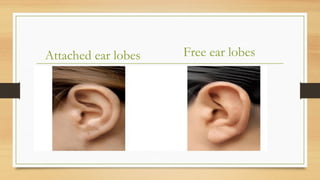
• -Free ear lobos and attached ear lobes are two variants found in human
populations.
Acquired trait and Inherited trait
• A trait of an organism which is not inherited but develops in response to the
environment is called an acquired trait. Acquired traits cannot be passed on to the
future generations.
Ex: Knowledge of doing something or any characteristic which was caused due to
environmental factors and not present by birth .
• A trait of an organism which is caused by a change in its DNA or genes is called an
inherited trait. These are characteristics which we receive from our parents. Only

these traits can be transmitted to future generations.
Ex: Eye colour, skin complexion etc.
Free ear lobes
Attached ear lobes
Important terms
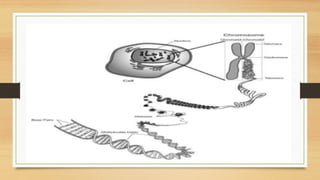
• Chromosome : It is a thread-like structure in the nucleus of
a cell formed of DNA which carries the genes.
• Gene : It is a unit of DNA on chromosome which governs
the synthesis of one protein that controls a specific
characteristic of an organism. Genes are actually units of
heredity which transfer characteristics from parents to their
offsprings during reproduction.
• Dominant Gene : The gene which decides the appearance
of an organism even in the presence of an alternative
contrasting gene is known as a dominant gene. It is
represented by a capital letter.
• Recessive gene : The gene which can decide the
appearance of an organism only in the presence of another
identical gene is called a recessive gene. It is represented by
the corresponding small letter.
• Genotype: It is the description of genes present in
an organism.
• Phenotype: It is the characteristic that is visible in
an organism.
• First Filial Generation or F1 Generation: When
two parents cross to produce offspring, their
offspring is called First Filial generation or F1
generation.
• Second Filial Generation or F2 Generation: When
the first generation offsprings cross among
themselves to produce second-generation
offsprings, then this offspring is called Second
Filial Generation or F2 Generation
• When a male gamete fuses with a female gamete during fertilization, they
make a new cell called a zygote with a full set of genes (on a full set of
chromosomes). This zygote grows & develops to form a new organism
having characteristics (or traits) from both the parents which it has inherited
through genes.
• The two genes (or pair of genes) responsible for particular characteristics
are always present on the corresponding positions of the pair of
chromosomes.
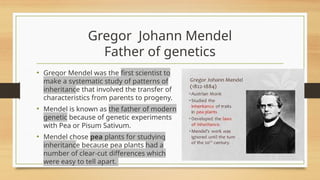
Gregor Johann Mendel
Father of genetics
• Gregor Mendel was the first scientist to
make a systematic study of patterns of
inheritance that involved the transfer of
characteristics from parents to progeny.
• Mendel is known as the father of modern
genetic because of genetic experiments
with Pea or Pisum Sativum.
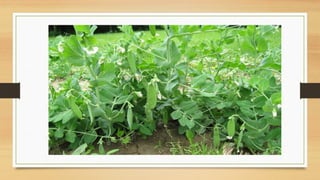
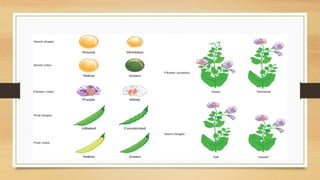
• Mendel chose pea plants for studying
inheritance because pea plants had a
number of clear-cut differences which
were easy to tell apart.
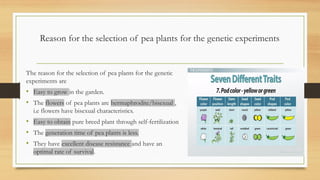
Reason for the selection of pea plants for the genetic experiments
The reason for the selection of pea plants for the genetic
experiments are
• Easy to grow in the garden.
• The flowers of pea plants are hermaphrodite/bisexual ,
i.e flowers have bisexual characteristics.
• Easy to obtain pure breed plant through self-fertilization
• The generation time of pea plants is less.
• They have excellent disease resistance and have an
optimal rate of survival.
Each character is controlled by 2 factors- 1
maternal and 1 paternal.
• Allele- the 2 factors controlling a character present on same position of
homologous chromosome constitute allele
• Homozygous- the condition in which the alleles controlling a character are
identical.
• Hetrozygous- the condition in which the alleles controlling a character arenot
identical.
1. Mendel's law of inheritance –
Law of dominance
• The characteristics or traits of parents are transmitted to their offsprings through genes present on their
chromosomes during the process of sexual reproduction.
• Genes work in pairs. For every trait there is a pair of genes ( one dominant and one recessive).

• Each parent passes only one of the two genes of the pair for each characteristic. Though the offspring
inherits two genes for each trait from its parents but the trait shown by the offspring depends on which
inherited gene is dominant of the two.
• Applicable only to heterozygous condition.
• When 2 factors controlling a character are dissimilar then 1 factor dominate the other factor.
• It is used to explain the 3:1 ratio of F2 of monohybrid cross.
2.Mendel's law of inheritance - the Law of
Segregation (law of purity of gametes)
• According to this law the 2 factors controlling a character separate from each
other during gamete formation and each gamete receive only 1 factor of each
pair.
• Law of segregation is based on the fact that 2 factors controlling a character
do not blend with each other but these two factors control a character
separate from one another during gamete formation.
• Therefore both of the parental characters appear as such in F2 generation.
3.Mendel’s law of inheritance
or
Law of Independent Assortment
Law of Independent Assortment states that “In the inheritance of more than
one pair of traits in a cross simultaneously, the factors responsible for each pair
of traits are distributed independently to the gametes.”
This law is applicable to those genes which are present on different
chromosomes (non- homologous).
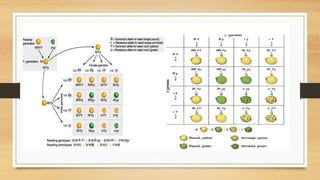
1 How do Mendel's experiment show that traits are inherited independently?
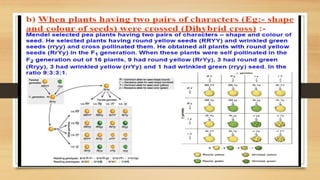
Mendel carried out dihybrid crosses by crossing two pea plants differing in contrasting traits of two
characters. For example, he crossed a pea plant having yellow colour and round seed characters with
another pea plant bearing green colour and wrinkled seed characters. In the F2 generation, he obtained
pea plants with two parental and two recombinant phenotypes as yellow round and green wrinkled
(parental) and yellow wrinkled and green round (recombinant). This indicated that traits separated
from their original parental combinations and got inherited independently.
draw dihybrid cross too
.
2. How did Mendel's explain that it is possible that a trait is
inherited but not expressed in an organism?
Mendel explained that it is possible that a trait is inherited but not
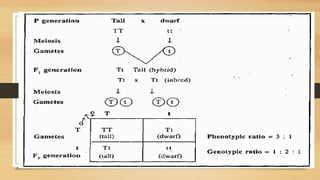
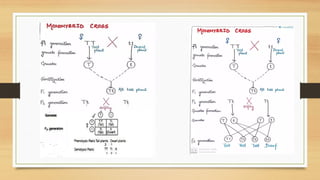
expressed in an organism with the help of a monohybrid cross.
Draw monohybrid cross
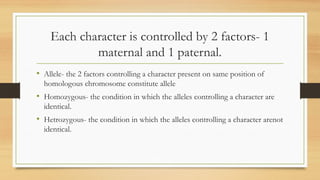
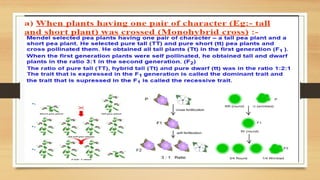
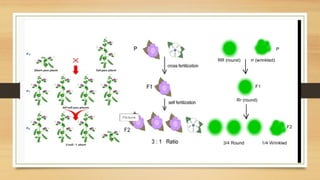
1. He crossed pure-bred tall plants (TT) with pure-bred dwarf
plants (tt).
2. The progeny he received in the first filial generation was tall.
The dwarfness did not show up in the F1 generation.
3. .He then crossed the tall pea plants of the F1 generation and
found that the dwarf plants were obtained in the second
generation. He obtained three tall plants and one dwarf plant
3 Name the plant Mendel used for his experiment. What type of
progeny was obtained by Mendel in F1 and F2 generations when
he crossed the tall and short plants? Write the ratio he obtained in
F2 generation plants
Monohybrid cross
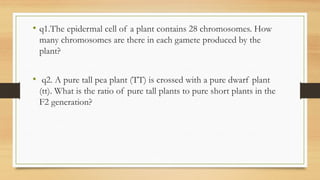
• q1.The epidermal cell of a plant contains 28 chromosomes. How
many chromosomes are there in each gamete produced by the
plant?
• q2. A pure tall pea plant (TT) is crossed with a pure dwarf plant
(tt). What is the ratio of pure tall plants to pure short plants in the
F2 generation?
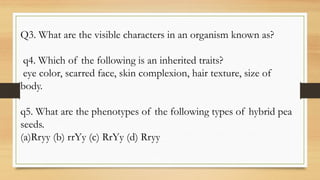
Q3. What are the visible characters in an organism known as?
q4. Which of the following is an inherited traits?
eye color, scarred face, skin complexion, hair texture, size of
body.
q5. What are the phenotypes of the following types of hybrid pea
seeds.
(a)Rryy (b) rrYy (c) RrYy (d) Rryy
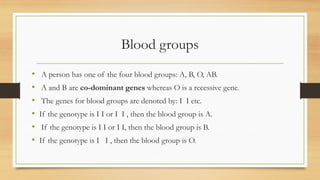
Blood groups
• A person has one of the four blood groups: A, B, O, AB.
• A and B are co-dominant genes whereas O is a recessive gene.
• The genes for blood groups are denoted by: I I etc.
• If the genotype is I I or I I , then the blood group is A.
• If the genotype is I I or I I, then the blood group is B.
• If the genotype is I I , then the blood group is O.
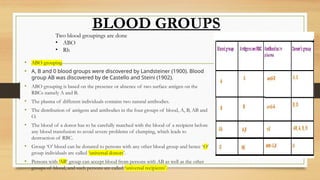
BLOOD GROUPS
Two blood groupings are done
• ABO
• Rh
• ABO grouping
• A, B and 0 blood groups were discovered by Landsteiner (1900). Blood
group AB was discovered by de Castello and Steini (1902).
• ABO grouping is based on the presence or absence of two surface antigen on the
RBCs namely A and B.
• The plasma of different individuals contains two natural antibodies.
• The distribution of antigens and antibodies in the four groups of blood, A, B, AB and
O.
• The blood of a donor has to be carefully matched with the blood of a recipient before
any blood transfusion to avoid severe problems of clumping, which leads to
destruction of RBC.
• Group ‘O’ blood can be donated to persons with any other blood group and hence ‘O’
group individuals are called ‘universal donors’.
• Persons with ‘AB’ group can accept blood from persons with AB as well as the other
groups of blood, and such persons are called ‘universal recipients’.
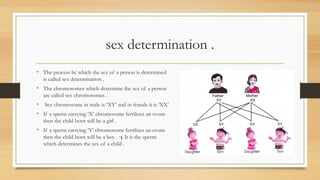
sex determination .
• The process by which the sex of a person is determined
is called sex determination .
• The chromosomes which determine the sex of a person
are called sex chromosomes .
• Sex chromosome in male is ‘XY’ and in female it is ‘XX’
• If a sperm carrying ‘X’ chromosome fertilizes an ovum
then the child born will be a girl .
• If a sperm carrying ‘Y’ chromosome fertilizes an ovum
then the child born will be a boy . It is the sperm

which determines the sex of a child .
Homework
• In text questions of page no. 143, 147
• Exercise question- 1 ,4,11
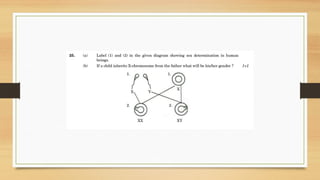
• “The sex of the children is determined by what they inherit from their father and not their mother.” Justify.
• A blue colour flower plant denoted by BB is cross bred with that of white colour flower plant denoted by
bb.
(a) State the colour of flower you would expect in their F1 generation plants.
(b) What must be the percentage of white flower plants in F2 generation if flowers of F1 plants are self-
pollinated?
(c) State the expected ratio of the genotypes BB and Bb in the F2 progeny. [Delhi]
Answer.

CLASS 10 SCIENCE CHAPTER 9- HEREDITY AND EVOLUTION

  • 1.
  • 2.
    What do youunderstand by ‘variations’?
  • 3.
    In which modeof reproduction is it maximum?
  • 4.
    Introduction • Genetics dealswith the study of heredity and Variation. • The transmission of characters/traits from one generation to the next generation is called Heredity. • The differences in the characters/traits between the parent and offspring is called Variation.
  • 5.
    Types of Variations Variationare of two types: (i) Somatic Variation (ii) Gametic Variation • Somatic Variation → It takes place in the body cell. → It is neither inherited nor transmitted. → It is also known as acquired traits. → Examples: cutting of tails in dogs, boring of pinna etc. • Gametic Variation → Takes place in the gametes/Reproductive cells. → Inherited as well as transmitted. → Also known as inherited traits. → Example: human height, skin colour.
  • 6.
    Accumulation of Variationduring Reproduction Variation occurs during reproduction whether organisms multiply sexually or asexually. Variations in Asexual Reproduction → Variations are fewer. → Occurs due to small inaccuracies in DNA copying.(Mutation) Variations in Sexual Reproduction- →Variations are large. → Occurs due to crossing over, separation of chromosomes, mutation.
  • 7.
    Importance of Variation →Depending upon the nature of variations different individuals would have different kinds of advantage. Example, Bacteria that can withstand heat will survive better in a heat wave. • Main advantage of variation to species is that it increases the chances of its survival in a changing environment. • -Free ear lobos and attached ear lobes are two variants found in human populations.
  • 8.
    Acquired trait andInherited trait • A trait of an organism which is not inherited but develops in response to the environment is called an acquired trait. Acquired traits cannot be passed on to the future generations. Ex: Knowledge of doing something or any characteristic which was caused due to environmental factors and not present by birth . • A trait of an organism which is caused by a change in its DNA or genes is called an inherited trait. These are characteristics which we receive from our parents. Only  these traits can be transmitted to future generations. Ex: Eye colour, skin complexion etc.
  • 9.
  • 10.
    Important terms • Chromosome: It is a thread-like structure in the nucleus of a cell formed of DNA which carries the genes. • Gene : It is a unit of DNA on chromosome which governs the synthesis of one protein that controls a specific characteristic of an organism. Genes are actually units of heredity which transfer characteristics from parents to their offsprings during reproduction. • Dominant Gene : The gene which decides the appearance of an organism even in the presence of an alternative contrasting gene is known as a dominant gene. It is represented by a capital letter. • Recessive gene : The gene which can decide the appearance of an organism only in the presence of another identical gene is called a recessive gene. It is represented by the corresponding small letter. • Genotype: It is the description of genes present in an organism. • Phenotype: It is the characteristic that is visible in an organism. • First Filial Generation or F1 Generation: When two parents cross to produce offspring, their offspring is called First Filial generation or F1 generation. • Second Filial Generation or F2 Generation: When the first generation offsprings cross among themselves to produce second-generation offsprings, then this offspring is called Second Filial Generation or F2 Generation
  • 12.
    • When amale gamete fuses with a female gamete during fertilization, they make a new cell called a zygote with a full set of genes (on a full set of chromosomes). This zygote grows & develops to form a new organism having characteristics (or traits) from both the parents which it has inherited through genes. • The two genes (or pair of genes) responsible for particular characteristics are always present on the corresponding positions of the pair of chromosomes.
  • 13.
    Gregor Johann Mendel Fatherof genetics • Gregor Mendel was the first scientist to make a systematic study of patterns of inheritance that involved the transfer of characteristics from parents to progeny. • Mendel is known as the father of modern genetic because of genetic experiments with Pea or Pisum Sativum. • Mendel chose pea plants for studying inheritance because pea plants had a number of clear-cut differences which were easy to tell apart.
  • 15.
    Reason for theselection of pea plants for the genetic experiments The reason for the selection of pea plants for the genetic experiments are • Easy to grow in the garden. • The flowers of pea plants are hermaphrodite/bisexual , i.e flowers have bisexual characteristics. • Easy to obtain pure breed plant through self-fertilization • The generation time of pea plants is less. • They have excellent disease resistance and have an optimal rate of survival.
  • 17.
    Each character iscontrolled by 2 factors- 1 maternal and 1 paternal. • Allele- the 2 factors controlling a character present on same position of homologous chromosome constitute allele • Homozygous- the condition in which the alleles controlling a character are identical. • Hetrozygous- the condition in which the alleles controlling a character arenot identical.
  • 22.
    1. Mendel's lawof inheritance – Law of dominance • The characteristics or traits of parents are transmitted to their offsprings through genes present on their chromosomes during the process of sexual reproduction. • Genes work in pairs. For every trait there is a pair of genes ( one dominant and one recessive). • Each parent passes only one of the two genes of the pair for each characteristic. Though the offspring inherits two genes for each trait from its parents but the trait shown by the offspring depends on which inherited gene is dominant of the two. • Applicable only to heterozygous condition. • When 2 factors controlling a character are dissimilar then 1 factor dominate the other factor. • It is used to explain the 3:1 ratio of F2 of monohybrid cross.
  • 23.
    2.Mendel's law ofinheritance - the Law of Segregation (law of purity of gametes) • According to this law the 2 factors controlling a character separate from each other during gamete formation and each gamete receive only 1 factor of each pair. • Law of segregation is based on the fact that 2 factors controlling a character do not blend with each other but these two factors control a character separate from one another during gamete formation. • Therefore both of the parental characters appear as such in F2 generation.
  • 26.
    3.Mendel’s law ofinheritance or Law of Independent Assortment Law of Independent Assortment states that “In the inheritance of more than one pair of traits in a cross simultaneously, the factors responsible for each pair of traits are distributed independently to the gametes.” This law is applicable to those genes which are present on different chromosomes (non- homologous).
  • 27.
    1 How doMendel's experiment show that traits are inherited independently? Mendel carried out dihybrid crosses by crossing two pea plants differing in contrasting traits of two characters. For example, he crossed a pea plant having yellow colour and round seed characters with another pea plant bearing green colour and wrinkled seed characters. In the F2 generation, he obtained pea plants with two parental and two recombinant phenotypes as yellow round and green wrinkled (parental) and yellow wrinkled and green round (recombinant). This indicated that traits separated from their original parental combinations and got inherited independently. draw dihybrid cross too .
  • 28.
    2. How didMendel's explain that it is possible that a trait is inherited but not expressed in an organism? Mendel explained that it is possible that a trait is inherited but not expressed in an organism with the help of a monohybrid cross. Draw monohybrid cross 1. He crossed pure-bred tall plants (TT) with pure-bred dwarf plants (tt). 2. The progeny he received in the first filial generation was tall. The dwarfness did not show up in the F1 generation. 3. .He then crossed the tall pea plants of the F1 generation and found that the dwarf plants were obtained in the second generation. He obtained three tall plants and one dwarf plant 3 Name the plant Mendel used for his experiment. What type of progeny was obtained by Mendel in F1 and F2 generations when he crossed the tall and short plants? Write the ratio he obtained in F2 generation plants Monohybrid cross
  • 29.
    • q1.The epidermalcell of a plant contains 28 chromosomes. How many chromosomes are there in each gamete produced by the plant? • q2. A pure tall pea plant (TT) is crossed with a pure dwarf plant (tt). What is the ratio of pure tall plants to pure short plants in the F2 generation?
  • 30.
    Q3. What arethe visible characters in an organism known as? q4. Which of the following is an inherited traits? eye color, scarred face, skin complexion, hair texture, size of body. q5. What are the phenotypes of the following types of hybrid pea seeds. (a)Rryy (b) rrYy (c) RrYy (d) Rryy
  • 31.
    Blood groups • Aperson has one of the four blood groups: A, B, O, AB. • A and B are co-dominant genes whereas O is a recessive gene. • The genes for blood groups are denoted by: I I etc. • If the genotype is I I or I I , then the blood group is A. • If the genotype is I I or I I, then the blood group is B. • If the genotype is I I , then the blood group is O.
  • 32.
    BLOOD GROUPS Two bloodgroupings are done • ABO • Rh • ABO grouping • A, B and 0 blood groups were discovered by Landsteiner (1900). Blood group AB was discovered by de Castello and Steini (1902). • ABO grouping is based on the presence or absence of two surface antigen on the RBCs namely A and B. • The plasma of different individuals contains two natural antibodies. • The distribution of antigens and antibodies in the four groups of blood, A, B, AB and O. • The blood of a donor has to be carefully matched with the blood of a recipient before any blood transfusion to avoid severe problems of clumping, which leads to destruction of RBC. • Group ‘O’ blood can be donated to persons with any other blood group and hence ‘O’ group individuals are called ‘universal donors’. • Persons with ‘AB’ group can accept blood from persons with AB as well as the other groups of blood, and such persons are called ‘universal recipients’.
  • 34.
    sex determination . •The process by which the sex of a person is determined is called sex determination . • The chromosomes which determine the sex of a person are called sex chromosomes . • Sex chromosome in male is ‘XY’ and in female it is ‘XX’ • If a sperm carrying ‘X’ chromosome fertilizes an ovum then the child born will be a girl . • If a sperm carrying ‘Y’ chromosome fertilizes an ovum then the child born will be a boy . It is the sperm  which determines the sex of a child .
  • 38.
    Homework • In textquestions of page no. 143, 147 • Exercise question- 1 ,4,11 • “The sex of the children is determined by what they inherit from their father and not their mother.” Justify. • A blue colour flower plant denoted by BB is cross bred with that of white colour flower plant denoted by bb. (a) State the colour of flower you would expect in their F1 generation plants. (b) What must be the percentage of white flower plants in F2 generation if flowers of F1 plants are self- pollinated? (c) State the expected ratio of the genotypes BB and Bb in the F2 progeny. [Delhi] Answer.