

Google Cloud vs
Microsoft Azure
Boris Simandoff:
Director V-Ray Cloud and Integration
Technologies at Chaos Group
Mihail Mateev :
Senior Solutions Architect at EPAM
Google Cloud vs Microsoft Azure
Google Cloud vs Microsoft Azure: Agenda
• Pricing
• Pricing Model
• Reselling Model
• IaaS features overview
• VMs
• Virtual Networks
• PaaS features overview
• Storage
• Messaging
• Cloud Storage
• Messaging Services
• Manages DBs
• Big Data
• Container
• Microservices
• IoT
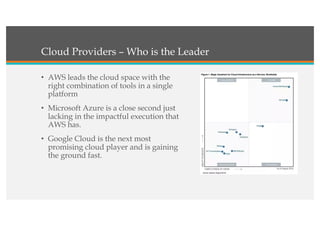
Cloud Providers – Who is the Leader
• AWS leads the cloud space with the
right combination of tools in a single
platform
• Microsoft Azure is a close second just
lacking in the impactful execution that
AWS has.
• Google Cloud is the next most
promising cloud player and is gaining
the ground fast.
Locations
Locations and Zones for Datacenters
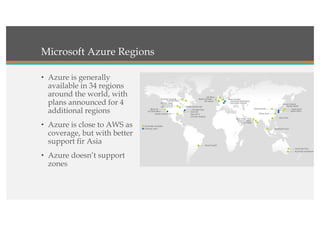
Microsoft Azure Regions
• Azure is generally
available in 34 regions
around the world, with
plans announced for 4
additional regions
• Azure is close to AWS as
coverage, but with better
support fir Asia
• Azure doesn’t support
zones
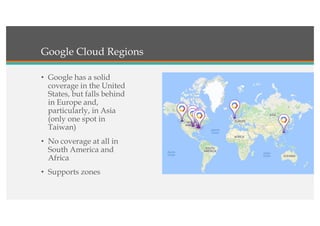
Google Cloud Regions
• Google has a solid
coverage in the United
States, but falls behind
in Europe and,
particularly, in Asia
(only one spot in
Taiwan)
• No coverage at all in
South America and
Africa
• Supports zones
Pricing
Understanding Cloud Discounting Options
Pricing
• On average, compute resources
represent 75-80 percent of your cloud
spend.
• it’s critical that you understand the
discount methods for each of the cloud
providers since that will be a major
driver in the price you pay.
Azure Pricing
• The primary approach to getting discounts on Azure is your
Microsoft Enterprise Agreement (EA)
• EAs offer discounts from 15-45 percent depending on the level of
usage
• There is used a 30 percent discount as the midpoint in our
comparisons below
Google Cloud Pricing
• Sustained Usage Discount (SUD) – up to 30%
• Per minute billing
• Custom machine types – 14 cores / 12.5 GB, or 6 cores /2 GB
• Preemptible VM instances – 80% discount
• Committed use discounts – up to 57% discounts
• Rightsizing recommendations
• Nearline Cloud - $0.01 GB/m – 100PB free for 6 months
Storage
• Object Storage
• Benchmarks are application-specific and vary based on network
load, neighboring VM activity
• Object storage (Amazon AWS Simple Storage Service (S3), Google
Cloud Storage (GCS), Microsoft Azure Storage) provides a simple
PUT/GET/HEAD/LIST interface for storing any sort of data too
large to put into a database.
Storage : Downloads
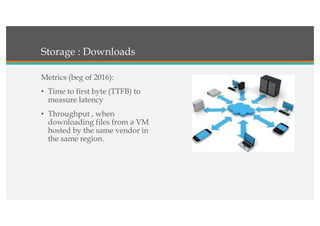
Metrics (beg of 2016):
• Time to first byte (TTFB) to
measure latency
• Throughput , when
downloading files from a VM
hosted by the same vendor in
the same region.
Storage : Downloads
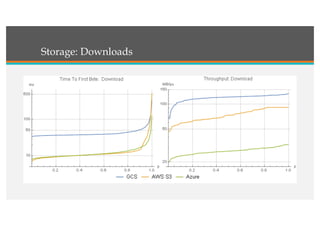
How Time to first byte (TTFB) is measured:
• In the plots, the percentile (or quantile) is on the x axis, and the metric is
on the y (note the log scale
• you can see the typical response (median, 0.5) as well as the best and
worst case behaviors.
Storage: Downloads
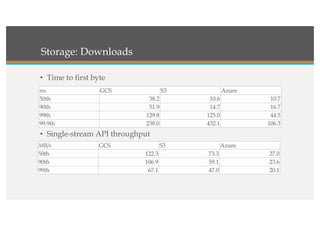
• Time to first byte
• Single-stream API throughput
Storage: Downloads
ms GCS S3 Azure
50th 38.2 10.6 10.7
90th 51.9 14.7 16.7
99th 129.8 125.0 44.5
99.9th 238.0 432.1 106.3
MB/s GCS S3 Azure
50th 122.3 73.3 27.0
90th 106.9 59.1 23.6
99th 67.1 47.0 20.1
Storage : Uploads
Metrics (similar to downloads):
• Time to first byte (TTFB) to
measure latency
• Throughput , when uploading
files to a VM hosted by the
same vendor in the same
region.
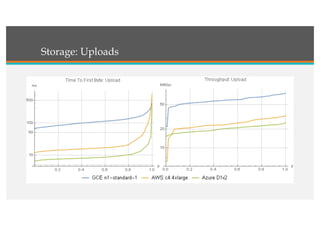
Storage: Uploads
• Time to first byte
• Single-stream API throughput
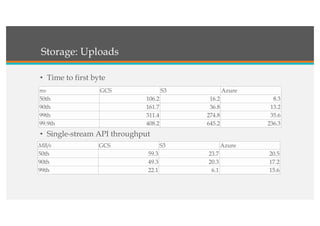
Storage: Uploads
ms GCS S3 Azure
50th 106.2 16.2 8.3
90th 161.7 36.8 13.2
99th 311.4 274.8 35.6
99.9th 408.2 645.2 236.3
MB/s GCS S3 Azure
50th 59.3 23.7 20.5
90th 49.3 20.3 17.2
99th 22.1 6.1 15.6
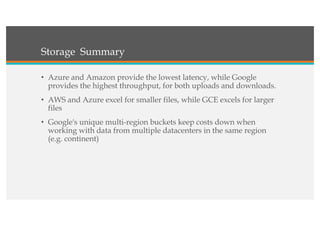
Storage Summary
• Azure and Amazon provide the lowest latency, while Google
provides the highest throughput, for both uploads and downloads.
• AWS and Azure excel for smaller files, while GCE excels for larger
files
• Google's unique multi-region buckets keep costs down when
working with data from multiple datacenters in the same region
(e.g. continent)
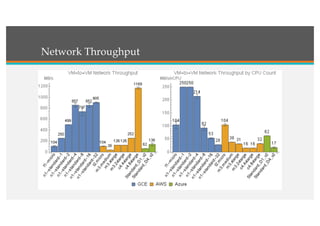
Network Throughput
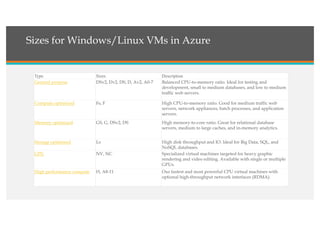
Sizes for Windows/Linux VMs in Azure
Type Sizes Description
General purpose DSv2, Dv2, DS, D, Av2, A0-7 Balanced CPU-to-memory ratio. Ideal for testing and
development, small to medium databases, and low to medium
traffic web servers.
Compute optimized Fs, F High CPU-to-memory ratio. Good for medium traffic web
servers, network appliances, batch processes, and application
servers.
Memory optimized GS, G, DSv2, DS High memory-to-core ratio. Great for relational database
servers, medium to large caches, and in-memory analytics.
Storage optimized Ls High disk throughput and IO. Ideal for Big Data, SQL, and
NoSQL databases.
GPU NV, NC Specialized virtual machines targeted for heavy graphic
rendering and video editing. Available with single or multiple
GPUs.
High performance compute H, A8-11 Our fastest and most powerful CPU virtual machines with
optional high-throughput network interfaces (RDMA).
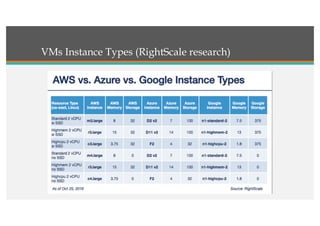
VMs Instance Types (RightScale research)
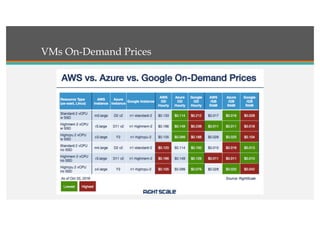
VMs On-Demand Prices
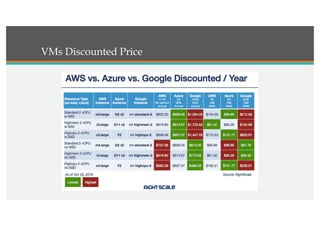
VMs Discounted Price
Databases
Comparison of Managed Databases
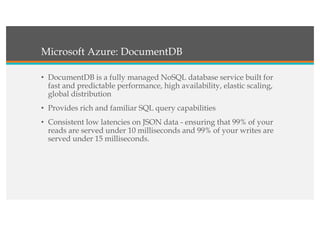
Microsoft Azure: DocumentDB
• DocumentDB is a fully managed NoSQL database service built for
fast and predictable performance, high availability, elastic scaling,
global distribution
• Provides rich and familiar SQL query capabilities
• Consistent low latencies on JSON data - ensuring that 99% of your
reads are served under 10 milliseconds and 99% of your writes are
served under 15 milliseconds.
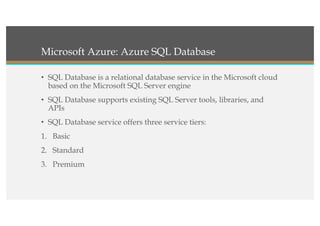
Microsoft Azure: Azure SQL Database
• SQL Database is a relational database service in the Microsoft cloud
based on the Microsoft SQL Server engine
• SQL Database supports existing SQL Server tools, libraries, and
APIs
• SQL Database service offers three service tiers:
1. Basic
2. Standard
3. Premium
Microsoft Azure: Azure SQL Database
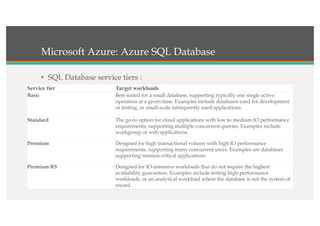
• SQL Database service tiers :
Service tier Target workloads
Basic Best suited for a small database, supporting typically one single active
operation at a given time. Examples include databases used for development
or testing, or small-scale infrequently used applications.
Standard The go-to option for cloud applications with low to medium IO performance
requirements, supporting multiple concurrent queries. Examples include
workgroup or web applications.
Premium Designed for high transactional volume with high IO performance
requirements, supporting many concurrent users. Examples are databases
supporting mission critical applications.
Premium RS Designed for IO-intensive workloads that do not require the highest
availability guarantees. Examples include testing high-performance
workloads, or an analytical workload where the database is not the system of
record.
Microsoft Azure: Azure SQL Database
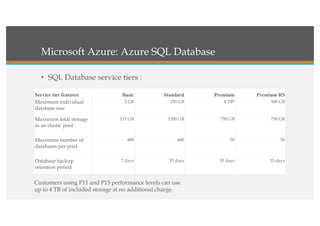
• SQL Database service tiers :
Service tier features Basic Standard Premium Premium RS
Maximum individual
database size
2 GB 250 GB 4 TB* 500 GB
Maximum total storage
in an elastic pool
117 GB 1200 GB 750 GB 750 GB
Maximum number of
databases per pool
400 400 50 50
Database backup
retention period
7 days 35 days 35 days 35 days
Customers using P11 and P15 performance levels can use
up to 4 TB of included storage at no additional charge.
Microsoft Azure: Microservices
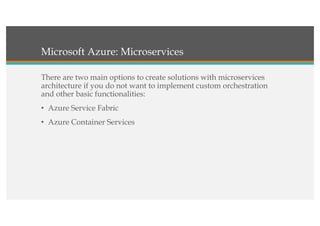
There are two main options to create solutions with microservices
architecture if you do not want to implement custom orchestration
and other basic functionalities:
• Azure Service Fabric
• Azure Container Services
Microsoft Azure: Microservices
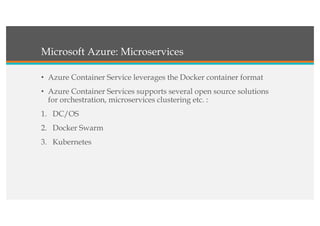
• Azure Container Service leverages the Docker container format
• Azure Container Services supports several open source solutions
for orchestration, microservices clustering etc. :
1. DC/OS
2. Docker Swarm
3. Kubernetes
Microsoft Azure: Microservices
• Azure Service Fabric provides own specific programming model
and orchestration
1. ASF is faster for implementation
2. ASF until Feb 2017 used only Windows container
3. From Feb 2017 there are Linux containers
4. ASF is more convenient for IoT solutions because of Actor model
Cloud Load Balancing
Azure Traffic Manager
• Allows you to control the distribution of user traffic for service
endpoints in different datacenters
• You can also use Traffic Manager with external, non-Azure
endpoints.
• Improve availability of critical applications
• Improve responsiveness for high-performance applications
• Perform service maintenance without downtime
• Combine on-premises and Cloud-based applications
Cloud Load Balancing
Azure Traffic Manager key benefits
• Distribution of traffic according to one of several traffic-routing
methods
• Continuous monitoring of endpoint health and automatic failover
when endpoints fail
Cloud Load Balancing
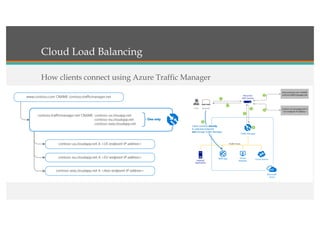
How clients connect using Azure Traffic Manager
Microsoft Azure: Use Cases
• Rolls-Royce
• Real-Madrid C.F.
• GE Healthcare
• NBC Universal
• 3M
• Mediterranean Shipping
Company (MSC)
• Marks And Spencer
• GKN
• Volvo
• Renault Nissan
• BMW
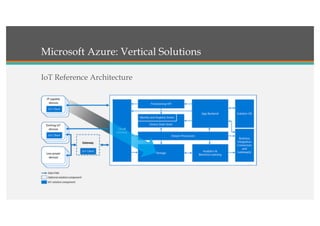
Microsoft Azure: Vertical Solutions
IoT Reference Architecture
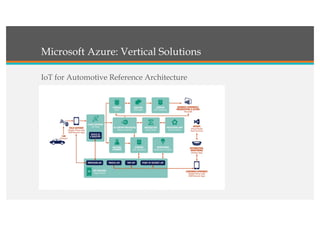
Microsoft Azure: Vertical Solutions
IoT for Automotive Reference Architecture
Microsoft Azure: Vertical Solutions
Microsoft Connected Vehicle Platform
Google Cloud
Google Cloud
• Dynamic Scalability
• Network Infrastructure
• Efficiency
• Monitoring
• Logging
• Automated development pipelines
Google Cloud Use Cases
• HomeDepot BlackFriday
• eBay
• Spotify
• Snapchat
• Pokeman Go
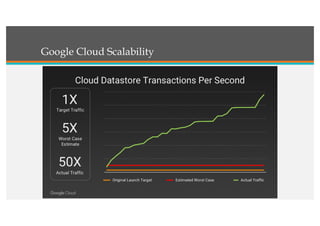
Google Cloud Scalability
Google Cloud Storage
• Cloud Storage – 11 9s
• Cloud SQL
• Cloud Spanner - 5 9s
• CAP Theorem - Eric Brewer
• Cloud Datastore
• Persistent Disk
• Mem Disk
Google Cloud Bigdata
• Cloud Pub/Sub
• BigQuery – Data warehouse
• Dataprep
• Dataflow
• Dataproc
Google Cloud Network
• Load Balancer
• BGP – Border Gateway Protocol
• Single Anycast IP
• Automatic CDN
• Edge Cache Servers
• 1M r/s
• HTTP2
• Virtual Network
• Cloud DNS
• Interconnect
Google Cloud Management Tools
• Monitoring
• Logging
• Cloud Container Engine
• Best environment for Microservices with
maximum flexibility
• Pipeline integration from development to
production deployment
Google Cloud Kubernetes
• Cloud Container Engine
• Best environment for Microservices with
maximum flexibility
• Pipeline integration from development to
production deployment
Google Cloud vs Microsoft Azure
Q & A
Thank You!

Clash of Technologies Google Cloud vs Microsoft Azure

  • 1.
    Google Cloud vs MicrosoftAzure Boris Simandoff: Director V-Ray Cloud and Integration Technologies at Chaos Group Mihail Mateev : Senior Solutions Architect at EPAM
  • 2.
    Google Cloud vsMicrosoft Azure
  • 3.
    Google Cloud vsMicrosoft Azure: Agenda • Pricing • Pricing Model • Reselling Model • IaaS features overview • VMs • Virtual Networks • PaaS features overview • Storage • Messaging • Cloud Storage • Messaging Services • Manages DBs • Big Data • Container • Microservices • IoT
  • 4.
    Cloud Providers –Who is the Leader • AWS leads the cloud space with the right combination of tools in a single platform • Microsoft Azure is a close second just lacking in the impactful execution that AWS has. • Google Cloud is the next most promising cloud player and is gaining the ground fast.
  • 5.
  • 6.
    Microsoft Azure Regions •Azure is generally available in 34 regions around the world, with plans announced for 4 additional regions • Azure is close to AWS as coverage, but with better support fir Asia • Azure doesn’t support zones
  • 7.
    Google Cloud Regions •Google has a solid coverage in the United States, but falls behind in Europe and, particularly, in Asia (only one spot in Taiwan) • No coverage at all in South America and Africa • Supports zones
  • 8.
  • 9.
    Pricing • On average,compute resources represent 75-80 percent of your cloud spend. • it’s critical that you understand the discount methods for each of the cloud providers since that will be a major driver in the price you pay.
  • 10.
    Azure Pricing • Theprimary approach to getting discounts on Azure is your Microsoft Enterprise Agreement (EA) • EAs offer discounts from 15-45 percent depending on the level of usage • There is used a 30 percent discount as the midpoint in our comparisons below
  • 11.
    Google Cloud Pricing •Sustained Usage Discount (SUD) – up to 30% • Per minute billing • Custom machine types – 14 cores / 12.5 GB, or 6 cores /2 GB • Preemptible VM instances – 80% discount • Committed use discounts – up to 57% discounts • Rightsizing recommendations • Nearline Cloud - $0.01 GB/m – 100PB free for 6 months
  • 12.
    Storage • Object Storage •Benchmarks are application-specific and vary based on network load, neighboring VM activity • Object storage (Amazon AWS Simple Storage Service (S3), Google Cloud Storage (GCS), Microsoft Azure Storage) provides a simple PUT/GET/HEAD/LIST interface for storing any sort of data too large to put into a database.
  • 13.
    Storage : Downloads Metrics(beg of 2016): • Time to first byte (TTFB) to measure latency • Throughput , when downloading files from a VM hosted by the same vendor in the same region.
  • 14.
    Storage : Downloads HowTime to first byte (TTFB) is measured: • In the plots, the percentile (or quantile) is on the x axis, and the metric is on the y (note the log scale • you can see the typical response (median, 0.5) as well as the best and worst case behaviors.
  • 15.
  • 16.
    • Time tofirst byte • Single-stream API throughput Storage: Downloads ms GCS S3 Azure 50th 38.2 10.6 10.7 90th 51.9 14.7 16.7 99th 129.8 125.0 44.5 99.9th 238.0 432.1 106.3 MB/s GCS S3 Azure 50th 122.3 73.3 27.0 90th 106.9 59.1 23.6 99th 67.1 47.0 20.1
  • 17.
    Storage : Uploads Metrics(similar to downloads): • Time to first byte (TTFB) to measure latency • Throughput , when uploading files to a VM hosted by the same vendor in the same region.
  • 18.
  • 19.
    • Time tofirst byte • Single-stream API throughput Storage: Uploads ms GCS S3 Azure 50th 106.2 16.2 8.3 90th 161.7 36.8 13.2 99th 311.4 274.8 35.6 99.9th 408.2 645.2 236.3 MB/s GCS S3 Azure 50th 59.3 23.7 20.5 90th 49.3 20.3 17.2 99th 22.1 6.1 15.6
  • 20.
    Storage Summary • Azureand Amazon provide the lowest latency, while Google provides the highest throughput, for both uploads and downloads. • AWS and Azure excel for smaller files, while GCE excels for larger files • Google's unique multi-region buckets keep costs down when working with data from multiple datacenters in the same region (e.g. continent)
  • 21.
  • 22.
    Sizes for Windows/LinuxVMs in Azure Type Sizes Description General purpose DSv2, Dv2, DS, D, Av2, A0-7 Balanced CPU-to-memory ratio. Ideal for testing and development, small to medium databases, and low to medium traffic web servers. Compute optimized Fs, F High CPU-to-memory ratio. Good for medium traffic web servers, network appliances, batch processes, and application servers. Memory optimized GS, G, DSv2, DS High memory-to-core ratio. Great for relational database servers, medium to large caches, and in-memory analytics. Storage optimized Ls High disk throughput and IO. Ideal for Big Data, SQL, and NoSQL databases. GPU NV, NC Specialized virtual machines targeted for heavy graphic rendering and video editing. Available with single or multiple GPUs. High performance compute H, A8-11 Our fastest and most powerful CPU virtual machines with optional high-throughput network interfaces (RDMA).
  • 23.
    VMs Instance Types(RightScale research)
  • 24.
  • 25.
  • 26.
  • 27.
    Microsoft Azure: DocumentDB •DocumentDB is a fully managed NoSQL database service built for fast and predictable performance, high availability, elastic scaling, global distribution • Provides rich and familiar SQL query capabilities • Consistent low latencies on JSON data - ensuring that 99% of your reads are served under 10 milliseconds and 99% of your writes are served under 15 milliseconds.
  • 28.
    Microsoft Azure: AzureSQL Database • SQL Database is a relational database service in the Microsoft cloud based on the Microsoft SQL Server engine • SQL Database supports existing SQL Server tools, libraries, and APIs • SQL Database service offers three service tiers: 1. Basic 2. Standard 3. Premium
  • 29.
    Microsoft Azure: AzureSQL Database • SQL Database service tiers : Service tier Target workloads Basic Best suited for a small database, supporting typically one single active operation at a given time. Examples include databases used for development or testing, or small-scale infrequently used applications. Standard The go-to option for cloud applications with low to medium IO performance requirements, supporting multiple concurrent queries. Examples include workgroup or web applications. Premium Designed for high transactional volume with high IO performance requirements, supporting many concurrent users. Examples are databases supporting mission critical applications. Premium RS Designed for IO-intensive workloads that do not require the highest availability guarantees. Examples include testing high-performance workloads, or an analytical workload where the database is not the system of record.
  • 30.
    Microsoft Azure: AzureSQL Database • SQL Database service tiers : Service tier features Basic Standard Premium Premium RS Maximum individual database size 2 GB 250 GB 4 TB* 500 GB Maximum total storage in an elastic pool 117 GB 1200 GB 750 GB 750 GB Maximum number of databases per pool 400 400 50 50 Database backup retention period 7 days 35 days 35 days 35 days Customers using P11 and P15 performance levels can use up to 4 TB of included storage at no additional charge.
  • 31.
    Microsoft Azure: Microservices Thereare two main options to create solutions with microservices architecture if you do not want to implement custom orchestration and other basic functionalities: • Azure Service Fabric • Azure Container Services
  • 32.
    Microsoft Azure: Microservices •Azure Container Service leverages the Docker container format • Azure Container Services supports several open source solutions for orchestration, microservices clustering etc. : 1. DC/OS 2. Docker Swarm 3. Kubernetes
  • 33.
    Microsoft Azure: Microservices •Azure Service Fabric provides own specific programming model and orchestration 1. ASF is faster for implementation 2. ASF until Feb 2017 used only Windows container 3. From Feb 2017 there are Linux containers 4. ASF is more convenient for IoT solutions because of Actor model
  • 34.
    Cloud Load Balancing AzureTraffic Manager • Allows you to control the distribution of user traffic for service endpoints in different datacenters • You can also use Traffic Manager with external, non-Azure endpoints. • Improve availability of critical applications • Improve responsiveness for high-performance applications • Perform service maintenance without downtime • Combine on-premises and Cloud-based applications
  • 35.
    Cloud Load Balancing AzureTraffic Manager key benefits • Distribution of traffic according to one of several traffic-routing methods • Continuous monitoring of endpoint health and automatic failover when endpoints fail
  • 36.
    Cloud Load Balancing Howclients connect using Azure Traffic Manager
  • 37.
    Microsoft Azure: UseCases • Rolls-Royce • Real-Madrid C.F. • GE Healthcare • NBC Universal • 3M • Mediterranean Shipping Company (MSC) • Marks And Spencer • GKN • Volvo • Renault Nissan • BMW
  • 38.
    Microsoft Azure: VerticalSolutions IoT Reference Architecture
  • 39.
    Microsoft Azure: VerticalSolutions IoT for Automotive Reference Architecture
  • 40.
    Microsoft Azure: VerticalSolutions Microsoft Connected Vehicle Platform
  • 41.
  • 42.
    Google Cloud • DynamicScalability • Network Infrastructure • Efficiency • Monitoring • Logging • Automated development pipelines
  • 43.
    Google Cloud UseCases • HomeDepot BlackFriday • eBay • Spotify • Snapchat • Pokeman Go
  • 44.
  • 45.
    Google Cloud Storage •Cloud Storage – 11 9s • Cloud SQL • Cloud Spanner - 5 9s • CAP Theorem - Eric Brewer • Cloud Datastore • Persistent Disk • Mem Disk
  • 46.
    Google Cloud Bigdata •Cloud Pub/Sub • BigQuery – Data warehouse • Dataprep • Dataflow • Dataproc
  • 47.
    Google Cloud Network •Load Balancer • BGP – Border Gateway Protocol • Single Anycast IP • Automatic CDN • Edge Cache Servers • 1M r/s • HTTP2 • Virtual Network • Cloud DNS • Interconnect
  • 48.
    Google Cloud ManagementTools • Monitoring • Logging • Cloud Container Engine • Best environment for Microservices with maximum flexibility • Pipeline integration from development to production deployment
  • 49.
    Google Cloud Kubernetes •Cloud Container Engine • Best environment for Microservices with maximum flexibility • Pipeline integration from development to production deployment
  • 50.
    Google Cloud vsMicrosoft Azure Q & A
  • 51.