Flexible metadata schemes for research data repositories
The Common Framework in Dataverse and the CMDI use case
Slava Tykhonov
Jerry de Vries
Eko Indarto
Andrea Scharnhorst
Femmy Admiraal
(DANS-KNAW)
CLARIAH IG Linked Open Data, 04.10.2021
Overall goal for the CMDI core metadata task
The goal mentioned in CMDI strategy 2019-2020: "Ready-made, good quality
profiles & components suitable for common use cases and resource types".
DataCite has three types for metadata elements: mandatory, recommended,
optional, how to distinguish CMDI core components for different CLARIN centers?
We are part of the specific CMDI task for the design and implementation of
CLARIN core metadata components and profiles, and the use of FAIR
vocabularies within CLARIN metadata.
Theory of inventive problem solving (Russian: TRIZ)
TRIZ presents a systematic approach for understanding and defining challenging problems: difficult problems require an inventive solution,
and TRIZ provides a range of strategies and tools for finding these inventive solutions. One of the earliest findings of the massive research
on which the theory is based is that the vast majority of problems that require inventive solutions typically reflect a need to overcome a
dilemma or a trade-off between two contradictory elements.
https://en.wikipedia.org/wiki/TRIZ
5 challenges for CMDI
Challenge 1: A proposal of a core set of CMDI metadata as recommendation
Challenge 2: Extraction of CMDI metadata and transform and load the metadata fields
into the Dataverse Core set of metadata
Challenge 3: Workflow for prediction and linking concepts from external controlled
vocabularies to the CMDI metadata values
Challenge 4: Extension of the Common Framework with support of FAIR controlled
vocabularies to create FAIR metadata
Challenge 5: Extension of the export functionality of Dataverse to export deposited
CMDI metadata back to the original CMDI format
Overall goals for DANS
● CMDI metadata archived in EASY TDR and marked as CLARIN collection
with very limited Dublin Core based metadata schema (EDM), curation and
further reuse isn’t possible
● DANS wants to run Data Station with CMDI metadata schema suitable for
different CLARIN use cases
● the long term goal of DANS is to make CMDI datasets harvestable and
approachable, and create an interoperability layer with external controlled
vocabularies (FAIR Data Point)
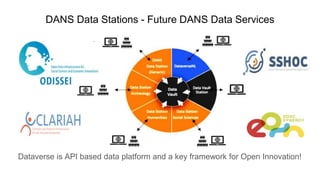
DANS Data Stations - Future DANS Data Services
Dataverse is API based data platform and a key framework for Open Innovation!
Semantic interoperability on the infrastructure level
Dataverse Semantic API in release 5.6: https://github.com/IQSS/dataverse/releases/tag/v5.6
“Dataset metadata can be retrieved, set, and updated using a new, flatter JSON-LD format -
following the format of an OAI-ORE export (RDA-conformant Bags), allowing for easier transfer of
metadata to/from other systems (i.e. without needing to know Dataverse's metadata block and field
storage architecture). This new API also allows for the update of terms metadata“.
External controlled vocabularies support is being developed by DANS in SSHOC project and
will be integrated in Dataverse core in the upcoming release 5.7.
Proposal: https://docs.google.com/document/d/1txdcFuxskRx_tLsDQ7KKLFTMR_r9IBhorDu3V_r445w/
Interfaces: http://github.com/gdcc/dataverse-external-vocab-support
Integrations: Wikidata, ORCID, MeSH, Skosmos vocabularies
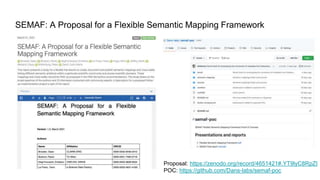
SEMAF: A Proposal for a Flexible Semantic Mapping Framework
Proposal: https://zenodo.org/record/4651421#.YT9lyC8RpZI
POC: https://github.com/Dans-labs/semaf-poc
CMDI example from EASY
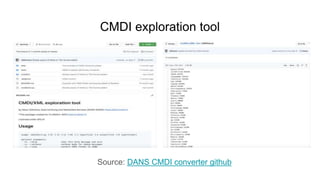
CMDI exploration tool
Source: DANS CMDI converter github
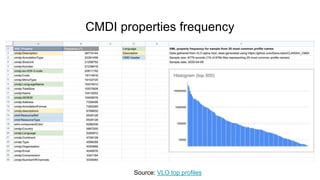
CMDI properties frequency
Source: VLO top profiles
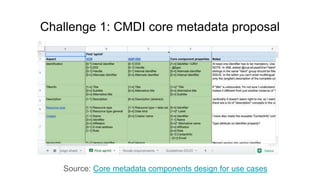
Challenge 1: CMDI core metadata proposal
Source: Core metadata components design for use cases
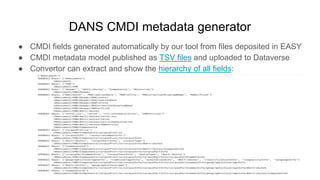
DANS CMDI metadata generator
● CMDI fields generated automatically by our tool from files deposited in EASY
● CMDI metadata model published as TSV files and uploaded to Dataverse
● Convertor can extract and show the hierarchy of all fields:
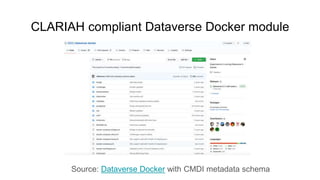
CLARIAH compliant Dataverse Docker module
Source: Dataverse Docker with CMDI metadata schema
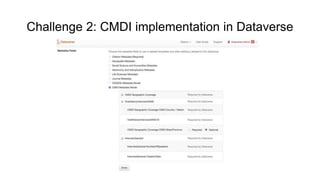
Challenge 2: CMDI implementation in Dataverse
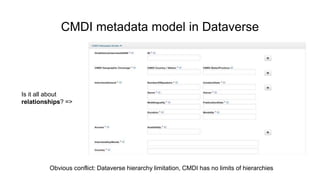
CMDI metadata model in Dataverse
Obvious conflict: Dataverse hierarchy limitation, CMDI has no limits of hierarchies
Is it all about
relationships? =>
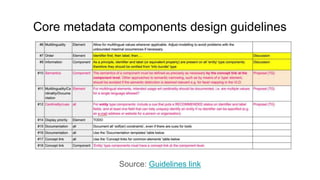
Core metadata components design guidelines
Source: Guidelines link
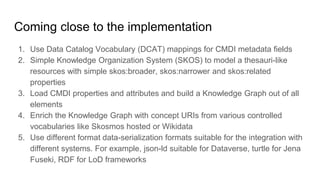
Coming close to the implementation
1. Use Data Catalog Vocabulary (DCAT) mappings for CMDI metadata fields
2. Simple Knowledge Organization System (SKOS) to model a thesauri-like
resources with simple skos:broader, skos:narrower and skos:related
properties
3. Load CMDI properties and attributes and build a Knowledge Graph out of all
elements
4. Enrich the Knowledge Graph with concept URIs from various controlled
vocabularies like Skosmos hosted or Wikidata
5. Use different format data-serialization formats suitable for the integration with
different systems. For example, json-ld suitable for Dataverse, turtle for Jena
Fuseki, RDF for LoD frameworks
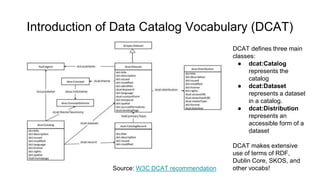
Introduction of Data Catalog Vocabulary (DCAT)
Source: W3C DCAT recommendation
DCAT defines three main
classes:
● dcat:Catalog
represents the
catalog
● dcat:Dataset
represents a dataset
in a catalog.
● dcat:Distribution
represents an
accessible form of a
dataset
DCAT makes extensive
use of terms of RDF,
Dublin Core, SKOS, and
other vocabs!
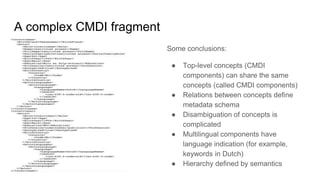
A complex CMDI fragment
Some conclusions:
● Top-level concepts (CMDI
components) can share the same
concepts (called CMDI components)
● Relations between concepts define
metadata schema
● Disambiguation of concepts is
complicated
● Multilingual components have
language indication (for example,
keywords in Dutch)
● Hierarchy defined by semantics
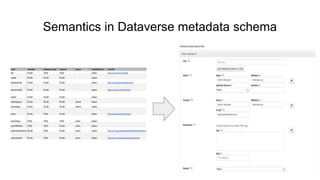
Semantics in Dataverse metadata schema
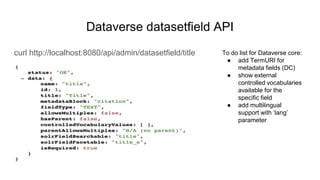
Dataverse datasetfield API
curl http://localhost:8080/api/admin/datasetfield/title To do list for Dataverse core:
● add TermURI for
metadata fields (DC)
● show external
controlled vocabularies
available for the
specific field
● add multilingual
support with ‘lang’
parameter
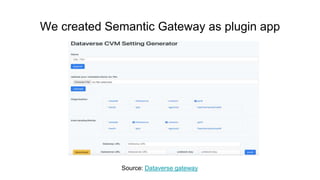
We created Semantic Gateway as plugin app
Source: Dataverse gateway
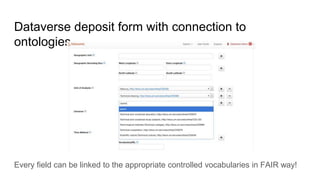
Dataverse deposit form with connection to
ontologies
Every field can be linked to the appropriate controlled vocabularies in FAIR way!
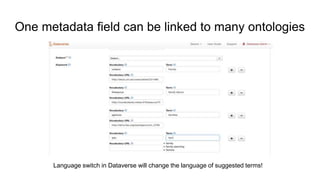
One metadata field can be linked to many ontologies
Language switch in Dataverse will change the language of suggested terms!
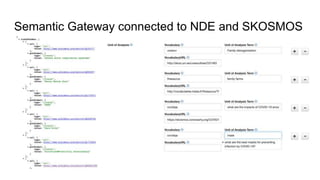
Semantic Gateway connected to NDE and SKOSMOS
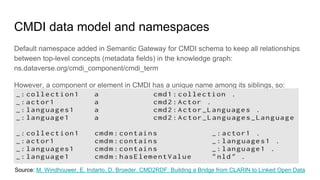
CMDI data model and namespaces
Default namespace added in Semantic Gateway for CMDI schema to keep all relationships
between top-level concepts (metadata fields) in the knowledge graph:
ns.dataverse.org/cmdi_component/cmdi_term
However, a component or element in CMDI has a unique name among its siblings, so:
Source: M. Windhouwer, E. Indarto, D. Broeder. CMD2RDF: Building a Bridge from CLARIN to Linked Open Data
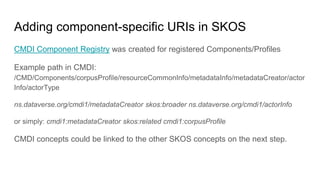
Adding component-specific URIs in SKOS
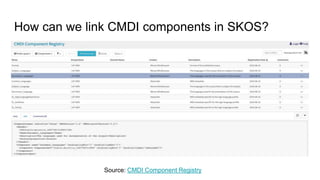
CMDI Component Registry was created for registered Components/Profiles
Example path in CMDI:
/CMD/Components/corpusProfile/resourceCommonInfo/metadataInfo/metadataCreator/actor
Info/actorType
ns.dataverse.org/cmdi1/metadataCreator skos:broader ns.dataverse.org/cmdi1/actorInfo
or simply: cmdi1:metadataCreator skos:related cmdi1:corpusProfile
CMDI concepts could be linked to the other SKOS concepts on the next step.
How can we link CMDI components in SKOS?
Source: CMDI Component Registry
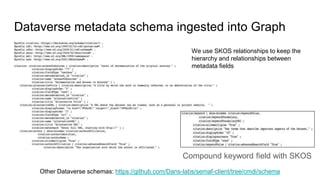
Dataverse metadata schema ingested into Graph
Compound keyword field with SKOS
We use SKOS relationships to keep the
hierarchy and relationships between
metadata fields
Other Dataverse schemas: https://github.com/Dans-labs/semaf-client/tree/cmdi/schema
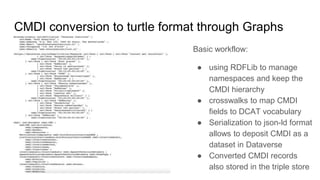
CMDI conversion to turtle format through Graphs
Basic workflow:
● using RDFLib to manage
namespaces and keep the
CMDI hierarchy
● crosswalks to map CMDI
fields to DCAT vocabulary
● Serialization to json-ld format
allows to deposit CMDI as a
dataset in Dataverse
● Converted CMDI records
also stored in the triple store
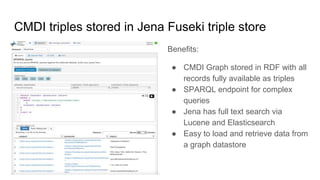
CMDI triples stored in Jena Fuseki triple store
Benefits:
● CMDI Graph stored in RDF with all
records fully available as triples
● SPARQL endpoint for complex
queries
● Jena has full text search via
Lucene and Elasticsearch
● Easy to load and retrieve data from
a graph datastore
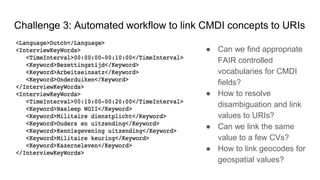
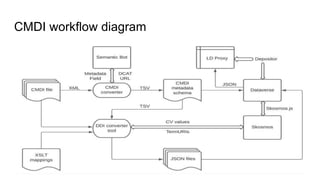
Challenge 3: Automated workflow to link CMDI concepts to URIs
● Can we find appropriate
FAIR controlled
vocabularies for CMDI
fields?
● How to resolve
disambiguation and link
values to URIs?
● Can we link the same
value to a few CVs?
● How to link geocodes for
geospatial values?
CMDI workflow diagram
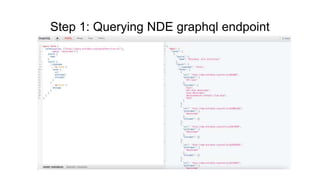
Step 1: Querying NDE graphql endpoint
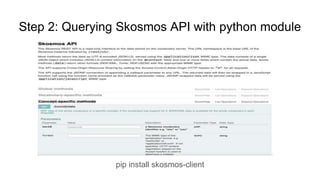
Step 2: Querying Skosmos API with python module
pip install skosmos-client
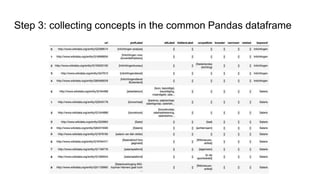
Step 3: collecting concepts in the common Pandas dataframe
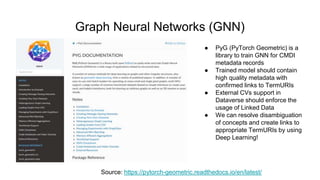
Graph Neural Networks (GNN)
Source: https://pytorch-geometric.readthedocs.io/en/latest/
● PyG (PyTorch Geometric) is a
library to train GNN for CMDI
metadata records
● Trained model should contain
high quality metadata with
confirmed links to TermURIs
● External CVs support in
Dataverse should enforce the
usage of Linked Data
● We can resolve disambiguation
of concepts and create links to
appropriate TermURIs by using
Deep Learning!
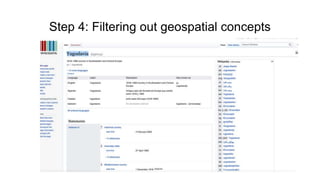
Step 4: Filtering out geospatial concepts
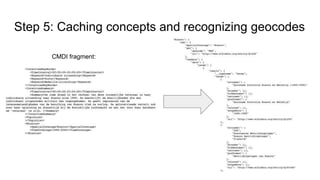
Step 5: Caching concepts and recognizing geocodes
CMDI fragment:
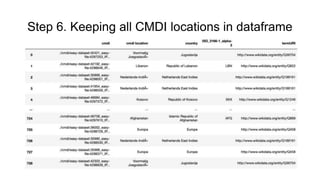
Step 6. Keeping all CMDI locations in dataframe
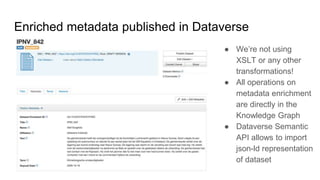
Enriched metadata published in Dataverse
● We’re not using
XSLT or any other
transformations!
● All operations on
metadata enrichment
are directly in the
Knowledge Graph
● Dataverse Semantic
API allows to import
json-ld representation
of dataset
Data analysis and CMDI visualizations with Superset
● Apache Superset integration with Dataverse was created in SSHOC project
● Superset allows to connect to various external data sources or databases
(postgresql, mysql, SOLR, MongoDB, ...). Every new connection considered
as a separate dataset
● about 50 different visualizations available out-of-the-box in Superset (charts,
maps, wordclouds, network graphs, …)
● Dataverse with ingested CMDI metadata could be connected to Superset
directly
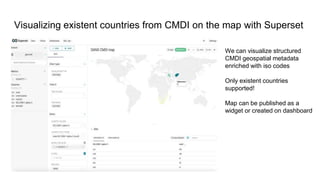
Visualizing existent countries from CMDI on the map with Superset
We can visualize structured
CMDI geospatial metadata
enriched with iso codes
Only existent countries
supported!
Map can be published as a
widget or created on dashboard
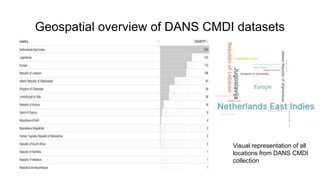
Geospatial overview of DANS CMDI datasets
Visual representation of all
locations from DANS CMDI
collection
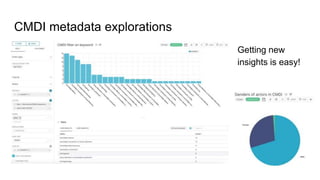
CMDI metadata explorations
Getting new
insights is easy!
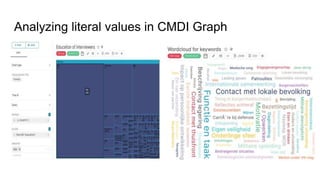
Analyzing literal values in CMDI Graph
Challenge 4: CMDI extension with support of CVs for FAIR metadata
● We can predict appropriate vocabularies for every field after the running
automated pipeline
● CMDI metadata schema could be extended with new CVs support in
Dataverse
● one CMDI field can be linked to a few CVs in the same time (for example,
Geospatial field to Wikidata and Geonames). User can select appropriate CV
in the deposit form during the metadata creation or edit process.
● We’re adding a configurable process to add or remove CVs in Dataverse
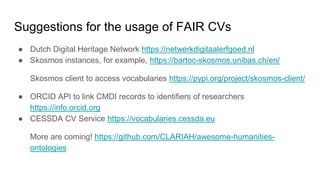
Suggestions for the usage of FAIR CVs
● Dutch Digital Heritage Network https://netwerkdigitaalerfgoed.nl
● Skosmos instances, for example, https://bartoc-skosmos.unibas.ch/en/
Skosmos client to access vocabularies https://pypi.org/project/skosmos-client/
● ORCID API to link CMDI records to identifiers of researchers
https://info.orcid.org
● CESSDA CV Service https://vocabularies.cessda.eu
More are coming! https://github.com/CLARIAH/awesome-humanities-
ontologies
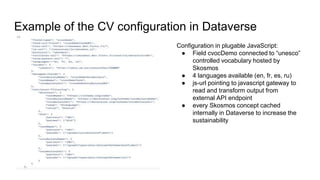
Example of the CV configuration in Dataverse
Configuration in plugable JavaScript:
● Field cvocDemo connected to “unesco”
controlled vocabulary hosted by
Skosmos
● 4 languages available (en, fr, es, ru)
● js-url pointing to javascript gateway to
read and transform output from
external API endpoint
● every Skosmos concept cached
internally in Dataverse to increase the
sustainability
Challenge 5: export from Dataverse metadata back to CMDI
Basic requirements:
Dataverse metadata schema should have CMDI metadata that can be extended
by custom components used by CLARIN centers in the different countries.
Original relationships between fields and concepts should be kept, custom
components should be added to SKOS schema.
Users should be able to download metadata in the original CMDI format without
losing quality.
This work is in progress...
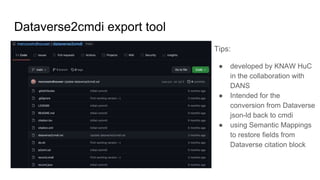
Dataverse2cmdi export tool
Tips:
● developed by KNAW HuC
in the collaboration with
DANS
● Intended for the
conversion from Dataverse
json-ld back to cmdi
● using Semantic Mappings
to restore fields from
Dataverse citation block
Questions?
Slava Tykhonov (DANS-KNAW)
Jerry de Vries (DANS-KNAW)
Andrea Scharnhorst (DANS-KNAW)
Eko Indarto (DANS-KNAW)
Femmy Admiraal (DANS-KNAW)
Semantic Gateway: https://github.com/Dans-labs/semantic-gateway
SEMAF client: https://github.com/Dans-labs/semaf-client

CLARIN CMDI use case and flexible metadata schemes

  • 1.
    Flexible metadata schemesfor research data repositories The Common Framework in Dataverse and the CMDI use case Slava Tykhonov Jerry de Vries Eko Indarto Andrea Scharnhorst Femmy Admiraal (DANS-KNAW) CLARIAH IG Linked Open Data, 04.10.2021
  • 2.
    Overall goal forthe CMDI core metadata task The goal mentioned in CMDI strategy 2019-2020: "Ready-made, good quality profiles & components suitable for common use cases and resource types". DataCite has three types for metadata elements: mandatory, recommended, optional, how to distinguish CMDI core components for different CLARIN centers? We are part of the specific CMDI task for the design and implementation of CLARIN core metadata components and profiles, and the use of FAIR vocabularies within CLARIN metadata.
  • 4.
    Theory of inventiveproblem solving (Russian: TRIZ) TRIZ presents a systematic approach for understanding and defining challenging problems: difficult problems require an inventive solution, and TRIZ provides a range of strategies and tools for finding these inventive solutions. One of the earliest findings of the massive research on which the theory is based is that the vast majority of problems that require inventive solutions typically reflect a need to overcome a dilemma or a trade-off between two contradictory elements. https://en.wikipedia.org/wiki/TRIZ
  • 5.
    5 challenges forCMDI Challenge 1: A proposal of a core set of CMDI metadata as recommendation Challenge 2: Extraction of CMDI metadata and transform and load the metadata fields into the Dataverse Core set of metadata Challenge 3: Workflow for prediction and linking concepts from external controlled vocabularies to the CMDI metadata values Challenge 4: Extension of the Common Framework with support of FAIR controlled vocabularies to create FAIR metadata Challenge 5: Extension of the export functionality of Dataverse to export deposited CMDI metadata back to the original CMDI format
  • 6.
    Overall goals forDANS ● CMDI metadata archived in EASY TDR and marked as CLARIN collection with very limited Dublin Core based metadata schema (EDM), curation and further reuse isn’t possible ● DANS wants to run Data Station with CMDI metadata schema suitable for different CLARIN use cases ● the long term goal of DANS is to make CMDI datasets harvestable and approachable, and create an interoperability layer with external controlled vocabularies (FAIR Data Point)
  • 7.
    DANS Data Stations- Future DANS Data Services Dataverse is API based data platform and a key framework for Open Innovation!
  • 8.
    Semantic interoperability onthe infrastructure level Dataverse Semantic API in release 5.6: https://github.com/IQSS/dataverse/releases/tag/v5.6 “Dataset metadata can be retrieved, set, and updated using a new, flatter JSON-LD format - following the format of an OAI-ORE export (RDA-conformant Bags), allowing for easier transfer of metadata to/from other systems (i.e. without needing to know Dataverse's metadata block and field storage architecture). This new API also allows for the update of terms metadata“. External controlled vocabularies support is being developed by DANS in SSHOC project and will be integrated in Dataverse core in the upcoming release 5.7. Proposal: https://docs.google.com/document/d/1txdcFuxskRx_tLsDQ7KKLFTMR_r9IBhorDu3V_r445w/ Interfaces: http://github.com/gdcc/dataverse-external-vocab-support Integrations: Wikidata, ORCID, MeSH, Skosmos vocabularies
  • 9.
    SEMAF: A Proposalfor a Flexible Semantic Mapping Framework Proposal: https://zenodo.org/record/4651421#.YT9lyC8RpZI POC: https://github.com/Dans-labs/semaf-poc
  • 10.
  • 11.
    CMDI exploration tool Source:DANS CMDI converter github
  • 12.
  • 13.
    Challenge 1: CMDIcore metadata proposal Source: Core metadata components design for use cases
  • 14.
    DANS CMDI metadatagenerator ● CMDI fields generated automatically by our tool from files deposited in EASY ● CMDI metadata model published as TSV files and uploaded to Dataverse ● Convertor can extract and show the hierarchy of all fields:
  • 15.
    CLARIAH compliant DataverseDocker module Source: Dataverse Docker with CMDI metadata schema
  • 16.
    Challenge 2: CMDIimplementation in Dataverse
  • 17.
    CMDI metadata modelin Dataverse Obvious conflict: Dataverse hierarchy limitation, CMDI has no limits of hierarchies Is it all about relationships? =>
  • 18.
    Core metadata componentsdesign guidelines Source: Guidelines link
  • 19.
    Coming close tothe implementation 1. Use Data Catalog Vocabulary (DCAT) mappings for CMDI metadata fields 2. Simple Knowledge Organization System (SKOS) to model a thesauri-like resources with simple skos:broader, skos:narrower and skos:related properties 3. Load CMDI properties and attributes and build a Knowledge Graph out of all elements 4. Enrich the Knowledge Graph with concept URIs from various controlled vocabularies like Skosmos hosted or Wikidata 5. Use different format data-serialization formats suitable for the integration with different systems. For example, json-ld suitable for Dataverse, turtle for Jena Fuseki, RDF for LoD frameworks
  • 20.
    Introduction of DataCatalog Vocabulary (DCAT) Source: W3C DCAT recommendation DCAT defines three main classes: ● dcat:Catalog represents the catalog ● dcat:Dataset represents a dataset in a catalog. ● dcat:Distribution represents an accessible form of a dataset DCAT makes extensive use of terms of RDF, Dublin Core, SKOS, and other vocabs!
  • 21.
    A complex CMDIfragment Some conclusions: ● Top-level concepts (CMDI components) can share the same concepts (called CMDI components) ● Relations between concepts define metadata schema ● Disambiguation of concepts is complicated ● Multilingual components have language indication (for example, keywords in Dutch) ● Hierarchy defined by semantics
  • 22.
    Semantics in Dataversemetadata schema
  • 23.
    Dataverse datasetfield API curlhttp://localhost:8080/api/admin/datasetfield/title To do list for Dataverse core: ● add TermURI for metadata fields (DC) ● show external controlled vocabularies available for the specific field ● add multilingual support with ‘lang’ parameter
  • 24.
    We created SemanticGateway as plugin app Source: Dataverse gateway
  • 25.
    Dataverse deposit formwith connection to ontologies Every field can be linked to the appropriate controlled vocabularies in FAIR way!
  • 26.
    One metadata fieldcan be linked to many ontologies Language switch in Dataverse will change the language of suggested terms!
  • 27.
    Semantic Gateway connectedto NDE and SKOSMOS
  • 28.
    CMDI data modeland namespaces Default namespace added in Semantic Gateway for CMDI schema to keep all relationships between top-level concepts (metadata fields) in the knowledge graph: ns.dataverse.org/cmdi_component/cmdi_term However, a component or element in CMDI has a unique name among its siblings, so: Source: M. Windhouwer, E. Indarto, D. Broeder. CMD2RDF: Building a Bridge from CLARIN to Linked Open Data
  • 29.
    Adding component-specific URIsin SKOS CMDI Component Registry was created for registered Components/Profiles Example path in CMDI: /CMD/Components/corpusProfile/resourceCommonInfo/metadataInfo/metadataCreator/actor Info/actorType ns.dataverse.org/cmdi1/metadataCreator skos:broader ns.dataverse.org/cmdi1/actorInfo or simply: cmdi1:metadataCreator skos:related cmdi1:corpusProfile CMDI concepts could be linked to the other SKOS concepts on the next step.
  • 30.
    How can welink CMDI components in SKOS? Source: CMDI Component Registry
  • 31.
    Dataverse metadata schemaingested into Graph Compound keyword field with SKOS We use SKOS relationships to keep the hierarchy and relationships between metadata fields Other Dataverse schemas: https://github.com/Dans-labs/semaf-client/tree/cmdi/schema
  • 32.
    CMDI conversion toturtle format through Graphs Basic workflow: ● using RDFLib to manage namespaces and keep the CMDI hierarchy ● crosswalks to map CMDI fields to DCAT vocabulary ● Serialization to json-ld format allows to deposit CMDI as a dataset in Dataverse ● Converted CMDI records also stored in the triple store
  • 33.
    CMDI triples storedin Jena Fuseki triple store Benefits: ● CMDI Graph stored in RDF with all records fully available as triples ● SPARQL endpoint for complex queries ● Jena has full text search via Lucene and Elasticsearch ● Easy to load and retrieve data from a graph datastore
  • 34.
    Challenge 3: Automatedworkflow to link CMDI concepts to URIs ● Can we find appropriate FAIR controlled vocabularies for CMDI fields? ● How to resolve disambiguation and link values to URIs? ● Can we link the same value to a few CVs? ● How to link geocodes for geospatial values?
  • 35.
  • 36.
    Step 1: QueryingNDE graphql endpoint
  • 37.
    Step 2: QueryingSkosmos API with python module pip install skosmos-client
  • 38.
    Step 3: collectingconcepts in the common Pandas dataframe
  • 39.
    Graph Neural Networks(GNN) Source: https://pytorch-geometric.readthedocs.io/en/latest/ ● PyG (PyTorch Geometric) is a library to train GNN for CMDI metadata records ● Trained model should contain high quality metadata with confirmed links to TermURIs ● External CVs support in Dataverse should enforce the usage of Linked Data ● We can resolve disambiguation of concepts and create links to appropriate TermURIs by using Deep Learning!
  • 40.
    Step 4: Filteringout geospatial concepts
  • 41.
    Step 5: Cachingconcepts and recognizing geocodes CMDI fragment:
  • 42.
    Step 6. Keepingall CMDI locations in dataframe
  • 43.
    Enriched metadata publishedin Dataverse ● We’re not using XSLT or any other transformations! ● All operations on metadata enrichment are directly in the Knowledge Graph ● Dataverse Semantic API allows to import json-ld representation of dataset
  • 44.
    Data analysis andCMDI visualizations with Superset ● Apache Superset integration with Dataverse was created in SSHOC project ● Superset allows to connect to various external data sources or databases (postgresql, mysql, SOLR, MongoDB, ...). Every new connection considered as a separate dataset ● about 50 different visualizations available out-of-the-box in Superset (charts, maps, wordclouds, network graphs, …) ● Dataverse with ingested CMDI metadata could be connected to Superset directly
  • 45.
    Visualizing existent countriesfrom CMDI on the map with Superset We can visualize structured CMDI geospatial metadata enriched with iso codes Only existent countries supported! Map can be published as a widget or created on dashboard
  • 46.
    Geospatial overview ofDANS CMDI datasets Visual representation of all locations from DANS CMDI collection
  • 47.
  • 48.
  • 49.
    Challenge 4: CMDIextension with support of CVs for FAIR metadata ● We can predict appropriate vocabularies for every field after the running automated pipeline ● CMDI metadata schema could be extended with new CVs support in Dataverse ● one CMDI field can be linked to a few CVs in the same time (for example, Geospatial field to Wikidata and Geonames). User can select appropriate CV in the deposit form during the metadata creation or edit process. ● We’re adding a configurable process to add or remove CVs in Dataverse
  • 50.
    Suggestions for theusage of FAIR CVs ● Dutch Digital Heritage Network https://netwerkdigitaalerfgoed.nl ● Skosmos instances, for example, https://bartoc-skosmos.unibas.ch/en/ Skosmos client to access vocabularies https://pypi.org/project/skosmos-client/ ● ORCID API to link CMDI records to identifiers of researchers https://info.orcid.org ● CESSDA CV Service https://vocabularies.cessda.eu More are coming! https://github.com/CLARIAH/awesome-humanities- ontologies
  • 51.
    Example of theCV configuration in Dataverse Configuration in plugable JavaScript: ● Field cvocDemo connected to “unesco” controlled vocabulary hosted by Skosmos ● 4 languages available (en, fr, es, ru) ● js-url pointing to javascript gateway to read and transform output from external API endpoint ● every Skosmos concept cached internally in Dataverse to increase the sustainability
  • 52.
    Challenge 5: exportfrom Dataverse metadata back to CMDI Basic requirements: Dataverse metadata schema should have CMDI metadata that can be extended by custom components used by CLARIN centers in the different countries. Original relationships between fields and concepts should be kept, custom components should be added to SKOS schema. Users should be able to download metadata in the original CMDI format without losing quality. This work is in progress...
  • 53.
    Dataverse2cmdi export tool Tips: ●developed by KNAW HuC in the collaboration with DANS ● Intended for the conversion from Dataverse json-ld back to cmdi ● using Semantic Mappings to restore fields from Dataverse citation block
  • 54.
    Questions? Slava Tykhonov (DANS-KNAW) Jerryde Vries (DANS-KNAW) Andrea Scharnhorst (DANS-KNAW) Eko Indarto (DANS-KNAW) Femmy Admiraal (DANS-KNAW) Semantic Gateway: https://github.com/Dans-labs/semantic-gateway SEMAF client: https://github.com/Dans-labs/semaf-client