Adding CMDI support in Dataverse
Slava Tykhonov
Senior Information Scientist,
Research & Innovation (DANS-KNAW)
CLARIN webinar, 02.12.2020
Overall goal for the CMDI core metadata task
The goal mentioned in CMDI strategy 2019-2020: "Ready-made, good quality
profiles & components suitable for common use cases and resource types".
DataCite has three types for metadata elements: mandatory, recommended,
optional, how to distinguish CMDI core components for different CLARIN centers?
We are part of the specific CMDI task for the design and implementation of
CLARIN core metadata components and profiles, and the use of FAIR
vocabularies within CLARIN metadata.
Overall goals for DANS
● CMDI metadata archived in EASY TDR and marked as CLARIN collection
with very limited Dublin Core based metadata schema (EDM), curation and
further reuse isn’t possible
● DANS wants to run Data Station with CMDI metadata schema suitable for
different CLARIN use cases
● the long term goal of DANS is to make CMDI datasets harvestable and
approachable, and create an interoperability layer with external controlled
vocabularies (FAIR Data Point)
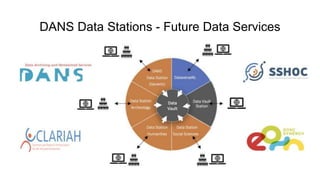
DANS Data Stations - Future Data Services
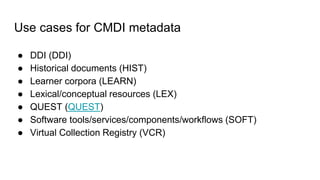
Use cases for CMDI metadata
● DDI (DDI)
● Historical documents (HIST)
● Learner corpora (LEARN)
● Lexical/conceptual resources (LEX)
● QUEST (QUEST)
● Software tools/services/components/workflows (SOFT)
● Virtual Collection Registry (VCR)
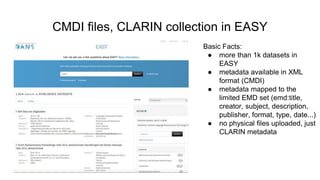
CMDI files, CLARIN collection in EASY
Basic Facts:
● more than 1k datasets in
EASY
● metadata available in XML
format (CMDI)
● metadata mapped to the
limited EMD set (emd:title,
creator, subject, description,
publisher, format, type, date...)
● no physical files uploaded, just
CLARIN metadata
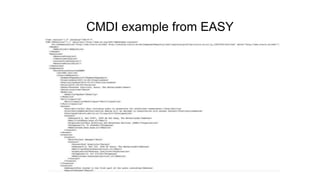
CMDI example from EASY
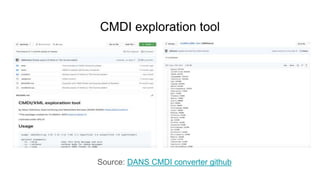
CMDI exploration tool
Source: DANS CMDI converter github
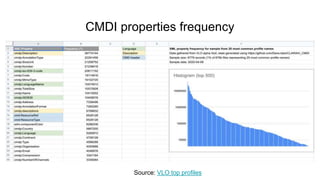
CMDI properties frequency
Source: VLO top profiles
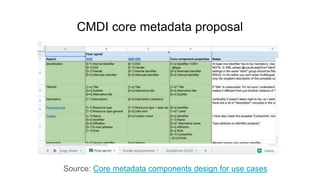
CMDI core metadata proposal
Source: Core metadata components design for use cases
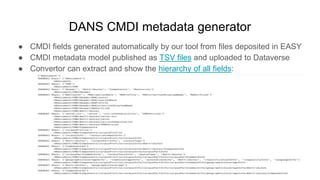
DANS CMDI metadata generator
● CMDI fields generated automatically by our tool from files deposited in EASY
● CMDI metadata model published as TSV files and uploaded to Dataverse
● Convertor can extract and show the hierarchy of all fields:
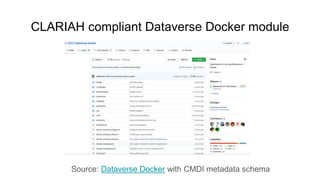
CLARIAH compliant Dataverse Docker module
Source: Dataverse Docker with CMDI metadata schema
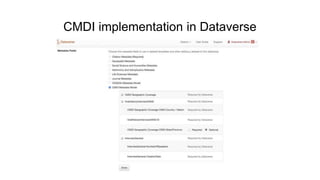
CMDI implementation in Dataverse
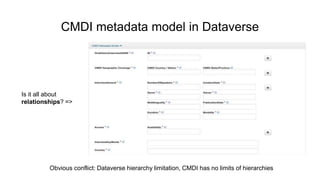
CMDI metadata model in Dataverse
Obvious conflict: Dataverse hierarchy limitation, CMDI has no limits of hierarchies
Is it all about
relationships? =>
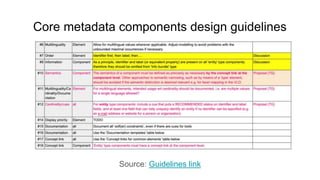
Core metadata components design guidelines
Source: Guidelines link
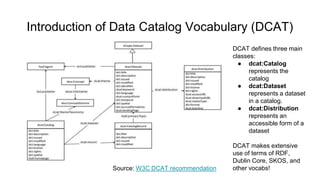
Introduction of Data Catalog Vocabulary (DCAT)
Source: W3C DCAT recommendation
DCAT defines three main
classes:
● dcat:Catalog
represents the
catalog
● dcat:Dataset
represents a dataset
in a catalog.
● dcat:Distribution
represents an
accessible form of a
dataset
DCAT makes extensive
use of terms of RDF,
Dublin Core, SKOS, and
other vocabs!
Simple Knowledge Organization System (SKOS)
SKOS models a thesauri-like resources:
- skos:Concepts with preferred labels and alternative labels (synonyms) attached to them
(skos:prefLabel, skos:altLabel).
- skos:Concept can be related with skos:broader, skos:narrower and skos:related properties.
- terms and concepts could have more than one broader term and concept.
SKOS allows to create a semantic layer on top of objects, a network with statements and relationships.
A major difference of SKOS is logical “is-a hierarchies”. In thesauri the hierarchical relation can represent
anything from “is-a” to “part-of”.
17
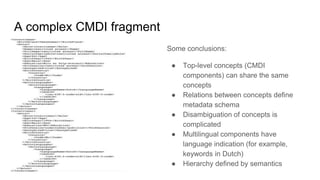
A complex CMDI fragment
Some conclusions:
● Top-level concepts (CMDI
components) can share the same
concepts
● Relations between concepts define
metadata schema
● Disambiguation of concepts is
complicated
● Multilingual components have
language indication (for example,
keywords in Dutch)
● Hierarchy defined by semantics
What is semantics?
Semantics (from Ancient Greek: σημαντικός sēmantikós, "significant")[a][1] is the study of meaning. The term can be used to
refer to subfields of several distinct disciplines including linguistics, philosophy, and computer science.
Linguistics
In linguistics, semantics is the subfield that studies meaning. Semantics can address meaning at the levels of words,
phrases, sentences, or larger units of discourse. One of the crucial questions which unites different approaches to linguistic
semantics is that of the relationship between form and meaning.[2]
Computer science
In computer science, the term semantics refers to the meaning of language constructs, as opposed to their form (syntax).
According to Euzenat, semantics "provides the rules for interpreting the syntax which do not provide the meaning directly
but constrains the possible interpretations of what is declared."[14]
(from Wikipedia)
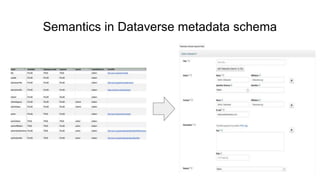
Semantics in Dataverse metadata schema
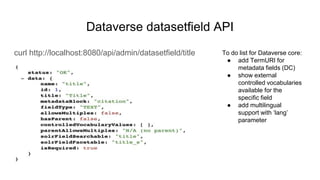
Dataverse datasetfield API
curl http://localhost:8080/api/admin/datasetfield/title To do list for Dataverse core:
● add TermURI for
metadata fields (DC)
● show external
controlled vocabularies
available for the
specific field
● add multilingual
support with ‘lang’
parameter
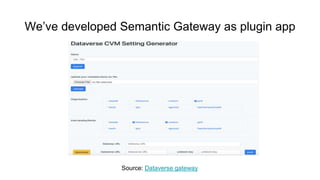
We’ve developed Semantic Gateway as plugin app
Source: Dataverse gateway
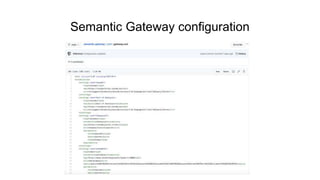
Semantic Gateway configuration
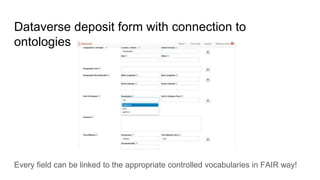
Dataverse deposit form with connection to
ontologies
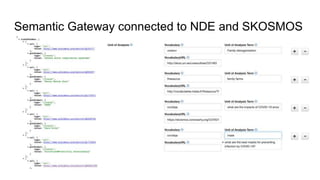
Every field can be linked to the appropriate controlled vocabularies in FAIR way!
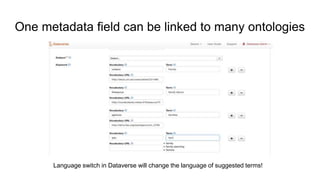
One metadata field can be linked to many ontologies
Language switch in Dataverse will change the language of suggested terms!
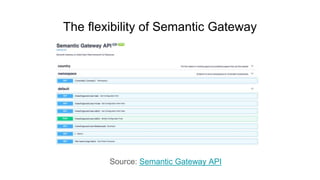
The flexibility of Semantic Gateway
Source: Semantic Gateway API
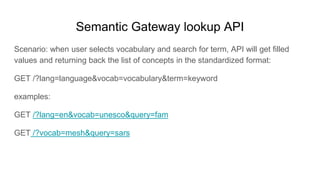
Semantic Gateway lookup API
Scenario: when user selects vocabulary and search for term, API will get filled
values and returning back the list of concepts in the standardized format:
GET /?lang=language&vocab=vocabulary&term=keyword
examples:
GET /?lang=en&vocab=unesco&query=fam
GET /?vocab=mesh&query=sars
Semantic Gateway connected to NDE and SKOSMOS
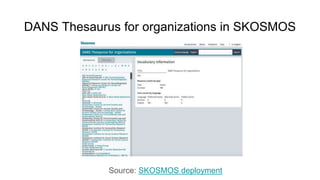
DANS Thesaurus for organizations in SKOSMOS
Source: SKOSMOS deployment
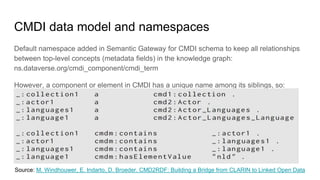
CMDI data model and namespaces
Default namespace added in Semantic Gateway for CMDI schema to keep all relationships
between top-level concepts (metadata fields) in the knowledge graph:
ns.dataverse.org/cmdi_component/cmdi_term
However, a component or element in CMDI has a unique name among its siblings, so:
Source: M. Windhouwer, E. Indarto, D. Broeder. CMD2RDF: Building a Bridge from CLARIN to Linked Open Data
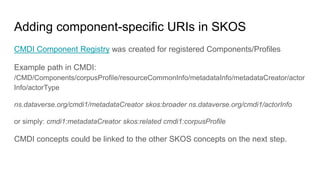
Adding component-specific URIs in SKOS
CMDI Component Registry was created for registered Components/Profiles
Example path in CMDI:
/CMD/Components/corpusProfile/resourceCommonInfo/metadataInfo/metadataCreator/actor
Info/actorType
ns.dataverse.org/cmdi1/metadataCreator skos:broader ns.dataverse.org/cmdi1/actorInfo
or simply: cmdi1:metadataCreator skos:related cmdi1:corpusProfile
CMDI concepts could be linked to the other SKOS concepts on the next step.
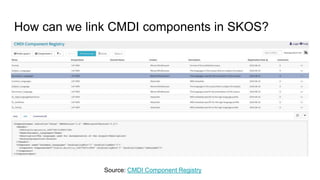
How can we link CMDI components in SKOS?
Source: CMDI Component Registry
Export from Dataverse metadata back to CMDI
Basic requirements:
Dataverse metadata schema should have CMDI metadata that can be extended
by custom components used by CLARIN centers in the different countries.
Original relationships between fields and concepts should be kept, custom
components should be added to SKOS schema.
Users should be able to download metadata in the original CMDI format without
losing quality.
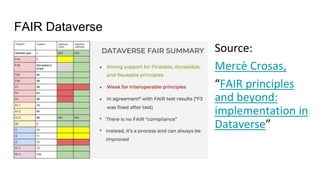
FAIR Dataverse
Source:
Mercè Crosas,
“FAIR principles
and beyond:
implementation in
Dataverse”
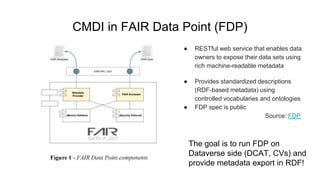
CMDI in FAIR Data Point (FDP)
● RESTful web service that enables data
owners to expose their data sets using
rich machine-readable metadata
● Provides standardized descriptions
(RDF-based metadata) using
controlled vocabularies and ontologies
● FDP spec is public
Source: FDP
The goal is to run FDP on
Dataverse side (DCAT, CVs) and
provide metadata export in RDF!
Questions?
Slava Tykhonov,
Senior Information Scientist
vyacheslav.tykhonov@dans.knaw.nl

CLARIN CMDI support in Dataverse

  • 1.
    Adding CMDI supportin Dataverse Slava Tykhonov Senior Information Scientist, Research & Innovation (DANS-KNAW) CLARIN webinar, 02.12.2020
  • 2.
    Overall goal forthe CMDI core metadata task The goal mentioned in CMDI strategy 2019-2020: "Ready-made, good quality profiles & components suitable for common use cases and resource types". DataCite has three types for metadata elements: mandatory, recommended, optional, how to distinguish CMDI core components for different CLARIN centers? We are part of the specific CMDI task for the design and implementation of CLARIN core metadata components and profiles, and the use of FAIR vocabularies within CLARIN metadata.
  • 3.
    Overall goals forDANS ● CMDI metadata archived in EASY TDR and marked as CLARIN collection with very limited Dublin Core based metadata schema (EDM), curation and further reuse isn’t possible ● DANS wants to run Data Station with CMDI metadata schema suitable for different CLARIN use cases ● the long term goal of DANS is to make CMDI datasets harvestable and approachable, and create an interoperability layer with external controlled vocabularies (FAIR Data Point)
  • 4.
    DANS Data Stations- Future Data Services
  • 5.
    Use cases forCMDI metadata ● DDI (DDI) ● Historical documents (HIST) ● Learner corpora (LEARN) ● Lexical/conceptual resources (LEX) ● QUEST (QUEST) ● Software tools/services/components/workflows (SOFT) ● Virtual Collection Registry (VCR)
  • 6.
    CMDI files, CLARINcollection in EASY Basic Facts: ● more than 1k datasets in EASY ● metadata available in XML format (CMDI) ● metadata mapped to the limited EMD set (emd:title, creator, subject, description, publisher, format, type, date...) ● no physical files uploaded, just CLARIN metadata
  • 7.
  • 8.
    CMDI exploration tool Source:DANS CMDI converter github
  • 9.
  • 10.
    CMDI core metadataproposal Source: Core metadata components design for use cases
  • 11.
    DANS CMDI metadatagenerator ● CMDI fields generated automatically by our tool from files deposited in EASY ● CMDI metadata model published as TSV files and uploaded to Dataverse ● Convertor can extract and show the hierarchy of all fields:
  • 12.
    CLARIAH compliant DataverseDocker module Source: Dataverse Docker with CMDI metadata schema
  • 13.
  • 14.
    CMDI metadata modelin Dataverse Obvious conflict: Dataverse hierarchy limitation, CMDI has no limits of hierarchies Is it all about relationships? =>
  • 15.
    Core metadata componentsdesign guidelines Source: Guidelines link
  • 16.
    Introduction of DataCatalog Vocabulary (DCAT) Source: W3C DCAT recommendation DCAT defines three main classes: ● dcat:Catalog represents the catalog ● dcat:Dataset represents a dataset in a catalog. ● dcat:Distribution represents an accessible form of a dataset DCAT makes extensive use of terms of RDF, Dublin Core, SKOS, and other vocabs!
  • 17.
    Simple Knowledge OrganizationSystem (SKOS) SKOS models a thesauri-like resources: - skos:Concepts with preferred labels and alternative labels (synonyms) attached to them (skos:prefLabel, skos:altLabel). - skos:Concept can be related with skos:broader, skos:narrower and skos:related properties. - terms and concepts could have more than one broader term and concept. SKOS allows to create a semantic layer on top of objects, a network with statements and relationships. A major difference of SKOS is logical “is-a hierarchies”. In thesauri the hierarchical relation can represent anything from “is-a” to “part-of”. 17
  • 18.
    A complex CMDIfragment Some conclusions: ● Top-level concepts (CMDI components) can share the same concepts ● Relations between concepts define metadata schema ● Disambiguation of concepts is complicated ● Multilingual components have language indication (for example, keywords in Dutch) ● Hierarchy defined by semantics
  • 19.
    What is semantics? Semantics(from Ancient Greek: σημαντικός sēmantikós, "significant")[a][1] is the study of meaning. The term can be used to refer to subfields of several distinct disciplines including linguistics, philosophy, and computer science. Linguistics In linguistics, semantics is the subfield that studies meaning. Semantics can address meaning at the levels of words, phrases, sentences, or larger units of discourse. One of the crucial questions which unites different approaches to linguistic semantics is that of the relationship between form and meaning.[2] Computer science In computer science, the term semantics refers to the meaning of language constructs, as opposed to their form (syntax). According to Euzenat, semantics "provides the rules for interpreting the syntax which do not provide the meaning directly but constrains the possible interpretations of what is declared."[14] (from Wikipedia)
  • 20.
    Semantics in Dataversemetadata schema
  • 21.
    Dataverse datasetfield API curlhttp://localhost:8080/api/admin/datasetfield/title To do list for Dataverse core: ● add TermURI for metadata fields (DC) ● show external controlled vocabularies available for the specific field ● add multilingual support with ‘lang’ parameter
  • 22.
    We’ve developed SemanticGateway as plugin app Source: Dataverse gateway
  • 23.
  • 24.
    Dataverse deposit formwith connection to ontologies Every field can be linked to the appropriate controlled vocabularies in FAIR way!
  • 25.
    One metadata fieldcan be linked to many ontologies Language switch in Dataverse will change the language of suggested terms!
  • 26.
    The flexibility ofSemantic Gateway Source: Semantic Gateway API
  • 27.
    Semantic Gateway lookupAPI Scenario: when user selects vocabulary and search for term, API will get filled values and returning back the list of concepts in the standardized format: GET /?lang=language&vocab=vocabulary&term=keyword examples: GET /?lang=en&vocab=unesco&query=fam GET /?vocab=mesh&query=sars
  • 28.
    Semantic Gateway connectedto NDE and SKOSMOS
  • 29.
    DANS Thesaurus fororganizations in SKOSMOS Source: SKOSMOS deployment
  • 30.
    CMDI data modeland namespaces Default namespace added in Semantic Gateway for CMDI schema to keep all relationships between top-level concepts (metadata fields) in the knowledge graph: ns.dataverse.org/cmdi_component/cmdi_term However, a component or element in CMDI has a unique name among its siblings, so: Source: M. Windhouwer, E. Indarto, D. Broeder. CMD2RDF: Building a Bridge from CLARIN to Linked Open Data
  • 31.
    Adding component-specific URIsin SKOS CMDI Component Registry was created for registered Components/Profiles Example path in CMDI: /CMD/Components/corpusProfile/resourceCommonInfo/metadataInfo/metadataCreator/actor Info/actorType ns.dataverse.org/cmdi1/metadataCreator skos:broader ns.dataverse.org/cmdi1/actorInfo or simply: cmdi1:metadataCreator skos:related cmdi1:corpusProfile CMDI concepts could be linked to the other SKOS concepts on the next step.
  • 32.
    How can welink CMDI components in SKOS? Source: CMDI Component Registry
  • 33.
    Export from Dataversemetadata back to CMDI Basic requirements: Dataverse metadata schema should have CMDI metadata that can be extended by custom components used by CLARIN centers in the different countries. Original relationships between fields and concepts should be kept, custom components should be added to SKOS schema. Users should be able to download metadata in the original CMDI format without losing quality.
  • 34.
    FAIR Dataverse Source: Mercè Crosas, “FAIRprinciples and beyond: implementation in Dataverse”
  • 35.
    CMDI in FAIRData Point (FDP) ● RESTful web service that enables data owners to expose their data sets using rich machine-readable metadata ● Provides standardized descriptions (RDF-based metadata) using controlled vocabularies and ontologies ● FDP spec is public Source: FDP The goal is to run FDP on Dataverse side (DCAT, CVs) and provide metadata export in RDF!
  • 36.
    Questions? Slava Tykhonov, Senior InformationScientist vyacheslav.tykhonov@dans.knaw.nl