Feedback Report
RAAFA
Alice Ross-King Care Centre
February 2020
Introduction
The following report contains the results of the Alice Ross-King Care Centre
CISCA survey conducted in February 2020 for RAAFA.
Results have been generated for the whole organisation, and for each site to
illustrate the care capability, employee engagement and customer feedback.
Summary
1
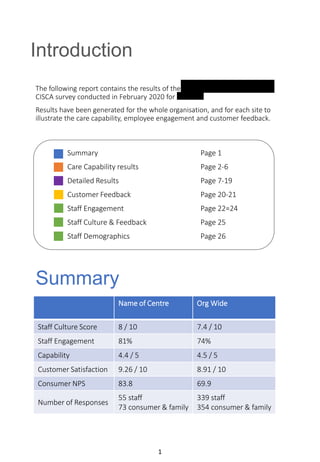
Summary Page 1
Care Capability results Page 2-6
Detailed Results Page 7-19
Customer Feedback Page 20-21
Staff Engagement Page 22=24
Staff Culture & Feedback Page 25
Staff Demographics Page 26
Name of Centre Org Wide
Staff Culture Score 8 / 10 7.4 / 10
Staff Engagement 81% 74%
Capability 4.4 / 5 4.5 / 5
Customer Satisfaction 9.26 / 10 8.91 / 10
Consumer NPS 83.8 69.9
Number of Responses
55 staff
73 consumer & family
339 staff
354 consumer & family
Customer Feedback
Calculating the Net Promoter Score:
Customers and their family members were asked to provide scores around their current
level of satisfaction as well as details on the positive aspects of the service being provided,
and what this team could do better.
Customer Satisfaction Score:
How satisfied are you with the services provided by this
organisation?
9.26 / 10
Net Promoter Score:
How likely are you to recommend this organisation to a friend or
family member?
83.8
The Net Promoter Score is an index ranging from -100 to 100 that measures the willingness
of customers to recommend an organisation’s products or services to others. It is used as a
proxy for gauging the customer’s overall satisfaction with an organisation’s service and the
customer’s loyalty to the brand.
Consumers and families were asked:
“On a scale of 0 to 10, How likely are you to recommend this organisation to a friend or
family member?”
The ratio of Promoters (score 9 or 10) to Detractors (score 0-6) provides the Net Promoter
Score.
20
Customer Feedback
Positive feedback about the service provided by this team:
What this team could do better to provide great quality service:
21
• Sincere and caring group of people.
• Staff genuinely care.
• Staff are friendly and build good relationships with residents and their
families (“they greet residents by name”).
• Residents and their families feel confident of the knowledge and skills of
staff.
• Issues or changes to care are shared with residents and staff quickly.
• Generally feel very satisfied with the service.
• More staff resources to enable more timely responses to customer
needs.
• Better communication amongst staff as to individual needs of
residents (in handovers for example).
• Provide more activities and outings accessible to those in wheelchairs.
• Greater choice and variety in the food menu available.
Staff Engagement
Employee engagement is the emotional commitment an employee has to their organisation
and its goals (Forbes, 2012). While employee satisfaction is a component of engagement, it
is not simply how ‘happy’ they feel at work or how ‘satisfied’ an employee is because a very
satisfied or happy employee may not go the extra mile.
Based on our review of the literature and our experience working with organisations from a
range of industries six factors of engagement were measured. Their results follow.
Career Development
Two questions were asked to examine the career development opportunities at this
organisation from the perspective of staff
Intention to Stay
Two questions were asked to understand employees’ intention to stay with this
organisation. A higher intention to stay would indicate a more engaged workforce.
22
*Percentage scores not shown are <5%
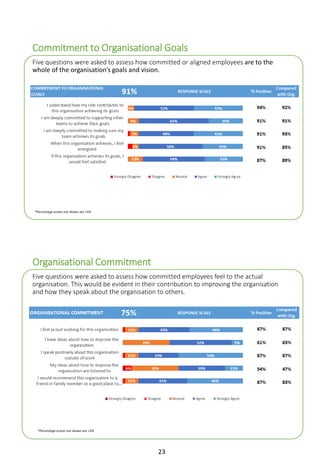
Commitment to Organisational Goals
Five questions were asked to assess how committed or aligned employees are to the
whole of the organisation’s goals and vision.
Organisational Commitment
Five questions were asked to assess how committed employees feel to the actual
organisation. This would be evident in their contribution to improving the organisation
and how they speak about the organisation to others.
23
*Percentage scores not shown are <5%
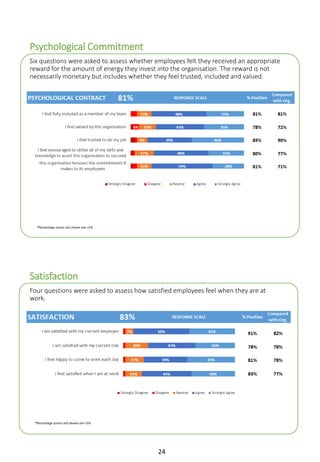
Psychological Commitment
Six questions were asked to assess whether employees felt they received an appropriate
reward for the amount of energy they invest into the organisation. The reward is not
necessarily monetary but includes whether they feel trusted, included and valued.
Satisfaction
Four questions were asked to assess how satisfied employees feel when they are at
work.
24
*Percentage scores not shown are <5%
Staff Culture and Feedback
Positive feedback about the team and the service it provides:
What this team feels it needs to be able to function more effectively:
25
• No themes identified in response to this question.
• Enjoyable team to work in.
• The team is alert to residents’ needs.
• Compassionate and caring delivery of work.
Staff members were asked to rate the current workplace culture of their organisation on a
scale of 1 (worst workplace culture i.e. unhappy staff, no communication, lots of conflict,
no relationships, poor teamwork) to 10 (best workplace culture i.e. happy and motivated
staff, open communication, fantastic team work and great leadership). They were also
asked details on the positive aspects of their team, and what their team could do better.
Staff Customer Score 8
Staff Response Demographics
26
42% Carer
24% Domestic (Kitchen, Domestic Laundry)
9% RN/EN
7% Kitchen / Club staff
5% Allied Health Worker (OT, Physio)
Role within the team
5% Other
4% Operational Management
(Residential Care)
2% Maintenance / Ground staff
2% Administration Assistants
Hours worked on average / week
0-10 11-20 21-30 31-40 40 + Other
0
10
20
30
40
< then 3
months
3 to 6
months
6 months
to 1 year
1 year to
5 years
5 years to
10 years
10 years
+
Years of service in
organisation
0
10
20
30
40
< then 3
months
3 to 6
months
6 months
to 1 year
1 year to
5 years
5 years to
10 years
10 years +
Years of service in
current team
CISCA sample report

CISCA sample report

  • 1.
    Feedback Report RAAFA Alice Ross-KingCare Centre February 2020
  • 2.
    Introduction The following reportcontains the results of the Alice Ross-King Care Centre CISCA survey conducted in February 2020 for RAAFA. Results have been generated for the whole organisation, and for each site to illustrate the care capability, employee engagement and customer feedback. Summary 1 Summary Page 1 Care Capability results Page 2-6 Detailed Results Page 7-19 Customer Feedback Page 20-21 Staff Engagement Page 22=24 Staff Culture & Feedback Page 25 Staff Demographics Page 26 Name of Centre Org Wide Staff Culture Score 8 / 10 7.4 / 10 Staff Engagement 81% 74% Capability 4.4 / 5 4.5 / 5 Customer Satisfaction 9.26 / 10 8.91 / 10 Consumer NPS 83.8 69.9 Number of Responses 55 staff 73 consumer & family 339 staff 354 consumer & family
  • 3.
    Customer Feedback Calculating theNet Promoter Score: Customers and their family members were asked to provide scores around their current level of satisfaction as well as details on the positive aspects of the service being provided, and what this team could do better. Customer Satisfaction Score: How satisfied are you with the services provided by this organisation? 9.26 / 10 Net Promoter Score: How likely are you to recommend this organisation to a friend or family member? 83.8 The Net Promoter Score is an index ranging from -100 to 100 that measures the willingness of customers to recommend an organisation’s products or services to others. It is used as a proxy for gauging the customer’s overall satisfaction with an organisation’s service and the customer’s loyalty to the brand. Consumers and families were asked: “On a scale of 0 to 10, How likely are you to recommend this organisation to a friend or family member?” The ratio of Promoters (score 9 or 10) to Detractors (score 0-6) provides the Net Promoter Score. 20
  • 4.
    Customer Feedback Positive feedbackabout the service provided by this team: What this team could do better to provide great quality service: 21 • Sincere and caring group of people. • Staff genuinely care. • Staff are friendly and build good relationships with residents and their families (“they greet residents by name”). • Residents and their families feel confident of the knowledge and skills of staff. • Issues or changes to care are shared with residents and staff quickly. • Generally feel very satisfied with the service. • More staff resources to enable more timely responses to customer needs. • Better communication amongst staff as to individual needs of residents (in handovers for example). • Provide more activities and outings accessible to those in wheelchairs. • Greater choice and variety in the food menu available.
  • 5.
    Staff Engagement Employee engagementis the emotional commitment an employee has to their organisation and its goals (Forbes, 2012). While employee satisfaction is a component of engagement, it is not simply how ‘happy’ they feel at work or how ‘satisfied’ an employee is because a very satisfied or happy employee may not go the extra mile. Based on our review of the literature and our experience working with organisations from a range of industries six factors of engagement were measured. Their results follow. Career Development Two questions were asked to examine the career development opportunities at this organisation from the perspective of staff Intention to Stay Two questions were asked to understand employees’ intention to stay with this organisation. A higher intention to stay would indicate a more engaged workforce. 22 *Percentage scores not shown are <5% *Percentage scores not shown are <5%
  • 6.
    Commitment to OrganisationalGoals Five questions were asked to assess how committed or aligned employees are to the whole of the organisation’s goals and vision. Organisational Commitment Five questions were asked to assess how committed employees feel to the actual organisation. This would be evident in their contribution to improving the organisation and how they speak about the organisation to others. 23 *Percentage scores not shown are <5% *Percentage scores not shown are <5%
  • 7.
    Psychological Commitment Six questionswere asked to assess whether employees felt they received an appropriate reward for the amount of energy they invest into the organisation. The reward is not necessarily monetary but includes whether they feel trusted, included and valued. Satisfaction Four questions were asked to assess how satisfied employees feel when they are at work. 24 *Percentage scores not shown are <5% *Percentage scores not shown are <5%
  • 8.
    Staff Culture andFeedback Positive feedback about the team and the service it provides: What this team feels it needs to be able to function more effectively: 25 • No themes identified in response to this question. • Enjoyable team to work in. • The team is alert to residents’ needs. • Compassionate and caring delivery of work. Staff members were asked to rate the current workplace culture of their organisation on a scale of 1 (worst workplace culture i.e. unhappy staff, no communication, lots of conflict, no relationships, poor teamwork) to 10 (best workplace culture i.e. happy and motivated staff, open communication, fantastic team work and great leadership). They were also asked details on the positive aspects of their team, and what their team could do better. Staff Customer Score 8
  • 9.
    Staff Response Demographics 26 42%Carer 24% Domestic (Kitchen, Domestic Laundry) 9% RN/EN 7% Kitchen / Club staff 5% Allied Health Worker (OT, Physio) Role within the team 5% Other 4% Operational Management (Residential Care) 2% Maintenance / Ground staff 2% Administration Assistants Hours worked on average / week 0-10 11-20 21-30 31-40 40 + Other 0 10 20 30 40 < then 3 months 3 to 6 months 6 months to 1 year 1 year to 5 years 5 years to 10 years 10 years + Years of service in organisation 0 10 20 30 40 < then 3 months 3 to 6 months 6 months to 1 year 1 year to 5 years 5 years to 10 years 10 years + Years of service in current team