GI: Cirrhosis
Marnie Quick, RN, MSN, CNRN
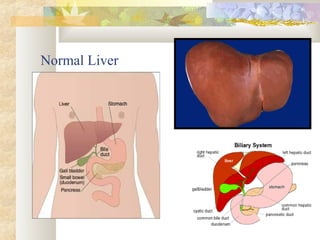
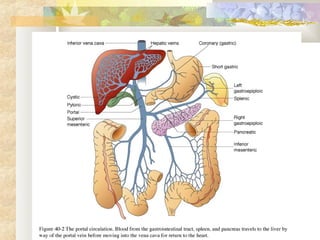
Normal Liver
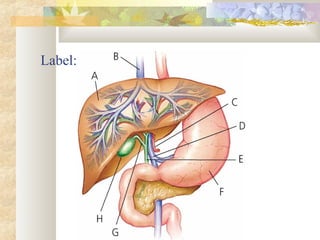
Label:
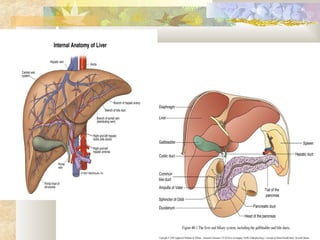
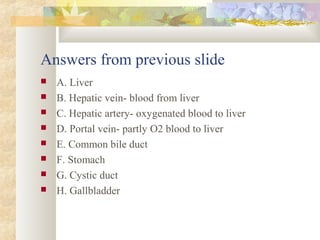
Answers from previous slide
 A. Liver
 B. Hepatic vein- blood from liver
 C. Hepatic artery- oxygenated blood to liver
 D. Portal vein- partly O2 blood to liver
 E. Common bile duct
 F. Stomach
 G. Cystic duct
 H. Gallbladder
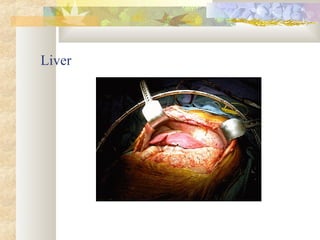
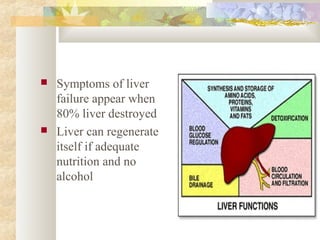
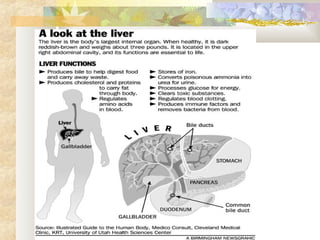
Liver
 Symptoms of liver
failure appear when
80% liver destroyed
 Liver can regenerate
itself if adequate
nutrition and no
alcohol
Liver functions
 1. Metabolic functions
 CHO- liver removes glucose from blood, stores it as
glycogen, breaks it down to release glucose PRN
 Protein- converts ammonia to urea**
 Protein (food/blood) is 1st
broken down by bacteria in GI to
form ammonia. Ammonia to liver which converts to urea.
 Fat- ketogenesis. (see next slide- bile)
 Steriod- aldosterone metabolism (liver damage= inc
levels aldosterone causing Na & H2O retention)
2. Bile synthesis & secretion-
Bile aids digestion/absorption fats in small intestine.
Indirect bilirubin broken down & excreted stool
3. Storage- Vitamin A, all B’s, D, E, and K
4. Regulates blood coagulation**-Forms prothrombin,
fibrinogen, heparin
If decrease Vit K & fibrinogen= increase fibrinolysis, &
decrease platelets> hemorrhage
5. Detoxification** -Rids body of endogenous waste- drugs,
bacteria, etc
6. Heat production
7. Phagocyte action- breakdown old RBC, WBC, bacteria
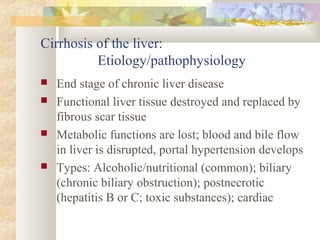
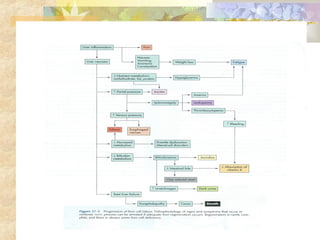
Cirrhosis of the liver:
Etiology/pathophysiology
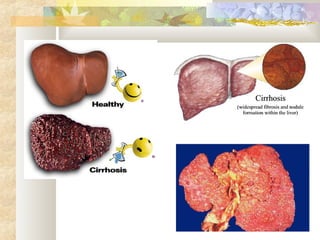
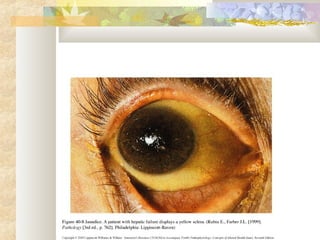
 End stage of chronic liver disease
 Functional liver tissue destroyed and replaced by
fibrous scar tissue
 Metabolic functions are lost; blood and bile flow
in liver is disrupted, portal hypertension develops
 Types: Alcoholic/nutritional (common); biliary
(chronic biliary obstruction); postnecrotic
(hepatitis B or C; toxic substances); cardiac
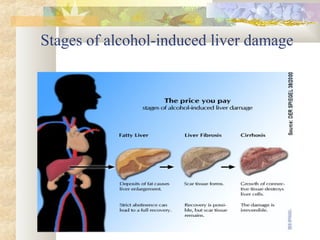
Stages of alcohol-induced liver damage
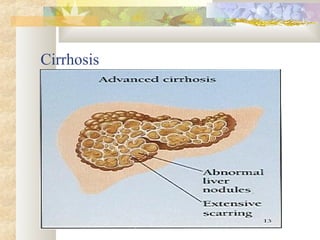
Cirrhosis
Alcoholic/nutritional cirrhosis
 Most common cause of cirrhosis with resultant
lack of nutrition
 Stage 1: metabolic changes affect fatty
metabolism, fat accumulates in liver. In this stage
abstinence from alcohol could allow liver to heal
 Stage 2: With continued use of alcohol,
inflammatory cells infiltrate the liver causing
necrosis, fibrosis and destruction of liver
 Stage 3: regenerative nodules form- liver shrinks
Cirrhosis of liver: Complication & treatment
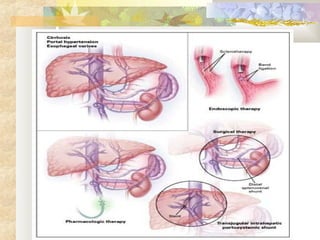
Portal hypertension
 Fibrous connective tissue in liver disrupt blood
and bile flow. Portal and hepatic veins become
compressed.
 With backup of blood have acites, splenomegaly,
peripheral edema, increase blood cell destruction-
anemia, low WBC and low platelets
 Treatment: medication to control hypertension,
diuretics to decrease fluid retention/acites and
TIPS procedure to increase blood flow
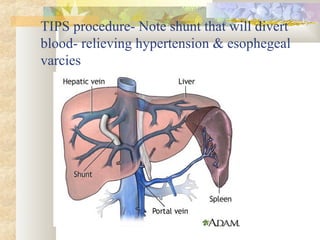
TIPS procedure- Note shunt that will divert
blood- relieving hypertension & esophegeal
varcies
Cirrhosis: complication & treatment
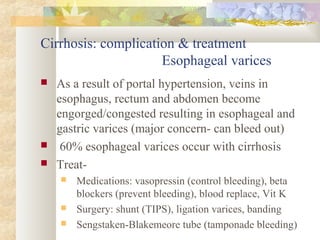
Esophageal varices
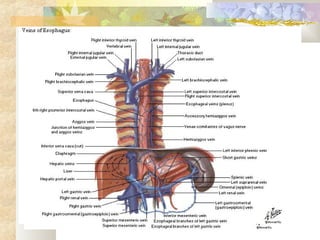
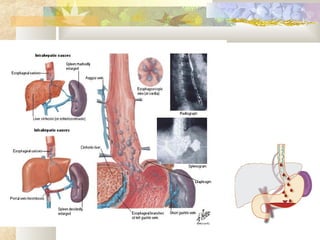
 As a result of portal hypertension, veins in
esophagus, rectum and abdomen become
engorged/congested resulting in esophageal and
gastric varices (major concern- can bleed out)
 60% esophageal varices occur with cirrhosis
 Treat-
 Medications: vasopressin (control bleeding), beta
blockers (prevent bleeding), blood replace, Vit K
 Surgery: shunt (TIPS), ligation varices, banding
 Sengstaken-Blakemeore tube (tamponade bleeding)
Esophageal varices
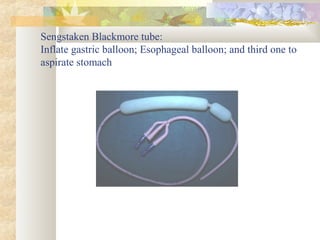
Sengstaken Blackmore tube:
Inflate gastric balloon; Esophageal balloon; and third one to
aspirate stomach
Cirrhosis: Complications and treatment
Splenomegaly, acites and peripheral edema
 Spleen enlarges from blood shunted from portal
hypertension. Blood cells destroyed
 As liver impairment of synthesis of albumin
occurs have accumulation plasma-rich fluid in
abd cavity- ascites (abd distention & wt gain)
 Treat ascites- diuretics (aldactone), paracentesis,
diet (hi CHO, low fat, low Na
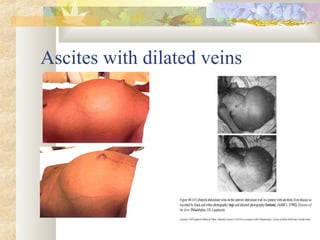
Ascites with dilated veins
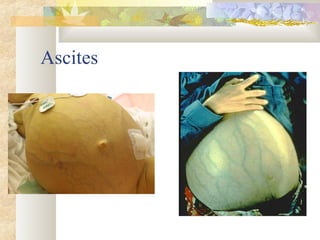
Ascites
Cirrhosis: Complications & treatment
Hepatic encephalopathy
 Protein (from food or blood in GI) is broken
down (with the aid of bacteria) in GI to ammonia
 Liver then converts ammonia to urea and is
excreted by kidneys
 With liver failure have accumulation of ammonia
in blood. Ammonia then enters brain and
interferes with function of brain- encephalopathy
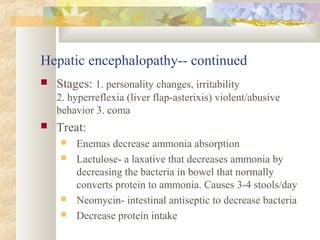
Hepatic encephalopathy-- continued
 Stages: 1. personality changes, irritability
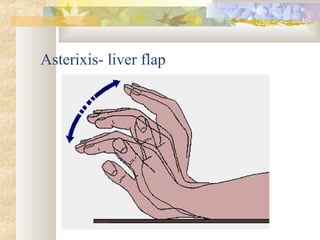
2. hyperreflexia (liver flap-asterixis) violent/abusive
behavior 3. coma
 Treat:
 Enemas decrease ammonia absorption
 Lactulose- a laxative that decreases ammonia by
decreasing the bacteria in bowel that normally
converts protein to ammonia. Causes 3-4 stools/day
 Neomycin- intestinal antiseptic to decrease bacteria
 Decrease protein intake
Asterixis- liver flap
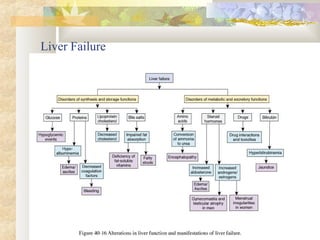
Liver Failure
Cirrhosis:
Therapeutic intervention
 Diagnostic tests-
 Liver function test ALT, AST- not as high as
hepatitis;
 CBC platelets (anemia, thrombocytopenia)
 Coagulation studies (lack Vit K- prolonged PT)
 Bilirubin (elevated); ammonia (elevated)
 Serum albumin (hypoalbuminemia)
 Abdominal ultrasound (liver size/nodular, ascitis)
 Esophagoscopy- varices
 Liver biopsy(p 590) not done if bleeding time
elevated
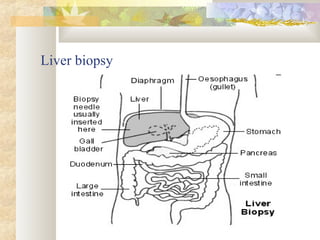
Liver biopsy
Cirrhosis
Therapeutic Interventions cont
 Medications:
 Avoid *drugs metabolized by the liver and drugs toxic to liver-
sedatives, hynotics, actaminophen, and alcohol.
 Diuretics to reduce ascites
 Lactulose (laxative) and neomycin (antibiotic) to dec ammonia-
hepatic encephalopathy
 Vit K to reduce risk bleeding
 Beta-blockers to prevent esophegeal varices from rebleeding
 Ferrous sulfate and folic acid to treat anemia
 Antacids decrease acute gastritis
Cirrhosis:
Therapeutic interventions cont
 Dietary and fluid
 Restricted fluid/Na intake based on response to
diuretic therapy, urine output and electrolyte values
 Hi calories; Hi CHO; low fat
 Surgery
 Surgery to treat complications
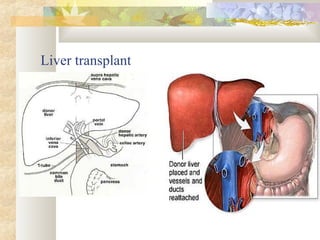
 Liver transplant (Lewis p 1087)
Liver transplant
Cirrhosis:
Nursing Assessment specific to Cirrhosis
 Health history
 Current symptoms, altered bowel; excess bleeding;
abdominal distention; jaundice; pruritus; history liver
or gallbladder disease; alchohol history
 Physical assessment
 VS; mental status, color skin; peripheral pulses and
edema; abd assessment; bowel sounds; abd girth;
tenderness and liver size
Cirrhosis:
Pertinent Nursing problems/Care
 Health promotion
 Patient family teaching guides
 Acute intervention
 Ambulatory home care
 Imbalance nutrition less than body reequirements
 Dysfunctional family process: alcoholism
 Excess fluid volume
 Potential complication: hemorrhage; hepatic
encephalopathy
Cirrhosis

Cirrhosis

  • 1.
  • 2.
  • 5.
  • 6.
    Answers from previousslide  A. Liver  B. Hepatic vein- blood from liver  C. Hepatic artery- oxygenated blood to liver  D. Portal vein- partly O2 blood to liver  E. Common bile duct  F. Stomach  G. Cystic duct  H. Gallbladder
  • 7.
  • 8.
     Symptoms ofliver failure appear when 80% liver destroyed  Liver can regenerate itself if adequate nutrition and no alcohol
  • 9.
    Liver functions  1.Metabolic functions  CHO- liver removes glucose from blood, stores it as glycogen, breaks it down to release glucose PRN  Protein- converts ammonia to urea**  Protein (food/blood) is 1st broken down by bacteria in GI to form ammonia. Ammonia to liver which converts to urea.  Fat- ketogenesis. (see next slide- bile)  Steriod- aldosterone metabolism (liver damage= inc levels aldosterone causing Na & H2O retention)
  • 10.
    2. Bile synthesis& secretion- Bile aids digestion/absorption fats in small intestine. Indirect bilirubin broken down & excreted stool 3. Storage- Vitamin A, all B’s, D, E, and K 4. Regulates blood coagulation**-Forms prothrombin, fibrinogen, heparin If decrease Vit K & fibrinogen= increase fibrinolysis, & decrease platelets> hemorrhage 5. Detoxification** -Rids body of endogenous waste- drugs, bacteria, etc 6. Heat production 7. Phagocyte action- breakdown old RBC, WBC, bacteria
  • 12.
    Cirrhosis of theliver: Etiology/pathophysiology  End stage of chronic liver disease  Functional liver tissue destroyed and replaced by fibrous scar tissue  Metabolic functions are lost; blood and bile flow in liver is disrupted, portal hypertension develops  Types: Alcoholic/nutritional (common); biliary (chronic biliary obstruction); postnecrotic (hepatitis B or C; toxic substances); cardiac
  • 14.
  • 15.
  • 16.
    Alcoholic/nutritional cirrhosis  Mostcommon cause of cirrhosis with resultant lack of nutrition  Stage 1: metabolic changes affect fatty metabolism, fat accumulates in liver. In this stage abstinence from alcohol could allow liver to heal  Stage 2: With continued use of alcohol, inflammatory cells infiltrate the liver causing necrosis, fibrosis and destruction of liver  Stage 3: regenerative nodules form- liver shrinks
  • 18.
    Cirrhosis of liver:Complication & treatment Portal hypertension  Fibrous connective tissue in liver disrupt blood and bile flow. Portal and hepatic veins become compressed.  With backup of blood have acites, splenomegaly, peripheral edema, increase blood cell destruction- anemia, low WBC and low platelets  Treatment: medication to control hypertension, diuretics to decrease fluid retention/acites and TIPS procedure to increase blood flow
  • 19.
    TIPS procedure- Noteshunt that will divert blood- relieving hypertension & esophegeal varcies
  • 20.
    Cirrhosis: complication &treatment Esophageal varices  As a result of portal hypertension, veins in esophagus, rectum and abdomen become engorged/congested resulting in esophageal and gastric varices (major concern- can bleed out)  60% esophageal varices occur with cirrhosis  Treat-  Medications: vasopressin (control bleeding), beta blockers (prevent bleeding), blood replace, Vit K  Surgery: shunt (TIPS), ligation varices, banding  Sengstaken-Blakemeore tube (tamponade bleeding)
  • 22.
  • 23.
    Sengstaken Blackmore tube: Inflategastric balloon; Esophageal balloon; and third one to aspirate stomach
  • 25.
    Cirrhosis: Complications andtreatment Splenomegaly, acites and peripheral edema  Spleen enlarges from blood shunted from portal hypertension. Blood cells destroyed  As liver impairment of synthesis of albumin occurs have accumulation plasma-rich fluid in abd cavity- ascites (abd distention & wt gain)  Treat ascites- diuretics (aldactone), paracentesis, diet (hi CHO, low fat, low Na
  • 26.
  • 27.
  • 28.
    Cirrhosis: Complications &treatment Hepatic encephalopathy  Protein (from food or blood in GI) is broken down (with the aid of bacteria) in GI to ammonia  Liver then converts ammonia to urea and is excreted by kidneys  With liver failure have accumulation of ammonia in blood. Ammonia then enters brain and interferes with function of brain- encephalopathy
  • 29.
    Hepatic encephalopathy-- continued Stages: 1. personality changes, irritability 2. hyperreflexia (liver flap-asterixis) violent/abusive behavior 3. coma  Treat:  Enemas decrease ammonia absorption  Lactulose- a laxative that decreases ammonia by decreasing the bacteria in bowel that normally converts protein to ammonia. Causes 3-4 stools/day  Neomycin- intestinal antiseptic to decrease bacteria  Decrease protein intake
  • 30.
  • 31.
  • 33.
    Cirrhosis: Therapeutic intervention  Diagnostictests-  Liver function test ALT, AST- not as high as hepatitis;  CBC platelets (anemia, thrombocytopenia)  Coagulation studies (lack Vit K- prolonged PT)  Bilirubin (elevated); ammonia (elevated)  Serum albumin (hypoalbuminemia)  Abdominal ultrasound (liver size/nodular, ascitis)  Esophagoscopy- varices  Liver biopsy(p 590) not done if bleeding time elevated
  • 34.
  • 35.
    Cirrhosis Therapeutic Interventions cont Medications:  Avoid *drugs metabolized by the liver and drugs toxic to liver- sedatives, hynotics, actaminophen, and alcohol.  Diuretics to reduce ascites  Lactulose (laxative) and neomycin (antibiotic) to dec ammonia- hepatic encephalopathy  Vit K to reduce risk bleeding  Beta-blockers to prevent esophegeal varices from rebleeding  Ferrous sulfate and folic acid to treat anemia  Antacids decrease acute gastritis
  • 36.
    Cirrhosis: Therapeutic interventions cont Dietary and fluid  Restricted fluid/Na intake based on response to diuretic therapy, urine output and electrolyte values  Hi calories; Hi CHO; low fat  Surgery  Surgery to treat complications  Liver transplant (Lewis p 1087)
  • 37.
  • 38.
    Cirrhosis: Nursing Assessment specificto Cirrhosis  Health history  Current symptoms, altered bowel; excess bleeding; abdominal distention; jaundice; pruritus; history liver or gallbladder disease; alchohol history  Physical assessment  VS; mental status, color skin; peripheral pulses and edema; abd assessment; bowel sounds; abd girth; tenderness and liver size
  • 39.
    Cirrhosis: Pertinent Nursing problems/Care Health promotion  Patient family teaching guides  Acute intervention  Ambulatory home care  Imbalance nutrition less than body reequirements  Dysfunctional family process: alcoholism  Excess fluid volume  Potential complication: hemorrhage; hepatic encephalopathy