

DIAGNOSIS AND CORRECTION OF READING DIFFICULTIES, LEVEL II CIRG 654  Holly Miles and Tarabeth Brumfield
Group Brainstorm What issues might you face as a Literacy Coach/Facilitator by using various assessment and selecting appropriate materials?
Agenda The Role of the Literacy Facilitator Interventionist Literacy Coach Professional Developer (Learning Community) Habitats  – A Case Study on Leadership
Chapter 10 :  Literacy Coaching and Teacher Development Read the introductory paragraph on page 161.  Be prepared to discuss a  community of practice .
The Role of the Literacy Facilitator Interventionist Literacy Coach Professional Developer aka Leader of Learning Communities
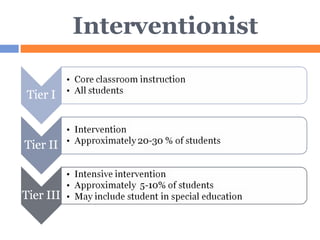
Interventionist
The Role of the Literacy Facilitator Interventionist Literacy Coach Professional Developer aka Leader of Learning Communities
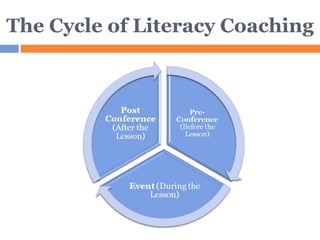
The Cycle of Literacy Coaching
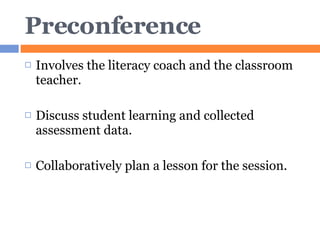
Preconference Involves the literacy coach and the classroom teacher. Discuss student learning and collected assessment data. Collaboratively plan a lesson for the session.
Event Classroom Teacher  implements agreed upon techniques (discussed in preconference) After lesson, teacher jots down thoughts and observations. Literacy Coach  observes classroom interactions and student learning collection observational data to analyze
Post Conference Involves the literacy coach and the classroom teacher. Discuss student learning and teacher behaviors.
Why Use this Model? The Literacy Coach and the Classroom Teacher take part in joint analysis and problem solving strategies to figure out what instructional adjustments would further enhance student engagement and subsequent learning. It is a means for continuous teacher development that results in student learning!
The Role of the Literacy Facilitator Interventionist Literacy Coach Professional Developer  aka Leader of Learning Communities
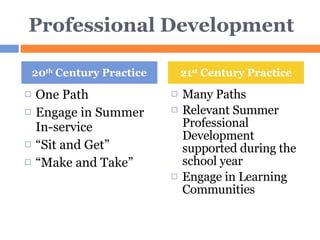
Professional Development One Path Engage in Summer In-service  “ Sit and Get” “ Make and Take” Many Paths Relevant Summer Professional Development supported during the school year Engage in Learning Communities 20 th  Century Practice 21 st  Century Practice
Why create a  professional learning community? Shared Leadership High Quality Professional Development Improved Student Learning WHY?
Framework for Shared Leadership Skim the article by Linda Lambert  (pp. 1-2) Note ideas and quotes that surprised you or affirmed your beliefs about school culture Share with your partner.
The nature of the relationships among the adults who inhabit a school has more to do with the school's quality and character, and with the accomplishment of its pupils than any other factor. Roland S. Barth
“ The least common form of relationship among adults in schools and universities is one that is collegial, cooperative, and interdependent.”
Heart By-pass Death Rate Drops 25% When Surgeons Share Know-How Twenty-three practicing surgeons and their staffs in three New England states observed one another in the operating room and shared their know-how "We didn't invent anything new; we got better at doing the things we already do." Seventy-four patients who were expected to die did not. Researchers believe the methods could be applied in other fields. Research conducted at Dartmouth Medical School, Lebanon, NH; March, 1996
Collegiality is the presence of four specific behaviors: Adults in schools talk about the practice of teaching and learning frequently. They work on the curriculum together by planning, designing, researching, and evaluating it. They observe each other teaching and administrating. They teach each other what they know about teaching, learning, and leading.
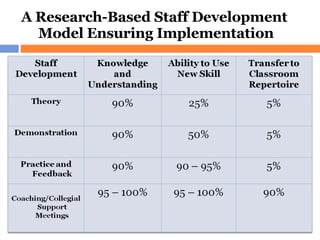
A Research-Based Staff Development  Model   Ensuring Implementation
What do you mean . . . a professional learning community?
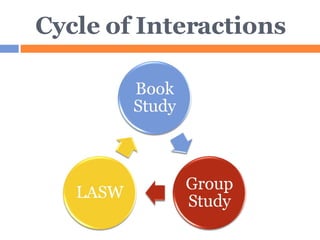
Cycle of Interactions
In Conclusion… Quality Teacher Development: Is grounded in inquiry, reflection, and experimentation, Is collaborative involving a sharing of knowledge and focuses on teachers’ community of practice rather than individual teachers, Is sustained, on-going, intensive and supported by the literacy coach, Is coupled with and resulting from teachers work with their students, Occurs in a community of practice.
What issues will I have to face as literacy coach and professional developer? Being a Leader
“ Habitats” A case study discussing leadership
Outline of Study Time to read (15 min) Understanding different perspectives (45 min) Written Reflection (15 min)
Number off in threes 1 = Gina  2 = Pat  3 = Maureen Move to “expert” groups to consider questions for your character Divide into smaller groups Appoint a recorder Use the questions to try to understand the perspective of your character – record your analysis to share with the whole group. Understanding Perspectives
Guiding Questions:  Gina’s Perspective How would Gina explain her coaching role to another teacher? Cite the evidence from the case on which you base your answer. What adjectives would you use to describe Gina’s approach to her role as coach to Pat? What seems to be most challenging about the coaching role for Gina?
Guiding Questions: Pat’s Perspective What does Pat believe Gina’s role as her coach to be? What evidence illustrates these beliefs? What adjectives would you use to describe Pat’s view of being coached by Gina? What are Pat’s concerns about the coaching relationship?
Guiding Questions: Maureen’s Perspective Put yourself in Maureen’s place and look at the coaching relationship between Gina and Pat.  What are Maureen’s beliefs about the coaching relationship? What evidence of those beliefs do you find in the text?
Final Reflection:   Consider at least one of the first three questions below and then respond to the final question. In this situation, imagine that you are Gina. What would you be thinking or feeling about your coaching relationship with Pat? What would your intention or goal be in coaching Pat? Has a colleague ever coached you? What did that colleague say to you?  What was his or her intention? How did that feel to you? Reflect on an experience in which you acted as a coach or imagine a situation in which you could possibly be a coach.  Describe that situation.  What did (would) you do as a coach? Look back over your response(s).  How would you characterize your own beliefs and expectations about coaching a colleague?

Cirg 654 Class Meeting #3.Pptx

  • 1.
    DIAGNOSIS AND CORRECTIONOF READING DIFFICULTIES, LEVEL II CIRG 654 Holly Miles and Tarabeth Brumfield
  • 2.
    Group Brainstorm Whatissues might you face as a Literacy Coach/Facilitator by using various assessment and selecting appropriate materials?
  • 3.
    Agenda The Roleof the Literacy Facilitator Interventionist Literacy Coach Professional Developer (Learning Community) Habitats – A Case Study on Leadership
  • 4.
    Chapter 10 : Literacy Coaching and Teacher Development Read the introductory paragraph on page 161. Be prepared to discuss a community of practice .
  • 5.
    The Role ofthe Literacy Facilitator Interventionist Literacy Coach Professional Developer aka Leader of Learning Communities
  • 6.
  • 7.
    The Role ofthe Literacy Facilitator Interventionist Literacy Coach Professional Developer aka Leader of Learning Communities
  • 8.
    The Cycle ofLiteracy Coaching
  • 9.
    Preconference Involves theliteracy coach and the classroom teacher. Discuss student learning and collected assessment data. Collaboratively plan a lesson for the session.
  • 10.
    Event Classroom Teacher implements agreed upon techniques (discussed in preconference) After lesson, teacher jots down thoughts and observations. Literacy Coach observes classroom interactions and student learning collection observational data to analyze
  • 11.
    Post Conference Involvesthe literacy coach and the classroom teacher. Discuss student learning and teacher behaviors.
  • 12.
    Why Use thisModel? The Literacy Coach and the Classroom Teacher take part in joint analysis and problem solving strategies to figure out what instructional adjustments would further enhance student engagement and subsequent learning. It is a means for continuous teacher development that results in student learning!
  • 13.
    The Role ofthe Literacy Facilitator Interventionist Literacy Coach Professional Developer aka Leader of Learning Communities
  • 14.
    Professional Development OnePath Engage in Summer In-service “ Sit and Get” “ Make and Take” Many Paths Relevant Summer Professional Development supported during the school year Engage in Learning Communities 20 th Century Practice 21 st Century Practice
  • 15.
    Why create a professional learning community? Shared Leadership High Quality Professional Development Improved Student Learning WHY?
  • 16.
    Framework for SharedLeadership Skim the article by Linda Lambert (pp. 1-2) Note ideas and quotes that surprised you or affirmed your beliefs about school culture Share with your partner.
  • 17.
    The nature ofthe relationships among the adults who inhabit a school has more to do with the school's quality and character, and with the accomplishment of its pupils than any other factor. Roland S. Barth
  • 18.
    “ The leastcommon form of relationship among adults in schools and universities is one that is collegial, cooperative, and interdependent.”
  • 19.
    Heart By-pass DeathRate Drops 25% When Surgeons Share Know-How Twenty-three practicing surgeons and their staffs in three New England states observed one another in the operating room and shared their know-how "We didn't invent anything new; we got better at doing the things we already do." Seventy-four patients who were expected to die did not. Researchers believe the methods could be applied in other fields. Research conducted at Dartmouth Medical School, Lebanon, NH; March, 1996
  • 20.
    Collegiality is thepresence of four specific behaviors: Adults in schools talk about the practice of teaching and learning frequently. They work on the curriculum together by planning, designing, researching, and evaluating it. They observe each other teaching and administrating. They teach each other what they know about teaching, learning, and leading.
  • 21.
    A Research-Based StaffDevelopment Model Ensuring Implementation
  • 22.
    What do youmean . . . a professional learning community?
  • 23.
  • 24.
    In Conclusion… QualityTeacher Development: Is grounded in inquiry, reflection, and experimentation, Is collaborative involving a sharing of knowledge and focuses on teachers’ community of practice rather than individual teachers, Is sustained, on-going, intensive and supported by the literacy coach, Is coupled with and resulting from teachers work with their students, Occurs in a community of practice.
  • 25.
    What issues willI have to face as literacy coach and professional developer? Being a Leader
  • 26.
    “ Habitats” Acase study discussing leadership
  • 27.
    Outline of StudyTime to read (15 min) Understanding different perspectives (45 min) Written Reflection (15 min)
  • 28.
    Number off inthrees 1 = Gina 2 = Pat 3 = Maureen Move to “expert” groups to consider questions for your character Divide into smaller groups Appoint a recorder Use the questions to try to understand the perspective of your character – record your analysis to share with the whole group. Understanding Perspectives
  • 29.
    Guiding Questions: Gina’s Perspective How would Gina explain her coaching role to another teacher? Cite the evidence from the case on which you base your answer. What adjectives would you use to describe Gina’s approach to her role as coach to Pat? What seems to be most challenging about the coaching role for Gina?
  • 30.
    Guiding Questions: Pat’sPerspective What does Pat believe Gina’s role as her coach to be? What evidence illustrates these beliefs? What adjectives would you use to describe Pat’s view of being coached by Gina? What are Pat’s concerns about the coaching relationship?
  • 31.
    Guiding Questions: Maureen’sPerspective Put yourself in Maureen’s place and look at the coaching relationship between Gina and Pat. What are Maureen’s beliefs about the coaching relationship? What evidence of those beliefs do you find in the text?
  • 32.
    Final Reflection: Consider at least one of the first three questions below and then respond to the final question. In this situation, imagine that you are Gina. What would you be thinking or feeling about your coaching relationship with Pat? What would your intention or goal be in coaching Pat? Has a colleague ever coached you? What did that colleague say to you? What was his or her intention? How did that feel to you? Reflect on an experience in which you acted as a coach or imagine a situation in which you could possibly be a coach. Describe that situation. What did (would) you do as a coach? Look back over your response(s). How would you characterize your own beliefs and expectations about coaching a colleague?