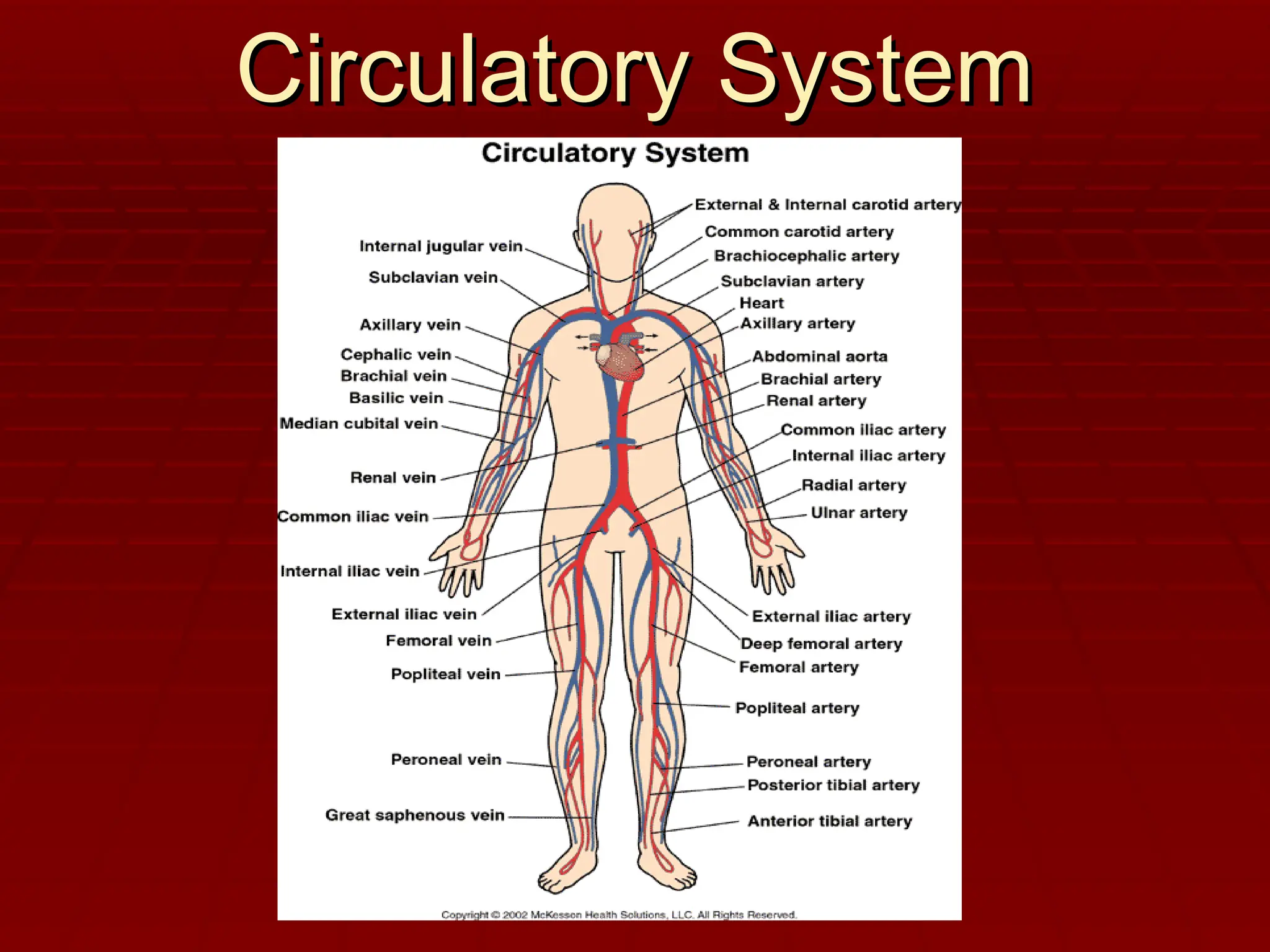
Circulatory System
Circulatory System
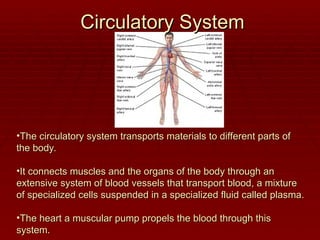
•The circulatory system transports materials to different parts of
The circulatory system transports materials to different parts of
the body.
the body.
•It connects muscles and the organs of the body through an
It connects muscles and the organs of the body through an
extensive system of blood vessels that transport blood, a mixture
of specialized cells suspended in a specialized fluid called plasma.
•The heart a muscular pump propels the blood through this
The heart a muscular pump propels the blood through this
system.
system.
Circulatory System
Circulatory System
Circulatory System
Circulatory System
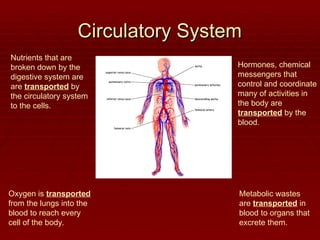
Nutrients that are
broken down by the
digestive system are
are transported by
the circulatory system
to the cells.
Oxygen is transported
from the lungs into the
blood to reach every
cell of the body.
Metabolic wastes
are transported in
blood to organs that
excrete them.
Hormones, chemical
messengers that
control and coordinate
many of activities in
the body are
transported by the
blood.
Circulatory System
Circulatory System
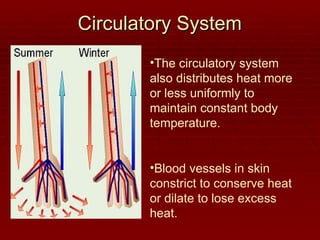
•The circulatory system
also distributes heat more
or less uniformly to
maintain constant body
temperature.
•Blood vessels in skin
constrict to conserve heat
or dilate to lose excess
heat.
Circulatory System
Circulatory System
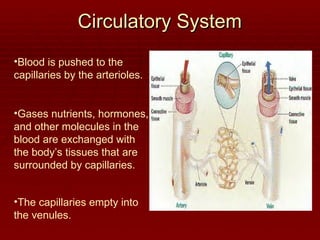
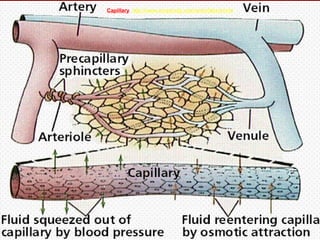
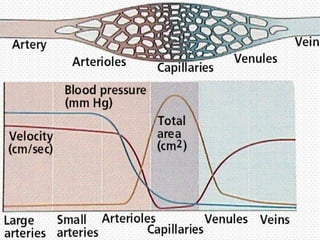
•Blood is pushed to the
capillaries by the arterioles.
•Gases nutrients, hormones,
and other molecules in the
blood are exchanged with
the body’s tissues that are
surrounded by capillaries.
•The capillaries empty into
the venules.
Circulatory System
Circulatory System
 Arteries
Arteries – vessels that carry blood away from
– vessels that carry blood away from
the heart to the body’s organs and tissues.
Contains thick smooth muscle. Are under high
pressure.
pressure.
 Capillaries
Capillaries – tiny blood vessels that allow
– tiny blood vessels that allow
exchange between blood and cells that make up
tissues. Contains no smooth muscle.
 Veins
Veins – large blood vessels that carry blood
– large blood vessels that carry blood
toward the heart. Contains thin smooth muscle
and valves. Are under lower pressure.
Capillary http://www.innerbody.com/anim/blood.html
Circulatory System
Circulatory System
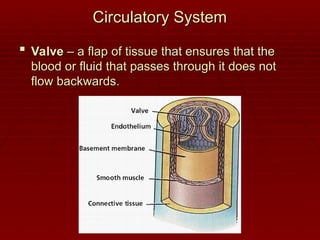
 Valve
Valve – a flap of tissue that ensures that the
– a flap of tissue that ensures that the
blood or fluid that passes through it does not
flow backwards.
flow backwards.
Circulatory System
Circulatory System
•Plasma – non-cellular portion of blood (a liquid).
•Red Blood Cells – cells in blood that carry oxygen.
White Blood Cells – cells in blood whose primary
job is to defend the body against disease.
•Platelets –un-nucleated cell fragments that aid in
blood clotting.
Circulatory System
Circulatory System
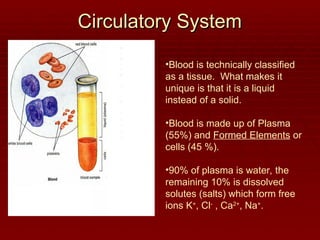
•Blood is technically classified
as a tissue. What makes it
unique is that it is a liquid
instead of a solid.
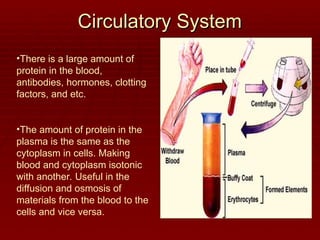
•Blood is made up of Plasma
(55%) and Formed Elements or
cells (45 %).
•90% of plasma is water, the
remaining 10% is dissolved
solutes (salts) which form free
ions K+
, Cl-
, Ca2+
, Na+
.
Circulatory System
Circulatory System
•There is a large amount of
protein in the blood,
antibodies, hormones, clotting
factors, and etc.
•The amount of protein in the
plasma is the same as the
cytoplasm in cells. Making
blood and cytoplasm isotonic
with another. Useful in the
diffusion and osmosis of
materials from the blood to the
cells and vice versa.
Circulatory System
Circulatory System
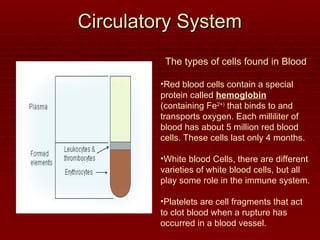
The types of cells found in Blood
•Red blood cells contain a special
protein called hemoglobin
(containing Fe2+)
that binds to and
transports oxygen. Each milliliter of
blood has about 5 million red blood
cells. These cells last only 4 months.
•White blood Cells, there are different
varieties of white blood cells, but all
play some role in the immune system.
•Platelets are cell fragments that act
to clot blood when a rupture has
occurred in a blood vessel.
Circulatory System
Circulatory System
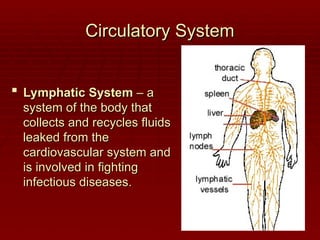
 Lymphatic System
Lymphatic System – a
– a
system of the body that
collects and recycles fluids
leaked from the
leaked from the
cardiovascular system and
is involved in fighting
infectious diseases.
Circulatory System
Circulatory System
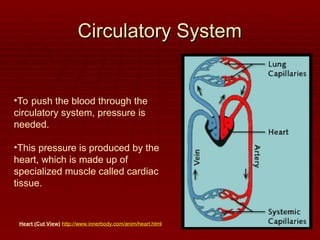
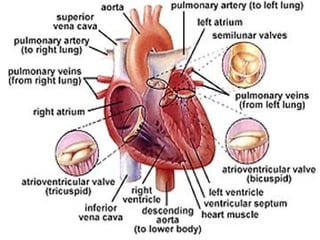
•To push the blood through the
circulatory system, pressure is
needed.
•This pressure is produced by the
heart, which is made up of
specialized muscle called cardiac
tissue.
Heart (Cut View) http://www.innerbody.com/anim/heart.html
Circulatory System
Circulatory System
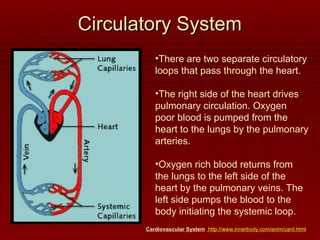
•There are two separate circulatory
loops that pass through the heart.
•The right side of the heart drives
pulmonary circulation. Oxygen
poor blood is pumped from the
heart to the lungs by the pulmonary
arteries.
•Oxygen rich blood returns from
the lungs to the left side of the
heart by the pulmonary veins. The
left side pumps the blood to the
body initiating the systemic loop.
Cardiovascular System http://www.innerbody.com/anim/card.html
Circulatory System
Circulatory System
• Atria - chambers that receives blood returning
to the heart. Smaller chambers on the top of the
heart.
• Ventricles – thick walled heart chamber that
pumps blood away from the heart. Larger
chamber s on the bottom of the heart.
• Inferior and Superior Venae Cava – veins that
collect all of the oxygen poor blood from the
body. Largest Vein in the body.
Circulatory System
Circulatory System
•Sinoatrial Node – a small cluster of cardiac muscle cells in
the upper wall of the right atrium that initiates and regulates
contraction of the heart.
•Aorta – main artery in the body; receives blood form the left
ventricle.
•Coronary Arteries – are arteries that branch from the aorta
and carry blood to the heart muscle.
•Stroke – a sudden attack of weakness or paralysis that occurs
when an area of the brain dies after blood flow to the brain is
interrupted.
Circulatory System
Circulatory System
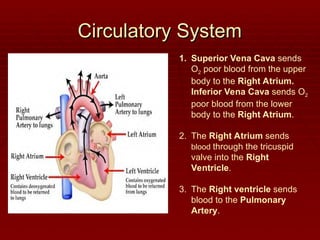
1. Superior Vena Cava sends
O2 poor blood from the upper
body to the Right Atrium.
Inferior Vena Cava sends O2
poor blood from the lower
body to the Right Atrium.
2. The Right Atrium sends
blood through the tricuspid
valve into the Right
Ventricle.
3. The Right ventricle sends
blood to the Pulmonary
Artery.
Circulatory System
Circulatory System
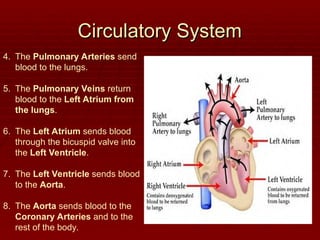
4. The Pulmonary Arteries send
blood to the lungs.
5. The Pulmonary Veins return
blood to the Left Atrium from
the lungs.
6. The Left Atrium sends blood
through the bicuspid valve into
the Left Ventricle.
7. The Left Ventricle sends blood
to the Aorta.
8. The Aorta sends blood to the
Coronary Arteries and to the
rest of the body.
Circulatory System
Circulatory System
 The heart pumps about
The heart pumps about 72 times a minute
72 times a minute.
.
This number decreases during sleep and
increases during strenuous activity.
 Heart disease is one of the leading causes
Heart disease is one of the leading causes
of death among humans. Health
professionals use different methods to
monitor the heart.
monitor the heart.
Circulatory System
Circulatory System
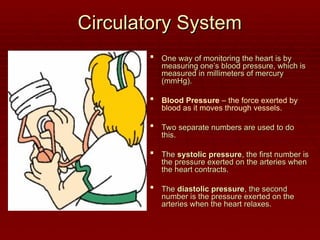
 One way of monitoring the heart is by
One way of monitoring the heart is by
measuring one’s blood pressure, which is
measured in millimeters of mercury
(mmHg).
(mmHg).
 Blood Pressure – the force exerted by
blood as it moves through vessels.
 Two separate numbers are used to do
Two separate numbers are used to do
this.
this.
 The
The systolic pressure
systolic pressure, the first number is
, the first number is
the pressure exerted on the arteries when
the heart contracts.
 The
The diastolic pressure
diastolic pressure, the second
, the second
number is the pressure exerted on the
arteries when the heart relaxes.
Circulatory System
Circulatory System
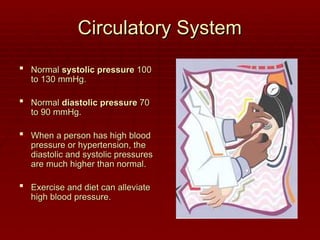
 Normal
Normal systolic pressure
systolic pressure 100
100
to 130 mmHg.
to 130 mmHg.
 Normal
Normal diastolic pressure
diastolic pressure 70
70
to 90 mmHg.
to 90 mmHg.
 When a person has high blood
When a person has high blood
pressure or hypertension, the
diastolic and systolic pressures
are much higher than normal.
 Exercise and diet can alleviate
Exercise and diet can alleviate
high blood pressure.
Circulatory System
Circulatory System
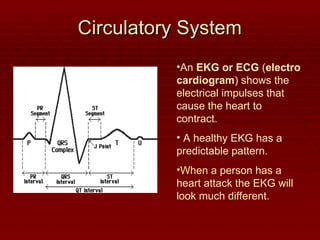
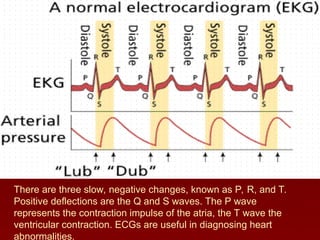
•An EKG or ECG (electro
cardiogram) shows the
electrical impulses that
cause the heart to
contract.
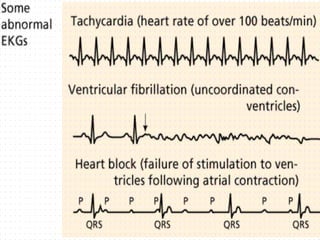
• A healthy EKG has a
predictable pattern.
•When a person has a
heart attack the EKG will
look much different.
There are three slow, negative changes, known as P, R, and T.
Positive deflections are the Q and S waves. The P wave
represents the contraction impulse of the atria, the T wave the
ventricular contraction. ECGs are useful in diagnosing heart
abnormalities.
Circulatory System
Circulatory System
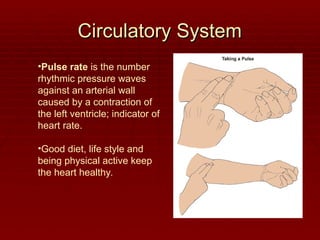
•Pulse rate is the number
rhythmic pressure waves
against an arterial wall
caused by a contraction of
the left ventricle; indicator of
heart rate.
•Good diet, life style and
being physical active keep
the heart healthy.
Circulatory System
Circulatory System
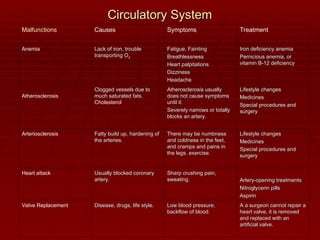
Malfunctions Causes Symptoms Treatment
Anemia Lack of iron, trouble
Lack of iron, trouble
transporting O
transporting O2
2
Fatigue, Fainting
Fatigue, Fainting
Breathlessness
Breathlessness
Heart palpitations
Heart palpitations
Dizziness
Dizziness
Headache
Headache
Iron deficiency anemia
Pernicious anemia, or
vitamin B-12 deficiency
Atherosclerosis
Clogged vessels due to
much saturated fats.
Cholesterol
Atherosclerosis usually
does not cause symptoms
until it:
until it:
Severely narrows or totally
blocks an artery.
blocks an artery.
Lifestyle changes
Lifestyle changes
Medicines
Medicines
Special procedures and
surgery
surgery
Arteriosclerosis Fatty build up, hardening of
Fatty build up, hardening of
the arteries.
the arteries.
There may be numbness
and coldness in the feet,
and cramps and pains in
the legs. exercise.
the legs. exercise.
Lifestyle changes
Lifestyle changes
Medicines
Medicines
Special procedures and
surgery
surgery
Heart attack Usually blocked coronary
Usually blocked coronary
artery.
artery.
Sharp crushing pain,
sweating.
sweating. Artery-opening treatments
Artery-opening treatments
Nitroglycerin pills
Nitroglycerin pills
Aspirin
Aspirin
Valve Replacement Disease, drugs, life style.
Disease, drugs, life style. Low blood pressure,
Low blood pressure,
backflow of blood.
backflow of blood.
A a surgeon cannot repair a
heart valve, it is removed
and replaced with an
artificial valve.
artificial valve.
Circulatory System
Circulatory System
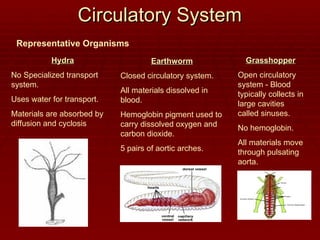
Representative Organisms
Hydra
Hydra
No Specialized transport
system.
Uses water for transport.
Materials are absorbed by
diffusion and cyclosis
Earthworm
Earthworm
Closed circulatory system.
All materials dissolved in
blood.
Hemoglobin pigment used to
carry dissolved oxygen and
carbon dioxide.
5 pairs of aortic arches.
Grasshopper
Grasshopper
Open circulatory
system - Blood
typically collects in
large cavities
called sinuses.
No hemoglobin.
All materials move
through pulsating
aorta.

Circulatory System Notes PLEASE STUDY NICELY

  • 1.
  • 2.
    •The circulatory systemtransports materials to different parts of The circulatory system transports materials to different parts of the body. the body. •It connects muscles and the organs of the body through an It connects muscles and the organs of the body through an extensive system of blood vessels that transport blood, a mixture extensive system of blood vessels that transport blood, a mixture of specialized cells suspended in a specialized fluid called plasma. of specialized cells suspended in a specialized fluid called plasma. •The heart a muscular pump propels the blood through this The heart a muscular pump propels the blood through this system. system. Circulatory System Circulatory System
  • 3.
    Circulatory System Circulatory System Nutrientsthat are broken down by the digestive system are are transported by the circulatory system to the cells. Oxygen is transported from the lungs into the blood to reach every cell of the body. Metabolic wastes are transported in blood to organs that excrete them. Hormones, chemical messengers that control and coordinate many of activities in the body are transported by the blood.
  • 4.
    Circulatory System Circulatory System •Thecirculatory system also distributes heat more or less uniformly to maintain constant body temperature. •Blood vessels in skin constrict to conserve heat or dilate to lose excess heat.
  • 5.
    Circulatory System Circulatory System •Bloodis pushed to the capillaries by the arterioles. •Gases nutrients, hormones, and other molecules in the blood are exchanged with the body’s tissues that are surrounded by capillaries. •The capillaries empty into the venules.
  • 6.
    Circulatory System Circulatory System Arteries Arteries – vessels that carry blood away from – vessels that carry blood away from the heart to the body’s organs and tissues. the heart to the body’s organs and tissues. Contains thick smooth muscle. Are under high Contains thick smooth muscle. Are under high pressure. pressure.  Capillaries Capillaries – tiny blood vessels that allow – tiny blood vessels that allow exchange between blood and cells that make up exchange between blood and cells that make up tissues. Contains no smooth muscle. tissues. Contains no smooth muscle.  Veins Veins – large blood vessels that carry blood – large blood vessels that carry blood toward the heart. Contains thin smooth muscle toward the heart. Contains thin smooth muscle and valves. Are under lower pressure. and valves. Are under lower pressure.
  • 7.
  • 8.
    Circulatory System Circulatory System Valve Valve – a flap of tissue that ensures that the – a flap of tissue that ensures that the blood or fluid that passes through it does not blood or fluid that passes through it does not flow backwards. flow backwards.
  • 9.
    Circulatory System Circulatory System •Plasma– non-cellular portion of blood (a liquid). •Red Blood Cells – cells in blood that carry oxygen. White Blood Cells – cells in blood whose primary job is to defend the body against disease. •Platelets –un-nucleated cell fragments that aid in blood clotting.
  • 10.
    Circulatory System Circulatory System •Bloodis technically classified as a tissue. What makes it unique is that it is a liquid instead of a solid. •Blood is made up of Plasma (55%) and Formed Elements or cells (45 %). •90% of plasma is water, the remaining 10% is dissolved solutes (salts) which form free ions K+ , Cl- , Ca2+ , Na+ .
  • 11.
    Circulatory System Circulatory System •Thereis a large amount of protein in the blood, antibodies, hormones, clotting factors, and etc. •The amount of protein in the plasma is the same as the cytoplasm in cells. Making blood and cytoplasm isotonic with another. Useful in the diffusion and osmosis of materials from the blood to the cells and vice versa.
  • 12.
    Circulatory System Circulatory System Thetypes of cells found in Blood •Red blood cells contain a special protein called hemoglobin (containing Fe2+) that binds to and transports oxygen. Each milliliter of blood has about 5 million red blood cells. These cells last only 4 months. •White blood Cells, there are different varieties of white blood cells, but all play some role in the immune system. •Platelets are cell fragments that act to clot blood when a rupture has occurred in a blood vessel.
  • 13.
    Circulatory System Circulatory System Lymphatic System Lymphatic System – a – a system of the body that system of the body that collects and recycles fluids collects and recycles fluids leaked from the leaked from the cardiovascular system and cardiovascular system and is involved in fighting is involved in fighting infectious diseases. infectious diseases.
  • 14.
    Circulatory System Circulatory System •Topush the blood through the circulatory system, pressure is needed. •This pressure is produced by the heart, which is made up of specialized muscle called cardiac tissue. Heart (Cut View) http://www.innerbody.com/anim/heart.html
  • 15.
    Circulatory System Circulatory System •Thereare two separate circulatory loops that pass through the heart. •The right side of the heart drives pulmonary circulation. Oxygen poor blood is pumped from the heart to the lungs by the pulmonary arteries. •Oxygen rich blood returns from the lungs to the left side of the heart by the pulmonary veins. The left side pumps the blood to the body initiating the systemic loop. Cardiovascular System http://www.innerbody.com/anim/card.html
  • 16.
    Circulatory System Circulatory System •Atria - chambers that receives blood returning to the heart. Smaller chambers on the top of the heart. • Ventricles – thick walled heart chamber that pumps blood away from the heart. Larger chamber s on the bottom of the heart. • Inferior and Superior Venae Cava – veins that collect all of the oxygen poor blood from the body. Largest Vein in the body.
  • 17.
    Circulatory System Circulatory System •SinoatrialNode – a small cluster of cardiac muscle cells in the upper wall of the right atrium that initiates and regulates contraction of the heart. •Aorta – main artery in the body; receives blood form the left ventricle. •Coronary Arteries – are arteries that branch from the aorta and carry blood to the heart muscle. •Stroke – a sudden attack of weakness or paralysis that occurs when an area of the brain dies after blood flow to the brain is interrupted.
  • 18.
    Circulatory System Circulatory System 1.Superior Vena Cava sends O2 poor blood from the upper body to the Right Atrium. Inferior Vena Cava sends O2 poor blood from the lower body to the Right Atrium. 2. The Right Atrium sends blood through the tricuspid valve into the Right Ventricle. 3. The Right ventricle sends blood to the Pulmonary Artery.
  • 19.
    Circulatory System Circulatory System 4.The Pulmonary Arteries send blood to the lungs. 5. The Pulmonary Veins return blood to the Left Atrium from the lungs. 6. The Left Atrium sends blood through the bicuspid valve into the Left Ventricle. 7. The Left Ventricle sends blood to the Aorta. 8. The Aorta sends blood to the Coronary Arteries and to the rest of the body.
  • 21.
    Circulatory System Circulatory System The heart pumps about The heart pumps about 72 times a minute 72 times a minute. . This number decreases during sleep and This number decreases during sleep and increases during strenuous activity. increases during strenuous activity.  Heart disease is one of the leading causes Heart disease is one of the leading causes of death among humans. Health of death among humans. Health professionals use different methods to professionals use different methods to monitor the heart. monitor the heart.
  • 22.
    Circulatory System Circulatory System One way of monitoring the heart is by One way of monitoring the heart is by measuring one’s blood pressure, which is measuring one’s blood pressure, which is measured in millimeters of mercury measured in millimeters of mercury (mmHg). (mmHg).  Blood Pressure – the force exerted by blood as it moves through vessels.  Two separate numbers are used to do Two separate numbers are used to do this. this.  The The systolic pressure systolic pressure, the first number is , the first number is the pressure exerted on the arteries when the pressure exerted on the arteries when the heart contracts. the heart contracts.  The The diastolic pressure diastolic pressure, the second , the second number is the pressure exerted on the number is the pressure exerted on the arteries when the heart relaxes. arteries when the heart relaxes.
  • 24.
    Circulatory System Circulatory System Normal Normal systolic pressure systolic pressure 100 100 to 130 mmHg. to 130 mmHg.  Normal Normal diastolic pressure diastolic pressure 70 70 to 90 mmHg. to 90 mmHg.  When a person has high blood When a person has high blood pressure or hypertension, the pressure or hypertension, the diastolic and systolic pressures diastolic and systolic pressures are much higher than normal. are much higher than normal.  Exercise and diet can alleviate Exercise and diet can alleviate high blood pressure. high blood pressure.
  • 25.
    Circulatory System Circulatory System •AnEKG or ECG (electro cardiogram) shows the electrical impulses that cause the heart to contract. • A healthy EKG has a predictable pattern. •When a person has a heart attack the EKG will look much different.
  • 26.
    There are threeslow, negative changes, known as P, R, and T. Positive deflections are the Q and S waves. The P wave represents the contraction impulse of the atria, the T wave the ventricular contraction. ECGs are useful in diagnosing heart abnormalities.
  • 28.
    Circulatory System Circulatory System •Pulserate is the number rhythmic pressure waves against an arterial wall caused by a contraction of the left ventricle; indicator of heart rate. •Good diet, life style and being physical active keep the heart healthy.
  • 29.
    Circulatory System Circulatory System MalfunctionsCauses Symptoms Treatment Anemia Lack of iron, trouble Lack of iron, trouble transporting O transporting O2 2 Fatigue, Fainting Fatigue, Fainting Breathlessness Breathlessness Heart palpitations Heart palpitations Dizziness Dizziness Headache Headache Iron deficiency anemia Iron deficiency anemia Pernicious anemia, or Pernicious anemia, or vitamin B-12 deficiency vitamin B-12 deficiency Atherosclerosis Clogged vessels due to Clogged vessels due to much saturated fats. much saturated fats. Cholesterol Atherosclerosis usually Atherosclerosis usually does not cause symptoms does not cause symptoms until it: until it: Severely narrows or totally Severely narrows or totally blocks an artery. blocks an artery. Lifestyle changes Lifestyle changes Medicines Medicines Special procedures and Special procedures and surgery surgery Arteriosclerosis Fatty build up, hardening of Fatty build up, hardening of the arteries. the arteries. There may be numbness There may be numbness and coldness in the feet, and coldness in the feet, and cramps and pains in and cramps and pains in the legs. exercise. the legs. exercise. Lifestyle changes Lifestyle changes Medicines Medicines Special procedures and Special procedures and surgery surgery Heart attack Usually blocked coronary Usually blocked coronary artery. artery. Sharp crushing pain, Sharp crushing pain, sweating. sweating. Artery-opening treatments Artery-opening treatments Nitroglycerin pills Nitroglycerin pills Aspirin Aspirin Valve Replacement Disease, drugs, life style. Disease, drugs, life style. Low blood pressure, Low blood pressure, backflow of blood. backflow of blood. A a surgeon cannot repair a A a surgeon cannot repair a heart valve, it is removed heart valve, it is removed and replaced with an and replaced with an artificial valve. artificial valve.
  • 30.
    Circulatory System Circulatory System RepresentativeOrganisms Hydra Hydra No Specialized transport system. Uses water for transport. Materials are absorbed by diffusion and cyclosis Earthworm Earthworm Closed circulatory system. All materials dissolved in blood. Hemoglobin pigment used to carry dissolved oxygen and carbon dioxide. 5 pairs of aortic arches. Grasshopper Grasshopper Open circulatory system - Blood typically collects in large cavities called sinuses. No hemoglobin. All materials move through pulsating aorta.