Data Structure
P. M. Patil
0 1 2 3
Q
0 1 2 3
Q
20
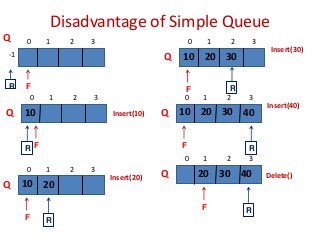
Disadvantage of Simple Queue
40
0 1 2 3
Q
F
R
-1
0 1 2 3
Q Insert(10)
10
F
R
0 1 2 3
Q
Insert(20)
R
10 20
F
0 1 2 3
Q
Insert(30)
R
F
10 20 30
Insert(40)
R
F
10 20 30
40 Delete()
R
F
20 30
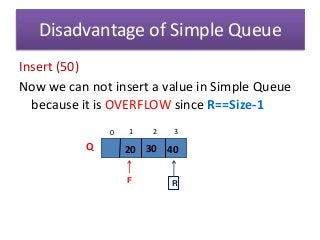
Disadvantage of Simple Queue
Insert (50)
Now we can not insert a value in Simple Queue
because it is OVERFLOW since R==Size-1
0 1 2 3
Q
R
F
40
20 30
Circular Queue
• In CQ we reset the Rear pointer
Operations of CQ
1) Insert
2) Delete
Algorithm for Insert CQ
Procedure CQINSER (F,R,CQ,Size) This procedure will insert an element into CQ which is a circular
queue.F and R are the pointers to the front and rear of the queue respectively. Initially F and
R are set to -1. Item is a temporary variable used.
1.[Reset rear pointer]
If R=Size -1
then R<- 0
Else R<- R+1
2. [Check for overflow]
if F=R
then Write(‘Overflow’)
End If
3. [Insert element in CQ]
Read(Item)
CQ[R]<- Item
Write(‘Item is inserted in CQ’)
4. [Set front properly]
If F=-1
then F<- 0
Else
0 1 2 3
CQ
0 1 2 3
CQ
20
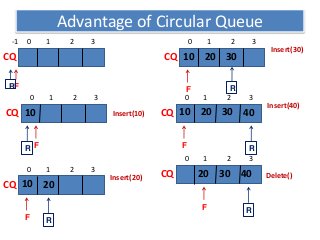
Advantage of Circular Queue
40
0 1 2 3
CQ
F
R
-1
0 1 2 3
CQ Insert(10)
10
F
R
0 1 2 3
CQ
Insert(20)
R
10 20
F
0 1 2 3
CQ
Insert(30)
R
F
10 20 30
Insert(40)
R
F
10 20 30
40 Delete()
R
F
20 30
Advantage of Circular Queue
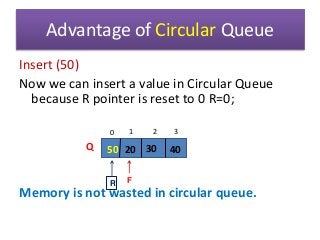
Insert (50)
Now we can insert a value in Circular Queue
because R pointer is reset to 0 R=0;
Memory is not wasted in circular queue.
0 1 2 3
Q
R F
50 20 30 40
Algorithm for Delete CQ
Procedure CQDELETE (F,R,CQ,Size) This procedure will delete an element from the CQ which is a
circular queue. F and R are the pointers to the front and rear of the queue respectively.
Initially F and R are set to -1. Item is a temporary variable used.
1.[Check CQ underflow]
If F = -1
then Write(‘CQ is underflow’)
Endif
2. [delete element]
Item =CQ[F]
Write(‘Item is deleted’)
End If
3. [Reset R and F]
if F=R
then F-1
R=-1
4. [Increment F]
If F= size-1
then F<- 0
Else
F<-F+1

Circular queue

  • 1.
  • 2.
    0 1 23 Q 0 1 2 3 Q 20 Disadvantage of Simple Queue 40 0 1 2 3 Q F R -1 0 1 2 3 Q Insert(10) 10 F R 0 1 2 3 Q Insert(20) R 10 20 F 0 1 2 3 Q Insert(30) R F 10 20 30 Insert(40) R F 10 20 30 40 Delete() R F 20 30
  • 3.
    Disadvantage of SimpleQueue Insert (50) Now we can not insert a value in Simple Queue because it is OVERFLOW since R==Size-1 0 1 2 3 Q R F 40 20 30
  • 4.
    Circular Queue • InCQ we reset the Rear pointer Operations of CQ 1) Insert 2) Delete
  • 5.
    Algorithm for InsertCQ Procedure CQINSER (F,R,CQ,Size) This procedure will insert an element into CQ which is a circular queue.F and R are the pointers to the front and rear of the queue respectively. Initially F and R are set to -1. Item is a temporary variable used. 1.[Reset rear pointer] If R=Size -1 then R<- 0 Else R<- R+1 2. [Check for overflow] if F=R then Write(‘Overflow’) End If 3. [Insert element in CQ] Read(Item) CQ[R]<- Item Write(‘Item is inserted in CQ’) 4. [Set front properly] If F=-1 then F<- 0 Else
  • 6.
    0 1 23 CQ 0 1 2 3 CQ 20 Advantage of Circular Queue 40 0 1 2 3 CQ F R -1 0 1 2 3 CQ Insert(10) 10 F R 0 1 2 3 CQ Insert(20) R 10 20 F 0 1 2 3 CQ Insert(30) R F 10 20 30 Insert(40) R F 10 20 30 40 Delete() R F 20 30
  • 7.
    Advantage of CircularQueue Insert (50) Now we can insert a value in Circular Queue because R pointer is reset to 0 R=0; Memory is not wasted in circular queue. 0 1 2 3 Q R F 50 20 30 40
  • 8.
    Algorithm for DeleteCQ Procedure CQDELETE (F,R,CQ,Size) This procedure will delete an element from the CQ which is a circular queue. F and R are the pointers to the front and rear of the queue respectively. Initially F and R are set to -1. Item is a temporary variable used. 1.[Check CQ underflow] If F = -1 then Write(‘CQ is underflow’) Endif 2. [delete element] Item =CQ[F] Write(‘Item is deleted’) End If 3. [Reset R and F] if F=R then F-1 R=-1 4. [Increment F] If F= size-1 then F<- 0 Else F<-F+1