Linear Data Structure
(Queue)
Data Structures (DS)
GTU # 3130702
Queue
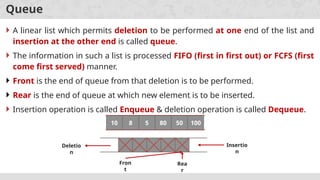
 A linear list which permits deletion to be performed at one end of the list and
insertion at the other end is called queue.
 The information in such a list is processed FIFO (first in first out) or FCFS (first
come first served) manner.
 Front is the end of queue from that deletion is to be performed.
 Rear is the end of queue at which new element is to be inserted.
 Insertion operation is called Enqueue & deletion operation is called Dequeue.
10 50
5 80
8
Rea
r
Fron
t
100
Insertio
n
Deletio
n
Applications of Queue
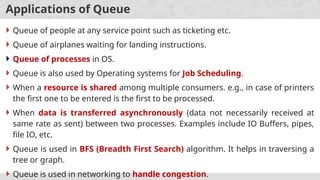
 Queue of people at any service point such as ticketing etc.
 Queue of airplanes waiting for landing instructions.
 Queue of processes in OS.
 Queue is also used by Operating systems for Job Scheduling.
 When a resource is shared among multiple consumers. e.g., in case of printers
the first one to be entered is the first to be processed.
 When data is transferred asynchronously (data not necessarily received at
same rate as sent) between two processes. Examples include IO Buffers, pipes,
file IO, etc.
 Queue is used in BFS (Breadth First Search) algorithm. It helps in traversing a
tree or graph.
 Queue is used in networking to handle congestion.
Procedure: Enqueue (Q, F, R, N,Y)
 This procedure inserts Y at rear end of Queue.
 Queue is represented by a vector Q containing N elements.
 F is pointer to the front element of a queue.
 R is pointer to the rear element of a queue.
1. [Check for Queue Overflow]
If R >= N-1
Then write (‘Queue Overflow’)
Return
2. [Increment REAR pointer]
R  R + 1
3. [Insert element]
Q[R]  Y
4. [Is front pointer properly set?]
IF F=-1
Then F  0
Return
5
N=3, R=-1, F=-
1
F =
R =
-1
-1
Enqueue (Q, F, R,
N=3,Y=5)
0
R
Enqueue (Q, F, R,
N=3,Y=20)
1
20
Enqueue (Q, F, R,
N=3,Y=80)
2
80
Enqueue (Q, F, R,
N=3,Y=3)
Queue Overflow
F
0
Function: Dequeue (Q, F, R)
 This function deletes & returns an element from front end of the Queue.
 Queue is represented by a vector Q containing N elements.
 F is pointer to the front element of a queue.
 R is pointer to the rear element of a queue.
1. [Check for Queue Underflow]
If F = -1
Then write (‘Queue Underflow’)
Return(0)
2. [Delete element]
Y  Q[F]
3. [Is Queue Empty?]
If F = R
Then F  R  -1
Else F  F + 1
4. [Return Element]
Return (Y)
-8 50
Case No
1:
F=-1, R=-1
Queue Underflow
Case No
2:
F=2, R=2
F R
F=-1, R=-
1
Case No
3:
F=0, R=2
F R
50
5
F=1, R=2
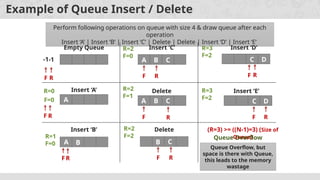
Example of Queue Insert / Delete
F R
Perform following operations on queue with size 4 & draw queue after each
operation
Insert ‘A’ | Insert ‘B’ | Insert ‘C’ | Delete | Delete | Insert ‘D’ | Insert ‘E’
Empty Queue
-1-1
Insert ‘A’
F R
R=0
F=0 A
Insert ‘B’
F
R
A
R=1
F=0 B
Insert ‘C’
A B
F
R
R=2
F=0
C
Delete
A B C
F R
R=2
F=1
Delete
B C
R
F
R=2
F=2
Insert ‘D’
F R
C
R=3
F=2
D
Insert ‘E’
R
F
C D
R=3
F=2
(R=3) >= ((N-1)=3) (Size of
Queue)
Queue Overflow
Queue Overflow, but
space is there with Queue,
this leads to the memory
wastage
Question
 Choose correct output for the following sequence of operations.
push(5), push(8), pop, push(2), push(5), pop, pop, pop, push(1), pop,
a) 8 5 2 5 1
b) 8 5 5 2 1
c) 8 2 5 5 1
d) 8 1 2 5 5
 Postfix representation of expression (12 – a) * (b + 9) / (d * 4) is ________________________
 Seven elements A, B, C, D, E, F and G are pushed onto a stack in reverse order, i.e., starting from
G. The stack is popped five times and each element is inserted into a queue. Two elements are
deleted from the queue and pushed back onto the stack. Now, one element is popped from the
stack. The popped item is ________.
Circular Queue
 A more suitable method of representing simple queue which prevents an
excessive use of memory is to arrange the elements Q[0], Q[1]….,Q[n-1] in a
circular fashion with Q[1] following Q[n], this is called circular queue.
 In circular queue the last node is connected back to the first node to make a
circle.
 Circular queue is a linear data structure. It follows FIFO principle.
 It is also called as “Ring buffer”.
Q[0] Q[1]
Q[n-
1]
Procedure: CQINSERT (F, R, Q, N, Y)
 This procedure inserts Y at rear end of the Circular Queue.
 Queue is represented by a vector Q containing N elements.
 F is pointer to the front element of a queue.
 R is pointer to the rear element of a queue.
1. [Reset Rear Pointer]
If R = N - 1
Then R  0
Else R  R + 1
2. [Overflow]
If F=R
Then
Write(‘Overflow’)
Return
3. [Insert element]
Q[R]  Y
4. [Is front pointer
properly set?]
IF F=-1
Then F  0
Return
8 15
R
F
8 15
R
F
23 6 8 15
R
F
Function: CQDELETE (F, R, Q, N)
 This function deletes & returns an element from front end of the Circular
Queue.
 Queue is represented by a vector Q containing N elements.
 F is pointer to the front element of a queue.
 R is pointer to the rear element of a queue.
1. [Underflow?]
If F = -1
Then Write(‘Underflow’)
Return(0)
2. [Delete Element]
Y  Q[F]
3. [Queue Empty?]
If F = R
Then F  R  -1
Return(Y)
4. Increment Front
Pointer]
IF F = N - 1
Then F  0
Else F  F + 1
Return(Y)
6
F R
2 6 4
F
R
6 8 4
F R
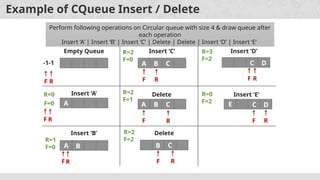
Example of CQueue Insert / Delete
F R
Empty Queue
-1-1
Insert ‘A’
F R
R=0
F=0 A
Insert ‘B’
F
R
A
R=1
F=0 B
Insert ‘C’
A B
F
R
R=2
F=0
C
Delete
A B C
F R
R=2
F=1
Delete
B C
R
F
R=2
F=2
Insert ‘D’
F R
C
R=3
F=2
D
Insert ‘E’
R
F
C D
R=0
F=2
E
Perform following operations on Circular queue with size 4 & draw queue after
each operation
Insert ‘A’ | Insert ‘B’ | Insert ‘C’ | Delete | Delete | Insert ‘D’ | Insert ‘E’
DQueue
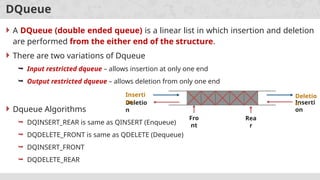
 A DQueue (double ended queue) is a linear list in which insertion and deletion
are performed from the either end of the structure.
 There are two variations of Dqueue
 Input restricted dqueue – allows insertion at only one end
 Output restricted dqueue – allows deletion from only one end
 Dqueue Algorithms
 DQINSERT_REAR is same as QINSERT (Enqueue)
 DQDELETE_FRONT is same as QDELETE (Dequeue)
 DQINSERT_FRONT
 DQDELETE_REAR
Inserti
on
Deletio
n
Rea
r
Inserti
on
Deletio
n
Fro
nt
Procedure: DQINSERT_FRONT (Q,F,R,N,Y)
 This procedure inserts Y at front end of the Queue.
 Queue is represented by a vector Q containing N elements.
 F is pointer to the front element of a queue.
 R is pointer to the rear element of a queue.
1. [Overflow?]
If F = 0
Then Write(‘Overflow’)
Return
2. [Decrement front Pointer]
F  F - 1
3. [Insert Element?]
Q[F]  Y
4. [Is rear pointer properly set?]
IF R = N
Then R  N-1
Return
10 89 7
10 89 7
F R
F R
Overflo
w
50
Function: DQDELETE_REAR(Q,F,R)
 This function deletes & returns an element from rear end of the Queue.
 Queue is represented by a vector Q containing N elements.
 F is pointer to the front element of a queue.
 R is pointer to the rear element of a queue.
1. [Underflow?]
If R = N
Then Write(‘Underflow’)
Return(0)
2. [Delete Element]
Y  Q[R]
3. [Queue Empty?]
IF R = F
Then R  F  N
Else R  R – 1
4. [Return Element]
Return(Y)
10 89
F R
F R
7
7
Priority Queue
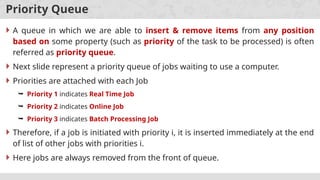
 A queue in which we are able to insert & remove items from any position
based on some property (such as priority of the task to be processed) is often
referred as priority queue.
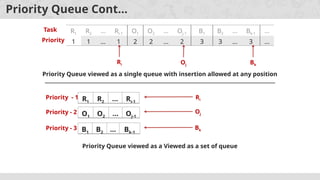
 Next slide represent a priority queue of jobs waiting to use a computer.
 Priorities are attached with each Job
 Priority 1 indicates Real Time Job
 Priority 2 indicates Online Job
 Priority 3 indicates Batch Processing Job
 Therefore, if a job is initiated with priority i, it is inserted immediately at the end
of list of other jobs with priorities i.
 Here jobs are always removed from the front of queue.
Priority Queue Cont…
R1 R2 … Ri-1 O1 O2 … Oj-1 B1 B2 … Bk-1 …
1 1 … 1 2 2 … 2 3 3 … 3 …
Priority
Task
Ri Oj Bk
Priority Queue viewed as a single queue with insertion allowed at any position
R1 R2 … Ri-1
O1 O2 … Oj-1
B1 B2 … Bk-1
Priority - 1
Priority - 2
Priority - 3
Ri
Oj
Bk
Priority Queue viewed as a Viewed as a set of queue
Thank
You

Queue Data Structures Intro and Types of Queue

  • 1.
    Linear Data Structure (Queue) DataStructures (DS) GTU # 3130702
  • 2.
    Queue  A linearlist which permits deletion to be performed at one end of the list and insertion at the other end is called queue.  The information in such a list is processed FIFO (first in first out) or FCFS (first come first served) manner.  Front is the end of queue from that deletion is to be performed.  Rear is the end of queue at which new element is to be inserted.  Insertion operation is called Enqueue & deletion operation is called Dequeue. 10 50 5 80 8 Rea r Fron t 100 Insertio n Deletio n
  • 3.
    Applications of Queue Queue of people at any service point such as ticketing etc.  Queue of airplanes waiting for landing instructions.  Queue of processes in OS.  Queue is also used by Operating systems for Job Scheduling.  When a resource is shared among multiple consumers. e.g., in case of printers the first one to be entered is the first to be processed.  When data is transferred asynchronously (data not necessarily received at same rate as sent) between two processes. Examples include IO Buffers, pipes, file IO, etc.  Queue is used in BFS (Breadth First Search) algorithm. It helps in traversing a tree or graph.  Queue is used in networking to handle congestion.
  • 4.
    Procedure: Enqueue (Q,F, R, N,Y)  This procedure inserts Y at rear end of Queue.  Queue is represented by a vector Q containing N elements.  F is pointer to the front element of a queue.  R is pointer to the rear element of a queue. 1. [Check for Queue Overflow] If R >= N-1 Then write (‘Queue Overflow’) Return 2. [Increment REAR pointer] R  R + 1 3. [Insert element] Q[R]  Y 4. [Is front pointer properly set?] IF F=-1 Then F  0 Return 5 N=3, R=-1, F=- 1 F = R = -1 -1 Enqueue (Q, F, R, N=3,Y=5) 0 R Enqueue (Q, F, R, N=3,Y=20) 1 20 Enqueue (Q, F, R, N=3,Y=80) 2 80 Enqueue (Q, F, R, N=3,Y=3) Queue Overflow F 0
  • 5.
    Function: Dequeue (Q,F, R)  This function deletes & returns an element from front end of the Queue.  Queue is represented by a vector Q containing N elements.  F is pointer to the front element of a queue.  R is pointer to the rear element of a queue. 1. [Check for Queue Underflow] If F = -1 Then write (‘Queue Underflow’) Return(0) 2. [Delete element] Y  Q[F] 3. [Is Queue Empty?] If F = R Then F  R  -1 Else F  F + 1 4. [Return Element] Return (Y) -8 50 Case No 1: F=-1, R=-1 Queue Underflow Case No 2: F=2, R=2 F R F=-1, R=- 1 Case No 3: F=0, R=2 F R 50 5 F=1, R=2
  • 6.
    Example of QueueInsert / Delete F R Perform following operations on queue with size 4 & draw queue after each operation Insert ‘A’ | Insert ‘B’ | Insert ‘C’ | Delete | Delete | Insert ‘D’ | Insert ‘E’ Empty Queue -1-1 Insert ‘A’ F R R=0 F=0 A Insert ‘B’ F R A R=1 F=0 B Insert ‘C’ A B F R R=2 F=0 C Delete A B C F R R=2 F=1 Delete B C R F R=2 F=2 Insert ‘D’ F R C R=3 F=2 D Insert ‘E’ R F C D R=3 F=2 (R=3) >= ((N-1)=3) (Size of Queue) Queue Overflow Queue Overflow, but space is there with Queue, this leads to the memory wastage
  • 7.
    Question  Choose correctoutput for the following sequence of operations. push(5), push(8), pop, push(2), push(5), pop, pop, pop, push(1), pop, a) 8 5 2 5 1 b) 8 5 5 2 1 c) 8 2 5 5 1 d) 8 1 2 5 5  Postfix representation of expression (12 – a) * (b + 9) / (d * 4) is ________________________  Seven elements A, B, C, D, E, F and G are pushed onto a stack in reverse order, i.e., starting from G. The stack is popped five times and each element is inserted into a queue. Two elements are deleted from the queue and pushed back onto the stack. Now, one element is popped from the stack. The popped item is ________.
  • 8.
    Circular Queue  Amore suitable method of representing simple queue which prevents an excessive use of memory is to arrange the elements Q[0], Q[1]….,Q[n-1] in a circular fashion with Q[1] following Q[n], this is called circular queue.  In circular queue the last node is connected back to the first node to make a circle.  Circular queue is a linear data structure. It follows FIFO principle.  It is also called as “Ring buffer”. Q[0] Q[1] Q[n- 1]
  • 9.
    Procedure: CQINSERT (F,R, Q, N, Y)  This procedure inserts Y at rear end of the Circular Queue.  Queue is represented by a vector Q containing N elements.  F is pointer to the front element of a queue.  R is pointer to the rear element of a queue. 1. [Reset Rear Pointer] If R = N - 1 Then R  0 Else R  R + 1 2. [Overflow] If F=R Then Write(‘Overflow’) Return 3. [Insert element] Q[R]  Y 4. [Is front pointer properly set?] IF F=-1 Then F  0 Return 8 15 R F 8 15 R F 23 6 8 15 R F
  • 10.
    Function: CQDELETE (F,R, Q, N)  This function deletes & returns an element from front end of the Circular Queue.  Queue is represented by a vector Q containing N elements.  F is pointer to the front element of a queue.  R is pointer to the rear element of a queue. 1. [Underflow?] If F = -1 Then Write(‘Underflow’) Return(0) 2. [Delete Element] Y  Q[F] 3. [Queue Empty?] If F = R Then F  R  -1 Return(Y) 4. Increment Front Pointer] IF F = N - 1 Then F  0 Else F  F + 1 Return(Y) 6 F R 2 6 4 F R 6 8 4 F R
  • 11.
    Example of CQueueInsert / Delete F R Empty Queue -1-1 Insert ‘A’ F R R=0 F=0 A Insert ‘B’ F R A R=1 F=0 B Insert ‘C’ A B F R R=2 F=0 C Delete A B C F R R=2 F=1 Delete B C R F R=2 F=2 Insert ‘D’ F R C R=3 F=2 D Insert ‘E’ R F C D R=0 F=2 E Perform following operations on Circular queue with size 4 & draw queue after each operation Insert ‘A’ | Insert ‘B’ | Insert ‘C’ | Delete | Delete | Insert ‘D’ | Insert ‘E’
  • 12.
    DQueue  A DQueue(double ended queue) is a linear list in which insertion and deletion are performed from the either end of the structure.  There are two variations of Dqueue  Input restricted dqueue – allows insertion at only one end  Output restricted dqueue – allows deletion from only one end  Dqueue Algorithms  DQINSERT_REAR is same as QINSERT (Enqueue)  DQDELETE_FRONT is same as QDELETE (Dequeue)  DQINSERT_FRONT  DQDELETE_REAR Inserti on Deletio n Rea r Inserti on Deletio n Fro nt
  • 13.
    Procedure: DQINSERT_FRONT (Q,F,R,N,Y) This procedure inserts Y at front end of the Queue.  Queue is represented by a vector Q containing N elements.  F is pointer to the front element of a queue.  R is pointer to the rear element of a queue. 1. [Overflow?] If F = 0 Then Write(‘Overflow’) Return 2. [Decrement front Pointer] F  F - 1 3. [Insert Element?] Q[F]  Y 4. [Is rear pointer properly set?] IF R = N Then R  N-1 Return 10 89 7 10 89 7 F R F R Overflo w 50
  • 14.
    Function: DQDELETE_REAR(Q,F,R)  Thisfunction deletes & returns an element from rear end of the Queue.  Queue is represented by a vector Q containing N elements.  F is pointer to the front element of a queue.  R is pointer to the rear element of a queue. 1. [Underflow?] If R = N Then Write(‘Underflow’) Return(0) 2. [Delete Element] Y  Q[R] 3. [Queue Empty?] IF R = F Then R  F  N Else R  R – 1 4. [Return Element] Return(Y) 10 89 F R F R 7 7
  • 15.
    Priority Queue  Aqueue in which we are able to insert & remove items from any position based on some property (such as priority of the task to be processed) is often referred as priority queue.  Next slide represent a priority queue of jobs waiting to use a computer.  Priorities are attached with each Job  Priority 1 indicates Real Time Job  Priority 2 indicates Online Job  Priority 3 indicates Batch Processing Job  Therefore, if a job is initiated with priority i, it is inserted immediately at the end of list of other jobs with priorities i.  Here jobs are always removed from the front of queue.
  • 16.
    Priority Queue Cont… R1R2 … Ri-1 O1 O2 … Oj-1 B1 B2 … Bk-1 … 1 1 … 1 2 2 … 2 3 3 … 3 … Priority Task Ri Oj Bk Priority Queue viewed as a single queue with insertion allowed at any position R1 R2 … Ri-1 O1 O2 … Oj-1 B1 B2 … Bk-1 Priority - 1 Priority - 2 Priority - 3 Ri Oj Bk Priority Queue viewed as a Viewed as a set of queue
  • 17.