Copyright © 2021, Texas Instruments Incorporated 1 ti.com/webench
WEBENCH
®
Design Report TPS63070RNMR : TPS63070RNMR 4.5V-13V to 5.00V @ 1.5A June 22, 2021 23:46:56 GMT-07:00
WEBENCH
®
Design Report
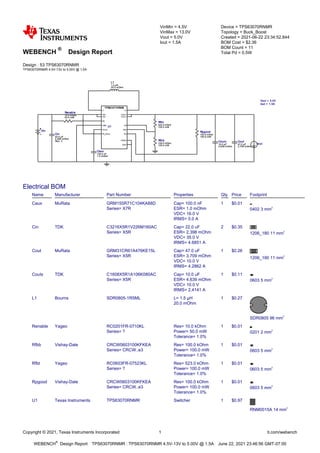
Design : 53 TPS63070RNMR
TPS63070RNMR 4.5V-13V to 5.00V @ 1.5A
VinMin = 4.5V
VinMax = 13.0V
Vout = 5.0V
Iout = 1.5A
Device = TPS63070RNMR
Topology = Buck_Boost
Created = 2021-06-22 23:34:52.844
BOM Cost = $2.36
BOM Count = 11
Total Pd = 0.5W
Rfbt
523.0 kOhm
100.0 mW
Cout
47.0 µF
3.709 mOhm
L1
1.5 µH
20.0 mOhm
Cin
22.0 µF
2.398 mOhm
Qty= 2
TPS63070RNM
PS_SYNC PG
VAUX
GND
FB
FB2
VOUT
VOUT
L2
PGND
L1
VIN
VIN
EN
VSEL
U1
Caux
100.0 nF
1.0 mOhm
Rfbb
100.0 kOhm
100.0 mW
Renable
10.0 kOhm
50.0 mW
Vout = 5.0V
Iout = 1.5A
Rpgood
100.0 kOhm
100.0 mW
Coutx
10.0 µF
4.639 mOhm
Vin
Iout
Electrical BOM
Name Manufacturer Part Number Properties Qty Price Footprint
Caux MuRata GRM155R71C104KA88D
Series= X7R
Cap= 100.0 nF
ESR= 1.0 mOhm
VDC= 16.0 V
IRMS= 0.0 A
1 $0.01
0402 3 mm
2
Cin TDK C3216X5R1V226M160AC
Series= X5R
Cap= 22.0 uF
ESR= 2.398 mOhm
VDC= 35.0 V
IRMS= 4.6851 A
2 $0.35
1206_180 11 mm
2
Cout MuRata GRM31CR61A476KE15L
Series= X5R
Cap= 47.0 uF
ESR= 3.709 mOhm
VDC= 10.0 V
IRMS= 4.2862 A
1 $0.26
1206_190 11 mm
2
Coutx TDK C1608X5R1A106K080AC
Series= X5R
Cap= 10.0 uF
ESR= 4.639 mOhm
VDC= 10.0 V
IRMS= 2.4141 A
1 $0.11
0603 5 mm
2
L1 Bourns SDR0805-1R5ML L= 1.5 µH
20.0 mOhm
1 $0.27
SDR0805 96 mm
2
Renable Yageo RC0201FR-0710KL
Series= ?
Res= 10.0 kOhm
Power= 50.0 mW
Tolerance= 1.0%
1 $0.01
0201 2 mm
2
Rfbb Vishay-Dale CRCW0603100KFKEA
Series= CRCW..e3
Res= 100.0 kOhm
Power= 100.0 mW
Tolerance= 1.0%
1 $0.01
0603 5 mm
2
Rfbt Yageo RC0603FR-07523KL
Series= ?
Res= 523.0 kOhm
Power= 100.0 mW
Tolerance= 1.0%
1 $0.01
0603 5 mm
2
Rpgood Vishay-Dale CRCW0603100KFKEA
Series= CRCW..e3
Res= 100.0 kOhm
Power= 100.0 mW
Tolerance= 1.0%
1 $0.01
0603 5 mm
2
U1 Texas Instruments TPS63070RNMR Switcher 1 $0.97
RNM0015A 14 mm
2
WEBENCH
®
Design
Copyright © 2021, Texas Instruments Incorporated 2 ti.com/webench
WEBENCH
®
Design Report TPS63070RNMR : TPS63070RNMR 4.5V-13V to 5.00V @ 1.5A June 22, 2021 23:46:56 GMT-07:00
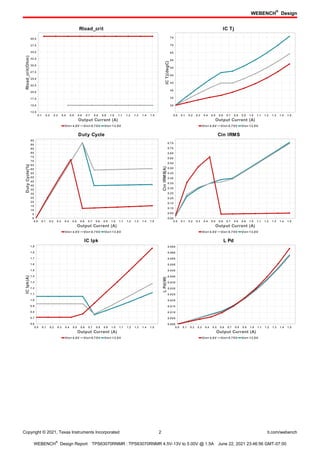
Rload_crit
Vin= 4.5V Vin= 8.75V Vin= 13.0V
0.1 0.2 0.3 0.4 0.5 0.6 0.7 0.8 0.9 1.0 1.1 1.2 1.3 1.4 1.5
Output Current (A)
12.5
15.0
17.5
20.0
22.5
25.0
27.5
30.0
32.5
35.0
37.5
40.0
Rload_crit(Ohm) IC Tj
Vin= 4.5V Vin= 8.75V Vin= 13.0V
0.0 0.1 0.2 0.3 0.4 0.5 0.6 0.7 0.8 0.9 1.0 1.1 1.2 1.3 1.4 1.5
Output Current (A)
30
35
40
45
50
55
60
65
70
75
IC
Tj(degC)
Duty Cycle
Vin= 4.5V Vin= 8.75V Vin= 13.0V
0.0 0.1 0.2 0.3 0.4 0.5 0.6 0.7 0.8 0.9 1.0 1.1 1.2 1.3 1.4 1.5
Output Current (A)
0
5
10
15
20
25
30
35
40
45
50
55
60
65
70
75
80
85
90
95
Duty
Cycle(%)
Cin IRMS
Vin= 4.5V Vin= 8.75V Vin= 13.0V
0.0 0.1 0.2 0.3 0.4 0.5 0.6 0.7 0.8 0.9 1.0 1.1 1.2 1.3 1.4 1.5
Output Current (A)
0.00
0.05
0.10
0.15
0.20
0.25
0.30
0.35
0.40
0.45
0.50
0.55
0.60
0.65
0.70
0.75
Cin
IRMS(A)
IC Ipk
Vin= 4.5V Vin= 8.75V Vin= 13.0V
0.0 0.1 0.2 0.3 0.4 0.5 0.6 0.7 0.8 0.9 1.0 1.1 1.2 1.3 1.4 1.5
Output Current (A)
0.6
0.7
0.8
0.9
1.0
1.1
1.2
1.3
1.4
1.5
1.6
1.7
1.8
1.9
IC
Ipk(A)
L Pd
Vin= 4.5V Vin= 8.75V Vin= 13.0V
0.0 0.1 0.2 0.3 0.4 0.5 0.6 0.7 0.8 0.9 1.0 1.1 1.2 1.3 1.4 1.5
Output Current (A)
0.000
0.005
0.010
0.015
0.020
0.025
0.030
0.035
0.040
0.045
0.050
0.055
0.060
0.065
L
Pd(W)
WEBENCH
®
Design
Copyright © 2021, Texas Instruments Incorporated 3 ti.com/webench
WEBENCH
®
Design Report TPS63070RNMR : TPS63070RNMR 4.5V-13V to 5.00V @ 1.5A June 22, 2021 23:46:56 GMT-07:00
Efficiency
Vin= 4.5V Vin= 8.75V Vin= 13.0V
0.0 0.1 0.2 0.3 0.4 0.5 0.6 0.7 0.8 0.9 1.0 1.1 1.2 1.3 1.4 1.5
Output Current (A)
65.0
67.5
70.0
72.5
75.0
77.5
80.0
82.5
85.0
87.5
90.0
92.5
95.0
97.5
Efficiency(%) Vout p- p
Vin= 4.5V Vin= 8.75V Vin= 13.0V
0.0 0.1 0.2 0.3 0.4 0.5 0.6 0.7 0.8 0.9 1.0 1.1 1.2 1.3 1.4 1.5
Output Current (A)
0.0000
0.0025
0.0050
0.0075
0.0100
0.0125
0.0150
0.0175
0.0200
0.0225
0.0250
0.0275
0.0300
Vout
p-
p(V)
Coutx IRMS
Vin= 4.5V Vin= 8.75V Vin= 13.0V
0.0 0.1 0.2 0.3 0.4 0.5 0.6 0.7 0.8 0.9 1.0 1.1 1.2 1.3 1.4 1.5
Output Current (A)
0.000
0.005
0.010
0.015
0.020
0.025
0.030
0.035
0.040
0.045
0.050
0.055
0.060
0.065
0.070
Coutx
IRMS(A)
Coutx Pd
Vin= 4.5V Vin= 8.75V Vin= 13.0V
0.0 0.1 0.2 0.3 0.4 0.5 0.6 0.7 0.8 0.9 1.0 1.1 1.2 1.3 1.4 1.5
Output Current (A)
0.0000000
0.0000025
0.0000050
0.0000075
0.0000100
0.0000125
0.0000150
0.0000175
0.0000200
Coutx
Pd(W)
Cin Pd
Vin= 4.5V Vin= 8.75V Vin= 13.0V
0.0 0.1 0.2 0.3 0.4 0.5 0.6 0.7 0.8 0.9 1.0 1.1 1.2 1.3 1.4 1.5
Output Current (A)
0.00000
0.00005
0.00010
0.00015
0.00020
0.00025
0.00030
0.00035
0.00040
0.00045
0.00050
0.00055
0.00060
0.00065
0.00070
Cin
Pd(W)
Cout Pd
Vin= 4.5V Vin= 8.75V Vin= 13.0V
0.0 0.1 0.2 0.3 0.4 0.5 0.6 0.7 0.8 0.9 1.0 1.1 1.2 1.3 1.4 1.5
Output Current (A)
0.0000
0.0001
0.0002
0.0003
0.0004
0.0005
0.0006
0.0007
0.0008
0.0009
0.0010
0.0011
0.0012
Cout
Pd(W)
WEBENCH
®
Design
Copyright © 2021, Texas Instruments Incorporated 4 ti.com/webench
WEBENCH
®
Design Report TPS63070RNMR : TPS63070RNMR 4.5V-13V to 5.00V @ 1.5A June 22, 2021 23:46:56 GMT-07:00
Pout
Vin= 4.5V Vin= 8.75V Vin= 13.0V
0.0 0.1 0.2 0.3 0.4 0.5 0.6 0.7 0.8 0.9 1.0 1.1 1.2 1.3 1.4 1.5
Output Current (A)
0.0
0.5
1.0
1.5
2.0
2.5
3.0
3.5
4.0
4.5
5.0
5.5
6.0
6.5
7.0
7.5
Pout(W) Iin Avg
Vin= 4.5V Vin= 8.75V Vin= 13.0V
0.0 0.1 0.2 0.3 0.4 0.5 0.6 0.7 0.8 0.9 1.0 1.1 1.2 1.3 1.4 1.5
Output Current (A)
0.0
0.1
0.2
0.3
0.4
0.5
0.6
0.7
0.8
0.9
1.0
1.1
1.2
1.3
1.4
1.5
1.6
1.7
1.8
Iin
Avg(A)
Total Pd
Vin= 4.5V Vin= 8.75V Vin= 13.0V
0.0 0.1 0.2 0.3 0.4 0.5 0.6 0.7 0.8 0.9 1.0 1.1 1.2 1.3 1.4 1.5
Output Current (A)
0.00
0.05
0.10
0.15
0.20
0.25
0.30
0.35
0.40
0.45
0.50
0.55
0.60
0.65
0.70
0.75
0.80
Total
Pd(W)
Cout IRMS
Vin= 4.5V Vin= 8.75V Vin= 13.0V
0.0 0.1 0.2 0.3 0.4 0.5 0.6 0.7 0.8 0.9 1.0 1.1 1.2 1.3 1.4 1.5
Output Current (A)
0.00
0.05
0.10
0.15
0.20
0.25
0.30
0.35
0.40
0.45
0.50
0.55
0.60
Cout
IRMS(A)
L Ipp
Vin= 4.5V Vin= 8.75V Vin= 13.0V
0.0 0.1 0.2 0.3 0.4 0.5 0.6 0.7 0.8 0.9 1.0 1.1 1.2 1.3 1.4 1.5
Output Current (A)
0.05
0.10
0.15
0.20
0.25
0.30
0.35
0.40
0.45
0.50
0.55
0.60
0.65
0.70
0.75
0.80
0.85
0.90
L
Ipp(A)
IC Pd
Vin= 4.5V Vin= 8.75V Vin= 13.0V
0.0 0.1 0.2 0.3 0.4 0.5 0.6 0.7 0.8 0.9 1.0 1.1 1.2 1.3 1.4 1.5
Output Current (A)
0.00
0.05
0.10
0.15
0.20
0.25
0.30
0.35
0.40
0.45
0.50
0.55
0.60
0.65
0.70
0.75
IC
Pd(W)
WEBENCH
®
Design
Copyright © 2021, Texas Instruments Incorporated 5 ti.com/webench
WEBENCH
®
Design Report TPS63070RNMR : TPS63070RNMR 4.5V-13V to 5.00V @ 1.5A June 22, 2021 23:46:56 GMT-07:00
Efficiency (Log- Scale)
Vin= 4.5V Vin= 8.75V Vin= 13.0V
1E- 3 3.16E- 3 1E- 2 3.16E- 2 1E- 1 3.16E- 1 1E0
Output Current (A)
65.0
67.5
70.0
72.5
75.0
77.5
80.0
82.5
85.0
87.5
90.0
92.5
95.0
97.5
Efficiency(%)
Operating Values
# Name Value Category Description
1. Cin IRMS 51.167 mA Capacitor Input capacitor RMS ripple current
2. Cin Pd 3.139 µW Capacitor Input capacitor power dissipation
3. Cout IRMS 573.005 mA Capacitor Output capacitor RMS ripple current
4. Cout Pd 0.0 W Capacitor Output capacitor power dissipation
5. Coutx IRMS 67.488 mA Capacitor Output capacitor_x RMS ripple current
6. Coutx Pd 0.0 W Capacitor Output capacitor_x power loss
7. IC Ipk 1.867 A IC Peak switch current in IC
8. IC Pd 435.68 mW IC IC power dissipation
9. IC Tj 57.448 degC IC IC junction temperature
10. ICThetaJA 63.0 degC/W IC IC junction-to-ambient thermal resistance
11. Iin Avg 1.778 A IC Average input current
12. L Ipp 177.25 mA Inductor Peak-to-peak inductor ripple current
13. L Pd 63.333 mW Inductor Inductor power dissipation
14. Cin Pd 3.139 µW Power Input capacitor power dissipation
15. Cout Pd 0.0 W Power Output capacitor power dissipation
16. Coutx Pd 0.0 W Power Output capacitor_x power loss
17. IC Pd 435.68 mW Power IC power dissipation
18. L Pd 63.333 mW Power Inductor power dissipation
19. Total Pd 499.07 mW Power Total Power Dissipation
20. BOM Count 11 System
Information
Total Design BOM count
21. Duty Cycle 15.205 % System
Information
Duty cycle
22. Efficiency 93.761 % System
Information
Steady state efficiency
23. FootPrint 167.0 mm
2
System
Information
Total Foot Print Area of BOM components
24. Frequency 2.5 MHz System
Information
Switching frequency
25. Iout 1.5 A System
Information
Iout operating point
26. Mode BOOST PWM CCM System
Information
PWM/PFM Mode
27. Pout 7.5 W System
Information
Total output power
28. Rload_crit 40.9 Ohm System
Information
Minimum Rload required during Start up
29. Total BOM $2.36 System
Information
Total BOM Cost
30. Vin 4.5 V System
Information
Vin operating point
31. Vout Actual 4.984 V System
Information
Vout Actual calculated based on selected voltage divider resistors
32. Vout Tolerance 1.696 % System
Information
Vout Tolerance based on IC Tolerance (no load) and voltage divider
resistors if applicable
33. Vout p-p 3.97 mV System
Information
Peak-to-peak output ripple voltage
Design Inputs
Name Value Description
Iout 1.5 Maximum Output Current
WEBENCH
®
Design
Copyright © 2021, Texas Instruments Incorporated 6 ti.com/webench
WEBENCH
®
Design Report TPS63070RNMR : TPS63070RNMR 4.5V-13V to 5.00V @ 1.5A June 22, 2021 23:46:56 GMT-07:00
Name Value Description
VinMax 13.0 Maximum input voltage
VinMin 4.5 Minimum input voltage
Vout 5.0 Output Voltage
base_pn TPS63070 Base Product Number
source DC Input Source Type
Ta 30.0 Ambient temperature
WEBENCH
®
Design
Copyright © 2021, Texas Instruments Incorporated 7 ti.com/webench
WEBENCH
®
Design Report TPS63070RNMR : TPS63070RNMR 4.5V-13V to 5.00V @ 1.5A June 22, 2021 23:46:56 GMT-07:00
WEBENCH
®
Assembly
Component Testing
Some published data on components in datasheets such as Capacitor ESR and Inductor DC resistance is based on conservative values that
will guarantee that the components always exceed the specification. For design purposes it is usually better to work with typical values. Since
this data is not always available it is a good practice to measure the Capacitance and ESR values of Cin and Cout, and the inductance and DC
resistance of L1 before assembly of the board. Any large discrepancies in values should be electrically simulated in WEBENCH to check for
instabilities and thermally simulated in WebTHERM to make sure critical temperatures are not exceeded.
Soldering Component to Board
If board assembly is done in house it is best to tack down one terminal of a component on the board then solder the other terminal. For surface
mount parts with large tabs, such as the DPAK, the tab on the back of the package should be pre-tinned with solder, then tacked into place
by one of the pins. To solder the tab town to the board place the iron down on the board while resting against the tab, heating both surfaces
simultaneously. Apply light pressure to the top of the plastic case until the solder flows around the part and the part is flush with the PCB. If the
solder is not flowing around the board you may need a higher wattage iron (generally 25W to 30W is enough).
Initial Startup of Circuit
It is best to initially power up the board by setting the input supply voltage to the lowest operating input voltage 4.5V and set the input supply's
current limit to zero. With the input supply off connect up the input supply to Vin and GND. Connect a digital volt meter and a load if needed
to set the minimum Iout of the design from Vout and GND. Turn on the input supply and slowly turn up the current limit on the input supply.
If the voltage starts to rise on the input supply continue increasing the input supply current limit while watching the output voltage. If the
current increases on the input supply, but the voltage remains near zero, then there may be a short or a component misplaced on the board.
Power down the board and visually inspect for solder bridges and recheck the diode and capacitor polarities. Once the power supply circuit is
operational then more extensive testing may include full load testing, transient load and line tests to compare with simulation results.
Load Testing
The setup is the same as the initial startup, except that an additional digital voltmeter is connected between Vin and GND, a load is connected
between Vout and GND and a current meter is connected in series between Vout and the load. The load must be able to handle at least rated
output power + 50% ( 7.5 watts for this design). Ideally the load is supplied in the form of a variable load test unit. It can also be done in the
form of suitably large power resistors. When using an oscilloscope to measure waveforms on the prototype board, the ground leads of the
oscilloscope probes should be as short as possible and the area of the loop formed by the ground lead should be kept to a minimum. This will
help reduce ground lead inductance and eliminate EMI noise that is not actually present in the circuit.
Design Assistance
1. Master key : B1426EAE683F59EC[v1]
2. TPS63070 Product Folder : http://www.ti.com/product/TPS63070 : contains the data sheet and other resources.
WEBENCH
®
Design
Copyright © 2021, Texas Instruments Incorporated 8 ti.com/webench
WEBENCH
®
Design Report TPS63070RNMR : TPS63070RNMR 4.5V-13V to 5.00V @ 1.5A June 22, 2021 23:46:56 GMT-07:00
Important Notice and Disclaimer
TI provides technical and reliability data (including datasheets), design resources (including reference designs), application or other design
advice, web tools, safety information, and other resources AS IS and with all faults, and disclaims all warranties. These resources are intended
for skilled developers designing with TI products. You are solely responsible for (1) selecting the appropriate TI products for your application, (2)
designing, validating and testing your application, and (3) ensuring your application meets applicable standards, and any other safety, security,
or other requirements.
These resources are subject to change without notice. TI grants you permission to use these resources only for development of an application
that uses the TI products described in the resource. Other reproduction and display of these resources is prohibited. No license is granted to
any other TI intellectual property right or to any third party intellectual property right. TI disclaims responsibility for, and you will fully indemnify TI
and its representatives against, any claims, damages, costs, losses, and liabilities arising out of your use of these resources.
Providing these resources does not expand or otherwise alter TI's applicable Terms of Sale or other applicable terms available either on ti.com
or provided in conjunction with TI products.

Circuit Design using TI

  • 1.
    Copyright © 2021,Texas Instruments Incorporated 1 ti.com/webench WEBENCH ® Design Report TPS63070RNMR : TPS63070RNMR 4.5V-13V to 5.00V @ 1.5A June 22, 2021 23:46:56 GMT-07:00 WEBENCH ® Design Report Design : 53 TPS63070RNMR TPS63070RNMR 4.5V-13V to 5.00V @ 1.5A VinMin = 4.5V VinMax = 13.0V Vout = 5.0V Iout = 1.5A Device = TPS63070RNMR Topology = Buck_Boost Created = 2021-06-22 23:34:52.844 BOM Cost = $2.36 BOM Count = 11 Total Pd = 0.5W Rfbt 523.0 kOhm 100.0 mW Cout 47.0 µF 3.709 mOhm L1 1.5 µH 20.0 mOhm Cin 22.0 µF 2.398 mOhm Qty= 2 TPS63070RNM PS_SYNC PG VAUX GND FB FB2 VOUT VOUT L2 PGND L1 VIN VIN EN VSEL U1 Caux 100.0 nF 1.0 mOhm Rfbb 100.0 kOhm 100.0 mW Renable 10.0 kOhm 50.0 mW Vout = 5.0V Iout = 1.5A Rpgood 100.0 kOhm 100.0 mW Coutx 10.0 µF 4.639 mOhm Vin Iout Electrical BOM Name Manufacturer Part Number Properties Qty Price Footprint Caux MuRata GRM155R71C104KA88D Series= X7R Cap= 100.0 nF ESR= 1.0 mOhm VDC= 16.0 V IRMS= 0.0 A 1 $0.01 0402 3 mm 2 Cin TDK C3216X5R1V226M160AC Series= X5R Cap= 22.0 uF ESR= 2.398 mOhm VDC= 35.0 V IRMS= 4.6851 A 2 $0.35 1206_180 11 mm 2 Cout MuRata GRM31CR61A476KE15L Series= X5R Cap= 47.0 uF ESR= 3.709 mOhm VDC= 10.0 V IRMS= 4.2862 A 1 $0.26 1206_190 11 mm 2 Coutx TDK C1608X5R1A106K080AC Series= X5R Cap= 10.0 uF ESR= 4.639 mOhm VDC= 10.0 V IRMS= 2.4141 A 1 $0.11 0603 5 mm 2 L1 Bourns SDR0805-1R5ML L= 1.5 µH 20.0 mOhm 1 $0.27 SDR0805 96 mm 2 Renable Yageo RC0201FR-0710KL Series= ? Res= 10.0 kOhm Power= 50.0 mW Tolerance= 1.0% 1 $0.01 0201 2 mm 2 Rfbb Vishay-Dale CRCW0603100KFKEA Series= CRCW..e3 Res= 100.0 kOhm Power= 100.0 mW Tolerance= 1.0% 1 $0.01 0603 5 mm 2 Rfbt Yageo RC0603FR-07523KL Series= ? Res= 523.0 kOhm Power= 100.0 mW Tolerance= 1.0% 1 $0.01 0603 5 mm 2 Rpgood Vishay-Dale CRCW0603100KFKEA Series= CRCW..e3 Res= 100.0 kOhm Power= 100.0 mW Tolerance= 1.0% 1 $0.01 0603 5 mm 2 U1 Texas Instruments TPS63070RNMR Switcher 1 $0.97 RNM0015A 14 mm 2
  • 2.
    WEBENCH ® Design Copyright © 2021,Texas Instruments Incorporated 2 ti.com/webench WEBENCH ® Design Report TPS63070RNMR : TPS63070RNMR 4.5V-13V to 5.00V @ 1.5A June 22, 2021 23:46:56 GMT-07:00 Rload_crit Vin= 4.5V Vin= 8.75V Vin= 13.0V 0.1 0.2 0.3 0.4 0.5 0.6 0.7 0.8 0.9 1.0 1.1 1.2 1.3 1.4 1.5 Output Current (A) 12.5 15.0 17.5 20.0 22.5 25.0 27.5 30.0 32.5 35.0 37.5 40.0 Rload_crit(Ohm) IC Tj Vin= 4.5V Vin= 8.75V Vin= 13.0V 0.0 0.1 0.2 0.3 0.4 0.5 0.6 0.7 0.8 0.9 1.0 1.1 1.2 1.3 1.4 1.5 Output Current (A) 30 35 40 45 50 55 60 65 70 75 IC Tj(degC) Duty Cycle Vin= 4.5V Vin= 8.75V Vin= 13.0V 0.0 0.1 0.2 0.3 0.4 0.5 0.6 0.7 0.8 0.9 1.0 1.1 1.2 1.3 1.4 1.5 Output Current (A) 0 5 10 15 20 25 30 35 40 45 50 55 60 65 70 75 80 85 90 95 Duty Cycle(%) Cin IRMS Vin= 4.5V Vin= 8.75V Vin= 13.0V 0.0 0.1 0.2 0.3 0.4 0.5 0.6 0.7 0.8 0.9 1.0 1.1 1.2 1.3 1.4 1.5 Output Current (A) 0.00 0.05 0.10 0.15 0.20 0.25 0.30 0.35 0.40 0.45 0.50 0.55 0.60 0.65 0.70 0.75 Cin IRMS(A) IC Ipk Vin= 4.5V Vin= 8.75V Vin= 13.0V 0.0 0.1 0.2 0.3 0.4 0.5 0.6 0.7 0.8 0.9 1.0 1.1 1.2 1.3 1.4 1.5 Output Current (A) 0.6 0.7 0.8 0.9 1.0 1.1 1.2 1.3 1.4 1.5 1.6 1.7 1.8 1.9 IC Ipk(A) L Pd Vin= 4.5V Vin= 8.75V Vin= 13.0V 0.0 0.1 0.2 0.3 0.4 0.5 0.6 0.7 0.8 0.9 1.0 1.1 1.2 1.3 1.4 1.5 Output Current (A) 0.000 0.005 0.010 0.015 0.020 0.025 0.030 0.035 0.040 0.045 0.050 0.055 0.060 0.065 L Pd(W)
  • 3.
    WEBENCH ® Design Copyright © 2021,Texas Instruments Incorporated 3 ti.com/webench WEBENCH ® Design Report TPS63070RNMR : TPS63070RNMR 4.5V-13V to 5.00V @ 1.5A June 22, 2021 23:46:56 GMT-07:00 Efficiency Vin= 4.5V Vin= 8.75V Vin= 13.0V 0.0 0.1 0.2 0.3 0.4 0.5 0.6 0.7 0.8 0.9 1.0 1.1 1.2 1.3 1.4 1.5 Output Current (A) 65.0 67.5 70.0 72.5 75.0 77.5 80.0 82.5 85.0 87.5 90.0 92.5 95.0 97.5 Efficiency(%) Vout p- p Vin= 4.5V Vin= 8.75V Vin= 13.0V 0.0 0.1 0.2 0.3 0.4 0.5 0.6 0.7 0.8 0.9 1.0 1.1 1.2 1.3 1.4 1.5 Output Current (A) 0.0000 0.0025 0.0050 0.0075 0.0100 0.0125 0.0150 0.0175 0.0200 0.0225 0.0250 0.0275 0.0300 Vout p- p(V) Coutx IRMS Vin= 4.5V Vin= 8.75V Vin= 13.0V 0.0 0.1 0.2 0.3 0.4 0.5 0.6 0.7 0.8 0.9 1.0 1.1 1.2 1.3 1.4 1.5 Output Current (A) 0.000 0.005 0.010 0.015 0.020 0.025 0.030 0.035 0.040 0.045 0.050 0.055 0.060 0.065 0.070 Coutx IRMS(A) Coutx Pd Vin= 4.5V Vin= 8.75V Vin= 13.0V 0.0 0.1 0.2 0.3 0.4 0.5 0.6 0.7 0.8 0.9 1.0 1.1 1.2 1.3 1.4 1.5 Output Current (A) 0.0000000 0.0000025 0.0000050 0.0000075 0.0000100 0.0000125 0.0000150 0.0000175 0.0000200 Coutx Pd(W) Cin Pd Vin= 4.5V Vin= 8.75V Vin= 13.0V 0.0 0.1 0.2 0.3 0.4 0.5 0.6 0.7 0.8 0.9 1.0 1.1 1.2 1.3 1.4 1.5 Output Current (A) 0.00000 0.00005 0.00010 0.00015 0.00020 0.00025 0.00030 0.00035 0.00040 0.00045 0.00050 0.00055 0.00060 0.00065 0.00070 Cin Pd(W) Cout Pd Vin= 4.5V Vin= 8.75V Vin= 13.0V 0.0 0.1 0.2 0.3 0.4 0.5 0.6 0.7 0.8 0.9 1.0 1.1 1.2 1.3 1.4 1.5 Output Current (A) 0.0000 0.0001 0.0002 0.0003 0.0004 0.0005 0.0006 0.0007 0.0008 0.0009 0.0010 0.0011 0.0012 Cout Pd(W)
  • 4.
    WEBENCH ® Design Copyright © 2021,Texas Instruments Incorporated 4 ti.com/webench WEBENCH ® Design Report TPS63070RNMR : TPS63070RNMR 4.5V-13V to 5.00V @ 1.5A June 22, 2021 23:46:56 GMT-07:00 Pout Vin= 4.5V Vin= 8.75V Vin= 13.0V 0.0 0.1 0.2 0.3 0.4 0.5 0.6 0.7 0.8 0.9 1.0 1.1 1.2 1.3 1.4 1.5 Output Current (A) 0.0 0.5 1.0 1.5 2.0 2.5 3.0 3.5 4.0 4.5 5.0 5.5 6.0 6.5 7.0 7.5 Pout(W) Iin Avg Vin= 4.5V Vin= 8.75V Vin= 13.0V 0.0 0.1 0.2 0.3 0.4 0.5 0.6 0.7 0.8 0.9 1.0 1.1 1.2 1.3 1.4 1.5 Output Current (A) 0.0 0.1 0.2 0.3 0.4 0.5 0.6 0.7 0.8 0.9 1.0 1.1 1.2 1.3 1.4 1.5 1.6 1.7 1.8 Iin Avg(A) Total Pd Vin= 4.5V Vin= 8.75V Vin= 13.0V 0.0 0.1 0.2 0.3 0.4 0.5 0.6 0.7 0.8 0.9 1.0 1.1 1.2 1.3 1.4 1.5 Output Current (A) 0.00 0.05 0.10 0.15 0.20 0.25 0.30 0.35 0.40 0.45 0.50 0.55 0.60 0.65 0.70 0.75 0.80 Total Pd(W) Cout IRMS Vin= 4.5V Vin= 8.75V Vin= 13.0V 0.0 0.1 0.2 0.3 0.4 0.5 0.6 0.7 0.8 0.9 1.0 1.1 1.2 1.3 1.4 1.5 Output Current (A) 0.00 0.05 0.10 0.15 0.20 0.25 0.30 0.35 0.40 0.45 0.50 0.55 0.60 Cout IRMS(A) L Ipp Vin= 4.5V Vin= 8.75V Vin= 13.0V 0.0 0.1 0.2 0.3 0.4 0.5 0.6 0.7 0.8 0.9 1.0 1.1 1.2 1.3 1.4 1.5 Output Current (A) 0.05 0.10 0.15 0.20 0.25 0.30 0.35 0.40 0.45 0.50 0.55 0.60 0.65 0.70 0.75 0.80 0.85 0.90 L Ipp(A) IC Pd Vin= 4.5V Vin= 8.75V Vin= 13.0V 0.0 0.1 0.2 0.3 0.4 0.5 0.6 0.7 0.8 0.9 1.0 1.1 1.2 1.3 1.4 1.5 Output Current (A) 0.00 0.05 0.10 0.15 0.20 0.25 0.30 0.35 0.40 0.45 0.50 0.55 0.60 0.65 0.70 0.75 IC Pd(W)
  • 5.
    WEBENCH ® Design Copyright © 2021,Texas Instruments Incorporated 5 ti.com/webench WEBENCH ® Design Report TPS63070RNMR : TPS63070RNMR 4.5V-13V to 5.00V @ 1.5A June 22, 2021 23:46:56 GMT-07:00 Efficiency (Log- Scale) Vin= 4.5V Vin= 8.75V Vin= 13.0V 1E- 3 3.16E- 3 1E- 2 3.16E- 2 1E- 1 3.16E- 1 1E0 Output Current (A) 65.0 67.5 70.0 72.5 75.0 77.5 80.0 82.5 85.0 87.5 90.0 92.5 95.0 97.5 Efficiency(%) Operating Values # Name Value Category Description 1. Cin IRMS 51.167 mA Capacitor Input capacitor RMS ripple current 2. Cin Pd 3.139 µW Capacitor Input capacitor power dissipation 3. Cout IRMS 573.005 mA Capacitor Output capacitor RMS ripple current 4. Cout Pd 0.0 W Capacitor Output capacitor power dissipation 5. Coutx IRMS 67.488 mA Capacitor Output capacitor_x RMS ripple current 6. Coutx Pd 0.0 W Capacitor Output capacitor_x power loss 7. IC Ipk 1.867 A IC Peak switch current in IC 8. IC Pd 435.68 mW IC IC power dissipation 9. IC Tj 57.448 degC IC IC junction temperature 10. ICThetaJA 63.0 degC/W IC IC junction-to-ambient thermal resistance 11. Iin Avg 1.778 A IC Average input current 12. L Ipp 177.25 mA Inductor Peak-to-peak inductor ripple current 13. L Pd 63.333 mW Inductor Inductor power dissipation 14. Cin Pd 3.139 µW Power Input capacitor power dissipation 15. Cout Pd 0.0 W Power Output capacitor power dissipation 16. Coutx Pd 0.0 W Power Output capacitor_x power loss 17. IC Pd 435.68 mW Power IC power dissipation 18. L Pd 63.333 mW Power Inductor power dissipation 19. Total Pd 499.07 mW Power Total Power Dissipation 20. BOM Count 11 System Information Total Design BOM count 21. Duty Cycle 15.205 % System Information Duty cycle 22. Efficiency 93.761 % System Information Steady state efficiency 23. FootPrint 167.0 mm 2 System Information Total Foot Print Area of BOM components 24. Frequency 2.5 MHz System Information Switching frequency 25. Iout 1.5 A System Information Iout operating point 26. Mode BOOST PWM CCM System Information PWM/PFM Mode 27. Pout 7.5 W System Information Total output power 28. Rload_crit 40.9 Ohm System Information Minimum Rload required during Start up 29. Total BOM $2.36 System Information Total BOM Cost 30. Vin 4.5 V System Information Vin operating point 31. Vout Actual 4.984 V System Information Vout Actual calculated based on selected voltage divider resistors 32. Vout Tolerance 1.696 % System Information Vout Tolerance based on IC Tolerance (no load) and voltage divider resistors if applicable 33. Vout p-p 3.97 mV System Information Peak-to-peak output ripple voltage Design Inputs Name Value Description Iout 1.5 Maximum Output Current
  • 6.
    WEBENCH ® Design Copyright © 2021,Texas Instruments Incorporated 6 ti.com/webench WEBENCH ® Design Report TPS63070RNMR : TPS63070RNMR 4.5V-13V to 5.00V @ 1.5A June 22, 2021 23:46:56 GMT-07:00 Name Value Description VinMax 13.0 Maximum input voltage VinMin 4.5 Minimum input voltage Vout 5.0 Output Voltage base_pn TPS63070 Base Product Number source DC Input Source Type Ta 30.0 Ambient temperature
  • 7.
    WEBENCH ® Design Copyright © 2021,Texas Instruments Incorporated 7 ti.com/webench WEBENCH ® Design Report TPS63070RNMR : TPS63070RNMR 4.5V-13V to 5.00V @ 1.5A June 22, 2021 23:46:56 GMT-07:00 WEBENCH ® Assembly Component Testing Some published data on components in datasheets such as Capacitor ESR and Inductor DC resistance is based on conservative values that will guarantee that the components always exceed the specification. For design purposes it is usually better to work with typical values. Since this data is not always available it is a good practice to measure the Capacitance and ESR values of Cin and Cout, and the inductance and DC resistance of L1 before assembly of the board. Any large discrepancies in values should be electrically simulated in WEBENCH to check for instabilities and thermally simulated in WebTHERM to make sure critical temperatures are not exceeded. Soldering Component to Board If board assembly is done in house it is best to tack down one terminal of a component on the board then solder the other terminal. For surface mount parts with large tabs, such as the DPAK, the tab on the back of the package should be pre-tinned with solder, then tacked into place by one of the pins. To solder the tab town to the board place the iron down on the board while resting against the tab, heating both surfaces simultaneously. Apply light pressure to the top of the plastic case until the solder flows around the part and the part is flush with the PCB. If the solder is not flowing around the board you may need a higher wattage iron (generally 25W to 30W is enough). Initial Startup of Circuit It is best to initially power up the board by setting the input supply voltage to the lowest operating input voltage 4.5V and set the input supply's current limit to zero. With the input supply off connect up the input supply to Vin and GND. Connect a digital volt meter and a load if needed to set the minimum Iout of the design from Vout and GND. Turn on the input supply and slowly turn up the current limit on the input supply. If the voltage starts to rise on the input supply continue increasing the input supply current limit while watching the output voltage. If the current increases on the input supply, but the voltage remains near zero, then there may be a short or a component misplaced on the board. Power down the board and visually inspect for solder bridges and recheck the diode and capacitor polarities. Once the power supply circuit is operational then more extensive testing may include full load testing, transient load and line tests to compare with simulation results. Load Testing The setup is the same as the initial startup, except that an additional digital voltmeter is connected between Vin and GND, a load is connected between Vout and GND and a current meter is connected in series between Vout and the load. The load must be able to handle at least rated output power + 50% ( 7.5 watts for this design). Ideally the load is supplied in the form of a variable load test unit. It can also be done in the form of suitably large power resistors. When using an oscilloscope to measure waveforms on the prototype board, the ground leads of the oscilloscope probes should be as short as possible and the area of the loop formed by the ground lead should be kept to a minimum. This will help reduce ground lead inductance and eliminate EMI noise that is not actually present in the circuit. Design Assistance 1. Master key : B1426EAE683F59EC[v1] 2. TPS63070 Product Folder : http://www.ti.com/product/TPS63070 : contains the data sheet and other resources.
  • 8.
    WEBENCH ® Design Copyright © 2021,Texas Instruments Incorporated 8 ti.com/webench WEBENCH ® Design Report TPS63070RNMR : TPS63070RNMR 4.5V-13V to 5.00V @ 1.5A June 22, 2021 23:46:56 GMT-07:00 Important Notice and Disclaimer TI provides technical and reliability data (including datasheets), design resources (including reference designs), application or other design advice, web tools, safety information, and other resources AS IS and with all faults, and disclaims all warranties. These resources are intended for skilled developers designing with TI products. You are solely responsible for (1) selecting the appropriate TI products for your application, (2) designing, validating and testing your application, and (3) ensuring your application meets applicable standards, and any other safety, security, or other requirements. These resources are subject to change without notice. TI grants you permission to use these resources only for development of an application that uses the TI products described in the resource. Other reproduction and display of these resources is prohibited. No license is granted to any other TI intellectual property right or to any third party intellectual property right. TI disclaims responsibility for, and you will fully indemnify TI and its representatives against, any claims, damages, costs, losses, and liabilities arising out of your use of these resources. Providing these resources does not expand or otherwise alter TI's applicable Terms of Sale or other applicable terms available either on ti.com or provided in conjunction with TI products.