Native American
Culture & Heritage
Jamie Smith
Did you know???
• According to the U.S. census bureau,
there are about 4.5 million Native
Americans and Alaska Natives in the
United States today. That’s about 1.5%
of the population!
• New Mexico is home to 22 tribes. Each
tribe is unique and they have their own
traditional language, customs, values,
prayers, songs, ceremonies, attire, and
way of life.
Native American groups
have inhabited the
territory of New Mexico for
thousands of years, many
centuries before Europeans
reached the Americas.
Traditional Native American Culture & Implications
Time
-measured by natural events (sunrise, seasons of the
year); less preoccupation with saving time and
planning; more emphasis on living day to day
-Having patience, showing respect, and caring for
others is more important than punctuality.
Native Americans will never break off a discussion in
order to keep another appointment, and will find it
rude if a teacher does so. Schedule conferences in a
manner to allow adequate time that will not make
parents feel rushed or disrespected.
Competition
-fierce competition between groups, but individuals
should not be the center of attention
-Self promotion is viewed negatively.
Although students will care about their education,
they will not focus on having the highest average or
reading the most books in order to gain praise. They
would be more inclined to participate in a class
competition.
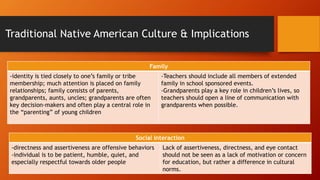
Traditional Native American Culture & Implications
Family
-identity is tied closely to one’s family or tribe
membership; much attention is placed on family
relationships; family consists of parents,
grandparents, aunts, uncles; grandparents are often
key decision-makers and often play a central role in
the “parenting” of young children
-Teachers should include all members of extended
family in school sponsored events.
-Grandparents play a key role in children’s lives, so
teachers should open a line of communication with
grandparents when possible.
Social Interaction
-directness and assertiveness are offensive behaviors
-individual is to be patient, humble, quiet, and
especially respectful towards older people
Lack of assertiveness, directness, and eye contact
should not be seen as a lack of motivation or concern
for education, but rather a difference in cultural
norms.
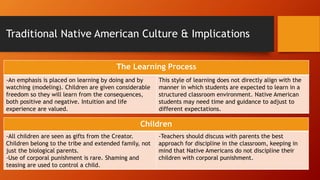
Traditional Native American Culture & Implications
The Learning Process
-An emphasis is placed on learning by doing and by
watching (modeling). Children are given considerable
freedom so they will learn from the consequences,
both positive and negative. Intuition and life
experience are valued.
This style of learning does not directly align with the
manner in which students are expected to learn in a
structured classroom environment. Native American
students may need time and guidance to adjust to
different expectations.
Children
-All children are seen as gifts from the Creator.
Children belong to the tribe and extended family, not
just the biological parents.
-Use of corporal punishment is rare. Shaming and
teasing are used to control a child.
-Teachers should discuss with parents the best
approach for discipline in the classroom, keeping in
mind that Native Americans do not discipline their
children with corporal punishment.
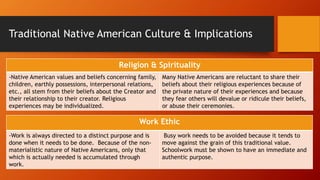
Traditional Native American Culture & Implications
Religion & Spirituality
-Native American values and beliefs concerning family,
children, earthly possessions, interpersonal relations,
etc., all stem from their beliefs about the Creator and
their relationship to their creator. Religious
experiences may be individualized.
Many Native Americans are reluctant to share their
beliefs about their religious experiences because of
the private nature of their experiences and because
they fear others will devalue or ridicule their beliefs,
or abuse their ceremonies.
Work Ethic
-Work is always directed to a distinct purpose and is
done when it needs to be done. Because of the non-
materialistic nature of Native Americans, only that
which is actually needed is accumulated through
work.
Busy work needs to be avoided because it tends to
move against the grain of this traditional value.
Schoolwork must be shown to have an immediate and
authentic purpose.
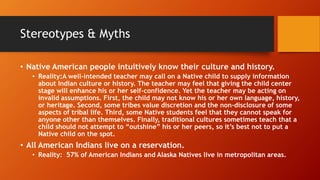
Stereotypes & Myths
• Native American people intuitively know their culture and history.
• Reality:A well-intended teacher may call on a Native child to supply information
about Indian culture or history. The teacher may feel that giving the child center
stage will enhance his or her self-confidence. Yet the teacher may be acting on
invalid assumptions. First, the child may not know his or her own language, history,
or heritage. Second, some tribes value discretion and the non-disclosure of some
aspects of tribal life. Third, some Native students feel that they cannot speak for
anyone other than themselves. Finally, traditional cultures sometimes teach that a
child should not attempt to “outshine” his or her peers, so it’s best not to put a
Native child on the spot.
• All American Indians live on a reservation.
• Reality: 57% of American Indians and Alaska Natives live in metropolitan areas.
References
• http://www.google.com/url?sa=t&rct=j&q=&esrc=s&frm=1&source
=web&cd=2&sqi=2&ved=0CDMQFjAB&url=http%3A%2F%2Fwww.jcu.
edu%2Feducation%2Fed350%2FMyths%2520and%2520Stereotypes%2
520About%2520Native%2520Americans.pdf&ei=_E4iUtqABoTm8wTX
n4DYBw&usg=AFQjCNGVrfaFqubcONhDIwolNGuXaeBCsg
• http://www.google.com/url?sa=t&rct=j&q=&esrc=s&frm=1&source
=web&cd=1&ved=0CCkQFjAA&url=http%3A%2F%2Fnwindian.evergr
een.edu%2Fcurriculum%2FValuesBehaviors.pdf&ei=RU0iUqHDMufJs
ATj64CwDA&usg=AFQjCNFNrlc3itOjllSl_R226CJyMtfHSg
• http://www.history.com/topics/native-american-cultures

Native American Culture- Implications for Teaching

  • 1.
    Native American Culture &Heritage Jamie Smith
  • 2.
    Did you know??? •According to the U.S. census bureau, there are about 4.5 million Native Americans and Alaska Natives in the United States today. That’s about 1.5% of the population! • New Mexico is home to 22 tribes. Each tribe is unique and they have their own traditional language, customs, values, prayers, songs, ceremonies, attire, and way of life. Native American groups have inhabited the territory of New Mexico for thousands of years, many centuries before Europeans reached the Americas.
  • 3.
    Traditional Native AmericanCulture & Implications Time -measured by natural events (sunrise, seasons of the year); less preoccupation with saving time and planning; more emphasis on living day to day -Having patience, showing respect, and caring for others is more important than punctuality. Native Americans will never break off a discussion in order to keep another appointment, and will find it rude if a teacher does so. Schedule conferences in a manner to allow adequate time that will not make parents feel rushed or disrespected. Competition -fierce competition between groups, but individuals should not be the center of attention -Self promotion is viewed negatively. Although students will care about their education, they will not focus on having the highest average or reading the most books in order to gain praise. They would be more inclined to participate in a class competition.
  • 4.
    Traditional Native AmericanCulture & Implications Family -identity is tied closely to one’s family or tribe membership; much attention is placed on family relationships; family consists of parents, grandparents, aunts, uncles; grandparents are often key decision-makers and often play a central role in the “parenting” of young children -Teachers should include all members of extended family in school sponsored events. -Grandparents play a key role in children’s lives, so teachers should open a line of communication with grandparents when possible. Social Interaction -directness and assertiveness are offensive behaviors -individual is to be patient, humble, quiet, and especially respectful towards older people Lack of assertiveness, directness, and eye contact should not be seen as a lack of motivation or concern for education, but rather a difference in cultural norms.
  • 5.
    Traditional Native AmericanCulture & Implications The Learning Process -An emphasis is placed on learning by doing and by watching (modeling). Children are given considerable freedom so they will learn from the consequences, both positive and negative. Intuition and life experience are valued. This style of learning does not directly align with the manner in which students are expected to learn in a structured classroom environment. Native American students may need time and guidance to adjust to different expectations. Children -All children are seen as gifts from the Creator. Children belong to the tribe and extended family, not just the biological parents. -Use of corporal punishment is rare. Shaming and teasing are used to control a child. -Teachers should discuss with parents the best approach for discipline in the classroom, keeping in mind that Native Americans do not discipline their children with corporal punishment.
  • 6.
    Traditional Native AmericanCulture & Implications Religion & Spirituality -Native American values and beliefs concerning family, children, earthly possessions, interpersonal relations, etc., all stem from their beliefs about the Creator and their relationship to their creator. Religious experiences may be individualized. Many Native Americans are reluctant to share their beliefs about their religious experiences because of the private nature of their experiences and because they fear others will devalue or ridicule their beliefs, or abuse their ceremonies. Work Ethic -Work is always directed to a distinct purpose and is done when it needs to be done. Because of the non- materialistic nature of Native Americans, only that which is actually needed is accumulated through work. Busy work needs to be avoided because it tends to move against the grain of this traditional value. Schoolwork must be shown to have an immediate and authentic purpose.
  • 7.
    Stereotypes & Myths •Native American people intuitively know their culture and history. • Reality:A well-intended teacher may call on a Native child to supply information about Indian culture or history. The teacher may feel that giving the child center stage will enhance his or her self-confidence. Yet the teacher may be acting on invalid assumptions. First, the child may not know his or her own language, history, or heritage. Second, some tribes value discretion and the non-disclosure of some aspects of tribal life. Third, some Native students feel that they cannot speak for anyone other than themselves. Finally, traditional cultures sometimes teach that a child should not attempt to “outshine” his or her peers, so it’s best not to put a Native child on the spot. • All American Indians live on a reservation. • Reality: 57% of American Indians and Alaska Natives live in metropolitan areas.
  • 8.