Going 'Beyond Education’:
Piloting a New Scholarship Model in
Sub-Saharan Africa
14 March 2014
The MasterCard Foundation Scholars Program
2
The MasterCard Foundation Scholars Program:
Context and Programmatic Need
Developing countries have achieved a remarkable expansion
in educational enrolment, however:
 Enrolment in secondary and tertiary education remains low, particularly
among poor and rural populations
 There are concerns about access to quality and relevant education,
even as demand for an educated workforce increases
 Many skilled graduates migrate to higher-income countries for better
remuneration and working conditions
 International scholarship programs too often contribute to brain drain
3
The MasterCard Foundation Scholars Program
 $500 million, 10-year initiative to educate and support 15,000 young
people – particularly from Africa – to act as “socially transformative
leaders,” driving change and making a positive social impact in their
communities
 11,000 secondary-level Scholarships; 6,000 tertiary-level
 Target population: youth who have demonstrated academic
talent, social consciousness and an orientation toward leadership, and
who come from highly disadvantaged socioeconomic backgrounds
 Implemented with and through a global network of 20 NGOs and
secondary and tertiary education institutions, which select and directly
support the Scholars
4
The MasterCard Foundation Scholars Program:
Program Components
5
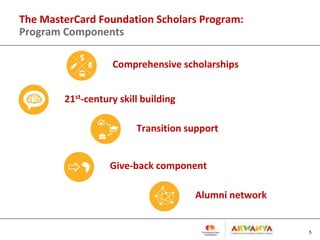
Comprehensive scholarships
Transition support
21st-century skill building
Give-back component
Alumni network
The MasterCard Foundation Scholars Program:
Akwanya Initiative
• Pilot program, 2012-2015: 85 Scholars
• Recruitment partners on the continent who nominate suitable candidates
• University partners invest at least 50% of the financial support for each
Scholar
• Matching ‘placement’ with universities based on Scholars’ academic and
professional goals, optimum learning and community environment, etc.
• Full-time program staff dedicated to supporting Akwanya Scholars in
university and throughout their personal/professional development
• Integration into the wider MasterCard Foundation Scholars network
6
Akwanya: Progress and Lessons Learned
• 51 Scholars from 22 countries, with another 25 joining in August
• Studying at 16 tertiary institutions in eight countries
• Early lessons learned
• The ‘cohort’ is key – students benefit in many ways from having fellow
Scholars on campus (and ‘solo’ Scholars have struggled)
• Relatively small financial incentives from the program make it attractive
and viable for universities with limited funding to engage
• Leveraging recruitment partners ensures a very high-quality applicant
pool
• Under-resourced international students are just as capable of success,
given the right support
• There is potential for incredible growth (high # of potential Scholars and
of interested university partners)
7
Contacts
Barry Burciul
 bburciul@mastercardfdn.org
Laura Kaub
 lkaub@africanleadershipacademy.org
8

Going 'Beyond Education’: Piloting a New Scholarship Model in Sub-Saharan African

  • 1.
    Going 'Beyond Education’: Pilotinga New Scholarship Model in Sub-Saharan Africa 14 March 2014
  • 2.
    The MasterCard FoundationScholars Program 2
  • 3.
    The MasterCard FoundationScholars Program: Context and Programmatic Need Developing countries have achieved a remarkable expansion in educational enrolment, however:  Enrolment in secondary and tertiary education remains low, particularly among poor and rural populations  There are concerns about access to quality and relevant education, even as demand for an educated workforce increases  Many skilled graduates migrate to higher-income countries for better remuneration and working conditions  International scholarship programs too often contribute to brain drain 3
  • 4.
    The MasterCard FoundationScholars Program  $500 million, 10-year initiative to educate and support 15,000 young people – particularly from Africa – to act as “socially transformative leaders,” driving change and making a positive social impact in their communities  11,000 secondary-level Scholarships; 6,000 tertiary-level  Target population: youth who have demonstrated academic talent, social consciousness and an orientation toward leadership, and who come from highly disadvantaged socioeconomic backgrounds  Implemented with and through a global network of 20 NGOs and secondary and tertiary education institutions, which select and directly support the Scholars 4
  • 5.
    The MasterCard FoundationScholars Program: Program Components 5 Comprehensive scholarships Transition support 21st-century skill building Give-back component Alumni network
  • 6.
    The MasterCard FoundationScholars Program: Akwanya Initiative • Pilot program, 2012-2015: 85 Scholars • Recruitment partners on the continent who nominate suitable candidates • University partners invest at least 50% of the financial support for each Scholar • Matching ‘placement’ with universities based on Scholars’ academic and professional goals, optimum learning and community environment, etc. • Full-time program staff dedicated to supporting Akwanya Scholars in university and throughout their personal/professional development • Integration into the wider MasterCard Foundation Scholars network 6
  • 7.
    Akwanya: Progress andLessons Learned • 51 Scholars from 22 countries, with another 25 joining in August • Studying at 16 tertiary institutions in eight countries • Early lessons learned • The ‘cohort’ is key – students benefit in many ways from having fellow Scholars on campus (and ‘solo’ Scholars have struggled) • Relatively small financial incentives from the program make it attractive and viable for universities with limited funding to engage • Leveraging recruitment partners ensures a very high-quality applicant pool • Under-resourced international students are just as capable of success, given the right support • There is potential for incredible growth (high # of potential Scholars and of interested university partners) 7
  • 8.
    Contacts Barry Burciul  bburciul@mastercardfdn.org LauraKaub  lkaub@africanleadershipacademy.org 8

Editor's Notes

  • #2 PanelAbstract: This presentation will provide additional detail about our pilot model and some of the unique features that we believe will lead to its success. Data illustrating our progress so far, particularly focusing on Scholar success, will be shared and critiqued, and we will share some key lessons learned from first two years of the program.Laura to start.
  • #3 The MasterCard Foundation is based in Toronto, Canada. We were established in 2006 through a gift from MasterCard Worldwide when it became a publicly traded company. We’re a fully independent and autonomousfoundation, now with over $9 billion in assets. Our programs, which span 46 countries, promote financial inclusion and advance youth learning, mostly in Africa. The Scholars Program is the signature program in our Youth Learning portfolio.
  • #6 Scholars receive comprehensive financial, academic, and social support, plus opportunities for community service and internships.In addition to offering comprehensive Scholarships, we’ve selected partners who are well equipped to give youth the skills they need to succeed in Africa’s job market, while also providing them with the knowledge they need to confront the challenges facing African societies.We provide tailored support services to meet the specific needs of our Scholars as they transition into their secondary or tertiary studies, and from there out into their careers.“Give-Back” to Africa is a priority both in terms of selection, and as something we seek to nurture through the Program. The vast majority of Scholars will hold Scholarships in Africa, while a smaller subset will study abroad. We expect our Scholars to either remain in or return to their region of origin, to deploy their talents in the service of their communities. To that end, we select Scholars who demonstrate an awareness of and desire to engage with these challenges, and we support these aspirations throughout their studies – as an example, for Scholars who study abroad: We encourage them to remain connected to their home countries by facilitating internships and experiential learning there during their Program, and we try to create conditions that will draw Scholars back to Africa at the end of their studies, by linking them to employment opportunities.Finally, virtual and real-world Communities of Scholars and alumni provide inspiration, knowledge, support and networking opportunities.
  • #8 University partners in Kenya, Zimbabwe, Germany, US and Canada,France, England, Uganda How high-level do we want our learnings to be? Others could be:--small, unexpected costs such as medical expenses really add up--recruitment organizations’ input are vital--substantive pre-uni orientation really impacts student success\