Solving Optimization Problems with MATLAB
2
 Introduction
 Least-squares minimization
 Nonlinear optimization
 Mixed-integer programming
 Global optimization
Topics
3
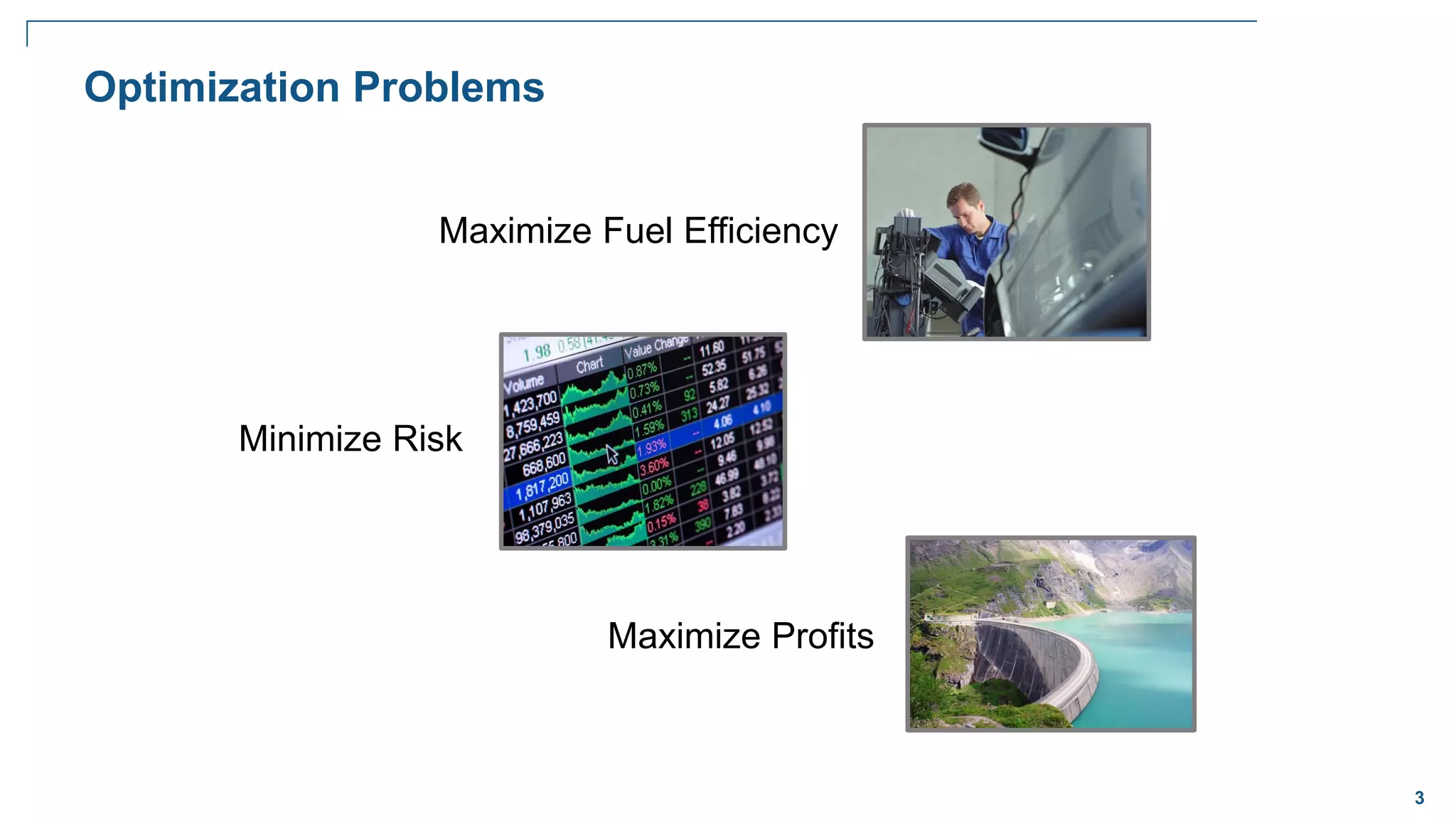
Optimization Problems
Minimize Risk
Maximize Profits
Maximize Fuel Efficiency
4
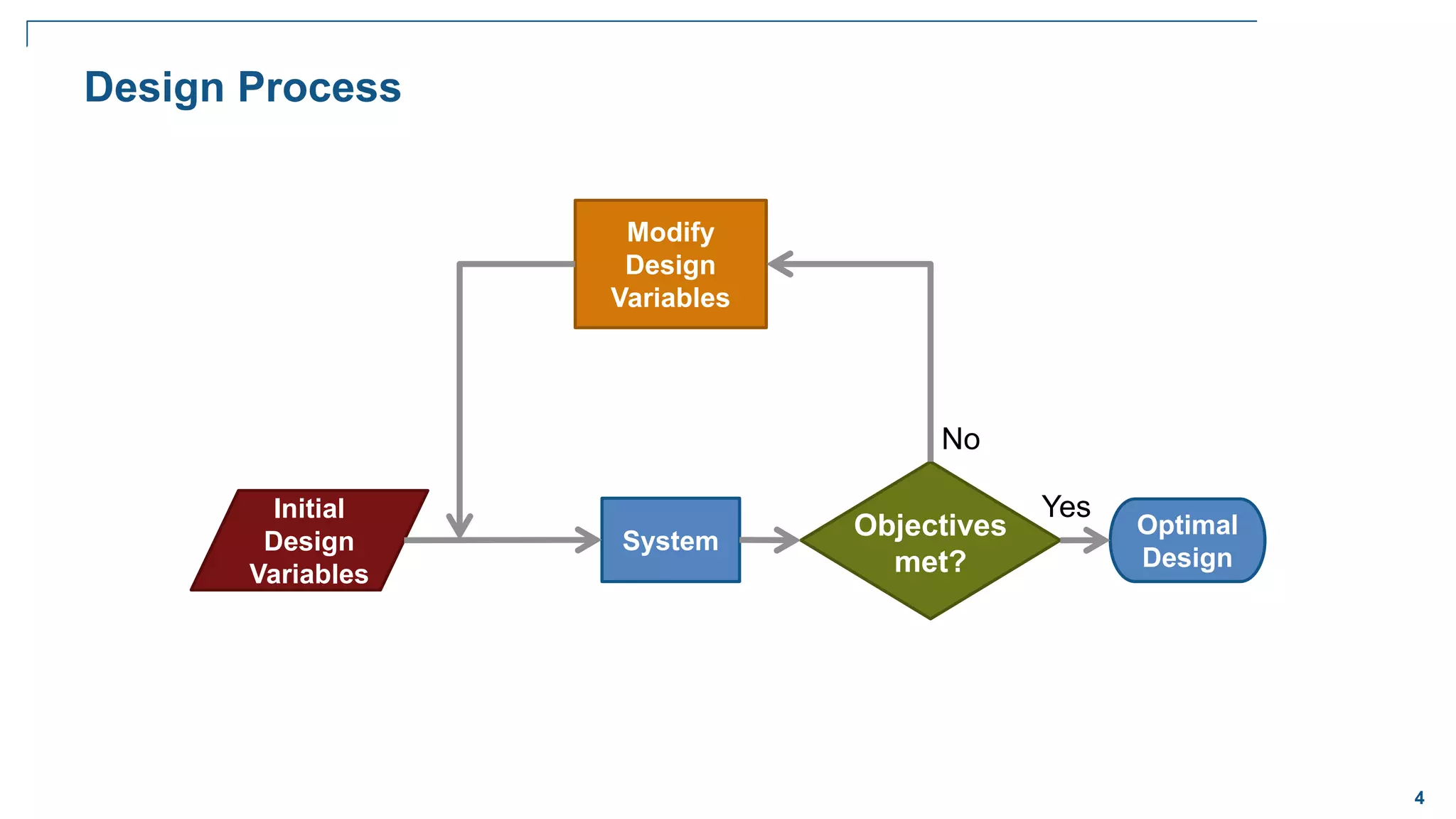
Design Process
Initial
Design
Variables
System
Modify
Design
Variables
Optimal
Design
Objectives
met?
No
Yes
5
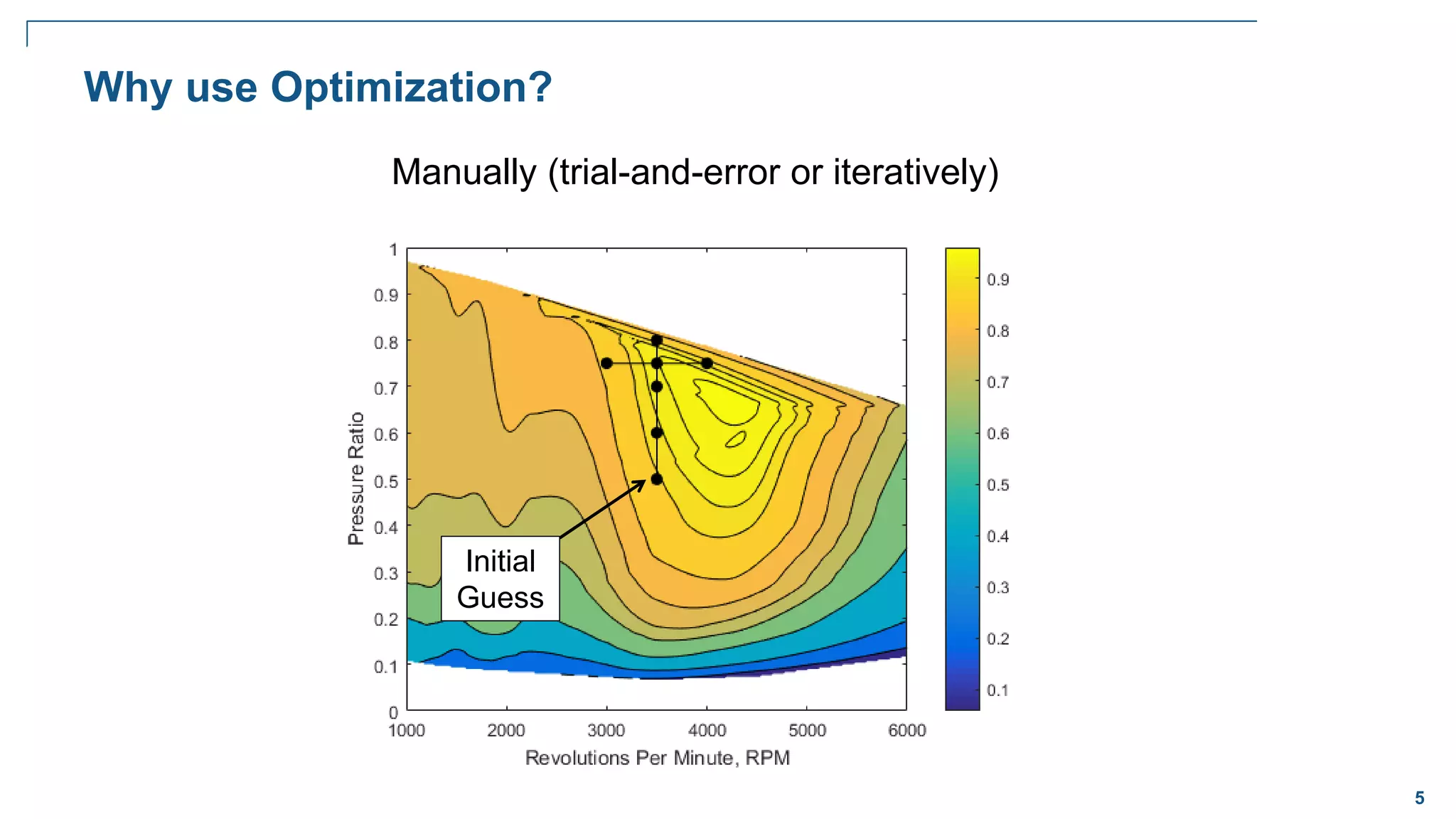
Manually (trial-and-error or iteratively)
Why use Optimization?
Initial
Guess
6
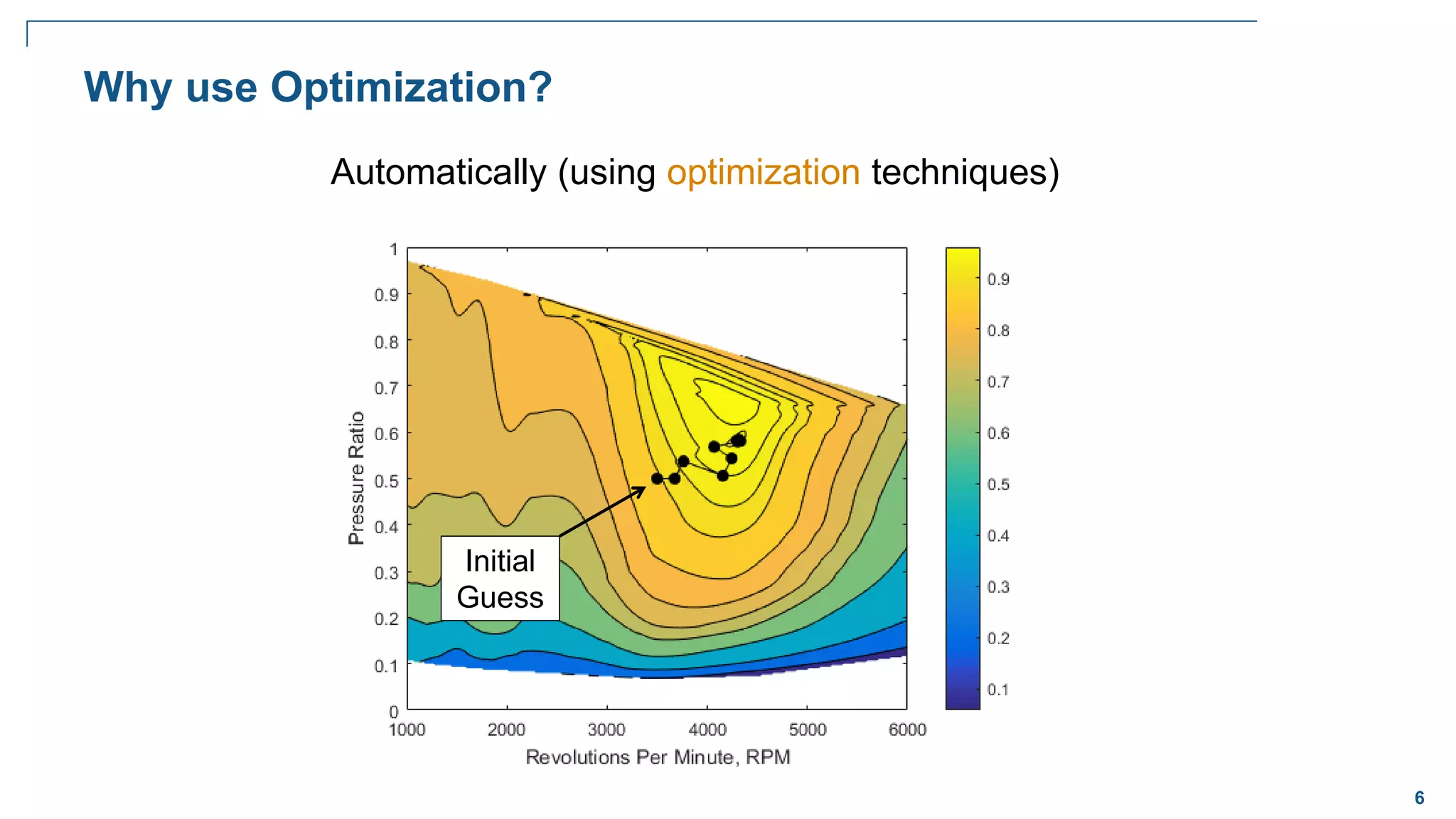
Automatically (using optimization techniques)
Initial
Guess
Why use Optimization?
7
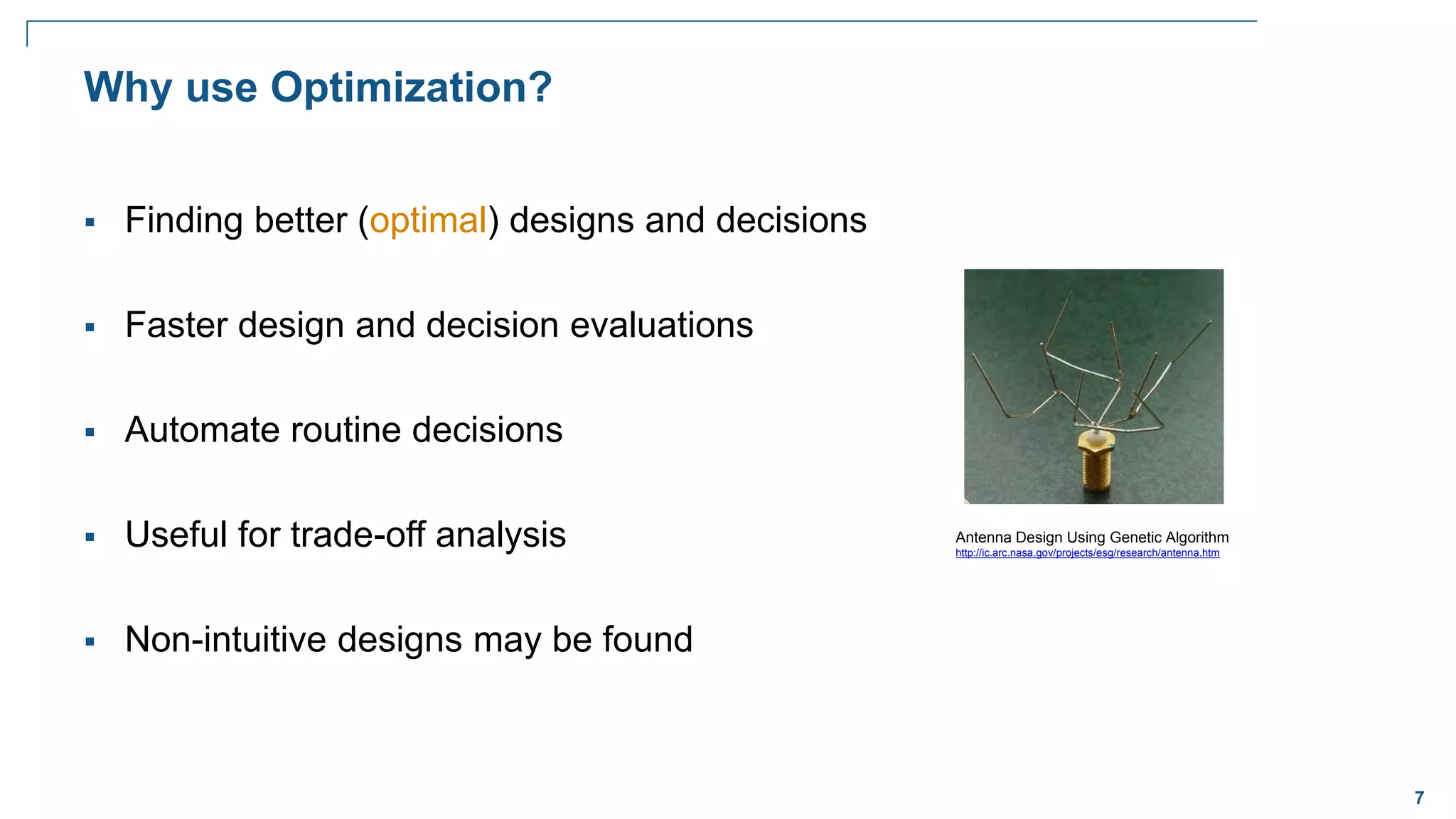
Why use Optimization?
 Finding better (optimal) designs and decisions
 Faster design and decision evaluations
 Automate routine decisions
 Useful for trade-off analysis
 Non-intuitive designs may be found
Antenna Design Using Genetic Algorithm
http://ic.arc.nasa.gov/projects/esg/research/antenna.htm
8
 Introduction
 Least-squares minimization
 Nonlinear optimization
 Mixed-integer programming
 Global optimization
Topics
9
Curve Fitting Demo
Given some data:
Fit a curve of the form:
t
e
c
c
t
y 

 2
1
)
(
t = [0 .3 .8 1.1 1.6 2.3];
y = [.82 .72 .63 .60 .55 .50];
10
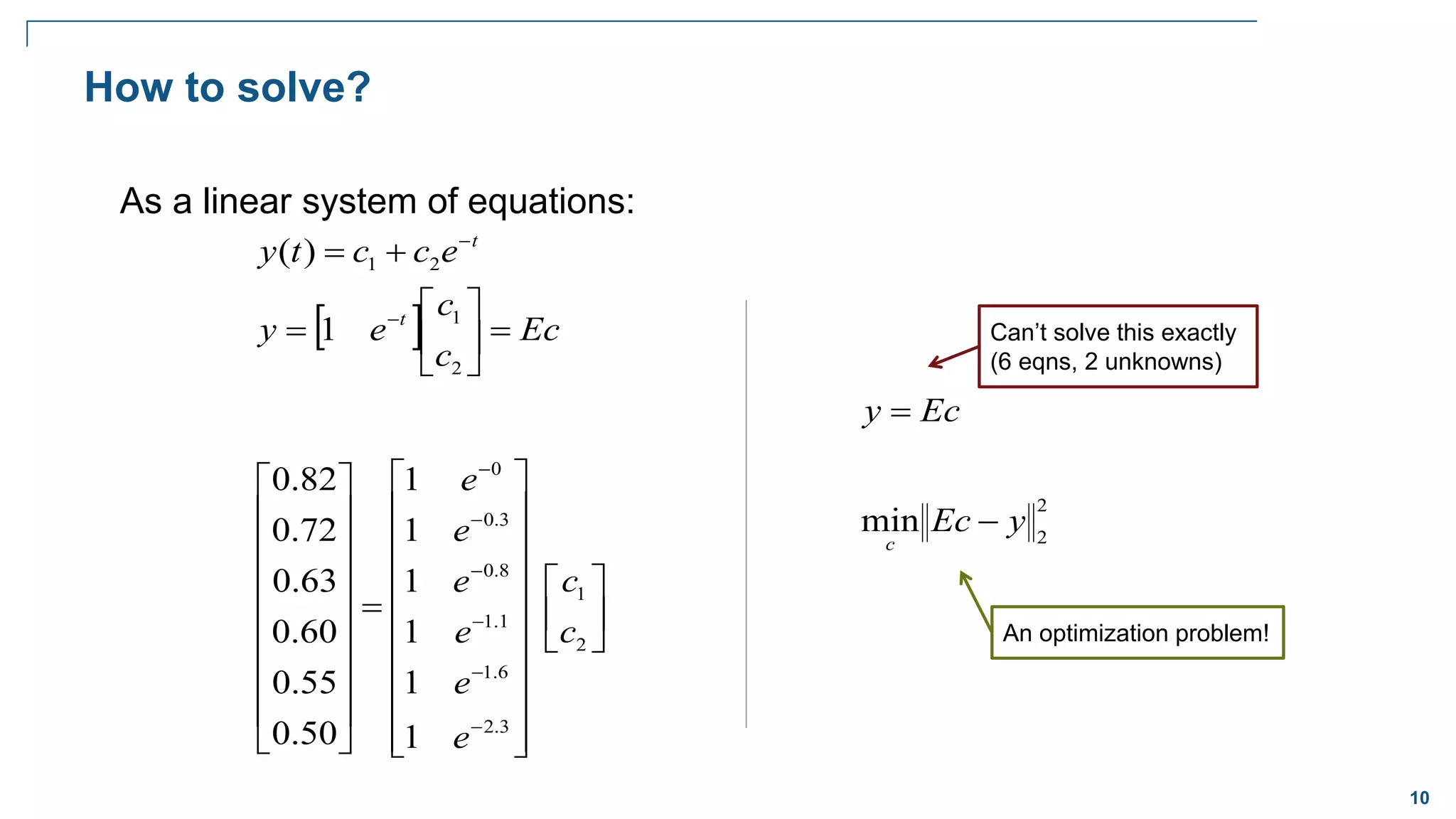
How to solve?
  Ec
c
c
e
y
e
c
c
t
y
t
t












2
1
2
1
1
)
(
As a linear system of equations:
2
2
min y
Ec
Ec
y
c


Can’t solve this exactly
(6 eqns, 2 unknowns)
An optimization problem!



















































2
1
3
.
2
6
.
1
1
.
1
8
.
0
3
.
0
0
1
1
1
1
1
1
50
.
0
55
.
0
60
.
0
63
.
0
72
.
0
82
.
0
c
c
e
e
e
e
e
e
11
 Introduction
 Least-squares minimization
 Nonlinear optimization
 Mixed-integer programming
 Global optimization
Topics
12
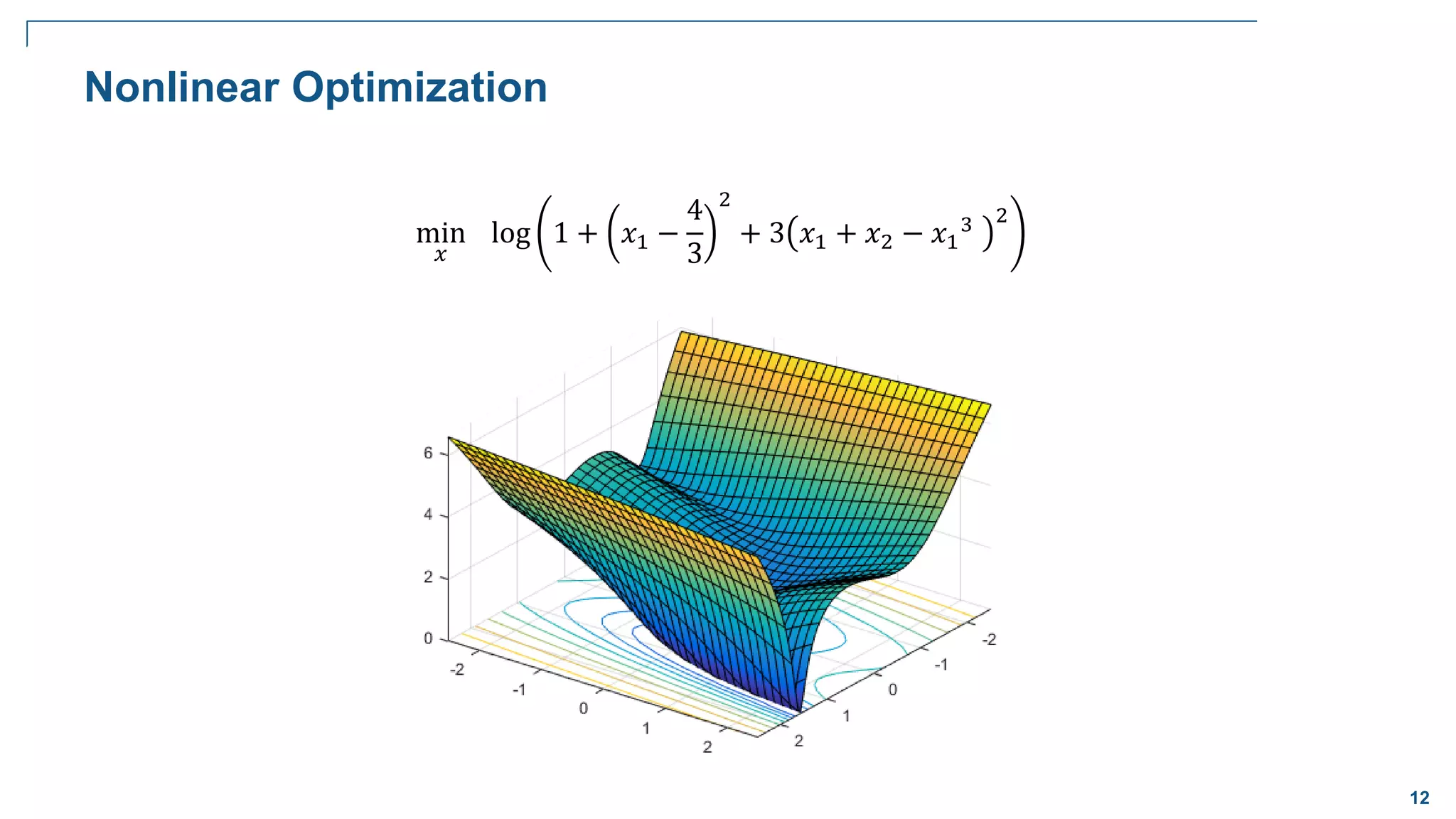
Nonlinear Optimization
min
𝑥
log 1 + 𝑥1 −
4
3
2
+ 3 𝑥1 + 𝑥2 − 𝑥1
3 2
13
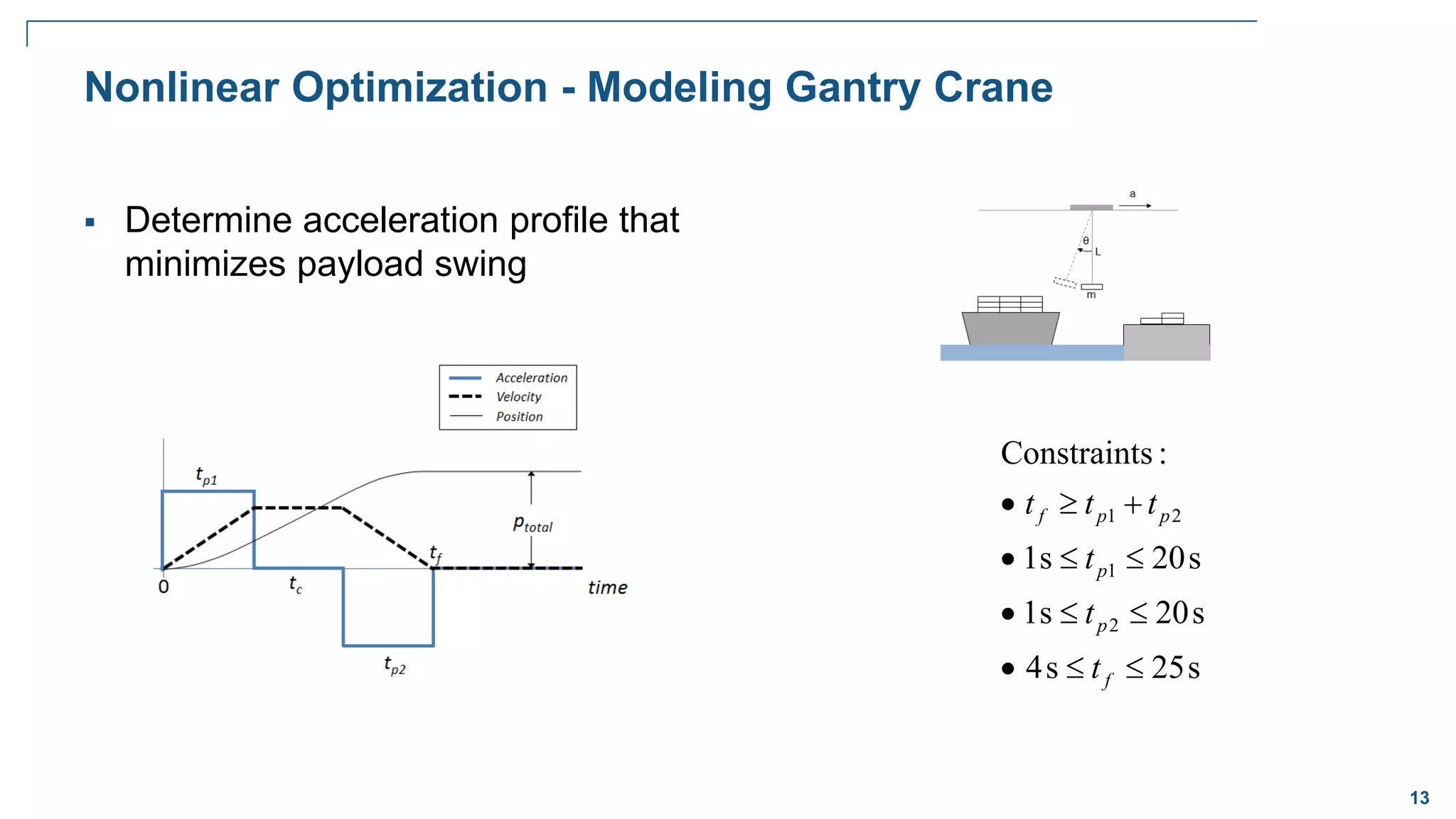
Nonlinear Optimization - Modeling Gantry Crane
 Determine acceleration profile that
minimizes payload swing
s
25
s
4
s
20
s
1
s
20
s
1
:
s
Constraint
2
1
2
1












f
p
p
p
p
f
t
t
t
t
t
t
14
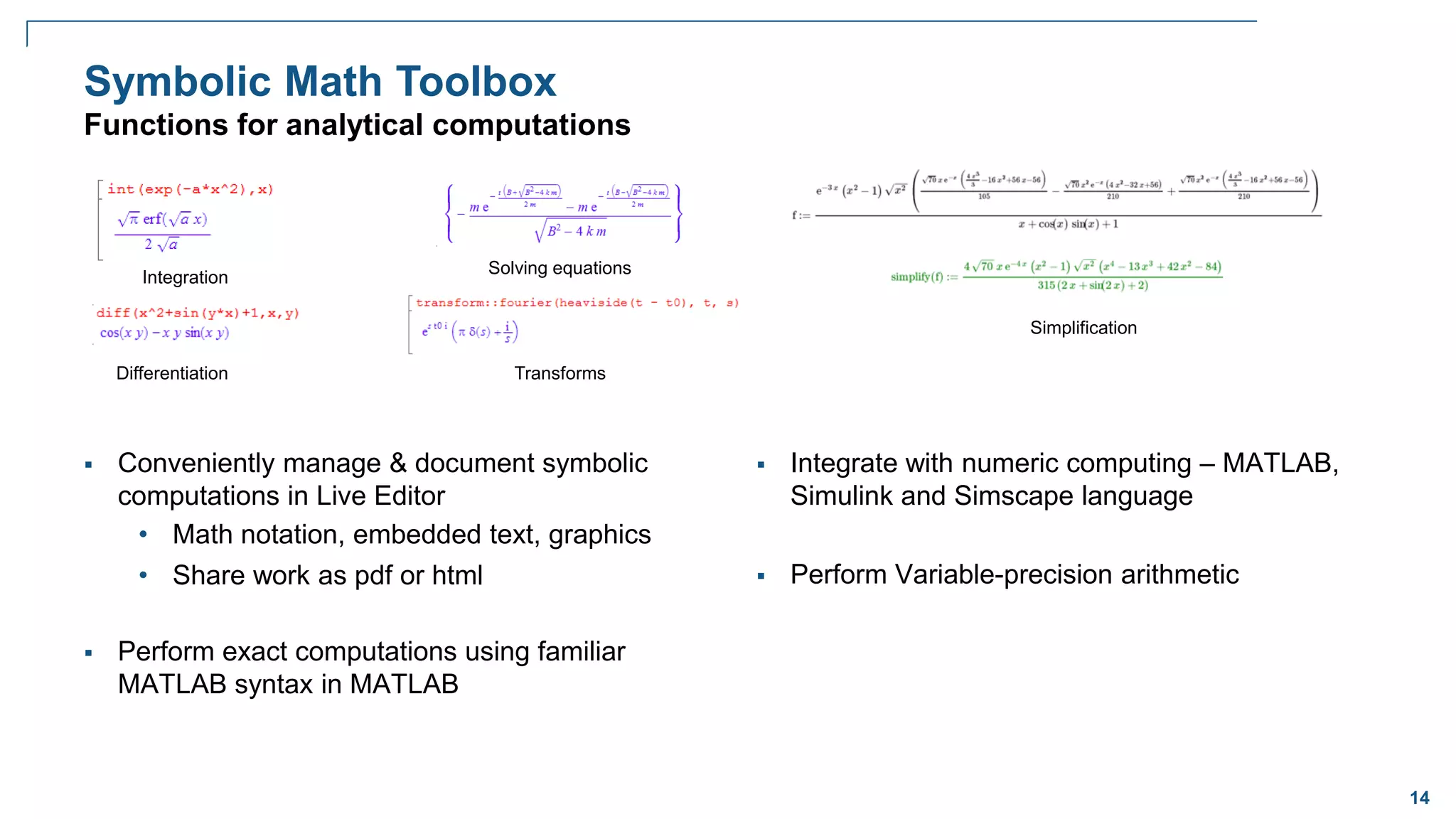
Symbolic Math Toolbox
Functions for analytical computations
 Conveniently manage & document symbolic
computations in Live Editor
• Math notation, embedded text, graphics
• Share work as pdf or html
 Perform exact computations using familiar
MATLAB syntax in MATLAB
Integration
Differentiation
Solving equations
Transforms
Simplification
 Integrate with numeric computing – MATLAB,
Simulink and Simscape language
 Perform Variable-precision arithmetic
15
 Introduction
 Least-squares minimization
 Nonlinear optimization
 Mixed-integer programming
 Global optimization
Topics
16
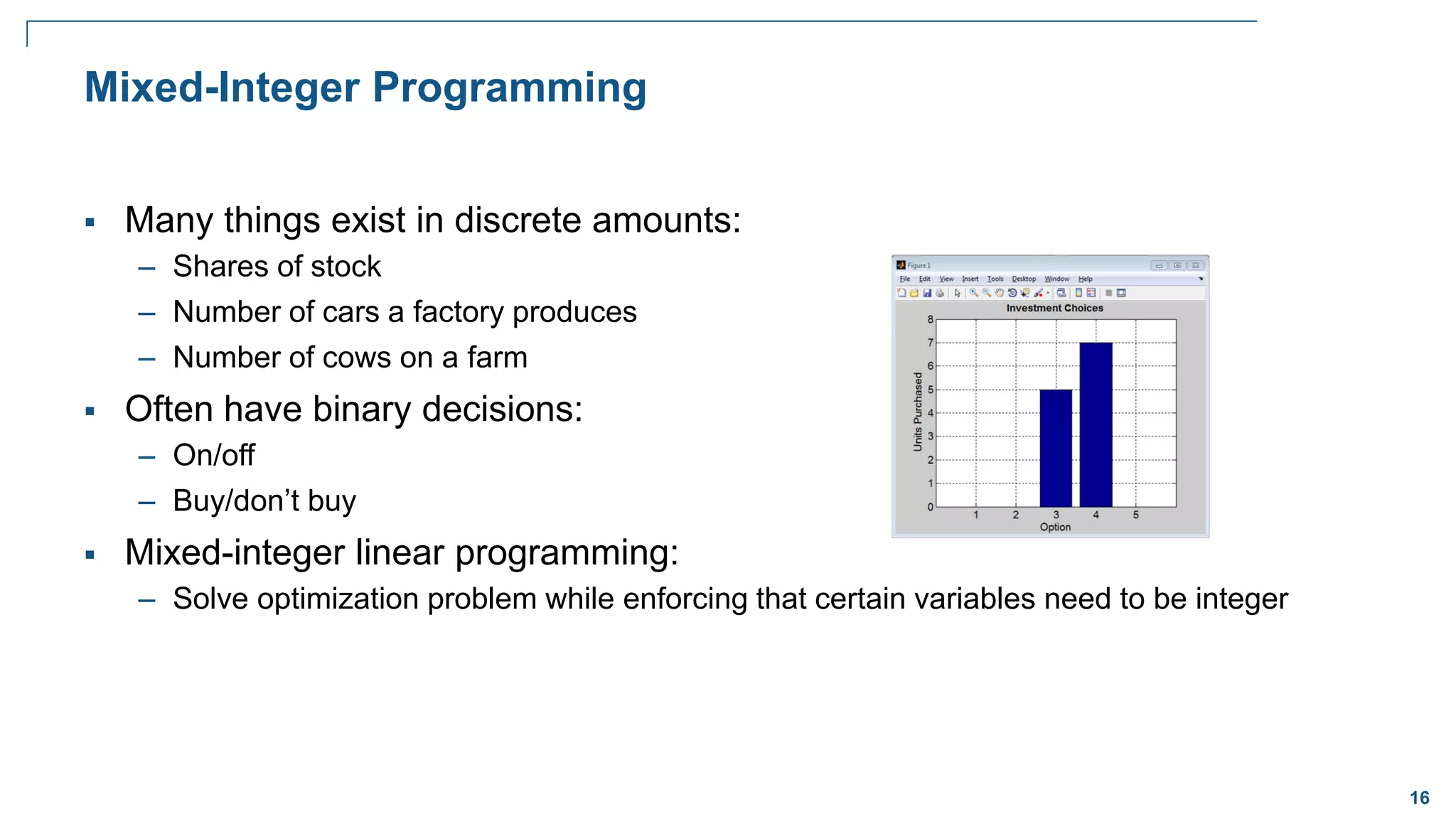
Mixed-Integer Programming
 Many things exist in discrete amounts:
– Shares of stock
– Number of cars a factory produces
– Number of cows on a farm
 Often have binary decisions:
– On/off
– Buy/don’t buy
 Mixed-integer linear programming:
– Solve optimization problem while enforcing that certain variables need to be integer
17
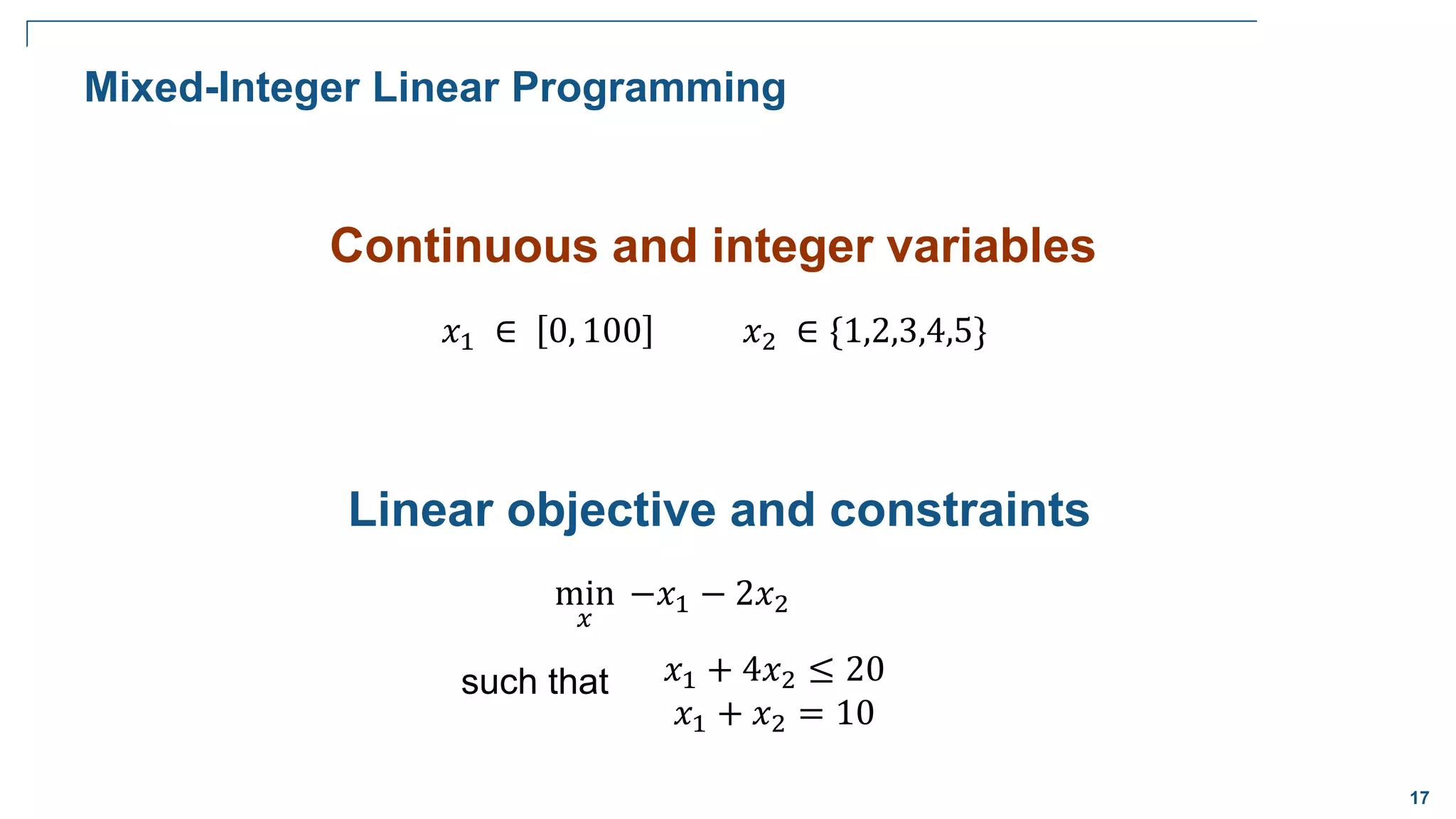
Continuous and integer variables
𝑥1 ∈ 0, 100 𝑥2 ∈ {1,2,3,4,5}
Linear objective and constraints
min
𝑥
−𝑥1 − 2𝑥2
𝑥1 + 4𝑥2 ≤ 20
𝑥1 + 𝑥2 = 10
such that
Mixed-Integer Linear Programming
18
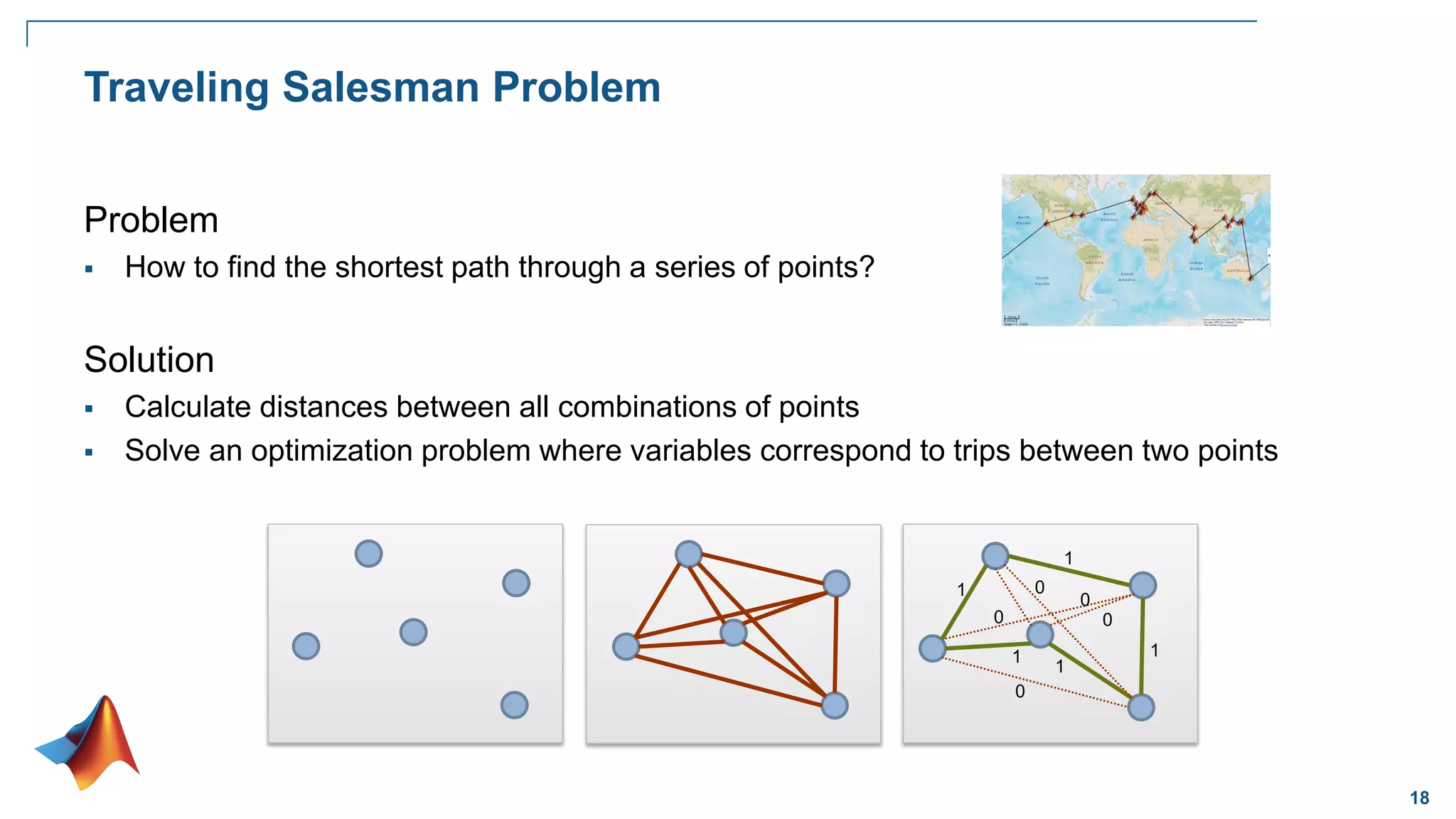
Traveling Salesman Problem
Problem
 How to find the shortest path through a series of points?
Solution
 Calculate distances between all combinations of points
 Solve an optimization problem where variables correspond to trips between two points
1
1
1
0
1
1
0
0
0
0
19
 Introduction
 Least-squares minimization
 Nonlinear optimization
 Mixed-integer programming
 Global optimization
Topics
20
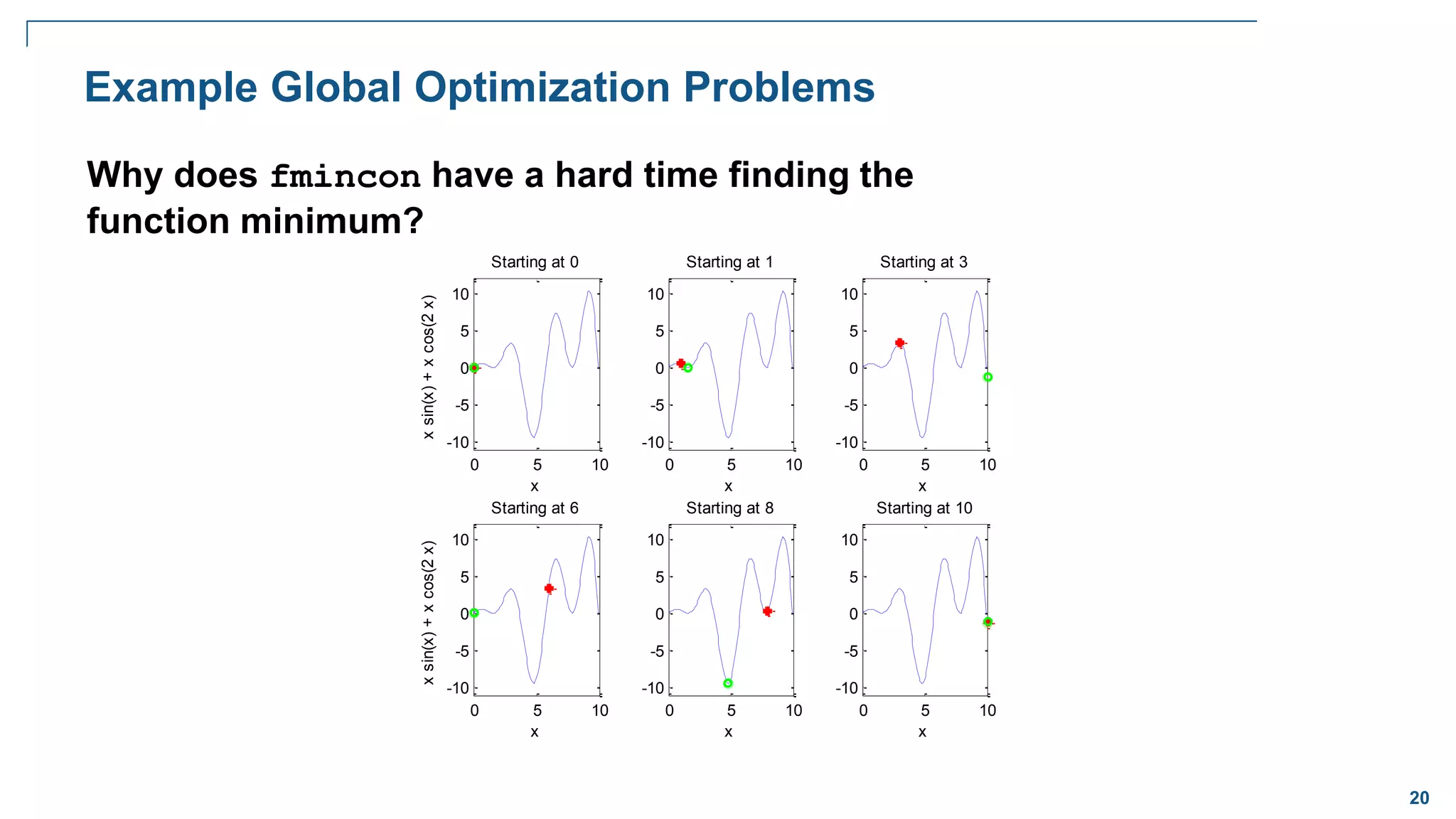
Example Global Optimization Problems
Why does fmincon have a hard time finding the
function minimum?
0 5 10
-10
-5
0
5
10
x
Starting at 10
0 5 10
-10
-5
0
5
10
x
Starting at 8
0 5 10
-10
-5
0
5
10
x
Starting at 6
x
sin(x)
+
x
cos(2
x)
0 5 10
-10
-5
0
5
10
x
Starting at 3
0 5 10
-10
-5
0
5
10
x
Starting at 1
0 5 10
-10
-5
0
5
10
x
Starting at 0
x
sin(x)
+
x
cos(2
x)
21
Initial
Guess
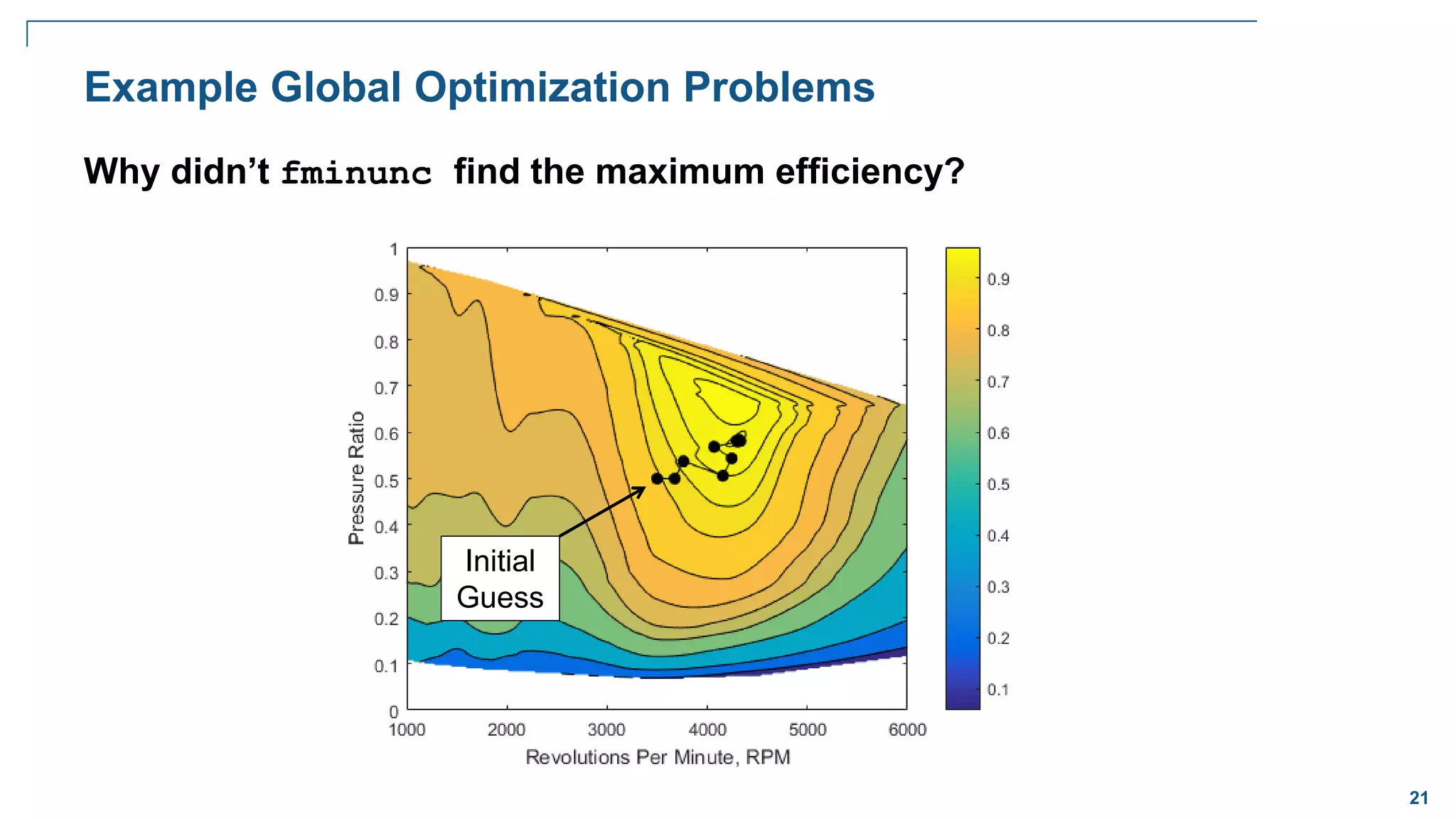
Example Global Optimization Problems
Why didn’t fminunc find the maximum efficiency?
22
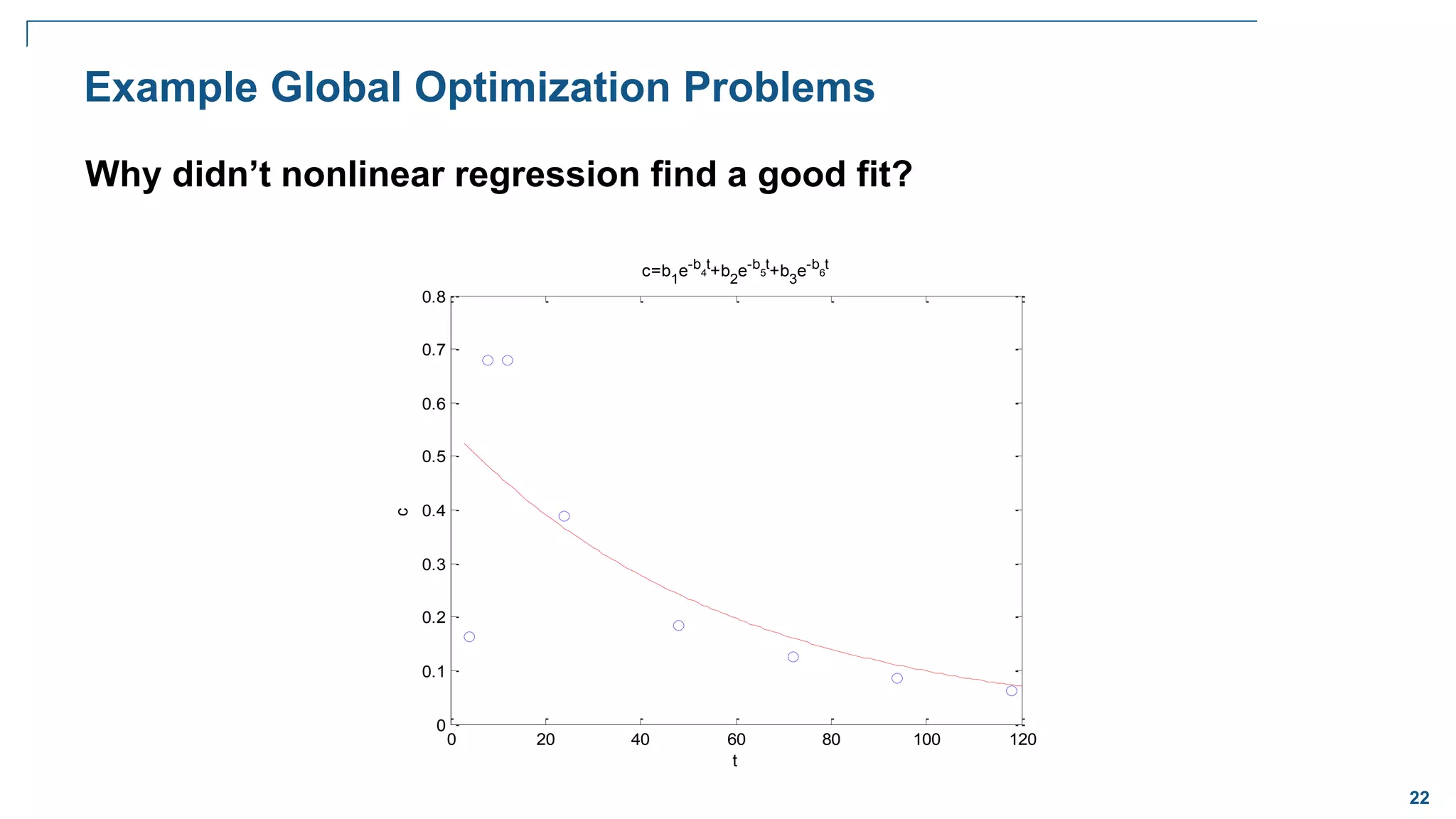
Example Global Optimization Problems
Why didn’t nonlinear regression find a good fit?
0 20 40 60 80 100 120
0
0.1
0.2
0.3
0.4
0.5
0.6
0.7
0.8
t
c
c=b1
e-b
4
t
+b2
e-b
5
t
+b3
e-b
6
t
23
Global Optimization
Goal:
Want to find the lowest/largest value of
the nonlinear function that has many local
minima/maxima
Problem:
Traditional solvers often return one of the
local minima (not the global)
Solution:
A solver that locates globally optimal
solutions
Global Minimum at [0 0]
Rastrigin’s Function
24
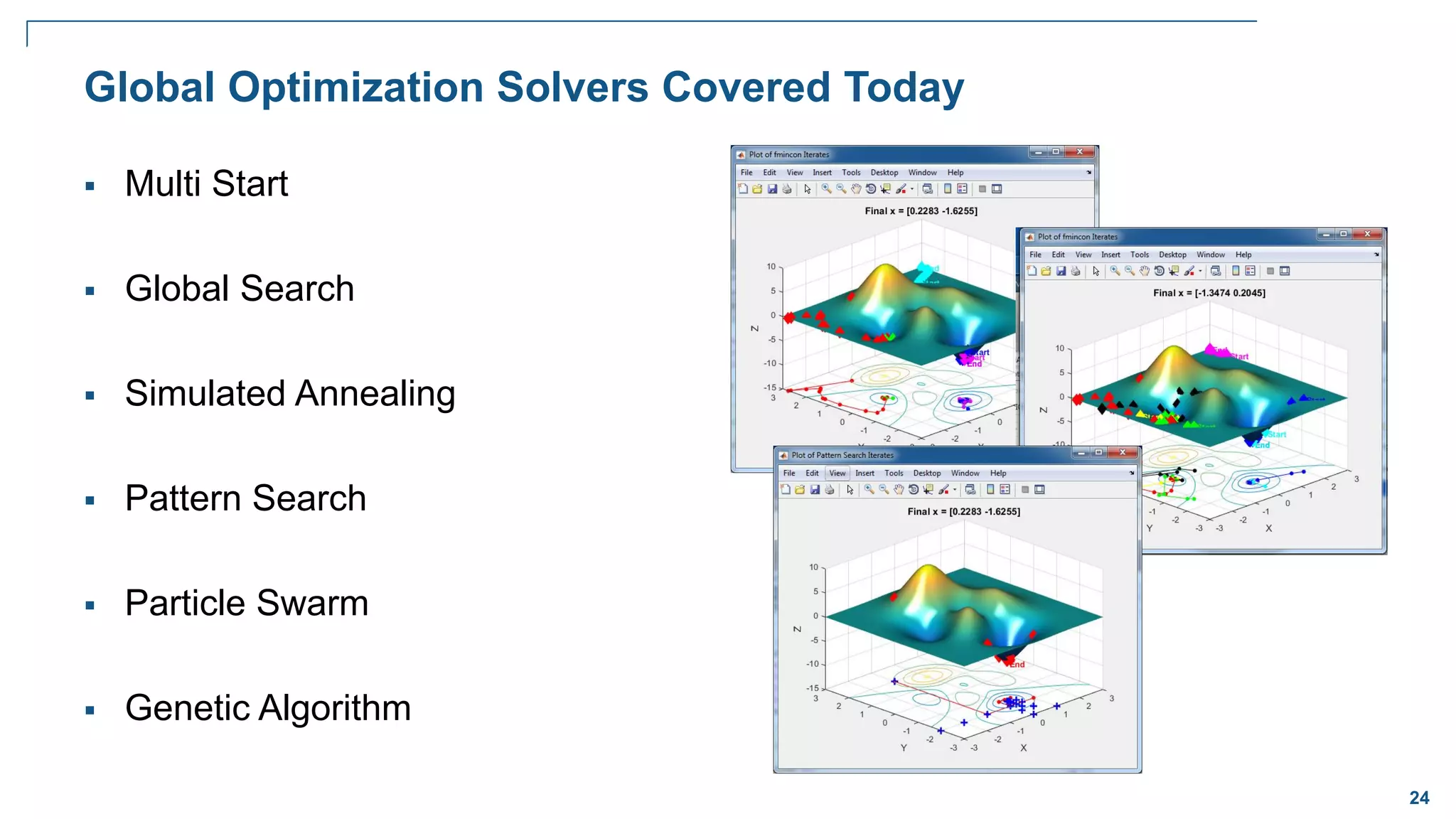
Global Optimization Solvers Covered Today
 Multi Start
 Global Search
 Simulated Annealing
 Pattern Search
 Particle Swarm
 Genetic Algorithm
25
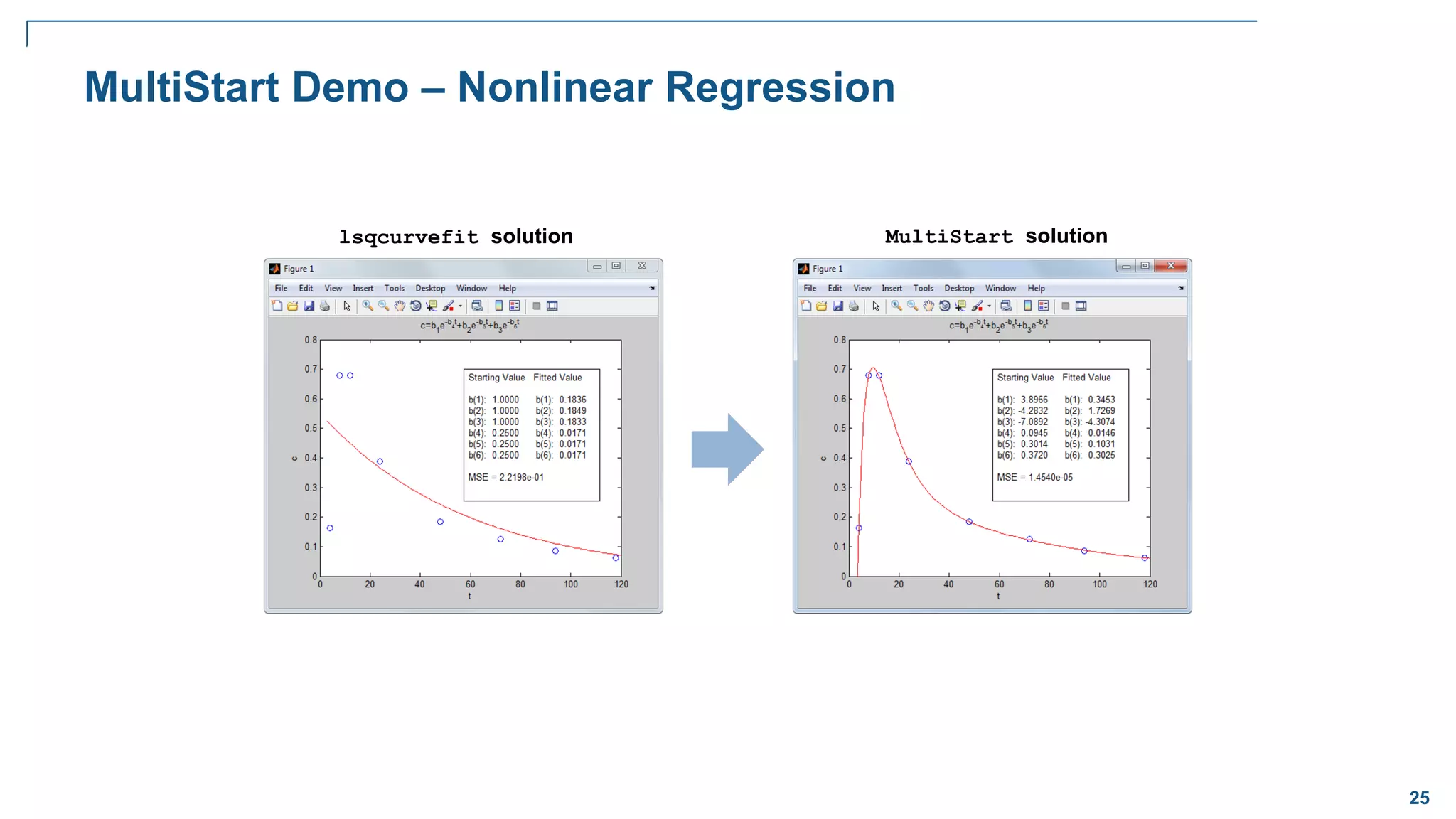
MultiStart Demo – Nonlinear Regression
lsqcurvefit solution MultiStart solution
26
MULTISTART
27
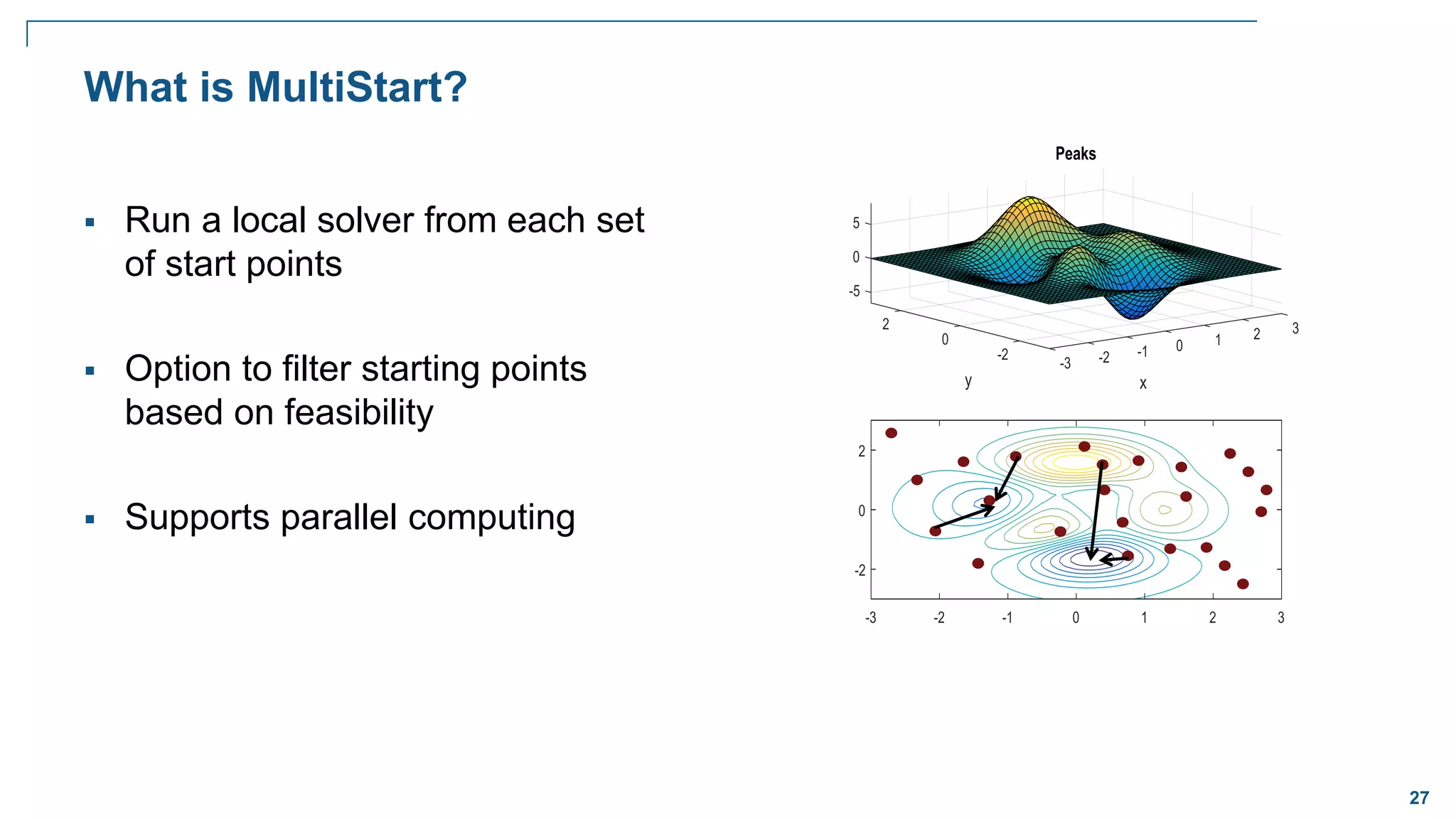
What is MultiStart?
 Run a local solver from each set
of start points
 Option to filter starting points
based on feasibility
 Supports parallel computing
28
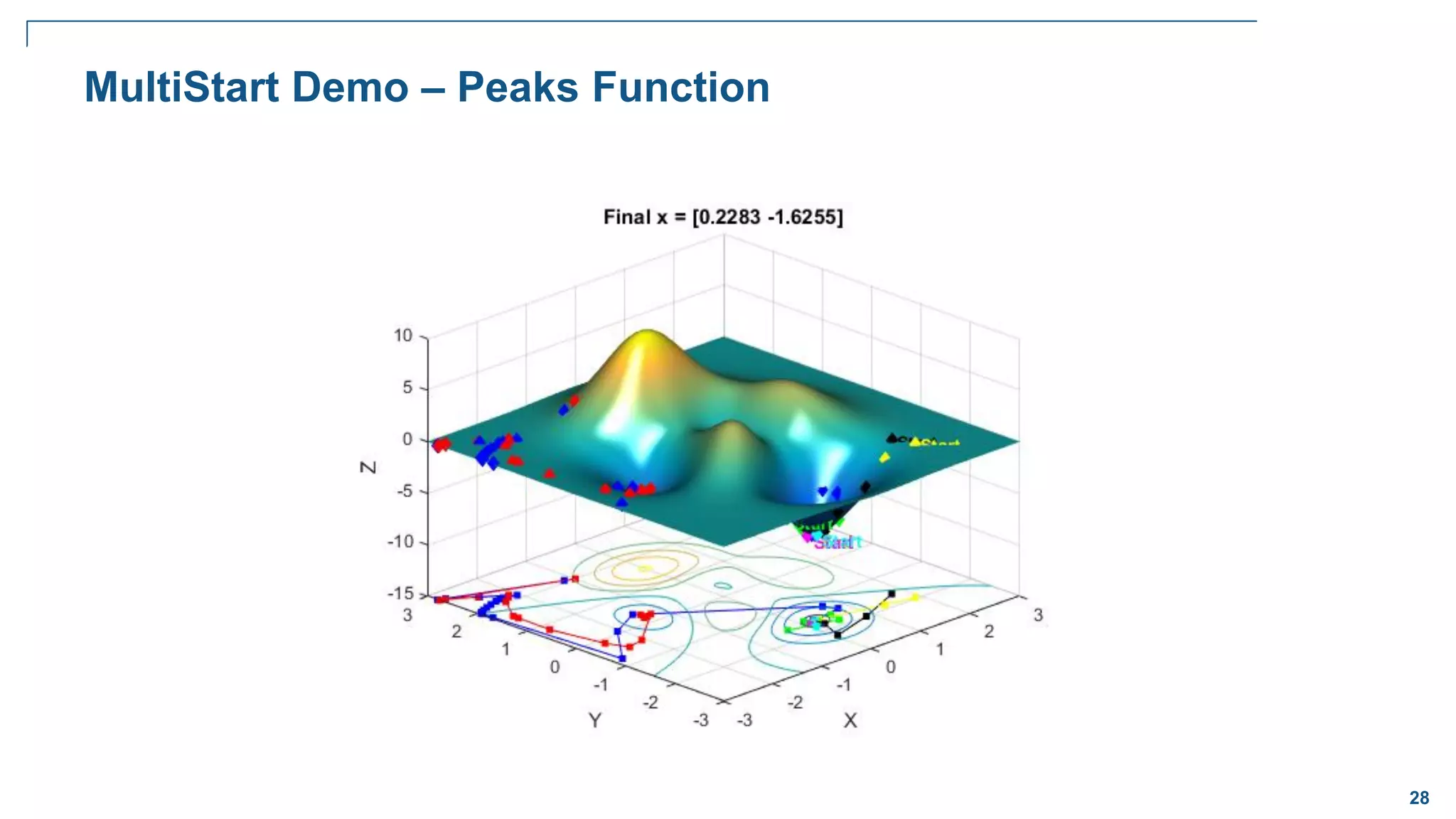
MultiStart Demo – Peaks Function
29
GLOBAL SEARCH
30
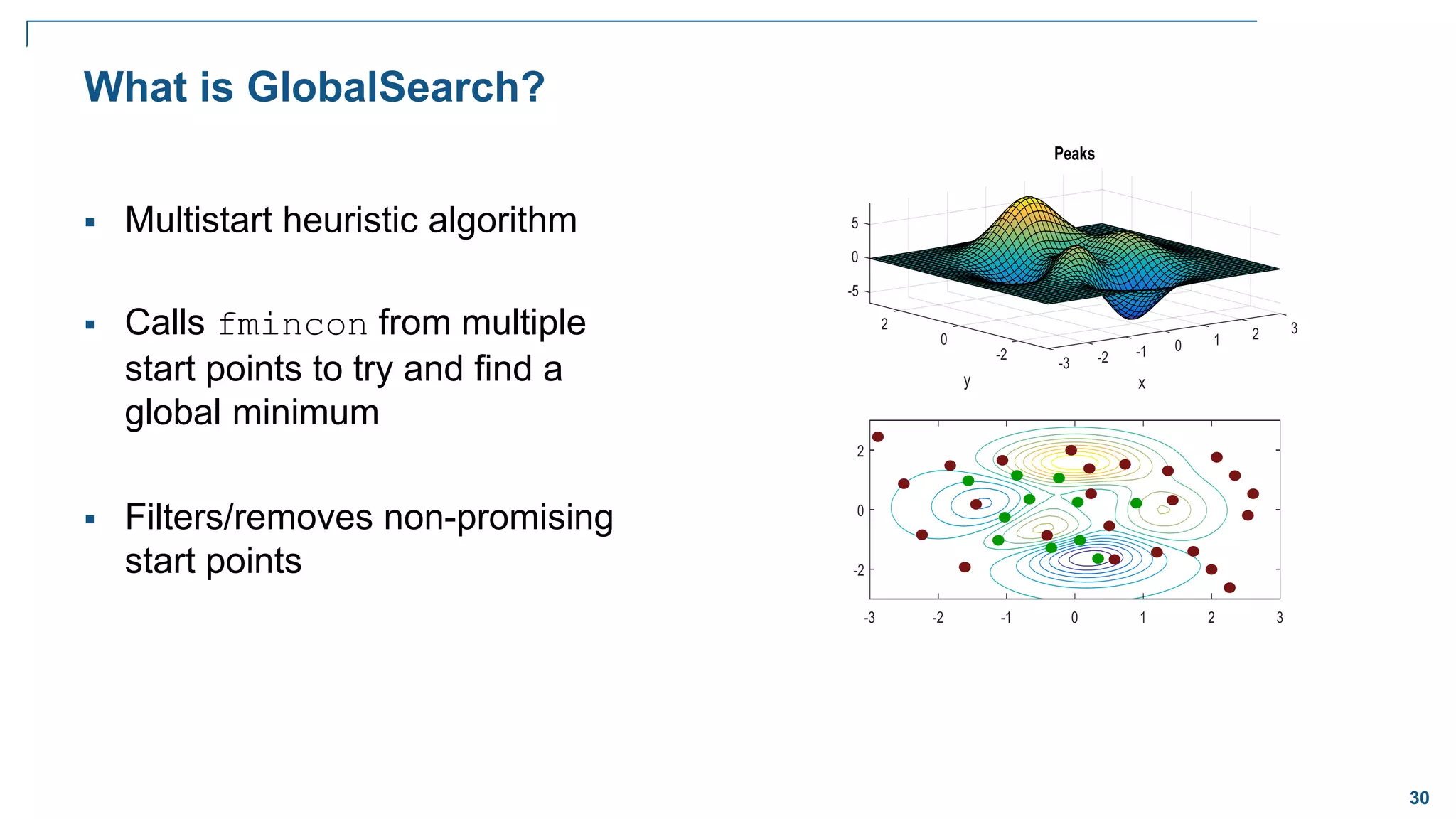
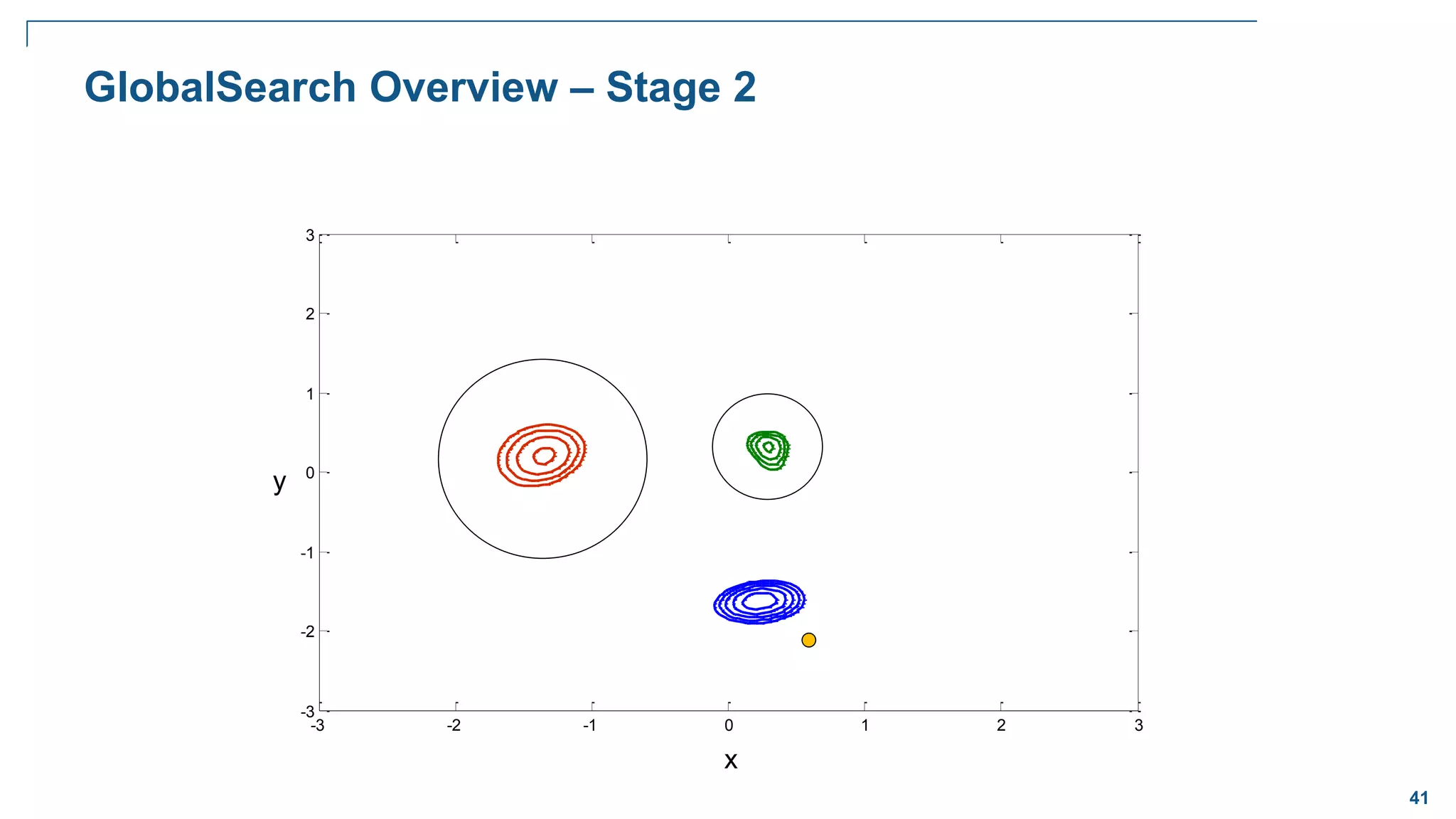
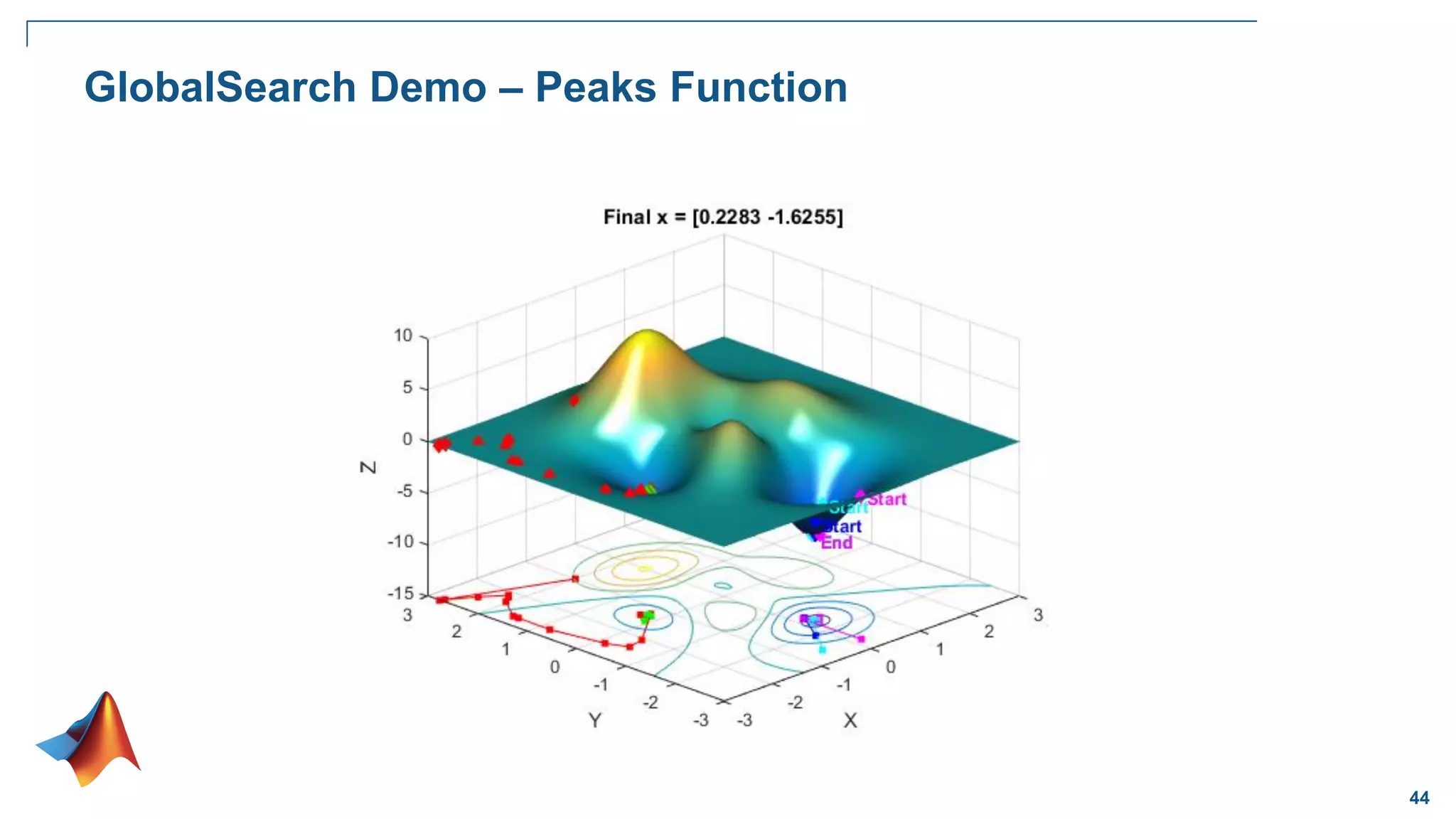
What is GlobalSearch?
 Multistart heuristic algorithm
 Calls fmincon from multiple
start points to try and find a
global minimum
 Filters/removes non-promising
start points
31
-3 -2 -1 0 1 2 3
-3
-2
-1
0
1
2
3
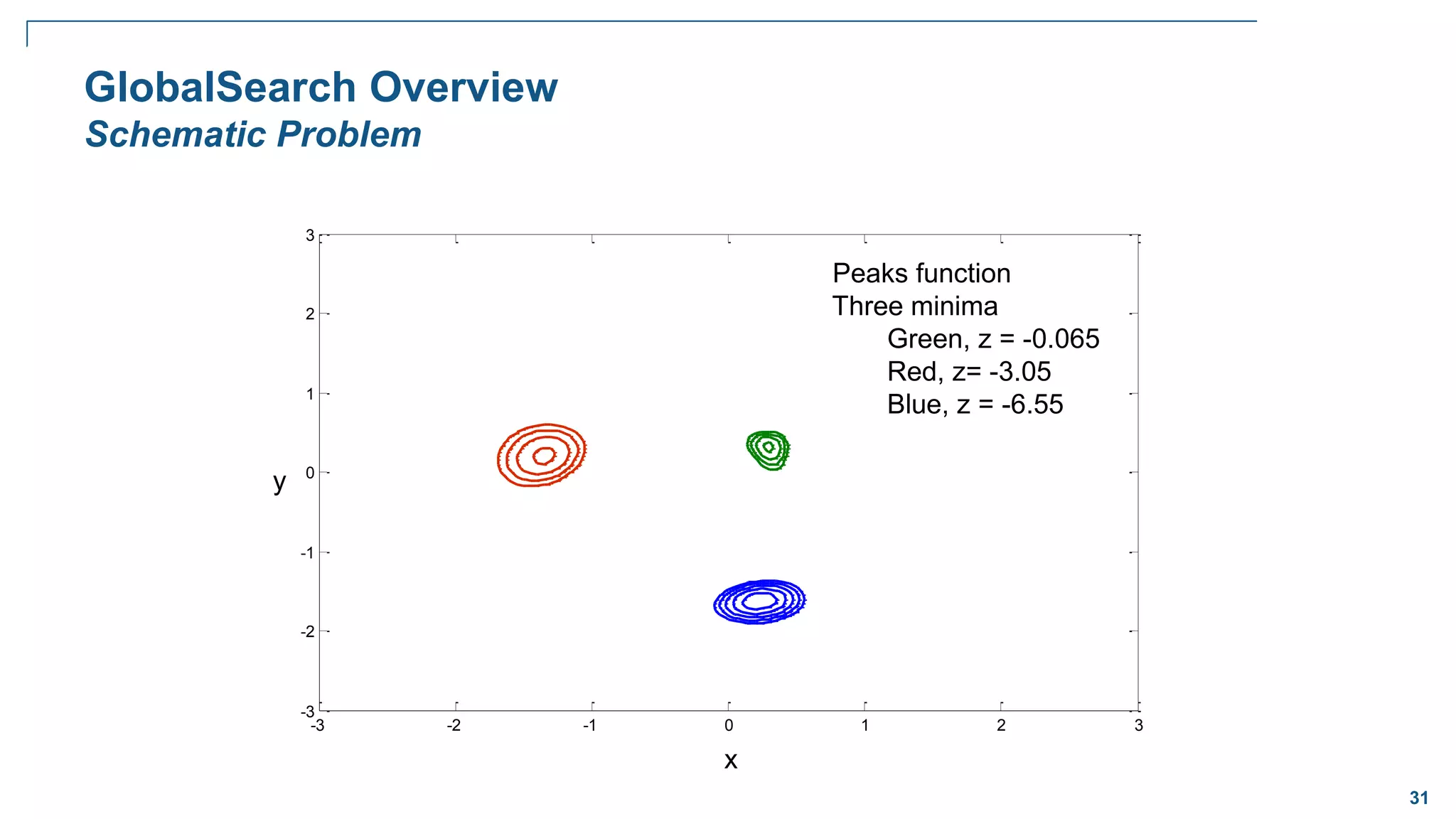
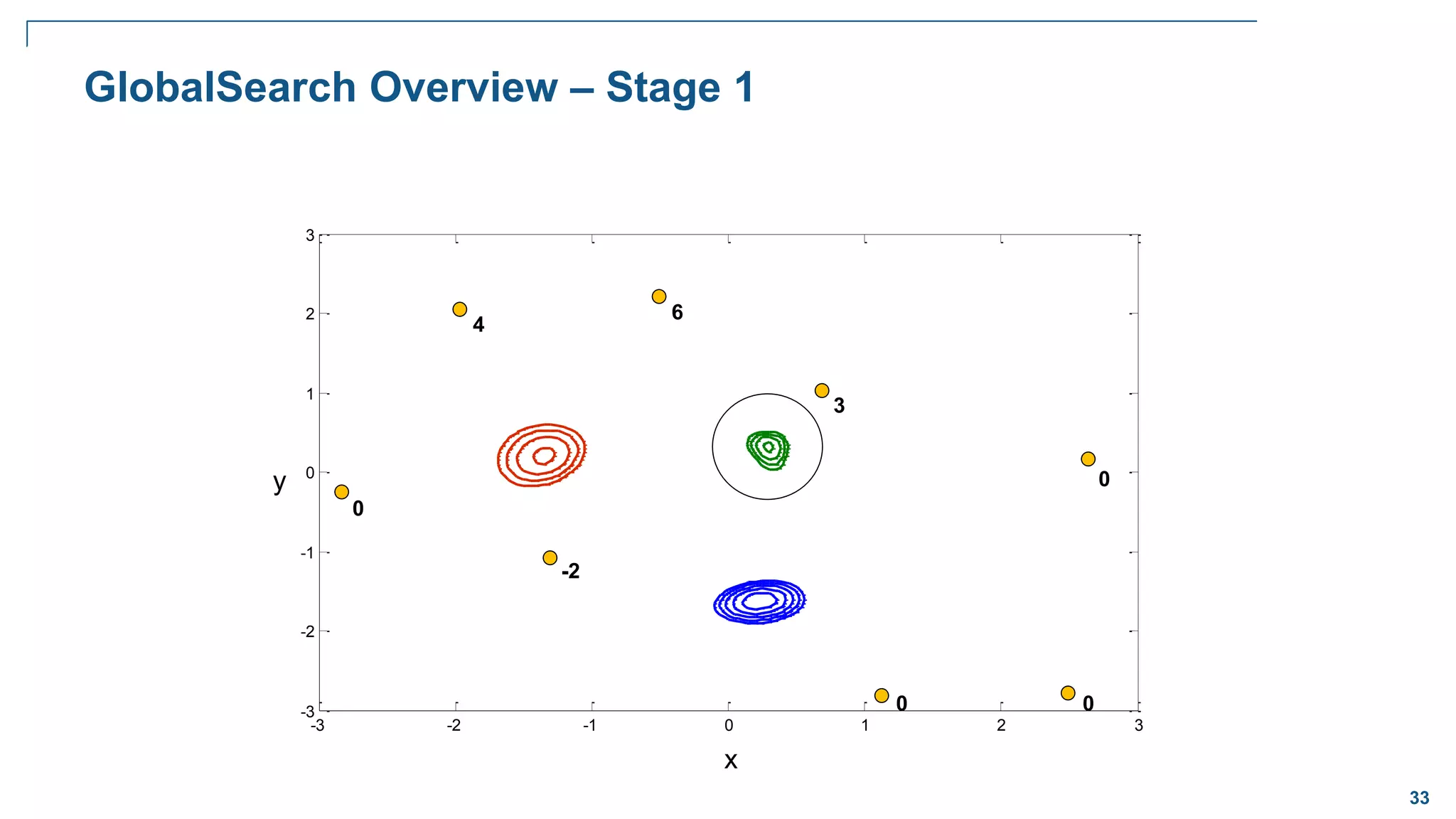
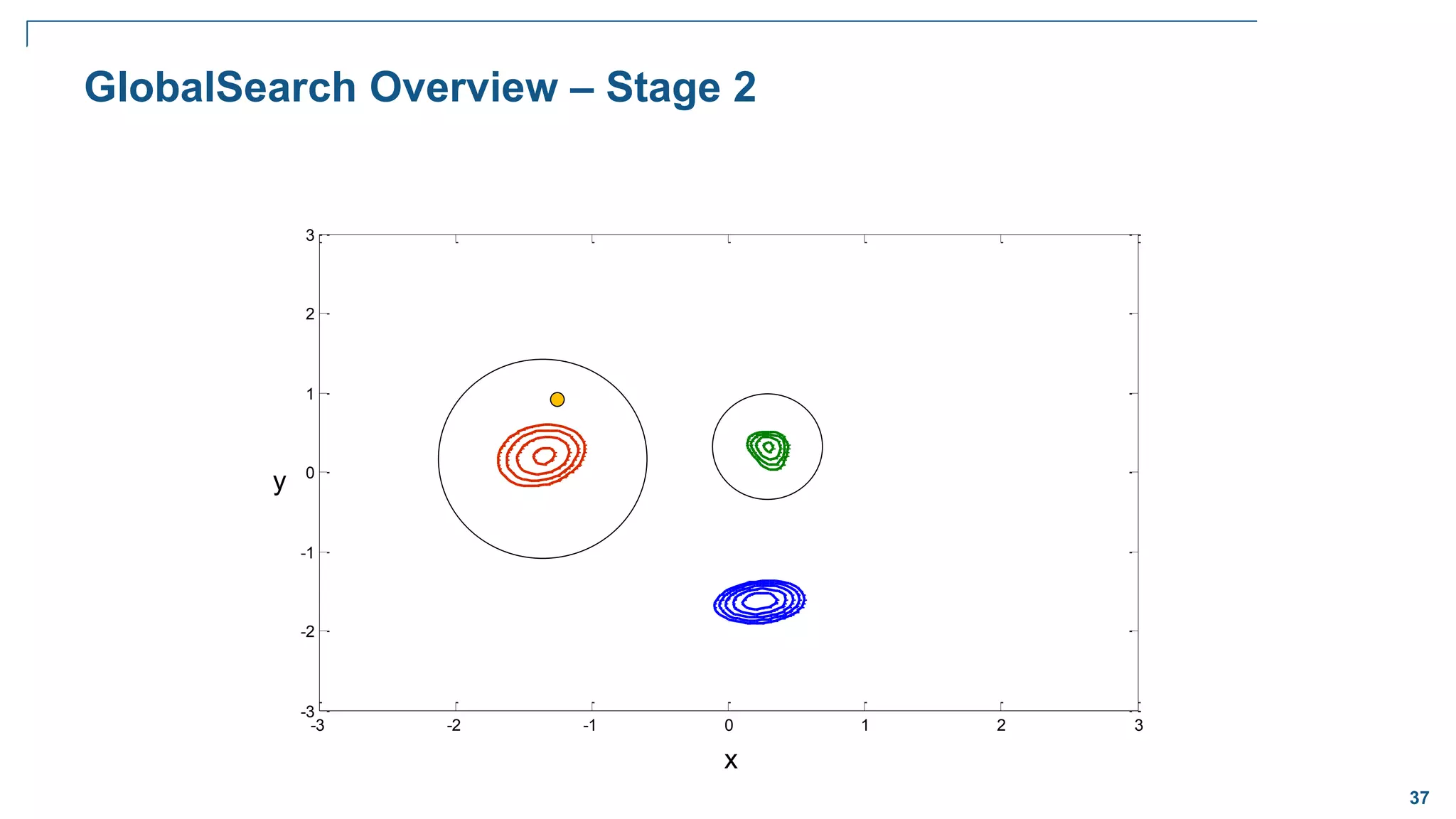
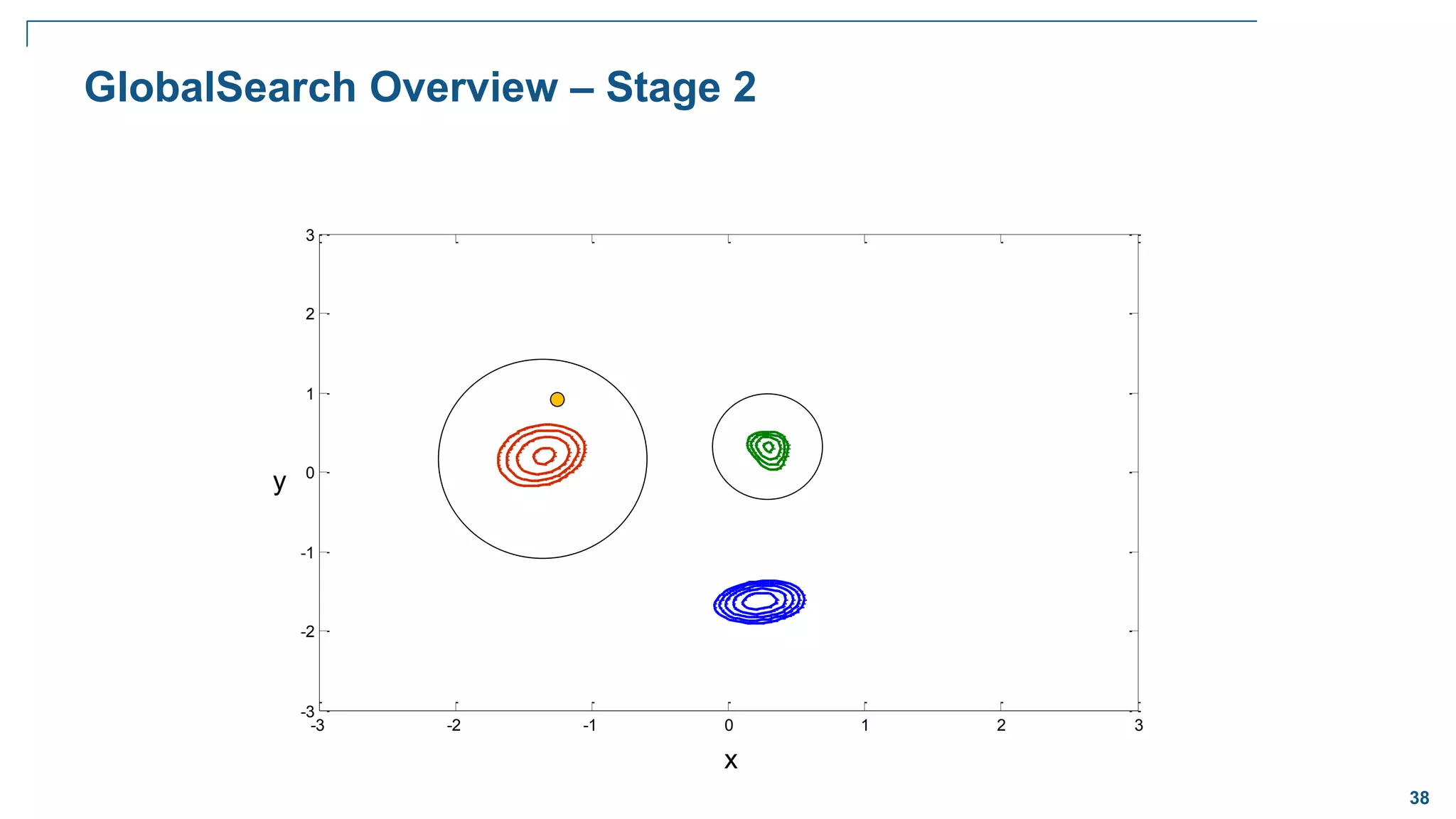
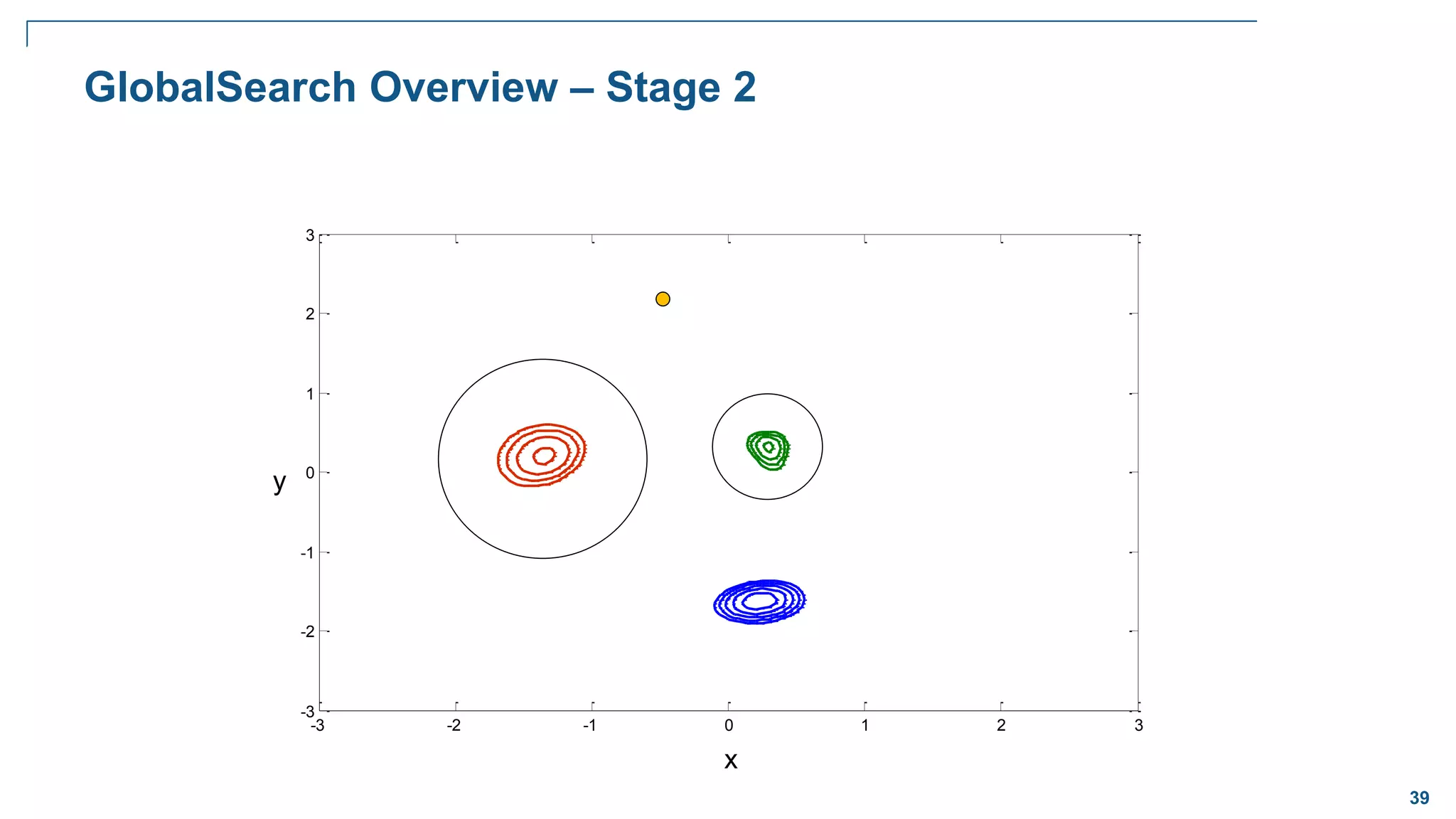
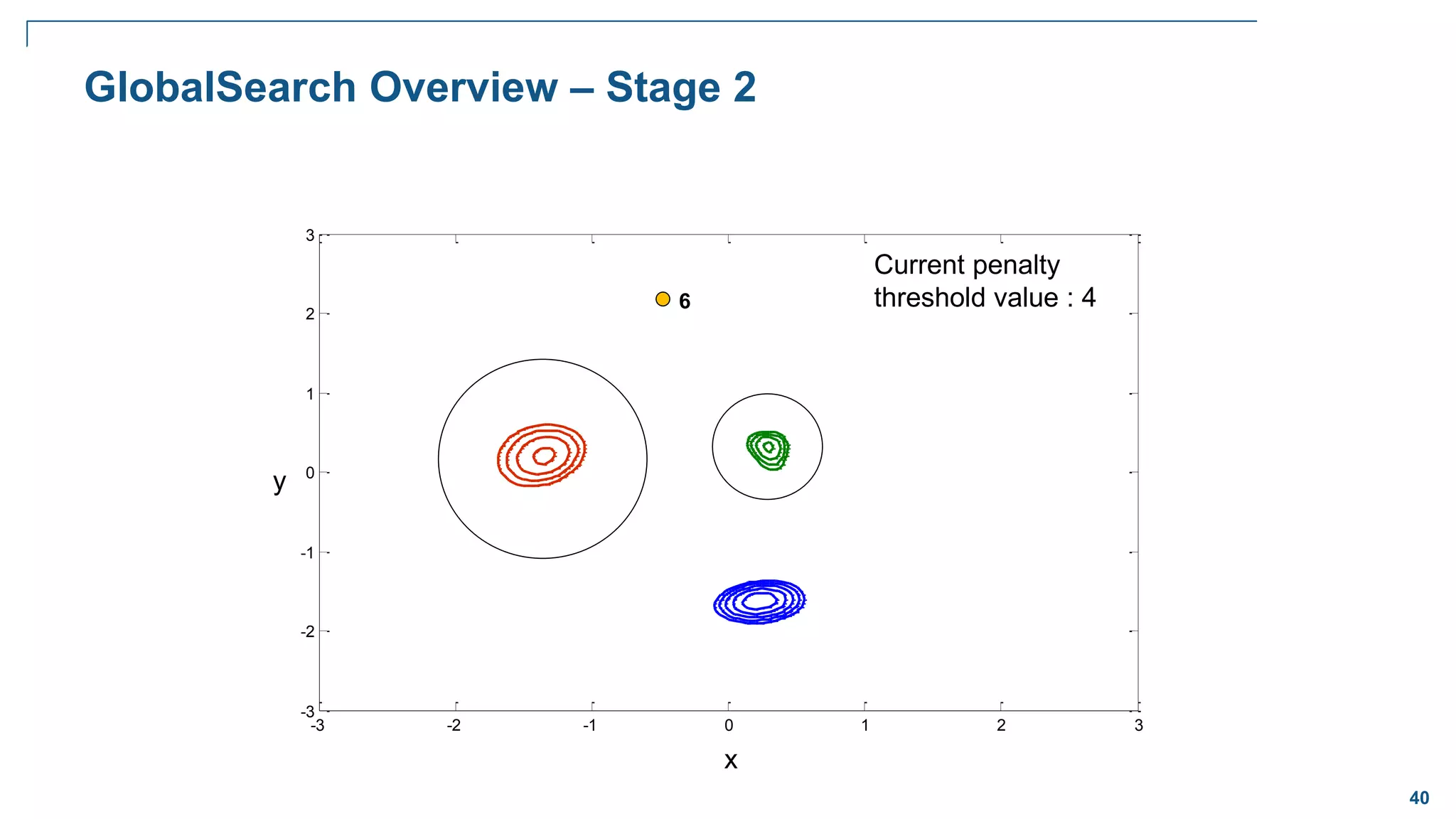
GlobalSearch Overview
Schematic Problem
Peaks function
Three minima
Green, z = -0.065
Red, z= -3.05
Blue, z = -6.55
x
y
32
-3 -2 -1 0 1 2 3
-3
-2
-1
0
1
2
3
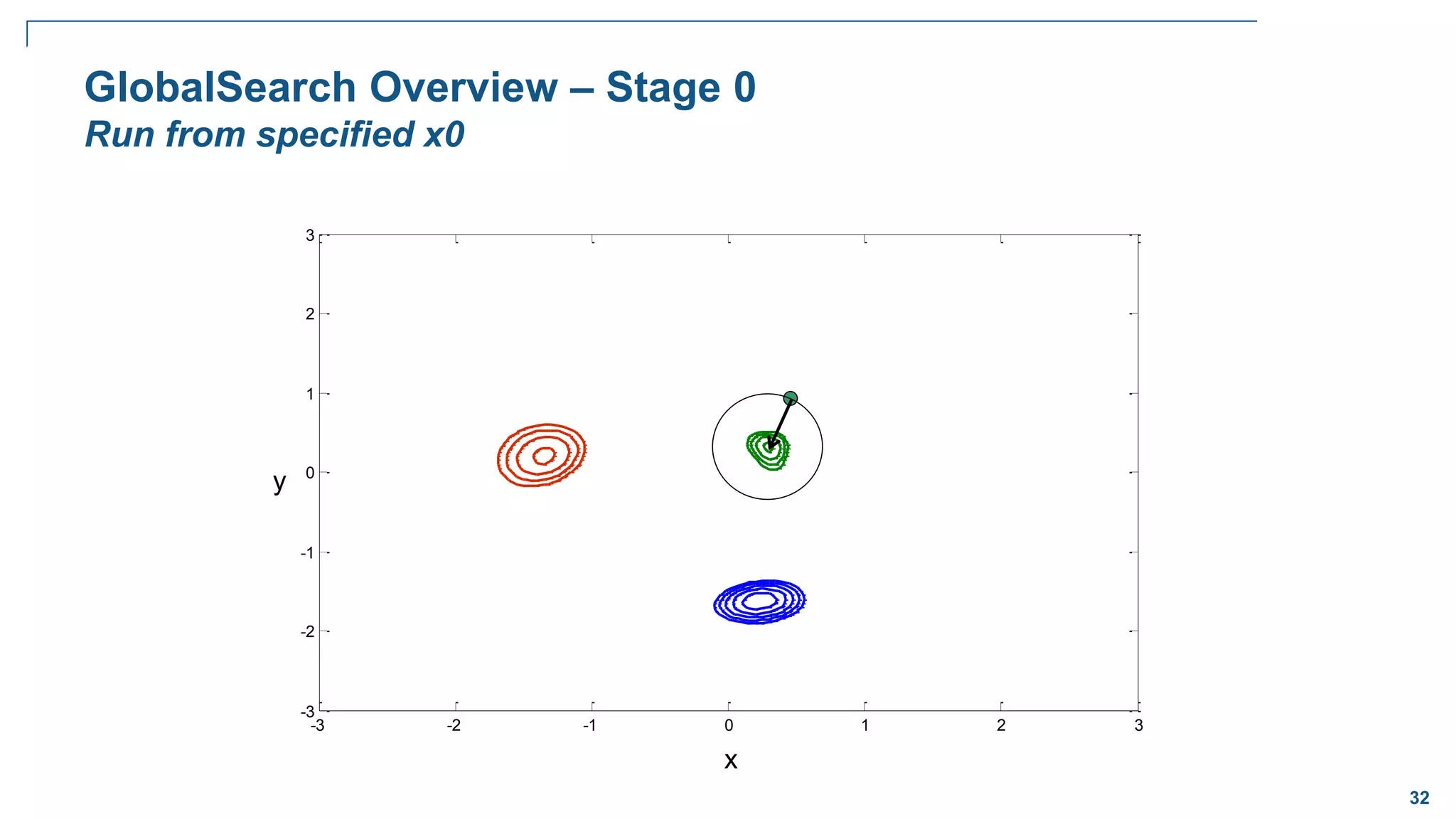
GlobalSearch Overview – Stage 0
Run from specified x0
x
y
33
-3 -2 -1 0 1 2 3
-3
-2
-1
0
1
2
3
GlobalSearch Overview – Stage 1
3
6
0
0
0
4
0
-2
x
y
34
-3 -2 -1 0 1 2 3
-3
-2
-1
0
1
2
3
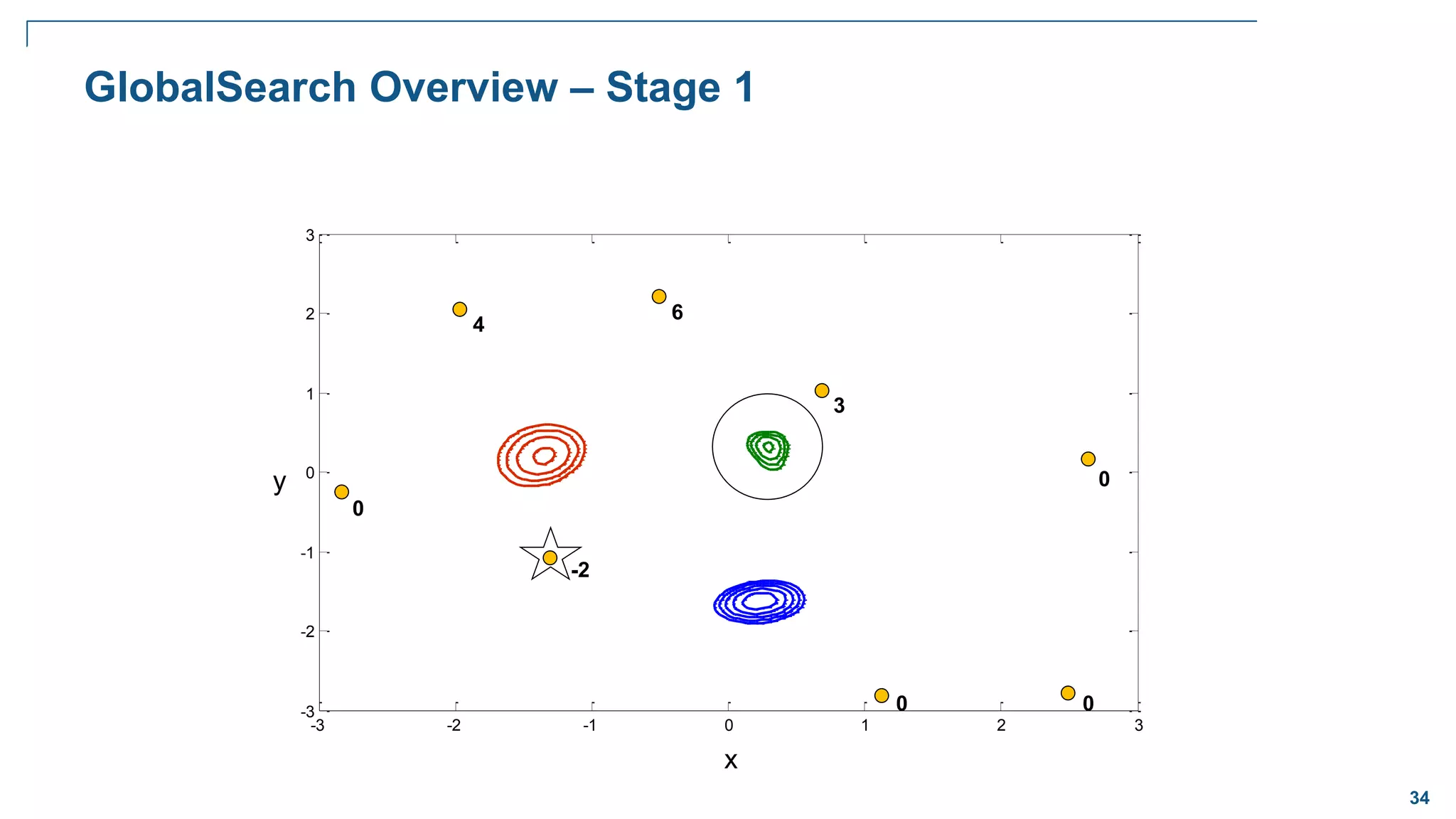
GlobalSearch Overview – Stage 1
3
6
0
0
0
4
0
-2
x
y
35
-3 -2 -1 0 1 2 3
-3
-2
-1
0
1
2
3
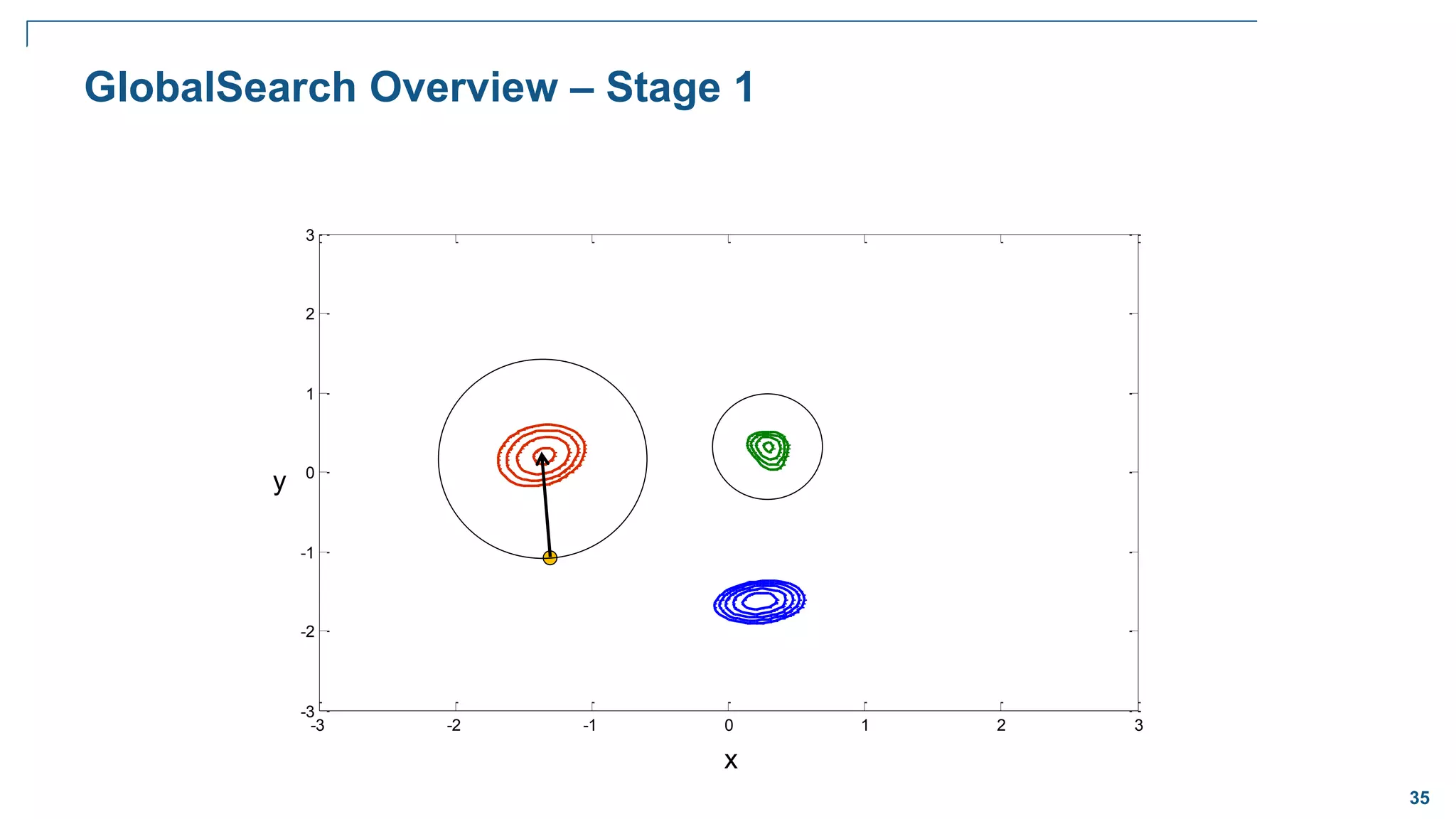
GlobalSearch Overview – Stage 1
x
y
36
-3 -2 -1 0 1 2 3
-3
-2
-1
0
1
2
3
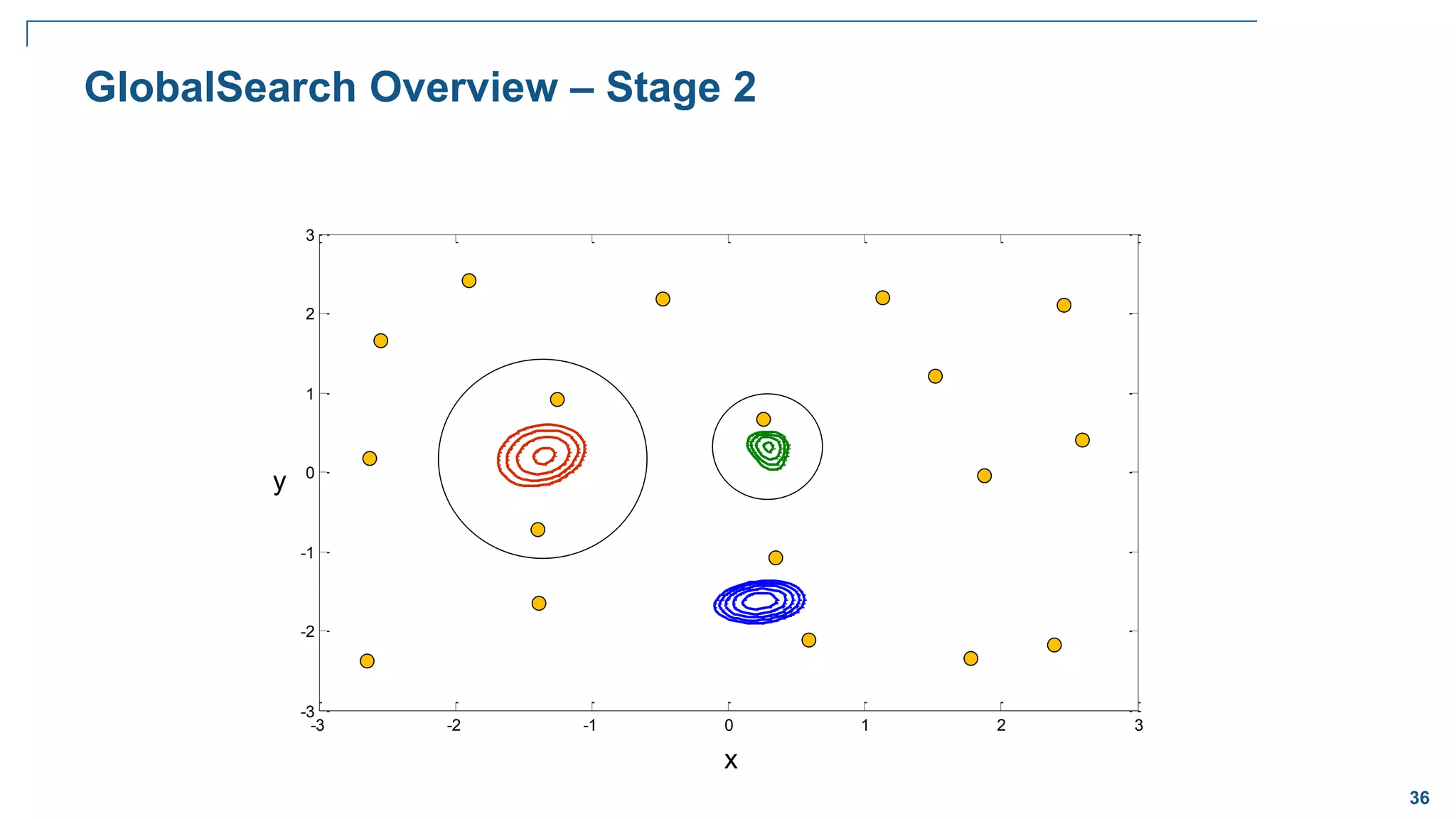
GlobalSearch Overview – Stage 2
x
y
37
-3 -2 -1 0 1 2 3
-3
-2
-1
0
1
2
3
GlobalSearch Overview – Stage 2
x
y
38
-3 -2 -1 0 1 2 3
-3
-2
-1
0
1
2
3
GlobalSearch Overview – Stage 2
x
y
39
-3 -2 -1 0 1 2 3
-3
-2
-1
0
1
2
3
GlobalSearch Overview – Stage 2
x
y
40
-3 -2 -1 0 1 2 3
-3
-2
-1
0
1
2
3
GlobalSearch Overview – Stage 2
6
Current penalty
threshold value : 4
x
y
41
-3 -2 -1 0 1 2 3
-3
-2
-1
0
1
2
3
GlobalSearch Overview – Stage 2
x
y
42
-3 -2 -1 0 1 2 3
-3
-2
-1
0
1
2
3
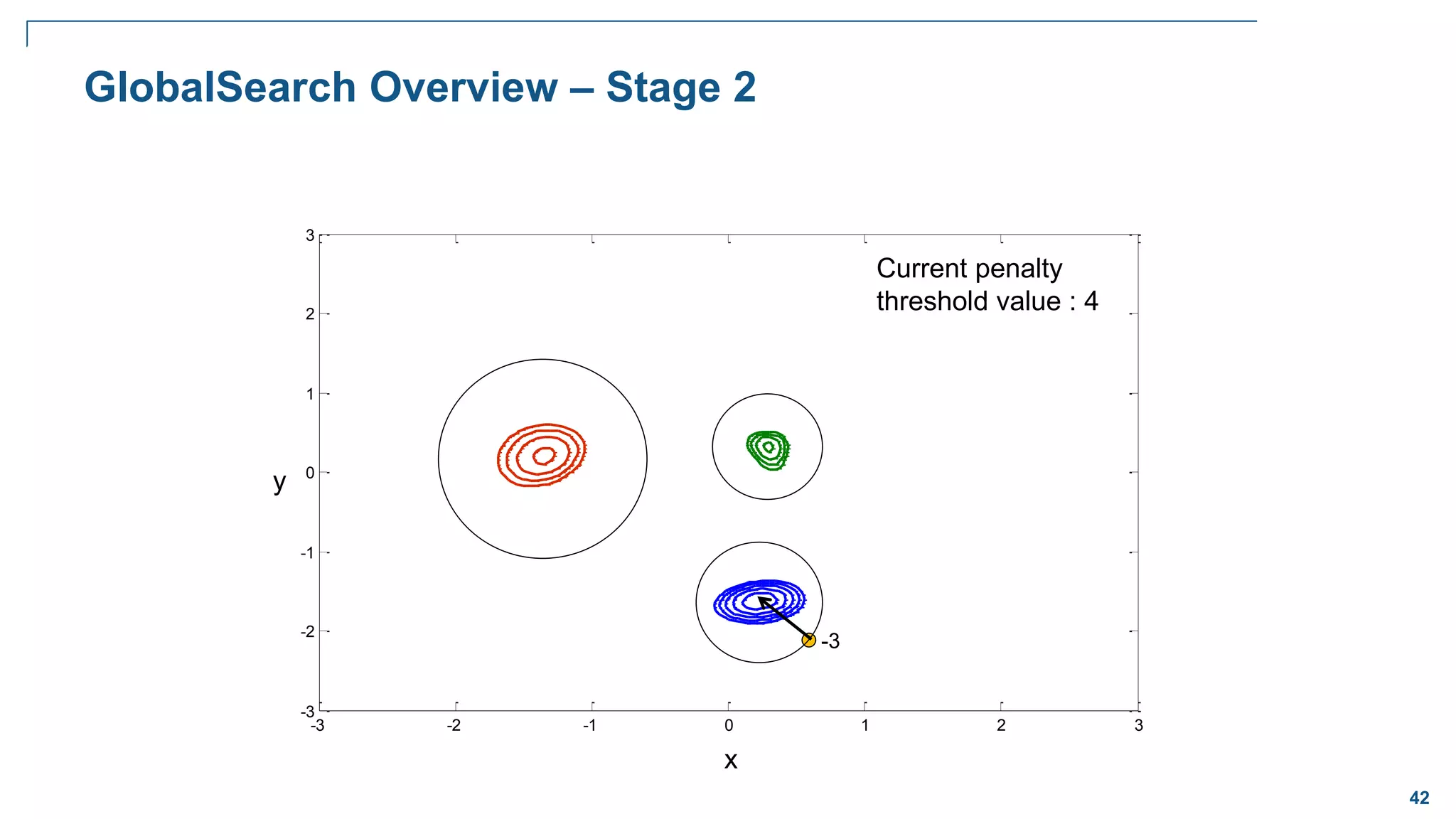
GlobalSearch Overview – Stage 2
Current penalty
threshold value : 4
-3
x
y
43
-3 -2 -1 0 1 2 3
-3
-2
-1
0
1
2
3
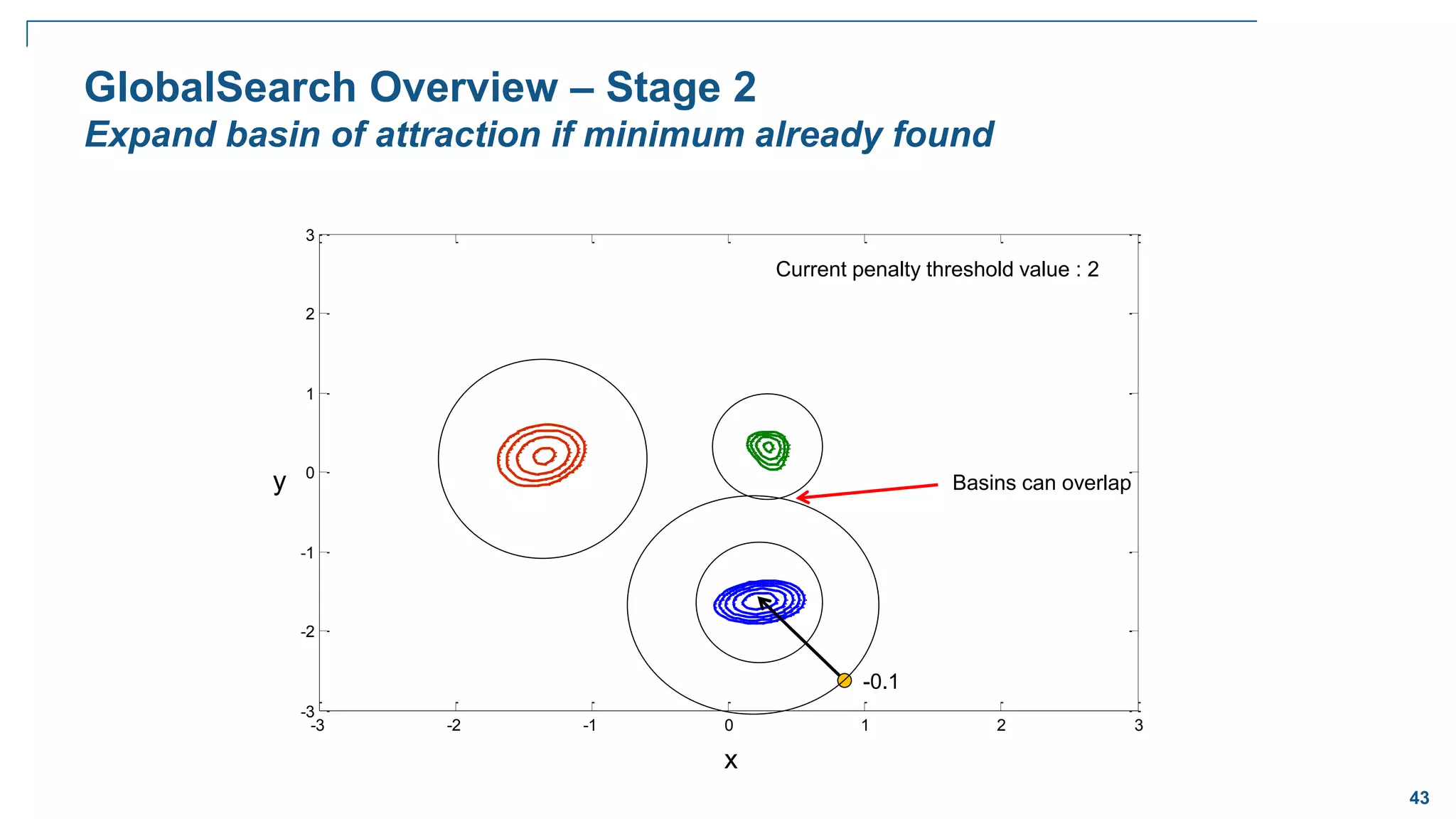
GlobalSearch Overview – Stage 2
Expand basin of attraction if minimum already found
Current penalty threshold value : 2
-0.1
x
y Basins can overlap
44
GlobalSearch Demo – Peaks Function
45
SIMULATED ANNEALING
46
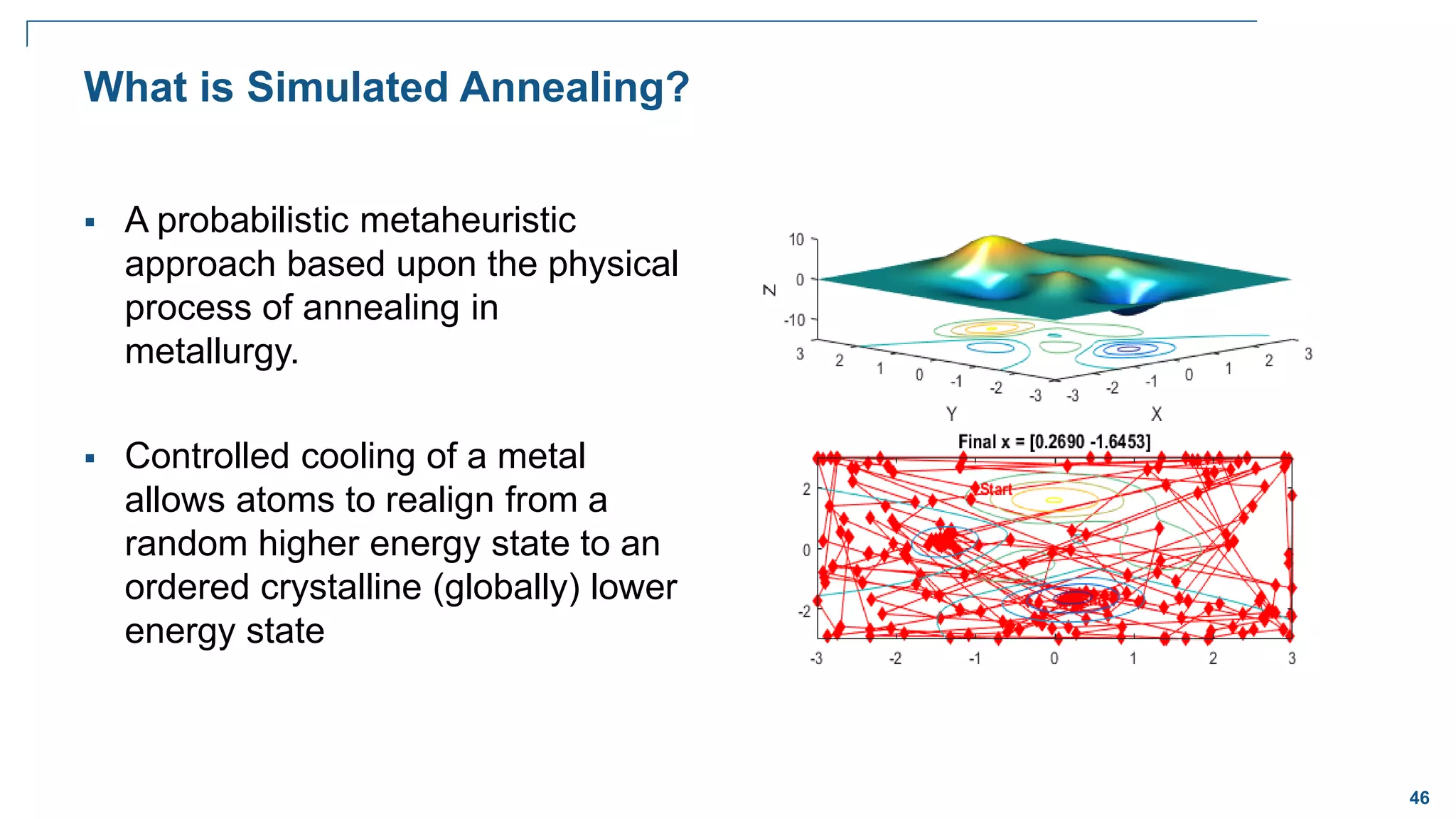
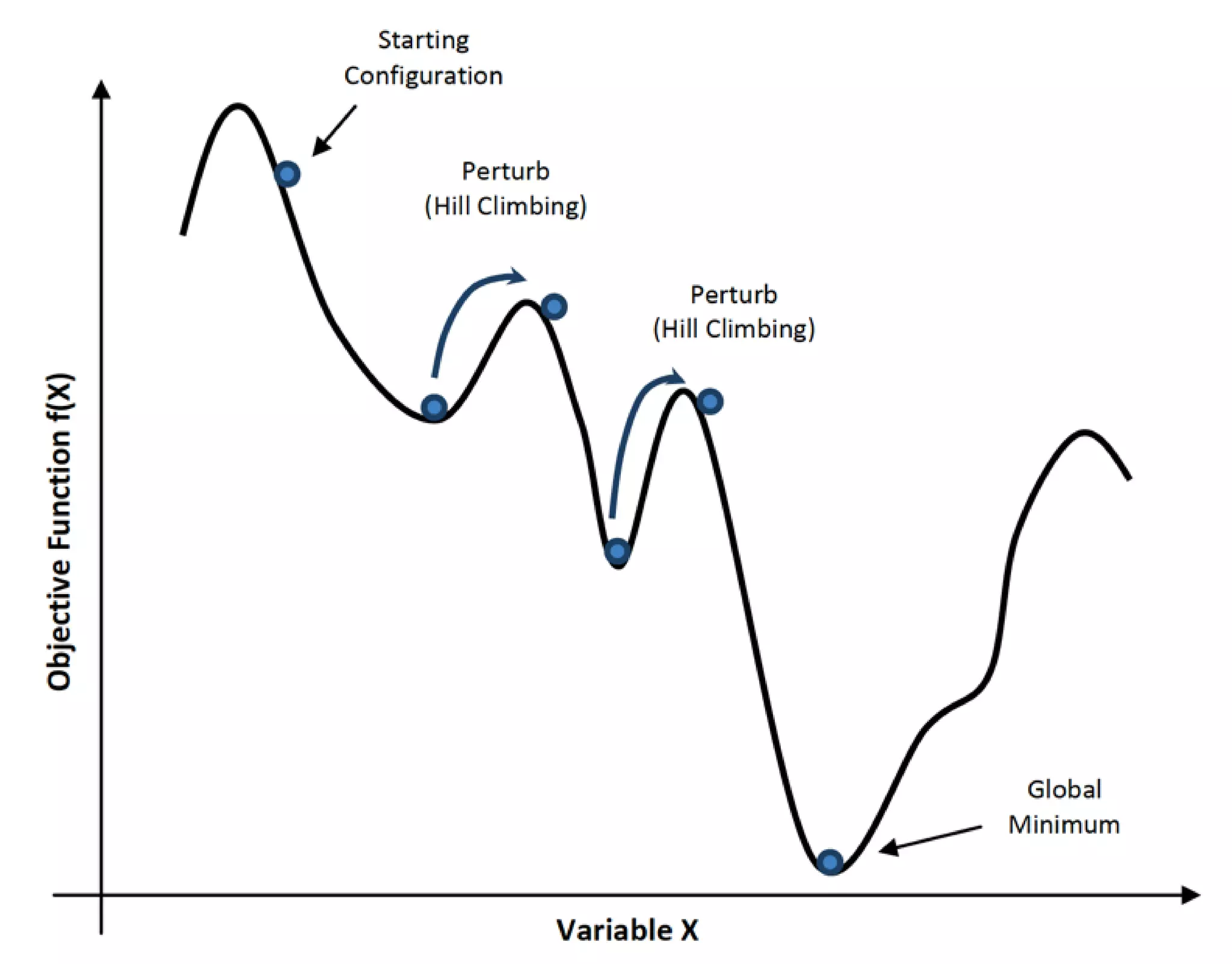
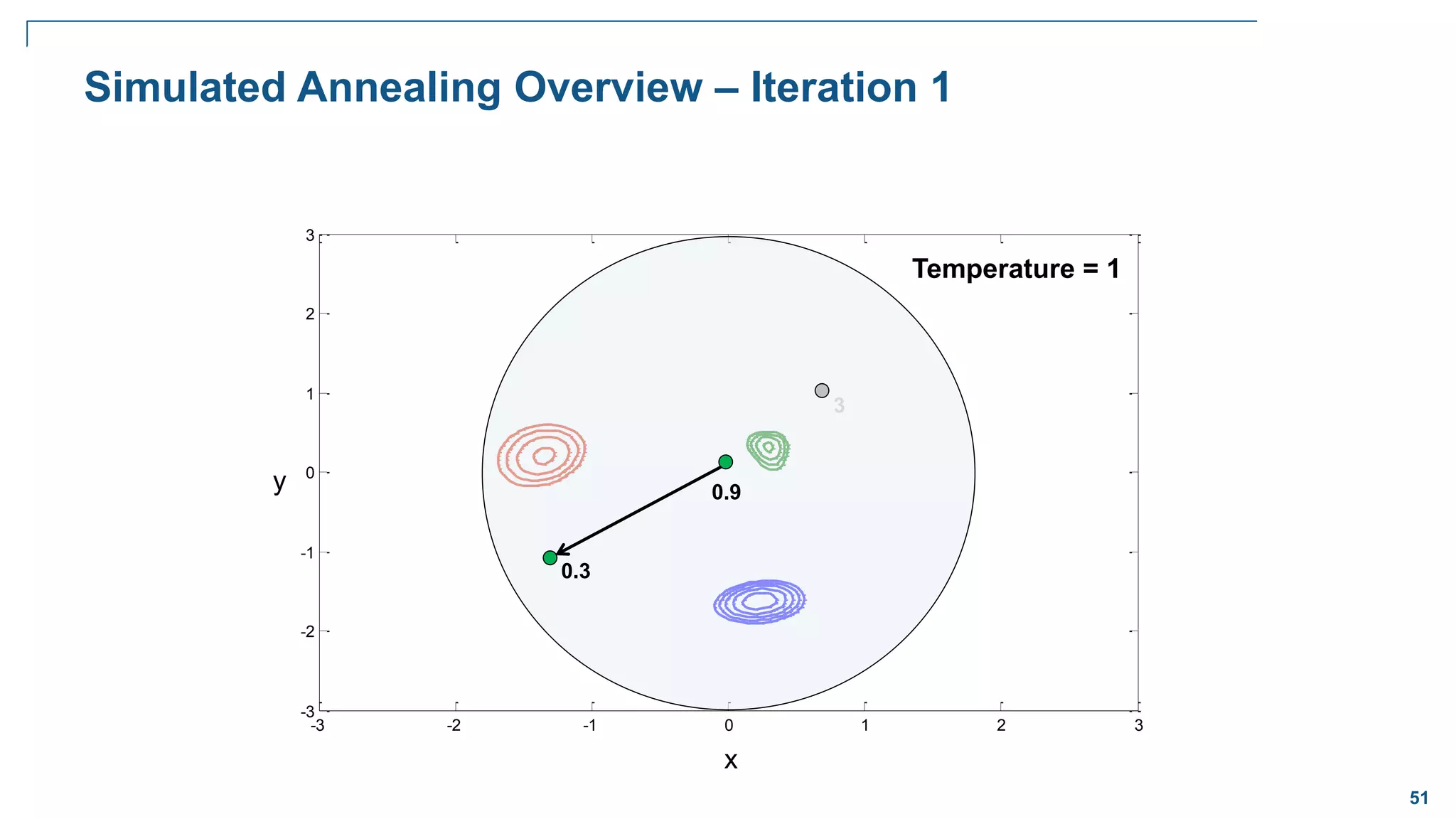
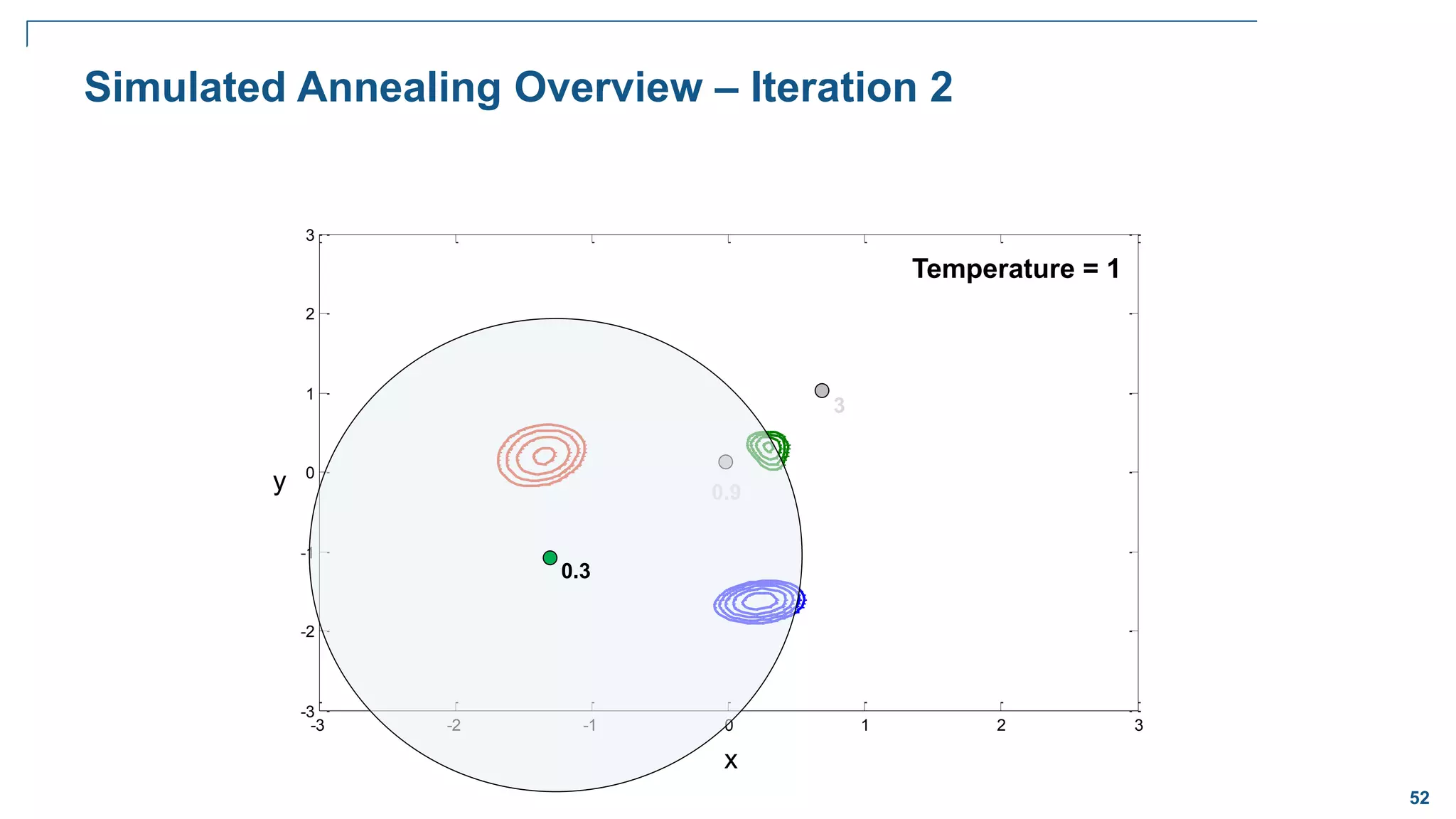
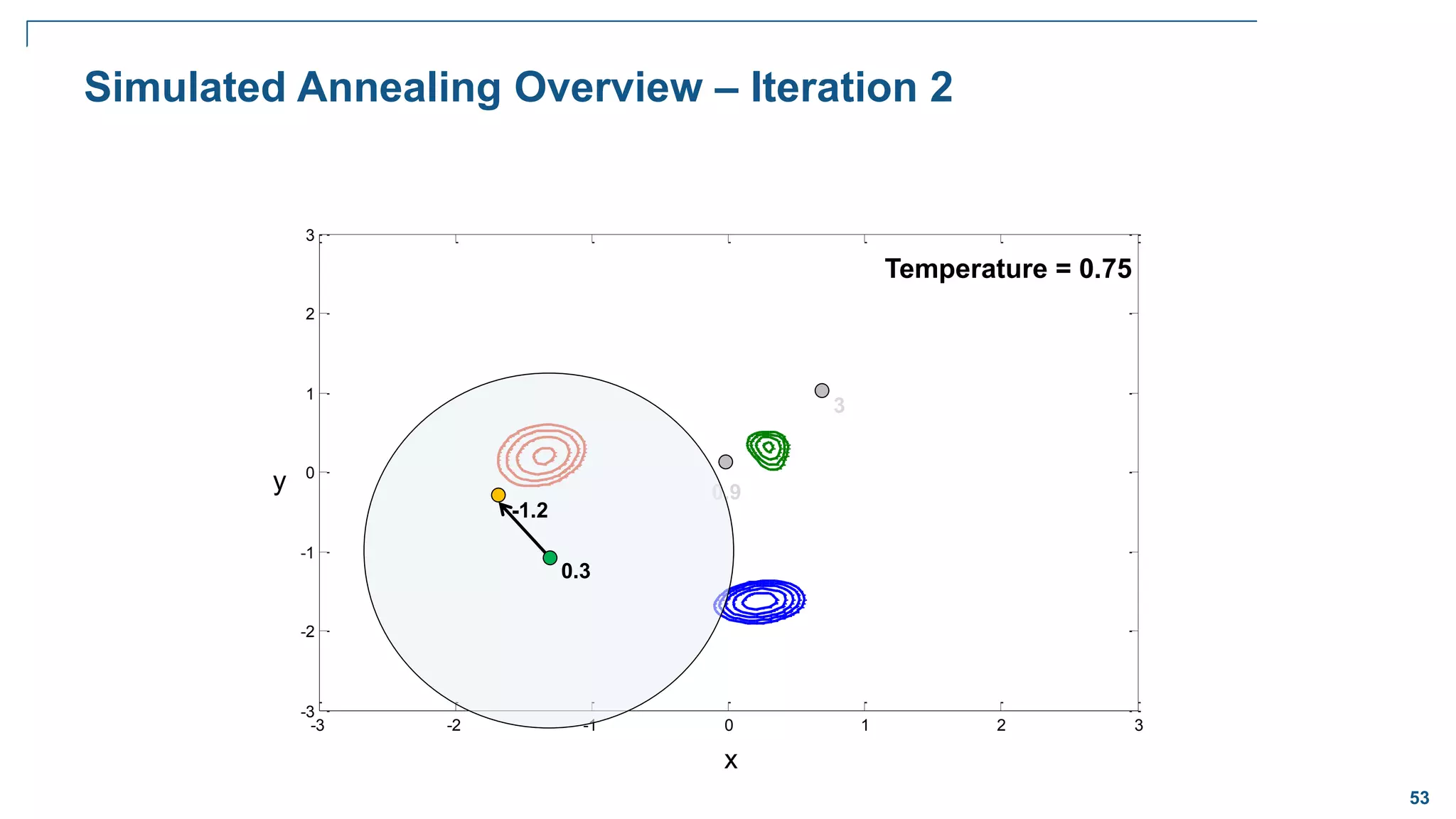
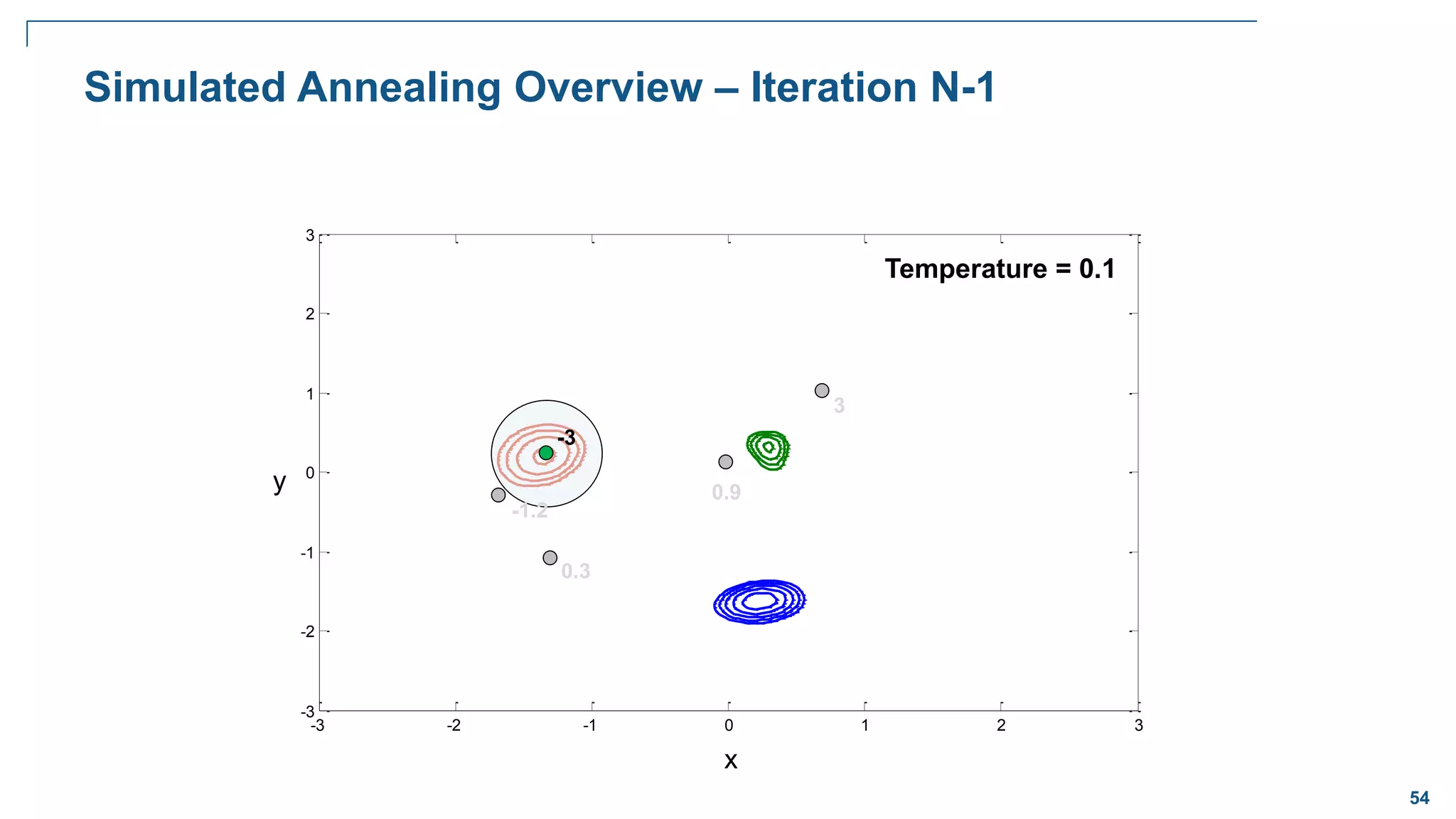
What is Simulated Annealing?
 A probabilistic metaheuristic
approach based upon the physical
process of annealing in
metallurgy.
 Controlled cooling of a metal
allows atoms to realign from a
random higher energy state to an
ordered crystalline (globally) lower
energy state
47
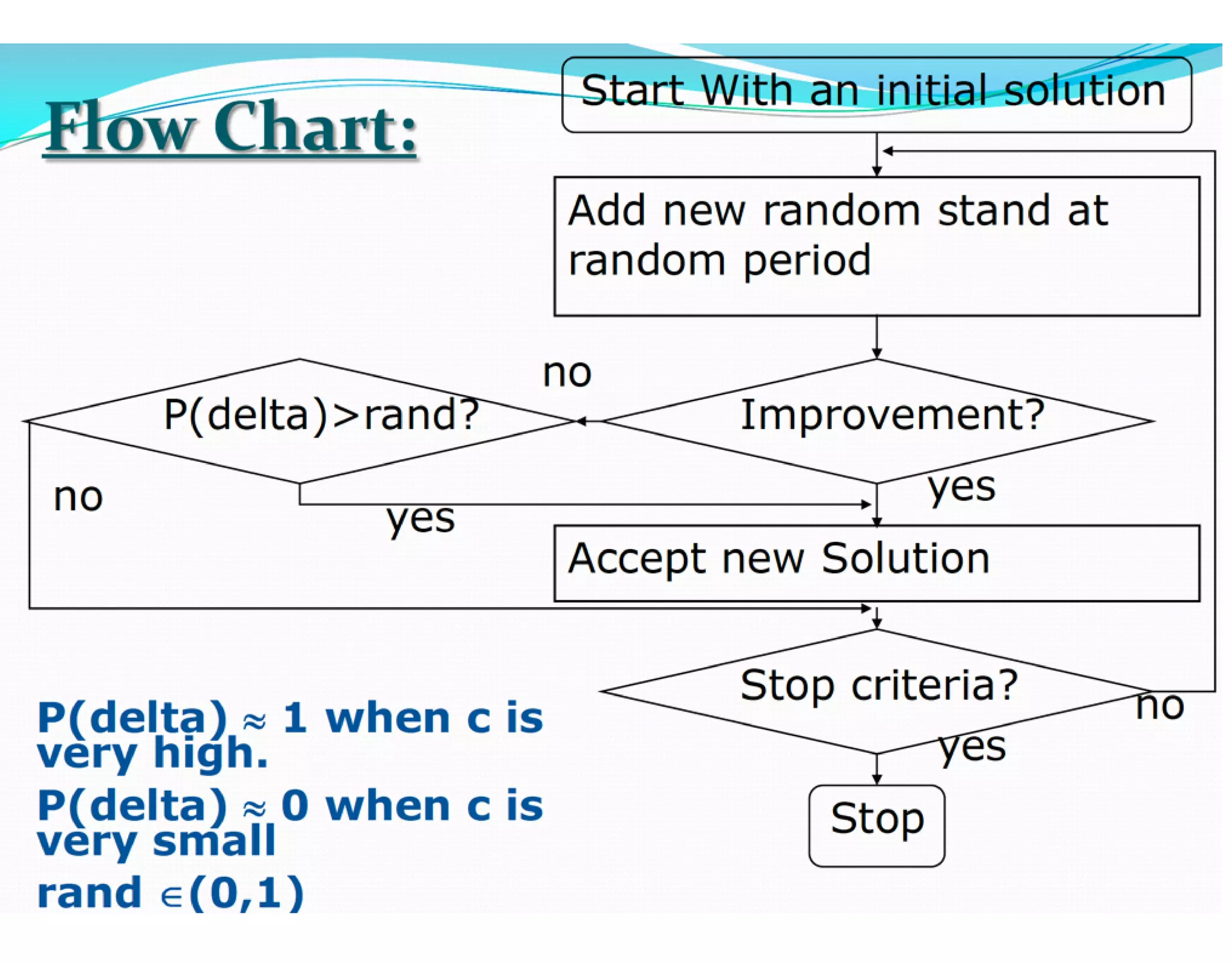
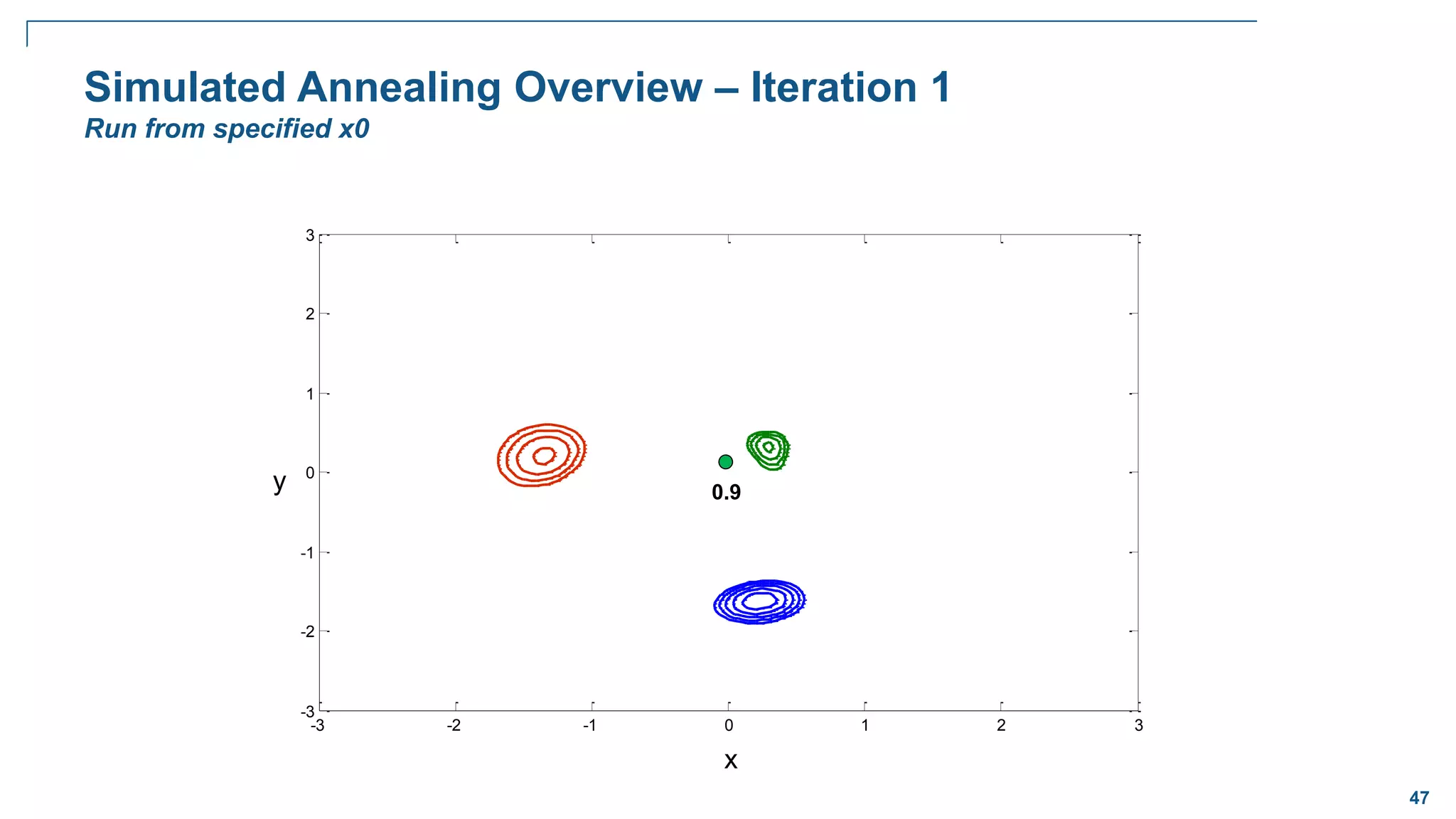
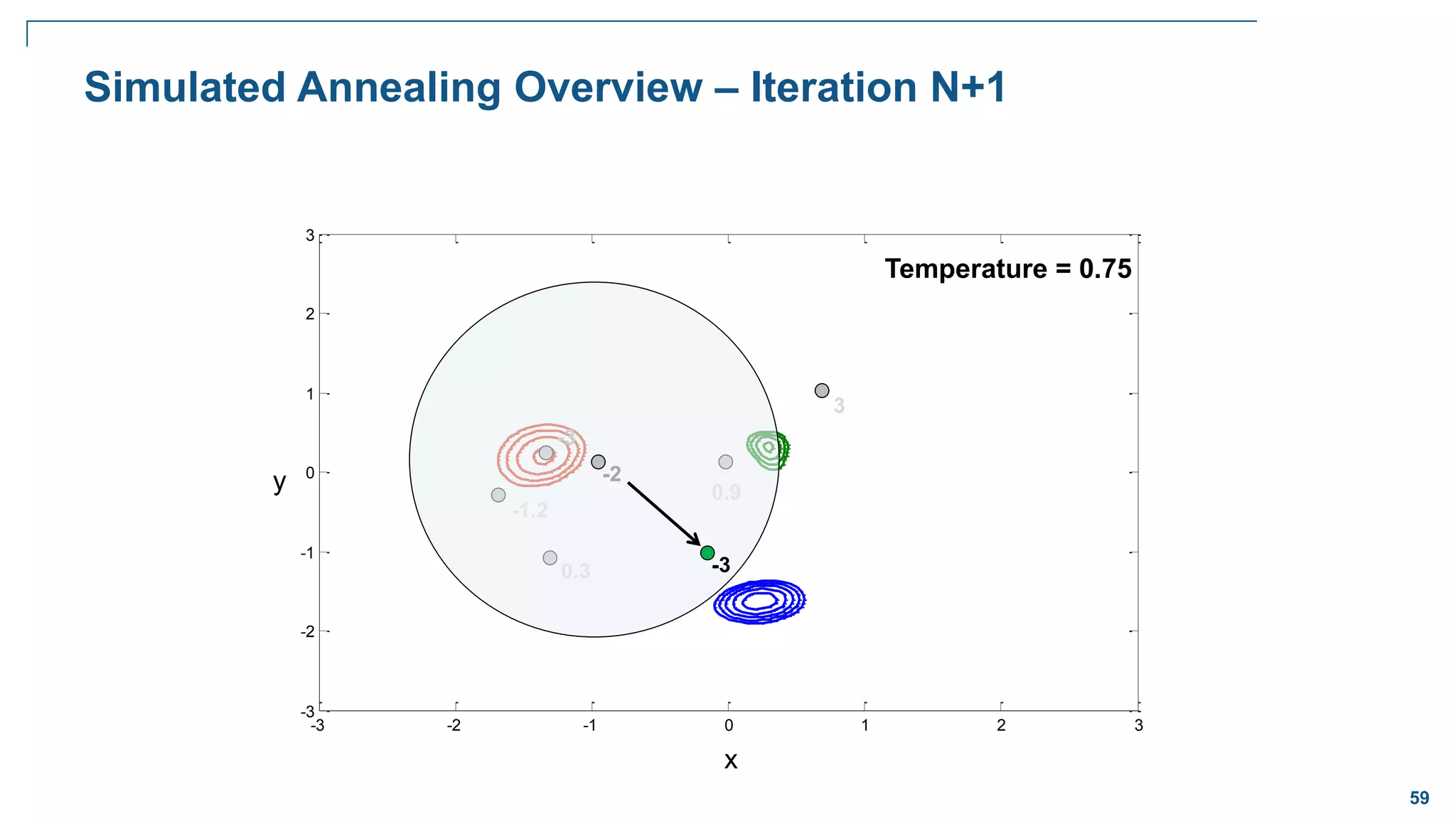
Simulated Annealing Overview – Iteration 1
Run from specified x0
x
y
-3 -2 -1 0 1 2 3
-3
-2
-1
0
1
2
3
0.9
48
-3 -2 -1 0 1 2 3
-3
-2
-1
0
1
2
3
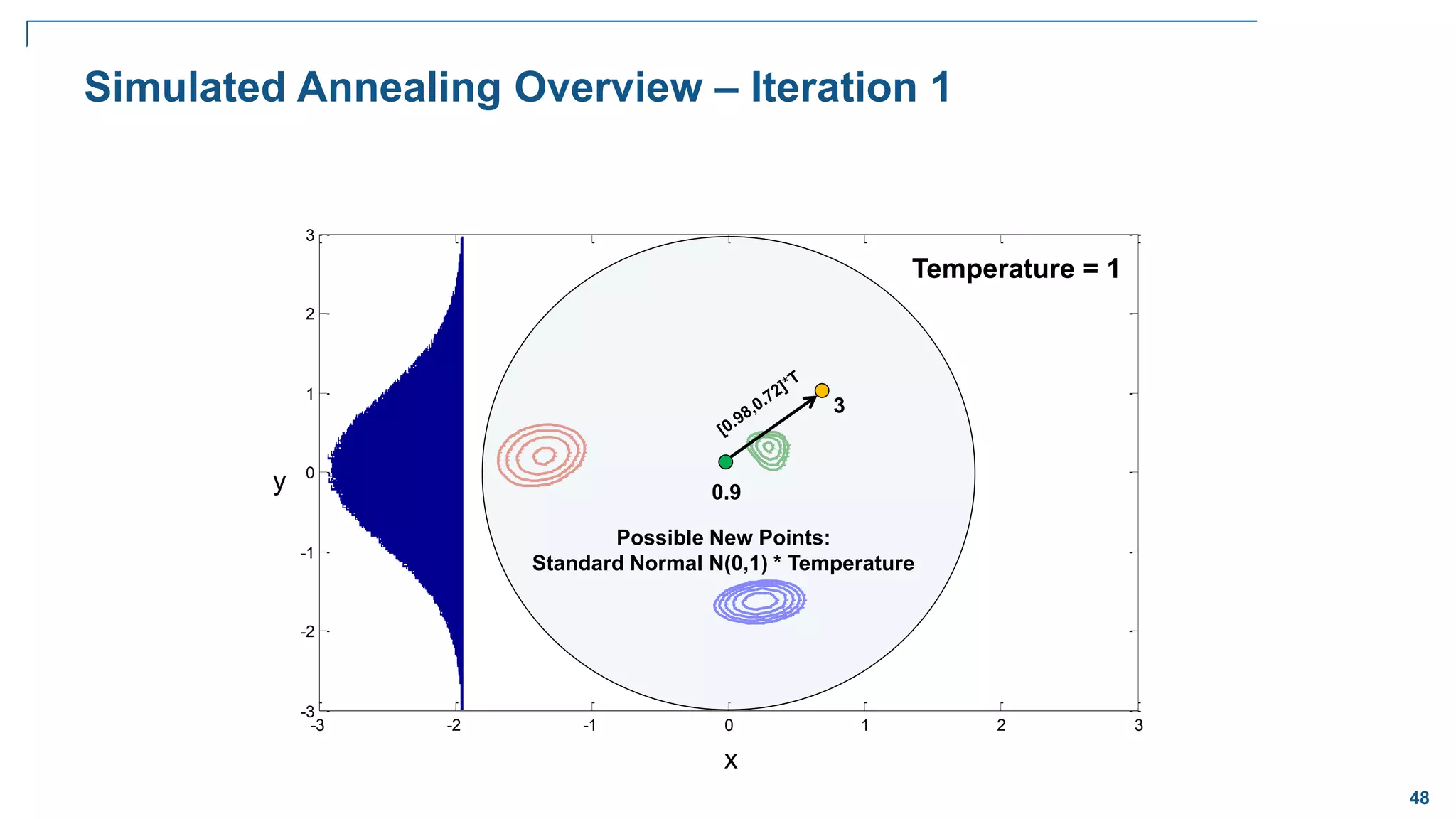
Simulated Annealing Overview – Iteration 1
3
x
y 0.9
Possible New Points:
Standard Normal N(0,1) * Temperature
Temperature = 1
49
-3 -2 -1 0 1 2 3
-3
-2
-1
0
1
2
3
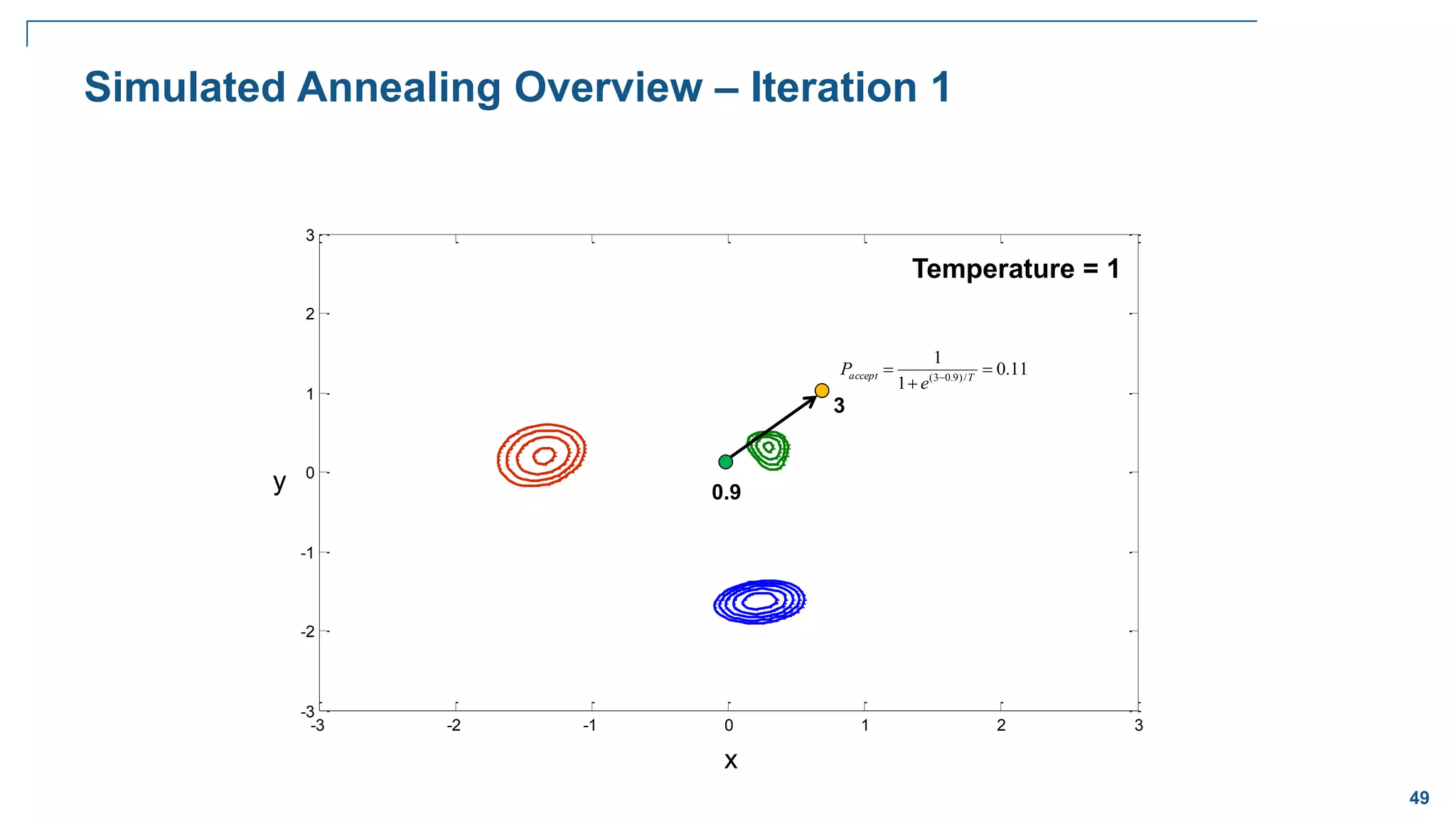
Simulated Annealing Overview – Iteration 1
3
x
y 0.9
Temperature = 1
11
.
0
1
1
/
)
9
.
0
3
(


  T
accept
e
P
50
-3 -2 -1 0 1 2 3
-3
-2
-1
0
1
2
3
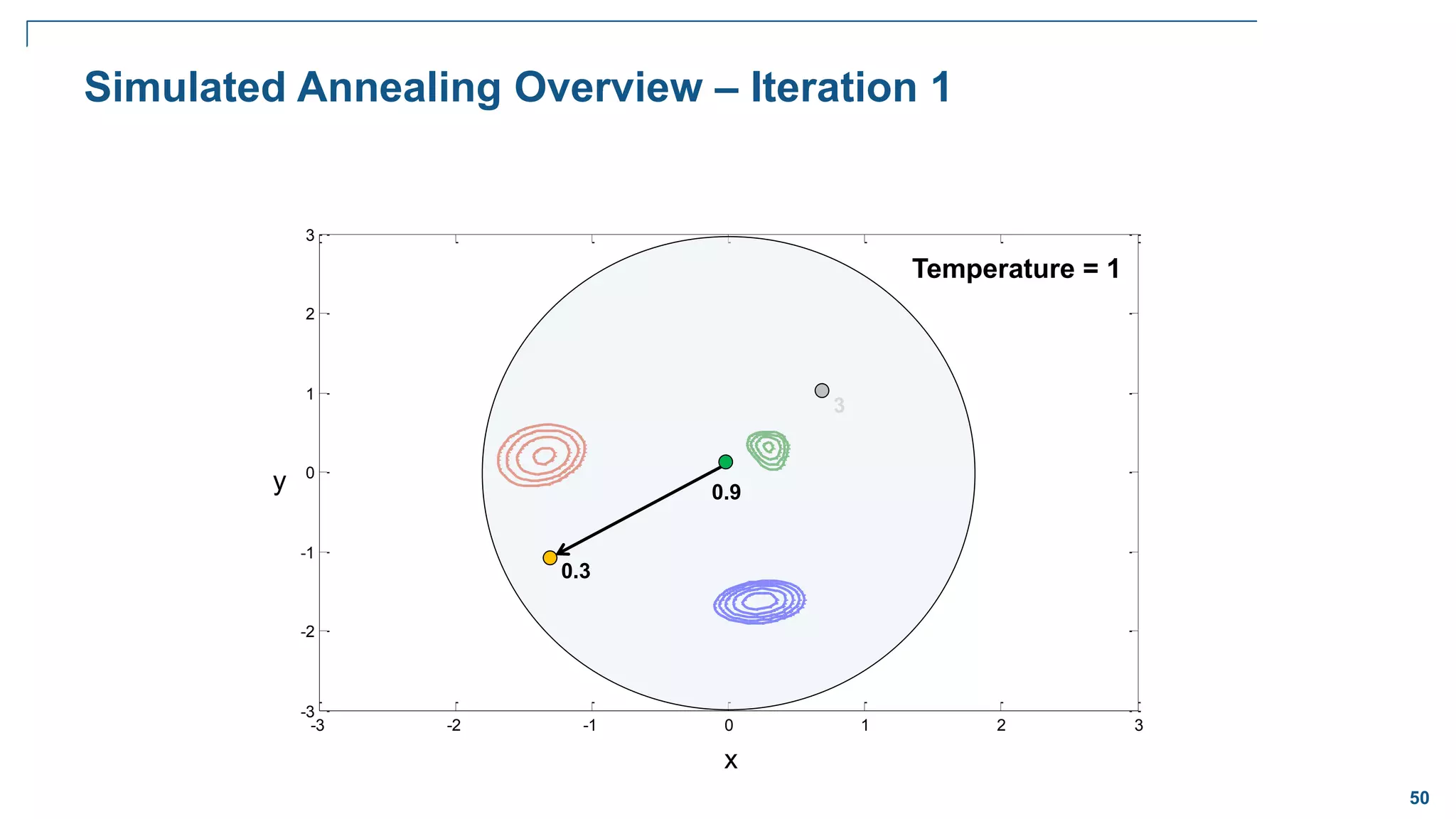
Simulated Annealing Overview – Iteration 1
3
x
y 0.9
Temperature = 1
0.3
51
-3 -2 -1 0 1 2 3
-3
-2
-1
0
1
2
3
Simulated Annealing Overview – Iteration 1
3
x
y 0.9
Temperature = 1
0.3
52
-3 -2 -1 0 1 2 3
-3
-2
-1
0
1
2
3
Simulated Annealing Overview – Iteration 2
3
x
y 0.9
Temperature = 1
0.3
53
-3 -2 -1 0 1 2 3
-3
-2
-1
0
1
2
3
Simulated Annealing Overview – Iteration 2
3
x
y 0.9
Temperature = 0.75
0.3
-1.2
54
-3 -2 -1 0 1 2 3
-3
-2
-1
0
1
2
3
Simulated Annealing Overview – Iteration N-1
3
x
y 0.9
Temperature = 0.1
0.3
-1.2
-3
55
-3 -2 -1 0 1 2 3
-3
-2
-1
0
1
2
3
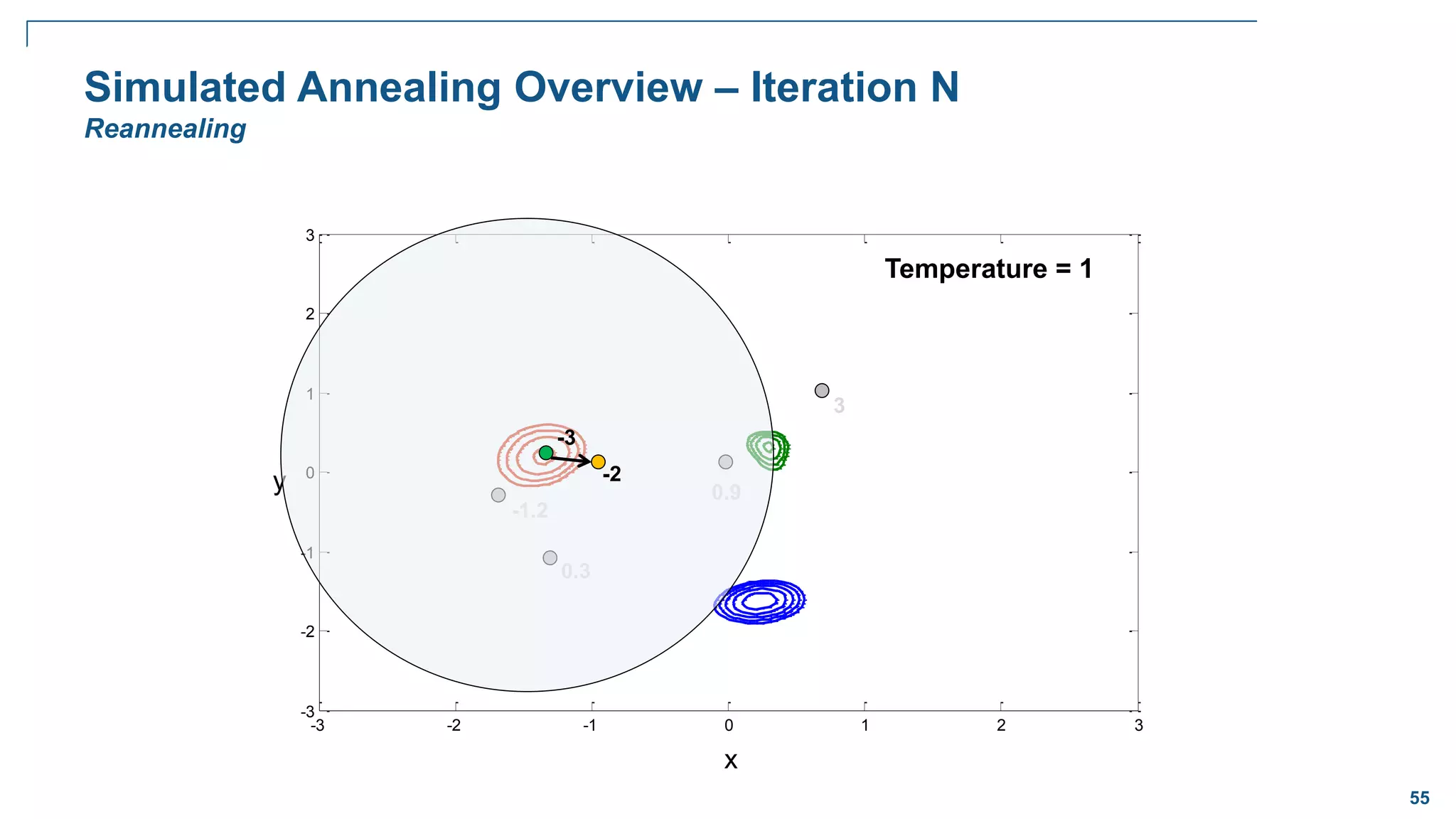
Simulated Annealing Overview – Iteration N
Reannealing
3
x
y 0.9
Temperature = 1
0.3
-1.2
-3
-2
56
-3 -2 -1 0 1 2 3
-3
-2
-1
0
1
2
3
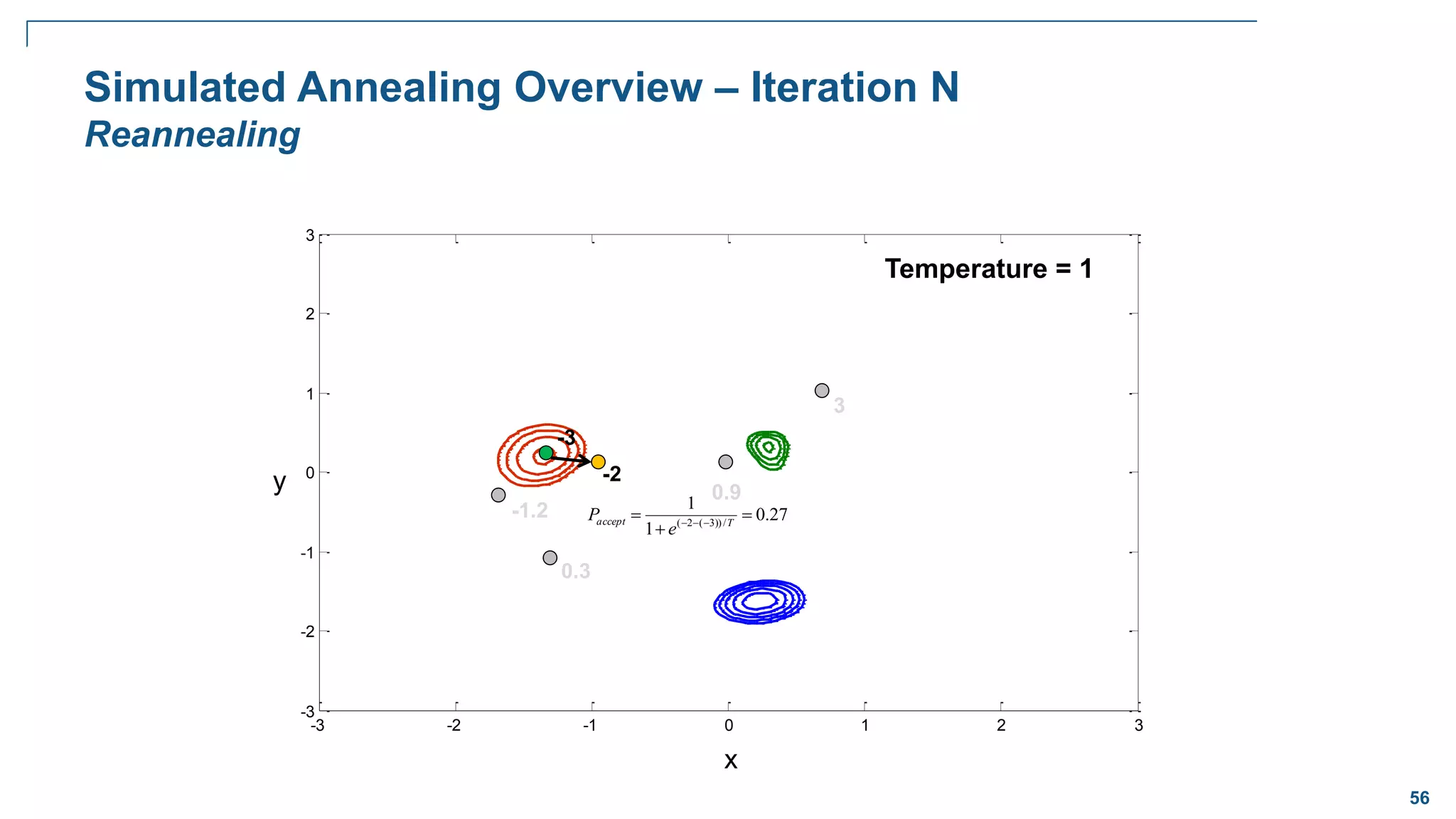
Simulated Annealing Overview – Iteration N
Reannealing
3
x
y 0.9
Temperature = 1
0.3
-1.2
-3
-2
27
.
0
1
1
/
))
3
(
2
(


 

 T
accept
e
P
57
-3 -2 -1 0 1 2 3
-3
-2
-1
0
1
2
3
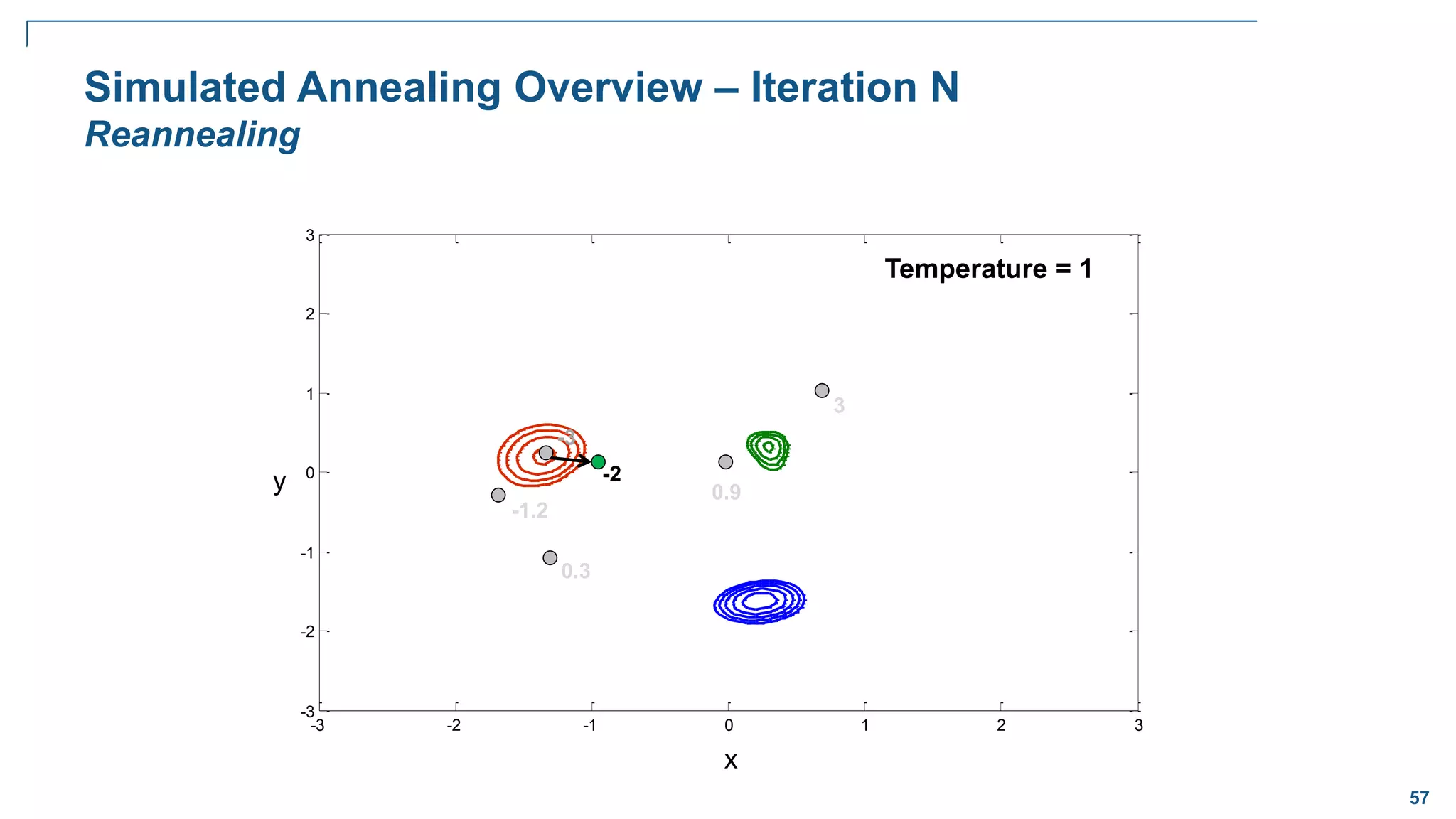
Simulated Annealing Overview – Iteration N
Reannealing
3
x
y 0.9
Temperature = 1
0.3
-1.2
-3
-2
58
-3 -2 -1 0 1 2 3
-3
-2
-1
0
1
2
3
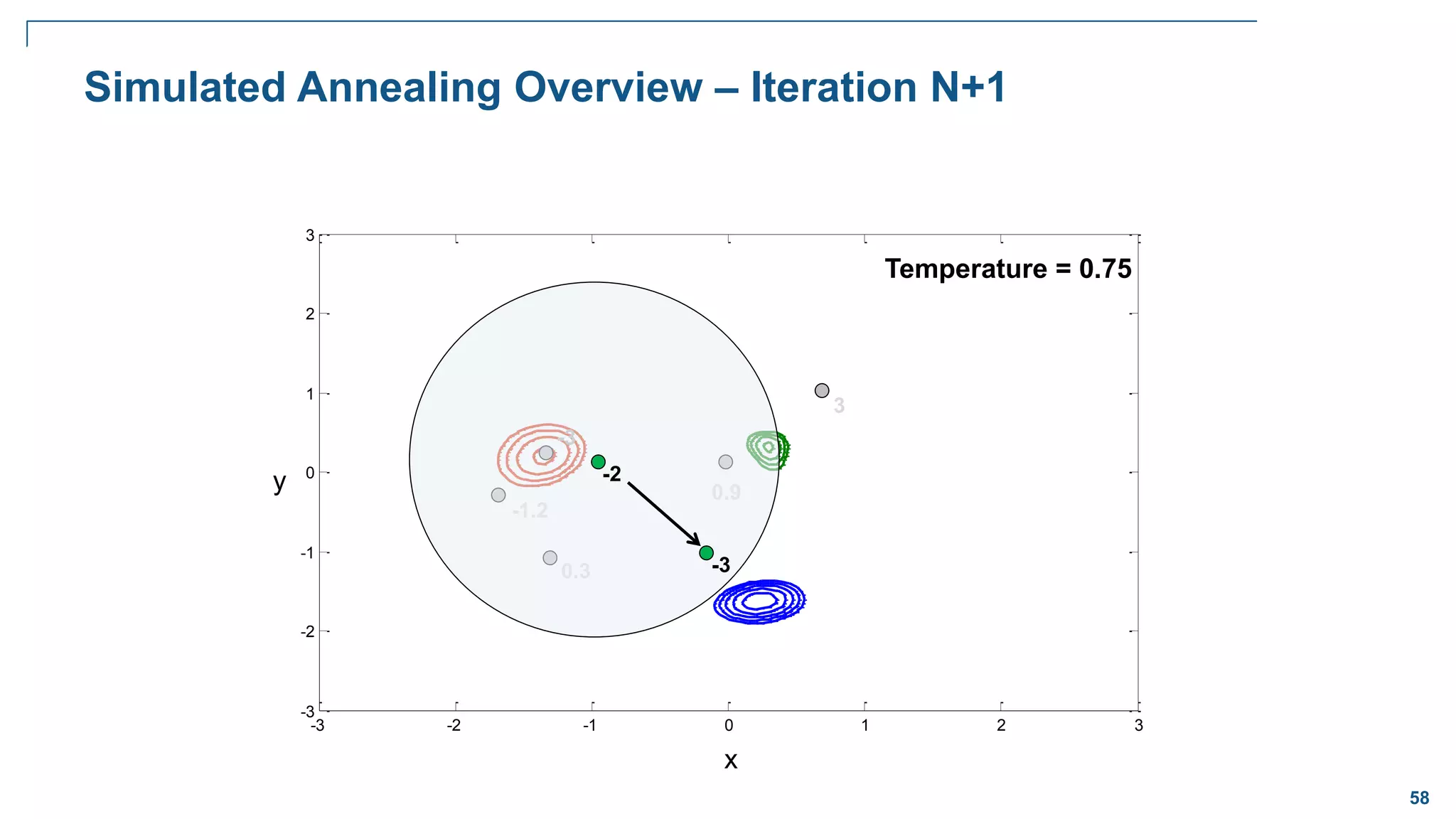
Simulated Annealing Overview – Iteration N+1
3
x
y 0.9
Temperature = 0.75
0.3
-1.2
-3
-2
-3
59
-3 -2 -1 0 1 2 3
-3
-2
-1
0
1
2
3
Simulated Annealing Overview – Iteration N+1
3
x
y 0.9
Temperature = 0.75
0.3
-1.2
-3
-2
-3
60
-3 -2 -1 0 1 2 3
-3
-2
-1
0
1
2
3
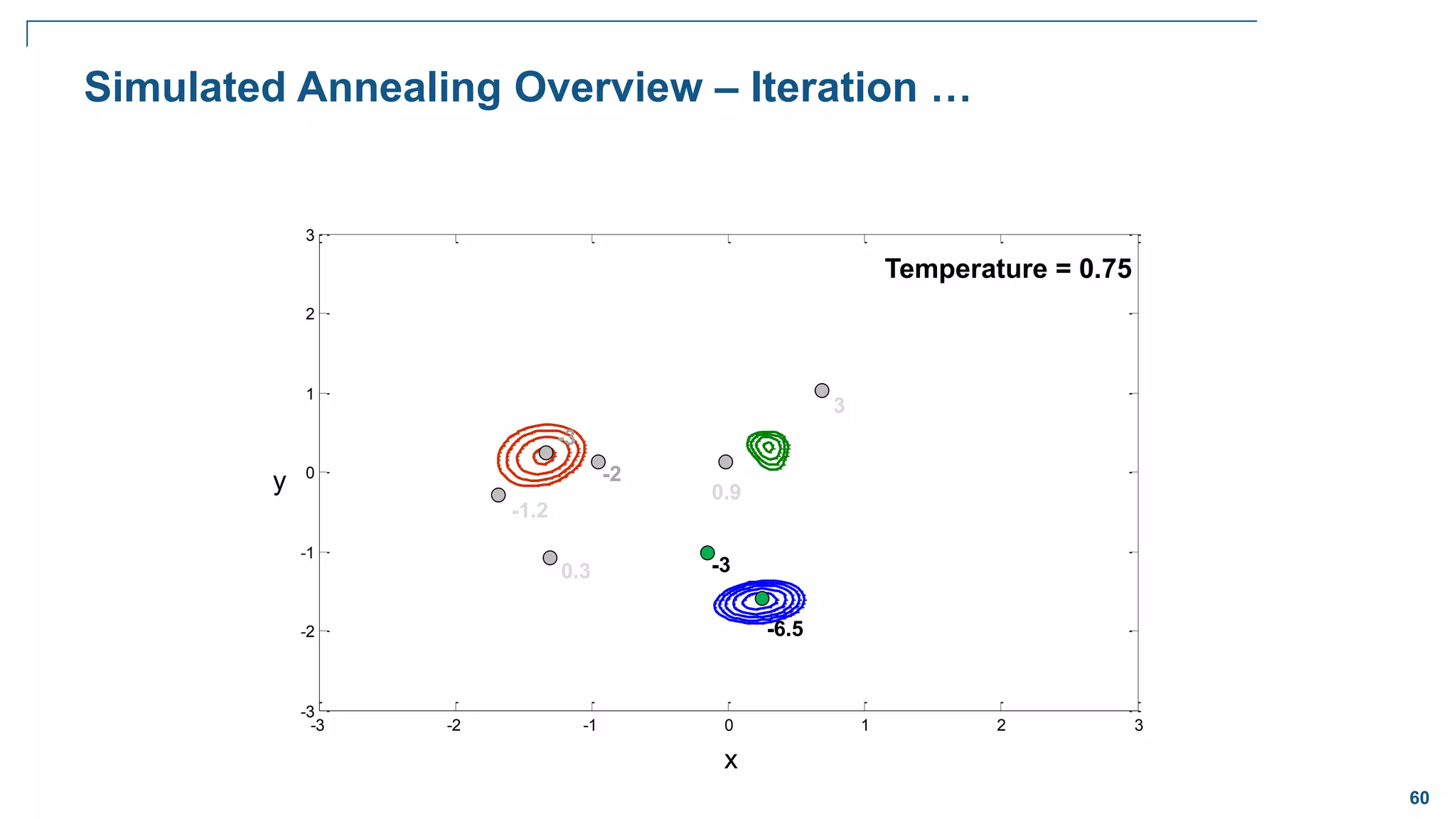
Simulated Annealing Overview – Iteration …
3
x
y 0.9
Temperature = 0.75
0.3
-1.2
-3
-2
-3
-6.5
61
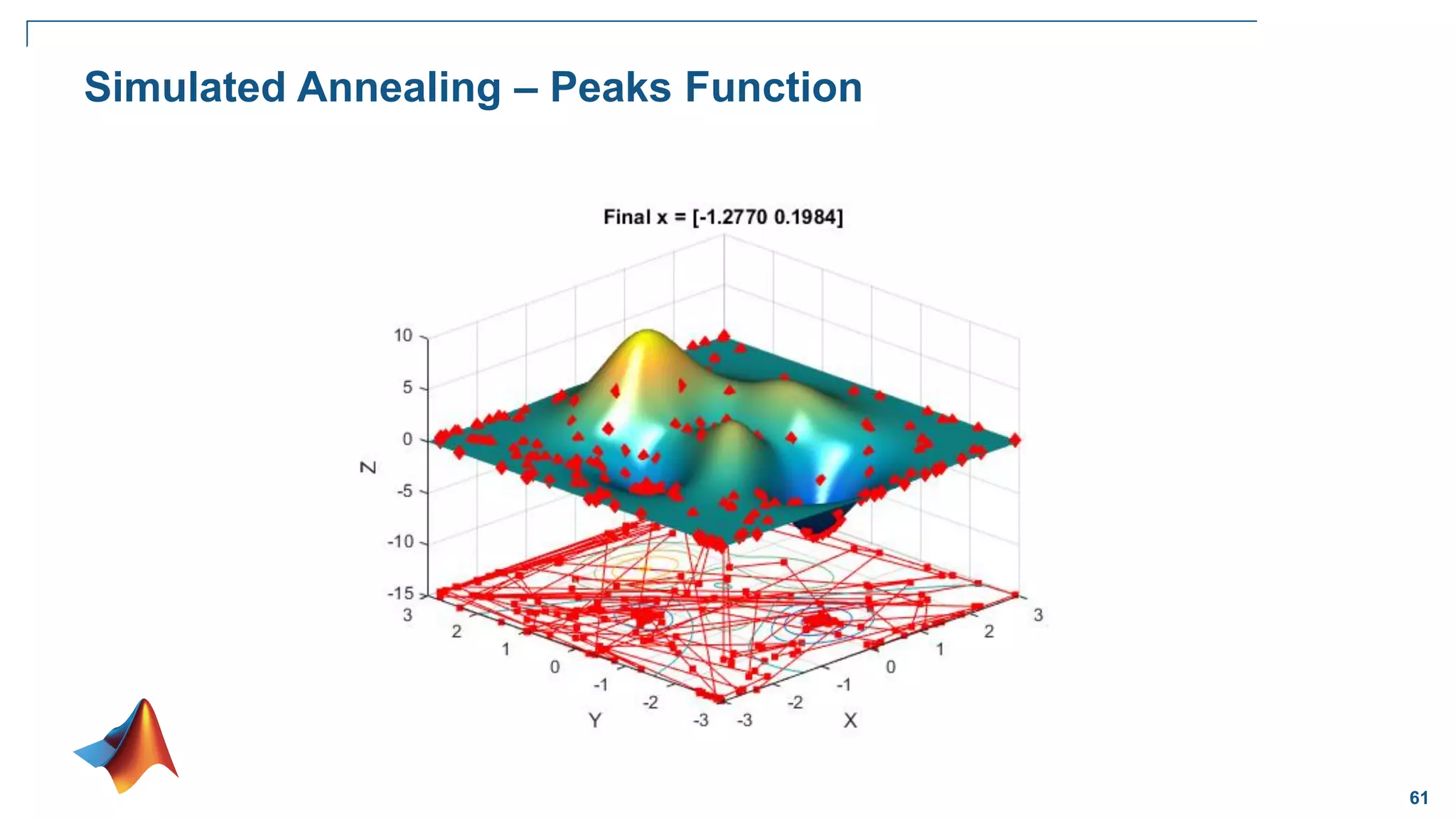
Simulated Annealing – Peaks Function
62
PATTERN SEARCH
(DIRECT SEARCH)
63
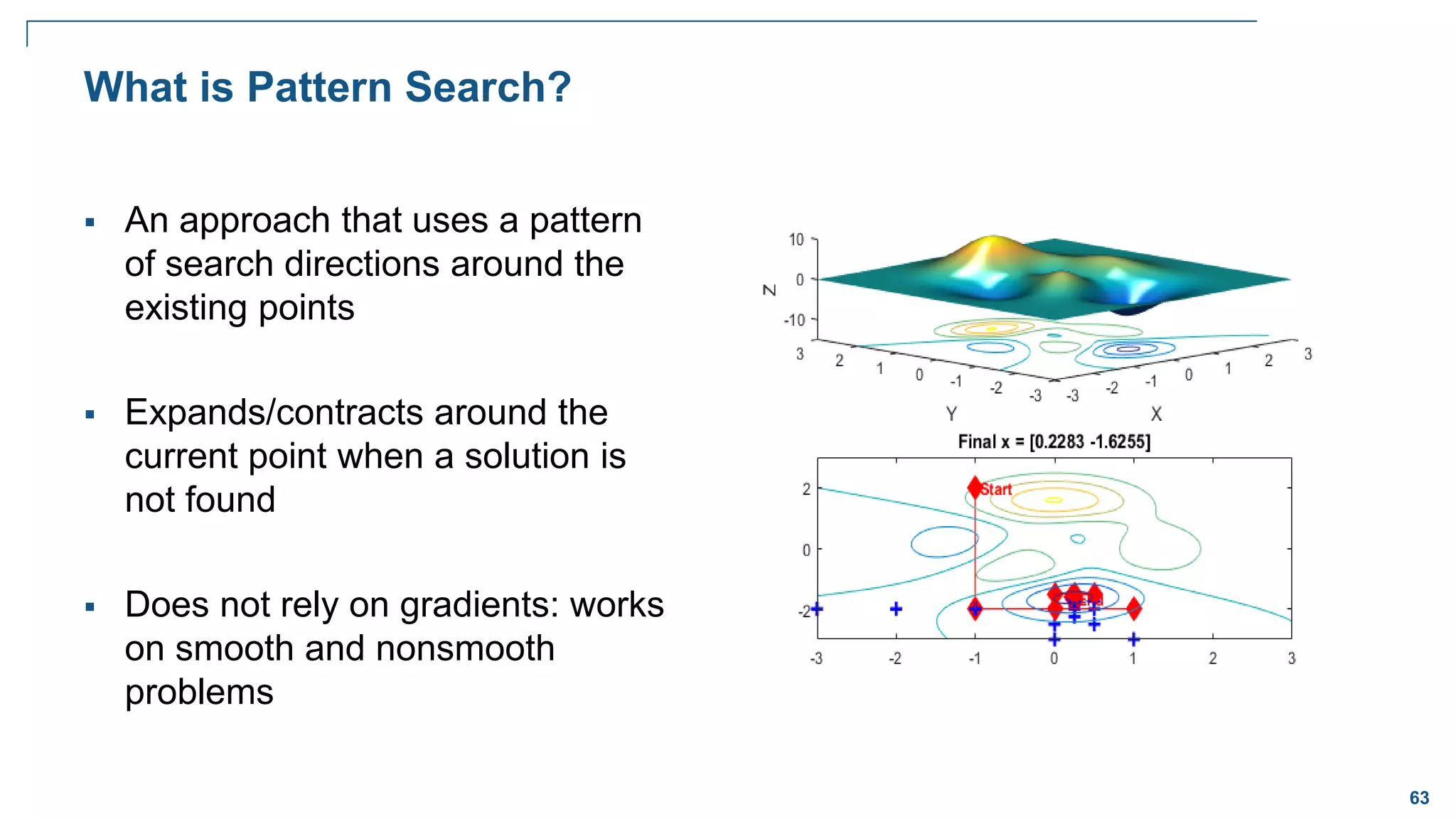
What is Pattern Search?
 An approach that uses a pattern
of search directions around the
existing points
 Expands/contracts around the
current point when a solution is
not found
 Does not rely on gradients: works
on smooth and nonsmooth
problems
64
-3 -2 -1 0 1 2 3
-3
-2
-1
0
1
2
3
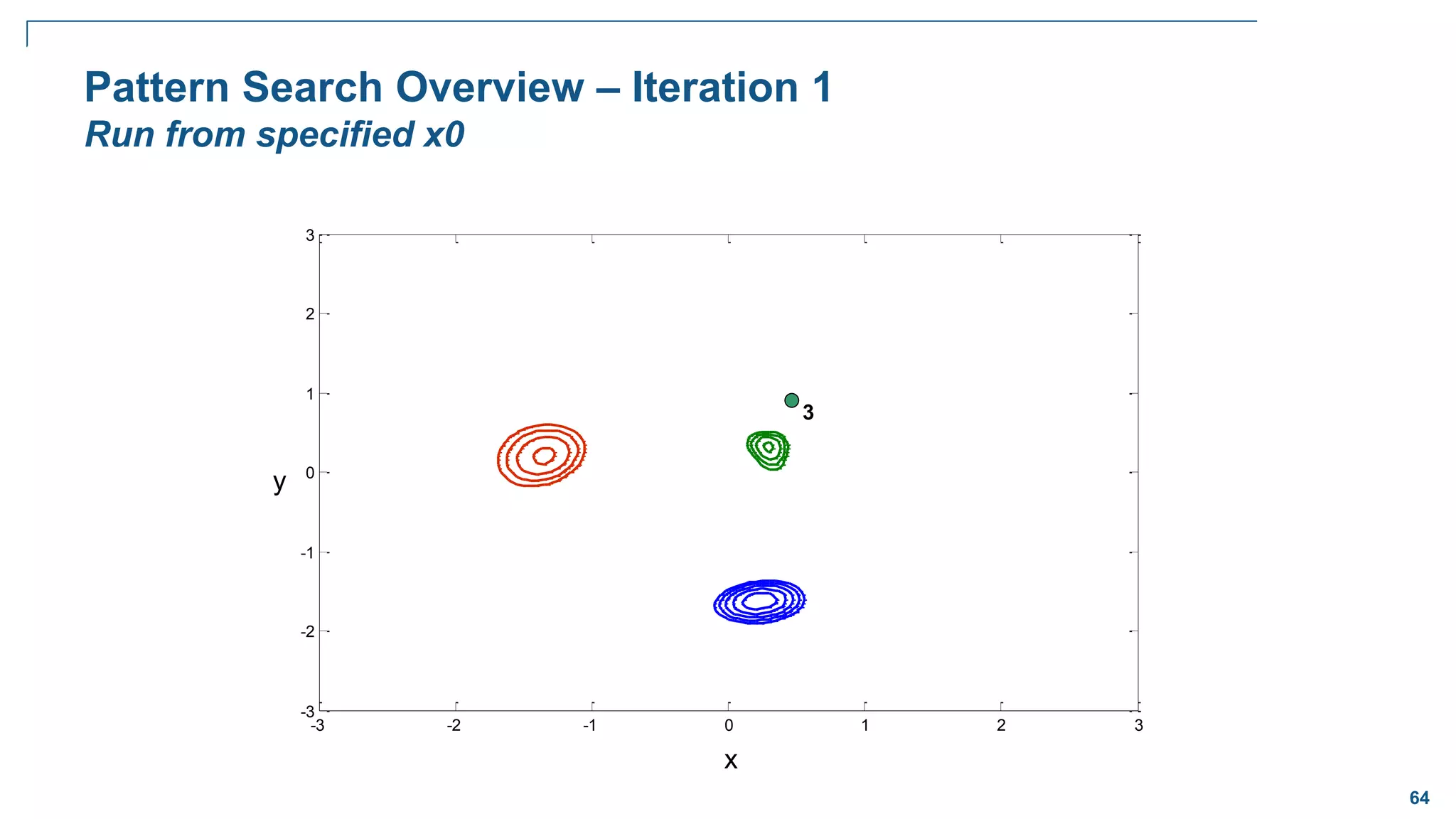
Pattern Search Overview – Iteration 1
Run from specified x0
x
y
3
65
-3 -2 -1 0 1 2 3
-3
-2
-1
0
1
2
3
Pattern Search Overview – Iteration 1
Apply pattern vector, poll new points for improvement
x
y
3
Mesh size = 1
Pattern vectors = [1,0], [0,1], [-1,0], [0,-1]
0
_
*
_ x
vector
pattern
size
mesh
Pnew 

0
]
0
,
1
[
*
1 x


1.6
0.4
4.6
2.8
First poll successful
Complete Poll (not default)
66
-3 -2 -1 0 1 2 3
-3
-2
-1
0
1
2
3
Pattern Search Overview – Iteration 2
x
y
3
Mesh size = 2
Pattern vectors = [1,0], [0,1], [-1,0], [0,-1]
1.6
0.4
4.6
2.8
-4
0.3
-2.8
Complete Poll
67
-3 -2 -1 0 1 2 3
-3
-2
-1
0
1
2
3
Pattern Search Overview – Iteration 3
x
y
3
Mesh size = 4
Pattern vectors = [1,0], [0,1], [-1,0], [0,-1]
1.6
0.4
4.6
2.8
-4
0.3
-2.8
68
-3 -2 -1 0 1 2 3
-3
-2
-1
0
1
2
3
Pattern Search Overview – Iteration 4
x
y
3
Mesh size = 4*0.5 = 2
Pattern vectors = [1,0], [0,1], [-1,0], [0,-1]
1.6
0.4
4.6
2.8
-4
0.3
-2.8
69
-3 -2 -1 0 1 2 3
-3
-2
-1
0
1
2
3
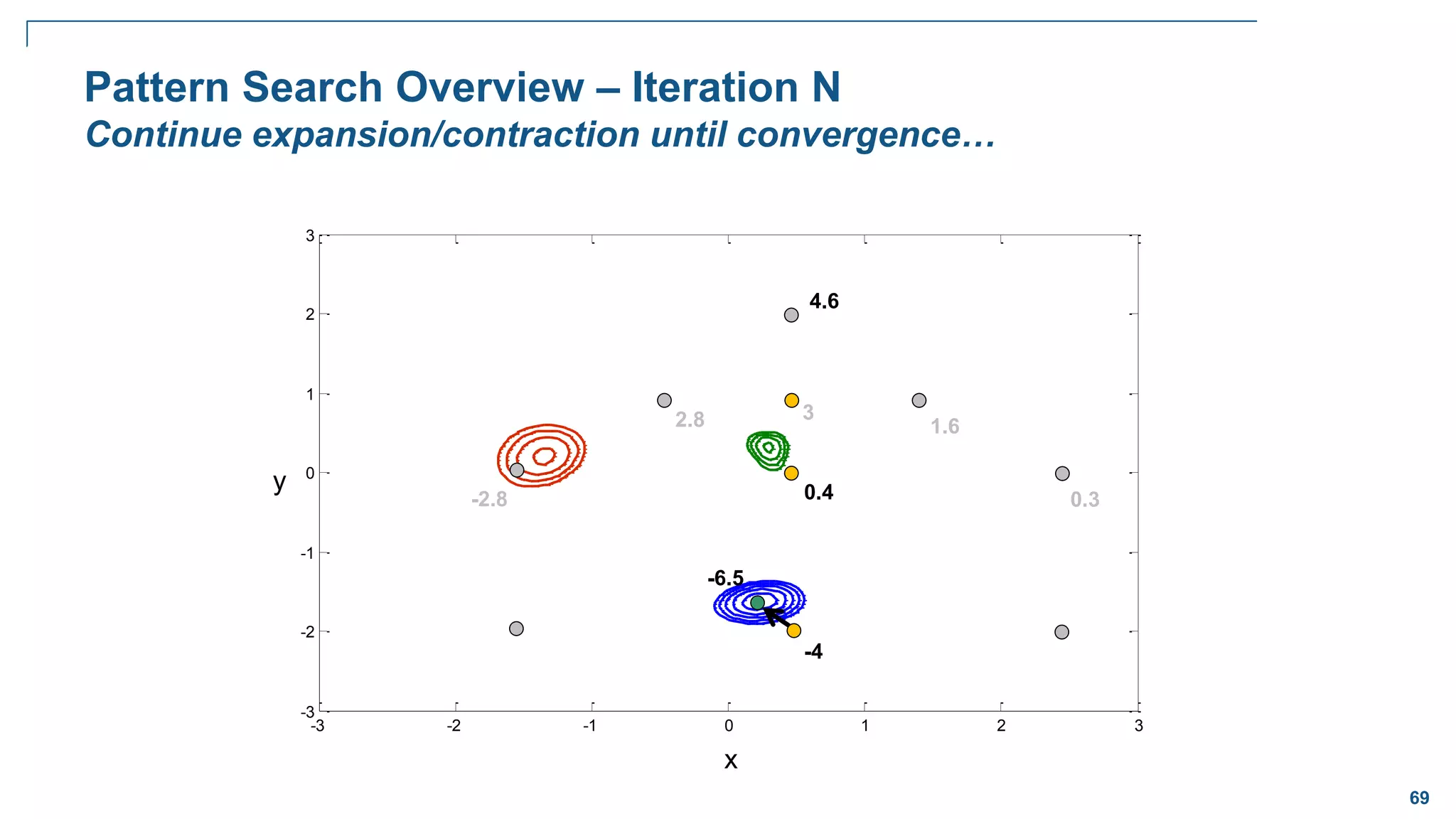
Pattern Search Overview – Iteration N
Continue expansion/contraction until convergence…
x
y
3
1.6
0.4
4.6
2.8
-4
0.3
-2.8
-6.5
70
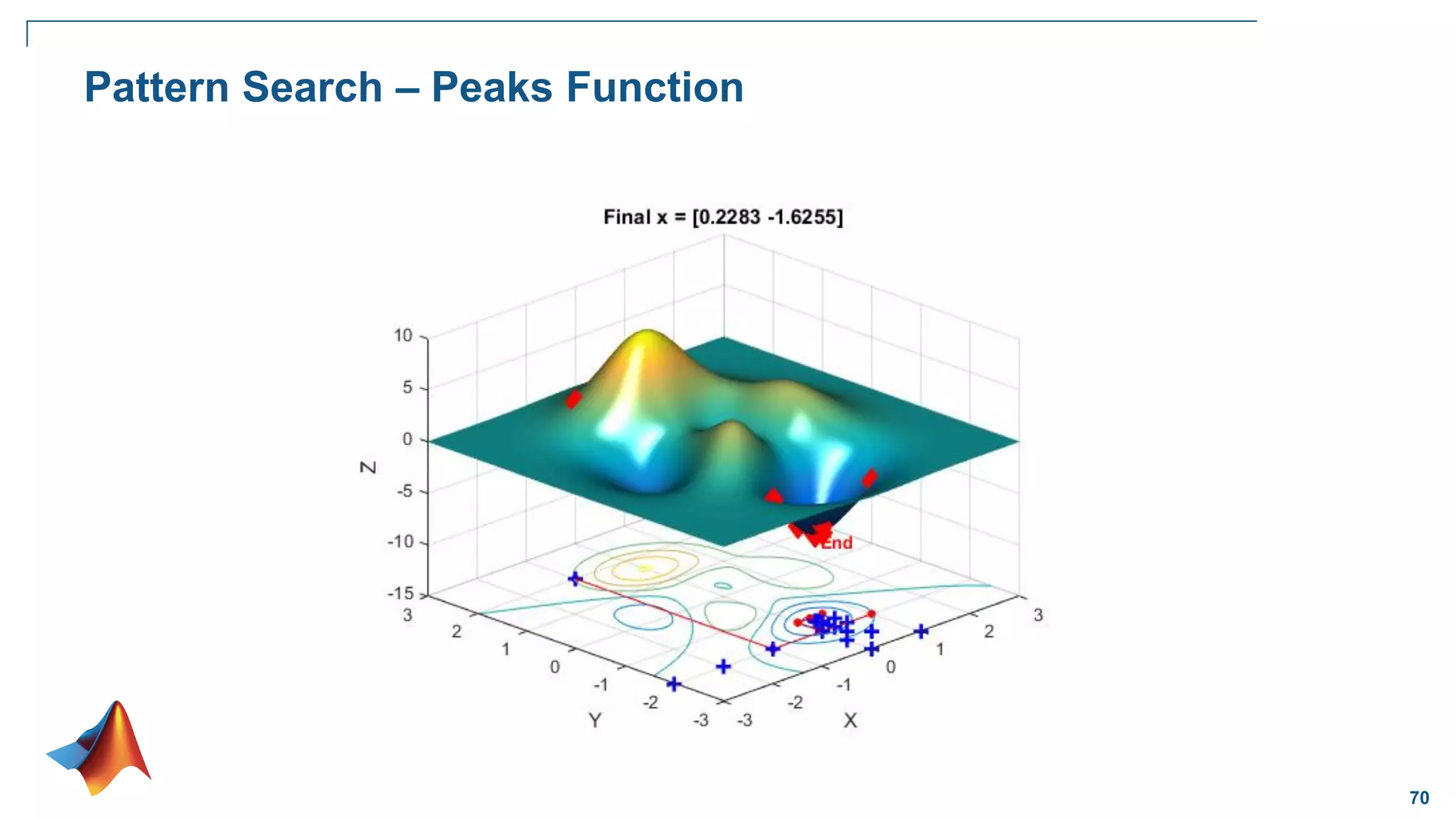
Pattern Search – Peaks Function
71
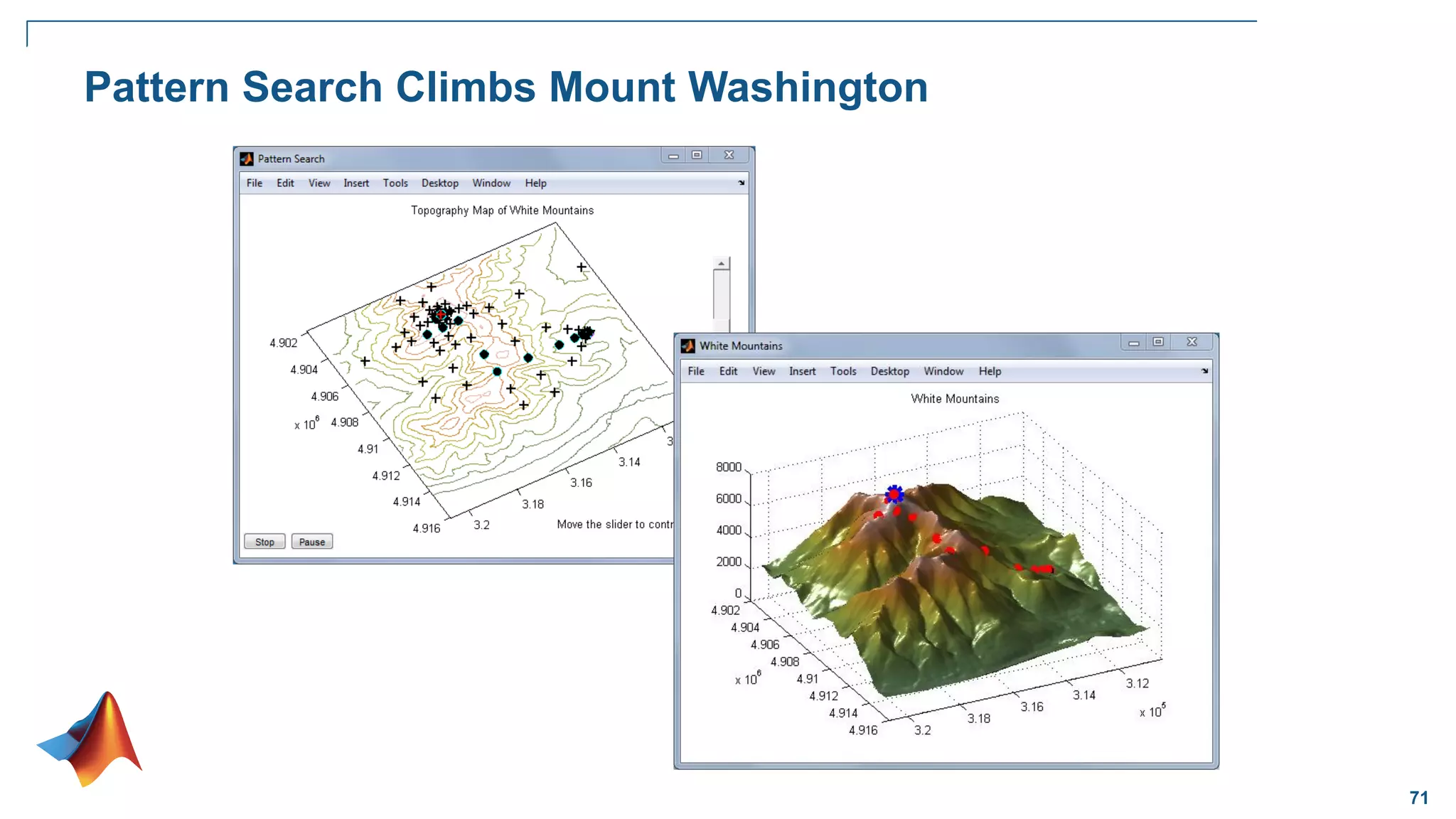
Pattern Search Climbs Mount Washington
72
PARTICLE SWARM
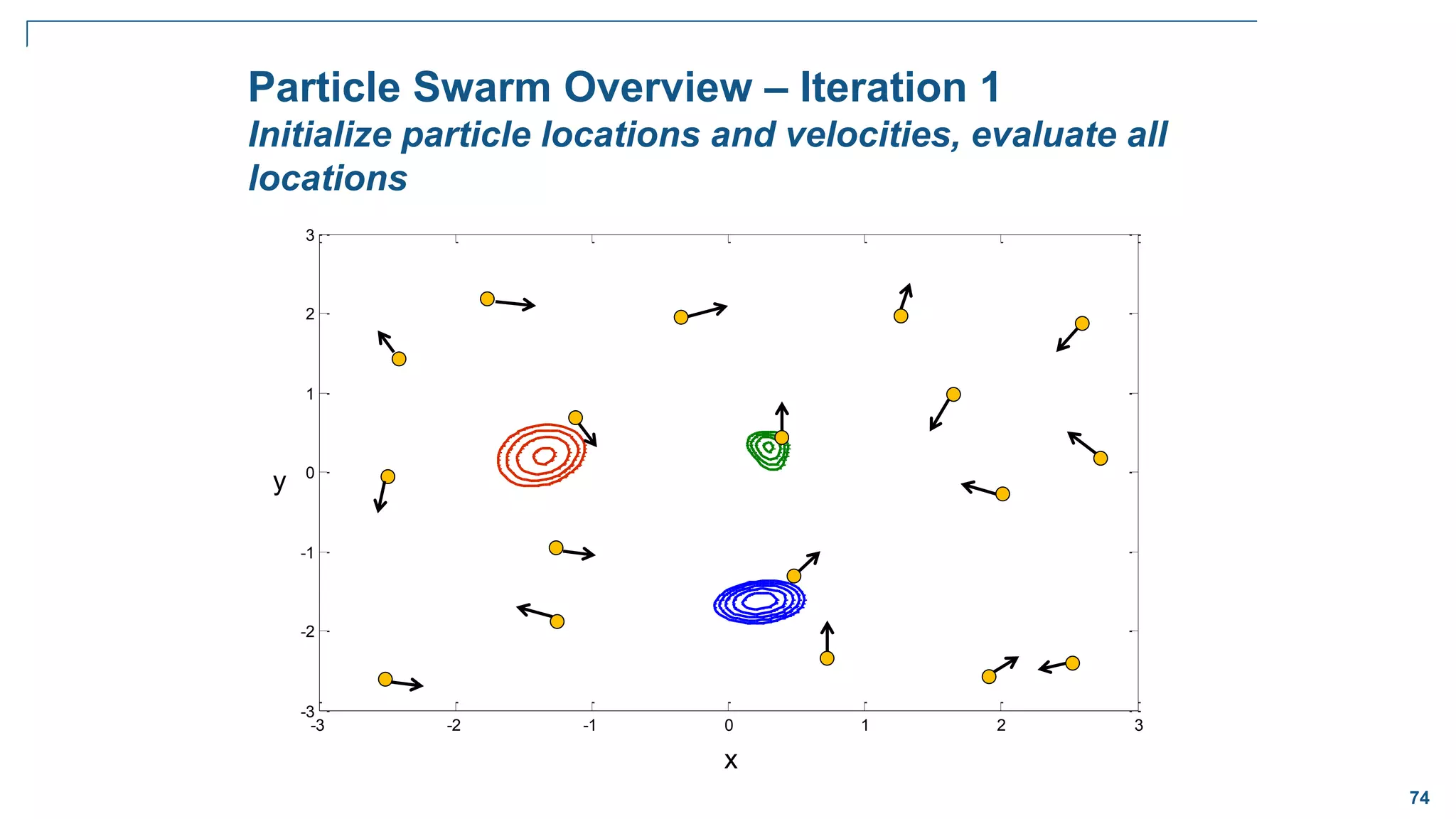
73
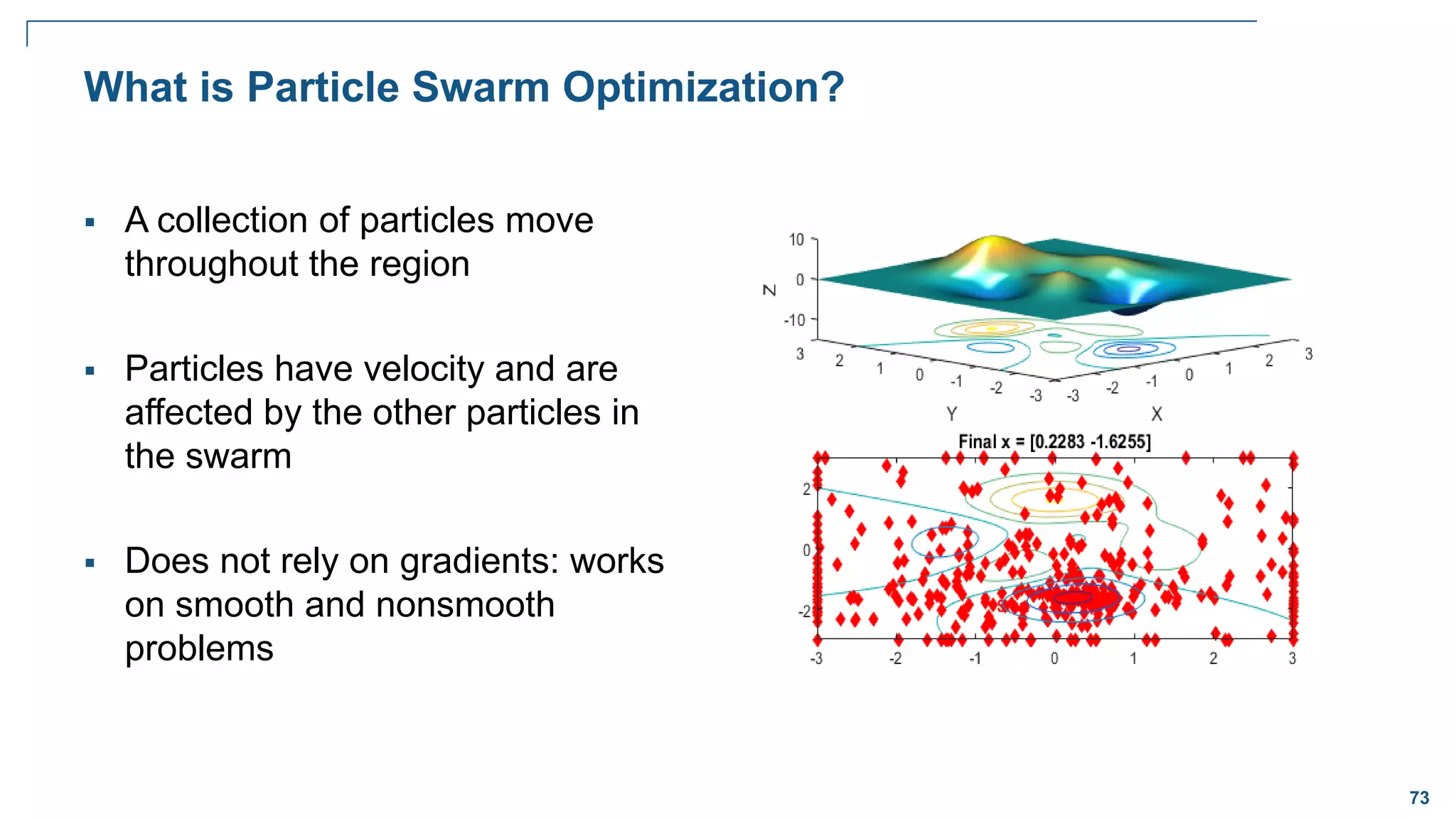
What is Particle Swarm Optimization?
 A collection of particles move
throughout the region
 Particles have velocity and are
affected by the other particles in
the swarm
 Does not rely on gradients: works
on smooth and nonsmooth
problems
74
-3 -2 -1 0 1 2 3
-3
-2
-1
0
1
2
3
Particle Swarm Overview – Iteration 1
Initialize particle locations and velocities, evaluate all
locations
x
y
75
-3 -2 -1 0 1 2 3
-3
-2
-1
0
1
2
3
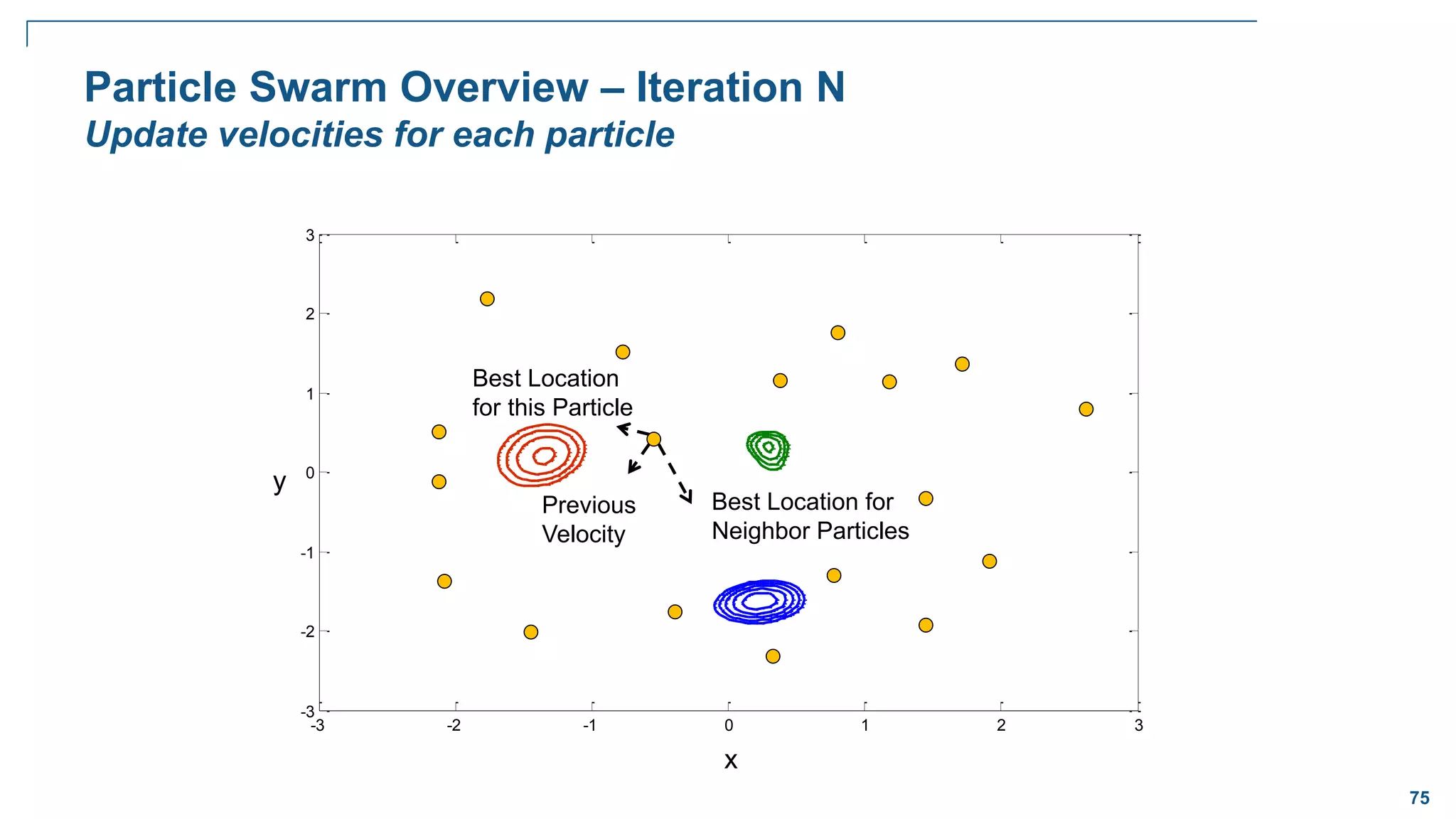
Particle Swarm Overview – Iteration N
Update velocities for each particle
x
y
Previous
Velocity
Best Location
for this Particle
Best Location for
Neighbor Particles
76
-3 -2 -1 0 1 2 3
-3
-2
-1
0
1
2
3
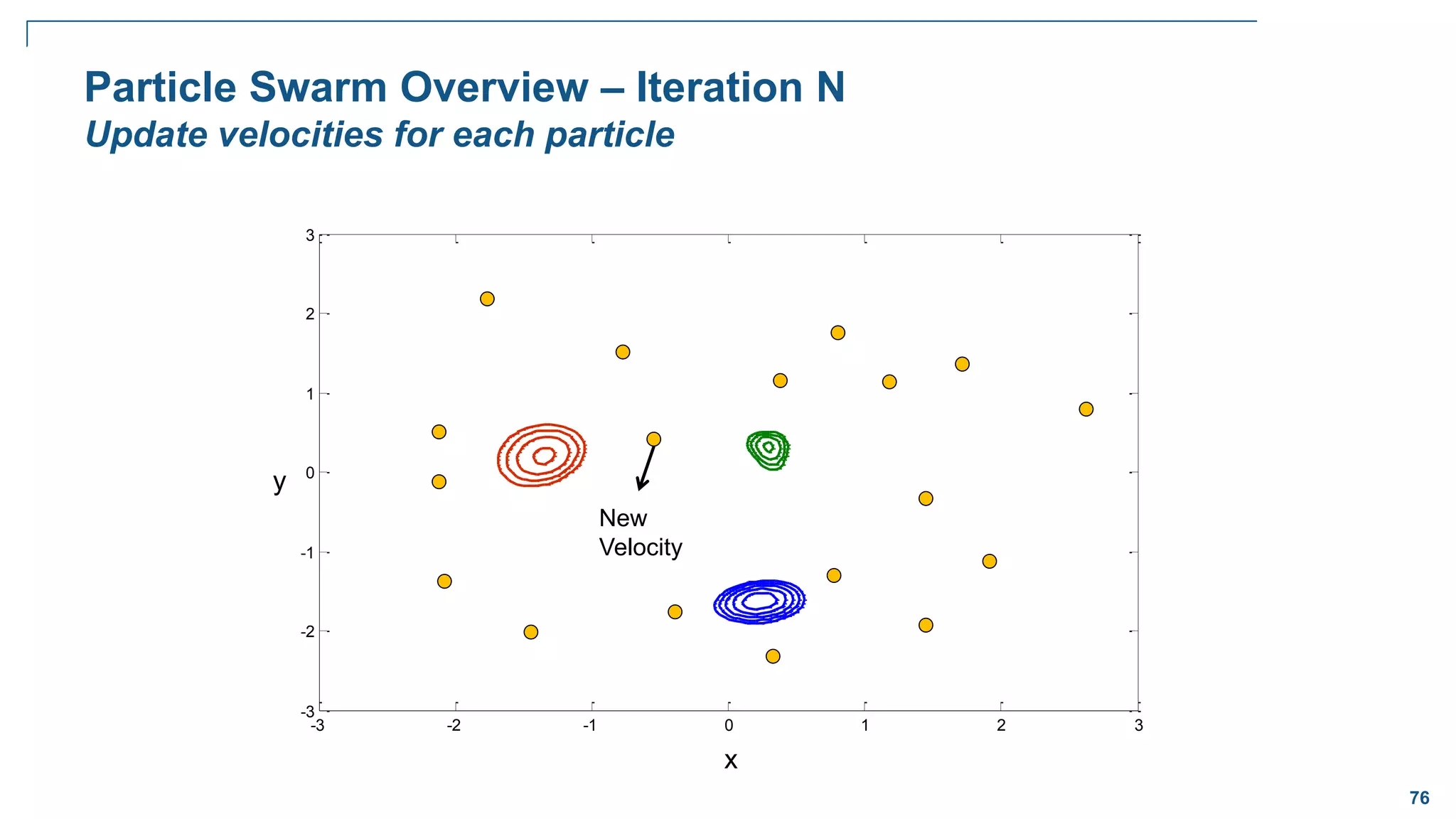
Particle Swarm Overview – Iteration N
Update velocities for each particle
x
y
New
Velocity
77
-3 -2 -1 0 1 2 3
-3
-2
-1
0
1
2
3
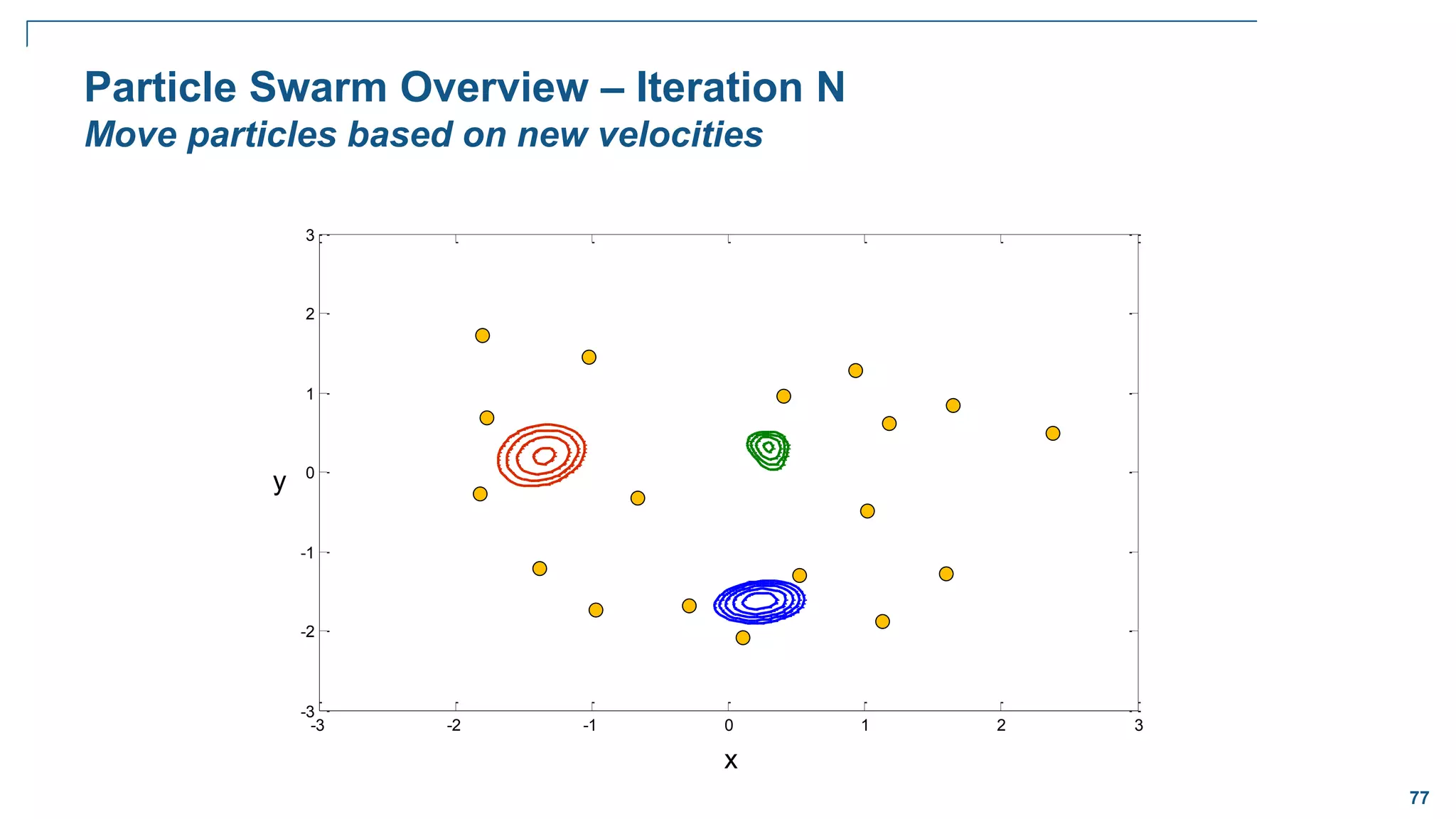
Particle Swarm Overview – Iteration N
Move particles based on new velocities
x
y
78
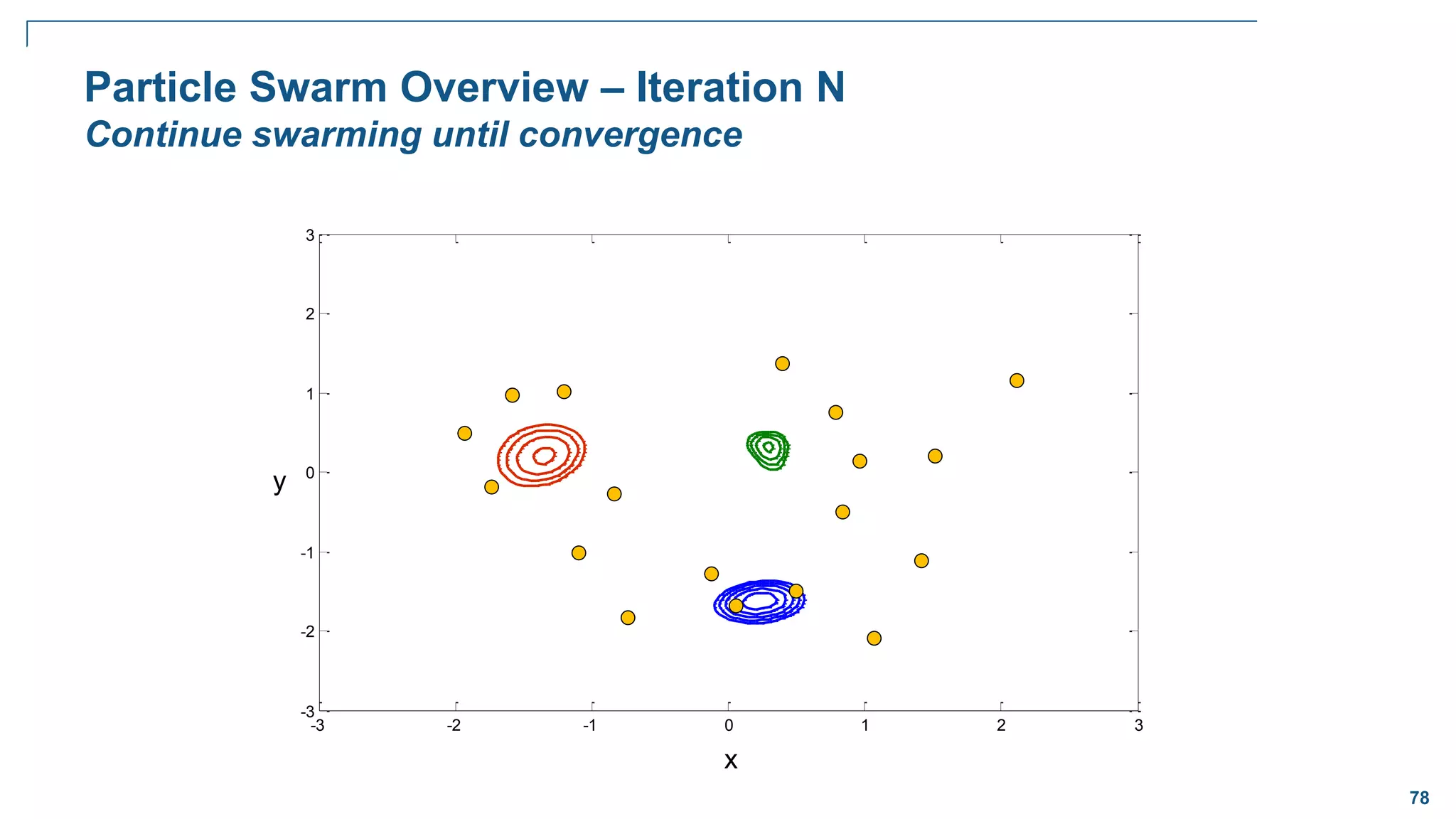
-3 -2 -1 0 1 2 3
-3
-2
-1
0
1
2
3
Particle Swarm Overview – Iteration N
Continue swarming until convergence
x
y
79
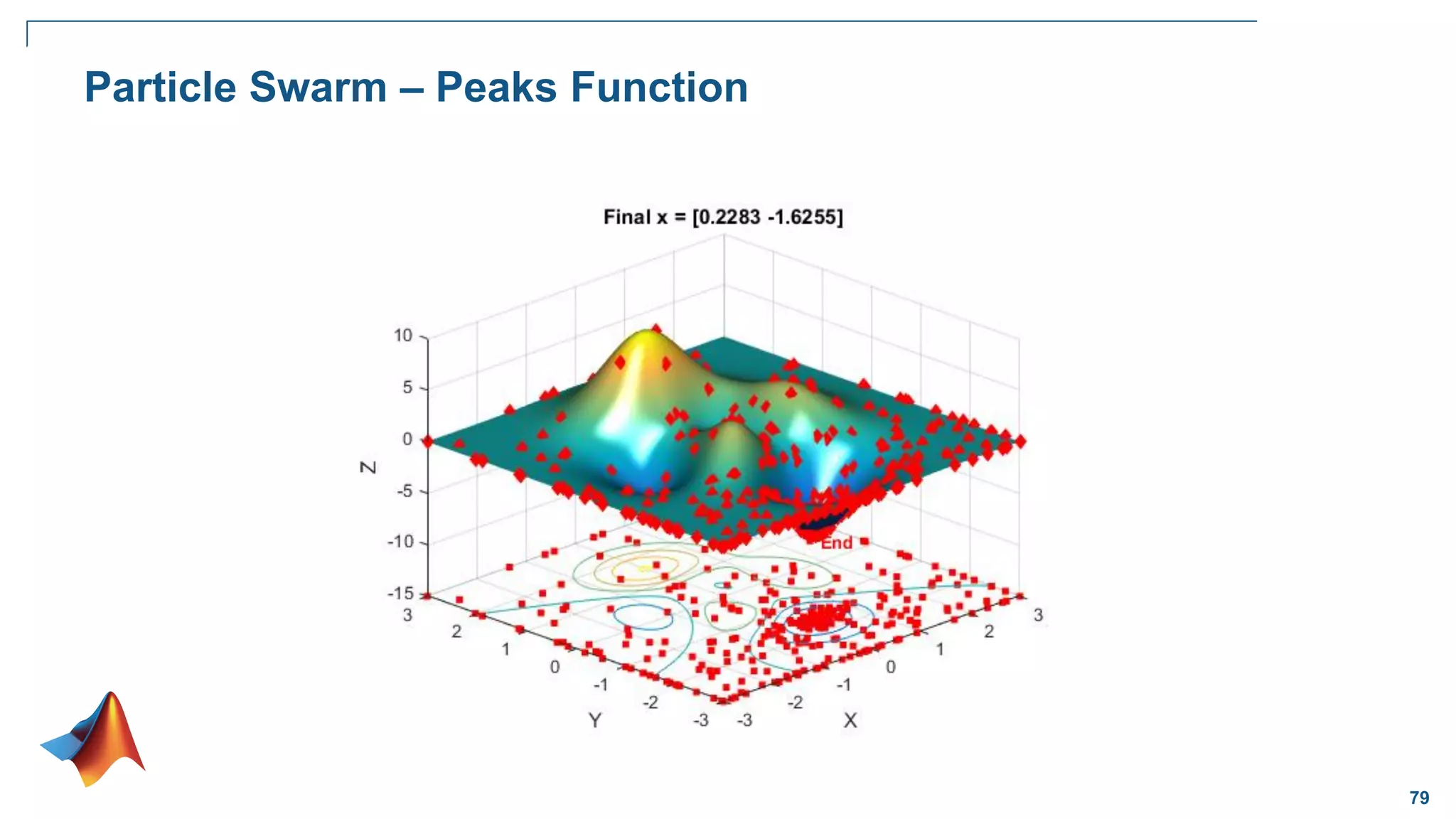
Particle Swarm – Peaks Function
80
GENETIC ALGORITHM
81
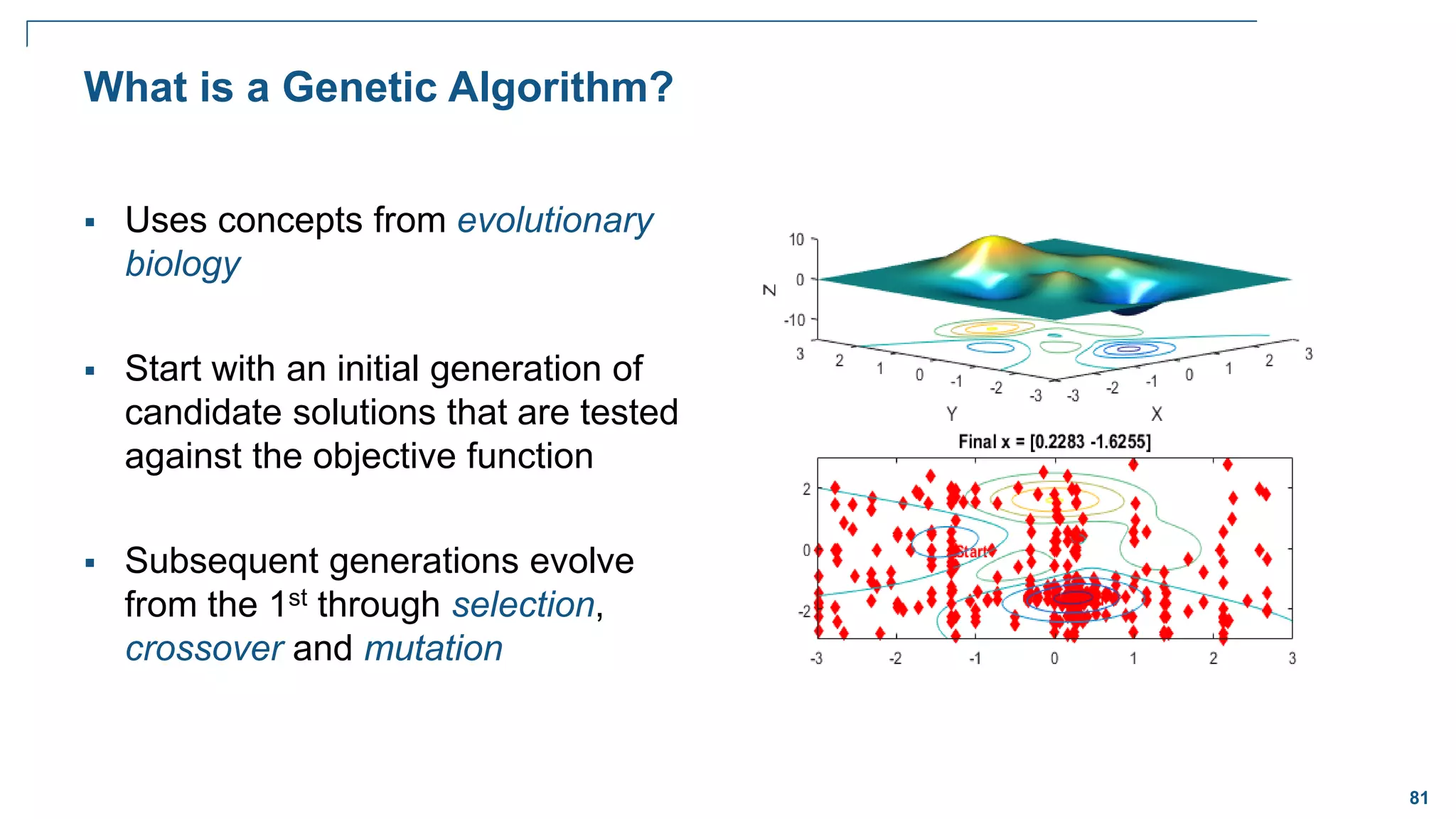
What is a Genetic Algorithm?
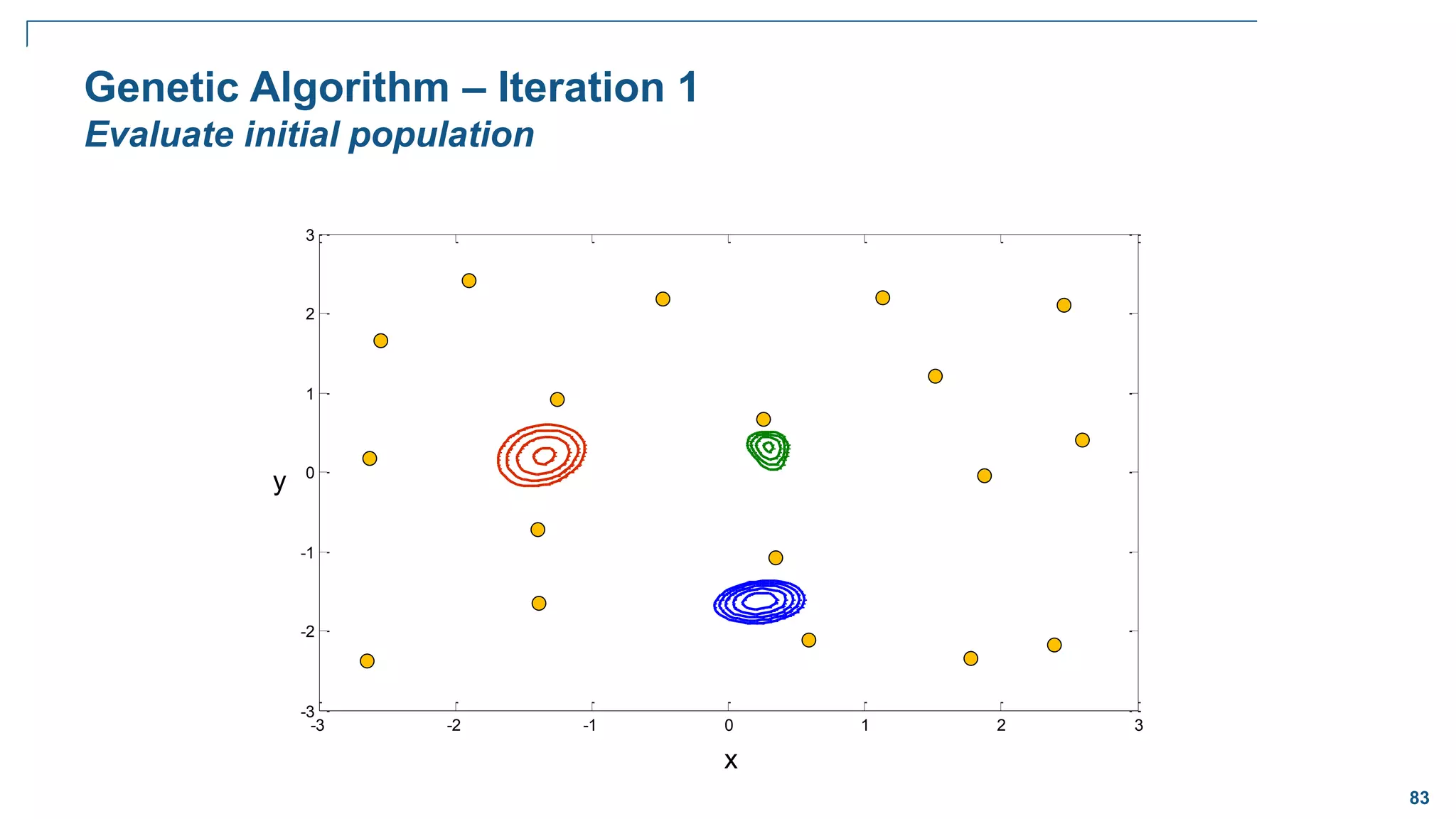
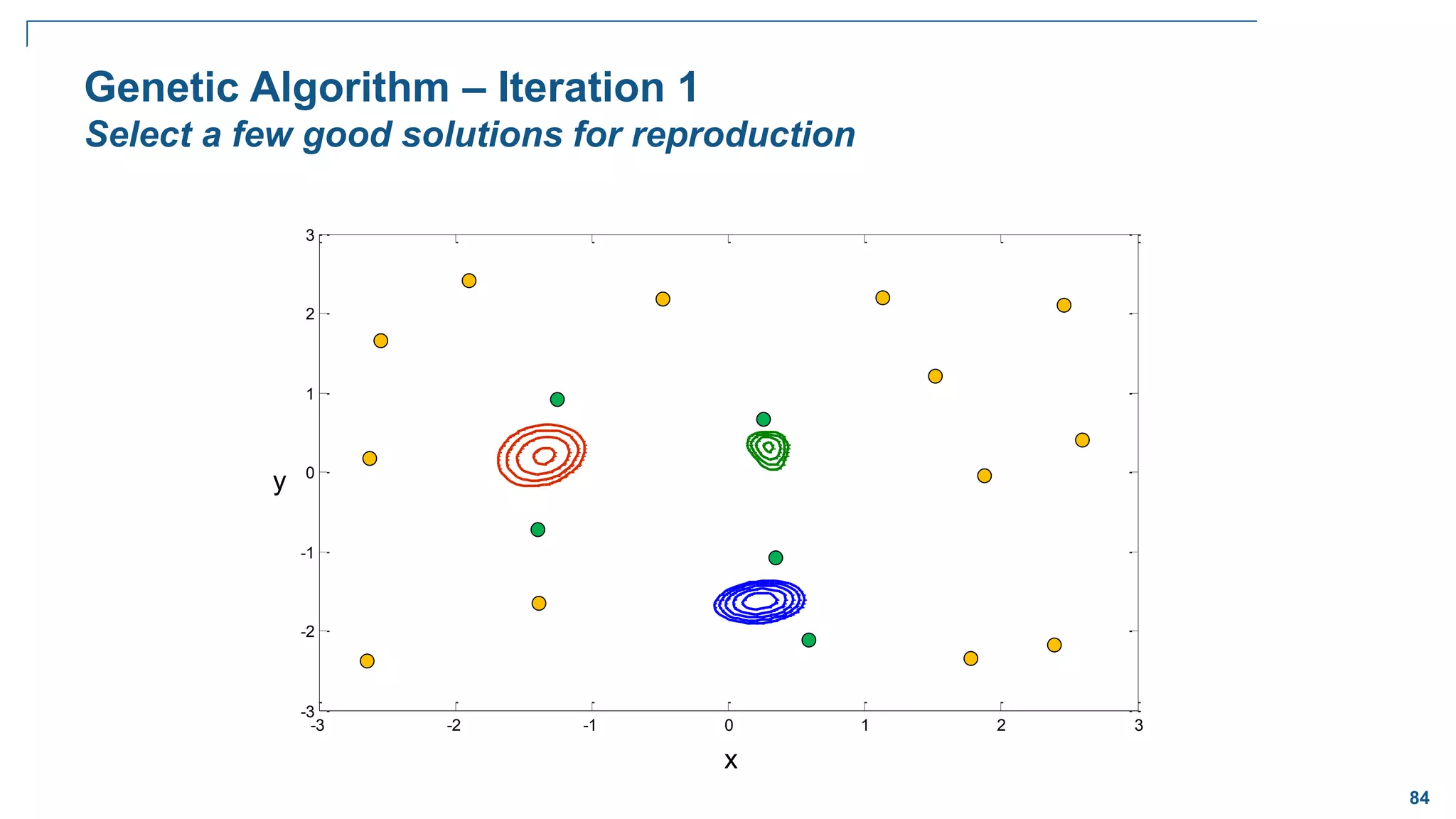
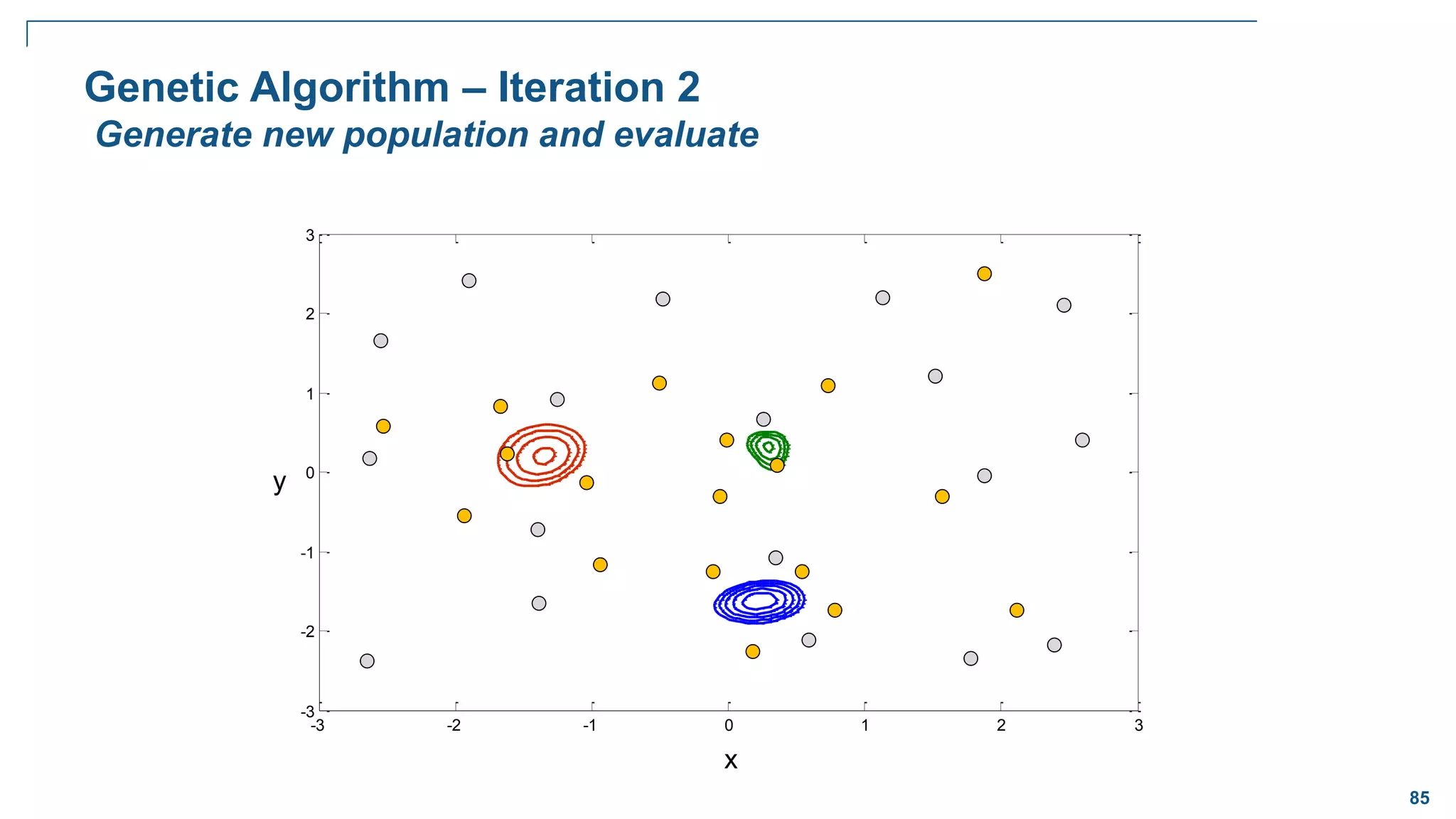
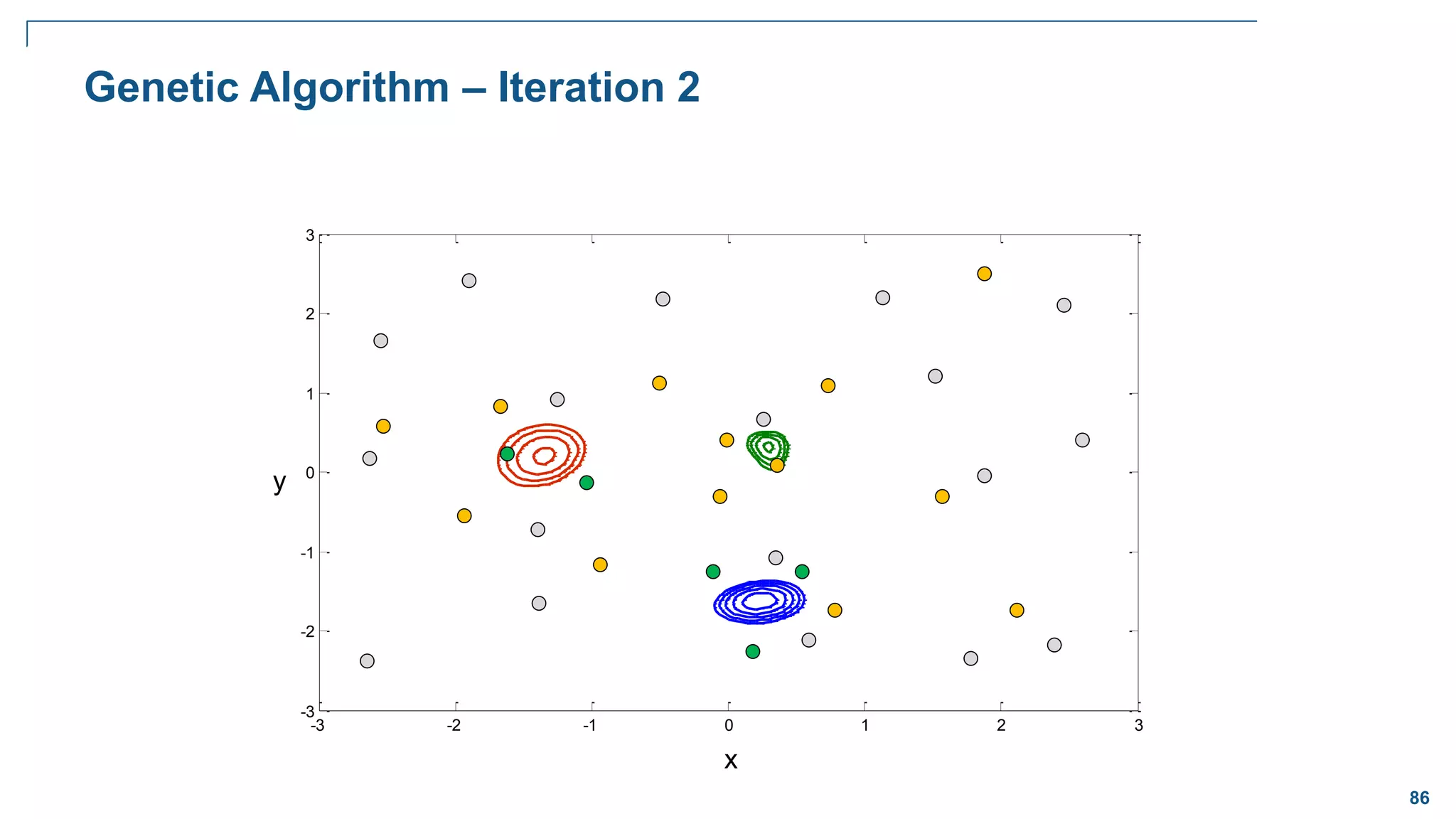
 Uses concepts from evolutionary
biology
 Start with an initial generation of
candidate solutions that are tested
against the objective function
 Subsequent generations evolve
from the 1st through selection,
crossover and mutation
82
How Evolution Works – Binary Case
 Selection
– Retain the best performing bit strings from one generation to the next. Favor these for
reproduction
– parent1 = [ 1 0 1 0 0 1 1 0 0 0 ]
– parent2 = [ 1 0 0 1 0 0 1 0 1 0 ]
 Crossover
– parent1 = [ 1 0 1 0 0 1 1 0 0 0 ]
– parent2 = [ 1 0 0 1 0 0 1 0 1 0 ]
– child = [ 1 0 0 0 0 1 1 0 1 0 ]
 Mutation
– parent = [ 1 0 1 0 0 1 1 0 0 0 ]
– child = [ 0 1 0 1 0 1 0 0 0 1 ]
83
-3 -2 -1 0 1 2 3
-3
-2
-1
0
1
2
3
Genetic Algorithm – Iteration 1
Evaluate initial population
x
y
84
-3 -2 -1 0 1 2 3
-3
-2
-1
0
1
2
3
Genetic Algorithm – Iteration 1
Select a few good solutions for reproduction
x
y
85
-3 -2 -1 0 1 2 3
-3
-2
-1
0
1
2
3
Genetic Algorithm – Iteration 2
Generate new population and evaluate
x
y
86
-3 -2 -1 0 1 2 3
-3
-2
-1
0
1
2
3
Genetic Algorithm – Iteration 2
x
y
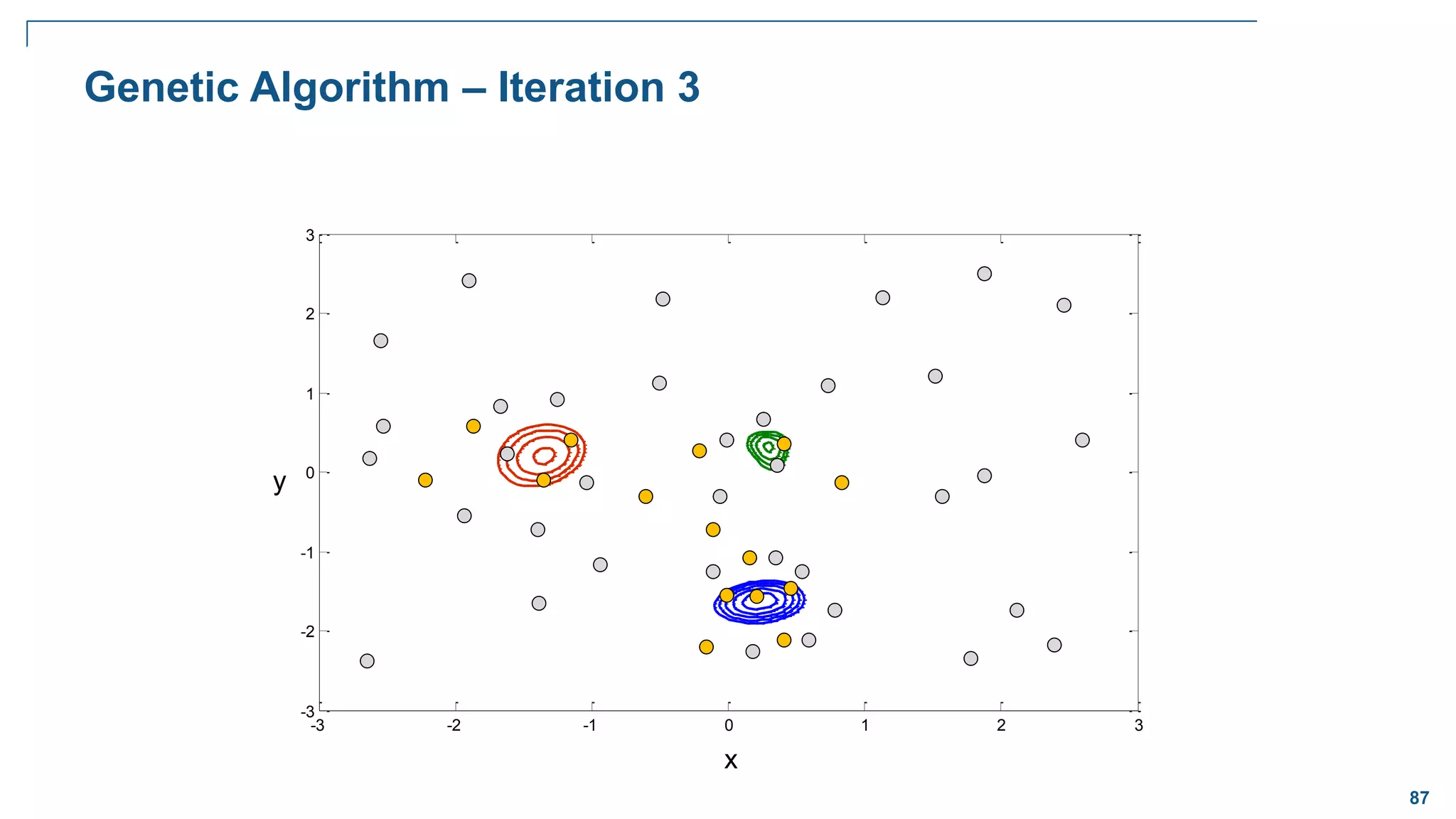
87
-3 -2 -1 0 1 2 3
-3
-2
-1
0
1
2
3
Genetic Algorithm – Iteration 3
x
y
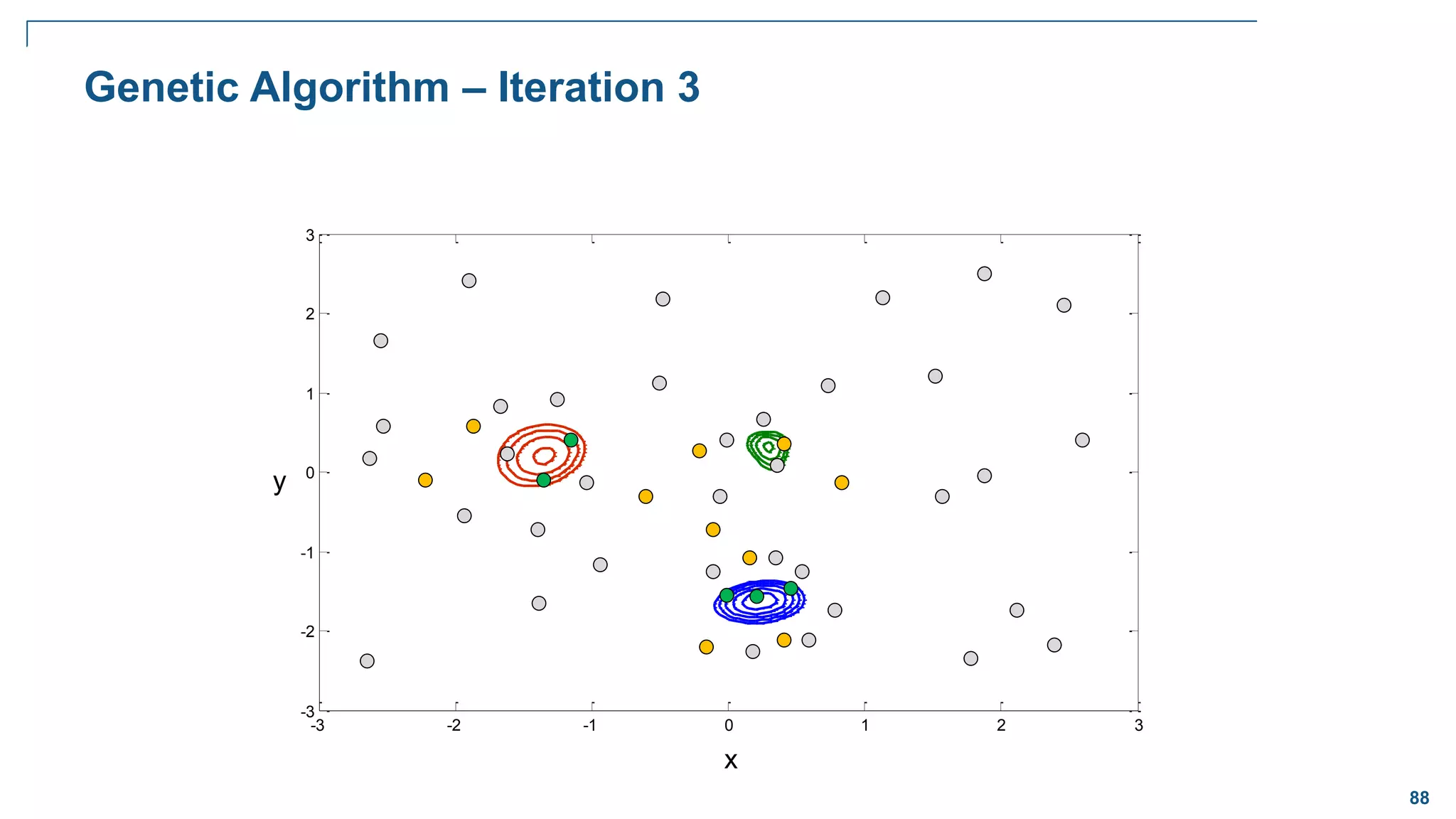
88
-3 -2 -1 0 1 2 3
-3
-2
-1
0
1
2
3
Genetic Algorithm – Iteration 3
x
y
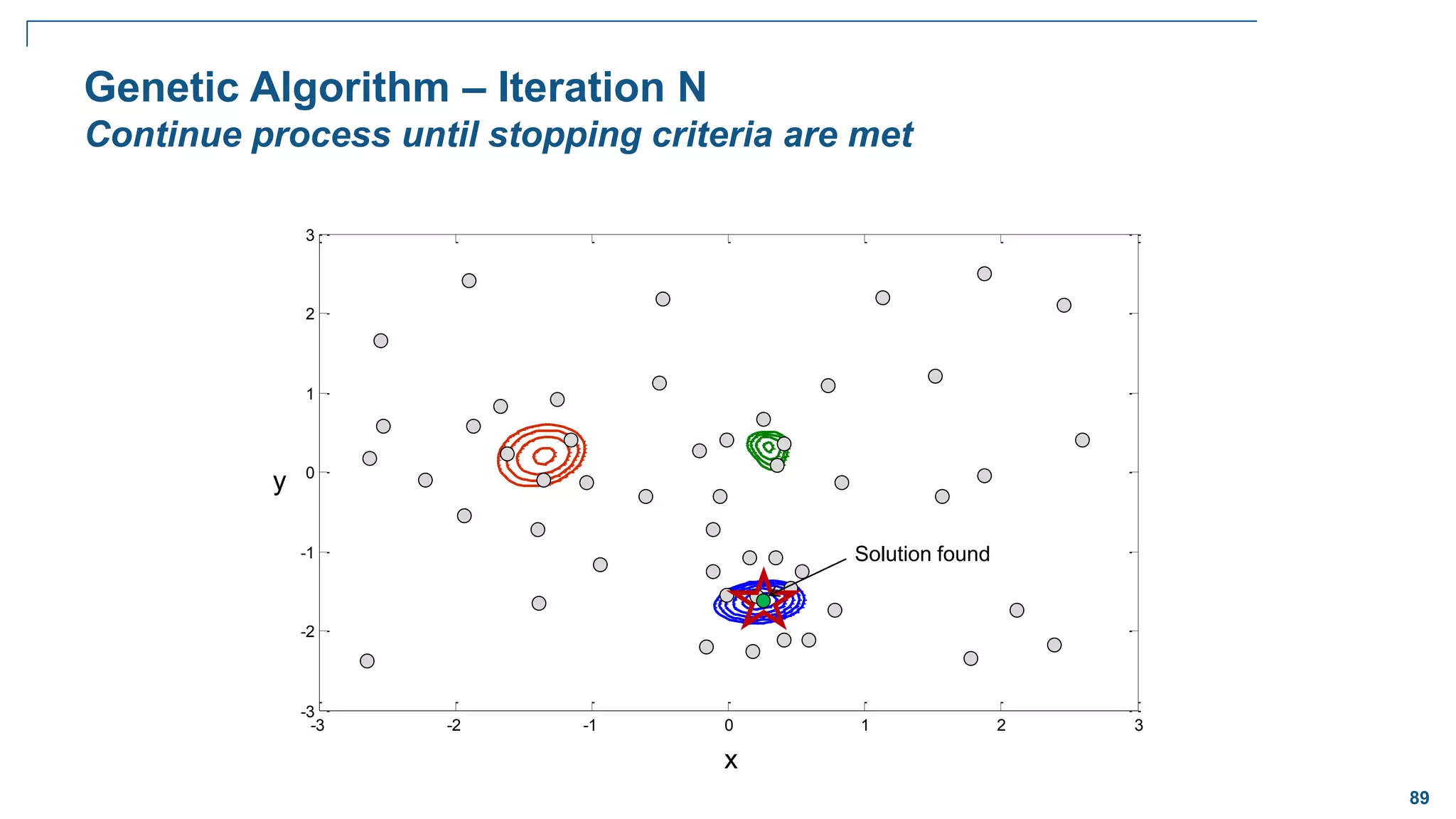
89
-3 -2 -1 0 1 2 3
-3
-2
-1
0
1
2
3
Genetic Algorithm – Iteration N
Continue process until stopping criteria are met
x
y
Solution found
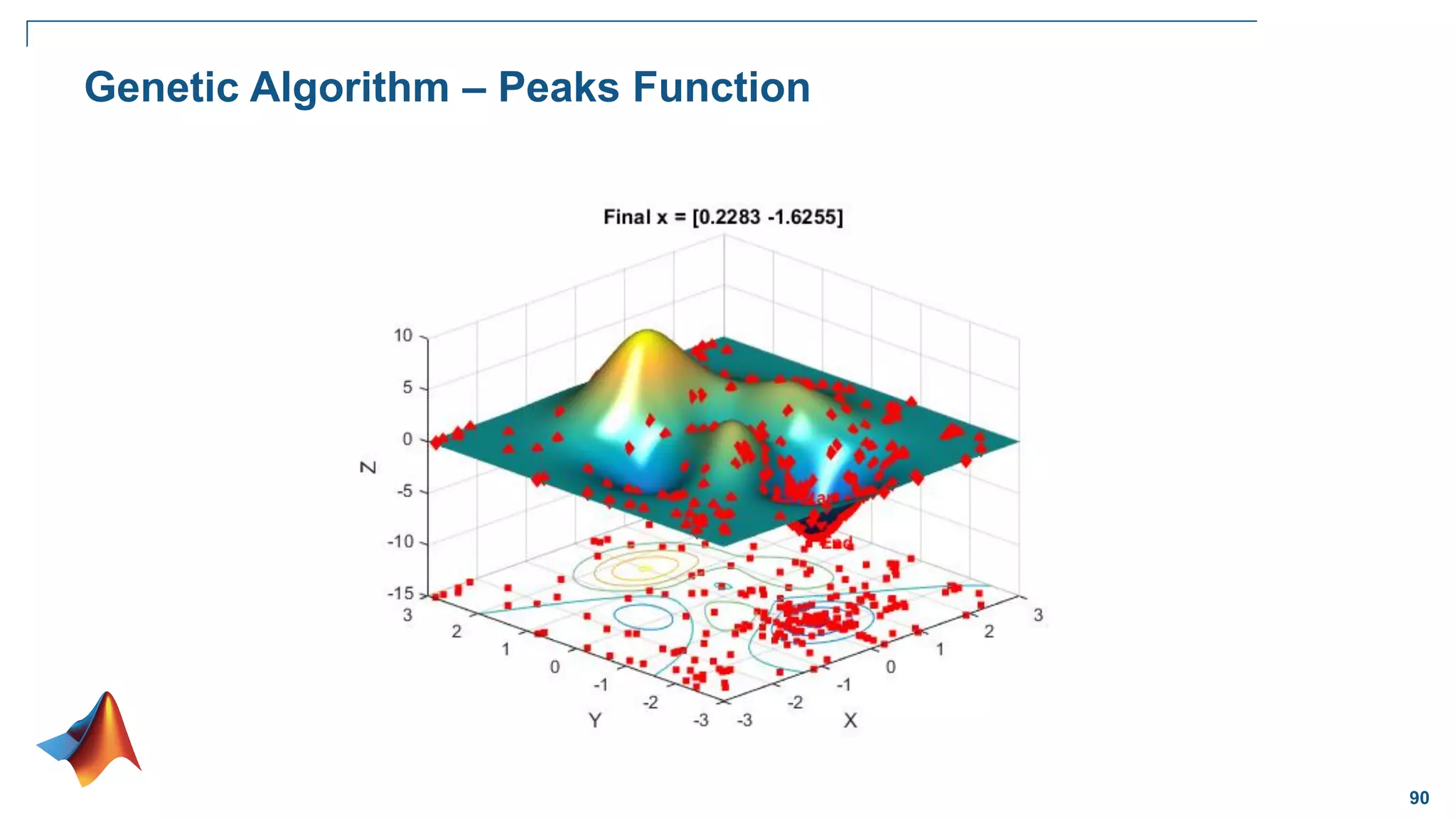
90
Genetic Algorithm – Peaks Function
91
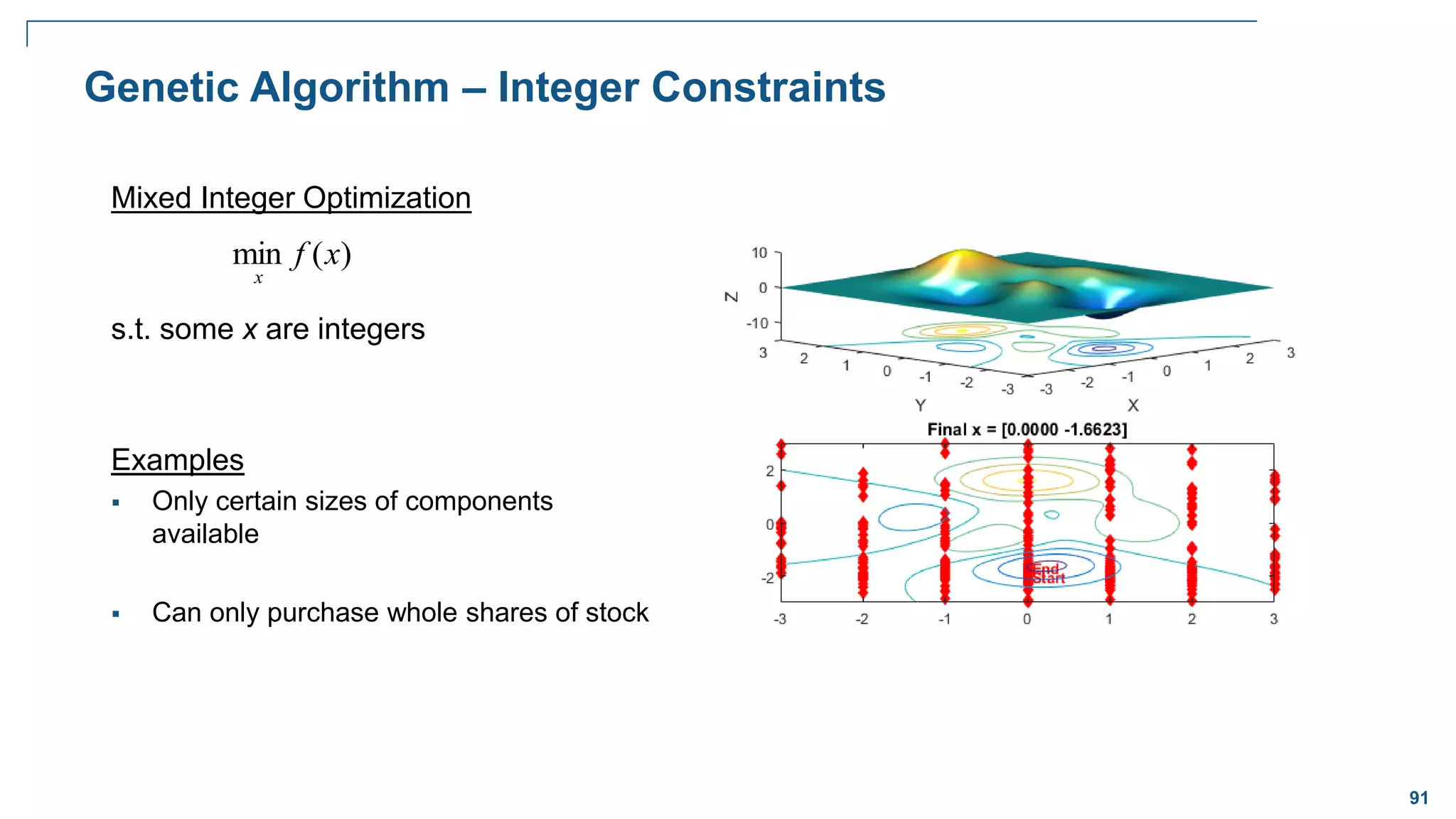
Genetic Algorithm – Integer Constraints
Mixed Integer Optimization
s.t. some x are integers
Examples
 Only certain sizes of components
available
 Can only purchase whole shares of stock
)
(
min x
f
x
92
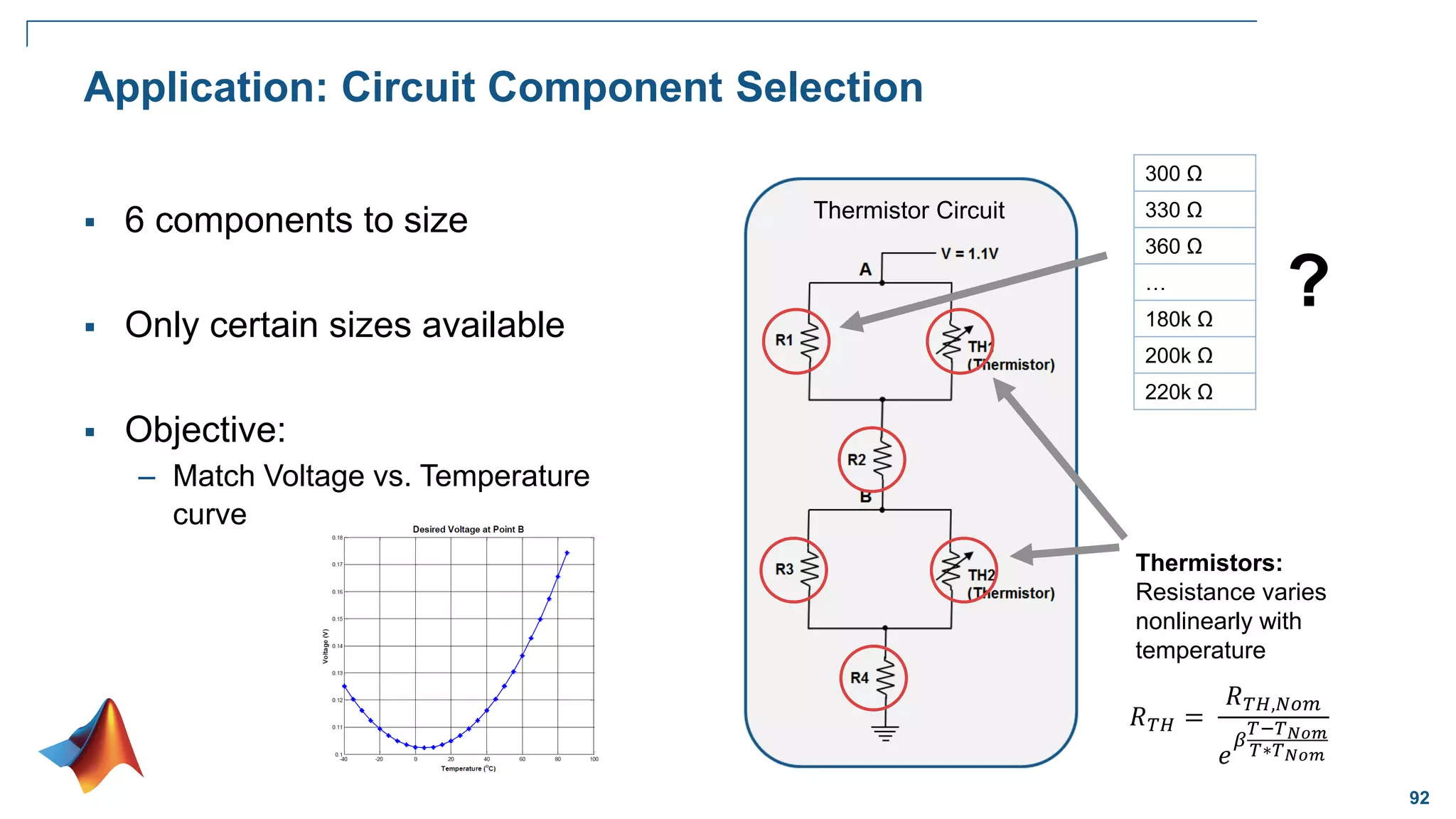
Application: Circuit Component Selection
 6 components to size
 Only certain sizes available
 Objective:
– Match Voltage vs. Temperature
curve
Thermistor Circuit
300 Ω
330 Ω
360 Ω
…
180k Ω
200k Ω
220k Ω
Thermistors:
Resistance varies
nonlinearly with
temperature
?
𝑅𝑇𝐻 =
𝑅𝑇𝐻,𝑁𝑜𝑚
𝑒
𝛽
𝑇−𝑇𝑁𝑜𝑚
𝑇∗𝑇𝑁𝑜𝑚
93
Global Optimization Toolbox Solvers
 GlobalSearch, MultiStart
– Well suited for smooth objective and constraints
– Return the location of local and global minima
 ga, gamultiobj, simulannealbnd, particleswarm
– Many function evaluations to sample the search space
– Work on both smooth and nonsmooth problems
 patternsearch
– Fewer function evaluations than ga, simulannealbnd, particlewarm
– Does not rely on gradient calculation like GlobalSearch and MultiStart
– Works on both smooth and nonsmooth problems
94
Optimization Toolbox Solvers
 fmincon, fminbnd, fminunc, fgoalattain, fminimax
– Nonlinear constraints and objectives
– Gradient-based methods for smooth objectives and constraints
 quadprog, linprog
– Linear constraints and quadratic or linear objective, respectively
 intlinprog
– Linear constraints and objective and integer variables
 lsqlin, lsqnonneg
– Constrained linear least squares
 lsqnonlin, lsqcurvefit
– Nonlinear least squares
 fsolve
– Nonlinear equations
95
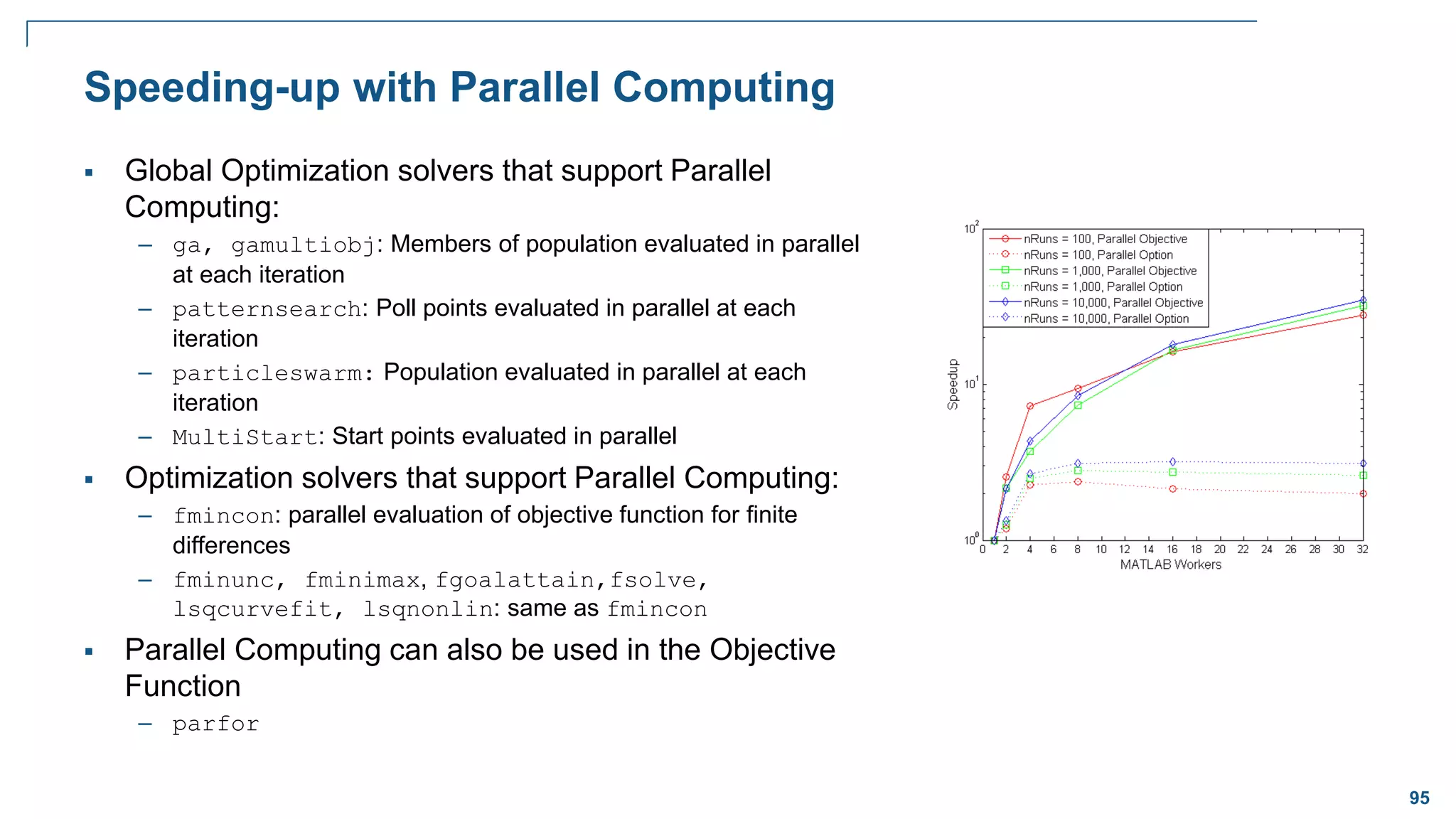
Speeding-up with Parallel Computing
 Global Optimization solvers that support Parallel
Computing:
– ga, gamultiobj: Members of population evaluated in parallel
at each iteration
– patternsearch: Poll points evaluated in parallel at each
iteration
– particleswarm: Population evaluated in parallel at each
iteration
– MultiStart: Start points evaluated in parallel
 Optimization solvers that support Parallel Computing:
– fmincon: parallel evaluation of objective function for finite
differences
– fminunc, fminimax, fgoalattain,fsolve,
lsqcurvefit, lsqnonlin: same as fmincon
 Parallel Computing can also be used in the Objective
Function
– parfor
96
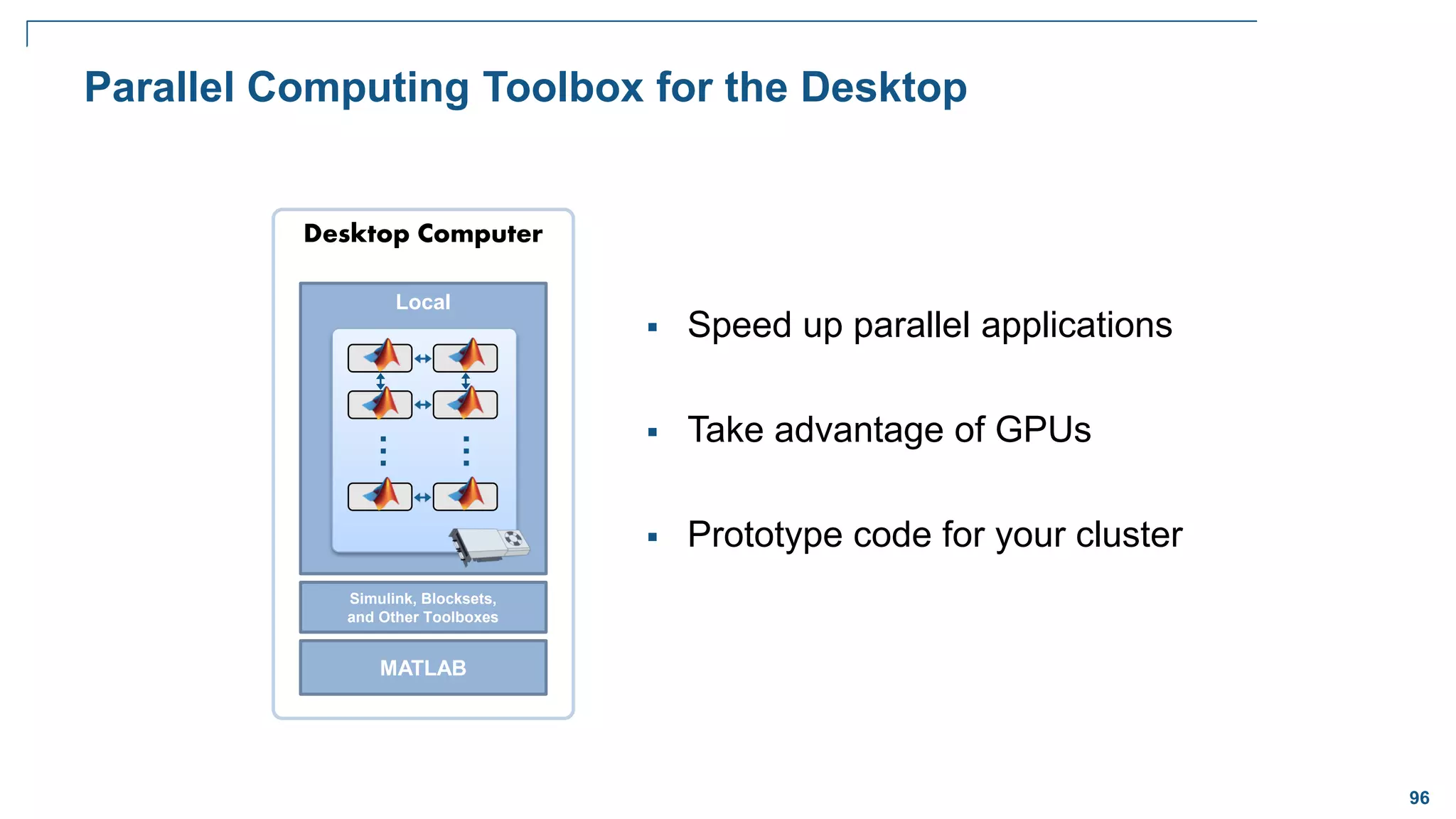
 Speed up parallel applications
 Take advantage of GPUs
 Prototype code for your cluster
Parallel Computing Toolbox for the Desktop
Simulink, Blocksets,
and Other Toolboxes
Local
Desktop Computer
MATLAB
…
…
97
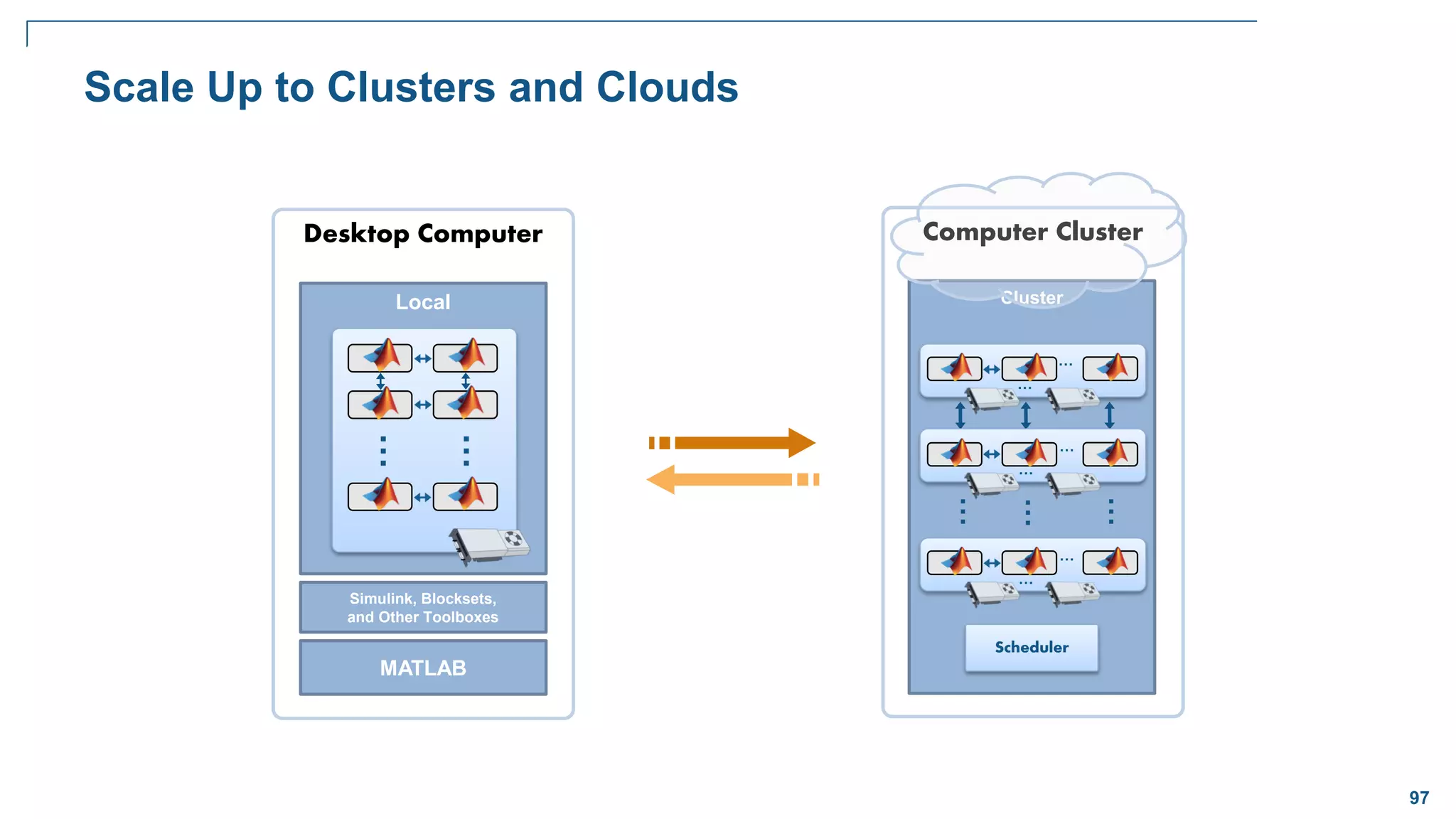
Scale Up to Clusters and Clouds
Cluster
Scheduler
Computer Cluster
…
…
…
…
…
…
…
…
…
Simulink, Blocksets,
and Other Toolboxes
Local
Desktop Computer
MATLAB
…
…
98
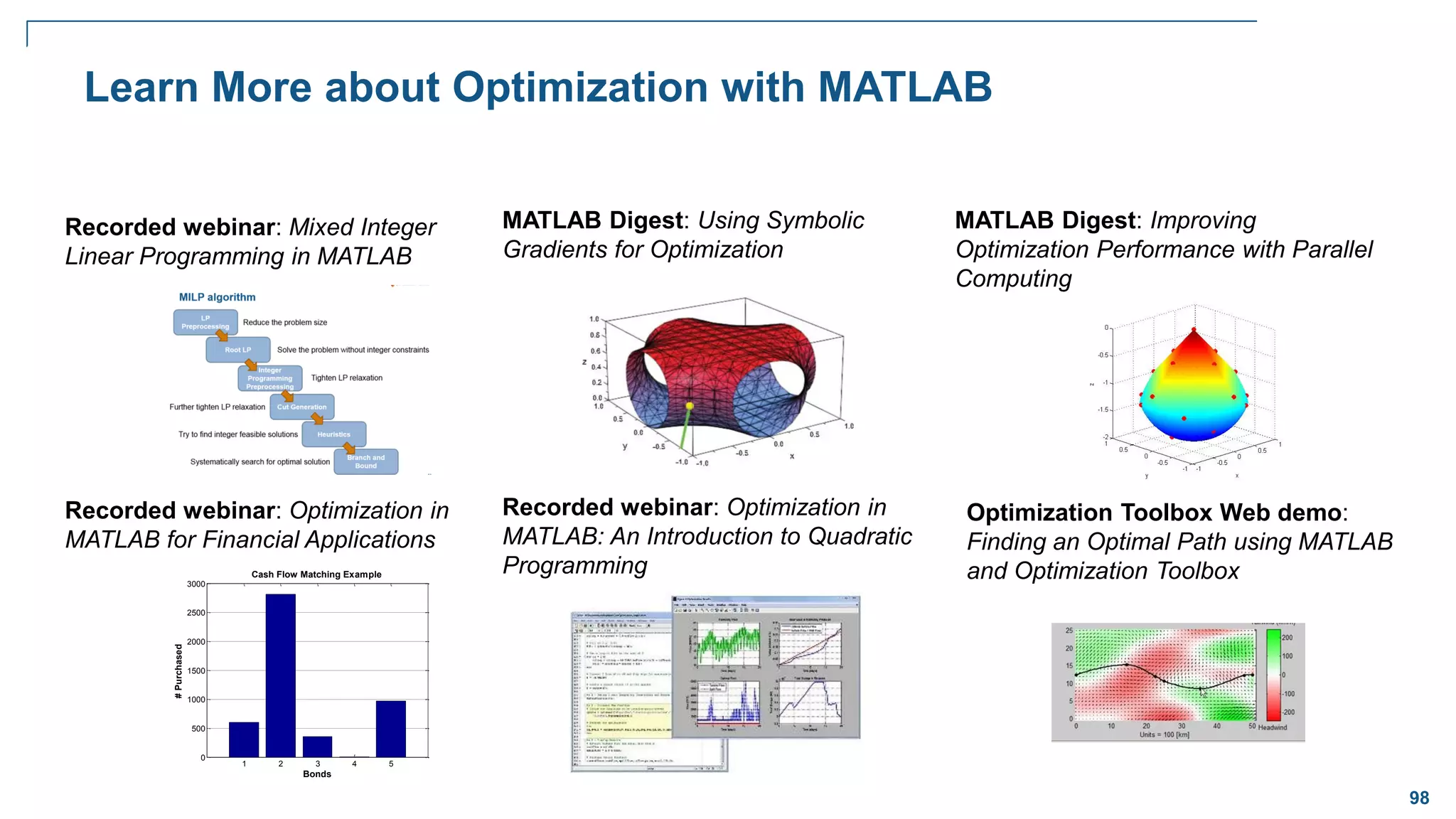
Learn More about Optimization with MATLAB
Recorded webinar: Optimization in
MATLAB: An Introduction to Quadratic
Programming
Optimization Toolbox Web demo:
Finding an Optimal Path using MATLAB
and Optimization Toolbox
MATLAB Digest: Improving
Optimization Performance with Parallel
Computing
MATLAB Digest: Using Symbolic
Gradients for Optimization
Recorded webinar: Mixed Integer
Linear Programming in MATLAB
Recorded webinar: Optimization in
MATLAB for Financial Applications
1 2 3 4 5
0
500
1000
1500
2000
2500
3000
Bonds
#
Purchased
Cash Flow Matching Example
99
Key Takeaways
 Solve a wide variety of optimization problems in MATLAB
– Linear and Nonlinear
– Continuous and mixed-integer
– Smooth and Nonsmooth
 Find better solutions to multiple minima and non-smooth problems using global
optimization
 Use symbolic math for setting up problems and automatically calculating gradients
 Using parallel computing to speed up optimization problems
Questions?

CI L11 Optimization 3 GlobalOptimization.pdf

  • 1.
  • 2.
    2  Introduction  Least-squaresminimization  Nonlinear optimization  Mixed-integer programming  Global optimization Topics
  • 3.
    3 Optimization Problems Minimize Risk MaximizeProfits Maximize Fuel Efficiency
  • 4.
  • 5.
    5 Manually (trial-and-error oriteratively) Why use Optimization? Initial Guess
  • 6.
    6 Automatically (using optimizationtechniques) Initial Guess Why use Optimization?
  • 7.
    7 Why use Optimization? Finding better (optimal) designs and decisions  Faster design and decision evaluations  Automate routine decisions  Useful for trade-off analysis  Non-intuitive designs may be found Antenna Design Using Genetic Algorithm http://ic.arc.nasa.gov/projects/esg/research/antenna.htm
  • 8.
    8  Introduction  Least-squaresminimization  Nonlinear optimization  Mixed-integer programming  Global optimization Topics
  • 9.
    9 Curve Fitting Demo Givensome data: Fit a curve of the form: t e c c t y    2 1 ) ( t = [0 .3 .8 1.1 1.6 2.3]; y = [.82 .72 .63 .60 .55 .50];
  • 10.
    10 How to solve?  Ec c c e y e c c t y t t             2 1 2 1 1 ) ( As a linear system of equations: 2 2 min y Ec Ec y c   Can’t solve this exactly (6 eqns, 2 unknowns) An optimization problem!                                                    2 1 3 . 2 6 . 1 1 . 1 8 . 0 3 . 0 0 1 1 1 1 1 1 50 . 0 55 . 0 60 . 0 63 . 0 72 . 0 82 . 0 c c e e e e e e
  • 11.
    11  Introduction  Least-squaresminimization  Nonlinear optimization  Mixed-integer programming  Global optimization Topics
  • 12.
    12 Nonlinear Optimization min 𝑥 log 1+ 𝑥1 − 4 3 2 + 3 𝑥1 + 𝑥2 − 𝑥1 3 2
  • 13.
    13 Nonlinear Optimization -Modeling Gantry Crane  Determine acceleration profile that minimizes payload swing s 25 s 4 s 20 s 1 s 20 s 1 : s Constraint 2 1 2 1             f p p p p f t t t t t t
  • 14.
    14 Symbolic Math Toolbox Functionsfor analytical computations  Conveniently manage & document symbolic computations in Live Editor • Math notation, embedded text, graphics • Share work as pdf or html  Perform exact computations using familiar MATLAB syntax in MATLAB Integration Differentiation Solving equations Transforms Simplification  Integrate with numeric computing – MATLAB, Simulink and Simscape language  Perform Variable-precision arithmetic
  • 15.
    15  Introduction  Least-squaresminimization  Nonlinear optimization  Mixed-integer programming  Global optimization Topics
  • 16.
    16 Mixed-Integer Programming  Manythings exist in discrete amounts: – Shares of stock – Number of cars a factory produces – Number of cows on a farm  Often have binary decisions: – On/off – Buy/don’t buy  Mixed-integer linear programming: – Solve optimization problem while enforcing that certain variables need to be integer
  • 17.
    17 Continuous and integervariables 𝑥1 ∈ 0, 100 𝑥2 ∈ {1,2,3,4,5} Linear objective and constraints min 𝑥 −𝑥1 − 2𝑥2 𝑥1 + 4𝑥2 ≤ 20 𝑥1 + 𝑥2 = 10 such that Mixed-Integer Linear Programming
  • 18.
    18 Traveling Salesman Problem Problem How to find the shortest path through a series of points? Solution  Calculate distances between all combinations of points  Solve an optimization problem where variables correspond to trips between two points 1 1 1 0 1 1 0 0 0 0
  • 19.
    19  Introduction  Least-squaresminimization  Nonlinear optimization  Mixed-integer programming  Global optimization Topics
  • 20.
    20 Example Global OptimizationProblems Why does fmincon have a hard time finding the function minimum? 0 5 10 -10 -5 0 5 10 x Starting at 10 0 5 10 -10 -5 0 5 10 x Starting at 8 0 5 10 -10 -5 0 5 10 x Starting at 6 x sin(x) + x cos(2 x) 0 5 10 -10 -5 0 5 10 x Starting at 3 0 5 10 -10 -5 0 5 10 x Starting at 1 0 5 10 -10 -5 0 5 10 x Starting at 0 x sin(x) + x cos(2 x)
  • 21.
    21 Initial Guess Example Global OptimizationProblems Why didn’t fminunc find the maximum efficiency?
  • 22.
    22 Example Global OptimizationProblems Why didn’t nonlinear regression find a good fit? 0 20 40 60 80 100 120 0 0.1 0.2 0.3 0.4 0.5 0.6 0.7 0.8 t c c=b1 e-b 4 t +b2 e-b 5 t +b3 e-b 6 t
  • 23.
    23 Global Optimization Goal: Want tofind the lowest/largest value of the nonlinear function that has many local minima/maxima Problem: Traditional solvers often return one of the local minima (not the global) Solution: A solver that locates globally optimal solutions Global Minimum at [0 0] Rastrigin’s Function
  • 24.
    24 Global Optimization SolversCovered Today  Multi Start  Global Search  Simulated Annealing  Pattern Search  Particle Swarm  Genetic Algorithm
  • 25.
    25 MultiStart Demo –Nonlinear Regression lsqcurvefit solution MultiStart solution
  • 26.
  • 27.
    27 What is MultiStart? Run a local solver from each set of start points  Option to filter starting points based on feasibility  Supports parallel computing
  • 28.
    28 MultiStart Demo –Peaks Function
  • 29.
  • 30.
    30 What is GlobalSearch? Multistart heuristic algorithm  Calls fmincon from multiple start points to try and find a global minimum  Filters/removes non-promising start points
  • 31.
    31 -3 -2 -10 1 2 3 -3 -2 -1 0 1 2 3 GlobalSearch Overview Schematic Problem Peaks function Three minima Green, z = -0.065 Red, z= -3.05 Blue, z = -6.55 x y
  • 32.
    32 -3 -2 -10 1 2 3 -3 -2 -1 0 1 2 3 GlobalSearch Overview – Stage 0 Run from specified x0 x y
  • 33.
    33 -3 -2 -10 1 2 3 -3 -2 -1 0 1 2 3 GlobalSearch Overview – Stage 1 3 6 0 0 0 4 0 -2 x y
  • 34.
    34 -3 -2 -10 1 2 3 -3 -2 -1 0 1 2 3 GlobalSearch Overview – Stage 1 3 6 0 0 0 4 0 -2 x y
  • 35.
    35 -3 -2 -10 1 2 3 -3 -2 -1 0 1 2 3 GlobalSearch Overview – Stage 1 x y
  • 36.
    36 -3 -2 -10 1 2 3 -3 -2 -1 0 1 2 3 GlobalSearch Overview – Stage 2 x y
  • 37.
    37 -3 -2 -10 1 2 3 -3 -2 -1 0 1 2 3 GlobalSearch Overview – Stage 2 x y
  • 38.
    38 -3 -2 -10 1 2 3 -3 -2 -1 0 1 2 3 GlobalSearch Overview – Stage 2 x y
  • 39.
    39 -3 -2 -10 1 2 3 -3 -2 -1 0 1 2 3 GlobalSearch Overview – Stage 2 x y
  • 40.
    40 -3 -2 -10 1 2 3 -3 -2 -1 0 1 2 3 GlobalSearch Overview – Stage 2 6 Current penalty threshold value : 4 x y
  • 41.
    41 -3 -2 -10 1 2 3 -3 -2 -1 0 1 2 3 GlobalSearch Overview – Stage 2 x y
  • 42.
    42 -3 -2 -10 1 2 3 -3 -2 -1 0 1 2 3 GlobalSearch Overview – Stage 2 Current penalty threshold value : 4 -3 x y
  • 43.
    43 -3 -2 -10 1 2 3 -3 -2 -1 0 1 2 3 GlobalSearch Overview – Stage 2 Expand basin of attraction if minimum already found Current penalty threshold value : 2 -0.1 x y Basins can overlap
  • 44.
  • 45.
  • 46.
    46 What is SimulatedAnnealing?  A probabilistic metaheuristic approach based upon the physical process of annealing in metallurgy.  Controlled cooling of a metal allows atoms to realign from a random higher energy state to an ordered crystalline (globally) lower energy state
  • 49.
    47 Simulated Annealing Overview– Iteration 1 Run from specified x0 x y -3 -2 -1 0 1 2 3 -3 -2 -1 0 1 2 3 0.9
  • 50.
    48 -3 -2 -10 1 2 3 -3 -2 -1 0 1 2 3 Simulated Annealing Overview – Iteration 1 3 x y 0.9 Possible New Points: Standard Normal N(0,1) * Temperature Temperature = 1
  • 51.
    49 -3 -2 -10 1 2 3 -3 -2 -1 0 1 2 3 Simulated Annealing Overview – Iteration 1 3 x y 0.9 Temperature = 1 11 . 0 1 1 / ) 9 . 0 3 (     T accept e P
  • 52.
    50 -3 -2 -10 1 2 3 -3 -2 -1 0 1 2 3 Simulated Annealing Overview – Iteration 1 3 x y 0.9 Temperature = 1 0.3
  • 53.
    51 -3 -2 -10 1 2 3 -3 -2 -1 0 1 2 3 Simulated Annealing Overview – Iteration 1 3 x y 0.9 Temperature = 1 0.3
  • 54.
    52 -3 -2 -10 1 2 3 -3 -2 -1 0 1 2 3 Simulated Annealing Overview – Iteration 2 3 x y 0.9 Temperature = 1 0.3
  • 55.
    53 -3 -2 -10 1 2 3 -3 -2 -1 0 1 2 3 Simulated Annealing Overview – Iteration 2 3 x y 0.9 Temperature = 0.75 0.3 -1.2
  • 56.
    54 -3 -2 -10 1 2 3 -3 -2 -1 0 1 2 3 Simulated Annealing Overview – Iteration N-1 3 x y 0.9 Temperature = 0.1 0.3 -1.2 -3
  • 57.
    55 -3 -2 -10 1 2 3 -3 -2 -1 0 1 2 3 Simulated Annealing Overview – Iteration N Reannealing 3 x y 0.9 Temperature = 1 0.3 -1.2 -3 -2
  • 58.
    56 -3 -2 -10 1 2 3 -3 -2 -1 0 1 2 3 Simulated Annealing Overview – Iteration N Reannealing 3 x y 0.9 Temperature = 1 0.3 -1.2 -3 -2 27 . 0 1 1 / )) 3 ( 2 (       T accept e P
  • 59.
    57 -3 -2 -10 1 2 3 -3 -2 -1 0 1 2 3 Simulated Annealing Overview – Iteration N Reannealing 3 x y 0.9 Temperature = 1 0.3 -1.2 -3 -2
  • 60.
    58 -3 -2 -10 1 2 3 -3 -2 -1 0 1 2 3 Simulated Annealing Overview – Iteration N+1 3 x y 0.9 Temperature = 0.75 0.3 -1.2 -3 -2 -3
  • 61.
    59 -3 -2 -10 1 2 3 -3 -2 -1 0 1 2 3 Simulated Annealing Overview – Iteration N+1 3 x y 0.9 Temperature = 0.75 0.3 -1.2 -3 -2 -3
  • 62.
    60 -3 -2 -10 1 2 3 -3 -2 -1 0 1 2 3 Simulated Annealing Overview – Iteration … 3 x y 0.9 Temperature = 0.75 0.3 -1.2 -3 -2 -3 -6.5
  • 63.
  • 64.
  • 65.
    63 What is PatternSearch?  An approach that uses a pattern of search directions around the existing points  Expands/contracts around the current point when a solution is not found  Does not rely on gradients: works on smooth and nonsmooth problems
  • 66.
    64 -3 -2 -10 1 2 3 -3 -2 -1 0 1 2 3 Pattern Search Overview – Iteration 1 Run from specified x0 x y 3
  • 67.
    65 -3 -2 -10 1 2 3 -3 -2 -1 0 1 2 3 Pattern Search Overview – Iteration 1 Apply pattern vector, poll new points for improvement x y 3 Mesh size = 1 Pattern vectors = [1,0], [0,1], [-1,0], [0,-1] 0 _ * _ x vector pattern size mesh Pnew   0 ] 0 , 1 [ * 1 x   1.6 0.4 4.6 2.8 First poll successful Complete Poll (not default)
  • 68.
    66 -3 -2 -10 1 2 3 -3 -2 -1 0 1 2 3 Pattern Search Overview – Iteration 2 x y 3 Mesh size = 2 Pattern vectors = [1,0], [0,1], [-1,0], [0,-1] 1.6 0.4 4.6 2.8 -4 0.3 -2.8 Complete Poll
  • 69.
    67 -3 -2 -10 1 2 3 -3 -2 -1 0 1 2 3 Pattern Search Overview – Iteration 3 x y 3 Mesh size = 4 Pattern vectors = [1,0], [0,1], [-1,0], [0,-1] 1.6 0.4 4.6 2.8 -4 0.3 -2.8
  • 70.
    68 -3 -2 -10 1 2 3 -3 -2 -1 0 1 2 3 Pattern Search Overview – Iteration 4 x y 3 Mesh size = 4*0.5 = 2 Pattern vectors = [1,0], [0,1], [-1,0], [0,-1] 1.6 0.4 4.6 2.8 -4 0.3 -2.8
  • 71.
    69 -3 -2 -10 1 2 3 -3 -2 -1 0 1 2 3 Pattern Search Overview – Iteration N Continue expansion/contraction until convergence… x y 3 1.6 0.4 4.6 2.8 -4 0.3 -2.8 -6.5
  • 72.
    70 Pattern Search –Peaks Function
  • 73.
    71 Pattern Search ClimbsMount Washington
  • 74.
  • 75.
    73 What is ParticleSwarm Optimization?  A collection of particles move throughout the region  Particles have velocity and are affected by the other particles in the swarm  Does not rely on gradients: works on smooth and nonsmooth problems
  • 76.
    74 -3 -2 -10 1 2 3 -3 -2 -1 0 1 2 3 Particle Swarm Overview – Iteration 1 Initialize particle locations and velocities, evaluate all locations x y
  • 77.
    75 -3 -2 -10 1 2 3 -3 -2 -1 0 1 2 3 Particle Swarm Overview – Iteration N Update velocities for each particle x y Previous Velocity Best Location for this Particle Best Location for Neighbor Particles
  • 78.
    76 -3 -2 -10 1 2 3 -3 -2 -1 0 1 2 3 Particle Swarm Overview – Iteration N Update velocities for each particle x y New Velocity
  • 79.
    77 -3 -2 -10 1 2 3 -3 -2 -1 0 1 2 3 Particle Swarm Overview – Iteration N Move particles based on new velocities x y
  • 80.
    78 -3 -2 -10 1 2 3 -3 -2 -1 0 1 2 3 Particle Swarm Overview – Iteration N Continue swarming until convergence x y
  • 81.
    79 Particle Swarm –Peaks Function
  • 82.
  • 83.
    81 What is aGenetic Algorithm?  Uses concepts from evolutionary biology  Start with an initial generation of candidate solutions that are tested against the objective function  Subsequent generations evolve from the 1st through selection, crossover and mutation
  • 84.
    82 How Evolution Works– Binary Case  Selection – Retain the best performing bit strings from one generation to the next. Favor these for reproduction – parent1 = [ 1 0 1 0 0 1 1 0 0 0 ] – parent2 = [ 1 0 0 1 0 0 1 0 1 0 ]  Crossover – parent1 = [ 1 0 1 0 0 1 1 0 0 0 ] – parent2 = [ 1 0 0 1 0 0 1 0 1 0 ] – child = [ 1 0 0 0 0 1 1 0 1 0 ]  Mutation – parent = [ 1 0 1 0 0 1 1 0 0 0 ] – child = [ 0 1 0 1 0 1 0 0 0 1 ]
  • 85.
    83 -3 -2 -10 1 2 3 -3 -2 -1 0 1 2 3 Genetic Algorithm – Iteration 1 Evaluate initial population x y
  • 86.
    84 -3 -2 -10 1 2 3 -3 -2 -1 0 1 2 3 Genetic Algorithm – Iteration 1 Select a few good solutions for reproduction x y
  • 87.
    85 -3 -2 -10 1 2 3 -3 -2 -1 0 1 2 3 Genetic Algorithm – Iteration 2 Generate new population and evaluate x y
  • 88.
    86 -3 -2 -10 1 2 3 -3 -2 -1 0 1 2 3 Genetic Algorithm – Iteration 2 x y
  • 89.
    87 -3 -2 -10 1 2 3 -3 -2 -1 0 1 2 3 Genetic Algorithm – Iteration 3 x y
  • 90.
    88 -3 -2 -10 1 2 3 -3 -2 -1 0 1 2 3 Genetic Algorithm – Iteration 3 x y
  • 91.
    89 -3 -2 -10 1 2 3 -3 -2 -1 0 1 2 3 Genetic Algorithm – Iteration N Continue process until stopping criteria are met x y Solution found
  • 92.
  • 93.
    91 Genetic Algorithm –Integer Constraints Mixed Integer Optimization s.t. some x are integers Examples  Only certain sizes of components available  Can only purchase whole shares of stock ) ( min x f x
  • 94.
    92 Application: Circuit ComponentSelection  6 components to size  Only certain sizes available  Objective: – Match Voltage vs. Temperature curve Thermistor Circuit 300 Ω 330 Ω 360 Ω … 180k Ω 200k Ω 220k Ω Thermistors: Resistance varies nonlinearly with temperature ? 𝑅𝑇𝐻 = 𝑅𝑇𝐻,𝑁𝑜𝑚 𝑒 𝛽 𝑇−𝑇𝑁𝑜𝑚 𝑇∗𝑇𝑁𝑜𝑚
  • 95.
    93 Global Optimization ToolboxSolvers  GlobalSearch, MultiStart – Well suited for smooth objective and constraints – Return the location of local and global minima  ga, gamultiobj, simulannealbnd, particleswarm – Many function evaluations to sample the search space – Work on both smooth and nonsmooth problems  patternsearch – Fewer function evaluations than ga, simulannealbnd, particlewarm – Does not rely on gradient calculation like GlobalSearch and MultiStart – Works on both smooth and nonsmooth problems
  • 96.
    94 Optimization Toolbox Solvers fmincon, fminbnd, fminunc, fgoalattain, fminimax – Nonlinear constraints and objectives – Gradient-based methods for smooth objectives and constraints  quadprog, linprog – Linear constraints and quadratic or linear objective, respectively  intlinprog – Linear constraints and objective and integer variables  lsqlin, lsqnonneg – Constrained linear least squares  lsqnonlin, lsqcurvefit – Nonlinear least squares  fsolve – Nonlinear equations
  • 97.
    95 Speeding-up with ParallelComputing  Global Optimization solvers that support Parallel Computing: – ga, gamultiobj: Members of population evaluated in parallel at each iteration – patternsearch: Poll points evaluated in parallel at each iteration – particleswarm: Population evaluated in parallel at each iteration – MultiStart: Start points evaluated in parallel  Optimization solvers that support Parallel Computing: – fmincon: parallel evaluation of objective function for finite differences – fminunc, fminimax, fgoalattain,fsolve, lsqcurvefit, lsqnonlin: same as fmincon  Parallel Computing can also be used in the Objective Function – parfor
  • 98.
    96  Speed upparallel applications  Take advantage of GPUs  Prototype code for your cluster Parallel Computing Toolbox for the Desktop Simulink, Blocksets, and Other Toolboxes Local Desktop Computer MATLAB … …
  • 99.
    97 Scale Up toClusters and Clouds Cluster Scheduler Computer Cluster … … … … … … … … … Simulink, Blocksets, and Other Toolboxes Local Desktop Computer MATLAB … …
  • 100.
    98 Learn More aboutOptimization with MATLAB Recorded webinar: Optimization in MATLAB: An Introduction to Quadratic Programming Optimization Toolbox Web demo: Finding an Optimal Path using MATLAB and Optimization Toolbox MATLAB Digest: Improving Optimization Performance with Parallel Computing MATLAB Digest: Using Symbolic Gradients for Optimization Recorded webinar: Mixed Integer Linear Programming in MATLAB Recorded webinar: Optimization in MATLAB for Financial Applications 1 2 3 4 5 0 500 1000 1500 2000 2500 3000 Bonds # Purchased Cash Flow Matching Example
  • 101.
    99 Key Takeaways  Solvea wide variety of optimization problems in MATLAB – Linear and Nonlinear – Continuous and mixed-integer – Smooth and Nonsmooth  Find better solutions to multiple minima and non-smooth problems using global optimization  Use symbolic math for setting up problems and automatically calculating gradients  Using parallel computing to speed up optimization problems
  • 102.