More Search Methods
• Local Search
– Hill Climbing
– Simulated Annealing
– Beam Search
– Genetic Search
• Local Search in Continuous Spaces
• Searching with Nondeterministic Actions
• Online Search (agent is executing actions)
2
3
Local Search Algorithms and
Optimization Problems
• Complete state formulation
– For example, for the 8 queens problem, all 8 queens
are on the board and need to be moved around to get
to a goal state
• Equivalent to optimization problems often found
in science and engineering
• Start somewhere and try to get to the solution
from there
• Local search around the current state to decide
where to go next
Pose Estimation Example
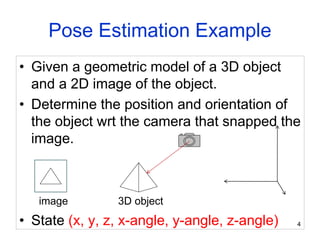
• Given a geometric model of a 3D object
and a 2D image of the object.
• Determine the position and orientation of
the object wrt the camera that snapped the
image.
image 3D object
• State (x, y, z, x-angle, y-angle, z-angle) 4
5
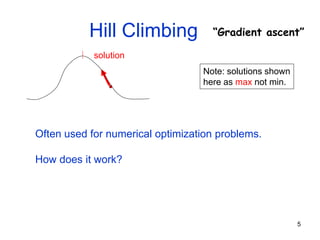
Hill Climbing “Gradient ascent”
solution
Note: solutions shown
here as max not min.
Often used for numerical optimization problems.
How does it work?
6
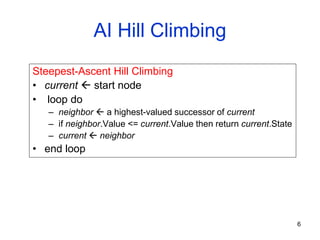
AI Hill Climbing
Steepest-Ascent Hill Climbing
• current  start node
• loop do
– neighbor  a highest-valued successor of current
– if neighbor.Value <= current.Value then return current.State
– current  neighbor
• end loop
7
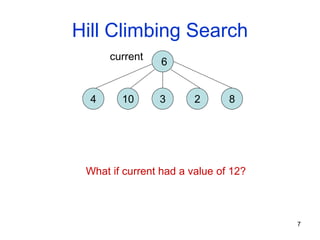
Hill Climbing Search
6
4 10 3 2 8
current
What if current had a value of 12?
8
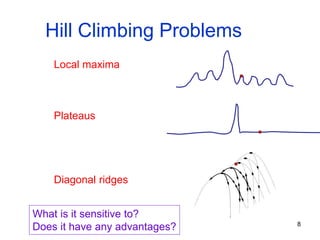
Hill Climbing Problems
Local maxima
Plateaus
Diagonal ridges
What is it sensitive to?
Does it have any advantages?
9
Solving the Problems
• Allow backtracking (What happens to complexity?)
• Stochastic hill climbing: choose at random from uphill
moves, using steepness for a probability
• Random restarts: “If at first you don’t succeed, try, try
again.”
• Several moves in each of several directions, then test
• Jump to a different part of the search space
10
Simulated Annealing
• Variant of hill climbing (so up is good)
• Tries to explore enough of the search
space early on, so that the final solution is
less sensitive to the start state
• May make some downhill moves before
finding a good way to move uphill.
11
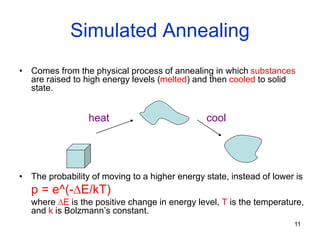
Simulated Annealing
• Comes from the physical process of annealing in which substances
are raised to high energy levels (melted) and then cooled to solid
state.
• The probability of moving to a higher energy state, instead of lower is
p = e^(-E/kT)
where E is the positive change in energy level, T is the temperature,
and k is Bolzmann’s constant.
heat cool
12
Simulated Annealing
• At the beginning, the temperature is high.
• As the temperature becomes lower
– kT becomes lower
– E/kT gets bigger
– (-E/kT) gets smaller
– e^(-E/kT) gets smaller
• As the process continues, the probability
of a downhill move gets smaller and
smaller.
13
For Simulated Annealing
• E represents the change in the value of
the objective function.
• Since the physical relationships no longer
apply, drop k. So p = e^(-E/T)
• We need an annealing schedule, which is
a sequence of values of T: T0, T1, T2, ...
14
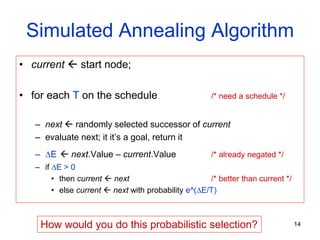
Simulated Annealing Algorithm
• current  start node;
• for each T on the schedule /* need a schedule */
– next  randomly selected successor of current
– evaluate next; it it’s a goal, return it
– E  next.Value – current.Value /* already negated */
– if E > 0
• then current  next /* better than current */
• else current  next with probability e^(E/T)
How would you do this probabilistic selection?
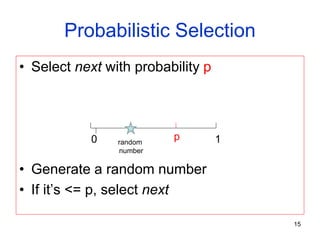
Probabilistic Selection
• Select next with probability p
• Generate a random number
• If it’s <= p, select next
15
0 1
p
random
number
16
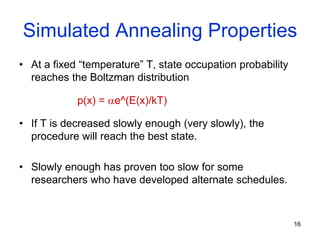
Simulated Annealing Properties
• At a fixed “temperature” T, state occupation probability
reaches the Boltzman distribution
• If T is decreased slowly enough (very slowly), the
procedure will reach the best state.
• Slowly enough has proven too slow for some
researchers who have developed alternate schedules.
p(x) = e^(E(x)/kT)
17
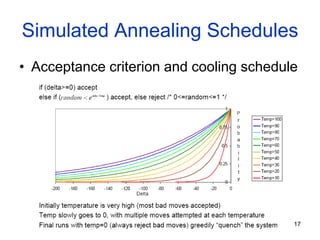
Simulated Annealing Schedules
• Acceptance criterion and cooling schedule
18
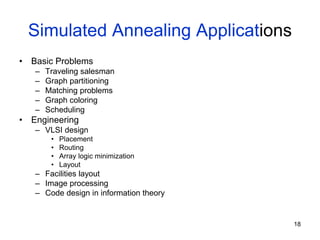
Simulated Annealing Applications
• Basic Problems
– Traveling salesman
– Graph partitioning
– Matching problems
– Graph coloring
– Scheduling
• Engineering
– VLSI design
• Placement
• Routing
• Array logic minimization
• Layout
– Facilities layout
– Image processing
– Code design in information theory
19
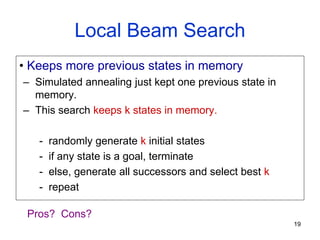
Local Beam Search
• Keeps more previous states in memory
– Simulated annealing just kept one previous state in
memory.
– This search keeps k states in memory.
- randomly generate k initial states
- if any state is a goal, terminate
- else, generate all successors and select best k
- repeat
Pros? Cons?
20
174611094281
174629844710
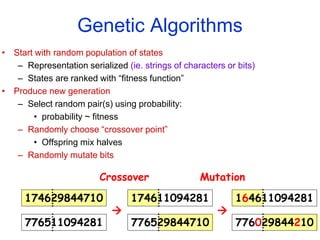
Genetic Algorithms
• Start with random population of states
– Representation serialized (ie. strings of characters or bits)
– States are ranked with “fitness function”
• Produce new generation
– Select random pair(s) using probability:
• probability ~ fitness
– Randomly choose “crossover point”
• Offspring mix halves
– Randomly mutate bits
776511094281 776529844710
164611094281
776029844210
Crossover Mutation
 
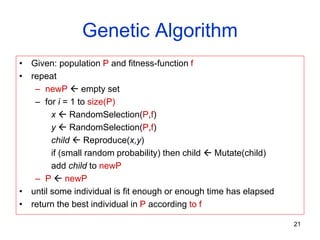
Genetic Algorithm
• Given: population P and fitness-function f
• repeat
– newP  empty set
– for i = 1 to size(P)
x  RandomSelection(P,f)
y  RandomSelection(P,f)
child  Reproduce(x,y)
if (small random probability) then child  Mutate(child)
add child to newP
– P  newP
• until some individual is fit enough or enough time has elapsed
• return the best individual in P according to f
21
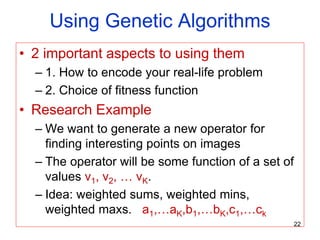
Using Genetic Algorithms
• 2 important aspects to using them
– 1. How to encode your real-life problem
– 2. Choice of fitness function
• Research Example
– We want to generate a new operator for
finding interesting points on images
– The operator will be some function of a set of
values v1, v2, … vK.
– Idea: weighted sums, weighted mins,
weighted maxs. a1,…aK,b1,…bK,c1,…ck
22
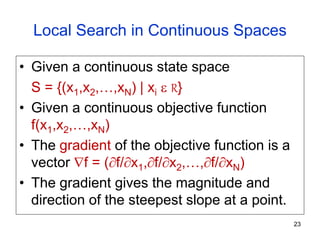
Local Search in Continuous Spaces
• Given a continuous state space
S = {(x1,x2,…,xN) | xi  R}
• Given a continuous objective function
f(x1,x2,…,xN)
• The gradient of the objective function is a
vector f = (f/x1,f/x2,…,f/xN)
• The gradient gives the magnitude and
direction of the steepest slope at a point.
23
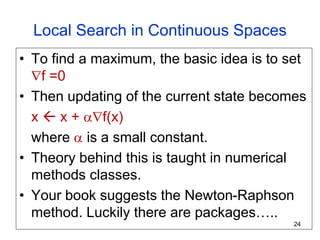
Local Search in Continuous Spaces
• To find a maximum, the basic idea is to set
f =0
• Then updating of the current state becomes
x  x + f(x)
where  is a small constant.
• Theory behind this is taught in numerical
methods classes.
• Your book suggests the Newton-Raphson
method. Luckily there are packages…..
24
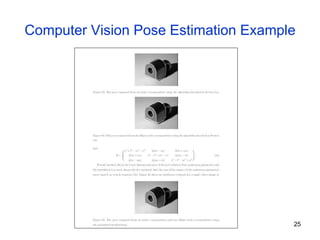
Computer Vision Pose Estimation Example
25
Computer Vision Pose Estimation Example
26
Read the “Airports in Romania” example in the text.
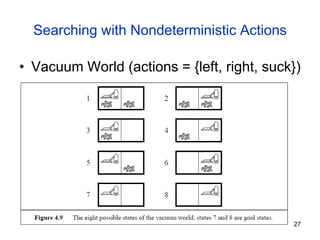
Searching with Nondeterministic Actions
• Vacuum World (actions = {left, right, suck})
27
Searching with Nondeterministic Actions
In the nondeterministic case, the result of an
action can vary.
Erratic Vacuum World:
• When sucking a dirty square, it cleans it and
sometimes cleans up dirt in an adjacent square.
• When sucking a clean square, it sometimes
deposits dirt on the carpet.
28
Generalization of State-Space
Model
1. Generalize the transition function to
return a set of possible outcomes.
oldf: S x A -> S newf: S x A -> 2S
2. Generalize the solution to a contingency
plan.
if state=s then action-set-1 else action-set-2
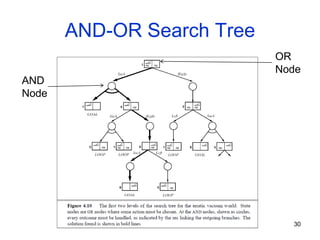
3. Generalize the search tree to an AND-OR
tree.
29
AND-OR Search Tree
30
AND
Node
OR
Node
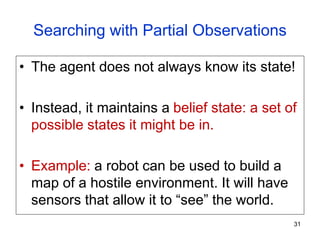
Searching with Partial Observations
• The agent does not always know its state!
• Instead, it maintains a belief state: a set of
possible states it might be in.
• Example: a robot can be used to build a
map of a hostile environment. It will have
sensors that allow it to “see” the world.
31
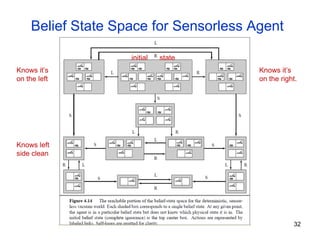
Belief State Space for Sensorless Agent
32
initial state
Knows it’s
on the right.
Knows it’s
on the left
Knows left
side clean
Online Search Problems
• Active agent
– executes actions
– acquires percepts from sensors
– deterministic and fully observable
– has to perform an action to know the
outcome
• Examples
– Web search
– Autonomous vehicle
33

BeyondClassicalSearch.ppt

  • 1.
    More Search Methods •Local Search – Hill Climbing – Simulated Annealing – Beam Search – Genetic Search • Local Search in Continuous Spaces • Searching with Nondeterministic Actions • Online Search (agent is executing actions) 2
  • 2.
    3 Local Search Algorithmsand Optimization Problems • Complete state formulation – For example, for the 8 queens problem, all 8 queens are on the board and need to be moved around to get to a goal state • Equivalent to optimization problems often found in science and engineering • Start somewhere and try to get to the solution from there • Local search around the current state to decide where to go next
  • 3.
    Pose Estimation Example •Given a geometric model of a 3D object and a 2D image of the object. • Determine the position and orientation of the object wrt the camera that snapped the image. image 3D object • State (x, y, z, x-angle, y-angle, z-angle) 4
  • 4.
    5 Hill Climbing “Gradientascent” solution Note: solutions shown here as max not min. Often used for numerical optimization problems. How does it work?
  • 5.
    6 AI Hill Climbing Steepest-AscentHill Climbing • current  start node • loop do – neighbor  a highest-valued successor of current – if neighbor.Value <= current.Value then return current.State – current  neighbor • end loop
  • 6.
    7 Hill Climbing Search 6 410 3 2 8 current What if current had a value of 12?
  • 7.
    8 Hill Climbing Problems Localmaxima Plateaus Diagonal ridges What is it sensitive to? Does it have any advantages?
  • 8.
    9 Solving the Problems •Allow backtracking (What happens to complexity?) • Stochastic hill climbing: choose at random from uphill moves, using steepness for a probability • Random restarts: “If at first you don’t succeed, try, try again.” • Several moves in each of several directions, then test • Jump to a different part of the search space
  • 9.
    10 Simulated Annealing • Variantof hill climbing (so up is good) • Tries to explore enough of the search space early on, so that the final solution is less sensitive to the start state • May make some downhill moves before finding a good way to move uphill.
  • 10.
    11 Simulated Annealing • Comesfrom the physical process of annealing in which substances are raised to high energy levels (melted) and then cooled to solid state. • The probability of moving to a higher energy state, instead of lower is p = e^(-E/kT) where E is the positive change in energy level, T is the temperature, and k is Bolzmann’s constant. heat cool
  • 11.
    12 Simulated Annealing • Atthe beginning, the temperature is high. • As the temperature becomes lower – kT becomes lower – E/kT gets bigger – (-E/kT) gets smaller – e^(-E/kT) gets smaller • As the process continues, the probability of a downhill move gets smaller and smaller.
  • 12.
    13 For Simulated Annealing •E represents the change in the value of the objective function. • Since the physical relationships no longer apply, drop k. So p = e^(-E/T) • We need an annealing schedule, which is a sequence of values of T: T0, T1, T2, ...
  • 13.
    14 Simulated Annealing Algorithm •current  start node; • for each T on the schedule /* need a schedule */ – next  randomly selected successor of current – evaluate next; it it’s a goal, return it – E  next.Value – current.Value /* already negated */ – if E > 0 • then current  next /* better than current */ • else current  next with probability e^(E/T) How would you do this probabilistic selection?
  • 14.
    Probabilistic Selection • Selectnext with probability p • Generate a random number • If it’s <= p, select next 15 0 1 p random number
  • 15.
    16 Simulated Annealing Properties •At a fixed “temperature” T, state occupation probability reaches the Boltzman distribution • If T is decreased slowly enough (very slowly), the procedure will reach the best state. • Slowly enough has proven too slow for some researchers who have developed alternate schedules. p(x) = e^(E(x)/kT)
  • 16.
    17 Simulated Annealing Schedules •Acceptance criterion and cooling schedule
  • 17.
    18 Simulated Annealing Applications •Basic Problems – Traveling salesman – Graph partitioning – Matching problems – Graph coloring – Scheduling • Engineering – VLSI design • Placement • Routing • Array logic minimization • Layout – Facilities layout – Image processing – Code design in information theory
  • 18.
    19 Local Beam Search •Keeps more previous states in memory – Simulated annealing just kept one previous state in memory. – This search keeps k states in memory. - randomly generate k initial states - if any state is a goal, terminate - else, generate all successors and select best k - repeat Pros? Cons?
  • 19.
    20 174611094281 174629844710 Genetic Algorithms • Startwith random population of states – Representation serialized (ie. strings of characters or bits) – States are ranked with “fitness function” • Produce new generation – Select random pair(s) using probability: • probability ~ fitness – Randomly choose “crossover point” • Offspring mix halves – Randomly mutate bits 776511094281 776529844710 164611094281 776029844210 Crossover Mutation  
  • 20.
    Genetic Algorithm • Given:population P and fitness-function f • repeat – newP  empty set – for i = 1 to size(P) x  RandomSelection(P,f) y  RandomSelection(P,f) child  Reproduce(x,y) if (small random probability) then child  Mutate(child) add child to newP – P  newP • until some individual is fit enough or enough time has elapsed • return the best individual in P according to f 21
  • 21.
    Using Genetic Algorithms •2 important aspects to using them – 1. How to encode your real-life problem – 2. Choice of fitness function • Research Example – We want to generate a new operator for finding interesting points on images – The operator will be some function of a set of values v1, v2, … vK. – Idea: weighted sums, weighted mins, weighted maxs. a1,…aK,b1,…bK,c1,…ck 22
  • 22.
    Local Search inContinuous Spaces • Given a continuous state space S = {(x1,x2,…,xN) | xi  R} • Given a continuous objective function f(x1,x2,…,xN) • The gradient of the objective function is a vector f = (f/x1,f/x2,…,f/xN) • The gradient gives the magnitude and direction of the steepest slope at a point. 23
  • 23.
    Local Search inContinuous Spaces • To find a maximum, the basic idea is to set f =0 • Then updating of the current state becomes x  x + f(x) where  is a small constant. • Theory behind this is taught in numerical methods classes. • Your book suggests the Newton-Raphson method. Luckily there are packages….. 24
  • 24.
    Computer Vision PoseEstimation Example 25
  • 25.
    Computer Vision PoseEstimation Example 26 Read the “Airports in Romania” example in the text.
  • 26.
    Searching with NondeterministicActions • Vacuum World (actions = {left, right, suck}) 27
  • 27.
    Searching with NondeterministicActions In the nondeterministic case, the result of an action can vary. Erratic Vacuum World: • When sucking a dirty square, it cleans it and sometimes cleans up dirt in an adjacent square. • When sucking a clean square, it sometimes deposits dirt on the carpet. 28
  • 28.
    Generalization of State-Space Model 1.Generalize the transition function to return a set of possible outcomes. oldf: S x A -> S newf: S x A -> 2S 2. Generalize the solution to a contingency plan. if state=s then action-set-1 else action-set-2 3. Generalize the search tree to an AND-OR tree. 29
  • 29.
  • 30.
    Searching with PartialObservations • The agent does not always know its state! • Instead, it maintains a belief state: a set of possible states it might be in. • Example: a robot can be used to build a map of a hostile environment. It will have sensors that allow it to “see” the world. 31
  • 31.
    Belief State Spacefor Sensorless Agent 32 initial state Knows it’s on the right. Knows it’s on the left Knows left side clean
  • 32.
    Online Search Problems •Active agent – executes actions – acquires percepts from sensors – deterministic and fully observable – has to perform an action to know the outcome • Examples – Web search – Autonomous vehicle 33