EDUCATION
RECONSTRUCTED
Rabindranath Tagore
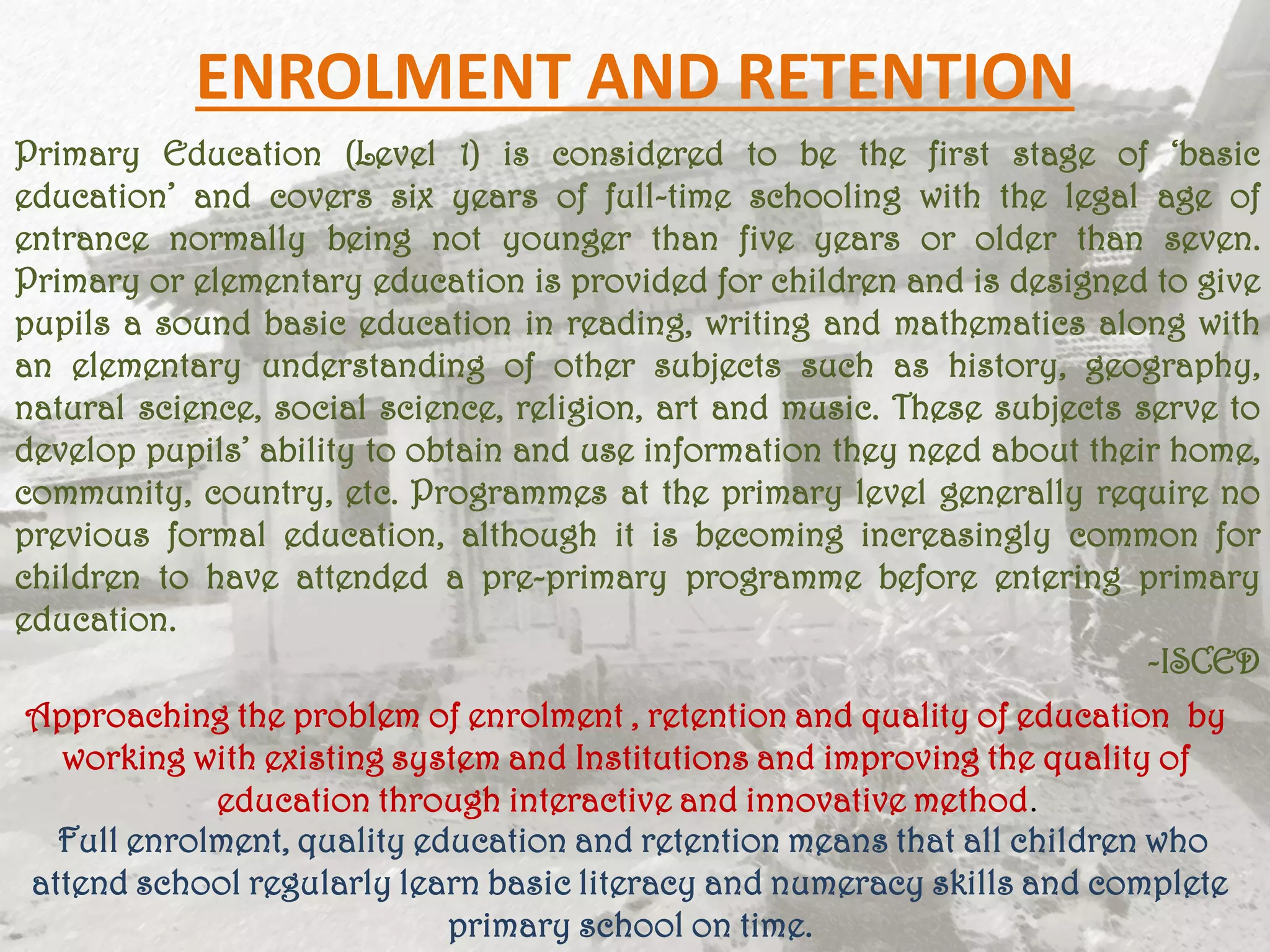
ENROLMENT AND RETENTION
Approaching the problem of enrolment , retention and quality of education by
working with existing system and Institutions and improving the quality of
education through interactive and innovative method.
Full enrolment, quality education and retention means that all children who
attend school regularly learn basic literacy and numeracy skills and complete
primary school on time.
Primary Education (Level 1) is considered to be the first stage of ‘basic
education’ and covers six years of full-time schooling with the legal age of
entrance normally being not younger than five years or older than seven.
Primary or elementary education is provided for children and is designed to give
pupils a sound basic education in reading, writing and mathematics along with
an elementary understanding of other subjects such as history, geography,
natural science, social science, religion, art and music. These subjects serve to
develop pupils’ ability to obtain and use information they need about their home,
community, country, etc. Programmes at the primary level generally require no
previous formal education, although it is becoming increasingly common for
children to have attended a pre-primary programme before entering primary
education.
-ISCED
CAUSES
• Faulty administration of
education
• Ineffective Pedagogy
• Political difficulties
• Inadequate Infrastructure
• Unsuitable curriculum
• Social Evils
• Language problem
In our understanding, the true value of anything can be beneficially utilised
only if that thing is in the hands of an equally potent facilitator. In this case,
pedagogy or the method of teaching is the method tool and teachers are the
vital most facilitators to apply the tool to impart education. This doesn't
however mean that a child's parents, kith and kin play no role in his/her
education, but yes, when it comes to the primary authority with whom lies the
on us, it is the teacher.
Problem that bothers us :
Ineffective Pedagogy and
the role of teachers
To facilitate lesson planning
sharing of Innovative teaching
method among teachers and to
further test the effectiveness of
the se innovative method.
INNOVATIVE SOLUTION CONCEPT
HOW WE SEE EDUCATION
MERITS OF THE PROPOSED SOLUTION.
• New and innovative teaching solution such
as Audio- Visual methods , games role-
plays etc.
• Transaction between teacher and student
would be better.
• Better classroom environment to ensure
better understanding among students and
hence decrease in drop-out rates.
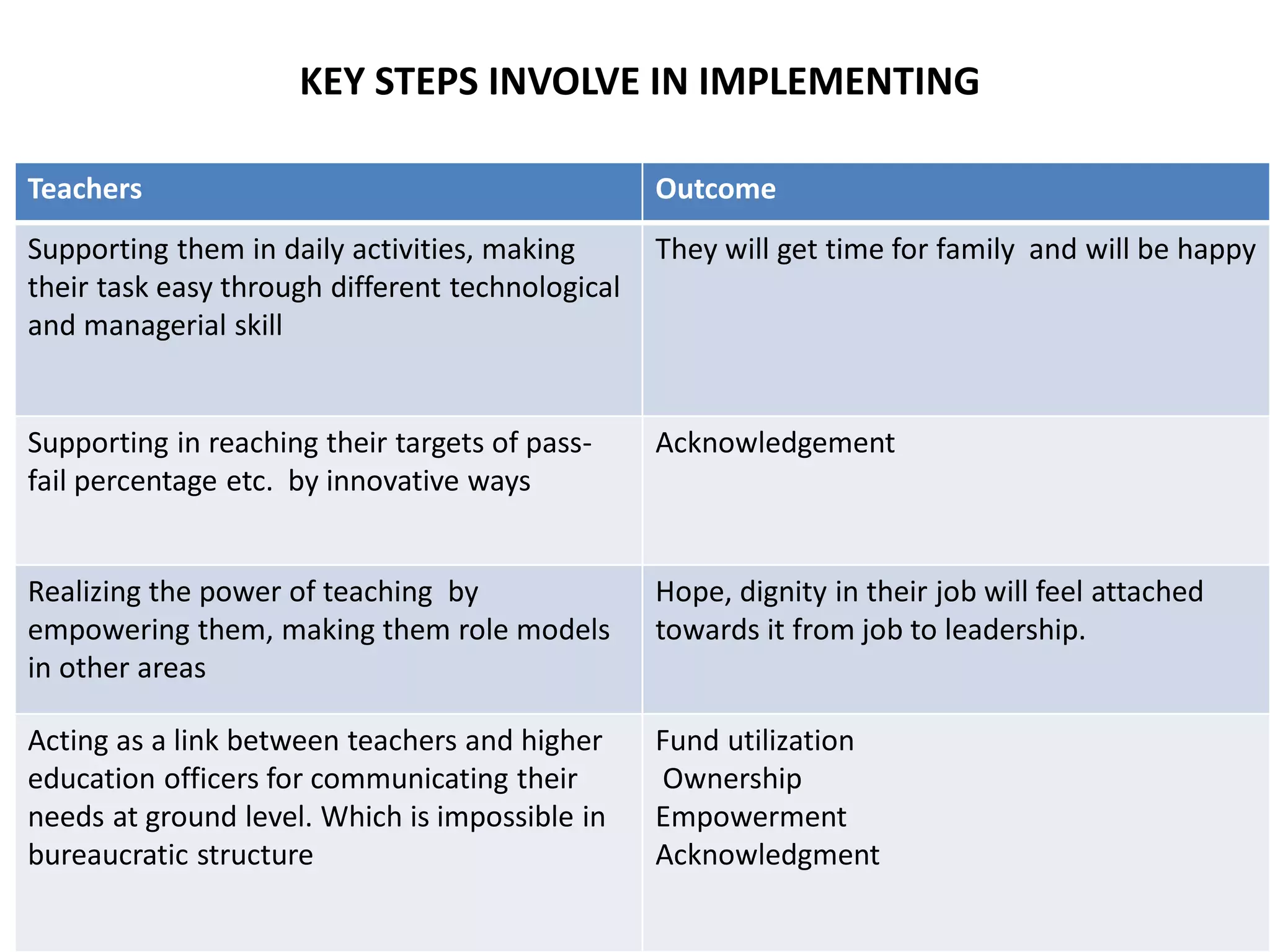
Teachers Outcome
Supporting them in daily activities, making
their task easy through different technological
and managerial skill
They will get time for family and will be happy
Supporting in reaching their targets of pass-
fail percentage etc. by innovative ways
Acknowledgement
Realizing the power of teaching by
empowering them, making them role models
in other areas
Hope, dignity in their job will feel attached
towards it from job to leadership.
Acting as a link between teachers and higher
education officers for communicating their
needs at ground level. Which is impossible in
bureaucratic structure
Fund utilization
Ownership
Empowerment
Acknowledgment
KEY STEPS INVOLVE IN IMPLEMENTING
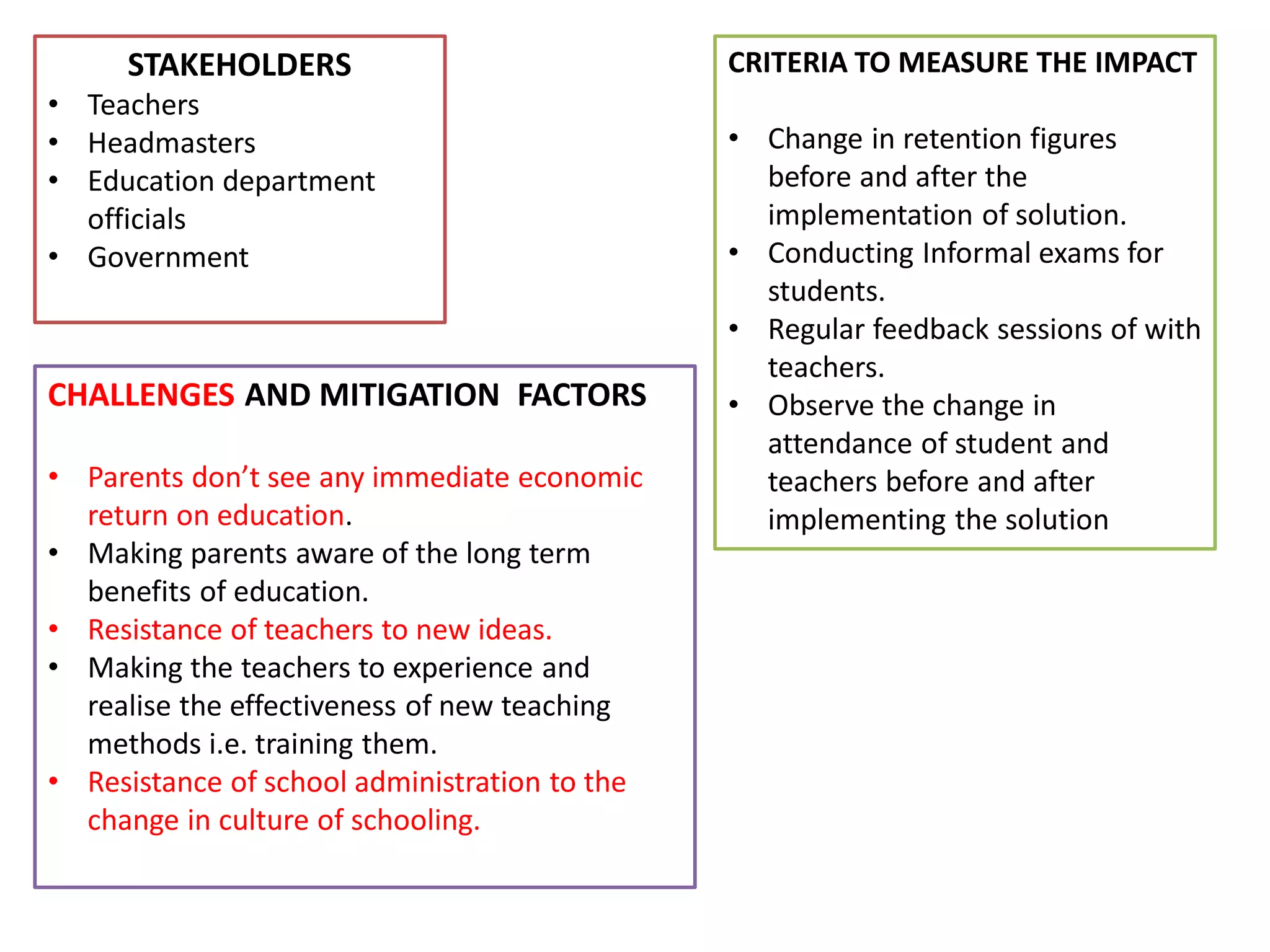
STAKEHOLDERS
• Teachers
• Headmasters
• Education department
officials
• Government
CRITERIA TO MEASURE THE IMPACT
• Change in retention figures
before and after the
implementation of solution.
• Conducting Informal exams for
students.
• Regular feedback sessions of with
teachers.
• Observe the change in
attendance of student and
teachers before and after
implementing the solution
CHALLENGES AND MITIGATION FACTORS
• Parents don’t see any immediate economic
return on education.
• Making parents aware of the long term
benefits of education.
• Resistance of teachers to new ideas.
• Making the teachers to experience and
realise the effectiveness of new teaching
methods i.e. training them.
• Resistance of school administration to the
change in culture of schooling.
OUT OF THE BOX IDEAS
• Public –Private partnership for mid-day meal to ensure the regular and
better quality of food.
• Bringing mid-day schemes under the umbrella MGNREGA to avoid the
over work load from teachers.
• Tax assumption for parents whose children are studying in government
schools.
• Appointing teachers within or around their native place.
• Lowering the bar of qualification for teachers from graduation to high
school for schools located in remote areas.
• Using the same models was used in 1969 during nationalisation of banks .
Making big players in education sectors like G.D. Goenka , DPS to open
two schools in rural area for every school opened in urban part and
making them to look after its operation. Running the school should be the
soul responsibility of that education sector giant only

CHRYSALIS

  • 1.
  • 2.
    ENROLMENT AND RETENTION Approachingthe problem of enrolment , retention and quality of education by working with existing system and Institutions and improving the quality of education through interactive and innovative method. Full enrolment, quality education and retention means that all children who attend school regularly learn basic literacy and numeracy skills and complete primary school on time. Primary Education (Level 1) is considered to be the first stage of ‘basic education’ and covers six years of full-time schooling with the legal age of entrance normally being not younger than five years or older than seven. Primary or elementary education is provided for children and is designed to give pupils a sound basic education in reading, writing and mathematics along with an elementary understanding of other subjects such as history, geography, natural science, social science, religion, art and music. These subjects serve to develop pupils’ ability to obtain and use information they need about their home, community, country, etc. Programmes at the primary level generally require no previous formal education, although it is becoming increasingly common for children to have attended a pre-primary programme before entering primary education. -ISCED
  • 3.
    CAUSES • Faulty administrationof education • Ineffective Pedagogy • Political difficulties • Inadequate Infrastructure • Unsuitable curriculum • Social Evils • Language problem In our understanding, the true value of anything can be beneficially utilised only if that thing is in the hands of an equally potent facilitator. In this case, pedagogy or the method of teaching is the method tool and teachers are the vital most facilitators to apply the tool to impart education. This doesn't however mean that a child's parents, kith and kin play no role in his/her education, but yes, when it comes to the primary authority with whom lies the on us, it is the teacher. Problem that bothers us : Ineffective Pedagogy and the role of teachers
  • 4.
    To facilitate lessonplanning sharing of Innovative teaching method among teachers and to further test the effectiveness of the se innovative method. INNOVATIVE SOLUTION CONCEPT HOW WE SEE EDUCATION MERITS OF THE PROPOSED SOLUTION. • New and innovative teaching solution such as Audio- Visual methods , games role- plays etc. • Transaction between teacher and student would be better. • Better classroom environment to ensure better understanding among students and hence decrease in drop-out rates.
  • 5.
    Teachers Outcome Supporting themin daily activities, making their task easy through different technological and managerial skill They will get time for family and will be happy Supporting in reaching their targets of pass- fail percentage etc. by innovative ways Acknowledgement Realizing the power of teaching by empowering them, making them role models in other areas Hope, dignity in their job will feel attached towards it from job to leadership. Acting as a link between teachers and higher education officers for communicating their needs at ground level. Which is impossible in bureaucratic structure Fund utilization Ownership Empowerment Acknowledgment KEY STEPS INVOLVE IN IMPLEMENTING
  • 6.
    STAKEHOLDERS • Teachers • Headmasters •Education department officials • Government CRITERIA TO MEASURE THE IMPACT • Change in retention figures before and after the implementation of solution. • Conducting Informal exams for students. • Regular feedback sessions of with teachers. • Observe the change in attendance of student and teachers before and after implementing the solution CHALLENGES AND MITIGATION FACTORS • Parents don’t see any immediate economic return on education. • Making parents aware of the long term benefits of education. • Resistance of teachers to new ideas. • Making the teachers to experience and realise the effectiveness of new teaching methods i.e. training them. • Resistance of school administration to the change in culture of schooling.
  • 7.
    OUT OF THEBOX IDEAS • Public –Private partnership for mid-day meal to ensure the regular and better quality of food. • Bringing mid-day schemes under the umbrella MGNREGA to avoid the over work load from teachers. • Tax assumption for parents whose children are studying in government schools. • Appointing teachers within or around their native place. • Lowering the bar of qualification for teachers from graduation to high school for schools located in remote areas. • Using the same models was used in 1969 during nationalisation of banks . Making big players in education sectors like G.D. Goenka , DPS to open two schools in rural area for every school opened in urban part and making them to look after its operation. Running the school should be the soul responsibility of that education sector giant only