Stepping Stone
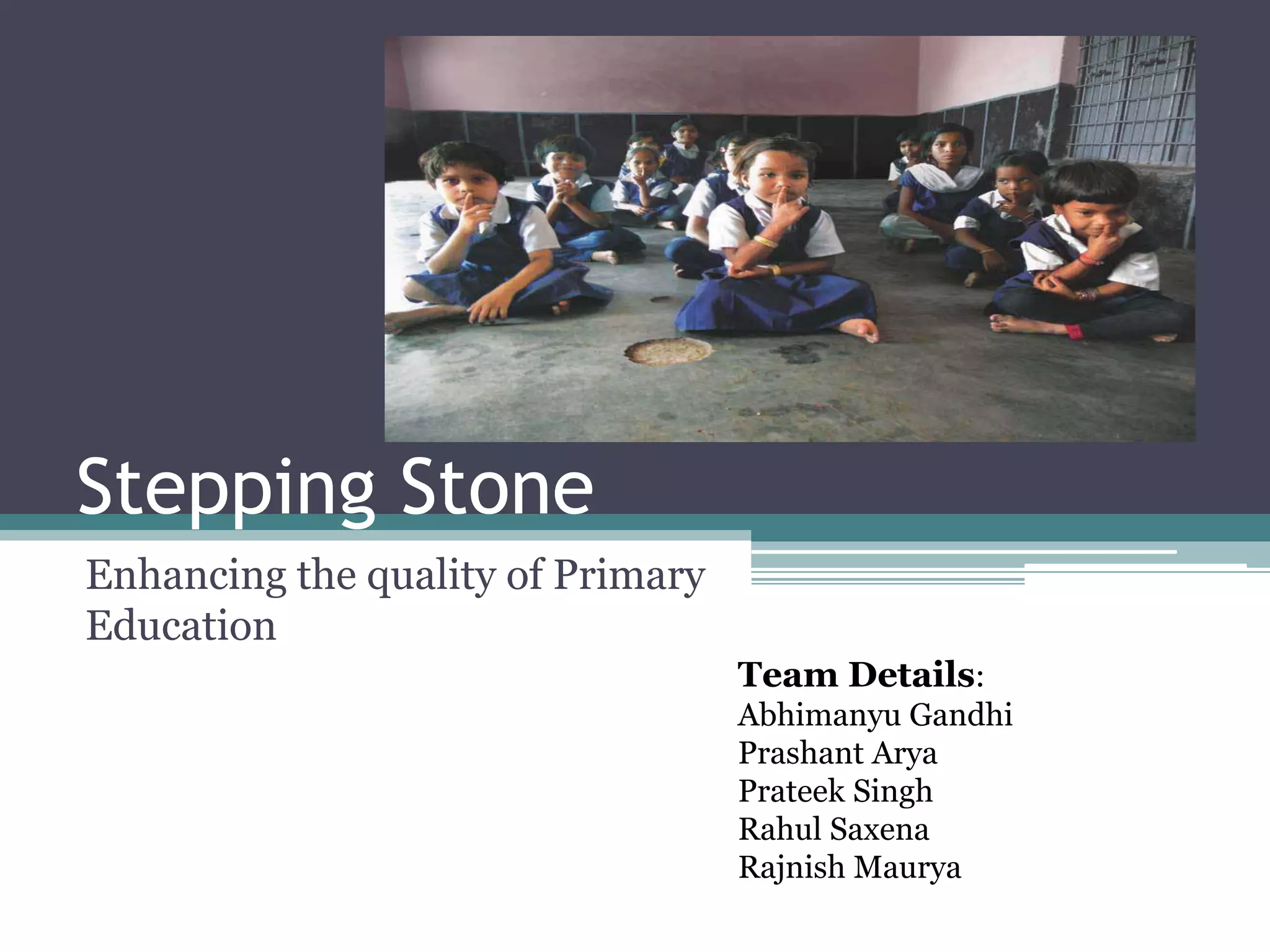
Enhancing the quality of Primary
Education
Team Details:
Abhimanyu Gandhi
Prashant Arya
Prateek Singh
Rahul Saxena
Rajnish Maurya
Facts for Primary
education
• 4% of children never go to school.
• Only 58% of remaining 96% get through class
5.
• Levels of reading and math at every level were
not only poor but declining in many states.
• Literacy rate of India is 74.07%.
• Female Education is 65%.
• Lack of infrastructure for primary schools.
Primary education in Rural areas
Issues
1. Workforce quality, funding and
infrastructure
• About 45% of the teachers were
found absent from their classes.
• 59% of schools had no drinking
water.
• 79% of school do not have toilets.
2. Curriculum followed in schools
• Rote learning method is mainly
taught instead of using problem
solving approach.
• Full attention is not paid to each
student of the class.
• Syllabus is not updated from time to
time.
3. Lack of awareness among peoples
living in village.
4. Gender inequality.
Quality of primary education can be increased by
improving the workforce quality, funding, and
infrastructure.
Primary education lays the foundation towards
building a pool of capable and empowered citizens
Building a committee under central body which will
ensure the improvement of primary education
Overview of the solution proposed
Committee will comprise of different departments which will look after
the specific task such as Surveying , recruitment of well qualified teachers, financial
requirements, etc. will be assigned to them.
Implementation of the solution
Committee formed will be a semi-government entity, it will conduct advance level exams
for recruitment of teachers, help of the NGOs will be taken for surveying, financial help
will be taken from charitable trust, help of the local people will be taken for creating
awareness.
Advantage over existing system
The teachers recruited will be well qualified, better infrastructure and facilities will
encourage student to come to school, updated curriculum will help the student to take
admission in better schools for their secondary education.
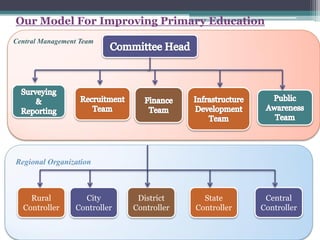
Central Management Team
Rural
Controller
City
Controller
Central
Controller
State
Controller
District
Controller
Regional Organization
Our Model For Improving Primary Education
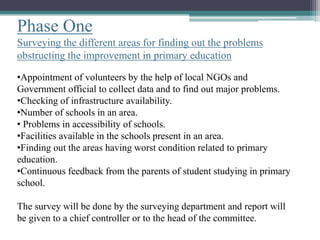
Phase One
Surveying the different areas for finding out the problems
obstructing the improvement in primary education
•Appointment of volunteers by the help of local NGOs and
Government official to collect data and to find out major problems.
•Checking of infrastructure availability.
•Number of schools in an area.
• Problems in accessibility of schools.
•Facilities available in the schools present in an area.
•Finding out the areas having worst condition related to primary
education.
•Continuous feedback from the parents of student studying in primary
school.
The survey will be done by the surveying department and report will
be given to a chief controller or to the head of the committee.
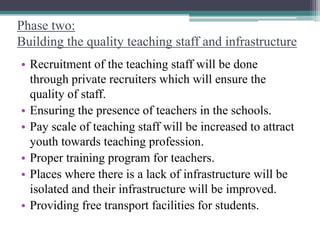
Phase two:
Building the quality teaching staff and infrastructure
• Recruitment of the teaching staff will be done
through private recruiters which will ensure the
quality of staff.
• Ensuring the presence of teachers in the schools.
• Pay scale of teaching staff will be increased to attract
youth towards teaching profession.
• Proper training program for teachers.
• Places where there is a lack of infrastructure will be
isolated and their infrastructure will be improved.
• Providing free transport facilities for students.
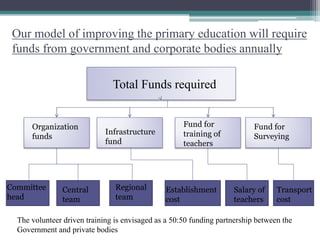
Our model of improving the primary education will require
funds from government and corporate bodies annually
Total Funds required
Organization
funds
Infrastructure
fund
Fund for
training of
teachers
Fund for
Surveying
Committee
head
Central
team
Regional
team
Establishment
cost
Transport
cost
Salary of
teachers
The volunteer driven training is envisaged as a 50:50 funding partnership between the
Government and private bodies
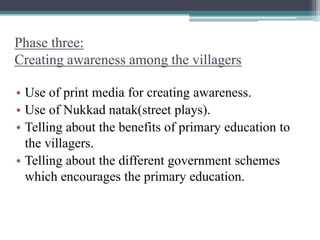
Phase three:
Creating awareness among the villagers
• Use of print media for creating awareness.
• Use of Nukkad natak(street plays).
• Telling about the benefits of primary education to
the villagers.
• Telling about the different government schemes
which encourages the primary education.
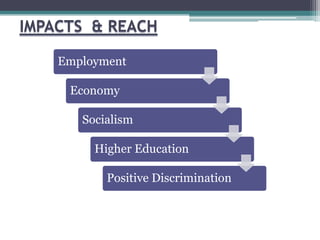
IMPACTS & REACH
Employment
Economy
Socialism
Higher Education
Positive Discrimination
Our model for improvement of primary education faces key
concept and implementation risks
Challenges and risk
• Youth is not interested in teaching profession.
• Volunteer enrollment minimal and key profession groups show no interest.
Implementation challenges
• Difficulty in integrating with government infrastructure and
Institutions
• Curriculum design needs a massive effort
References
• Teach for India (2012).
• ASER. (2012). Annual Status of Education Report, 2012.
• Index Mundi. (2013). India demographics profile.
• Financial Express. (2012, May 12). Education’s Primary Problems.
• Financial Express. (2013, July 23). Education’s primary problems.

TROJANS

  • 1.
    Stepping Stone Enhancing thequality of Primary Education Team Details: Abhimanyu Gandhi Prashant Arya Prateek Singh Rahul Saxena Rajnish Maurya
  • 2.
    Facts for Primary education •4% of children never go to school. • Only 58% of remaining 96% get through class 5. • Levels of reading and math at every level were not only poor but declining in many states. • Literacy rate of India is 74.07%. • Female Education is 65%. • Lack of infrastructure for primary schools. Primary education in Rural areas Issues 1. Workforce quality, funding and infrastructure • About 45% of the teachers were found absent from their classes. • 59% of schools had no drinking water. • 79% of school do not have toilets. 2. Curriculum followed in schools • Rote learning method is mainly taught instead of using problem solving approach. • Full attention is not paid to each student of the class. • Syllabus is not updated from time to time. 3. Lack of awareness among peoples living in village. 4. Gender inequality. Quality of primary education can be increased by improving the workforce quality, funding, and infrastructure. Primary education lays the foundation towards building a pool of capable and empowered citizens
  • 3.
    Building a committeeunder central body which will ensure the improvement of primary education Overview of the solution proposed Committee will comprise of different departments which will look after the specific task such as Surveying , recruitment of well qualified teachers, financial requirements, etc. will be assigned to them. Implementation of the solution Committee formed will be a semi-government entity, it will conduct advance level exams for recruitment of teachers, help of the NGOs will be taken for surveying, financial help will be taken from charitable trust, help of the local people will be taken for creating awareness. Advantage over existing system The teachers recruited will be well qualified, better infrastructure and facilities will encourage student to come to school, updated curriculum will help the student to take admission in better schools for their secondary education.
  • 4.
  • 5.
    Phase One Surveying thedifferent areas for finding out the problems obstructing the improvement in primary education •Appointment of volunteers by the help of local NGOs and Government official to collect data and to find out major problems. •Checking of infrastructure availability. •Number of schools in an area. • Problems in accessibility of schools. •Facilities available in the schools present in an area. •Finding out the areas having worst condition related to primary education. •Continuous feedback from the parents of student studying in primary school. The survey will be done by the surveying department and report will be given to a chief controller or to the head of the committee.
  • 6.
    Phase two: Building thequality teaching staff and infrastructure • Recruitment of the teaching staff will be done through private recruiters which will ensure the quality of staff. • Ensuring the presence of teachers in the schools. • Pay scale of teaching staff will be increased to attract youth towards teaching profession. • Proper training program for teachers. • Places where there is a lack of infrastructure will be isolated and their infrastructure will be improved. • Providing free transport facilities for students.
  • 7.
    Our model ofimproving the primary education will require funds from government and corporate bodies annually Total Funds required Organization funds Infrastructure fund Fund for training of teachers Fund for Surveying Committee head Central team Regional team Establishment cost Transport cost Salary of teachers The volunteer driven training is envisaged as a 50:50 funding partnership between the Government and private bodies
  • 8.
    Phase three: Creating awarenessamong the villagers • Use of print media for creating awareness. • Use of Nukkad natak(street plays). • Telling about the benefits of primary education to the villagers. • Telling about the different government schemes which encourages the primary education.
  • 9.
    IMPACTS & REACH Employment Economy Socialism HigherEducation Positive Discrimination
  • 10.
    Our model forimprovement of primary education faces key concept and implementation risks Challenges and risk • Youth is not interested in teaching profession. • Volunteer enrollment minimal and key profession groups show no interest. Implementation challenges • Difficulty in integrating with government infrastructure and Institutions • Curriculum design needs a massive effort
  • 11.
    References • Teach forIndia (2012). • ASER. (2012). Annual Status of Education Report, 2012. • Index Mundi. (2013). India demographics profile. • Financial Express. (2012, May 12). Education’s Primary Problems. • Financial Express. (2013, July 23). Education’s primary problems.