CHROMOSOMAL BASIS OF
INHERITANCE
LEARNING OBJECTIVES
▪ Distinguish among sex limited, sex influenced, and sex linked
traits.
▪ Explain the chromosomal basis for genetic linkage and
demonstrate how the chromosomal locations of linked genes can
be mapped.
▪ Identify the specific patterns of inheritance that are characteristic
of sex-linked traits.
▪ Know some human diseases or disorders caused by
chromosomal alteration.
TOPICS
▪ Chromosome Theory of Heredity
▪ Gene Dosage and Compensation
▪ Chromosome Mutation
▪ Changes in Chromosome Number
▪ Changes in Chromosome Structure
▪ Chromosomal Alterations in Human
Disease/Disorders
CHROMOSOMES
▪ Threadlike structures within
nucleus.
▪ A very long DNA molecule and
associated proteins, that carry
portions of the hereditary
information of an organism.
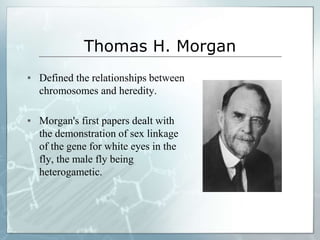
Thomas H. Morgan
▪ Defined the relationships between
chromosomes and heredity.
▪ Morgan's first papers dealt with
the demonstration of sex linkage
of the gene for white eyes in the
fly, the male fly being
heterogametic.
CHROMOSOMES
THEORY OF HEREDITY
It says that genes
are located on
chromosomes.
CHROMOSOME
MAPPING
Lists the sequences of
genetic loci along a
particular
chromosome
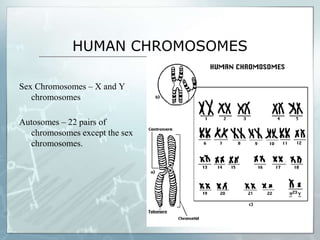
HUMAN CHROMOSOMES
Sex Chromosomes – X and Y
chromosomes
Autosomes – 22 pairs of
chromosomes except the sex
chromosomes.
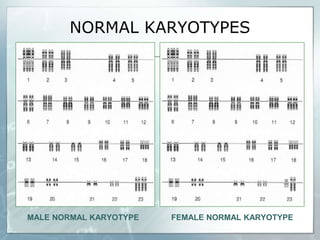
NORMAL KARYOTYPES
FEMALE NORMAL KARYOTYPE
MALE NORMAL KARYOTYPE
Sex -limited,
Sex-influenced,
and
Sex-linked
traits.
Sex-Limited Inheritance
Inheritance in which a trait or phenotype is expressed in one sex
only
Example:
A man may inherit his beard type from his mother rather
than from his father. Both sexes transmit the genes although
only one sex normally expresses the trait.
Sex-Influenced Inheritance
Inheritance that is autosomal but has a different intensity of
expression in the two sexes
Example:
In humans, baldness occurs in males with a single copy or
the allele. A woman will lose her hair only if she is
homozygous for the alleles.
Sex-Linked Inheritance
Inheritance that may result from a mutant gene located on either
the X- or Y-chromosome.
Example:
Color Blindness – mild disorder
Hemophilia – Any of several hereditary blood-coagulation
disorders, manifested almost exclusively in males, in which
the blood fails to clot normally because of a deficiency or
an abnormality of one of the clotting factors.
Gene Dosage
and
Compensation
GENE DOSAGE COMPENSATION
▪ In mammals, only one X chromosome if fully active in most
diploid cells.
▪ In females, one of the two X chromosomes is inactivated
during embrayonic development.
GENE DOSAGE COMPENSATION
▪ The inactive X chromosome contracts into a dense object, called
a BARR BODY, which lies along the inside of the nuclear
envelope in cells of females.
▪ Most of the genes of the X chromosomes that forms the BARR
BODY are not expressed, although small regions of that
chromosomes remain active.
CHROMOSOMES MUTATIONS
▪ Major changes in the chromosomes of a cell may occur as a result
of errors during meiosis, mitosis or because of MUTAGENS.
▪ CHROMOSOME MUTATIONS – changes in genetic material that
involve entire chromosomes or pieces of them.
CHROMOSOMES MUTATIONS
▪ Changes in chromosome structure (chromosomal mutations) are
of great importance.
▪ Chromosomal mutations are used as tools in genetic experiments.
▪ In addition, many human diseases including many types of
cancer are caused by chromosomal rearrangements.
CHANGES IN
CHROMOSOME
NUMBER
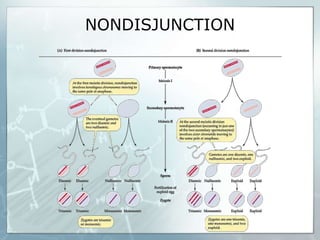
NONDISJUNCTION
An accident of meiosis or mitosis in which both members of a
pair of homologous chromosomes or both sister chromatids
fail to separate properly
NONDISJUNCTION
ANEUPLOIDY
A chromosomal aberration in which certain chromosomes are present
in extra copies or deficient in number
a. trisomy- cell has an extra chromosome (2N + 1)
b. monosomy- cell is missing a chromosome (2N-1)
POLYPLOIDY
When an organism has more than two complete chromosome sets
a. Triploids – three complete sets
b. Tetraploids – four sets
CHANGES IN
CHROMOSOME
STRUCTURE
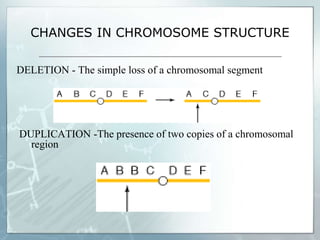
CHANGES IN CHROMOSOME STRUCTURE
DELETION - The simple loss of a chromosomal segment
DUPLICATION -The presence of two copies of a chromosomal
region
CHANGES IN CHROMOSOME STRUCTURE
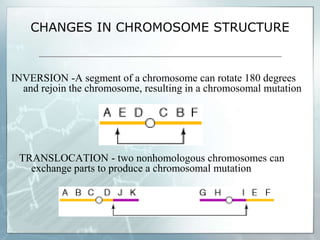
INVERSION -A segment of a chromosome can rotate 180 degrees
and rejoin the chromosome, resulting in a chromosomal mutation
TRANSLOCATION - two nonhomologous chromosomes can
exchange parts to produce a chromosomal mutation
MECHANISMS OF CHANGE
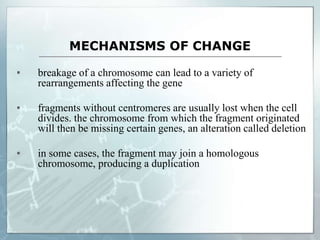
▪ breakage of a chromosome can lead to a variety of
rearrangements affecting the gene
▪ fragments without centromeres are usually lost when the cell
divides. the chromosome from which the fragment originated
will then be missing certain genes, an alteration called deletion
▪ in some cases, the fragment may join a homologous
chromosome, producing a duplication
MECHANISMS OF CHANGE
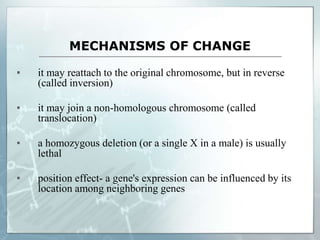
▪ it may reattach to the original chromosome, but in reverse
(called inversion)
▪ it may join a non-homologous chromosome (called
translocation)
▪ a homozygous deletion (or a single X in a male) is usually
lethal
▪ position effect- a gene's expression can be influenced by its
location among neighboring genes
Chromosomal
Alterations in
Human
Disease/Disorders
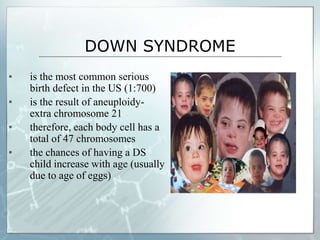
DOWN SYNDROME
▪ is the most common serious
birth defect in the US (1:700)
▪ is the result of aneuploidy-
extra chromosome 21
▪ therefore, each body cell has a
total of 47 chromosomes
▪ the chances of having a DS
child increase with age (usually
due to age of eggs)
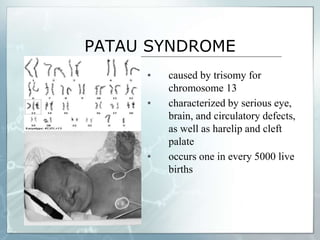
PATAU SYNDROME
▪ caused by trisomy for
chromosome 13
▪ characterized by serious eye,
brain, and circulatory defects,
as well as harelip and cleft
palate
▪ occurs one in every 5000 live
births
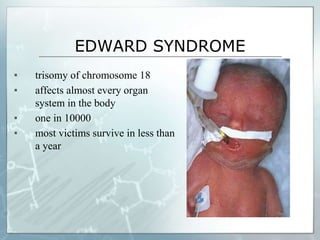
EDWARD SYNDROME
▪ trisomy of chromosome 18
▪ affects almost every organ
system in the body
▪ one in 10000
▪ most victims survive in less than
a year
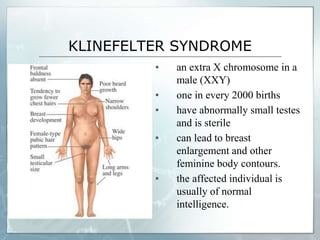
KLINEFELTER SYNDROME
▪ an extra X chromosome in a
male (XXY)
▪ one in every 2000 births
▪ have abnormally small testes
and is sterile
▪ can lead to breast
enlargement and other
feminine body contours.
▪ the affected individual is
usually of normal
intelligence.
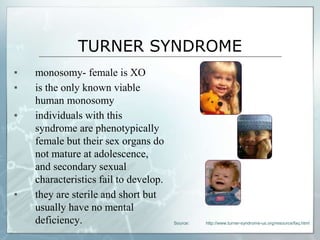
TURNER SYNDROME
▪ monosomy- female is XO
▪ is the only known viable
human monosomy
▪ individuals with this
syndrome are phenotypically
female but their sex organs do
not mature at adolescence,
and secondary sexual
characteristics fail to develop.
▪ they are sterile and short but
usually have no mental
deficiency. Source: http://www.turner-syndrome-us.org/resource/faq.html
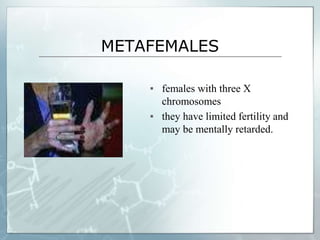
METAFEMALES
▪ females with three X
chromosomes
▪ they have limited fertility and
may be mentally retarded.
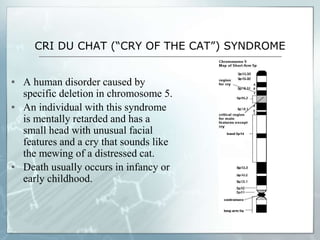
CRI DU CHAT (“CRY OF THE CAT”) SYNDROME
▪ A human disorder caused by
specific deletion in chromosome 5.
▪ An individual with this syndrome
is mentally retarded and has a
small head with unusual facial
features and a cry that sounds like
the mewing of a distressed cat.
▪ Death usually occurs in infancy or
early childhood.

CHROMOSOMAL BASIS OF INHERITANCE.pptx

  • 1.
  • 2.
    LEARNING OBJECTIVES ▪ Distinguishamong sex limited, sex influenced, and sex linked traits. ▪ Explain the chromosomal basis for genetic linkage and demonstrate how the chromosomal locations of linked genes can be mapped. ▪ Identify the specific patterns of inheritance that are characteristic of sex-linked traits. ▪ Know some human diseases or disorders caused by chromosomal alteration.
  • 3.
    TOPICS ▪ Chromosome Theoryof Heredity ▪ Gene Dosage and Compensation ▪ Chromosome Mutation ▪ Changes in Chromosome Number ▪ Changes in Chromosome Structure ▪ Chromosomal Alterations in Human Disease/Disorders
  • 4.
    CHROMOSOMES ▪ Threadlike structureswithin nucleus. ▪ A very long DNA molecule and associated proteins, that carry portions of the hereditary information of an organism.
  • 5.
    Thomas H. Morgan ▪Defined the relationships between chromosomes and heredity. ▪ Morgan's first papers dealt with the demonstration of sex linkage of the gene for white eyes in the fly, the male fly being heterogametic.
  • 6.
    CHROMOSOMES THEORY OF HEREDITY Itsays that genes are located on chromosomes.
  • 7.
    CHROMOSOME MAPPING Lists the sequencesof genetic loci along a particular chromosome
  • 8.
    HUMAN CHROMOSOMES Sex Chromosomes– X and Y chromosomes Autosomes – 22 pairs of chromosomes except the sex chromosomes.
  • 9.
    NORMAL KARYOTYPES FEMALE NORMALKARYOTYPE MALE NORMAL KARYOTYPE
  • 10.
  • 11.
    Sex-Limited Inheritance Inheritance inwhich a trait or phenotype is expressed in one sex only Example: A man may inherit his beard type from his mother rather than from his father. Both sexes transmit the genes although only one sex normally expresses the trait.
  • 12.
    Sex-Influenced Inheritance Inheritance thatis autosomal but has a different intensity of expression in the two sexes Example: In humans, baldness occurs in males with a single copy or the allele. A woman will lose her hair only if she is homozygous for the alleles.
  • 13.
    Sex-Linked Inheritance Inheritance thatmay result from a mutant gene located on either the X- or Y-chromosome. Example: Color Blindness – mild disorder Hemophilia – Any of several hereditary blood-coagulation disorders, manifested almost exclusively in males, in which the blood fails to clot normally because of a deficiency or an abnormality of one of the clotting factors.
  • 14.
  • 15.
    GENE DOSAGE COMPENSATION ▪In mammals, only one X chromosome if fully active in most diploid cells. ▪ In females, one of the two X chromosomes is inactivated during embrayonic development.
  • 16.
    GENE DOSAGE COMPENSATION ▪The inactive X chromosome contracts into a dense object, called a BARR BODY, which lies along the inside of the nuclear envelope in cells of females. ▪ Most of the genes of the X chromosomes that forms the BARR BODY are not expressed, although small regions of that chromosomes remain active.
  • 17.
    CHROMOSOMES MUTATIONS ▪ Majorchanges in the chromosomes of a cell may occur as a result of errors during meiosis, mitosis or because of MUTAGENS. ▪ CHROMOSOME MUTATIONS – changes in genetic material that involve entire chromosomes or pieces of them.
  • 18.
    CHROMOSOMES MUTATIONS ▪ Changesin chromosome structure (chromosomal mutations) are of great importance. ▪ Chromosomal mutations are used as tools in genetic experiments. ▪ In addition, many human diseases including many types of cancer are caused by chromosomal rearrangements.
  • 19.
  • 20.
    NONDISJUNCTION An accident ofmeiosis or mitosis in which both members of a pair of homologous chromosomes or both sister chromatids fail to separate properly
  • 21.
  • 22.
    ANEUPLOIDY A chromosomal aberrationin which certain chromosomes are present in extra copies or deficient in number a. trisomy- cell has an extra chromosome (2N + 1) b. monosomy- cell is missing a chromosome (2N-1)
  • 23.
    POLYPLOIDY When an organismhas more than two complete chromosome sets a. Triploids – three complete sets b. Tetraploids – four sets
  • 24.
  • 25.
    CHANGES IN CHROMOSOMESTRUCTURE DELETION - The simple loss of a chromosomal segment DUPLICATION -The presence of two copies of a chromosomal region
  • 26.
    CHANGES IN CHROMOSOMESTRUCTURE INVERSION -A segment of a chromosome can rotate 180 degrees and rejoin the chromosome, resulting in a chromosomal mutation TRANSLOCATION - two nonhomologous chromosomes can exchange parts to produce a chromosomal mutation
  • 27.
    MECHANISMS OF CHANGE ▪breakage of a chromosome can lead to a variety of rearrangements affecting the gene ▪ fragments without centromeres are usually lost when the cell divides. the chromosome from which the fragment originated will then be missing certain genes, an alteration called deletion ▪ in some cases, the fragment may join a homologous chromosome, producing a duplication
  • 28.
    MECHANISMS OF CHANGE ▪it may reattach to the original chromosome, but in reverse (called inversion) ▪ it may join a non-homologous chromosome (called translocation) ▪ a homozygous deletion (or a single X in a male) is usually lethal ▪ position effect- a gene's expression can be influenced by its location among neighboring genes
  • 29.
  • 30.
    DOWN SYNDROME ▪ isthe most common serious birth defect in the US (1:700) ▪ is the result of aneuploidy- extra chromosome 21 ▪ therefore, each body cell has a total of 47 chromosomes ▪ the chances of having a DS child increase with age (usually due to age of eggs)
  • 31.
    PATAU SYNDROME ▪ causedby trisomy for chromosome 13 ▪ characterized by serious eye, brain, and circulatory defects, as well as harelip and cleft palate ▪ occurs one in every 5000 live births
  • 32.
    EDWARD SYNDROME ▪ trisomyof chromosome 18 ▪ affects almost every organ system in the body ▪ one in 10000 ▪ most victims survive in less than a year
  • 33.
    KLINEFELTER SYNDROME ▪ anextra X chromosome in a male (XXY) ▪ one in every 2000 births ▪ have abnormally small testes and is sterile ▪ can lead to breast enlargement and other feminine body contours. ▪ the affected individual is usually of normal intelligence.
  • 34.
    TURNER SYNDROME ▪ monosomy-female is XO ▪ is the only known viable human monosomy ▪ individuals with this syndrome are phenotypically female but their sex organs do not mature at adolescence, and secondary sexual characteristics fail to develop. ▪ they are sterile and short but usually have no mental deficiency. Source: http://www.turner-syndrome-us.org/resource/faq.html
  • 35.
    METAFEMALES ▪ females withthree X chromosomes ▪ they have limited fertility and may be mentally retarded.
  • 36.
    CRI DU CHAT(“CRY OF THE CAT”) SYNDROME ▪ A human disorder caused by specific deletion in chromosome 5. ▪ An individual with this syndrome is mentally retarded and has a small head with unusual facial features and a cry that sounds like the mewing of a distressed cat. ▪ Death usually occurs in infancy or early childhood.