1
Fertilization                                              2

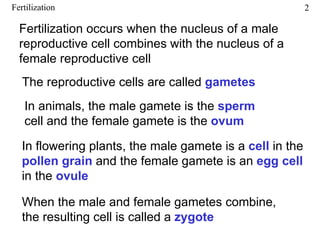
  Fertilization occurs when the nucleus of a male
  reproductive cell combines with the nucleus of a
  female reproductive cell
   The reproductive cells are called gametes
   In animals, the male gamete is the sperm
   cell and the female gamete is the ovum

   In flowering plants, the male gamete is a cell in the
   pollen grain and the female gamete is an egg cell
   in the ovule

   When the male and female gametes combine,
   the resulting cell is called a zygote
3
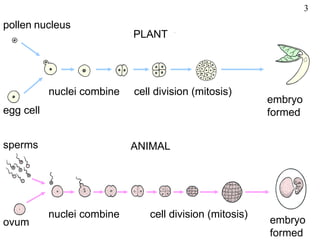
pollen nucleus
                            PLANT


           nuclei combine   cell division (mitosis)
                                                         embryo
egg cell                                                 formed


sperms                      ANIMAL


           nuclei combine      cell division (mitosis)
ovum                                                     embryo
                                                         formed
0.1 mm           4

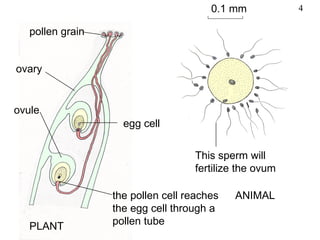
   pollen grain


ovary


ovule
                    egg cell


                                   This sperm will
                                   fertilize the ovum

                  the pollen cell reaches   ANIMAL
                  the egg cell through a
   PLANT          pollen tube
5


As a result of fertilization, the chromosomes from the
male and female cells are combined in the same nuclear
membrane


      Do you see a problem with this?
6

The problem is that if the full complement of male and
female chromosomes combine, the zygote and
embryo would have twice as many chromosomes
as its parents
If 46 male chromosomes combined with 46 female
chromosomes, the offspring would have 92 chromosomes
in their cells
And the next generation would have 184 chromosomes,
and so on
In fact, when the gametes are formed, the number of
chromosomes is halved so that the zygote ends up with
the same number of chromosomes as its parents.
7

The type of cell division which gives rise to gametes
is called


 At cell division, before the chromatids separate, the
 chromosomes are shared equally between the two
 daughter cells

   The following slides describe this process.
   Only two pairs of chromosomes are shown
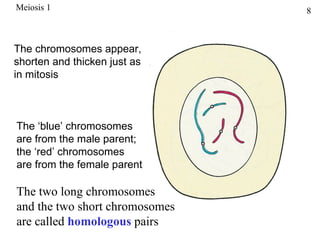
Meiosis 1                       8


The chromosomes appear,
shorten and thicken just as
in mitosis


The ‘blue’ chromosomes
are from the male parent;
the ‘red’ chromosomes
are from the female parent

The two long chromosomes
and the two short chromosomes
are called homologous pairs
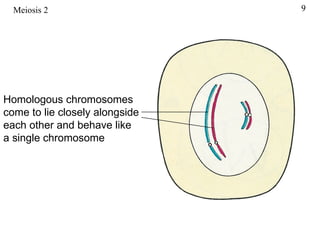
Meiosis 2                     9


Homologous chromosomes
come to lie closely alongside
each other and behave like
a single chromosome
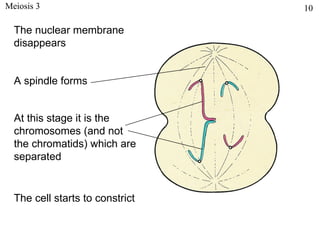
Meiosis 3                        10

  The nuclear membrane
  disappears


  A spindle forms


  At this stage it is the
  chromosomes (and not
  the chromatids) which are
  separated


  The cell starts to constrict
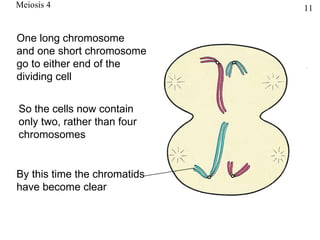
Meiosis 4                     11


One long chromosome
and one short chromosome
go to either end of the
dividing cell


So the cells now contain
only two, rather than four
chromosomes


By this time the chromatids
have become clear
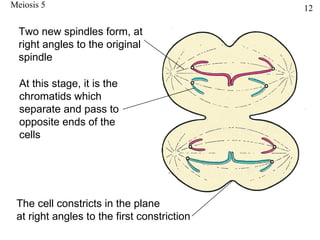
Meiosis 5                                    12

  Two new spindles form, at
  right angles to the original
  spindle

  At this stage, it is the
  chromatids which
  separate and pass to
  opposite ends of the
  cells


 The cell constricts in the plane
 at right angles to the first constriction
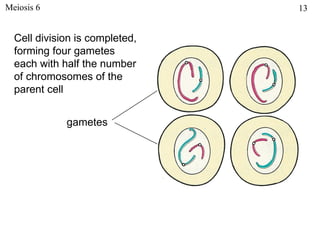
Meiosis 6                       13


  Cell division is completed,
  forming four gametes
  each with half the number
  of chromosomes of the
  parent cell


             gametes
14


The number of chromosomes in the body cells is called
the diploid number


The number of chromosomes in the gametes is called
the haploid number (half the diploid number)


The diploid number in human cells is 46. The haploid
number in the gametes is 23
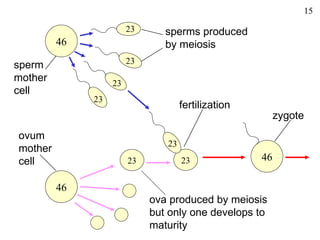
15

                        23      sperms produced
         46                     by meiosis
                        23
sperm
mother             23
cell
              23
                                     fertilization
                                                          zygote
ovum
                                23
mother
cell                    23           23              46

         46
                             ova produced by meiosis
                             but only one develops to
                             maturity
16


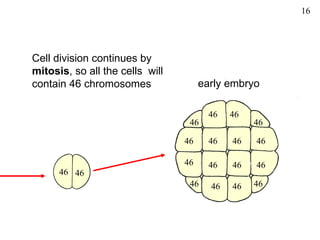
Cell division continues by
mitosis, so all the cells will
contain 46 chromosomes                early embryo

                                        46   46
                                  46              46

                                 46     46   46   46

                                 46     46   46   46
      46 46
                                  46    46   46   46
Genes                                                     17
                                             gene for
                 gene for brown eyes         blue eyes


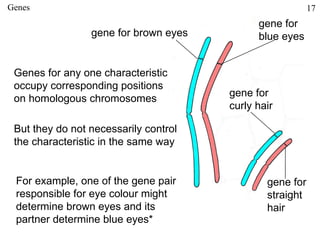
 Genes for any one characteristic
 occupy corresponding positions
                                       gene for
 on homologous chromosomes
                                       curly hair

 But they do not necessarily control
 the characteristic in the same way


 For example, one of the gene pair             gene for
 responsible for eye colour might              straight
 determine brown eyes and its                  hair
 partner determine blue eyes*
18


Usually only one of a gene pair will be expressed in an
individual

A person inheriting the gene for brown eyes and the gene
for blue eyes will have brown eyes

The gene for brown eyes is said to be dominant to
the gene for blue eyes. The gene for blue eyes is not
expressed in this individual

The gene for blue eyes is said to be recessive to the
gene for brown eyes
Gene combinations                                                    19


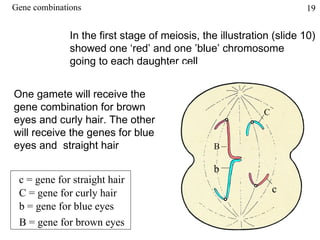
              In the first stage of meiosis, the illustration (slide 10)
              showed one ‘red’ and one ’blue’ chromosome
              going to each daughter cell


One gamete will receive the
gene combination for brown                                 C
eyes and curly hair. The other
will receive the genes for blue
                                               B
eyes and straight hair                         B

                                                b
 c = gene for straight hair
 C = gene for curly hair                                       c
 b = gene for blue eyes
 B = gene for brown eyes
20

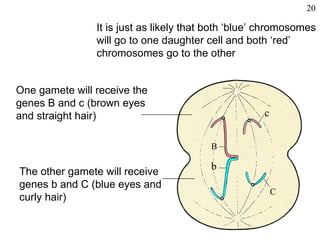
                It is just as likely that both ‘blue’ chromosomes
                will go to one daughter cell and both ‘red’
                chromosomes go to the other


One gamete will receive the
genes B and c (brown eyes
and straight hair)                                   c


                                         B

                                         b
The other gamete will receive
genes b and C (blue eyes and
                                                         C
curly hair)
21

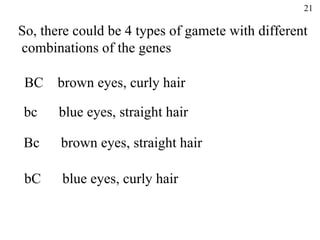
So, there could be 4 types of gamete with different
combinations of the genes

 BC   brown eyes, curly hair

 bc    blue eyes, straight hair

Bc     brown eyes, straight hair

 bC    blue eyes, curly hair
Variation                                         22


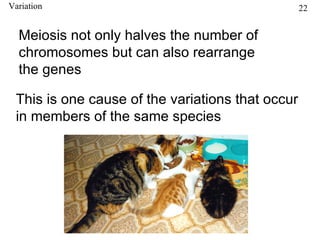
  Meiosis not only halves the number of
  chromosomes but can also rearrange
  the genes

 This is one cause of the variations that occur
 in members of the same species
23


Rearrangement of genes can also take
place at fertilization

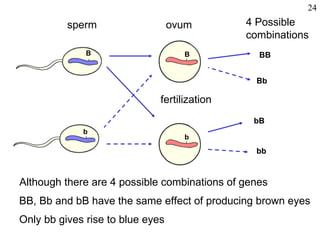
A sperm may carry a gene for brown eyes (B)
               or a gene for blue eyes (b)

An ovum may carry a gene for brown eyes (B)
                or a gene for blue eyes (b)

At fertilization, four possible combinations
can occur
24
          sperm                   ovum        4 Possible
                                              combinations
              B                     B            BB


                                                Bb

                              fertilization
                                                bB
             b
                                    b

                                                bb


Although there are 4 possible combinations of genes
BB, Bb and bB have the same effect of producing brown eyes
Only bb gives rise to blue eyes
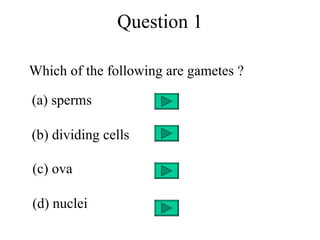
Question 1

Which of the following are gametes ?

(a) sperms

(b) dividing cells

(c) ova

(d) nuclei
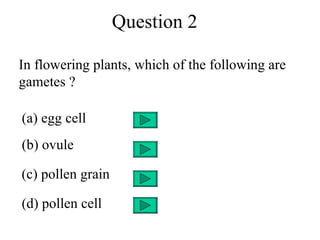
Question 2

In flowering plants, which of the following are
gametes ?

(a) egg cell
(b) ovule

(c) pollen grain

(d) pollen cell
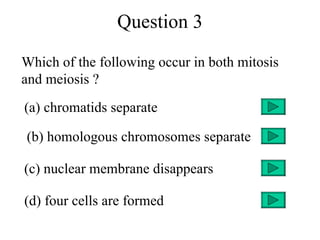
Question 3
Which of the following occur in both mitosis
and meiosis ?
(a) chromatids separate

(b) homologous chromosomes separate

(c) nuclear membrane disappears

(d) four cells are formed
Question 4
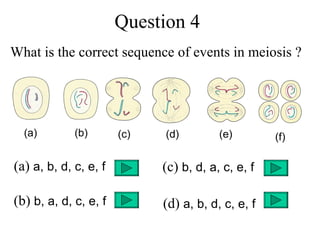
What is the correct sequence of events in meiosis ?


  (a)        (b)       (c)   (d)         (e)        (f)

(a) a, b, d, c, e, f         (c) b, d, a, c, e, f

(b) b, a, d, c, e, f         (d) a, b, d, c, e, f
Question 5

Which of the following represent variation
within a species ?

(a) black cats and tabby cats

(b) collie dogs and dachshunds

(c) goldfinch and greenfinch

(d) shire horses and race horses
Answer


Correct
Answer


Incorrect

Chromosomes fertilization

  • 1.
  • 2.
    Fertilization 2 Fertilization occurs when the nucleus of a male reproductive cell combines with the nucleus of a female reproductive cell The reproductive cells are called gametes In animals, the male gamete is the sperm cell and the female gamete is the ovum In flowering plants, the male gamete is a cell in the pollen grain and the female gamete is an egg cell in the ovule When the male and female gametes combine, the resulting cell is called a zygote
  • 3.
    3 pollen nucleus PLANT nuclei combine cell division (mitosis) embryo egg cell formed sperms ANIMAL nuclei combine cell division (mitosis) ovum embryo formed
  • 4.
    0.1 mm 4 pollen grain ovary ovule egg cell This sperm will fertilize the ovum the pollen cell reaches ANIMAL the egg cell through a PLANT pollen tube
  • 5.
    5 As a resultof fertilization, the chromosomes from the male and female cells are combined in the same nuclear membrane Do you see a problem with this?
  • 6.
    6 The problem isthat if the full complement of male and female chromosomes combine, the zygote and embryo would have twice as many chromosomes as its parents If 46 male chromosomes combined with 46 female chromosomes, the offspring would have 92 chromosomes in their cells And the next generation would have 184 chromosomes, and so on In fact, when the gametes are formed, the number of chromosomes is halved so that the zygote ends up with the same number of chromosomes as its parents.
  • 7.
    7 The type ofcell division which gives rise to gametes is called At cell division, before the chromatids separate, the chromosomes are shared equally between the two daughter cells The following slides describe this process. Only two pairs of chromosomes are shown
  • 8.
    Meiosis 1 8 The chromosomes appear, shorten and thicken just as in mitosis The ‘blue’ chromosomes are from the male parent; the ‘red’ chromosomes are from the female parent The two long chromosomes and the two short chromosomes are called homologous pairs
  • 9.
    Meiosis 2 9 Homologous chromosomes come to lie closely alongside each other and behave like a single chromosome
  • 10.
    Meiosis 3 10 The nuclear membrane disappears A spindle forms At this stage it is the chromosomes (and not the chromatids) which are separated The cell starts to constrict
  • 11.
    Meiosis 4 11 One long chromosome and one short chromosome go to either end of the dividing cell So the cells now contain only two, rather than four chromosomes By this time the chromatids have become clear
  • 12.
    Meiosis 5 12 Two new spindles form, at right angles to the original spindle At this stage, it is the chromatids which separate and pass to opposite ends of the cells The cell constricts in the plane at right angles to the first constriction
  • 13.
    Meiosis 6 13 Cell division is completed, forming four gametes each with half the number of chromosomes of the parent cell gametes
  • 14.
    14 The number ofchromosomes in the body cells is called the diploid number The number of chromosomes in the gametes is called the haploid number (half the diploid number) The diploid number in human cells is 46. The haploid number in the gametes is 23
  • 15.
    15 23 sperms produced 46 by meiosis 23 sperm mother 23 cell 23 fertilization zygote ovum 23 mother cell 23 23 46 46 ova produced by meiosis but only one develops to maturity
  • 16.
    16 Cell division continuesby mitosis, so all the cells will contain 46 chromosomes early embryo 46 46 46 46 46 46 46 46 46 46 46 46 46 46 46 46 46 46
  • 17.
    Genes 17 gene for gene for brown eyes blue eyes Genes for any one characteristic occupy corresponding positions gene for on homologous chromosomes curly hair But they do not necessarily control the characteristic in the same way For example, one of the gene pair gene for responsible for eye colour might straight determine brown eyes and its hair partner determine blue eyes*
  • 18.
    18 Usually only oneof a gene pair will be expressed in an individual A person inheriting the gene for brown eyes and the gene for blue eyes will have brown eyes The gene for brown eyes is said to be dominant to the gene for blue eyes. The gene for blue eyes is not expressed in this individual The gene for blue eyes is said to be recessive to the gene for brown eyes
  • 19.
    Gene combinations 19 In the first stage of meiosis, the illustration (slide 10) showed one ‘red’ and one ’blue’ chromosome going to each daughter cell One gamete will receive the gene combination for brown C eyes and curly hair. The other will receive the genes for blue B eyes and straight hair B b c = gene for straight hair C = gene for curly hair c b = gene for blue eyes B = gene for brown eyes
  • 20.
    20 It is just as likely that both ‘blue’ chromosomes will go to one daughter cell and both ‘red’ chromosomes go to the other One gamete will receive the genes B and c (brown eyes and straight hair) c B b The other gamete will receive genes b and C (blue eyes and C curly hair)
  • 21.
    21 So, there couldbe 4 types of gamete with different combinations of the genes BC brown eyes, curly hair bc blue eyes, straight hair Bc brown eyes, straight hair bC blue eyes, curly hair
  • 22.
    Variation 22 Meiosis not only halves the number of chromosomes but can also rearrange the genes This is one cause of the variations that occur in members of the same species
  • 23.
    23 Rearrangement of genescan also take place at fertilization A sperm may carry a gene for brown eyes (B) or a gene for blue eyes (b) An ovum may carry a gene for brown eyes (B) or a gene for blue eyes (b) At fertilization, four possible combinations can occur
  • 24.
    24 sperm ovum 4 Possible combinations B B BB Bb fertilization bB b b bb Although there are 4 possible combinations of genes BB, Bb and bB have the same effect of producing brown eyes Only bb gives rise to blue eyes
  • 25.
    Question 1 Which ofthe following are gametes ? (a) sperms (b) dividing cells (c) ova (d) nuclei
  • 26.
    Question 2 In floweringplants, which of the following are gametes ? (a) egg cell (b) ovule (c) pollen grain (d) pollen cell
  • 27.
    Question 3 Which ofthe following occur in both mitosis and meiosis ? (a) chromatids separate (b) homologous chromosomes separate (c) nuclear membrane disappears (d) four cells are formed
  • 28.
    Question 4 What isthe correct sequence of events in meiosis ? (a) (b) (c) (d) (e) (f) (a) a, b, d, c, e, f (c) b, d, a, c, e, f (b) b, a, d, c, e, f (d) a, b, d, c, e, f
  • 29.
    Question 5 Which ofthe following represent variation within a species ? (a) black cats and tabby cats (b) collie dogs and dachshunds (c) goldfinch and greenfinch (d) shire horses and race horses
  • 30.
  • 31.

Editor's Notes

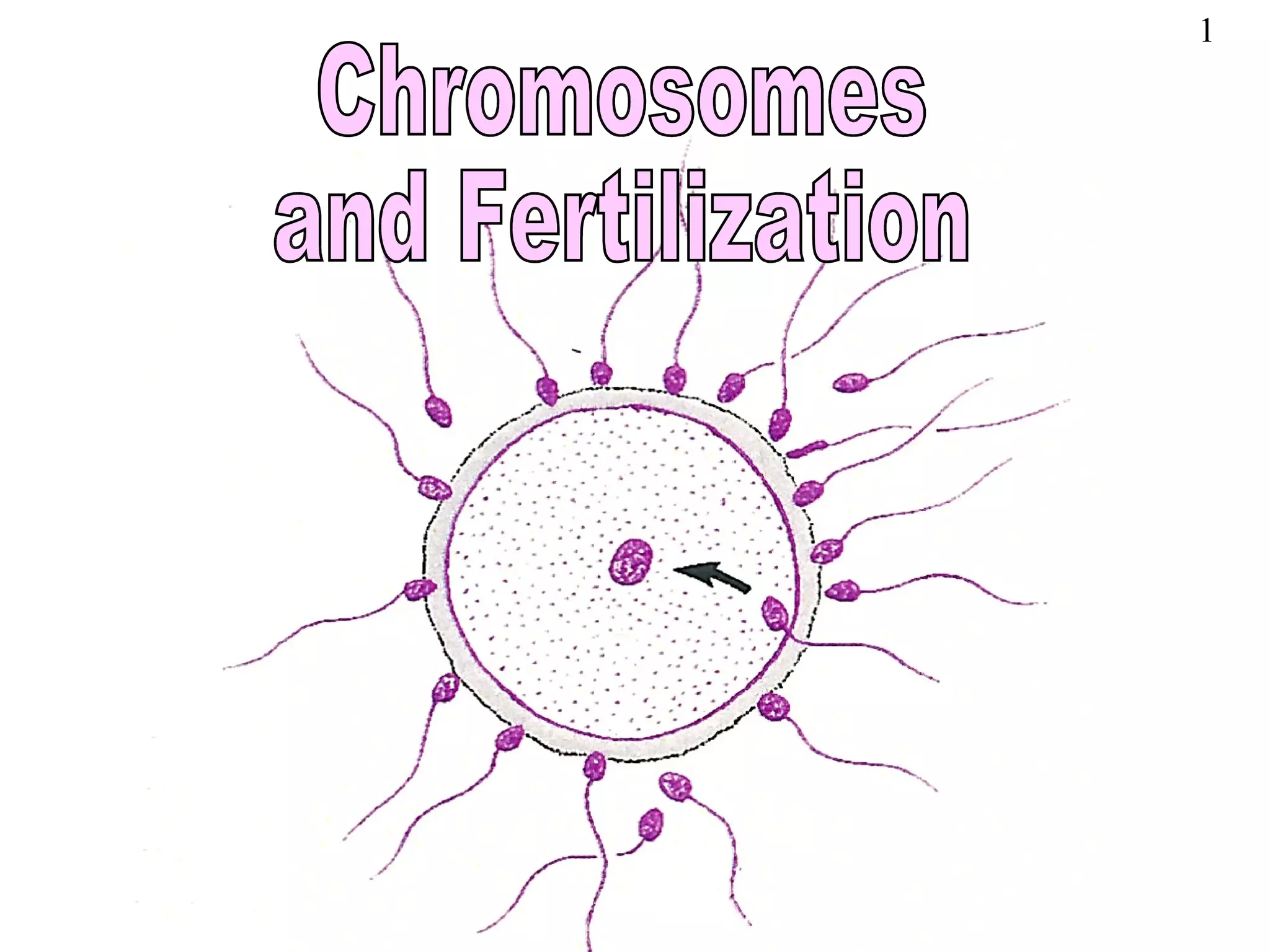
  • #2 The drawing represents a sperm fertilizing an ovum in a mammalian cell. Only one of the swarm of sperms will penetrate the ovum and bring about fertilization
  • #5 The left hand drawing represents a vertical section through the ovary of a plant. When the pollen grains land on the stigma they produce pollen tubes which grow through the ovary to reach the ovule. In the drawing on the right, many thousands of sperm cells swim towards the ovum but only one of them will penetrate and fertilise it.
  • #9 The chromosomes have already replicated but the chromatids are not obvious at this stage
  • #12 In some organisms the cell divides completely at this stage.
  • #16 Human body cells contain 46 chromosomes, but the gametes contain only 23. At fertilisation, the number is restored to 46. In humans and most other mammals, the ovum mother cell produces four cells by meiosis but only one of these goes on to become a gamete.
  • #18 *This example is solely for illustration of the principle. Eye colour and hair curliness are not controlled by single genes.
  • #20 The genes b and B are said to control contrasting characters , i.e. either blue or brown eyes. Similarly, curly hair and straight hair are contrasting characteristics