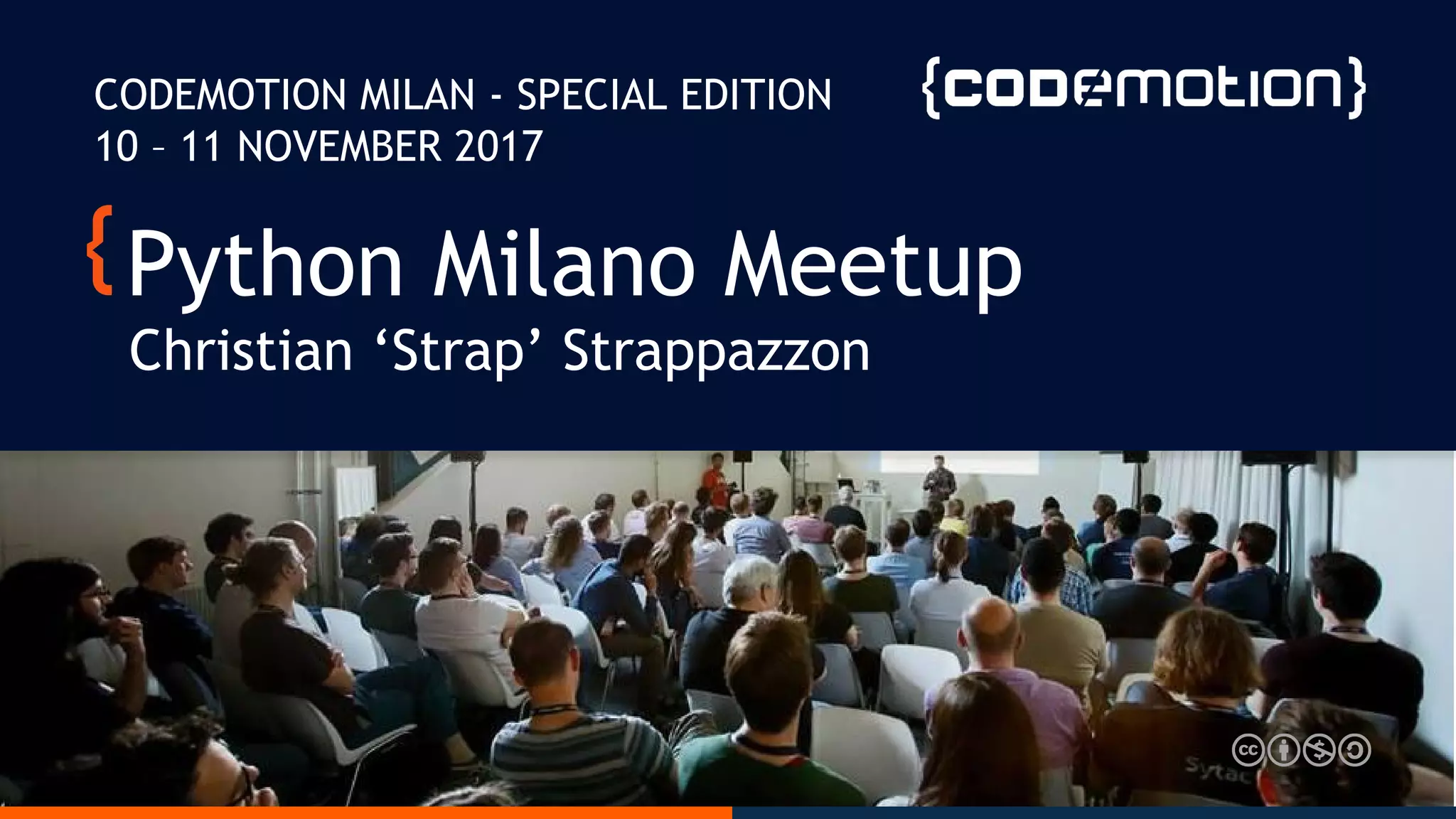
Python Milano Meetup
Christian ‘Strap’ Strappazzon
CODEMOTION MILAN - SPECIAL EDITION
10 – 11 NOVEMBER 2017
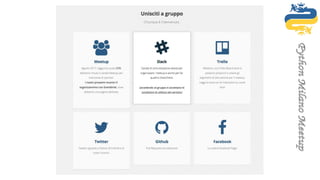
Python Milano
Aperto a tutti, sviluppatrici, sviluppatori,
appassionate e appassionati di Python
Who We Are
What we do,
why, how, when, where...
Carlo Miron @cm
Cesare Placanica @keobox
Christian Strappazzon @cstrap
Flavio Percoco @flaper87
Lorenzo Mele @greenkey
Pietro Brunetti @gunzapper
Simone Picciani @zanza00
http://milano.python.it/
Slack
http://pythonmilano.herokuapp.com/
Join us!
Let’s Start!
http://cultofthepartyparrot.com/
Python Blueprint
The tools, the packages and the ecosystem
@ Codemotion Milan 2017
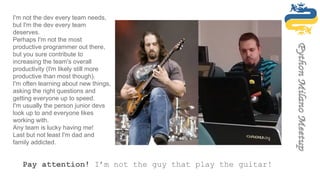
Pay attention! I’m not the guy that play the guitar!
I'm not the dev every team needs,
but I'm the dev every team
deserves.
Perhaps I'm not the most
productive programmer out there,
but you sure contribute to
increasing the team's overall
productivity (I'm likely still more
productive than most though).
I'm often learning about new things,
asking the right questions and
getting everyone up to speed.
I'm usually the person junior devs
look up to and everyone likes
working with.
Any team is lucky having me!
Last but not least I'm dad and
family addicted.
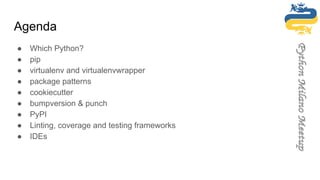
Agenda
● Which Python?
● pip
● virtualenv and virtualenvwrapper
● package patterns
● cookiecutter
● bumpversion & punch
● PyPI
● Linting, coverage and testing frameworks
● IDEs
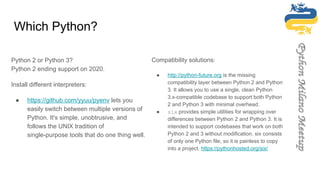
Which Python?
Python 2 or Python 3?
Python 2 ending support on 2020.
Install different interpreters:
● https://github.com/yyuu/pyenv lets you
easily switch between multiple versions of
Python. It's simple, unobtrusive, and
follows the UNIX tradition of
single-purpose tools that do one thing well.
Compatibility solutions:
● http://python-future.org is the missing
compatibility layer between Python 2 and Python
3. It allows you to use a single, clean Python
3.x-compatible codebase to support both Python
2 and Python 3 with minimal overhead.
● six provides simple utilities for wrapping over
differences between Python 2 and Python 3. It is
intended to support codebases that work on both
Python 2 and 3 without modification. six consists
of only one Python file, so it is painless to copy
into a project. https://pythonhosted.org/six/
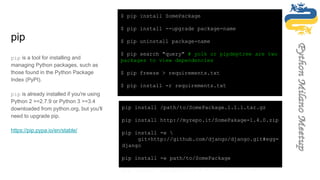
pip
pip is a tool for installing and
managing Python packages, such as
those found in the Python Package
Index (PyPI).
pip is already installed if you're using
Python 2 >=2.7.9 or Python 3 >=3.4
downloaded from python.org, but you'll
need to upgrade pip.
https://pip.pypa.io/en/stable/
$ pip install SomePackage
$ pip install --upgrade package-name
$ pip uninstall package-name
$ pip search "query" # yolk or pipdeptree are two
packages to view dependencies
$ pip freeze > requirements.txt
$ pip install -r requirements.txt
pip install /path/to/SomePackage.1.1.1.tar.gz
pip install http://myrepo.it/SomePakage-1.4.0.zip
pip install -e 
git+http://github.com/django/django.git#egg=
django
pip install -e path/to/SomePackage
pip install django>=1.7 # ==, >=, >, <, <=
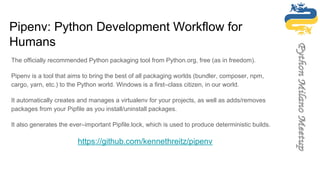
Pipenv: Python Development Workflow for
Humans
The officially recommended Python packaging tool from Python.org, free (as in freedom).
Pipenv is a tool that aims to bring the best of all packaging worlds (bundler, composer, npm,
cargo, yarn, etc.) to the Python world. Windows is a first–class citizen, in our world.
It automatically creates and manages a virtualenv for your projects, as well as adds/removes
packages from your Pipfile as you install/uninstall packages.
It also generates the ever–important Pipfile.lock, which is used to produce deterministic builds.
https://github.com/kennethreitz/pipenv
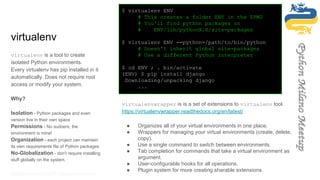
virtualenv
virtualenv is a tool to create
isolated Python environments.
Every virtualenv has pip installed in it
automatically. Does not require root
access or modify your system.
Why?
Isolation - Python packages and even
version live in their own space
Permissions - No sudoers, the
environment is mine!
Organization - each project can maintain
its own requirements file of Python packages
No-Globalization - don't require installing
stuff globally on the system.
https://virtualenv.readthedocs.org/en/latest/
$ virtualenv ENV
# This creates a folder ENV in the $PWD
# You'll find python packages on
# ENV/lib/pythonX.X/site-packages
$ virtualenv ENV --python=/path/to/bin/python
# Doesn't inherit global site-packages
# Use a different Python interpreter
$ cd ENV ; . bin/activate
(ENV) $ pip install django
Downloading/unpacking django
...
virtualenvwrapper is is a set of extensions to virtualenv tool.
https://virtualenvwrapper.readthedocs.org/en/latest/
● Organizes all of your virtual environments in one place.
● Wrappers for managing your virtual environments (create, delete,
copy).
● Use a single command to switch between environments.
● Tab completion for commands that take a virtual environment as
argument.
● User-configurable hooks for all operations.
● Plugin system for more creating sharable extensions.
http://pythonmilano.herokuapp.com/
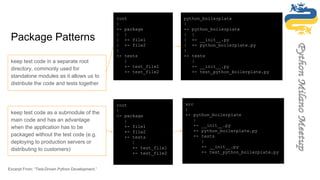
Package Patterns
keep test code in a separate root
directory, commonly used for
standalone modules as it allows us to
distribute the code and tests together
root
|
+- package
| |
| +- file1
| +- file2
|
+- tests
|
+- test_file1
+- test_file2
root
|
+- package
|
+- file1
+- file2
+- tests
|
+- test_file1
+- test_file2
keep test code as a submodule of the
main code and has an advantage
when the application has to be
packaged without the test code (e.g.
deploying to production servers or
distributing to customers)
python_boilerplate
|
+- python_boilerplate
| |
| +- __init__.py
| +- python_boilerplate.py
|
+- tests
|
+- __init__.py
+- test_python_boilerplate.py
src
|
+- python_boilerplate
|
+- __init__.py
+- python_boilerplate.py
+- tests
|
+- __init__.py
+- test_python_boilerplate.py
Excerpt From: “Test-Driven Python Development.”
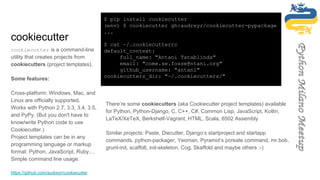
cookiecutter
cookiecutter is a command-line
utility that creates projects from
cookiecutters (project templates).
Some features:
Cross-platform: Windows, Mac, and
Linux are officially supported.
Works with Python 2.7, 3.3, 3.4, 3.5,
and PyPy. (But you don't have to
know/write Python code to use
Cookiecutter.)
Project templates can be in any
programming language or markup
format: Python, JavaScript, Ruby,...
Simple command line usage.
https://github.com/audreyr/cookiecutter
$ pip install cookiecutter
(env) $ cookiecutter gh:audreyr/cookiecutter-pypackage
...
$ cat ~/.cookiecutterrc
default_context:
full_name: "Antani Tatablinda"
email: "come.se.fosse@ntani.org"
github_username: "antani"
cookiecutters_dir: "~/.cookiecutters/"
There’re some cookiecutters (aka Cookiecutter project templates) available
for Python, Python-Django, C, C++, C#, Common Lisp, JavaScript, Kotlin,
LaTeX/XeTeX, Berkshelf-Vagrant, HTML, Scala, 6502 Assembly
Similar projects: Paste, Diecutter, Django‘s startproject and startapp
commands, python-packager, Yeoman, Pyramid‘s pcreate command, mr.bob,
grunt-init, scaffolt, init-skeleton, Cog, Skaffold and maybe others :-)
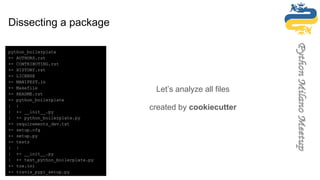
Dissecting a package
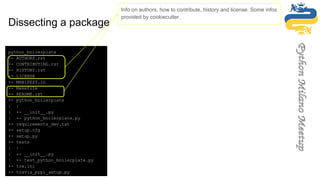
Let’s analyze all files
created by cookiecutter
python_boilerplate
+- AUTHORS.rst
+- CONTRIBUTING.rst
+- HISTORY.rst
+- LICENSE
+- MANIFEST.in
+- Makefile
+- README.rst
+- python_boilerplate
| |
| +- __init__.py
| +- python_boilerplate.py
+- requirements_dev.txt
+- setup.cfg
+- setup.py
+- tests
| |
| +- __init__.py
| +- test_python_boilerplate.py
+- tox.ini
+- travis_pypi_setup.py
python_boilerplate
+- AUTHORS.rst
+- CONTRIBUTING.rst
+- HISTORY.rst
+- LICENSE
+- MANIFEST.in
+- Makefile
+- README.rst
+- python_boilerplate
| |
| +- __init__.py
| +- python_boilerplate.py
+- requirements_dev.txt
+- setup.cfg
+- setup.py
+- tests
| |
| +- __init__.py
| +- test_python_boilerplate.py
+- tox.ini
+- travis_pypi_setup.py
python_boilerplate
+- AUTHORS.rst
+- CONTRIBUTING.rst
+- HISTORY.rst
+- LICENSE
+- MANIFEST.in
+- Makefile
+- README.rst
+- python_boilerplate
| |
| +- __init__.py
| +- python_boilerplate.py
+- requirements_dev.txt
+- setup.cfg
+- setup.py
+- tests
| |
| +- __init__.py
| +- test_python_boilerplate.py
+- tox.ini
+- travis_pypi_setup.py
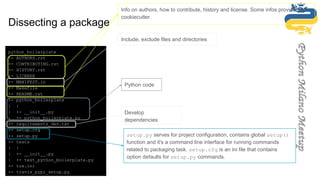
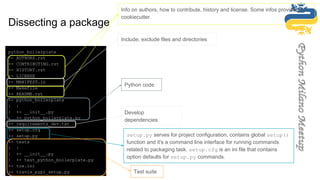
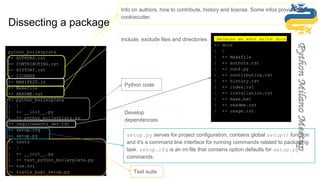
Info on authors, how to contribute, history and license. Some infos
provided by cookiecutter.
Dissecting a package
python_boilerplate
+- AUTHORS.rst
+- CONTRIBUTING.rst
+- HISTORY.rst
+- LICENSE
+- MANIFEST.in
+- Makefile
+- README.rst
+- python_boilerplate
| |
| +- __init__.py
| +- python_boilerplate.py
+- requirements_dev.txt
+- setup.cfg
+- setup.py
+- tests
| |
| +- __init__.py
| +- test_python_boilerplate.py
+- tox.ini
+- travis_pypi_setup.py
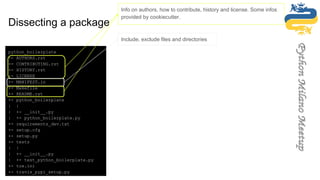
Info on authors, how to contribute, history and license. Some infos
provided by cookiecutter.
Include, exclude files and directories
Dissecting a package
python_boilerplate
+- AUTHORS.rst
+- CONTRIBUTING.rst
+- HISTORY.rst
+- LICENSE
+- MANIFEST.in
+- Makefile
+- README.rst
+- python_boilerplate
| |
| +- __init__.py
| +- python_boilerplate.py
+- requirements_dev.txt
+- setup.cfg
+- setup.py
+- tests
| |
| +- __init__.py
| +- test_python_boilerplate.py
+- tox.ini
+- travis_pypi_setup.py
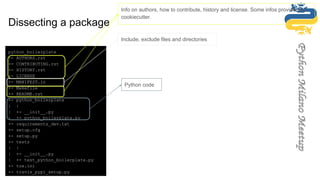
Info on authors, how to contribute, history and license. Some infos provided by
cookiecutter.
Python code
Include, exclude files and directories
Dissecting a package
python_boilerplate
+- AUTHORS.rst
+- CONTRIBUTING.rst
+- HISTORY.rst
+- LICENSE
+- MANIFEST.in
+- Makefile
+- README.rst
+- python_boilerplate
| |
| +- __init__.py
| +- python_boilerplate.py
+- requirements_dev.txt
+- setup.cfg
+- setup.py
+- tests
| |
| +- __init__.py
| +- test_python_boilerplate.py
+- tox.ini
+- travis_pypi_setup.py
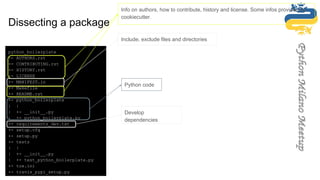
Info on authors, how to contribute, history and license. Some infos provided by
cookiecutter.
Python code
Include, exclude files and directories
Develop
dependencies
Dissecting a package
python_boilerplate
+- AUTHORS.rst
+- CONTRIBUTING.rst
+- HISTORY.rst
+- LICENSE
+- MANIFEST.in
+- Makefile
+- README.rst
+- python_boilerplate
| |
| +- __init__.py
| +- python_boilerplate.py
+- requirements_dev.txt
+- setup.cfg
+- setup.py
+- tests
| |
| +- __init__.py
| +- test_python_boilerplate.py
+- tox.ini
+- travis_pypi_setup.py
Info on authors, how to contribute, history and license. Some infos provided by
cookiecutter.
Python code
Include, exclude files and directories
Develop
dependencies
setup.py serves for project configuration, contains global setup()
function and it's a command line interface for running commands
related to packaging task. setup.cfg is an ini file that contains
option defaults for setup.py commands.
Dissecting a package
python_boilerplate
+- AUTHORS.rst
+- CONTRIBUTING.rst
+- HISTORY.rst
+- LICENSE
+- MANIFEST.in
+- Makefile
+- README.rst
+- python_boilerplate
| |
| +- __init__.py
| +- python_boilerplate.py
+- requirements_dev.txt
+- setup.cfg
+- setup.py
+- tests
| |
| +- __init__.py
| +- test_python_boilerplate.py
+- tox.ini
+- travis_pypi_setup.py
Info on authors, how to contribute, history and license. Some infos provided by
cookiecutter.
Python code
Include, exclude files and directories
Develop
dependencies
setup.py serves for project configuration, contains global setup()
function and it's a command line interface for running commands
related to packaging task. setup.cfg is an ini file that contains
option defaults for setup.py commands.
Test suite
Dissecting a package
python_boilerplate
+- AUTHORS.rst
+- CONTRIBUTING.rst
+- HISTORY.rst
+- LICENSE
+- MANIFEST.in
+- Makefile
+- README.rst
+- python_boilerplate
| |
| +- __init__.py
| +- python_boilerplate.py
+- requirements_dev.txt
+- setup.cfg
+- setup.py
+- tests
| |
| +- __init__.py
| +- test_python_boilerplate.py
+- tox.ini
+- travis_pypi_setup.py
Info on authors, how to contribute, history and license. Some infos provided by
cookiecutter.
Python code
Include, exclude files and directories
Test suite
Develop
dependencies
setup.py serves for project configuration, contains global setup() function
and it's a command line interface for running commands related to packaging
task. setup.cfg is an ini file that contains option defaults for setup.py
commands.
Dissecting a package
Because we want write docs!
+- docs
| |
| +- Makefile
| +- authors.rst
| +- conf.py
| +- contributing.rst
| +- history.rst
| +- index.rst
| +- installation.rst
| +- make.bat
| +- readme.rst
| +- usage.rst
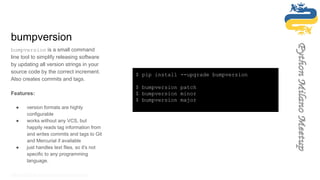
bumpversion
bumpversion is a small command
line tool to simplify releasing software
by updating all version strings in your
source code by the correct increment.
Also creates commits and tags.
Features:
● version formats are highly
configurable
● works without any VCS, but
happily reads tag information from
and writes commits and tags to Git
and Mercurial if available
● just handles text files, so it's not
specific to any programming
language.
https://github.com/peritus/bumpversion/
$ pip install --upgrade bumpversion
$ bumpversion patch
$ bumpversion minor
$ bumpversion major
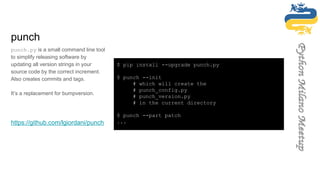
punch
punch.py is a small command line tool
to simplify releasing software by
updating all version strings in your
source code by the correct increment.
Also creates commits and tags.
It’s a replacement for bumpversion.
https://github.com/lgiordani/punch
$ pip install --upgrade punch.py
$ punch --init
# which will create the
# punch_config.py
# punch_version.py
# in the current directory
$ punch --part patch
...
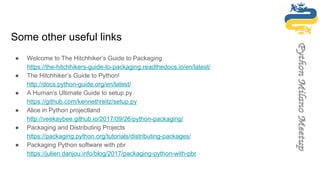
Some other useful links
● Welcome to The Hitchhiker’s Guide to Packaging
https://the-hitchhikers-guide-to-packaging.readthedocs.io/en/latest/
● The Hitchhiker’s Guide to Python!
http://docs.python-guide.org/en/latest/
● A Human's Ultimate Guide to setup.py.
https://github.com/kennethreitz/setup.py
● Alice in Python projectland
http://veekaybee.github.io/2017/09/26/python-packaging/
● Packaging and Distributing Projects
https://packaging.python.org/tutorials/distributing-packages/
● Packaging Python software with pbr
https://julien.danjou.info/blog/2017/packaging-python-with-pbr
PyPI
PyPI is a repository of software for
Python and currently count more than
76000 packages.
The PyPI repository provides
alternative locations that store the
packages.
You can create your own mirror,
following the PEP 381 or using a tool
such as pep381client
You can host your own private
repository: e.g. pypiserver can
easly do the job.
https://pypi.python.org/pypi
$ virtualenv cheeseshop
$ cd cheeshop ; . bin/activate
(cheeseshop) $ pip install pypiserver passlib
...
(cheeseshop) $ mkdir packages
(cheeseshop) $ pypi-server -p 8080 ~/packages
$ cat .pypirc
[distutils]
index-servers =
pypi
myPyPi
[pypi]
repository=https://pypi.python.org/pypi
username=
password=
[myPyPi]
repository=http://csgs1.pythonanywhere.com
username=foobar
password=barfoo
(env) $ pip install --extra-index-url
http://localhost:8080/simple/...
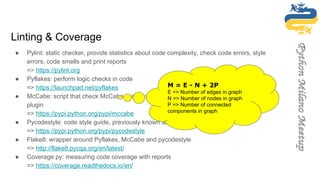
Linting & Coverage
● Pylint: static checker, provide statistics about code complexity, check code errors, style
errors, code smells and print reports
=> https://pylint.org
● Pyflakes: perform logic checks in code
=> https://launchpad.net/pyflakes
● McCabe: script that check McCabe complexity of code, used also as a Pylint and Flake8
plugin
=> https://pypi.python.org/pypi/mccabe
● Pycodestyle: code style guide, previously known as pep8
=> https://pypi.python.org/pypi/pycodestyle
● Flake8: wrapper around Pyflakes, McCabe and pycodestyle
=> http://flake8.pycqa.org/en/latest/
● Coverage.py: measuring code coverage with reports
=> https://coverage.readthedocs.io/en/
M = E - N + 2P
E => Number of edges in graph
N => Number of nodes in graph
P => Number of connected
components in graph
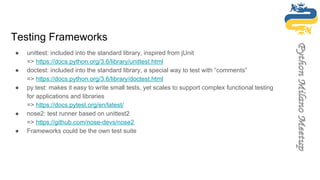
Testing Frameworks
● unittest: included into the standard library, inspired from jUnit
=> https://docs.python.org/3.6/library/unittest.html
● doctest: included into the standard library, a special way to test with “comments”
=> https://docs.python.org/3.6/library/doctest.html
● py.test: makes it easy to write small tests, yet scales to support complex functional testing
for applications and libraries
=> https://docs.pytest.org/en/latest/
● nose2: test runner based on unittest2
=> https://github.com/nose-devs/nose2
● Frameworks could be the own test suite
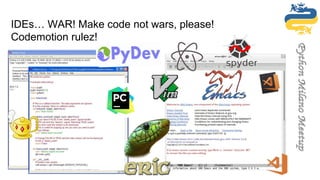
IDEs… WAR! Make code not wars, please!
Codemotion rulez!
Next Events
Python e la Fotografia
Astronomica Automatizzata
30/11/2017
https://pymi.eventbrite.com
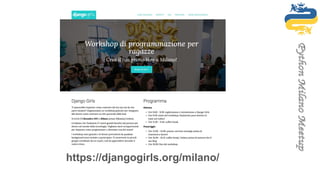
https://djangogirls.org/milano/
https://www.pycon.it/
Thanks!
Follow me!
@cstrap on Twitter, GitHub, Bitbucket, LinkendIn, Trello...
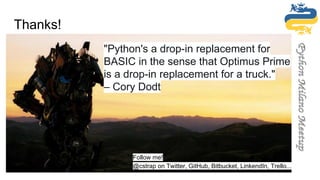
"Python's a drop-in replacement for
BASIC in the sense that Optimus Prime
is a drop-in replacement for a truck."
– Cory Dodt

Christian Strappazzon - Presentazione Python Milano - Codemotion Milano 2017

  • 1.
    Python Milano Meetup Christian‘Strap’ Strappazzon CODEMOTION MILAN - SPECIAL EDITION 10 – 11 NOVEMBER 2017
  • 2.
    Python Milano Aperto atutti, sviluppatrici, sviluppatori, appassionate e appassionati di Python
  • 3.
    Who We Are Whatwe do, why, how, when, where... Carlo Miron @cm Cesare Placanica @keobox Christian Strappazzon @cstrap Flavio Percoco @flaper87 Lorenzo Mele @greenkey Pietro Brunetti @gunzapper Simone Picciani @zanza00 http://milano.python.it/ Slack http://pythonmilano.herokuapp.com/ Join us!
  • 6.
  • 7.
    Python Blueprint The tools,the packages and the ecosystem @ Codemotion Milan 2017
  • 8.
    Pay attention! I’mnot the guy that play the guitar! I'm not the dev every team needs, but I'm the dev every team deserves. Perhaps I'm not the most productive programmer out there, but you sure contribute to increasing the team's overall productivity (I'm likely still more productive than most though). I'm often learning about new things, asking the right questions and getting everyone up to speed. I'm usually the person junior devs look up to and everyone likes working with. Any team is lucky having me! Last but not least I'm dad and family addicted.
  • 9.
    Agenda ● Which Python? ●pip ● virtualenv and virtualenvwrapper ● package patterns ● cookiecutter ● bumpversion & punch ● PyPI ● Linting, coverage and testing frameworks ● IDEs
  • 10.
    Which Python? Python 2or Python 3? Python 2 ending support on 2020. Install different interpreters: ● https://github.com/yyuu/pyenv lets you easily switch between multiple versions of Python. It's simple, unobtrusive, and follows the UNIX tradition of single-purpose tools that do one thing well. Compatibility solutions: ● http://python-future.org is the missing compatibility layer between Python 2 and Python 3. It allows you to use a single, clean Python 3.x-compatible codebase to support both Python 2 and Python 3 with minimal overhead. ● six provides simple utilities for wrapping over differences between Python 2 and Python 3. It is intended to support codebases that work on both Python 2 and 3 without modification. six consists of only one Python file, so it is painless to copy into a project. https://pythonhosted.org/six/
  • 11.
    pip pip is atool for installing and managing Python packages, such as those found in the Python Package Index (PyPI). pip is already installed if you're using Python 2 >=2.7.9 or Python 3 >=3.4 downloaded from python.org, but you'll need to upgrade pip. https://pip.pypa.io/en/stable/ $ pip install SomePackage $ pip install --upgrade package-name $ pip uninstall package-name $ pip search "query" # yolk or pipdeptree are two packages to view dependencies $ pip freeze > requirements.txt $ pip install -r requirements.txt pip install /path/to/SomePackage.1.1.1.tar.gz pip install http://myrepo.it/SomePakage-1.4.0.zip pip install -e git+http://github.com/django/django.git#egg= django pip install -e path/to/SomePackage pip install django>=1.7 # ==, >=, >, <, <=
  • 12.
    Pipenv: Python DevelopmentWorkflow for Humans The officially recommended Python packaging tool from Python.org, free (as in freedom). Pipenv is a tool that aims to bring the best of all packaging worlds (bundler, composer, npm, cargo, yarn, etc.) to the Python world. Windows is a first–class citizen, in our world. It automatically creates and manages a virtualenv for your projects, as well as adds/removes packages from your Pipfile as you install/uninstall packages. It also generates the ever–important Pipfile.lock, which is used to produce deterministic builds. https://github.com/kennethreitz/pipenv
  • 13.
    virtualenv virtualenv is atool to create isolated Python environments. Every virtualenv has pip installed in it automatically. Does not require root access or modify your system. Why? Isolation - Python packages and even version live in their own space Permissions - No sudoers, the environment is mine! Organization - each project can maintain its own requirements file of Python packages No-Globalization - don't require installing stuff globally on the system. https://virtualenv.readthedocs.org/en/latest/ $ virtualenv ENV # This creates a folder ENV in the $PWD # You'll find python packages on # ENV/lib/pythonX.X/site-packages $ virtualenv ENV --python=/path/to/bin/python # Doesn't inherit global site-packages # Use a different Python interpreter $ cd ENV ; . bin/activate (ENV) $ pip install django Downloading/unpacking django ... virtualenvwrapper is is a set of extensions to virtualenv tool. https://virtualenvwrapper.readthedocs.org/en/latest/ ● Organizes all of your virtual environments in one place. ● Wrappers for managing your virtual environments (create, delete, copy). ● Use a single command to switch between environments. ● Tab completion for commands that take a virtual environment as argument. ● User-configurable hooks for all operations. ● Plugin system for more creating sharable extensions.
  • 14.
  • 15.
    Package Patterns keep testcode in a separate root directory, commonly used for standalone modules as it allows us to distribute the code and tests together root | +- package | | | +- file1 | +- file2 | +- tests | +- test_file1 +- test_file2 root | +- package | +- file1 +- file2 +- tests | +- test_file1 +- test_file2 keep test code as a submodule of the main code and has an advantage when the application has to be packaged without the test code (e.g. deploying to production servers or distributing to customers) python_boilerplate | +- python_boilerplate | | | +- __init__.py | +- python_boilerplate.py | +- tests | +- __init__.py +- test_python_boilerplate.py src | +- python_boilerplate | +- __init__.py +- python_boilerplate.py +- tests | +- __init__.py +- test_python_boilerplate.py Excerpt From: “Test-Driven Python Development.”
  • 16.
    cookiecutter cookiecutter is acommand-line utility that creates projects from cookiecutters (project templates). Some features: Cross-platform: Windows, Mac, and Linux are officially supported. Works with Python 2.7, 3.3, 3.4, 3.5, and PyPy. (But you don't have to know/write Python code to use Cookiecutter.) Project templates can be in any programming language or markup format: Python, JavaScript, Ruby,... Simple command line usage. https://github.com/audreyr/cookiecutter $ pip install cookiecutter (env) $ cookiecutter gh:audreyr/cookiecutter-pypackage ... $ cat ~/.cookiecutterrc default_context: full_name: "Antani Tatablinda" email: "come.se.fosse@ntani.org" github_username: "antani" cookiecutters_dir: "~/.cookiecutters/" There’re some cookiecutters (aka Cookiecutter project templates) available for Python, Python-Django, C, C++, C#, Common Lisp, JavaScript, Kotlin, LaTeX/XeTeX, Berkshelf-Vagrant, HTML, Scala, 6502 Assembly Similar projects: Paste, Diecutter, Django‘s startproject and startapp commands, python-packager, Yeoman, Pyramid‘s pcreate command, mr.bob, grunt-init, scaffolt, init-skeleton, Cog, Skaffold and maybe others :-)
  • 17.
    Dissecting a package Let’sanalyze all files created by cookiecutter python_boilerplate +- AUTHORS.rst +- CONTRIBUTING.rst +- HISTORY.rst +- LICENSE +- MANIFEST.in +- Makefile +- README.rst +- python_boilerplate | | | +- __init__.py | +- python_boilerplate.py +- requirements_dev.txt +- setup.cfg +- setup.py +- tests | | | +- __init__.py | +- test_python_boilerplate.py +- tox.ini +- travis_pypi_setup.py
  • 18.
    python_boilerplate +- AUTHORS.rst +- CONTRIBUTING.rst +-HISTORY.rst +- LICENSE +- MANIFEST.in +- Makefile +- README.rst +- python_boilerplate | | | +- __init__.py | +- python_boilerplate.py +- requirements_dev.txt +- setup.cfg +- setup.py +- tests | | | +- __init__.py | +- test_python_boilerplate.py +- tox.ini +- travis_pypi_setup.py python_boilerplate +- AUTHORS.rst +- CONTRIBUTING.rst +- HISTORY.rst +- LICENSE +- MANIFEST.in +- Makefile +- README.rst +- python_boilerplate | | | +- __init__.py | +- python_boilerplate.py +- requirements_dev.txt +- setup.cfg +- setup.py +- tests | | | +- __init__.py | +- test_python_boilerplate.py +- tox.ini +- travis_pypi_setup.py Info on authors, how to contribute, history and license. Some infos provided by cookiecutter. Dissecting a package
  • 19.
    python_boilerplate +- AUTHORS.rst +- CONTRIBUTING.rst +-HISTORY.rst +- LICENSE +- MANIFEST.in +- Makefile +- README.rst +- python_boilerplate | | | +- __init__.py | +- python_boilerplate.py +- requirements_dev.txt +- setup.cfg +- setup.py +- tests | | | +- __init__.py | +- test_python_boilerplate.py +- tox.ini +- travis_pypi_setup.py Info on authors, how to contribute, history and license. Some infos provided by cookiecutter. Include, exclude files and directories Dissecting a package
  • 20.
    python_boilerplate +- AUTHORS.rst +- CONTRIBUTING.rst +-HISTORY.rst +- LICENSE +- MANIFEST.in +- Makefile +- README.rst +- python_boilerplate | | | +- __init__.py | +- python_boilerplate.py +- requirements_dev.txt +- setup.cfg +- setup.py +- tests | | | +- __init__.py | +- test_python_boilerplate.py +- tox.ini +- travis_pypi_setup.py Info on authors, how to contribute, history and license. Some infos provided by cookiecutter. Python code Include, exclude files and directories Dissecting a package
  • 21.
    python_boilerplate +- AUTHORS.rst +- CONTRIBUTING.rst +-HISTORY.rst +- LICENSE +- MANIFEST.in +- Makefile +- README.rst +- python_boilerplate | | | +- __init__.py | +- python_boilerplate.py +- requirements_dev.txt +- setup.cfg +- setup.py +- tests | | | +- __init__.py | +- test_python_boilerplate.py +- tox.ini +- travis_pypi_setup.py Info on authors, how to contribute, history and license. Some infos provided by cookiecutter. Python code Include, exclude files and directories Develop dependencies Dissecting a package
  • 22.
    python_boilerplate +- AUTHORS.rst +- CONTRIBUTING.rst +-HISTORY.rst +- LICENSE +- MANIFEST.in +- Makefile +- README.rst +- python_boilerplate | | | +- __init__.py | +- python_boilerplate.py +- requirements_dev.txt +- setup.cfg +- setup.py +- tests | | | +- __init__.py | +- test_python_boilerplate.py +- tox.ini +- travis_pypi_setup.py Info on authors, how to contribute, history and license. Some infos provided by cookiecutter. Python code Include, exclude files and directories Develop dependencies setup.py serves for project configuration, contains global setup() function and it's a command line interface for running commands related to packaging task. setup.cfg is an ini file that contains option defaults for setup.py commands. Dissecting a package
  • 23.
    python_boilerplate +- AUTHORS.rst +- CONTRIBUTING.rst +-HISTORY.rst +- LICENSE +- MANIFEST.in +- Makefile +- README.rst +- python_boilerplate | | | +- __init__.py | +- python_boilerplate.py +- requirements_dev.txt +- setup.cfg +- setup.py +- tests | | | +- __init__.py | +- test_python_boilerplate.py +- tox.ini +- travis_pypi_setup.py Info on authors, how to contribute, history and license. Some infos provided by cookiecutter. Python code Include, exclude files and directories Develop dependencies setup.py serves for project configuration, contains global setup() function and it's a command line interface for running commands related to packaging task. setup.cfg is an ini file that contains option defaults for setup.py commands. Test suite Dissecting a package
  • 24.
    python_boilerplate +- AUTHORS.rst +- CONTRIBUTING.rst +-HISTORY.rst +- LICENSE +- MANIFEST.in +- Makefile +- README.rst +- python_boilerplate | | | +- __init__.py | +- python_boilerplate.py +- requirements_dev.txt +- setup.cfg +- setup.py +- tests | | | +- __init__.py | +- test_python_boilerplate.py +- tox.ini +- travis_pypi_setup.py Info on authors, how to contribute, history and license. Some infos provided by cookiecutter. Python code Include, exclude files and directories Test suite Develop dependencies setup.py serves for project configuration, contains global setup() function and it's a command line interface for running commands related to packaging task. setup.cfg is an ini file that contains option defaults for setup.py commands. Dissecting a package Because we want write docs! +- docs | | | +- Makefile | +- authors.rst | +- conf.py | +- contributing.rst | +- history.rst | +- index.rst | +- installation.rst | +- make.bat | +- readme.rst | +- usage.rst
  • 25.
    bumpversion bumpversion is asmall command line tool to simplify releasing software by updating all version strings in your source code by the correct increment. Also creates commits and tags. Features: ● version formats are highly configurable ● works without any VCS, but happily reads tag information from and writes commits and tags to Git and Mercurial if available ● just handles text files, so it's not specific to any programming language. https://github.com/peritus/bumpversion/ $ pip install --upgrade bumpversion $ bumpversion patch $ bumpversion minor $ bumpversion major
  • 26.
    punch punch.py is asmall command line tool to simplify releasing software by updating all version strings in your source code by the correct increment. Also creates commits and tags. It’s a replacement for bumpversion. https://github.com/lgiordani/punch $ pip install --upgrade punch.py $ punch --init # which will create the # punch_config.py # punch_version.py # in the current directory $ punch --part patch ...
  • 27.
    Some other usefullinks ● Welcome to The Hitchhiker’s Guide to Packaging https://the-hitchhikers-guide-to-packaging.readthedocs.io/en/latest/ ● The Hitchhiker’s Guide to Python! http://docs.python-guide.org/en/latest/ ● A Human's Ultimate Guide to setup.py. https://github.com/kennethreitz/setup.py ● Alice in Python projectland http://veekaybee.github.io/2017/09/26/python-packaging/ ● Packaging and Distributing Projects https://packaging.python.org/tutorials/distributing-packages/ ● Packaging Python software with pbr https://julien.danjou.info/blog/2017/packaging-python-with-pbr
  • 28.
    PyPI PyPI is arepository of software for Python and currently count more than 76000 packages. The PyPI repository provides alternative locations that store the packages. You can create your own mirror, following the PEP 381 or using a tool such as pep381client You can host your own private repository: e.g. pypiserver can easly do the job. https://pypi.python.org/pypi $ virtualenv cheeseshop $ cd cheeshop ; . bin/activate (cheeseshop) $ pip install pypiserver passlib ... (cheeseshop) $ mkdir packages (cheeseshop) $ pypi-server -p 8080 ~/packages $ cat .pypirc [distutils] index-servers = pypi myPyPi [pypi] repository=https://pypi.python.org/pypi username= password= [myPyPi] repository=http://csgs1.pythonanywhere.com username=foobar password=barfoo (env) $ pip install --extra-index-url http://localhost:8080/simple/...
  • 29.
    Linting & Coverage ●Pylint: static checker, provide statistics about code complexity, check code errors, style errors, code smells and print reports => https://pylint.org ● Pyflakes: perform logic checks in code => https://launchpad.net/pyflakes ● McCabe: script that check McCabe complexity of code, used also as a Pylint and Flake8 plugin => https://pypi.python.org/pypi/mccabe ● Pycodestyle: code style guide, previously known as pep8 => https://pypi.python.org/pypi/pycodestyle ● Flake8: wrapper around Pyflakes, McCabe and pycodestyle => http://flake8.pycqa.org/en/latest/ ● Coverage.py: measuring code coverage with reports => https://coverage.readthedocs.io/en/ M = E - N + 2P E => Number of edges in graph N => Number of nodes in graph P => Number of connected components in graph
  • 30.
    Testing Frameworks ● unittest:included into the standard library, inspired from jUnit => https://docs.python.org/3.6/library/unittest.html ● doctest: included into the standard library, a special way to test with “comments” => https://docs.python.org/3.6/library/doctest.html ● py.test: makes it easy to write small tests, yet scales to support complex functional testing for applications and libraries => https://docs.pytest.org/en/latest/ ● nose2: test runner based on unittest2 => https://github.com/nose-devs/nose2 ● Frameworks could be the own test suite
  • 31.
    IDEs… WAR! Makecode not wars, please! Codemotion rulez!
  • 32.
  • 33.
    Python e laFotografia Astronomica Automatizzata 30/11/2017 https://pymi.eventbrite.com
  • 34.
  • 35.
  • 36.
    Thanks! Follow me! @cstrap onTwitter, GitHub, Bitbucket, LinkendIn, Trello... "Python's a drop-in replacement for BASIC in the sense that Optimus Prime is a drop-in replacement for a truck." – Cory Dodt