Welcome to the Cheese Shop
setuptools, virtualenv and PyPUG
Dale Visser
https://dalevisser.wordpress.com/
Outline
● Cheese Shop?
● Setuptools
● Sdists, Eggs and Wheels
● Demo of pip and virtualenv
● Online Resources
● Conclusion
Image credit: http://www.clker.com/clipart-cheese-wheel.html
Cheese Shop?
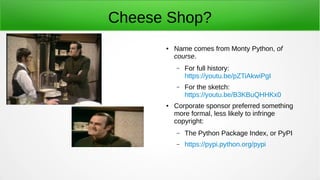
● Name comes from Monty Python, of
course.
– For full history:
https://youtu.be/pZTiAkwiPgI
– For the sketch:
https://youtu.be/B3KBuQHHKx0
● Corporate sponsor preferred something
more formal, less likely to infringe
copyright:
– The Python Package Index, or PyPI
– https://pypi.python.org/pypi
Setuptools (1/2)
https://bitbucket.org/pypa/setuptools
from setuptools import setup, find_packages
setup(
    name = "HelloWorld",
    version = "0.1",
    packages = find_packages(),
    scripts = ['say_hello.py'],
    # Project uses reStructuredText, so ensure that the docutils get
    # installed or upgraded on the target machine
    install_requires = ['docutils>=0.3'],
    package_data = {
        # If any package contains *.txt or *.rst files, include them:
        '': ['*.txt', '*.rst'],
        # And include any *.msg files found in the 'hello' package, too:
        'hello': ['*.msg'],
    },
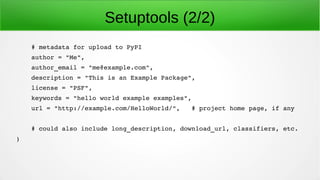
Setuptools (2/2)
    # metadata for upload to PyPI
    author = "Me",
    author_email = "me@example.com",
    description = "This is an Example Package",
    license = "PSF",
    keywords = "hello world example examples",
    url = "http://example.com/HelloWorld/",   # project home page, if any
    # could also include long_description, download_url, classifiers, etc.
)
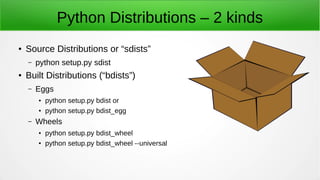
Python Distributions – 2 kinds
● Source Distributions or “sdists”
– python setup.py sdist
● Built Distributions (“bdists”)
– Eggs
● python setup.py bdist or
● python setup.py bdist_egg
– Wheels
●
python setup.py bdist_wheel
● python setup.py bdist_wheel --universal
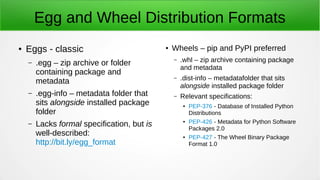
Egg and Wheel Distribution Formats
● Eggs - classic
– .egg – zip archive or folder
containing package and
metadata
– .egg-info – metadata folder that
sits alongside installed package
folder
– Lacks formal specification, but is
well-described:
http://bit.ly/egg_format
● Wheels – pip and PyPI preferred
– .whl – zip archive containing package
and metadata
– .dist-info – metadatafolder that sits
alongside installed package folder
– Relevant specifications:
● PEP-376 - Database of Installed Python
Distributions
● PEP-426 - Metadata for Python Software
Packages 2.0
● PEP-427 - The Wheel Binary Package
Format 1.0
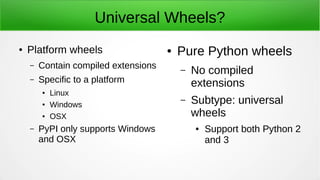
Universal Wheels?
● Platform wheels
– Contain compiled extensions
– Specific to a platform
●
Linux
● Windows
● OSX
– PyPI only supports Windows
and OSX
● Pure Python wheels
– No compiled
extensions
– Subtype: universal
wheels
● Support both Python 2
and 3
pip and virtualenv demo
Online Resources
● Your first, best resource is this:
https://packaging.python.org/
– It is a collaborative resource created by the PyPI
people. E.g., find out about twine
● Also, you can “pip install” from git
repos!: http://bit.ly/pip_vcs
Image credit: http://www.clker.com/clipart-9829.html
Conclusion
● This talk just scratched the surface.
● Keeping your library-dependent software
secure:
– Have a look at OWASP Dependency Check.
– With any luck, a near-future release will be Python-
aware.
This work is licensed under the Creative
Commons Attribution-ShareAlike 4.0 International
License. To view a copy of this license, visit
http://creativecommons.org/licenses/by-sa/4.0/ or
send a letter to Creative Commons, PO Box 1866,
Mountain View, CA 94042, USA.

Welcome to the Cheese Shop: setuptools, virtualenv and PyPUG