Data Points to Success:  Getting Started with a Database for Your Organization   Kevin Lo Lead Technology Analyst July 19 th , 2011
We are working toward a time when every social benefit organization on the planet has the technology resources and knowledge they need to operate at their full potential.
45+ US TechSoup Donor Partners
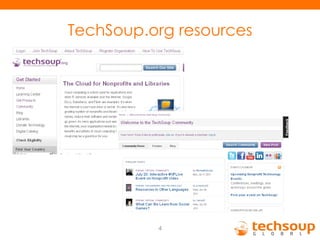
TechSoup.org resources
Overview Logic model review Planning your database Resourcing  Decision points The future of data
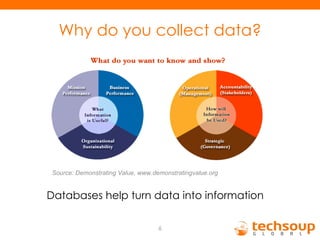
Why do you collect data? Source: Demonstrating Value, www.demonstratingvalue.org Databases help turn data into information
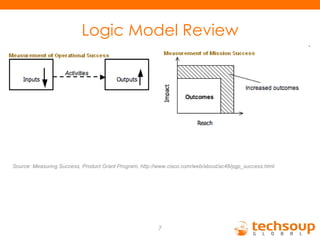
Logic Model Review Source: Measuring Success, Product Grant Program, http://www.cisco.com/web/about/ac48/pgp_success.html
Planning your database Current and future data What sort of data do you have already? What data do you wish you collected? Business processes Who handles your data? (ie. data flow) Are there areas of improvement? Reporting How can you better assess your performance? What kind of report would you like to produce for your board/funders/supporters?
Requisite Resources Don’t expect a database to be “one time expense” Will include both capital and operating expenditures (“CapEx” vs “OpEx”) Acquisition costs Ongoing costs Maintenance costs
Things to ask yourselves Off-the-shelf vs customized? Online vs. Offline? How open/secure do you want your data?  Who needs to access what data? How much interoperability do you need?  What platforms do you run?
Plan of action RFP Prepare a budget Setting a timeframe  Determine deliverables Review and correct
Advanced data Business Intelligence Analytics  Infographics Benchmarking and dashboards Un/Semi/structured data
Additional Resources http://www.techsoup.org/learningcenter/databases/archives/page10161.cfm  - Database Planning Guide http://www.mckinsey.com/mgi/publications/big_data/index.asp  - McKinsey Big Data Report
Questions and Comments? [email_address]

Choosing a Database

  • 1.
    Data Points toSuccess: Getting Started with a Database for Your Organization Kevin Lo Lead Technology Analyst July 19 th , 2011
  • 2.
    We are workingtoward a time when every social benefit organization on the planet has the technology resources and knowledge they need to operate at their full potential.
  • 3.
    45+ US TechSoupDonor Partners
  • 4.
  • 5.
    Overview Logic modelreview Planning your database Resourcing Decision points The future of data
  • 6.
    Why do youcollect data? Source: Demonstrating Value, www.demonstratingvalue.org Databases help turn data into information
  • 7.
    Logic Model ReviewSource: Measuring Success, Product Grant Program, http://www.cisco.com/web/about/ac48/pgp_success.html
  • 8.
    Planning your databaseCurrent and future data What sort of data do you have already? What data do you wish you collected? Business processes Who handles your data? (ie. data flow) Are there areas of improvement? Reporting How can you better assess your performance? What kind of report would you like to produce for your board/funders/supporters?
  • 9.
    Requisite Resources Don’texpect a database to be “one time expense” Will include both capital and operating expenditures (“CapEx” vs “OpEx”) Acquisition costs Ongoing costs Maintenance costs
  • 10.
    Things to askyourselves Off-the-shelf vs customized? Online vs. Offline? How open/secure do you want your data? Who needs to access what data? How much interoperability do you need? What platforms do you run?
  • 11.
    Plan of actionRFP Prepare a budget Setting a timeframe Determine deliverables Review and correct
  • 12.
    Advanced data BusinessIntelligence Analytics Infographics Benchmarking and dashboards Un/Semi/structured data
  • 13.
    Additional Resources http://www.techsoup.org/learningcenter/databases/archives/page10161.cfm - Database Planning Guide http://www.mckinsey.com/mgi/publications/big_data/index.asp - McKinsey Big Data Report
  • 14.
    Questions and Comments?[email_address]

Editor's Notes

  • #7 Not just about another piece of software in the office Data is how you show the value you deliver to the community
  • #8 You can’t show your impact without the proper data in place
  • #9 Sample data for WCCS -staff hours, expenses, events held, Current and future data -migrate reasonable amount of data, past data is nice-to-have but no need to Business processes -databases should create inefficiencies and self-serve model (“where’s that report”) Reporting -grant proposals/reports -campaign appeals
  • #10 acquisitions costs cover more than just software, could be hardware, improved networking Buy-in throughout your organization Products from TechSoup – MS Access, SQL Server, Filemaker, CRM
  • #11 Not binary answers, gradients privilege levels data sharing platforms Mobile?
  • #13 Data explosion eg. Social data, geolocation