Chlamydia Trachomatis 
Infection 
Lena Wahyu Setianingsih
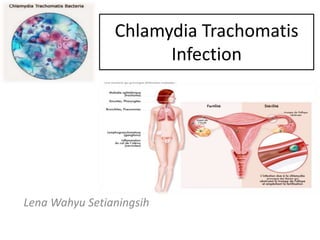
DEFINISI 
• Chlamydia adalah penyakit menular seksual (STD) yang 
disebabkan oleh infeksi Chlamydia trachomatis. (CDC, 
2014) 
• Hal ini dapat menyebabkan servisitis pada wanita dan 
uretritis dan proctitis baik pada pria maupun wanita. 
• Infeksi klamidia pada wanita dapat menyebabkan 
konsekuensi serius termasuk penyakit radang panggul 
(PID), infertilitas faktor tuba, kehamilan ektopik, dan 
nyeri panggul kronis. (CDC, 2014)
ETIOLOGI 
• Chlamydia trachomatis serotype D-K
TRANSMISI 
Penularan C. 
trachomatis 
Kontak 
SEKSUAL dgn 
Pasangan 
Terinfeksi 
Dari ibu -> bayi 
(Saat Persalinan) 
Kontak Seksual 
• Vagina 
• Penis 
• Anus 
• Oral
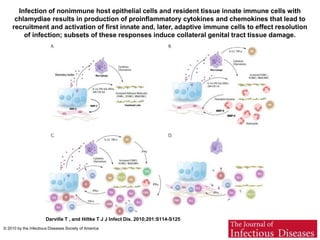
PATOFISIOLOGI 
Siklus Hidup Chlamydia trachomatis
Infection of nonimmune host epithelial cells and resident tissue innate immune cells with 
chlamydiae results in production of proinflammatory cytokines and chemokines that lead to 
recruitment and activation of first innate and, later, adaptive immune cells to effect resolution 
of infection; subsets of these responses induce collateral genital tract tissue damage. 
Darville T , and Hiltke T J J Infect Dis. 2010;201:S114-S125 
© 2010 by the Infectious Diseases Society of America
Manifestasi Klinis Pada Laki-laki... 
• Masa Inkubasi : 1-3 minggu 
• Gejala uretritis => uretra 
discharge berlendir atau 
berair & disuria. 
• Sebagian kecil => 
Berkembang jd epididimitis 
(dengan atau tanpa gejala 
uretritis) 
– nyeri unilateral testis & 
swelling.
Manifestasi Klinis Pada Perempuan... 
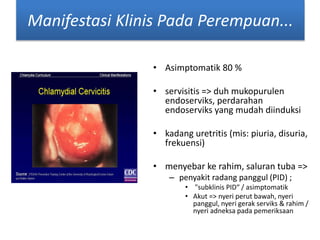
• Asimptomatik 80 % 
• servisitis => duh mukopurulen 
endoserviks, perdarahan 
endoserviks yang mudah diinduksi 
• kadang uretritis (mis: piuria, disuria, 
frekuensi) 
• menyebar ke rahim, saluran tuba => 
– penyakit radang panggul (PID) ; 
• "subklinis PID“ / asimptomatik 
• Akut => nyeri perut bawah, nyeri 
panggul, nyeri gerak serviks & rahim / 
nyeri adneksa pada pemeriksaan
DAFTAR PUSTAKA 
• Centers for Disease Control and Prevention (CDC). 
2014. Chlamydia-CDC Fact. 
http://www.cdc.gov/std/chlamydia/stdfact-chlamydia- 
detailed.htm (Diakses 9 Desember 
2014) 
• Kelley Struble. 2014. Chlamydial Genitourinary 
Infections. Madscape. 
http://emedicine.medscape.com/article/214823- 
overview#a0104 (diakses 9 Desember 2014)
• Darville, Toni., Hiltke, Thomas. 2010. 
Pathogenesis of Genital Tract Disease Due to 
Chlamydia trachomatis. Oxford Journals. 
http://jid.oxfordjournals.org/content/201/Sup 
plement_2/S114.full (Diakses 9 Desember 
2014)

Chlamydia trachomatis (Definisi, Etiologi, Patofisiologi dan Manifestasi Klinis)

  • 1.
    Chlamydia Trachomatis Infection Lena Wahyu Setianingsih
  • 2.
    DEFINISI • Chlamydiaadalah penyakit menular seksual (STD) yang disebabkan oleh infeksi Chlamydia trachomatis. (CDC, 2014) • Hal ini dapat menyebabkan servisitis pada wanita dan uretritis dan proctitis baik pada pria maupun wanita. • Infeksi klamidia pada wanita dapat menyebabkan konsekuensi serius termasuk penyakit radang panggul (PID), infertilitas faktor tuba, kehamilan ektopik, dan nyeri panggul kronis. (CDC, 2014)
  • 3.
    ETIOLOGI • Chlamydiatrachomatis serotype D-K
  • 4.
    TRANSMISI Penularan C. trachomatis Kontak SEKSUAL dgn Pasangan Terinfeksi Dari ibu -> bayi (Saat Persalinan) Kontak Seksual • Vagina • Penis • Anus • Oral
  • 5.
    PATOFISIOLOGI Siklus HidupChlamydia trachomatis
  • 6.
    Infection of nonimmunehost epithelial cells and resident tissue innate immune cells with chlamydiae results in production of proinflammatory cytokines and chemokines that lead to recruitment and activation of first innate and, later, adaptive immune cells to effect resolution of infection; subsets of these responses induce collateral genital tract tissue damage. Darville T , and Hiltke T J J Infect Dis. 2010;201:S114-S125 © 2010 by the Infectious Diseases Society of America
  • 9.
    Manifestasi Klinis PadaLaki-laki... • Masa Inkubasi : 1-3 minggu • Gejala uretritis => uretra discharge berlendir atau berair & disuria. • Sebagian kecil => Berkembang jd epididimitis (dengan atau tanpa gejala uretritis) – nyeri unilateral testis & swelling.
  • 10.
    Manifestasi Klinis PadaPerempuan... • Asimptomatik 80 % • servisitis => duh mukopurulen endoserviks, perdarahan endoserviks yang mudah diinduksi • kadang uretritis (mis: piuria, disuria, frekuensi) • menyebar ke rahim, saluran tuba => – penyakit radang panggul (PID) ; • "subklinis PID“ / asimptomatik • Akut => nyeri perut bawah, nyeri panggul, nyeri gerak serviks & rahim / nyeri adneksa pada pemeriksaan
  • 11.
    DAFTAR PUSTAKA •Centers for Disease Control and Prevention (CDC). 2014. Chlamydia-CDC Fact. http://www.cdc.gov/std/chlamydia/stdfact-chlamydia- detailed.htm (Diakses 9 Desember 2014) • Kelley Struble. 2014. Chlamydial Genitourinary Infections. Madscape. http://emedicine.medscape.com/article/214823- overview#a0104 (diakses 9 Desember 2014)
  • 12.
    • Darville, Toni.,Hiltke, Thomas. 2010. Pathogenesis of Genital Tract Disease Due to Chlamydia trachomatis. Oxford Journals. http://jid.oxfordjournals.org/content/201/Sup plement_2/S114.full (Diakses 9 Desember 2014)

Editor's Notes

  • #3 Proctitis : peradangan pada rectum dan anus
  • #7 Infection of nonimmune host epithelial cells and resident tissue innate immune cells with chlamydiae results in production of proinflammatory cytokines and chemokines that lead to recruitment and activation of first innate and, later, adaptive immune cells to effect resolution of infection; subsets of these responses induce collateral genital tract tissue damage. A, Infection of reproductive tract epithelium results in production of interleuken (IL)-1, tumor necrosis factor (TNF), IL-8, growth-related oncogene (GRO)-α, granulocyte-macrophage colony stimulating factor (GM-CSF), and IL-6, which induce increased expression of endothelial adhesion molecules that aid in the attraction of immune cells. Resident tissue macrophages also contribute to early release of cytokines and chemokines. Infected epithelial cells release matrix metalloproteases (MMPs) that contribute to tissue proteolysis and remodeling. B, Neutrophils, natural killer (NK) cells, and monocytes are rapidly recruited into the infected tissue site. Neutrophil release of MMPs and elastase contribute to tissue damage. C, NK cell production of interferon (IFN)-γ drives CD4 T cells toward the Th1 (IFN-γ-producing) phenotype, and a mixture of CD4, CD8, B cells, and plasma cells (PCs) infiltrate the infected tissue. Antibodies released from PCs inactivate extracellular elementary bodies (EBs), and T cell production of IFN-γ inhibits intracellular chlamydial replication. Th17 cell involvement has not yet been determined. D, After infection has resolved, inflammation abates, but chronic scarring may be the end result.