Running Header: How Non Profit Organizations Use and Misuse Social media
Non Profit Organizations and Social Media: An exploration into how Non Profit
Organizations use and misuse social media outlets utilizing framing and public spheres
A Thesis
Presented to the Faculty in Communication and Organizational Leadership
School of Professional Studies
Gonzaga University
Under the Supervision of Dr. Heather Crandall
Under the Mentorship of Dr. Carolyn Cunningham
In Partial Fulfillment
Of the Requirements for the Degree
Master of Arts in Communication and Organizational Leadership
By
Alexandra Chiulli
December 2014
2
2
How Non Profit Organizations Use and Misuse Social Media
ABSTRACT
This thesis researched how well social media works with NPOs to effectively
communicate with their supporters. Being in a technology age, NPOs have had to
embrace social media as being the main form of communication; however, this does not
mean that all like to use it. One of the main conflicts in NPOs using social media as the
main communicative tool is the loss of personal interaction with their supporters. NPOs
began with having to utilize interpersonal communication only and with the new age of
technology, they are struggling with keeping up with the different sites as well as the lack
of personal interaction with their supporters. Though the efficiency of social media is
appealing to NPOs, most are having difficulty finding the time and manpower to keep up
with the maintenance of the sites and maintaining the relevancy of their posts. This
requires more staff and for most NPOs, that is difficult as they do not have huge funds to
pay employees and this stands in the way of them hiring more staff. Thus, NPOs face the
problem of keeping relevant with their supporters if they are unable to maintain their
different social sites.
3
3
How Non Profit Organizations Use and Misuse Social Media
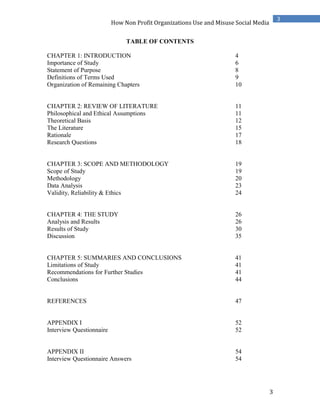
TABLE OF CONTENTS
CHAPTER 1: INTRODUCTION 4
Importance of Study 6
Statement of Purpose 8
Definitions of Terms Used 9
Organization of Remaining Chapters 10
CHAPTER 2: REVIEW OF LITERATURE 11
Philosophical and Ethical Assumptions 11
Theoretical Basis 12
The Literature 15
Rationale 17
Research Questions 18
CHAPTER 3: SCOPE AND METHODOLOGY 19
Scope of Study 19
Methodology 20
Data Analysis 23
Validity, Reliability & Ethics 24
CHAPTER 4: THE STUDY 26
Analysis and Results 26
Results of Study 30
Discussion 35
CHAPTER 5: SUMMARIES AND CONCLUSIONS 41
Limitations of Study 41
Recommendations for Further Studies 41
Conclusions 44
REFERENCES 47
APPENDIX I 52
Interview Questionnaire 52
APPENDIX II 54
Interview Questionnaire Answers 54
4
4
How Non Profit Organizations Use and Misuse Social Media
Chapter 1. Introduction
Introduction
Social media has the appearance of being beneficial for people in that they will be able to
connect with others so quickly and easily in order to chat, share pictures, find a new love
interest, etc. However, there are disadvantages of using social media as well, such as the
lack of human interaction, the lack of self-satisfaction and losing self-esteem. With
regard to non-profit organizations (NPOs) and the use of social media, the research
focuses on how social media enhances as well as cripples the messages that NPOs are
trying to raise awareness about or gain funding for. This thesis displays the themes of
how effective social media is in communicating effectively with supporters using
framing, how NPOs now have to depend upon the public sphere as a main tool of
communicating and the flaws that are still present in using social media as a main
communicative tool. The research focuses on how non-profits attempt to utilize social
media in order to better their organization and if these attempts are well executed or
perceived as effective tools vis a vis NPO goals.
Non-profit organizations have entered into the realm of appealing to the greater
public through the use of social media. Lovejoy and Saxton (2012) explain that
"organizations seem to employ new media for at least two primary purposes-information-
sharing and dialogic relationship-building" (Lovejoy & Saxton, 2012, p. 339). Lovejoy
and Saxton identified three major aspects of an organization's use of social media:
information, community and action. The "information" function involves spreading
information about the organization, its activities, or anything of potential interest to
followers. The second function, "community," explains how organizations can create
5
5
How Non Profit Organizations Use and Misuse Social Media
relationships, networks, and build communities on social media through aspects that
promote interactivity and dialogue. The third function, which we call "action," has the
aim of getting followers to ‘‘do something’’ for the organization, whether it is to donate,
buy a product, attend an event, join a movement, or launch a protest (Lovejoy & Saxton,
2012). These three functions aid the organizations in reaching new audiences as well as
spreading awareness of their cause to other communities along with their own.
In comparison to the Lovejoy and Saxton article, Waters and Lo (2012) explain
how the bulk of information shared in social media was related to organizational
disclosure and information sharing while relationship development through engagement
was virtually neglected. Their research found that " the most often used strategy was
providing photographs and posting discussion topics or statuses to generate discussions,
which resulted in comments from their followers" (Waters & Lo, 2012, p. 306). This
allows for the nonprofits to take note of what interests their followers as well as what
kind of activities generated the most funding and dialogue. The article states that
nonprofits were open to letting others know who they were as they frequently provided a
description of the organization (95.5%), linked to their organization’s website so that
users could learn more (80%), and provided the organization’s logo as a visual reminder
as to whom the organization is (71.6%) (Waters & Lo, 2012). Nonprofits generally share
significant information about their programs and results by distributing information
through news stories, discussion- wall conversations, photographs, and other information
exchange outlets Facebook and other social media provides. Waters and Lo (2012)
explains how "the focus on achievements and results has long been a mainstay of
nonprofit organizations websites around the globe as they rely on one-way directional
6
6
How Non Profit Organizations Use and Misuse Social Media
communication to develop organizational identity and publicize their successes" (Waters
& Lo, 2012, p. 313). This correlates to the ideas presented by the three major functions of
social media as discussed above in the Lovejoy and Saxton (2012) article. The theories
presented in each article outline the ways in which nonprofits utilize social media to gain
more support from the surrounding communities. Each theory explains the major
functions nonprofits use social media for as well as what type of reaction can be expected
by audiences. Having the ability to gage what type of reaction an audience is going to
have will aid NPOs in how to appeal to their audience more.
Importance of Study
Communications that help donors understand how their donations will be used to
help those in need is the single most important predictor for trust, commitment, and
satisfaction, and reinforces prior survey and focus group research (Sargeant 2001a,
2001b; Sargeant & Lee, 2002, 2004). Using social media allows for nonprofits to
communicate to their donors exactly what their donations are put towards. Social media
creates an easier way for nonprofits to communicate to present and future donors; the
donors have the ability to send in donations and learn everything they need to know about
the organization at their fingertips. NPOs are able to create structures for the donors and
audiences to follow in order to assist their community.
Nonprofit organizations (NPOs) use social media in order to connect closely to
the community members as well as to keep up to date with the values and beliefs of said
community. NPOs are ‘‘dominated by values and norms that define their behaviour and
are reflected in the way they function’’ (Hafsi & Thomas, 2005, p. 344). NPOs create a
"frame" for the intended audience to interpret the information given them in any way they
7
7
How Non Profit Organizations Use and Misuse Social Media
want. Audiences interpret information through their own frames. Audiences' frames may
overlap or contradict the media's frames ("Frames" n.d., para 2). They are dependent on
their publics and held to higher expectations than most for-profit entities. They are also
organizations that are shaped by the wants and needs of their external environments
(Hafsi & Thomas, 2005). Referring to the theory that NPOs are dominated by the values
and beliefs of the community members it is supporting, social media plays a constant role
in how NPOs should behave. Framing refers to how the media packages and presents
information to the public ("Frames" n.d., para 1). This assists the NPOs in narrowing on
what values they should be advertising to gain more support from the surrounding
communities. Framing works to shape and alter audience members' interpretations and
preferences through priming (Entman, 2007, p. 164). Framing allows for NPOs to focus
on what is seemingly most important to their audiences. Working in conjunction with the
theory of framing in this study is the public sphere. Habermas (1989) defines the public
sphere as the sphere of private people who join together to form a "public." This idea of
creating publics within a certain area of one's lifestyle pertains to the idea of the
audiences NPOs are attempting to connect with via social media. They use these public
spheres as a way to find those who truly support their cause as opposed to those who are
just looking over their site or information.
Public spheres assist NPOs in navigating through the different audiences they are
attempting to gain contact with as they are able to penetrate the different groups formed
over like public spheres. NPOs coordinate with the public's opinion of their organization
in order to become more appealing to said public. "Public opinion remains the object of
domination even when it forces the [organization] to make concessions or to reorient it"
8
8
How Non Profit Organizations Use and Misuse Social Media
(Habermas, 1989, p. 243). By dominating the public opinion through priming, a NPO can
remain the leader, so to speak, over the public sphere of their organization through
appealing to popular topics expressed by followers in their public sphere.
The word nonprofit implies a kind of organization that stands outside the laws of
economics—one that is exempt from the requirement to generate more cash than it
spends (Maguire, 2009). NPOs choose to advertise and promote through social media,
showing consumers another way to live apart from the vanity usually displayed- a way
that benefits others. With each new type of social media, there are new ways needed to be
discovered by the NPOs to reach their audiences. They are constantly competing amongst
each other to gain the most support or donations as well as competing as to how to appeal
the most to the different community members. However, in the literature focusing around
social media and nonprofits, there is a lack of information regarding how nonprofits
utilize social media in order to gain the attention of specific audiences. Therefore, the
intent of this study is to explain how nonprofits utilize the tools given to them by social
media to the best (or worst) of their ability. This will help audiences gain a better
understanding of the amount of effort NPOs put into displaying the main values and
beliefs of a community and how they try to reach out to the members.
Statement of the Problem
NPOs have the challenge of remaining relevant in their audiences lives through the use of
social media while creating meaningful relationships with these new audiences. NPOs
must maintain their pages every day with keeping the information shared up to date and
interesting to generate more attention from broader audiences. Found to be most
challenging is creating and maintaining relationships with more supporters through a
9
9
How Non Profit Organizations Use and Misuse Social Media
colder style of communication through social media. NPOs rely upon these relationships
to gain more support for their organization. Support is gained through word of mouth for
most NPOs as a way to spread awareness of their cause and create a personal relationship
for the organization with a supporter. By having more intimate communication with each
other, a supporter is able to be a part of the NPO family rather than just be an outsider
donator. The challenge that social media presents is one that makes being personal and
close with supporters much more difficult through computers, and more specifically the
demand of social media outlets.
Definitions
Social media refers to the means of interactions among people in which they create,
share, and/or exchange information and ideas in virtual communities and networks
according to Tufts University (2013).
The NPOs, for the purpose of this thesis, is defined as "small, community-based, groups
that heavily rely on volunteers. Nonprofit organizations [NPOs] tend to agree on shared
causes and are dedicated to a progressive process of social change for the betterment of
themselves and others" (Kenix, 2008, p. 409).
Framing theory and the concept of framing bias suggests that how something is presented
(the “frame”) influences the choices people make.
The public sphere is "a discursive space in which individuals and groups congregate to
discuss matters of mutual interest and, where possible, to reach a common judgment."
Further Outline
The rest of this thesis explores how well NPOs believe social media works in
effectively communicating with their supporters as well as if NPOs believe social media
10
10
How Non Profit Organizations Use and Misuse Social Media
to be the best way to communicate with supporters. Chapter 2 outlines the established
research about NPOs utilizing social media in order to effectively communicate with
supporters and donors and the communication theory that guides the work. It explores
what collected research has found out about how previously interviewed NPOs view
social media and if they feel it is effective or not. Chapter 3 discusses the scope and
methodology used in collecting the thesis data as well as the ethical concerns with regard
to social media and NPOs use of it. Chapter 4 analyzes the data collected through
interviews and study of the different social media sites used by the NPOs. It connects the
data found with already established communication theories of framing and public
sphere. Chapter 5 concludes the thesis with a summary of the findings as well as how to
further the research on how to use social media effectively to gain support for NPOs.
11
11
How Non Profit Organizations Use and Misuse Social Media
Chapter 2. REVIEW OF THE LITERATURE
PHILOSOPHICAL ASSUMPTIONS
With companies and organizations having the ability to reach audiences through
many different outlets, competition becomes a way of life for said organizations. Smaller
organizations, NPOs and local businesses can suffer somewhat from the availability of
the internet as they must rely upon exposure through social media in order to gain
awareness. The internet is able to create an even playing field for all NPOs to compete
upon; however, it is up to the audience to use social media effectively and correctly. This
relates to John Milton’s Areopagitica, in which he offered the initial theoretical predicate
for modern marketplace theory. The marketplace of ideas theory stands for the notion
that, with minimal government intervention—a laissez faire approach to the regulation of
speech and expression—ideas, theories, propositions, and movements will succeed or fail
on their own merits (Pinaire, 2014). NPOs need to have the discipline to create and
maintain the social media sites necessary to promoting the NPO to its fullest potential.
When using social media, the amount of success achieved through the use of said sites
becomes the responsibility of only the organization, or person, rather than the internet
itself.
In support of Milton's modern marketplace theory, John Stuart Mill expanded on
the notion, arguing that free expression was valuable on individual and social grounds
because it served to develop and sustain the rational capacity of man and, in an
instrumental sense, facilitated the search for truth (Pinaire, 2014). Milton and Mill
developed this philosophy to explain how an organization must take responsibility for all
actions taken through social media, accepting whether they succeed or fail as they can
12
12
How Non Profit Organizations Use and Misuse Social Media
only hold themselves responsible for the actions taken in marketing. NPOs, along with
many other organizations, tend to forget that "packaging" matters just as much as the
information they are trying to spread. If their social media sites are not interesting or
attention-grabbing, NPOs will realize that failure is more likely to occur as the audience
does not fully remember what they read about the NPO nor can they differentiate
between what the NPO informed them of as their mission and what hearsay they could
have heard about the NPO.
THEORETICAL BASIS
Communication—the use of available resources to convey information, to move,
to inspire, to persuade, to enlighten, to connect—is an inherently ethical undertaking.
Regardless of context, communication involves choice, reflects values, and has
consequences (Makau, 2009). NPOs must use communication outlets to connect with
their audience, which includes donors as well as supporters. Every choice made about
how a certain social media page should look or what they should say can greatly affect
how a message for a NPO is perceived by those attending to NPO messages.
Nonprofit organizations (NPOs) use social media in order to connect closely to
the community members as well as to keep up to date with the values and beliefs of said
community. NPOs are ‘‘dominated by values and norms that define their behaviour and
are reflected in the way they function’’ (Hafsi & Thomas, 2005, p. 344). NPOs create a
"frame" for the intended audience to interpret the information given them in any way they
want. Audiences interpret information through their own frames. Audiences' frames may
overlap or contradict the media's frames ("Frames" n.d., para 2). They are dependent on
their publics and held to higher expectations than most for-profit entities. They are also
13
13
How Non Profit Organizations Use and Misuse Social Media
organizations that are shaped by the wants and needs of their external environments
(Hafsi & Thomas, 2005). Referring to the theory that NPOs are dominated by the values
and beliefs of the community members it is supporting, social media plays a constant role
in how NPOs should behave. Framing refers to how the media packages and presents
information to the public ("Frames" n.d., para 1). This assists NPOs in narrowing on what
values they should be advertising to gain more support from the surrounding
communities. Framing works to shape and alter audience members' interpretations and
preferences through priming (Entman, 2007, p. 164). Framing allows for NPOs to focus
on what is seemingly most important to their audiences.
Working in conjunction with the theory of framing in this study is the public
sphere. Habermas (1989) defines the public sphere as the sphere of private people who
join together to form a "public." This idea of creating publics within a certain area of
one's lifestyle pertains to the idea of the audiences NPOs are attempting to connect with
via social media. They use these public spheres as a way to find those who truly support
their cause as opposed to those who are just looking over their site or information.
Communications that help donors understand how their donations will be used to help
those in need is the single most important predictor for trust, commitment, and
satisfaction, and reinforces prior survey and focus group research (Sargeant 2001a,
2001b; Sargeant & Lee, 2002, 2004). Using social media allows for nonprofits to
communicate to their donors exactly what their donations are put towards. Social media
creates an easier way for nonprofits to communicate to present and future donors who use
it; the donors have the ability to send in donations and learn everything they need to
14
14
How Non Profit Organizations Use and Misuse Social Media
know about the organization at their fingertips. NPOs are able to create structures for the
donors and audiences to follow in order to assist their community.
Public spheres assist NPOs in navigating through the different audiences they are
attempting to gain contact with as they are able to penetrate the different groups formed
over like public spheres. NPOs coordinate with the public's opinion of their organization
in order to become more appealing to said public. "Public opinion remains the object of
domination even when it forces the [organization] to make concessions or to reorient it"
(Habermas, 1989, p. 243). By dominating the public opinion through priming, a NPO can
remain the leader, so to speak, over the public sphere of their organization through
appealing to popular topics expressed by followers in their public sphere. For the purpose
of this study, working definitions of social media as well as social networking sites will
be provided. Social networking sites may be defined as:
Web-based services that allow individuals to (1) construct a public or semi-public
profile within a bounded system, (2) articulate a list of other users with whom they share
a connection, and (3) view and traverse their list of connections and those made by others
within the system. The nature and nomenclature of these connections may vary from site
to site (Boyd, D. & Ellison, N., 2007, p. 211).
These forums provide opportunities for different audiences to connect and discuss
different topics. This allows for these audiences to converse with the media
representatives for the social networking sites as they are who manage the sites.
Audiences are able to directly influence the representatives as they are able to
communicate one-on-one with said representatives. These sites give the opportunity for
people to come together over certain topics or ideas in order to be heard and possibly
15
15
How Non Profit Organizations Use and Misuse Social Media
make a difference in society. With respect to NPOs, social network sites provide these
organizations with the opportunity to reach their supporters at any time of day or night
and in any location.
Social media has many different benefits for businesses and organizations (NPOs)
such as increased brand recognition, improved brand loyalty, more opportunities to gain
supporters, higher conversion rates, higher brand authority, increased inbound traffic,
decreased marketing costs, better search engine rankings, more meaningful customer
experiences, and improved customer insights. (Forbes Magazine, 2014) NPOs are able to
utilize these advantages of social media in order to remain in contact with their
customers/ supporters as these are the people that want to be able to contact the NPOs at
any time and know they will get an answer. This is one of the drawbacks of social media
as well as social networking sites in that there has to be someone always maintaining the
sites and networks for the NPOs in order for them to stay relevant in their consumers'
daily lives.
The Literature
Recent literature documents the positive and negative effects that social media
outlets have on nonprofit organizations (NPOs). The word nonprofit implies a kind of
organization that stands outside the laws of economics—one that is exempt from the
requirement to generate more cash than it spends (Maguire, 2009). Social media
manipulates audiences that there is always something better out there for them to donate
to or spend money on. With the ideality of how accessible material items and businesses
are through the internet, it is not hard to believe that NPOs feel a lot of pressure with
trying to compete with World Wide Web. Light (2003), for instance, has argued that
16
16
How Non Profit Organizations Use and Misuse Social Media
“confidence clearly affects the public’s willingness to donate time and money, shapes the
political and regulatory environment that governs charitable organizations, and has at
least some influence on morale within the charitable workforce” (p. 1). NPOs have
begun to branch into social media in order to market and advertise to consumers in a way
that identifies with today's culture more.
The use of social media for fundraising allows nonprofits to receive money with
fewer restrictions, so they are not stuck in grant cycles where operational funding is so
urgently required that small nonprofits find themselves writing proposals tailored to
wishes of international NPOs and development institutions, having been persuaded away
from their original missions (Amtzis, 2014, p. 136).
Social media sites assist NPOs with low budget marketing for their organization
while also reaching multiple different audiences. The social media sites use a sense of
priming in order to outline for the NPOs how to proceed with their sites. NPOs utilize
priming and framing in order to prep their audiences for what changes they can expect
from the organization as the literature discusses. Social media, however, presents a
chaotic structure to gaining solidified support for NPOs. With each new type of social
media, there are new communicative strategies developed by NPOs to reach their
audiences. They are constantly competing amongst each other to gain the most support or
donations as well as competing as to how to appeal the most to the different community
members.
Practitioners have clearly adopted the more established and institutional tools (e-
mail, Intranet), yet they also seem comfortable with blogs and podcasts. They are slower
to integrate more technologically complicated tools that cater to a niche audience (e.g.,
17
17
How Non Profit Organizations Use and Misuse Social Media
text messaging, social networks, virtual worlds) (Eyrich, Padman, & Sweetser, 2008, pp.
413-414).
However, in the literature focusing around social media and nonprofits, there is a
lack of information regarding how nonprofits utilize social media in order to gain the
attention of specific audiences as nonprofit organizations often deliver services on behalf
of governments, particularly in the health and community sectors. Before Facebook was
created, there were other social sites; however, they would be blogs, company websites,
etc. Kenix (2008) discusses how NPOs are able to use these pre-Facebook social media in
order to broaden their ways of communicating to consumers. It examined how NPOs
needed to break into the commercial aspect of media instead of strictly relying on
interpersonal communication. Nonprofits are often open to intense public scrutiny and are
usually accountable to more than one stakeholder group (Brace-Govan, Brady, Brennan
& Conduit, 2011). Therefore, the intent of this study is to explain how nonprofits utilize
the tools given to them by social media to the best (or worst) of their ability in order to
market towards a broader audience. This will help audiences gain a better understanding
of the amount of effort NPOs put into displaying the main values and beliefs of a
community and how they try to reach out to the members. The processes by which an
organization collects and uses information are what provide the support for fundraising
performance (Brace-Govan, Brady, Brennan & Conduit, 2011). NPOs gain and retain
support through social media as they are utilizing one of the main resources used by the
majority of people in order to raise funds for their organization.
RATIONALE
18
18
How Non Profit Organizations Use and Misuse Social Media
An examination of how well NPOs utilize social media is desperately needed. The
literature currently published about this matter lacks details of the how effective the use
of social media is for NPOs. Explained is how they use the different social media sites,
but no one has truly touched upon insider perceptions of whether the social media
approach is working effectively for NPOs. It explains how NPOs use priming and
structuring in order to gain awareness of their sites. Strategic framing highlights the
causes of problems, to encourage moral judgments (and associated affective responses),
and to promote favored policies. Priming, then, is a name for the goal, the intended effect,
of strategic actors’ framing activities (Entman, 2007, p. 165). This study allows for an
opportunity to expand upon previous research and help fill in the gaps of what other
research articles are lacking. This study expands upon research that excludes how well
NPOs are grasping social media, how effective social media is in spreading awareness for
NPOs as well as how audiences react when they find a NPO on social media.
RESEARCH QUESTION(S)
RQ 1: How do NPOs effectively communicate through framing and priming with their
intended audience (s) through social media?
RQ 2: In what ways do NPOs solicit support from audiences?
19
19
How Non Profit Organizations Use and Misuse Social Media
CHAPTER 3
SCOPE
The scope of a NPO can range from NPOs raising funds for cancer awareness, or
a specific ill child, homeless animals, etc. Having this capability allows for NPOs to
capture a broad audience and able to dominate the market. However, with social media
being the most used/ sought after tool in society today, NPOs are losing their capabilities
to reach the audience in general. They are new to the social media market and this causes
NPOs to lose support as they are unable to appeal to broad enough audience. Nonprofits
have been designated to the outer limits of cyber space, nowhere near the heart of the
internet. This suggests "if nonprofits do not appropriate a commercial perspective, they
may find themselves to be an irrelevant irritant on the internet" (Kenix, 2008, p. 411).
This thesis chooses to study NPOs and their use of social media as it is a consistent
aggravation for NPOs that causes the groups to lose followers in this technology age.
Social media is a constant threat to NPOs as the sites offer little space for advertisements.
Ads must be flashy and attention grabbing right away. When referencing social media,
the NPOs may also have branched into utilization of the different social sites in order to
join the cyber-community of their followers. The pages created by NPOs to further the
awareness of their cause are not always produced with the best of one’s ability as the
NPOs view social media as a last resort or something not as important as word-of-mouth
or fundraising.
In this case, the data were collected through studying the posts made by NPOs
using social media, more specifically Facebook, Twitter, and Instagram. As all of these
sites named link together, mainly being examined will be the Facebook pages of the
20
20
How Non Profit Organizations Use and Misuse Social Media
organizations. The research will cover all posts made by a small focus group consisting
of five NPOs, whether it is advertising for the organization, celebrating, commemorating,
etc. a specific issue. The study focuses on the techniques used by the NPOs to creatively
market their ideas to different audiences. Specifically, any pictures posted as well as
comments made by the NPOs in order to gain followers as well as how said pictures and
posts portray a positive frame to market for a NPO or if there are negative effects from
using social media.
METHODOLOGY
This thesis utilizes rhetorical analysis, which is when researchers examine how
well a text, audience and author relate. This method seemed the most appropriate to apply
to the data as the thesis centers on how well the NPOs market to the broad audiences of
social media. "When writing a rhetorical analysis, you are NOT saying whether or not
you agree with the argument. Instead, you’re discussing how the rhetorician makes that
argument and whether or not the approach used is successful" (Texas A&M University,
2011). The research gathered focuses on how well NPOs communicate their message and
need for help through social media. Data collected examines how successful different
NPOs were in utilizes different social media sites as well as the different tools on each
site. The NPOs have to employ Neo-Aristotelian rhetoric, more specifically the aspect of
pathos, in order to grab the attention of audience members in order to assist their cause.
Focusing on invoking certain emotions in audiences allows NPOs to utilize rhetoric in a
way that brings them closer to the audience. NPOs will have advertisements on the sides
of social media sites, have their own pages on said sites, use TV and radio ads in order to
spread the awareness of their use of the social media sites, etc. NPOs need to expose their
21
21
How Non Profit Organizations Use and Misuse Social Media
reliability to the users as there are many false reports in social media. Reliability can be
defined as a measure’s stability, consistency and repeatability for this thesis (Rubin,
2010). In establishing their reliability, NPOs will have more viewers on their social
media sites as well as have research that provides evidence of the validity of their cause.
Utilizing rhetorical analysis, this thesis explores how NPOs address their
audiences through the Neo-Aristotelian style of rhetorical analysis as well as the variety
of social media sites. "From the earliest examples of rhetorical analysis to the present,
this analytical work has involved the analyst in interpreting the meaning of these textual
components--both in isolation and in combination--for the person (or people)
experiencing the text" (Zachry, 2009, p. 1). Through analyzing how well NPOs employ
rhetoric to gain awareness and followers, this thesis will discuss the most effective ways
to use social media in a way to profit, both financially and socially.
In order to collect data for the analysis, qualitative interviews were used in
conjunction with the Neo-Aristotelian rhetorical analysis. It is important to specify that
the interviews are qualitative, as rhetorical analysis is also a qualitative process thus
connecting the two. A qualitative interview allows for rapport to build and remain
between the interviewer and interviewee, which helps prolong the interview and extract
more information. With this type of interview, there are three types: descriptive,
structural, and contrast. For the purpose of this interview, the questions asked are
structural, and more specifically they are categorized as cover-term questions. "A cover-
term is a naturally occurring label for a given domain or grouping" (Chapter 14, p. 334).
Cover-terms are able to shed light on the different events that dictate membership into a
given domain. For example, one of the questions asked refers to NPOs using social media
22
22
How Non Profit Organizations Use and Misuse Social Media
and follows up with the question of what strategies are used within the said NPO. This
allows the interviewer to further probe into how a NPO uses social media while also
gaining more insight into the means that they assume are working most effectively.
“Field research interviewers watch for markers, a passing reference made [in a field
interview] by a respondent to an important event or feeling state” (Neuman, 2012, p.452).
Using these cover-term questions as a guide, the interview is laid out as an ethnographic
conversation. This allows for the interview to be conducted informally, with or without
the participants knowing the interviewer is a researcher. In this case, the participants were
aware of the researcher; however, an ethnographic conversation lends a more casual feel
to an interview, which then leads to the interviewee feeling more comfortable with the
whole process. When an interviewee is most comfortable, they are more willing to
discuss more in-depth information about their organization rather than answer in a more
cut-and-dry manner.
This type of interview is useful for the purpose of this research as it allows for the
interviewer to gain all knowledge of how participants feel about social media and NPOs,
what current strategies are being put in place to help NPOs navigate social media, as well
as the participants thoughts on what other resources are needed to make communication
more effective for the NPO through social media. Qualitative interviewing requires the
researcher to identify their purpose and design an interview plan of how to conduct said
interview. This works as well with this topic as the researcher structured the interview so
that main topics would be covered, i.e. the use of social media in NPOs, how the
members feel about social media, what needs to change within the social media aspect of
NPOs, etc., but they also allow for a more casual conversation and natural act to occur
23
23
How Non Profit Organizations Use and Misuse Social Media
between the interviewer and interviewee. Interview questions will be used to assess how
the participants and members of NPOs feel about the use of social media for advertising
for a NPO as well as if they feel that they are connecting to more audiences by marketing
through social media.
When an organization communicates solely through social media, people may
begin to question the authenticity of a NPO if they have no other source of marketing.
People would be able to see the NPO as a scam or fraud if there is no actual literature or
publications from the NPO besides what they post on social media. Social media in this
aspect should be used as an affirmation of the NPO’s authenticity rather than aiding in
fraud. Rubin (2010) defines validity, generally, as measuring what one intends to
measure; however, Rubin also introduces two types of validity: internal and external.
This thesis is utilizing the idea of external validity as it is defined in Rubin (2010) as the
results of empirical research studies that are generalizable to other people, times, etc. It is
the NPO’s responsibility to make sure that they have all information necessary and
needed for people to know that they are accredited as well as open about their efforts to
progress further. NPOs must be able to portray a strong message through the first look at
their social media sites in order to gain validity in the eyes of the audiences from the start.
If a NPO's most utilized way to promote their message is through social media,
people may begin to question the authenticity of a NPO if they offer no additional
source(s) of information to accredit their organization. NPOs should have published
works to post on their social media pages as well as links to their sponsors' sites as
features of their social media outlets. This allows the public to have access to an idea of
the truth that makes evident the authenticity of the NPO. Audiences need to be able to
24
24
How Non Profit Organizations Use and Misuse Social Media
rely on the information being presented to them via social media of NPOs. By carefully
formatting their information on the different social media sites, NPOs have an
opportunity to relay their most important messages directly to a community. This also
opens up windows for the different audiences of the different sites to research further into
the mission and research behind the NPO as well as the sponsorship gained.
Ethics
NPOs have the obligation of having to validate the reliability of their organization
in that there has to be reassurance for followers to know that what they are giving their
time and money towards is a worthy cause. Reliability is defined as a measure’s stability,
consistency, and repeatability (Rubin, Rubin, & Haridakis, 2010). In regard to NPOs, the
idea of reliability relates to how often an NPO is relaying the message of their cause,
showing what the volunteers and donations are being put towards as well as posting
further information regarding the research that the NPO is dedicated to.
Today's society is one that is in need of constant verification that they are not
being taken advantage of and that they have a solid idea to believe in. This is also where
validity ties into how reliable a source is. There are two types of validity: external and
internal. For the purpose of this thesis, external validity is found to be the most
reasonable for NPOs to utilize. External validity is the result of an empirical research
study that are generalizable to other people, situations, times, and so forth (Rubin et al.,
2010). An NPO's main goal is to connect with those around them in every way possible;
they want to show how much support they have for the surrounding communities as well
as how much they want to help others. The information published through the social
media sites for NPOs is crucial in that it must apply to the most people as possible in
25
25
How Non Profit Organizations Use and Misuse Social Media
order to gain more and more support. The more people that are able to identify with an
NPO's cause, the more donations and volunteers there will be. Utilizing external validity
allows NPOs to publish research articles and information that can be applied to many
different people in different situations that may just have one common goal.
26
26
How Non Profit Organizations Use and Misuse Social Media
Chapter 4
Analysis and Results
As discussed, NPOs have become to rely upon social media as a way to reach out
to their supporters and potential supporters. Social media sites have become the
predominant way in which organizations are able to collect donations and
volunteers/supporters. This thesis focuses on a small sample of NPOs, five in total, each
utilizing social media in the most efficient way they have discovered. With each of the
five NPOs, an interview was conducted in order to discover how the different NPOs use
social media, if they find it efficient and whether or not the organization believes there is
something to be improved upon for the social media sites.
The analysis of the transcripts for the interviews displays the connecting themes
of the public sphere using Neo-Aristotelian rhetoric as well as the application of framing
and priming. Utilizing these common themes, the findings from the transcripts are broken
up into three major sections. The first section will examine the different mission
statements of the NPOs in order to establish background information. The second section
explores how well the NPOs believe that social media assists them in communicating
with their intended audience (RQ1), while the third section explores how the NPOs gain
the support from audiences utilizing social media (RQ2).
Missions for Good Cause
The NPOs that participated were asked to summarize what the mission of their
organization was in order to provide a background of the cause they promote and why.
This section is going to explore each of the different mission statements and compare
how the different organizations market themselves through this statement. With a mission
27
27
How Non Profit Organizations Use and Misuse Social Media
statement, an organization must be able to convey a story of their journey as an NPO and
why they are dedicated to a specific cause. This allows for the NPOs to play off of the
pathos of viewers. The five NPOs that participated in this thesis were Mass General
Hospital (MGH), DOVE (Domestic Violence Ended, Inc.), Essex County Greenbelt,
Generations Inc., and City Year*. Having a variety in the NPOs interviewed allows for
more exploration of how different organizations have to adjust how they utilize social
media in comparison to other NPOs.
A mission statement is an NPO's first impression to make with viewers; this
statement is what draws people in to explore the website and research of the NPO further.
MGH's mission statement was summarized in the interview as follows: "Guided by the
needs of our patients and their families, we aim to deliver the very best health care in a
safe, compassionate environment; to advance that care through innovative research and
education; and to improve the health and well-being of the diverse communities we
serve." Michael Morrison, the marketing consultant interviewed, stated that MGH drives
towards change and with that, they are embracing social media to the best of their ability.
Their mission statement states that the organization is moving toward improving the
surrounding communities by bettering their health and well-being. This can be
accomplished through social media in that the NPOs have endless possibilities with how
they reach both old and new supporters utilizing these sites.
Having easy access to marketing for a specific cause or organization allows for
the organization to reach supporters instantaneously. Essex County Greenbelt declares
their mission as follows:
28
28
How Non Profit Organizations Use and Misuse Social Media
Since 1961, Greenbelt has been working to protect the farmland, wildlife habitat
and scenic landscapes for the benefit of all who live, work and enjoy the resources
in Essex County. Our work helps to maintain clean air and water, preserve the
fragile ecosystems that harbor native wildlife and plants, sustain farmland to
assure a safe, local food supply, and protect vulnerable scenic views and open
space that contribute to our region's unique quality of life.
Greenbelt focuses mainly on the environmental aspect of life; however, with social media
being as prevalent as it is, Greenbelt must be able to connect on a more human level with
their audiences. It may seem funny that through social media the NPO would be able to
make a more human approach, but in today's society, communicating through media is
that type of approach. Communicating via computers or smart phones has taken the place
of face-to-face communication, as it is more convenient to do so. Utilizing social media,
Greenbelt is able to add more human interaction amongst their environmental projects
and missions.
Social media is a way in which NPOs can connect on a more "human" level; it
also presents a safer way to communicate with those viewers who may be looking into
getting serious help. DOVE assists those who have been the victim of domestic violence
and offer their social sites as ways in which they can seek help in a safe way. Their
mission statement is as follows: "DOVE is committed to partnering with diverse
communities, families, and individuals impacted by domestic violence. We promote
hope, healing, safety, and social change by providing a broad range of preventive and
responsive services." They utilize social media sites in order to promote a safe
environment for those looking for help. They set up an option on the sites so that the site
29
29
How Non Profit Organizations Use and Misuse Social Media
will automatically close out if you need it to. DOVE makes their social media more
applicable to audiences by formatting their sites to cater to the needs of their audience
members. This allows audiences to see the enactment of DOVE's mission statement right
away before even researching more into their information.
In keeping organized, Generations Inc.'s mission statement is on display on their
website and it explains, "Generations Incorporated strives to improve the literacy skills of
young children through grade three. We do this by recruiting and training older adults to
serve as literacy tutors at our partner schools and after-school programs in low-income
communities." The recruiters and mentors help students develop better studying skills
and better ways to learn in the classroom. They utilize face-to-face interactions rather
than social media in assisting their students; however, in gaining support and awareness,
they do have some social media outlets. The spokesperson for Generations Inc., CT,
explained that they do not have enough staff to keep the social media up to date and thus,
their sites suffer. CT explained that they find that social media hinders their relationship
with their sponsors as well as their students. He does not find that social media assists
them in furthering their mission. He fears that social media will cause more of a gap
between the organization and its participants, especially where the NPO is severely
understaffed and no one is able to man the social media sites.
As with the caring of children, Generations Inc and City Year worry that social
media jeopardizes the privacy of their students. The NPOs realize how easy social media
makes it to find out all sorts of information and they risk their students' privacy if they
were to post certain pictures or articles on their sites. City Year's mission statement
outlines that they support students in grades 3-10 in a tutor/mentor program. They work
30
30
How Non Profit Organizations Use and Misuse Social Media
with inner city kids to learn better skills for the classroom as well as how to utilize these
skills in order to bridge the gap between what the students learn in the classroom and then
learn at City Year. City Year is committed to their students and is trying to work with
social media sites in a way to utilize their resources for research instead of using social
media solely for recreational use.
Communicating Via Social Media
Effectively Communicating. When asked, “How do you communicate with
supporters of your organization? Is this effective?”, each of the NPOs answered in a
similar manner. Each explained the different media outlets that are utilized for
communication. Each of the NPOs answered their social media sites (Facebook, Twitter,
LinkedIn, Pinterest, NPO website, etc.) as the first attempt at communication with their
supporters, while “snail mail” and email blasts were listed as secondary forms of
communication. The NPOs found these ways to be the most effective in reaching their
supporters. Most found Facebook to be the most direct way to communicate with
supporters as their supporters always seemed to be on Facebook. Each organization was
asked which social media sites were being utilized. Each of the five interviewed listed
Facebook as the main social media outlet, followed by Twitter, blogging, and Instagram.
When asked, “How do you communicate with clients of your organization? Is this
effective?”, the NPOs answered similarly to the question above. Phone calls were An
additional form of communication from DOVE, in particular, stated how it was much
more effective for them to utilize the telephone when getting in touch with their clients
rather than social media. This allows a more immediate response from both the NPO as
well as the clients in gaining more support for the NPO as they are able to discuss their
31
31
How Non Profit Organizations Use and Misuse Social Media
mission at length via the telephone, i.e. real time two-way communication The MGH
response to this question proved interesting as they stated that they are able to
communicate so effectively with their clients as the clients have a variety of ways in
which to reach the NPO. They explained that they are only effective in their
communication with clients because of the many options offered to clients with regard to
contacting the NPO. Greenbelt offered the aspect of one-on-one conversations as being
an effective way of communicating with their clients as well. One-on-one conversations
are extremely effective in raising awareness for causes; conversations provide an
opportunity for the NPO to get to know clients on a more personal level. This creates an
actual bond between the NPO and the clients, which also helps provide reliability of the
NPO for the clients.
The NPOs were then asked to describe their organization’s website and whether
they believe it to be user-friendly. Each answered positively, noting that their websites
were catered towards their clients and assisting them in finding the research they need.
MGH offered during their interview the insight that their website was not user-friendly
but that was why it is being redesigned. Mr. Morrison stated, “Our organization’s web
site is currently going through a redesign to focus more on usability and interaction.
Currently it is an effective way for patients to find out information about our services.”
He recognized the faults in the current design and instead of looking upon them
negatively, he saw them as the building blocks for a newly designed website. This allows
for MGH to expand their reach with their new website in making it more user-friendly
and easily navigated. As with the other NPOs, the websites are the main focal point for
32
32
How Non Profit Organizations Use and Misuse Social Media
drawing in supporters and clients. The websites present the main ideas and research of
the NPOs right away for supporters and clients to utilize.
Utilizing Social Media as a Main Tool for Communication
Communicating via social media. The NPOs interviewed were asked how they
used social media, as in what websites are they utilizing and through what strategies
are they best using the social media. There was a general consensus between the
answers given that each of the NPOs does use social media to connect with the
surrounding communities through offering updated news and research on their
specific cause. MGH's Mr. Morrison responded in a way that offers a summary of
sorts of the other responses to the same question: "Our organization does use social
media. Through social media we’re able to identify and cultivate a diverse
community of people who following the hospital’s social media accounts for a variety
of reasons. We generally like to offer news and information as well as good public
health messages and sharing the latest in medical research." Receiving similar
responses to the same question from the other NPPOs, this answer offers the most
detailed account of how the NPOs use social media.
This response provides an outline of how other NPOs utilize social media in that
it offers a way in which to expand their community ties and grow in their
relationships with supporters and clients. Social media is used in order to provide
viewers further research and knowledge of the cause that the NPOs are supporting in
order to provide validity to the relationship being built. However, not everything with
social media is easy and without problem for NPOs. When asked what challenges
social media presents to the NPOs, there were two major concerns that emerged from
33
33
How Non Profit Organizations Use and Misuse Social Media
the responses given: time and privacy. The NPOs expressed their concerns on not
having enough time or staff to spend with their social media sites, which can cause
those sites to suffer if they are not kept updated or run properly. If a social media site
is not maintained, viewers are able to tell and that can cause a decrease in viewing/
donating. However, it also takes someone around the clock to be monitoring the site
to make sure all inquiries are answered as well as the information on the site remains
relevant and up-to-date. This was a major concern of all of the NPOs interviewed.
They acknowledged that they need to be able to have someone available to maintain
the social media sites only, no concentration on anything else. CT from Generations
Inc. presents the challenges of social media as follows: "utilizing social media to raise
money, encouraging thoughtful and contemplative philanthropy through social media
(as nice as the Ice Bucket Challenge is, ice melts.. meaning that it draws people in,
but how to sustain and make people more thoughtful about it), and gaining new
followers." He summarizes the main challenges of social media in this statement,
opining that though social media is extremely accessible, it presents problems with
keeping close to supporters.
Competing with time as the main concern was the aspect of privacy. It was
expressed that the NPOs were concerned with keeping the privacy of their supporters
and clients safe as with social media, information is far too accessible sometimes. The
NPOs worry about their client's rights to privacy and understand the threat that social
media poses to this. Thus, even with security and privacy settings at the maximum,
NPOs know that if there is a will, there is a way for people to invade the privacy of
their supporters/ viewers. However, when asked if they think that social media is an
34
34
How Non Profit Organizations Use and Misuse Social Media
effective tool being used, the NPOs opined that it is an extremely efficient manner to
communicate with those supporting them. Mr. Morrison of the MGH NPO explained
perfectly how social media aides NPOs:
Social media can be a very effective tool for non-profits. Often, non-
profits depend on a dedicated community of stakeholders for support. By
cultivating these individuals and spreading information and awareness
about the organization directly to them via social media, you can
strengthen the community and spur action. You also arm your followers
with the information and ability to spread your message in their own
community.
As explained above, social media is a way for NPOs to "arm" their audiences with the
information necessary to spread further awareness of a cause. Social media presents a
way for "word-of-mouth" to become relevant again as well as audiences are able to take
the information presented to them and spread awareness for a cause. However, CT from
Generations Inc. provided a contrary response to how well social media assists NPOs. He
believes that though it is useful, he does not believe in the hype that social media makes it
easier to plan events and gain support. He found that with Generations Inc., social media
presented to be more of an obstacle in maintaining support. CT explains how they find
that they are more likely to get a quicker response through using a telephone rather than
wait around for people to respond to a Facebook invite or Twitter blast. He states that he
does not understand the hype of utilizing only social media and feels that social media is
making the traditional ways of communication become obsolete, and not in a good way.
35
35
How Non Profit Organizations Use and Misuse Social Media
He finds that the more traditional use of a telephone or face-to-face interaction is much
more efficient than relying on response times to social media posts.
The NPOs were also asked what other social media outlets they think they should
be utilizing and/or are there any other media outlets they believe should be breached. The
idea of mobile apps and mobile texting/ accessibility came as one of the more popular
responses. The NPOs recognize that there is more of a dependency on mobile devices
than in the past and with this comes a cause for change. In order to remain relevant,
NPOs need to be able to stay ahead of the change. The idea of mobile apps for the NPOs
presented a righteous change that would benefit their causes as well as their supporters.
However, Generations, Inc.'s spokesperson, CT, presented the idea of utilizing telephones
more. He explains it as, "It's an underutilized piece of technology that has the capacity to
get the job done quicker than multiple calendar invites, emails, and missed social media
postings." This contrasting opinion allows insight into the other side of NPOs, the more
traditional side that focuses mainly on the interaction between NPO and supporter.
Discussion
Results indicated a similar reaction to NPOs use of social media in terms of their
beliefs of the effectiveness of the social media sites. All but one NPO found social media
to be most beneficial to their organization; the contrasting opinion found that there was
too much up-keep for their understaffed organization. For example, the agreeing NPOs
were of larger staff than the one contrasting opinion thus maintenance was not their main
concern but rather relevancy was. The NPO that had the contrasting opinion made good
points with explaining how they do not want to lose touch with their supporters and thus,
their NPO relies more heavily on phone calls and face-to-face interactions. This response
36
36
How Non Profit Organizations Use and Misuse Social Media
displayed the theme of society being too dependent on technology, as it is more common
for NPOs to create a Facebook event or blog blast rather than call a donor or supporter
and meet in person.
The findings highlight three major points of conclusion. First, of the five NPOs
interviewed, all but one agreed on the efficiency of using social media sites. The
contrasting NPO displays the idea of framing a relationship in a more traditional manner
rather than one compliant with the technology error so to speak. "Framing theory
suggests that how something is presented to the audience (called “the frame”) influences
the choices people make about how to process that information" (Goffman, 1974;
Fairhurst & Sarr, 1996; Scheufele, 1999). For example, the contrasting NPO wants to be
able to emphasize on the pathos of their audience and they are able to invoke more
emotion over the telephone or in person rather than through a social media site. Second,
NPOs depend upon the public sphere as their main form of communication. They use
social media sites to remain relevant through blog blasts, picture posts, and sharing links
to each other's articles. This allows the NPOs to utilize the public sphere in a way that
connects them most efficiently to their audience. Third, and finally, the findings highlight
the fact that though social media is effective, there are flaws that cannot be overlooked by
the NPOs. The NPOs interviewed expressed concerns about maintenance of their sites,
privacy for their supporters, and remaining relevant in mainstream social media.
Communication Theory
The findings emphasize the central themes of framing and public sphere in
communication between NPOs and their supporters via social media, as well as
highlighting the common flaws in social media for NPOs. Fully- developed frames
37
37
How Non Profit Organizations Use and Misuse Social Media
typically perform four functions: problem definition, causal analysis, moral judgment,
and remedy promotion (Entman, 2007). Frames introduce or raise the salience or
apparent importance of certain ideas, activating schemas that encourage target audiences
to think, feel, and decide in a particular way. For example, City Year frames the
importance of education through engaging their students in activities that allow them to
enjoy doing school work, rather than using school work as a punishment. City Year
frames the idea of learning as fun through bulletin boards mimicking social media sites in
order to grab the attention of the students. Through these frames of displaying that
education and learning is fun, City Year is able to encourage students to look positively
upon school rather than have them dread going.
The public sphere for social media is something that requires a lot of attention by
NPOs. They must constantly be monitoring the social media public sphere in order to
maintain relevancy as well as to gain more support. For nonprofits, the consequences of
having a static web presence include the loss of potential clients, volunteers, and donors
as well as appearing to be outdated solely on the basis of their online presentation (Water
& Lo, 2012). Maintaining their presence in the public sphere is crucial as this is the
quickest way to contact new/old supporters and donors. Social media sites, such as
Facebook, provide an outlet that allows NPOs to connect with users via pictures, posts,
statuses, etc. Facebook’s wall serves as a dialogic platform for organizations to involve
their fans and build a devoted community (Waters & Lo, 2012). For example, the MGH
spokesperson explained, "We generally like to offer news and information as well as
good public health messages and sharing the latest in medical research." They use their
Facebook wall to further the information process for their supporters as well as help
38
38
How Non Profit Organizations Use and Misuse Social Media
support other NPOs by sharing their research articles on their Facebook wall. They utilize
the public sphere in a way that benefits both themselves as well as fellow NPOs; this
allows for both MGH and their supporting NPOs to remain relevant and help with
maintenance for each other's social media sites. Working together allows NPOs to share
information about their work as well as help promote the work of the other NPOs that
they are working with. Social media allows NPOs to build better relationships amongst
each other as well as better relationships with their supporters and donators.
Social Media as an Effective Communication Tool
While the NPOs interviewed explained the positive aspects of social media, the
negative aspects must also be recognized. Only one NPO exploited the fact that social
media is not the perfect way to communicate, or rather, not the only way to still
communicate with supporters. With social media comes the issue of privacy and whether
or not an organization is able to keep their supporters information safe. As easy as it is for
NPOs to create an event or blog blast via social media, it is also just as easy for them to
pick up a phone and set up a face-to-face interaction. Social media may allow NPOs to
reach a broader audience, but they also jeopardize the reliability of a relationship between
NPOs and supporters as well as NPOs and other organizations. This is an aspect that each
of the NPOs interviewed addressed. They outlined why they appreciated the availability
of social media and ease of access it provides to the NPOs for reaching their audiences;
however, also outlined was the fact that with social media comes the jeopardizing of
privacy for supporters.
The ease of access that social media provides is a driving force in today's society,
not just among the NPOs. Social media provides an option of remaining close with
39
39
How Non Profit Organizations Use and Misuse Social Media
supporters without having to actually meet supporters. NPOs are able to use social media
to set up online events as well as further spread information on the research being done
by the NPOs. Reliability comes when supporters are able to track the information given
to them by the NPOs as well as establish actual communication with associates of the
NPOs. Supporters need to be able to know that if there is ever the need to talk to a real
person, they will be able to reach one. Social media presents a way for supporters to
quickly reach the associates they need to in the NPOs; it provides a way in which
supporters can know that their questions will be answered by the NPO in a timely manner
and without hassle to both parties.
Traditional forms of communication such as phone calls and face-to-face
interactions act as obstacles in a relationship between supporters and NPOs in today's
technology age. Supporters very rarely want to take the time to meet with an organization
and discuss the visions and research of the organization when there is a social media site
or website that tells them the same information. Supporters would rather accept an evite
to an event that they may or may not attend rather than have to call a NPO and explain
how they may not want to attend a function but feel guilty about it. Social media presents
a much more relaxed atmosphere for NPOs and supporters to interact; however, this can
also make both supporters and NPOs lazy in their efforts to stay connected directly with
each other. CT from Generations Inc. explains, “We see greater, effective results (more
leads, donations, volunteer recruitment) from in person interaction and phone calls.”
These traditional options make both the NPO and supporter try harder at their
relationship rather than communicating solely through the computer as with traditional
efforts of communication, there is emotion that can be portrayed while the computer
40
40
How Non Profit Organizations Use and Misuse Social Media
blankets over emotion, as text does not convey emotion as well as verbal communication
can.
Social media has both pros and cons when it comes to NPOs trying to find and
maintain supporters for their cause. It provides a quick and convenient way of
communicating with each other for NPOs and supporters. Using Facebook walls, blog
blasts, tweets, etc. NPOs are able to reach out to their supporters in a way that makes it
easy to perpetuate information about their cause. Social media also takes the pressure off
of supporters to constantly be calling-in or emailing, as they are able to look at the social
media sites and learn what they need to as well as send a message to an associate if need
be. Social media is a way to strengthen support for a cause; however, it should be used as
a secondary source of communication. This research found that in first establishing a
relationship with supporters, NPOs would be able to start off stronger by beginning a
relationship with a phone call and face-to-face interaction. Social media provides a
convenient way of maintaining relationships but a more difficult way in creating new
ones as it is more difficult to differentiate supporters through social media than having
one specific phone number to call, so to speak.
41
41
How Non Profit Organizations Use and Misuse Social Media
CHAPTER 5. Summaries and Conclusion
Limitations of Study
As this thesis had a small focus group of five (5) local non-profit organizations,
the research is limited to what was found in the sites and the data collected from these
five NPOs. The research is also limited by the area of concentration that houses the
NPOs. The NPOs are all based out of the Boston area, though there are national
charters that allow the NPOs to reach out to the other states. The NPO representatives
that were interviewed were all from the Boston area as well which assists in framing
their responses to the interview questions. This is a limitation though in that their
answers are framed as being solely about work in the Boston area. Their answers are
outlining how social media effects their Boston audience, rather than a national
audience. Being a small focus group of NPOs, the answers given during the
interviews are extremely concentrated as the percentages are only 1 out of 5 rather
than 1 out of 100 or 5,000. There is also the limitation of the amount of diversity in
the causes that these NPOs support. Research found three major genres for the causes
of NPOs; they were education, health and environment. There was not much variety
in the types of causes being supported by the NPOs which also frames these answers
in a more limited manner.
Further Study/ Recommendations
For this study, it was found that social media, though quite effective for
communicating with supporters, still has flaws that must be addressed. The NPOs
found that social media was much more efficient in addressing the masses than
traditional forms of communication; however, they also found that there was a lot of
42
42
How Non Profit Organizations Use and Misuse Social Media
maintenance and up keep to be had with social media. The NPOs expressed concerns
about not having the amount of available staff needed to maintain the social media
sites they need to remain relevant in their supporters' lives. They also showed
concern with maintaining their supporters' privacy through the use of social media
sites and the information required to input in order to create accounts for these sites.
The thesis showed how well social media can be used to reach a more broad audience
as well as help share further information about themselves and other NPOs. The data
also displayed the amount of discontent some NPOs have for social media as it brings
them further apart from their supporters. The NPOs thrive on the relationships made
with their supporters; however, social media has expanded their audiences to a point
in which it is not possible to form personal relationships with each supporter. Further
research is needed to explore how this problem may be rectified for the NPOs. They
have a need to be able to properly maintain social sites while also remaining relevant
in their supporter's lives. This has been the true struggle for NPOs as they are battling
the technology age and the larger ideals of supporters. They know that in order to
remain successful for their cause, they must reach out to further audiences. However,
with a limited staff, this presents another challenge in need of further research.
NPOs have the obligation of needing supporters in order to thrive; this presents
much of a challenge in today's technology age. Though technology makes it easier to
connect with supporters in a way that will send them more information, it also makes
it more difficult for NPOs to build meaningful relationships with their supporters.
This along with the challenge of keeping the privacy of their supporters presents a
tiresome job for the NPOs. There is further research needed in exploring how NPOs
43
43
How Non Profit Organizations Use and Misuse Social Media
may utilize social media in a more productive manner as well. Of the NPOs
interviewed, all found that they did not have the time to constantly be manning the
sites. This effected how well the utilized the sites as they would have to spend less
time on the posts they were making in trying to update all social media. This strains
the amount of time and effort put into each post, potentially making each of the posts
less informative. Further research is needed in order to help figure out how NPOs can
utilize social media in a time-sensitive manner with the limited staff they have
available.
Conclusion
Social media has the ability of making advertising and marketing much easier for
organizations, in particular for this thesis NPOs. It is able to reach a much more broad
audience while also offering ways in which different NPOs can share the information
about each other and spread further awareness and support to each other. This helps
build stronger relationships between the NPOs; however, social media also presents
the challenge of remaining close with supporters. NPOs have been able to establish
relationships with supporters through ore traditional forms on communication such as
phone calls and face-to-face interactions as they ask for more attention to be paid.
Social media offers an easier way out for communicating with supporters but this
also is at the cost of the integrity of the relationship. NPOs are attempting to find the
balance between remaining close with supporters as well as remaining mainstream for
future supporters along with current supporters. In order to remain relevant, NPOs
must constantly be updating their social media pages and adding more information as
well as interactive concepts in order to keep supporters interested in their pages. This
44
44
How Non Profit Organizations Use and Misuse Social Media
is a timely activity that most NPOs do not have the staff for. Hiring new staff is not
always the answer either as most NPOs do not have a huge budget to work with for
their staff. NPOs have found flaws in using just social media as their way to
communicate with supporters such as jeopardizing the privacy of supporters
potentially, maintaining the sites properly with lack of staff as well as remaining up to
date with their supporters in order to remain viewed and to gain new support. This
constant demand on maintenance is one that may prove to be too much for NPOs as
they do not have the time to dedicate to maintaining only their social pages and not
their other facets of their organizations.
45
45
How Non Profit Organizations Use and Misuse Social Media
References
Amtzis, R. (2014). Crowdsourcing from the ground up: How a new generation of Nepali
nonprofits uses social media to successfully promote its initiatives. Journal of
Creative Communications, 9 (2): 127–146
Avery, E. et al (2010). Diffusion of social media among public relations practitioners
in health departments across various community population sizes. Journal of
Public Relations Research, 22 (3): 336–358
Bortree, D., & Seltzer, T. (2009). Dialogic strategies and outcomes: An analysis of
environmental advocacy groups’ Facebook profiles. Public Relations Review,
35(3), 317-319. doi:10.1016/j.pubrev.2009.05.002.
Boyd, D., & Ellison, N. (2007, December 17). Journal of Computer-Mediated
CommunicationVolume 13, Issue 1, Article first published online: 17 DEC
2007. Social Network Sites: Definition, History, and Scholarship. Retrieved
September 29, 2014, from http://onlinelibrary.wiley.com/doi/10.1111/j.1083-
6101.2007.00393.x/pdf
Brace-Govan, J., Brady, E., Brennan, L., & Conduit, J. (2011). Market orientation and
marketing in nonprofit organizations – Indications for fundraising from Victoria
International Journal of Nonprofit and Voluntary Sector Marketing, Vol. 16 No.
1, pp. 84-98.
Coombs, W. (2007). Crisis management and communications. Retrieved February 19,
2008 from
http://www.instituteforpr.org/essential_knowledge/detail/crisis_management_and
_communications
46
46
How Non Profit Organizations Use and Misuse Social Media
Curtis, L. (2009). Adoption of social media for public relations by nonprofit
organizations. Public Relations Review, 36: 90–92
Dow Jones & Co., & Public Relations Society of America (PRSA). (2007). Wired for
change: A survey of public relations professionals and students: Attitudes, usage
and expectations in the new communication technology environment. Retrieved
July 16, 2009 from www.prsa.org/resources/wiredforchange.pdf
Entman, R.M. (2007). Framing bias: Media in the distribution of power. Journal Of
Communication, 57 (1): 163-173. doi: 10.1111/j.1460-2466.2006.00336.x
Eyrich, N., Padman, M. L., & Sweetser, K. D. (2008). PR practitioners’ use of social
media tools and communication technology. Public Relations Review, 34, 412–
414.Fairhurst, G. & Sarr, R. 1996. The art of Framing. San Francisco: Jossey-
Bass.
Framing Theory. (n.d.). Communication Studies. Retrieved June 12, 2014, from
http://www.communicationstudies.com/communication-theories/framing-theory
Goffman, Erving. 1974. Frame Analysis: An Essay on the Organization of Experience.
New York, NY et al.: Harper & Row
Greenberg, J., & MacAulay, M. (2009). NPO 2.0? Exploring the web presence of
environmental nonprofit organizations in Canada. Global Media Journal --
Canadian Edition, 2(1), 63-88.
Habermas, J. (1989). The structural transformation of the public sphere: An inquiry into
a category of bourgeois society, (9), xi-299
47
47
How Non Profit Organizations Use and Misuse Social Media
Hafsi, T. Ø., and Thomas, H. (2005). Strategic management and change in high
dependency environments: The case of a philanthropic organization. Voluntas, 16,
329–351
http://www.tufts.edu. (n.d.). Social Media Overview. Retrieved September 27, 2014, from
http://webcomm.tufts.edu/social-media-overview13/
Ingenhoff, D., & Koelling, M. A. (2009). The potential of web sites as a relationship
building tool for charitable fundraising NPOs. Public Relations Review, 35, 66–
73.
Kenix, L.J. (2008). Nonprofit organizations' perceptions and uses of the internet.
Television and New Media, 9(5), 407-428
Light, P. C. (2003). To give or not to give: The crisis of confidence in charities (Policy
Brief #7). Washington, DC: Brookings Institution Press.
Lovejoy, K., and Saxton, G. D. (2012). Information, community, and action: How
nonprofit organizations use social media. Journal Of Computer-Mediated
Communication, 17(3), 337-353. doi:10.1111/j.1083-6101.2012.01576.x
Lovejoy, K., Saxton, G.D., and Waters, R. Engaging stakeholders through Twitter: How
nonprofit organizations are getting more out of 140 characters or less. Public
Relations Review, forthcoming.
Maguire, M. (2009). The nonprofit business model: Empirical evidence from the
magazine industry. Journal Of Media Economics, 22(3), 119-133.
doi:10.1080/08997760903129333
48
48
How Non Profit Organizations Use and Misuse Social Media
Makau, Josina M. "Ethical and Unethical Communication." 21st century
communication: A reference handbook. ed. . Thousand Oaks, CA: SAGE, 2009.
433-44. SAGE Reference Online. Web. 2 Jul. 2012.
Neuman, W.L. (2012). Social research methods: Qualitative and quantitative
approaches (7th Ed). Upper Saddle River, NJ: Allyn and Bacon. ISBN-10:
0205615961
O'Neil, J. (2008). Linking public relations tactics to long-term success: An
investigation of how communications contribute to trust, satisfaction, and
commitment in a nonprofit organization. Journal Of Promotion
Management, 14(3/4), 263-274. doi:10.1080/10496490802623358
Rubin, R. M., Rubin, A. M., Haridakis, P. M. (2010). Communication research:
Strategies and sources (7th ed.). Wadsworth
Sargeant, A. (2001a). Managing donor deflection: Why should donors stop giving? New
directions for philanthropic fundraising, issue No. 32, 59–74
Sargeant, A. (2001b) Relationship fundraising: How to keep donors loyal. Nonprofit
Management and Leadership, 12(2), 177–192.
Scheufele, Dietram A. 1999. “Framing as a Theory of Media Effects.” Journal of
Communication 49 (4): 103-22.
Seltzer, T. & Mitrook, M.A. (2007). The dialogic potential of weblogs in relationship
building. Public Relations Review, 33, 227-229.
49
49
How Non Profit Organizations Use and Misuse Social Media
Solis, B., & Breakenridge, D. (2009). Putting the Public Back in Public Relations: How
Social Media is Reinventing the Aging Business of PR. Upper Saddle River, NJ:
FT Press.
Taylor, M., & Perry, D. (2005). Diffusion of traditional and new media tactics in crisis
communication. Public Relations Review, 31, 209–217.
Waters, R. D., and Lo, K. D. (2012). Exploring the impact of culture in the social media
sphere: A content analysis of nonprofit organizations’ use of
Facebook. Journal Of Intercultural Communication Research, 41(3), 297-319.
doi:10.1080/17475759.2012.728772
Waters, R. D., Burnett, E., Lamm, A., & Lucas, J. (2009). Engaging stakeholders
through social networking: How nonprofit organizations are using Facebook.
Public Relations Review 35: 102–106.
Zachry, M., Rhetorical Analysis. The Handbook of Business Discourse, ed. by Francesca
Bargiela-Chiappini. Edinburgh Univ. Press, 2009
50
50
How Non Profit Organizations Use and Misuse Social Media
APPENDIX I
Interview questions
1. Describe the mission of the organization.
2. How do you communicate with supporters of your organization? Is this effective?
3. How do you communicate with clients of your organization? Is this effective?
4. How would you describe your organization’s website?
5. Does your organization use social media? If so, what strategies do you use
through social media?
6. What challenges does your organization face in using social media?
7. Do you think social media is a good tool for nonprofits? Why or why not?
51
51
How Non Profit Organizations Use and Misuse Social Media
8. What other forms of communication should nonprofits be using?
9. What resources does your organization need to effectively communicate its
mission?
10. Anything else you want to add?
52
52
How Non Profit Organizations Use and Misuse Social Media
Appendix II
Interview Answers
MGH SOCIAL MEDIA QUESTIONNAIRE
1. Describe the mission of the organization.
Guided by the needs of our patients and their families, we aim to deliver the very best
health care in a safe, compassionate environment; to advance that care through innovative
research and education; and to improve the health and well-being of the diverse
communities we serve.
2. How do you communicate with supporters of your organization? Is this effective?
The Public Affairs Office at Mass General is tasked with communicating to our various
internal and external audiences. We do so externally through the traditional news media,
online content, and social media. Internally we produce a weekly employee newsletter,
draft all-user emails, special announcements and manage various portions of the
employee intranet.
3. How do you communicate with clients of your organization? Is this effective?
Various parts of the hospital, including clinical and non clinical, communicate with
patients in a variety of ways including written documents, posters and other signage on
53
53
How Non Profit Organizations Use and Misuse Social Media
the property, phone calls, emails and through online patient portals. We communicate
effectively because patients have a variety of methods of interacting with us.
4. How would you describe your organization’s website?
Our organization’s web site is currently going through a redesign to focus more on
usability and interaction. Currently it is an effective way for patients to find out
information about our services.
5. Does your organization use social media? If so, what strategies do you use
through social media?
Our organization does use social media. Through social media we’re able to identify and
cultivate a diverse community of people who following the hospital’s social media
accounts for a variety of reasons. We generally like to offer news and information as well
as good public health messages and sharing the latest in medical research.
6. What challenges does your organization face in using social media?
As always, we are concerned with patient privacy. In an increasingly less private world
we must balance those needs of our patients with providing information that can be
valuable to the public. This doesn’t necessarily hinder us, per se, but does add an extra
layer of caution to various social initiatives and projects.
54
54
How Non Profit Organizations Use and Misuse Social Media
7. Do you think social media is a good tool for nonprofits? Why or why not?
Social media can be a very effective tool for non-profits. Often, non-profits depend on a
dedicated community of stakeholders for support. By cultivating these individuals and
spreading information and awareness about the organization directly to them via social
media, you can strengthen the community and spur action. You also arm your followers
with the information and ability to spread your message in their own community.
8. What other forms of communication should nonprofits be using?
Along with traditional online strategies, non-profits should look into how they might
integrate mobile devices into their strategy. So much communication now takes place on
mobile devices that it’s important to make sure messaging is optimized for mobile.
Another possible venue is looking at mobile apps.
9. What resources does your organization need to effectively communicate its
mission?
In order to effectively communicate our mission, we need support from our institutional
leaders who understand the importance of letting our community know who we are, what
55
55
How Non Profit Organizations Use and Misuse Social Media
we do, and what we stand for. When leadership understands that importance, those tasked
with doing so will find success.
10. Anything else you would like to add?
While certain types of social platforms may come and go, the need for good quality
content for your audience won’t. When considering using social media it’s critical to plan
for the type of content you will produce, who will produce it, and what it will convey.
Social media can be like someone giving a free home, but you still have to furnish the
entire thing. And to be more accurate, you would have to constantly change the furniture
to keep it fresh so your friends will want to keep visiting.
ESSEX COUNTY GREENBELT SOCIAL MEDIA QUESTIONNAIRE
1. Describe the mission of the organization.
2. How do you communicate with supporters of your organization? Is this effective?
Website: http://www.ecga.org/
Facebook Page:https://www.facebook.com/pages/Greenbelt-Essex-Countys-Land-
Trust/59778864195?fref=ts , Twitter, Pinterest, Linked-In.
Monthly e-news, ad hoc e-blasts, community-based land campaign mailings or messages,
signage and kiosks on our properties, property guidebook, annual report, articles in local
press, regional and national publications.
56
56
How Non Profit Organizations Use and Misuse Social Media
3. How do you communicate with clients of your organization? Is this effective?
Mailings, email, website, one-on-one conversations.
4. How would you describe your organization’s website?
Good
5. Does your organization use social media? If so, what strategies do you use
through social media? Yes. Primarily as a communication and engagement vehicle.
6. What challenges does your organization face in using social media?
The time and resources required to frequently post and keep material fresh. We cannot
afford a dedicated headcount to these responsibilities, but to do a thorough job, more time
needs to be spent in this area.
7. Do you think social media is a good tool for nonprofits? Why or why not?
Yes, It’s cost effective and most people are engaged in the use of some form of social
media.
8. What other forms of communication should nonprofits be using?
Instagram,
57
57
How Non Profit Organizations Use and Misuse Social Media
9. What resources does your organization need to effectively communicate its
mission?
Staff that are more familiar and exposed to emerging social media tools.
10. Anything else you would like to add?
DOVE SOCIAL MEDIA QUESTIONNAIRE
1. Describe the mission of the organization.
DOVE’s Mission
DOVE is committed to partnering with diverse communities,
families, and individuals impacted by domestic violence.
We promote hope, healing, safety, and social change by providing
a broad range of preventive and responsive services.
2. How do you communicate with supporters of your organization?
Constant Contact, FB, and snail mail Is this effective? Yes
3. How do you communicate with clients of your organization? Is this effective?
Phone
58
58
How Non Profit Organizations Use and Misuse Social Media
4. How would you describe your organization’s website? Brand new and fabulous
5. Does your organization use social media? Yes- FB, Twitter, and Pinterest If so, what
strategies do you use through social media? Post a lot of robust content
6. What challenges does your organization face in using social media? We need a
part-time designated staff person to create and maintain the flow of content
7. Do you think social media is a good tool for nonprofits? YES, it gives us several
forums to spread the word and share our mission
8. What other forms of communication should nonprofits be using? I think we are
using everything possible at this time
9. What resources does your organization need to effectively communicate its
mission? Additional staff, money
59
59
How Non Profit Organizations Use and Misuse Social Media
10. Anything else you would like to add? No
GENERATIONS INC. SOCIAL MEDIA QUESTIONNAIRE
1. Describe the mission of the organization.
Generations Incorporated strives to improve the literacy skills of young children through
grade three. We do this by recruiting and training older adults to serve as literacy tutors at
our partner schools and after-school programs in low-income communities.
2. How do you communicate with supporters of your organization? Is this
effective?
Through direct mail, communications (social media platforms, blog, e-mail marketing),
peer to peer meetings, phone calls. Some channels are more effective than others. Email
marketing sees anywhere from 20-25% open rate with 1-2% click-through (in an email
list of 1300+ people). We see greater, effective results (more leads, donations, volunteer
recruitment) from in person interaction and phone calls.
60
60
How Non Profit Organizations Use and Misuse Social Media
3. How do you communicate with clients of your organization? Is this effective?
Primarily through grassroots initiatives. Information sessions, flyering in the community,
phone calls.
4. How would you describe your organization’s website?
New, though I am always looking to improve it. Interactive, informative, and trying to
keep things simple. And, mobile friendly.
5. Does your organization use social media? If so, what strategies do you use
through social media?
Yes. We use FB, Linkedin, and Twitter. Our strategy is to post about recruitment needs
and events, fundraising events and campaigns, special interest stories, and relevant
articles to our mission and partners. We also sync social media platforms to schedule
posts and post altogether.
61
61
How Non Profit Organizations Use and Misuse Social Media
6. What challenges does your organization face in using social media?
Utilizing to raise money, encouraging thoughtful and contemplative philanthropy
through social media (as nice as the Ice Bucket Challenge is, ice melts.. meaning that it
draws people in, but how to sustain and make people more thoughtful about it).
Maintaining and jazzing our existing followers. Gaining new folllowers.
7. Do you think social media is a good tool for nonprofits? Why or why not?
Yes, though I question the hype of it for fundraising and recruitment.
8. What other forms of communication should nonprofits be using?
The phone. It's an underutilized piece of technology that has the capacity to get the job
done quicker than multiple calendar invites, emails, and missed social media postings.
62
62
How Non Profit Organizations Use and Misuse Social Media
9. What resources does your organization need to effectively communicate its
mission?
Marketing and communications assistance around how to best determine our audience,
their wants and needs, and methods for recruitment and donation solicitation.
10. Anything else you would like to add?
Happy to answer any further questions!
CITY YEAR SOCIAL MEDIA QUESTIONNAIRE
1. Describe the mission of the organization.
City Year is an educational NPO that works with Americore programs. The
organization supports students in grades 3-10 through tutoring and mentor programs. The
NPO targets areas of school skills in order to promote graduation and good school
conduct with their students. City Year works to bridge the gap between what students
learn at school and what they learn at home in a way to benefit the students in the best
way possible.
2. How do you communicate with supporters of your organization? Is this effective?
63
63
How Non Profit Organizations Use and Misuse Social Media
We communicate with supporters through Twitter, Facebook, blogs, email, phone
calls, etc. We train our core members to actively invest in professional development
using these resources. We find it to be very effective in outsourcing our information for
further research for supporters as well as quick communication with supporters.
3. How do you communicate with clients of your organization? Is this effective?
Our clients are our students, and we do use social media to keep in touch with
them; however, we choose to use it academically by forwarding articles and information
to them via Facebook and other websites rather than just to be “friends” on social media.
That is strictly prohibited. A lot of the communication with the students occurs in person
or over the phone. We find these to be the most effective in staying in touch and actively
being present in our students’ lives.
4. How would you describe your organization’s website?
We still have room to grow with our website; however, in the late winter/ early
spring, we did transform our website. It is now easier to maneuver as well as find out
more information specifically for certain communities rather than a general overview of
City Year as a whole. Each community is able to reach those members specifically
dedicated to their area.
5. Does your organization use social media? If so, what strategies do you use
through social media?
64
64
How Non Profit Organizations Use and Misuse Social Media
Our organization does use social media; however, we stress to our core members
to remain unplugged during City Year time. We want people to be able to approach them
on the train or street when they are in uniform and feel comfortable asking questions
knowing they will receive full responses. Once students get to City Year after school, we
still do not allow them on social media; this helps reiterate the fact that it is not ok to be
on social media during class time. We do set up bulletin boards to look like certain media
pages so that it is somewhat similar to what they would be reading on Facebook or
Twitter. Our social media pages are “used” when being maintained by members or
sending out information blasts.
6. What challenges does your organization face in using social media?
The main challenge we are faced with is the compromising of our student’s
privacy and safety. We have to always be monitoring what is posted on our social media
sites in order to not exploit our students or organization members. We also find that the
idea of social media being readily available is very distracting for the students in paying
attention to their school work.
7. Do you think social media is a good tool for nonprofits? Why or why not?
I think social media is a good tool for NPOs to use in that it creates mutually
beneficial relationships between supporters and the organization. It also helps build
beneficial relationships between different organizations as they share information from
each other’s pages and have links to each other’s pages for further information on a
certain cause. Social media makes it easier to connect with more supporters as well as
65
65
How Non Profit Organizations Use and Misuse Social Media
maintain relationships built with existing supporters and businesses. Social media allows
for our organization to remain “relevant” in the eyes of the public as well as in the eyes of
other NPOs.
8. What other forms of communication should nonprofits be using?
I still stand by that you should never underestimate the power of a phone call. I
think that phone calls and in-person meetings are what build the relationships between
NPOs and communities; social media is a way to maintain and keep those relationships
fresh. Word of mouth is also a very powerful tool in spreading awareness of a message.
9. What resources does your organization need to effectively communicate its
mission?
Our organization relies on phone calls, word of mouth and recruitment to
effectively communicate our mission while using social media to keep the message and
awareness relevant.
10. Anything else you want to add?

Chiulli Thesis FINAL

  • 1.
    Running Header: HowNon Profit Organizations Use and Misuse Social media Non Profit Organizations and Social Media: An exploration into how Non Profit Organizations use and misuse social media outlets utilizing framing and public spheres A Thesis Presented to the Faculty in Communication and Organizational Leadership School of Professional Studies Gonzaga University Under the Supervision of Dr. Heather Crandall Under the Mentorship of Dr. Carolyn Cunningham In Partial Fulfillment Of the Requirements for the Degree Master of Arts in Communication and Organizational Leadership By Alexandra Chiulli December 2014
  • 3.
    2 2 How Non ProfitOrganizations Use and Misuse Social Media ABSTRACT This thesis researched how well social media works with NPOs to effectively communicate with their supporters. Being in a technology age, NPOs have had to embrace social media as being the main form of communication; however, this does not mean that all like to use it. One of the main conflicts in NPOs using social media as the main communicative tool is the loss of personal interaction with their supporters. NPOs began with having to utilize interpersonal communication only and with the new age of technology, they are struggling with keeping up with the different sites as well as the lack of personal interaction with their supporters. Though the efficiency of social media is appealing to NPOs, most are having difficulty finding the time and manpower to keep up with the maintenance of the sites and maintaining the relevancy of their posts. This requires more staff and for most NPOs, that is difficult as they do not have huge funds to pay employees and this stands in the way of them hiring more staff. Thus, NPOs face the problem of keeping relevant with their supporters if they are unable to maintain their different social sites.
  • 4.
    3 3 How Non ProfitOrganizations Use and Misuse Social Media TABLE OF CONTENTS CHAPTER 1: INTRODUCTION 4 Importance of Study 6 Statement of Purpose 8 Definitions of Terms Used 9 Organization of Remaining Chapters 10 CHAPTER 2: REVIEW OF LITERATURE 11 Philosophical and Ethical Assumptions 11 Theoretical Basis 12 The Literature 15 Rationale 17 Research Questions 18 CHAPTER 3: SCOPE AND METHODOLOGY 19 Scope of Study 19 Methodology 20 Data Analysis 23 Validity, Reliability & Ethics 24 CHAPTER 4: THE STUDY 26 Analysis and Results 26 Results of Study 30 Discussion 35 CHAPTER 5: SUMMARIES AND CONCLUSIONS 41 Limitations of Study 41 Recommendations for Further Studies 41 Conclusions 44 REFERENCES 47 APPENDIX I 52 Interview Questionnaire 52 APPENDIX II 54 Interview Questionnaire Answers 54
  • 5.
    4 4 How Non ProfitOrganizations Use and Misuse Social Media Chapter 1. Introduction Introduction Social media has the appearance of being beneficial for people in that they will be able to connect with others so quickly and easily in order to chat, share pictures, find a new love interest, etc. However, there are disadvantages of using social media as well, such as the lack of human interaction, the lack of self-satisfaction and losing self-esteem. With regard to non-profit organizations (NPOs) and the use of social media, the research focuses on how social media enhances as well as cripples the messages that NPOs are trying to raise awareness about or gain funding for. This thesis displays the themes of how effective social media is in communicating effectively with supporters using framing, how NPOs now have to depend upon the public sphere as a main tool of communicating and the flaws that are still present in using social media as a main communicative tool. The research focuses on how non-profits attempt to utilize social media in order to better their organization and if these attempts are well executed or perceived as effective tools vis a vis NPO goals. Non-profit organizations have entered into the realm of appealing to the greater public through the use of social media. Lovejoy and Saxton (2012) explain that "organizations seem to employ new media for at least two primary purposes-information- sharing and dialogic relationship-building" (Lovejoy & Saxton, 2012, p. 339). Lovejoy and Saxton identified three major aspects of an organization's use of social media: information, community and action. The "information" function involves spreading information about the organization, its activities, or anything of potential interest to followers. The second function, "community," explains how organizations can create
  • 6.
    5 5 How Non ProfitOrganizations Use and Misuse Social Media relationships, networks, and build communities on social media through aspects that promote interactivity and dialogue. The third function, which we call "action," has the aim of getting followers to ‘‘do something’’ for the organization, whether it is to donate, buy a product, attend an event, join a movement, or launch a protest (Lovejoy & Saxton, 2012). These three functions aid the organizations in reaching new audiences as well as spreading awareness of their cause to other communities along with their own. In comparison to the Lovejoy and Saxton article, Waters and Lo (2012) explain how the bulk of information shared in social media was related to organizational disclosure and information sharing while relationship development through engagement was virtually neglected. Their research found that " the most often used strategy was providing photographs and posting discussion topics or statuses to generate discussions, which resulted in comments from their followers" (Waters & Lo, 2012, p. 306). This allows for the nonprofits to take note of what interests their followers as well as what kind of activities generated the most funding and dialogue. The article states that nonprofits were open to letting others know who they were as they frequently provided a description of the organization (95.5%), linked to their organization’s website so that users could learn more (80%), and provided the organization’s logo as a visual reminder as to whom the organization is (71.6%) (Waters & Lo, 2012). Nonprofits generally share significant information about their programs and results by distributing information through news stories, discussion- wall conversations, photographs, and other information exchange outlets Facebook and other social media provides. Waters and Lo (2012) explains how "the focus on achievements and results has long been a mainstay of nonprofit organizations websites around the globe as they rely on one-way directional
  • 7.
    6 6 How Non ProfitOrganizations Use and Misuse Social Media communication to develop organizational identity and publicize their successes" (Waters & Lo, 2012, p. 313). This correlates to the ideas presented by the three major functions of social media as discussed above in the Lovejoy and Saxton (2012) article. The theories presented in each article outline the ways in which nonprofits utilize social media to gain more support from the surrounding communities. Each theory explains the major functions nonprofits use social media for as well as what type of reaction can be expected by audiences. Having the ability to gage what type of reaction an audience is going to have will aid NPOs in how to appeal to their audience more. Importance of Study Communications that help donors understand how their donations will be used to help those in need is the single most important predictor for trust, commitment, and satisfaction, and reinforces prior survey and focus group research (Sargeant 2001a, 2001b; Sargeant & Lee, 2002, 2004). Using social media allows for nonprofits to communicate to their donors exactly what their donations are put towards. Social media creates an easier way for nonprofits to communicate to present and future donors; the donors have the ability to send in donations and learn everything they need to know about the organization at their fingertips. NPOs are able to create structures for the donors and audiences to follow in order to assist their community. Nonprofit organizations (NPOs) use social media in order to connect closely to the community members as well as to keep up to date with the values and beliefs of said community. NPOs are ‘‘dominated by values and norms that define their behaviour and are reflected in the way they function’’ (Hafsi & Thomas, 2005, p. 344). NPOs create a "frame" for the intended audience to interpret the information given them in any way they
  • 8.
    7 7 How Non ProfitOrganizations Use and Misuse Social Media want. Audiences interpret information through their own frames. Audiences' frames may overlap or contradict the media's frames ("Frames" n.d., para 2). They are dependent on their publics and held to higher expectations than most for-profit entities. They are also organizations that are shaped by the wants and needs of their external environments (Hafsi & Thomas, 2005). Referring to the theory that NPOs are dominated by the values and beliefs of the community members it is supporting, social media plays a constant role in how NPOs should behave. Framing refers to how the media packages and presents information to the public ("Frames" n.d., para 1). This assists the NPOs in narrowing on what values they should be advertising to gain more support from the surrounding communities. Framing works to shape and alter audience members' interpretations and preferences through priming (Entman, 2007, p. 164). Framing allows for NPOs to focus on what is seemingly most important to their audiences. Working in conjunction with the theory of framing in this study is the public sphere. Habermas (1989) defines the public sphere as the sphere of private people who join together to form a "public." This idea of creating publics within a certain area of one's lifestyle pertains to the idea of the audiences NPOs are attempting to connect with via social media. They use these public spheres as a way to find those who truly support their cause as opposed to those who are just looking over their site or information. Public spheres assist NPOs in navigating through the different audiences they are attempting to gain contact with as they are able to penetrate the different groups formed over like public spheres. NPOs coordinate with the public's opinion of their organization in order to become more appealing to said public. "Public opinion remains the object of domination even when it forces the [organization] to make concessions or to reorient it"
  • 9.
    8 8 How Non ProfitOrganizations Use and Misuse Social Media (Habermas, 1989, p. 243). By dominating the public opinion through priming, a NPO can remain the leader, so to speak, over the public sphere of their organization through appealing to popular topics expressed by followers in their public sphere. The word nonprofit implies a kind of organization that stands outside the laws of economics—one that is exempt from the requirement to generate more cash than it spends (Maguire, 2009). NPOs choose to advertise and promote through social media, showing consumers another way to live apart from the vanity usually displayed- a way that benefits others. With each new type of social media, there are new ways needed to be discovered by the NPOs to reach their audiences. They are constantly competing amongst each other to gain the most support or donations as well as competing as to how to appeal the most to the different community members. However, in the literature focusing around social media and nonprofits, there is a lack of information regarding how nonprofits utilize social media in order to gain the attention of specific audiences. Therefore, the intent of this study is to explain how nonprofits utilize the tools given to them by social media to the best (or worst) of their ability. This will help audiences gain a better understanding of the amount of effort NPOs put into displaying the main values and beliefs of a community and how they try to reach out to the members. Statement of the Problem NPOs have the challenge of remaining relevant in their audiences lives through the use of social media while creating meaningful relationships with these new audiences. NPOs must maintain their pages every day with keeping the information shared up to date and interesting to generate more attention from broader audiences. Found to be most challenging is creating and maintaining relationships with more supporters through a
  • 10.
    9 9 How Non ProfitOrganizations Use and Misuse Social Media colder style of communication through social media. NPOs rely upon these relationships to gain more support for their organization. Support is gained through word of mouth for most NPOs as a way to spread awareness of their cause and create a personal relationship for the organization with a supporter. By having more intimate communication with each other, a supporter is able to be a part of the NPO family rather than just be an outsider donator. The challenge that social media presents is one that makes being personal and close with supporters much more difficult through computers, and more specifically the demand of social media outlets. Definitions Social media refers to the means of interactions among people in which they create, share, and/or exchange information and ideas in virtual communities and networks according to Tufts University (2013). The NPOs, for the purpose of this thesis, is defined as "small, community-based, groups that heavily rely on volunteers. Nonprofit organizations [NPOs] tend to agree on shared causes and are dedicated to a progressive process of social change for the betterment of themselves and others" (Kenix, 2008, p. 409). Framing theory and the concept of framing bias suggests that how something is presented (the “frame”) influences the choices people make. The public sphere is "a discursive space in which individuals and groups congregate to discuss matters of mutual interest and, where possible, to reach a common judgment." Further Outline The rest of this thesis explores how well NPOs believe social media works in effectively communicating with their supporters as well as if NPOs believe social media
  • 11.
    10 10 How Non ProfitOrganizations Use and Misuse Social Media to be the best way to communicate with supporters. Chapter 2 outlines the established research about NPOs utilizing social media in order to effectively communicate with supporters and donors and the communication theory that guides the work. It explores what collected research has found out about how previously interviewed NPOs view social media and if they feel it is effective or not. Chapter 3 discusses the scope and methodology used in collecting the thesis data as well as the ethical concerns with regard to social media and NPOs use of it. Chapter 4 analyzes the data collected through interviews and study of the different social media sites used by the NPOs. It connects the data found with already established communication theories of framing and public sphere. Chapter 5 concludes the thesis with a summary of the findings as well as how to further the research on how to use social media effectively to gain support for NPOs.
  • 12.
    11 11 How Non ProfitOrganizations Use and Misuse Social Media Chapter 2. REVIEW OF THE LITERATURE PHILOSOPHICAL ASSUMPTIONS With companies and organizations having the ability to reach audiences through many different outlets, competition becomes a way of life for said organizations. Smaller organizations, NPOs and local businesses can suffer somewhat from the availability of the internet as they must rely upon exposure through social media in order to gain awareness. The internet is able to create an even playing field for all NPOs to compete upon; however, it is up to the audience to use social media effectively and correctly. This relates to John Milton’s Areopagitica, in which he offered the initial theoretical predicate for modern marketplace theory. The marketplace of ideas theory stands for the notion that, with minimal government intervention—a laissez faire approach to the regulation of speech and expression—ideas, theories, propositions, and movements will succeed or fail on their own merits (Pinaire, 2014). NPOs need to have the discipline to create and maintain the social media sites necessary to promoting the NPO to its fullest potential. When using social media, the amount of success achieved through the use of said sites becomes the responsibility of only the organization, or person, rather than the internet itself. In support of Milton's modern marketplace theory, John Stuart Mill expanded on the notion, arguing that free expression was valuable on individual and social grounds because it served to develop and sustain the rational capacity of man and, in an instrumental sense, facilitated the search for truth (Pinaire, 2014). Milton and Mill developed this philosophy to explain how an organization must take responsibility for all actions taken through social media, accepting whether they succeed or fail as they can
  • 13.
    12 12 How Non ProfitOrganizations Use and Misuse Social Media only hold themselves responsible for the actions taken in marketing. NPOs, along with many other organizations, tend to forget that "packaging" matters just as much as the information they are trying to spread. If their social media sites are not interesting or attention-grabbing, NPOs will realize that failure is more likely to occur as the audience does not fully remember what they read about the NPO nor can they differentiate between what the NPO informed them of as their mission and what hearsay they could have heard about the NPO. THEORETICAL BASIS Communication—the use of available resources to convey information, to move, to inspire, to persuade, to enlighten, to connect—is an inherently ethical undertaking. Regardless of context, communication involves choice, reflects values, and has consequences (Makau, 2009). NPOs must use communication outlets to connect with their audience, which includes donors as well as supporters. Every choice made about how a certain social media page should look or what they should say can greatly affect how a message for a NPO is perceived by those attending to NPO messages. Nonprofit organizations (NPOs) use social media in order to connect closely to the community members as well as to keep up to date with the values and beliefs of said community. NPOs are ‘‘dominated by values and norms that define their behaviour and are reflected in the way they function’’ (Hafsi & Thomas, 2005, p. 344). NPOs create a "frame" for the intended audience to interpret the information given them in any way they want. Audiences interpret information through their own frames. Audiences' frames may overlap or contradict the media's frames ("Frames" n.d., para 2). They are dependent on their publics and held to higher expectations than most for-profit entities. They are also
  • 14.
    13 13 How Non ProfitOrganizations Use and Misuse Social Media organizations that are shaped by the wants and needs of their external environments (Hafsi & Thomas, 2005). Referring to the theory that NPOs are dominated by the values and beliefs of the community members it is supporting, social media plays a constant role in how NPOs should behave. Framing refers to how the media packages and presents information to the public ("Frames" n.d., para 1). This assists NPOs in narrowing on what values they should be advertising to gain more support from the surrounding communities. Framing works to shape and alter audience members' interpretations and preferences through priming (Entman, 2007, p. 164). Framing allows for NPOs to focus on what is seemingly most important to their audiences. Working in conjunction with the theory of framing in this study is the public sphere. Habermas (1989) defines the public sphere as the sphere of private people who join together to form a "public." This idea of creating publics within a certain area of one's lifestyle pertains to the idea of the audiences NPOs are attempting to connect with via social media. They use these public spheres as a way to find those who truly support their cause as opposed to those who are just looking over their site or information. Communications that help donors understand how their donations will be used to help those in need is the single most important predictor for trust, commitment, and satisfaction, and reinforces prior survey and focus group research (Sargeant 2001a, 2001b; Sargeant & Lee, 2002, 2004). Using social media allows for nonprofits to communicate to their donors exactly what their donations are put towards. Social media creates an easier way for nonprofits to communicate to present and future donors who use it; the donors have the ability to send in donations and learn everything they need to
  • 15.
    14 14 How Non ProfitOrganizations Use and Misuse Social Media know about the organization at their fingertips. NPOs are able to create structures for the donors and audiences to follow in order to assist their community. Public spheres assist NPOs in navigating through the different audiences they are attempting to gain contact with as they are able to penetrate the different groups formed over like public spheres. NPOs coordinate with the public's opinion of their organization in order to become more appealing to said public. "Public opinion remains the object of domination even when it forces the [organization] to make concessions or to reorient it" (Habermas, 1989, p. 243). By dominating the public opinion through priming, a NPO can remain the leader, so to speak, over the public sphere of their organization through appealing to popular topics expressed by followers in their public sphere. For the purpose of this study, working definitions of social media as well as social networking sites will be provided. Social networking sites may be defined as: Web-based services that allow individuals to (1) construct a public or semi-public profile within a bounded system, (2) articulate a list of other users with whom they share a connection, and (3) view and traverse their list of connections and those made by others within the system. The nature and nomenclature of these connections may vary from site to site (Boyd, D. & Ellison, N., 2007, p. 211). These forums provide opportunities for different audiences to connect and discuss different topics. This allows for these audiences to converse with the media representatives for the social networking sites as they are who manage the sites. Audiences are able to directly influence the representatives as they are able to communicate one-on-one with said representatives. These sites give the opportunity for people to come together over certain topics or ideas in order to be heard and possibly
  • 16.
    15 15 How Non ProfitOrganizations Use and Misuse Social Media make a difference in society. With respect to NPOs, social network sites provide these organizations with the opportunity to reach their supporters at any time of day or night and in any location. Social media has many different benefits for businesses and organizations (NPOs) such as increased brand recognition, improved brand loyalty, more opportunities to gain supporters, higher conversion rates, higher brand authority, increased inbound traffic, decreased marketing costs, better search engine rankings, more meaningful customer experiences, and improved customer insights. (Forbes Magazine, 2014) NPOs are able to utilize these advantages of social media in order to remain in contact with their customers/ supporters as these are the people that want to be able to contact the NPOs at any time and know they will get an answer. This is one of the drawbacks of social media as well as social networking sites in that there has to be someone always maintaining the sites and networks for the NPOs in order for them to stay relevant in their consumers' daily lives. The Literature Recent literature documents the positive and negative effects that social media outlets have on nonprofit organizations (NPOs). The word nonprofit implies a kind of organization that stands outside the laws of economics—one that is exempt from the requirement to generate more cash than it spends (Maguire, 2009). Social media manipulates audiences that there is always something better out there for them to donate to or spend money on. With the ideality of how accessible material items and businesses are through the internet, it is not hard to believe that NPOs feel a lot of pressure with trying to compete with World Wide Web. Light (2003), for instance, has argued that
  • 17.
    16 16 How Non ProfitOrganizations Use and Misuse Social Media “confidence clearly affects the public’s willingness to donate time and money, shapes the political and regulatory environment that governs charitable organizations, and has at least some influence on morale within the charitable workforce” (p. 1). NPOs have begun to branch into social media in order to market and advertise to consumers in a way that identifies with today's culture more. The use of social media for fundraising allows nonprofits to receive money with fewer restrictions, so they are not stuck in grant cycles where operational funding is so urgently required that small nonprofits find themselves writing proposals tailored to wishes of international NPOs and development institutions, having been persuaded away from their original missions (Amtzis, 2014, p. 136). Social media sites assist NPOs with low budget marketing for their organization while also reaching multiple different audiences. The social media sites use a sense of priming in order to outline for the NPOs how to proceed with their sites. NPOs utilize priming and framing in order to prep their audiences for what changes they can expect from the organization as the literature discusses. Social media, however, presents a chaotic structure to gaining solidified support for NPOs. With each new type of social media, there are new communicative strategies developed by NPOs to reach their audiences. They are constantly competing amongst each other to gain the most support or donations as well as competing as to how to appeal the most to the different community members. Practitioners have clearly adopted the more established and institutional tools (e- mail, Intranet), yet they also seem comfortable with blogs and podcasts. They are slower to integrate more technologically complicated tools that cater to a niche audience (e.g.,
  • 18.
    17 17 How Non ProfitOrganizations Use and Misuse Social Media text messaging, social networks, virtual worlds) (Eyrich, Padman, & Sweetser, 2008, pp. 413-414). However, in the literature focusing around social media and nonprofits, there is a lack of information regarding how nonprofits utilize social media in order to gain the attention of specific audiences as nonprofit organizations often deliver services on behalf of governments, particularly in the health and community sectors. Before Facebook was created, there were other social sites; however, they would be blogs, company websites, etc. Kenix (2008) discusses how NPOs are able to use these pre-Facebook social media in order to broaden their ways of communicating to consumers. It examined how NPOs needed to break into the commercial aspect of media instead of strictly relying on interpersonal communication. Nonprofits are often open to intense public scrutiny and are usually accountable to more than one stakeholder group (Brace-Govan, Brady, Brennan & Conduit, 2011). Therefore, the intent of this study is to explain how nonprofits utilize the tools given to them by social media to the best (or worst) of their ability in order to market towards a broader audience. This will help audiences gain a better understanding of the amount of effort NPOs put into displaying the main values and beliefs of a community and how they try to reach out to the members. The processes by which an organization collects and uses information are what provide the support for fundraising performance (Brace-Govan, Brady, Brennan & Conduit, 2011). NPOs gain and retain support through social media as they are utilizing one of the main resources used by the majority of people in order to raise funds for their organization. RATIONALE
  • 19.
    18 18 How Non ProfitOrganizations Use and Misuse Social Media An examination of how well NPOs utilize social media is desperately needed. The literature currently published about this matter lacks details of the how effective the use of social media is for NPOs. Explained is how they use the different social media sites, but no one has truly touched upon insider perceptions of whether the social media approach is working effectively for NPOs. It explains how NPOs use priming and structuring in order to gain awareness of their sites. Strategic framing highlights the causes of problems, to encourage moral judgments (and associated affective responses), and to promote favored policies. Priming, then, is a name for the goal, the intended effect, of strategic actors’ framing activities (Entman, 2007, p. 165). This study allows for an opportunity to expand upon previous research and help fill in the gaps of what other research articles are lacking. This study expands upon research that excludes how well NPOs are grasping social media, how effective social media is in spreading awareness for NPOs as well as how audiences react when they find a NPO on social media. RESEARCH QUESTION(S) RQ 1: How do NPOs effectively communicate through framing and priming with their intended audience (s) through social media? RQ 2: In what ways do NPOs solicit support from audiences?
  • 20.
    19 19 How Non ProfitOrganizations Use and Misuse Social Media CHAPTER 3 SCOPE The scope of a NPO can range from NPOs raising funds for cancer awareness, or a specific ill child, homeless animals, etc. Having this capability allows for NPOs to capture a broad audience and able to dominate the market. However, with social media being the most used/ sought after tool in society today, NPOs are losing their capabilities to reach the audience in general. They are new to the social media market and this causes NPOs to lose support as they are unable to appeal to broad enough audience. Nonprofits have been designated to the outer limits of cyber space, nowhere near the heart of the internet. This suggests "if nonprofits do not appropriate a commercial perspective, they may find themselves to be an irrelevant irritant on the internet" (Kenix, 2008, p. 411). This thesis chooses to study NPOs and their use of social media as it is a consistent aggravation for NPOs that causes the groups to lose followers in this technology age. Social media is a constant threat to NPOs as the sites offer little space for advertisements. Ads must be flashy and attention grabbing right away. When referencing social media, the NPOs may also have branched into utilization of the different social sites in order to join the cyber-community of their followers. The pages created by NPOs to further the awareness of their cause are not always produced with the best of one’s ability as the NPOs view social media as a last resort or something not as important as word-of-mouth or fundraising. In this case, the data were collected through studying the posts made by NPOs using social media, more specifically Facebook, Twitter, and Instagram. As all of these sites named link together, mainly being examined will be the Facebook pages of the
  • 21.
    20 20 How Non ProfitOrganizations Use and Misuse Social Media organizations. The research will cover all posts made by a small focus group consisting of five NPOs, whether it is advertising for the organization, celebrating, commemorating, etc. a specific issue. The study focuses on the techniques used by the NPOs to creatively market their ideas to different audiences. Specifically, any pictures posted as well as comments made by the NPOs in order to gain followers as well as how said pictures and posts portray a positive frame to market for a NPO or if there are negative effects from using social media. METHODOLOGY This thesis utilizes rhetorical analysis, which is when researchers examine how well a text, audience and author relate. This method seemed the most appropriate to apply to the data as the thesis centers on how well the NPOs market to the broad audiences of social media. "When writing a rhetorical analysis, you are NOT saying whether or not you agree with the argument. Instead, you’re discussing how the rhetorician makes that argument and whether or not the approach used is successful" (Texas A&M University, 2011). The research gathered focuses on how well NPOs communicate their message and need for help through social media. Data collected examines how successful different NPOs were in utilizes different social media sites as well as the different tools on each site. The NPOs have to employ Neo-Aristotelian rhetoric, more specifically the aspect of pathos, in order to grab the attention of audience members in order to assist their cause. Focusing on invoking certain emotions in audiences allows NPOs to utilize rhetoric in a way that brings them closer to the audience. NPOs will have advertisements on the sides of social media sites, have their own pages on said sites, use TV and radio ads in order to spread the awareness of their use of the social media sites, etc. NPOs need to expose their
  • 22.
    21 21 How Non ProfitOrganizations Use and Misuse Social Media reliability to the users as there are many false reports in social media. Reliability can be defined as a measure’s stability, consistency and repeatability for this thesis (Rubin, 2010). In establishing their reliability, NPOs will have more viewers on their social media sites as well as have research that provides evidence of the validity of their cause. Utilizing rhetorical analysis, this thesis explores how NPOs address their audiences through the Neo-Aristotelian style of rhetorical analysis as well as the variety of social media sites. "From the earliest examples of rhetorical analysis to the present, this analytical work has involved the analyst in interpreting the meaning of these textual components--both in isolation and in combination--for the person (or people) experiencing the text" (Zachry, 2009, p. 1). Through analyzing how well NPOs employ rhetoric to gain awareness and followers, this thesis will discuss the most effective ways to use social media in a way to profit, both financially and socially. In order to collect data for the analysis, qualitative interviews were used in conjunction with the Neo-Aristotelian rhetorical analysis. It is important to specify that the interviews are qualitative, as rhetorical analysis is also a qualitative process thus connecting the two. A qualitative interview allows for rapport to build and remain between the interviewer and interviewee, which helps prolong the interview and extract more information. With this type of interview, there are three types: descriptive, structural, and contrast. For the purpose of this interview, the questions asked are structural, and more specifically they are categorized as cover-term questions. "A cover- term is a naturally occurring label for a given domain or grouping" (Chapter 14, p. 334). Cover-terms are able to shed light on the different events that dictate membership into a given domain. For example, one of the questions asked refers to NPOs using social media
  • 23.
    22 22 How Non ProfitOrganizations Use and Misuse Social Media and follows up with the question of what strategies are used within the said NPO. This allows the interviewer to further probe into how a NPO uses social media while also gaining more insight into the means that they assume are working most effectively. “Field research interviewers watch for markers, a passing reference made [in a field interview] by a respondent to an important event or feeling state” (Neuman, 2012, p.452). Using these cover-term questions as a guide, the interview is laid out as an ethnographic conversation. This allows for the interview to be conducted informally, with or without the participants knowing the interviewer is a researcher. In this case, the participants were aware of the researcher; however, an ethnographic conversation lends a more casual feel to an interview, which then leads to the interviewee feeling more comfortable with the whole process. When an interviewee is most comfortable, they are more willing to discuss more in-depth information about their organization rather than answer in a more cut-and-dry manner. This type of interview is useful for the purpose of this research as it allows for the interviewer to gain all knowledge of how participants feel about social media and NPOs, what current strategies are being put in place to help NPOs navigate social media, as well as the participants thoughts on what other resources are needed to make communication more effective for the NPO through social media. Qualitative interviewing requires the researcher to identify their purpose and design an interview plan of how to conduct said interview. This works as well with this topic as the researcher structured the interview so that main topics would be covered, i.e. the use of social media in NPOs, how the members feel about social media, what needs to change within the social media aspect of NPOs, etc., but they also allow for a more casual conversation and natural act to occur
  • 24.
    23 23 How Non ProfitOrganizations Use and Misuse Social Media between the interviewer and interviewee. Interview questions will be used to assess how the participants and members of NPOs feel about the use of social media for advertising for a NPO as well as if they feel that they are connecting to more audiences by marketing through social media. When an organization communicates solely through social media, people may begin to question the authenticity of a NPO if they have no other source of marketing. People would be able to see the NPO as a scam or fraud if there is no actual literature or publications from the NPO besides what they post on social media. Social media in this aspect should be used as an affirmation of the NPO’s authenticity rather than aiding in fraud. Rubin (2010) defines validity, generally, as measuring what one intends to measure; however, Rubin also introduces two types of validity: internal and external. This thesis is utilizing the idea of external validity as it is defined in Rubin (2010) as the results of empirical research studies that are generalizable to other people, times, etc. It is the NPO’s responsibility to make sure that they have all information necessary and needed for people to know that they are accredited as well as open about their efforts to progress further. NPOs must be able to portray a strong message through the first look at their social media sites in order to gain validity in the eyes of the audiences from the start. If a NPO's most utilized way to promote their message is through social media, people may begin to question the authenticity of a NPO if they offer no additional source(s) of information to accredit their organization. NPOs should have published works to post on their social media pages as well as links to their sponsors' sites as features of their social media outlets. This allows the public to have access to an idea of the truth that makes evident the authenticity of the NPO. Audiences need to be able to
  • 25.
    24 24 How Non ProfitOrganizations Use and Misuse Social Media rely on the information being presented to them via social media of NPOs. By carefully formatting their information on the different social media sites, NPOs have an opportunity to relay their most important messages directly to a community. This also opens up windows for the different audiences of the different sites to research further into the mission and research behind the NPO as well as the sponsorship gained. Ethics NPOs have the obligation of having to validate the reliability of their organization in that there has to be reassurance for followers to know that what they are giving their time and money towards is a worthy cause. Reliability is defined as a measure’s stability, consistency, and repeatability (Rubin, Rubin, & Haridakis, 2010). In regard to NPOs, the idea of reliability relates to how often an NPO is relaying the message of their cause, showing what the volunteers and donations are being put towards as well as posting further information regarding the research that the NPO is dedicated to. Today's society is one that is in need of constant verification that they are not being taken advantage of and that they have a solid idea to believe in. This is also where validity ties into how reliable a source is. There are two types of validity: external and internal. For the purpose of this thesis, external validity is found to be the most reasonable for NPOs to utilize. External validity is the result of an empirical research study that are generalizable to other people, situations, times, and so forth (Rubin et al., 2010). An NPO's main goal is to connect with those around them in every way possible; they want to show how much support they have for the surrounding communities as well as how much they want to help others. The information published through the social media sites for NPOs is crucial in that it must apply to the most people as possible in
  • 26.
    25 25 How Non ProfitOrganizations Use and Misuse Social Media order to gain more and more support. The more people that are able to identify with an NPO's cause, the more donations and volunteers there will be. Utilizing external validity allows NPOs to publish research articles and information that can be applied to many different people in different situations that may just have one common goal.
  • 27.
    26 26 How Non ProfitOrganizations Use and Misuse Social Media Chapter 4 Analysis and Results As discussed, NPOs have become to rely upon social media as a way to reach out to their supporters and potential supporters. Social media sites have become the predominant way in which organizations are able to collect donations and volunteers/supporters. This thesis focuses on a small sample of NPOs, five in total, each utilizing social media in the most efficient way they have discovered. With each of the five NPOs, an interview was conducted in order to discover how the different NPOs use social media, if they find it efficient and whether or not the organization believes there is something to be improved upon for the social media sites. The analysis of the transcripts for the interviews displays the connecting themes of the public sphere using Neo-Aristotelian rhetoric as well as the application of framing and priming. Utilizing these common themes, the findings from the transcripts are broken up into three major sections. The first section will examine the different mission statements of the NPOs in order to establish background information. The second section explores how well the NPOs believe that social media assists them in communicating with their intended audience (RQ1), while the third section explores how the NPOs gain the support from audiences utilizing social media (RQ2). Missions for Good Cause The NPOs that participated were asked to summarize what the mission of their organization was in order to provide a background of the cause they promote and why. This section is going to explore each of the different mission statements and compare how the different organizations market themselves through this statement. With a mission
  • 28.
    27 27 How Non ProfitOrganizations Use and Misuse Social Media statement, an organization must be able to convey a story of their journey as an NPO and why they are dedicated to a specific cause. This allows for the NPOs to play off of the pathos of viewers. The five NPOs that participated in this thesis were Mass General Hospital (MGH), DOVE (Domestic Violence Ended, Inc.), Essex County Greenbelt, Generations Inc., and City Year*. Having a variety in the NPOs interviewed allows for more exploration of how different organizations have to adjust how they utilize social media in comparison to other NPOs. A mission statement is an NPO's first impression to make with viewers; this statement is what draws people in to explore the website and research of the NPO further. MGH's mission statement was summarized in the interview as follows: "Guided by the needs of our patients and their families, we aim to deliver the very best health care in a safe, compassionate environment; to advance that care through innovative research and education; and to improve the health and well-being of the diverse communities we serve." Michael Morrison, the marketing consultant interviewed, stated that MGH drives towards change and with that, they are embracing social media to the best of their ability. Their mission statement states that the organization is moving toward improving the surrounding communities by bettering their health and well-being. This can be accomplished through social media in that the NPOs have endless possibilities with how they reach both old and new supporters utilizing these sites. Having easy access to marketing for a specific cause or organization allows for the organization to reach supporters instantaneously. Essex County Greenbelt declares their mission as follows:
  • 29.
    28 28 How Non ProfitOrganizations Use and Misuse Social Media Since 1961, Greenbelt has been working to protect the farmland, wildlife habitat and scenic landscapes for the benefit of all who live, work and enjoy the resources in Essex County. Our work helps to maintain clean air and water, preserve the fragile ecosystems that harbor native wildlife and plants, sustain farmland to assure a safe, local food supply, and protect vulnerable scenic views and open space that contribute to our region's unique quality of life. Greenbelt focuses mainly on the environmental aspect of life; however, with social media being as prevalent as it is, Greenbelt must be able to connect on a more human level with their audiences. It may seem funny that through social media the NPO would be able to make a more human approach, but in today's society, communicating through media is that type of approach. Communicating via computers or smart phones has taken the place of face-to-face communication, as it is more convenient to do so. Utilizing social media, Greenbelt is able to add more human interaction amongst their environmental projects and missions. Social media is a way in which NPOs can connect on a more "human" level; it also presents a safer way to communicate with those viewers who may be looking into getting serious help. DOVE assists those who have been the victim of domestic violence and offer their social sites as ways in which they can seek help in a safe way. Their mission statement is as follows: "DOVE is committed to partnering with diverse communities, families, and individuals impacted by domestic violence. We promote hope, healing, safety, and social change by providing a broad range of preventive and responsive services." They utilize social media sites in order to promote a safe environment for those looking for help. They set up an option on the sites so that the site
  • 30.
    29 29 How Non ProfitOrganizations Use and Misuse Social Media will automatically close out if you need it to. DOVE makes their social media more applicable to audiences by formatting their sites to cater to the needs of their audience members. This allows audiences to see the enactment of DOVE's mission statement right away before even researching more into their information. In keeping organized, Generations Inc.'s mission statement is on display on their website and it explains, "Generations Incorporated strives to improve the literacy skills of young children through grade three. We do this by recruiting and training older adults to serve as literacy tutors at our partner schools and after-school programs in low-income communities." The recruiters and mentors help students develop better studying skills and better ways to learn in the classroom. They utilize face-to-face interactions rather than social media in assisting their students; however, in gaining support and awareness, they do have some social media outlets. The spokesperson for Generations Inc., CT, explained that they do not have enough staff to keep the social media up to date and thus, their sites suffer. CT explained that they find that social media hinders their relationship with their sponsors as well as their students. He does not find that social media assists them in furthering their mission. He fears that social media will cause more of a gap between the organization and its participants, especially where the NPO is severely understaffed and no one is able to man the social media sites. As with the caring of children, Generations Inc and City Year worry that social media jeopardizes the privacy of their students. The NPOs realize how easy social media makes it to find out all sorts of information and they risk their students' privacy if they were to post certain pictures or articles on their sites. City Year's mission statement outlines that they support students in grades 3-10 in a tutor/mentor program. They work
  • 31.
    30 30 How Non ProfitOrganizations Use and Misuse Social Media with inner city kids to learn better skills for the classroom as well as how to utilize these skills in order to bridge the gap between what the students learn in the classroom and then learn at City Year. City Year is committed to their students and is trying to work with social media sites in a way to utilize their resources for research instead of using social media solely for recreational use. Communicating Via Social Media Effectively Communicating. When asked, “How do you communicate with supporters of your organization? Is this effective?”, each of the NPOs answered in a similar manner. Each explained the different media outlets that are utilized for communication. Each of the NPOs answered their social media sites (Facebook, Twitter, LinkedIn, Pinterest, NPO website, etc.) as the first attempt at communication with their supporters, while “snail mail” and email blasts were listed as secondary forms of communication. The NPOs found these ways to be the most effective in reaching their supporters. Most found Facebook to be the most direct way to communicate with supporters as their supporters always seemed to be on Facebook. Each organization was asked which social media sites were being utilized. Each of the five interviewed listed Facebook as the main social media outlet, followed by Twitter, blogging, and Instagram. When asked, “How do you communicate with clients of your organization? Is this effective?”, the NPOs answered similarly to the question above. Phone calls were An additional form of communication from DOVE, in particular, stated how it was much more effective for them to utilize the telephone when getting in touch with their clients rather than social media. This allows a more immediate response from both the NPO as well as the clients in gaining more support for the NPO as they are able to discuss their
  • 32.
    31 31 How Non ProfitOrganizations Use and Misuse Social Media mission at length via the telephone, i.e. real time two-way communication The MGH response to this question proved interesting as they stated that they are able to communicate so effectively with their clients as the clients have a variety of ways in which to reach the NPO. They explained that they are only effective in their communication with clients because of the many options offered to clients with regard to contacting the NPO. Greenbelt offered the aspect of one-on-one conversations as being an effective way of communicating with their clients as well. One-on-one conversations are extremely effective in raising awareness for causes; conversations provide an opportunity for the NPO to get to know clients on a more personal level. This creates an actual bond between the NPO and the clients, which also helps provide reliability of the NPO for the clients. The NPOs were then asked to describe their organization’s website and whether they believe it to be user-friendly. Each answered positively, noting that their websites were catered towards their clients and assisting them in finding the research they need. MGH offered during their interview the insight that their website was not user-friendly but that was why it is being redesigned. Mr. Morrison stated, “Our organization’s web site is currently going through a redesign to focus more on usability and interaction. Currently it is an effective way for patients to find out information about our services.” He recognized the faults in the current design and instead of looking upon them negatively, he saw them as the building blocks for a newly designed website. This allows for MGH to expand their reach with their new website in making it more user-friendly and easily navigated. As with the other NPOs, the websites are the main focal point for
  • 33.
    32 32 How Non ProfitOrganizations Use and Misuse Social Media drawing in supporters and clients. The websites present the main ideas and research of the NPOs right away for supporters and clients to utilize. Utilizing Social Media as a Main Tool for Communication Communicating via social media. The NPOs interviewed were asked how they used social media, as in what websites are they utilizing and through what strategies are they best using the social media. There was a general consensus between the answers given that each of the NPOs does use social media to connect with the surrounding communities through offering updated news and research on their specific cause. MGH's Mr. Morrison responded in a way that offers a summary of sorts of the other responses to the same question: "Our organization does use social media. Through social media we’re able to identify and cultivate a diverse community of people who following the hospital’s social media accounts for a variety of reasons. We generally like to offer news and information as well as good public health messages and sharing the latest in medical research." Receiving similar responses to the same question from the other NPPOs, this answer offers the most detailed account of how the NPOs use social media. This response provides an outline of how other NPOs utilize social media in that it offers a way in which to expand their community ties and grow in their relationships with supporters and clients. Social media is used in order to provide viewers further research and knowledge of the cause that the NPOs are supporting in order to provide validity to the relationship being built. However, not everything with social media is easy and without problem for NPOs. When asked what challenges social media presents to the NPOs, there were two major concerns that emerged from
  • 34.
    33 33 How Non ProfitOrganizations Use and Misuse Social Media the responses given: time and privacy. The NPOs expressed their concerns on not having enough time or staff to spend with their social media sites, which can cause those sites to suffer if they are not kept updated or run properly. If a social media site is not maintained, viewers are able to tell and that can cause a decrease in viewing/ donating. However, it also takes someone around the clock to be monitoring the site to make sure all inquiries are answered as well as the information on the site remains relevant and up-to-date. This was a major concern of all of the NPOs interviewed. They acknowledged that they need to be able to have someone available to maintain the social media sites only, no concentration on anything else. CT from Generations Inc. presents the challenges of social media as follows: "utilizing social media to raise money, encouraging thoughtful and contemplative philanthropy through social media (as nice as the Ice Bucket Challenge is, ice melts.. meaning that it draws people in, but how to sustain and make people more thoughtful about it), and gaining new followers." He summarizes the main challenges of social media in this statement, opining that though social media is extremely accessible, it presents problems with keeping close to supporters. Competing with time as the main concern was the aspect of privacy. It was expressed that the NPOs were concerned with keeping the privacy of their supporters and clients safe as with social media, information is far too accessible sometimes. The NPOs worry about their client's rights to privacy and understand the threat that social media poses to this. Thus, even with security and privacy settings at the maximum, NPOs know that if there is a will, there is a way for people to invade the privacy of their supporters/ viewers. However, when asked if they think that social media is an
  • 35.
    34 34 How Non ProfitOrganizations Use and Misuse Social Media effective tool being used, the NPOs opined that it is an extremely efficient manner to communicate with those supporting them. Mr. Morrison of the MGH NPO explained perfectly how social media aides NPOs: Social media can be a very effective tool for non-profits. Often, non- profits depend on a dedicated community of stakeholders for support. By cultivating these individuals and spreading information and awareness about the organization directly to them via social media, you can strengthen the community and spur action. You also arm your followers with the information and ability to spread your message in their own community. As explained above, social media is a way for NPOs to "arm" their audiences with the information necessary to spread further awareness of a cause. Social media presents a way for "word-of-mouth" to become relevant again as well as audiences are able to take the information presented to them and spread awareness for a cause. However, CT from Generations Inc. provided a contrary response to how well social media assists NPOs. He believes that though it is useful, he does not believe in the hype that social media makes it easier to plan events and gain support. He found that with Generations Inc., social media presented to be more of an obstacle in maintaining support. CT explains how they find that they are more likely to get a quicker response through using a telephone rather than wait around for people to respond to a Facebook invite or Twitter blast. He states that he does not understand the hype of utilizing only social media and feels that social media is making the traditional ways of communication become obsolete, and not in a good way.
  • 36.
    35 35 How Non ProfitOrganizations Use and Misuse Social Media He finds that the more traditional use of a telephone or face-to-face interaction is much more efficient than relying on response times to social media posts. The NPOs were also asked what other social media outlets they think they should be utilizing and/or are there any other media outlets they believe should be breached. The idea of mobile apps and mobile texting/ accessibility came as one of the more popular responses. The NPOs recognize that there is more of a dependency on mobile devices than in the past and with this comes a cause for change. In order to remain relevant, NPOs need to be able to stay ahead of the change. The idea of mobile apps for the NPOs presented a righteous change that would benefit their causes as well as their supporters. However, Generations, Inc.'s spokesperson, CT, presented the idea of utilizing telephones more. He explains it as, "It's an underutilized piece of technology that has the capacity to get the job done quicker than multiple calendar invites, emails, and missed social media postings." This contrasting opinion allows insight into the other side of NPOs, the more traditional side that focuses mainly on the interaction between NPO and supporter. Discussion Results indicated a similar reaction to NPOs use of social media in terms of their beliefs of the effectiveness of the social media sites. All but one NPO found social media to be most beneficial to their organization; the contrasting opinion found that there was too much up-keep for their understaffed organization. For example, the agreeing NPOs were of larger staff than the one contrasting opinion thus maintenance was not their main concern but rather relevancy was. The NPO that had the contrasting opinion made good points with explaining how they do not want to lose touch with their supporters and thus, their NPO relies more heavily on phone calls and face-to-face interactions. This response
  • 37.
    36 36 How Non ProfitOrganizations Use and Misuse Social Media displayed the theme of society being too dependent on technology, as it is more common for NPOs to create a Facebook event or blog blast rather than call a donor or supporter and meet in person. The findings highlight three major points of conclusion. First, of the five NPOs interviewed, all but one agreed on the efficiency of using social media sites. The contrasting NPO displays the idea of framing a relationship in a more traditional manner rather than one compliant with the technology error so to speak. "Framing theory suggests that how something is presented to the audience (called “the frame”) influences the choices people make about how to process that information" (Goffman, 1974; Fairhurst & Sarr, 1996; Scheufele, 1999). For example, the contrasting NPO wants to be able to emphasize on the pathos of their audience and they are able to invoke more emotion over the telephone or in person rather than through a social media site. Second, NPOs depend upon the public sphere as their main form of communication. They use social media sites to remain relevant through blog blasts, picture posts, and sharing links to each other's articles. This allows the NPOs to utilize the public sphere in a way that connects them most efficiently to their audience. Third, and finally, the findings highlight the fact that though social media is effective, there are flaws that cannot be overlooked by the NPOs. The NPOs interviewed expressed concerns about maintenance of their sites, privacy for their supporters, and remaining relevant in mainstream social media. Communication Theory The findings emphasize the central themes of framing and public sphere in communication between NPOs and their supporters via social media, as well as highlighting the common flaws in social media for NPOs. Fully- developed frames
  • 38.
    37 37 How Non ProfitOrganizations Use and Misuse Social Media typically perform four functions: problem definition, causal analysis, moral judgment, and remedy promotion (Entman, 2007). Frames introduce or raise the salience or apparent importance of certain ideas, activating schemas that encourage target audiences to think, feel, and decide in a particular way. For example, City Year frames the importance of education through engaging their students in activities that allow them to enjoy doing school work, rather than using school work as a punishment. City Year frames the idea of learning as fun through bulletin boards mimicking social media sites in order to grab the attention of the students. Through these frames of displaying that education and learning is fun, City Year is able to encourage students to look positively upon school rather than have them dread going. The public sphere for social media is something that requires a lot of attention by NPOs. They must constantly be monitoring the social media public sphere in order to maintain relevancy as well as to gain more support. For nonprofits, the consequences of having a static web presence include the loss of potential clients, volunteers, and donors as well as appearing to be outdated solely on the basis of their online presentation (Water & Lo, 2012). Maintaining their presence in the public sphere is crucial as this is the quickest way to contact new/old supporters and donors. Social media sites, such as Facebook, provide an outlet that allows NPOs to connect with users via pictures, posts, statuses, etc. Facebook’s wall serves as a dialogic platform for organizations to involve their fans and build a devoted community (Waters & Lo, 2012). For example, the MGH spokesperson explained, "We generally like to offer news and information as well as good public health messages and sharing the latest in medical research." They use their Facebook wall to further the information process for their supporters as well as help
  • 39.
    38 38 How Non ProfitOrganizations Use and Misuse Social Media support other NPOs by sharing their research articles on their Facebook wall. They utilize the public sphere in a way that benefits both themselves as well as fellow NPOs; this allows for both MGH and their supporting NPOs to remain relevant and help with maintenance for each other's social media sites. Working together allows NPOs to share information about their work as well as help promote the work of the other NPOs that they are working with. Social media allows NPOs to build better relationships amongst each other as well as better relationships with their supporters and donators. Social Media as an Effective Communication Tool While the NPOs interviewed explained the positive aspects of social media, the negative aspects must also be recognized. Only one NPO exploited the fact that social media is not the perfect way to communicate, or rather, not the only way to still communicate with supporters. With social media comes the issue of privacy and whether or not an organization is able to keep their supporters information safe. As easy as it is for NPOs to create an event or blog blast via social media, it is also just as easy for them to pick up a phone and set up a face-to-face interaction. Social media may allow NPOs to reach a broader audience, but they also jeopardize the reliability of a relationship between NPOs and supporters as well as NPOs and other organizations. This is an aspect that each of the NPOs interviewed addressed. They outlined why they appreciated the availability of social media and ease of access it provides to the NPOs for reaching their audiences; however, also outlined was the fact that with social media comes the jeopardizing of privacy for supporters. The ease of access that social media provides is a driving force in today's society, not just among the NPOs. Social media provides an option of remaining close with
  • 40.
    39 39 How Non ProfitOrganizations Use and Misuse Social Media supporters without having to actually meet supporters. NPOs are able to use social media to set up online events as well as further spread information on the research being done by the NPOs. Reliability comes when supporters are able to track the information given to them by the NPOs as well as establish actual communication with associates of the NPOs. Supporters need to be able to know that if there is ever the need to talk to a real person, they will be able to reach one. Social media presents a way for supporters to quickly reach the associates they need to in the NPOs; it provides a way in which supporters can know that their questions will be answered by the NPO in a timely manner and without hassle to both parties. Traditional forms of communication such as phone calls and face-to-face interactions act as obstacles in a relationship between supporters and NPOs in today's technology age. Supporters very rarely want to take the time to meet with an organization and discuss the visions and research of the organization when there is a social media site or website that tells them the same information. Supporters would rather accept an evite to an event that they may or may not attend rather than have to call a NPO and explain how they may not want to attend a function but feel guilty about it. Social media presents a much more relaxed atmosphere for NPOs and supporters to interact; however, this can also make both supporters and NPOs lazy in their efforts to stay connected directly with each other. CT from Generations Inc. explains, “We see greater, effective results (more leads, donations, volunteer recruitment) from in person interaction and phone calls.” These traditional options make both the NPO and supporter try harder at their relationship rather than communicating solely through the computer as with traditional efforts of communication, there is emotion that can be portrayed while the computer
  • 41.
    40 40 How Non ProfitOrganizations Use and Misuse Social Media blankets over emotion, as text does not convey emotion as well as verbal communication can. Social media has both pros and cons when it comes to NPOs trying to find and maintain supporters for their cause. It provides a quick and convenient way of communicating with each other for NPOs and supporters. Using Facebook walls, blog blasts, tweets, etc. NPOs are able to reach out to their supporters in a way that makes it easy to perpetuate information about their cause. Social media also takes the pressure off of supporters to constantly be calling-in or emailing, as they are able to look at the social media sites and learn what they need to as well as send a message to an associate if need be. Social media is a way to strengthen support for a cause; however, it should be used as a secondary source of communication. This research found that in first establishing a relationship with supporters, NPOs would be able to start off stronger by beginning a relationship with a phone call and face-to-face interaction. Social media provides a convenient way of maintaining relationships but a more difficult way in creating new ones as it is more difficult to differentiate supporters through social media than having one specific phone number to call, so to speak.
  • 42.
    41 41 How Non ProfitOrganizations Use and Misuse Social Media CHAPTER 5. Summaries and Conclusion Limitations of Study As this thesis had a small focus group of five (5) local non-profit organizations, the research is limited to what was found in the sites and the data collected from these five NPOs. The research is also limited by the area of concentration that houses the NPOs. The NPOs are all based out of the Boston area, though there are national charters that allow the NPOs to reach out to the other states. The NPO representatives that were interviewed were all from the Boston area as well which assists in framing their responses to the interview questions. This is a limitation though in that their answers are framed as being solely about work in the Boston area. Their answers are outlining how social media effects their Boston audience, rather than a national audience. Being a small focus group of NPOs, the answers given during the interviews are extremely concentrated as the percentages are only 1 out of 5 rather than 1 out of 100 or 5,000. There is also the limitation of the amount of diversity in the causes that these NPOs support. Research found three major genres for the causes of NPOs; they were education, health and environment. There was not much variety in the types of causes being supported by the NPOs which also frames these answers in a more limited manner. Further Study/ Recommendations For this study, it was found that social media, though quite effective for communicating with supporters, still has flaws that must be addressed. The NPOs found that social media was much more efficient in addressing the masses than traditional forms of communication; however, they also found that there was a lot of
  • 43.
    42 42 How Non ProfitOrganizations Use and Misuse Social Media maintenance and up keep to be had with social media. The NPOs expressed concerns about not having the amount of available staff needed to maintain the social media sites they need to remain relevant in their supporters' lives. They also showed concern with maintaining their supporters' privacy through the use of social media sites and the information required to input in order to create accounts for these sites. The thesis showed how well social media can be used to reach a more broad audience as well as help share further information about themselves and other NPOs. The data also displayed the amount of discontent some NPOs have for social media as it brings them further apart from their supporters. The NPOs thrive on the relationships made with their supporters; however, social media has expanded their audiences to a point in which it is not possible to form personal relationships with each supporter. Further research is needed to explore how this problem may be rectified for the NPOs. They have a need to be able to properly maintain social sites while also remaining relevant in their supporter's lives. This has been the true struggle for NPOs as they are battling the technology age and the larger ideals of supporters. They know that in order to remain successful for their cause, they must reach out to further audiences. However, with a limited staff, this presents another challenge in need of further research. NPOs have the obligation of needing supporters in order to thrive; this presents much of a challenge in today's technology age. Though technology makes it easier to connect with supporters in a way that will send them more information, it also makes it more difficult for NPOs to build meaningful relationships with their supporters. This along with the challenge of keeping the privacy of their supporters presents a tiresome job for the NPOs. There is further research needed in exploring how NPOs
  • 44.
    43 43 How Non ProfitOrganizations Use and Misuse Social Media may utilize social media in a more productive manner as well. Of the NPOs interviewed, all found that they did not have the time to constantly be manning the sites. This effected how well the utilized the sites as they would have to spend less time on the posts they were making in trying to update all social media. This strains the amount of time and effort put into each post, potentially making each of the posts less informative. Further research is needed in order to help figure out how NPOs can utilize social media in a time-sensitive manner with the limited staff they have available. Conclusion Social media has the ability of making advertising and marketing much easier for organizations, in particular for this thesis NPOs. It is able to reach a much more broad audience while also offering ways in which different NPOs can share the information about each other and spread further awareness and support to each other. This helps build stronger relationships between the NPOs; however, social media also presents the challenge of remaining close with supporters. NPOs have been able to establish relationships with supporters through ore traditional forms on communication such as phone calls and face-to-face interactions as they ask for more attention to be paid. Social media offers an easier way out for communicating with supporters but this also is at the cost of the integrity of the relationship. NPOs are attempting to find the balance between remaining close with supporters as well as remaining mainstream for future supporters along with current supporters. In order to remain relevant, NPOs must constantly be updating their social media pages and adding more information as well as interactive concepts in order to keep supporters interested in their pages. This
  • 45.
    44 44 How Non ProfitOrganizations Use and Misuse Social Media is a timely activity that most NPOs do not have the staff for. Hiring new staff is not always the answer either as most NPOs do not have a huge budget to work with for their staff. NPOs have found flaws in using just social media as their way to communicate with supporters such as jeopardizing the privacy of supporters potentially, maintaining the sites properly with lack of staff as well as remaining up to date with their supporters in order to remain viewed and to gain new support. This constant demand on maintenance is one that may prove to be too much for NPOs as they do not have the time to dedicate to maintaining only their social pages and not their other facets of their organizations.
  • 46.
    45 45 How Non ProfitOrganizations Use and Misuse Social Media References Amtzis, R. (2014). Crowdsourcing from the ground up: How a new generation of Nepali nonprofits uses social media to successfully promote its initiatives. Journal of Creative Communications, 9 (2): 127–146 Avery, E. et al (2010). Diffusion of social media among public relations practitioners in health departments across various community population sizes. Journal of Public Relations Research, 22 (3): 336–358 Bortree, D., & Seltzer, T. (2009). Dialogic strategies and outcomes: An analysis of environmental advocacy groups’ Facebook profiles. Public Relations Review, 35(3), 317-319. doi:10.1016/j.pubrev.2009.05.002. Boyd, D., & Ellison, N. (2007, December 17). Journal of Computer-Mediated CommunicationVolume 13, Issue 1, Article first published online: 17 DEC 2007. Social Network Sites: Definition, History, and Scholarship. Retrieved September 29, 2014, from http://onlinelibrary.wiley.com/doi/10.1111/j.1083- 6101.2007.00393.x/pdf Brace-Govan, J., Brady, E., Brennan, L., & Conduit, J. (2011). Market orientation and marketing in nonprofit organizations – Indications for fundraising from Victoria International Journal of Nonprofit and Voluntary Sector Marketing, Vol. 16 No. 1, pp. 84-98. Coombs, W. (2007). Crisis management and communications. Retrieved February 19, 2008 from http://www.instituteforpr.org/essential_knowledge/detail/crisis_management_and _communications
  • 47.
    46 46 How Non ProfitOrganizations Use and Misuse Social Media Curtis, L. (2009). Adoption of social media for public relations by nonprofit organizations. Public Relations Review, 36: 90–92 Dow Jones & Co., & Public Relations Society of America (PRSA). (2007). Wired for change: A survey of public relations professionals and students: Attitudes, usage and expectations in the new communication technology environment. Retrieved July 16, 2009 from www.prsa.org/resources/wiredforchange.pdf Entman, R.M. (2007). Framing bias: Media in the distribution of power. Journal Of Communication, 57 (1): 163-173. doi: 10.1111/j.1460-2466.2006.00336.x Eyrich, N., Padman, M. L., & Sweetser, K. D. (2008). PR practitioners’ use of social media tools and communication technology. Public Relations Review, 34, 412– 414.Fairhurst, G. & Sarr, R. 1996. The art of Framing. San Francisco: Jossey- Bass. Framing Theory. (n.d.). Communication Studies. Retrieved June 12, 2014, from http://www.communicationstudies.com/communication-theories/framing-theory Goffman, Erving. 1974. Frame Analysis: An Essay on the Organization of Experience. New York, NY et al.: Harper & Row Greenberg, J., & MacAulay, M. (2009). NPO 2.0? Exploring the web presence of environmental nonprofit organizations in Canada. Global Media Journal -- Canadian Edition, 2(1), 63-88. Habermas, J. (1989). The structural transformation of the public sphere: An inquiry into a category of bourgeois society, (9), xi-299
  • 48.
    47 47 How Non ProfitOrganizations Use and Misuse Social Media Hafsi, T. Ø., and Thomas, H. (2005). Strategic management and change in high dependency environments: The case of a philanthropic organization. Voluntas, 16, 329–351 http://www.tufts.edu. (n.d.). Social Media Overview. Retrieved September 27, 2014, from http://webcomm.tufts.edu/social-media-overview13/ Ingenhoff, D., & Koelling, M. A. (2009). The potential of web sites as a relationship building tool for charitable fundraising NPOs. Public Relations Review, 35, 66– 73. Kenix, L.J. (2008). Nonprofit organizations' perceptions and uses of the internet. Television and New Media, 9(5), 407-428 Light, P. C. (2003). To give or not to give: The crisis of confidence in charities (Policy Brief #7). Washington, DC: Brookings Institution Press. Lovejoy, K., and Saxton, G. D. (2012). Information, community, and action: How nonprofit organizations use social media. Journal Of Computer-Mediated Communication, 17(3), 337-353. doi:10.1111/j.1083-6101.2012.01576.x Lovejoy, K., Saxton, G.D., and Waters, R. Engaging stakeholders through Twitter: How nonprofit organizations are getting more out of 140 characters or less. Public Relations Review, forthcoming. Maguire, M. (2009). The nonprofit business model: Empirical evidence from the magazine industry. Journal Of Media Economics, 22(3), 119-133. doi:10.1080/08997760903129333
  • 49.
    48 48 How Non ProfitOrganizations Use and Misuse Social Media Makau, Josina M. "Ethical and Unethical Communication." 21st century communication: A reference handbook. ed. . Thousand Oaks, CA: SAGE, 2009. 433-44. SAGE Reference Online. Web. 2 Jul. 2012. Neuman, W.L. (2012). Social research methods: Qualitative and quantitative approaches (7th Ed). Upper Saddle River, NJ: Allyn and Bacon. ISBN-10: 0205615961 O'Neil, J. (2008). Linking public relations tactics to long-term success: An investigation of how communications contribute to trust, satisfaction, and commitment in a nonprofit organization. Journal Of Promotion Management, 14(3/4), 263-274. doi:10.1080/10496490802623358 Rubin, R. M., Rubin, A. M., Haridakis, P. M. (2010). Communication research: Strategies and sources (7th ed.). Wadsworth Sargeant, A. (2001a). Managing donor deflection: Why should donors stop giving? New directions for philanthropic fundraising, issue No. 32, 59–74 Sargeant, A. (2001b) Relationship fundraising: How to keep donors loyal. Nonprofit Management and Leadership, 12(2), 177–192. Scheufele, Dietram A. 1999. “Framing as a Theory of Media Effects.” Journal of Communication 49 (4): 103-22. Seltzer, T. & Mitrook, M.A. (2007). The dialogic potential of weblogs in relationship building. Public Relations Review, 33, 227-229.
  • 50.
    49 49 How Non ProfitOrganizations Use and Misuse Social Media Solis, B., & Breakenridge, D. (2009). Putting the Public Back in Public Relations: How Social Media is Reinventing the Aging Business of PR. Upper Saddle River, NJ: FT Press. Taylor, M., & Perry, D. (2005). Diffusion of traditional and new media tactics in crisis communication. Public Relations Review, 31, 209–217. Waters, R. D., and Lo, K. D. (2012). Exploring the impact of culture in the social media sphere: A content analysis of nonprofit organizations’ use of Facebook. Journal Of Intercultural Communication Research, 41(3), 297-319. doi:10.1080/17475759.2012.728772 Waters, R. D., Burnett, E., Lamm, A., & Lucas, J. (2009). Engaging stakeholders through social networking: How nonprofit organizations are using Facebook. Public Relations Review 35: 102–106. Zachry, M., Rhetorical Analysis. The Handbook of Business Discourse, ed. by Francesca Bargiela-Chiappini. Edinburgh Univ. Press, 2009
  • 51.
    50 50 How Non ProfitOrganizations Use and Misuse Social Media APPENDIX I Interview questions 1. Describe the mission of the organization. 2. How do you communicate with supporters of your organization? Is this effective? 3. How do you communicate with clients of your organization? Is this effective? 4. How would you describe your organization’s website? 5. Does your organization use social media? If so, what strategies do you use through social media? 6. What challenges does your organization face in using social media? 7. Do you think social media is a good tool for nonprofits? Why or why not?
  • 52.
    51 51 How Non ProfitOrganizations Use and Misuse Social Media 8. What other forms of communication should nonprofits be using? 9. What resources does your organization need to effectively communicate its mission? 10. Anything else you want to add?
  • 53.
    52 52 How Non ProfitOrganizations Use and Misuse Social Media Appendix II Interview Answers MGH SOCIAL MEDIA QUESTIONNAIRE 1. Describe the mission of the organization. Guided by the needs of our patients and their families, we aim to deliver the very best health care in a safe, compassionate environment; to advance that care through innovative research and education; and to improve the health and well-being of the diverse communities we serve. 2. How do you communicate with supporters of your organization? Is this effective? The Public Affairs Office at Mass General is tasked with communicating to our various internal and external audiences. We do so externally through the traditional news media, online content, and social media. Internally we produce a weekly employee newsletter, draft all-user emails, special announcements and manage various portions of the employee intranet. 3. How do you communicate with clients of your organization? Is this effective? Various parts of the hospital, including clinical and non clinical, communicate with patients in a variety of ways including written documents, posters and other signage on
  • 54.
    53 53 How Non ProfitOrganizations Use and Misuse Social Media the property, phone calls, emails and through online patient portals. We communicate effectively because patients have a variety of methods of interacting with us. 4. How would you describe your organization’s website? Our organization’s web site is currently going through a redesign to focus more on usability and interaction. Currently it is an effective way for patients to find out information about our services. 5. Does your organization use social media? If so, what strategies do you use through social media? Our organization does use social media. Through social media we’re able to identify and cultivate a diverse community of people who following the hospital’s social media accounts for a variety of reasons. We generally like to offer news and information as well as good public health messages and sharing the latest in medical research. 6. What challenges does your organization face in using social media? As always, we are concerned with patient privacy. In an increasingly less private world we must balance those needs of our patients with providing information that can be valuable to the public. This doesn’t necessarily hinder us, per se, but does add an extra layer of caution to various social initiatives and projects.
  • 55.
    54 54 How Non ProfitOrganizations Use and Misuse Social Media 7. Do you think social media is a good tool for nonprofits? Why or why not? Social media can be a very effective tool for non-profits. Often, non-profits depend on a dedicated community of stakeholders for support. By cultivating these individuals and spreading information and awareness about the organization directly to them via social media, you can strengthen the community and spur action. You also arm your followers with the information and ability to spread your message in their own community. 8. What other forms of communication should nonprofits be using? Along with traditional online strategies, non-profits should look into how they might integrate mobile devices into their strategy. So much communication now takes place on mobile devices that it’s important to make sure messaging is optimized for mobile. Another possible venue is looking at mobile apps. 9. What resources does your organization need to effectively communicate its mission? In order to effectively communicate our mission, we need support from our institutional leaders who understand the importance of letting our community know who we are, what
  • 56.
    55 55 How Non ProfitOrganizations Use and Misuse Social Media we do, and what we stand for. When leadership understands that importance, those tasked with doing so will find success. 10. Anything else you would like to add? While certain types of social platforms may come and go, the need for good quality content for your audience won’t. When considering using social media it’s critical to plan for the type of content you will produce, who will produce it, and what it will convey. Social media can be like someone giving a free home, but you still have to furnish the entire thing. And to be more accurate, you would have to constantly change the furniture to keep it fresh so your friends will want to keep visiting. ESSEX COUNTY GREENBELT SOCIAL MEDIA QUESTIONNAIRE 1. Describe the mission of the organization. 2. How do you communicate with supporters of your organization? Is this effective? Website: http://www.ecga.org/ Facebook Page:https://www.facebook.com/pages/Greenbelt-Essex-Countys-Land- Trust/59778864195?fref=ts , Twitter, Pinterest, Linked-In. Monthly e-news, ad hoc e-blasts, community-based land campaign mailings or messages, signage and kiosks on our properties, property guidebook, annual report, articles in local press, regional and national publications.
  • 57.
    56 56 How Non ProfitOrganizations Use and Misuse Social Media 3. How do you communicate with clients of your organization? Is this effective? Mailings, email, website, one-on-one conversations. 4. How would you describe your organization’s website? Good 5. Does your organization use social media? If so, what strategies do you use through social media? Yes. Primarily as a communication and engagement vehicle. 6. What challenges does your organization face in using social media? The time and resources required to frequently post and keep material fresh. We cannot afford a dedicated headcount to these responsibilities, but to do a thorough job, more time needs to be spent in this area. 7. Do you think social media is a good tool for nonprofits? Why or why not? Yes, It’s cost effective and most people are engaged in the use of some form of social media. 8. What other forms of communication should nonprofits be using? Instagram,
  • 58.
    57 57 How Non ProfitOrganizations Use and Misuse Social Media 9. What resources does your organization need to effectively communicate its mission? Staff that are more familiar and exposed to emerging social media tools. 10. Anything else you would like to add? DOVE SOCIAL MEDIA QUESTIONNAIRE 1. Describe the mission of the organization. DOVE’s Mission DOVE is committed to partnering with diverse communities, families, and individuals impacted by domestic violence. We promote hope, healing, safety, and social change by providing a broad range of preventive and responsive services. 2. How do you communicate with supporters of your organization? Constant Contact, FB, and snail mail Is this effective? Yes 3. How do you communicate with clients of your organization? Is this effective? Phone
  • 59.
    58 58 How Non ProfitOrganizations Use and Misuse Social Media 4. How would you describe your organization’s website? Brand new and fabulous 5. Does your organization use social media? Yes- FB, Twitter, and Pinterest If so, what strategies do you use through social media? Post a lot of robust content 6. What challenges does your organization face in using social media? We need a part-time designated staff person to create and maintain the flow of content 7. Do you think social media is a good tool for nonprofits? YES, it gives us several forums to spread the word and share our mission 8. What other forms of communication should nonprofits be using? I think we are using everything possible at this time 9. What resources does your organization need to effectively communicate its mission? Additional staff, money
  • 60.
    59 59 How Non ProfitOrganizations Use and Misuse Social Media 10. Anything else you would like to add? No GENERATIONS INC. SOCIAL MEDIA QUESTIONNAIRE 1. Describe the mission of the organization. Generations Incorporated strives to improve the literacy skills of young children through grade three. We do this by recruiting and training older adults to serve as literacy tutors at our partner schools and after-school programs in low-income communities. 2. How do you communicate with supporters of your organization? Is this effective? Through direct mail, communications (social media platforms, blog, e-mail marketing), peer to peer meetings, phone calls. Some channels are more effective than others. Email marketing sees anywhere from 20-25% open rate with 1-2% click-through (in an email list of 1300+ people). We see greater, effective results (more leads, donations, volunteer recruitment) from in person interaction and phone calls.
  • 61.
    60 60 How Non ProfitOrganizations Use and Misuse Social Media 3. How do you communicate with clients of your organization? Is this effective? Primarily through grassroots initiatives. Information sessions, flyering in the community, phone calls. 4. How would you describe your organization’s website? New, though I am always looking to improve it. Interactive, informative, and trying to keep things simple. And, mobile friendly. 5. Does your organization use social media? If so, what strategies do you use through social media? Yes. We use FB, Linkedin, and Twitter. Our strategy is to post about recruitment needs and events, fundraising events and campaigns, special interest stories, and relevant articles to our mission and partners. We also sync social media platforms to schedule posts and post altogether.
  • 62.
    61 61 How Non ProfitOrganizations Use and Misuse Social Media 6. What challenges does your organization face in using social media? Utilizing to raise money, encouraging thoughtful and contemplative philanthropy through social media (as nice as the Ice Bucket Challenge is, ice melts.. meaning that it draws people in, but how to sustain and make people more thoughtful about it). Maintaining and jazzing our existing followers. Gaining new folllowers. 7. Do you think social media is a good tool for nonprofits? Why or why not? Yes, though I question the hype of it for fundraising and recruitment. 8. What other forms of communication should nonprofits be using? The phone. It's an underutilized piece of technology that has the capacity to get the job done quicker than multiple calendar invites, emails, and missed social media postings.
  • 63.
    62 62 How Non ProfitOrganizations Use and Misuse Social Media 9. What resources does your organization need to effectively communicate its mission? Marketing and communications assistance around how to best determine our audience, their wants and needs, and methods for recruitment and donation solicitation. 10. Anything else you would like to add? Happy to answer any further questions! CITY YEAR SOCIAL MEDIA QUESTIONNAIRE 1. Describe the mission of the organization. City Year is an educational NPO that works with Americore programs. The organization supports students in grades 3-10 through tutoring and mentor programs. The NPO targets areas of school skills in order to promote graduation and good school conduct with their students. City Year works to bridge the gap between what students learn at school and what they learn at home in a way to benefit the students in the best way possible. 2. How do you communicate with supporters of your organization? Is this effective?
  • 64.
    63 63 How Non ProfitOrganizations Use and Misuse Social Media We communicate with supporters through Twitter, Facebook, blogs, email, phone calls, etc. We train our core members to actively invest in professional development using these resources. We find it to be very effective in outsourcing our information for further research for supporters as well as quick communication with supporters. 3. How do you communicate with clients of your organization? Is this effective? Our clients are our students, and we do use social media to keep in touch with them; however, we choose to use it academically by forwarding articles and information to them via Facebook and other websites rather than just to be “friends” on social media. That is strictly prohibited. A lot of the communication with the students occurs in person or over the phone. We find these to be the most effective in staying in touch and actively being present in our students’ lives. 4. How would you describe your organization’s website? We still have room to grow with our website; however, in the late winter/ early spring, we did transform our website. It is now easier to maneuver as well as find out more information specifically for certain communities rather than a general overview of City Year as a whole. Each community is able to reach those members specifically dedicated to their area. 5. Does your organization use social media? If so, what strategies do you use through social media?
  • 65.
    64 64 How Non ProfitOrganizations Use and Misuse Social Media Our organization does use social media; however, we stress to our core members to remain unplugged during City Year time. We want people to be able to approach them on the train or street when they are in uniform and feel comfortable asking questions knowing they will receive full responses. Once students get to City Year after school, we still do not allow them on social media; this helps reiterate the fact that it is not ok to be on social media during class time. We do set up bulletin boards to look like certain media pages so that it is somewhat similar to what they would be reading on Facebook or Twitter. Our social media pages are “used” when being maintained by members or sending out information blasts. 6. What challenges does your organization face in using social media? The main challenge we are faced with is the compromising of our student’s privacy and safety. We have to always be monitoring what is posted on our social media sites in order to not exploit our students or organization members. We also find that the idea of social media being readily available is very distracting for the students in paying attention to their school work. 7. Do you think social media is a good tool for nonprofits? Why or why not? I think social media is a good tool for NPOs to use in that it creates mutually beneficial relationships between supporters and the organization. It also helps build beneficial relationships between different organizations as they share information from each other’s pages and have links to each other’s pages for further information on a certain cause. Social media makes it easier to connect with more supporters as well as
  • 66.
    65 65 How Non ProfitOrganizations Use and Misuse Social Media maintain relationships built with existing supporters and businesses. Social media allows for our organization to remain “relevant” in the eyes of the public as well as in the eyes of other NPOs. 8. What other forms of communication should nonprofits be using? I still stand by that you should never underestimate the power of a phone call. I think that phone calls and in-person meetings are what build the relationships between NPOs and communities; social media is a way to maintain and keep those relationships fresh. Word of mouth is also a very powerful tool in spreading awareness of a message. 9. What resources does your organization need to effectively communicate its mission? Our organization relies on phone calls, word of mouth and recruitment to effectively communicate our mission while using social media to keep the message and awareness relevant. 10. Anything else you want to add?