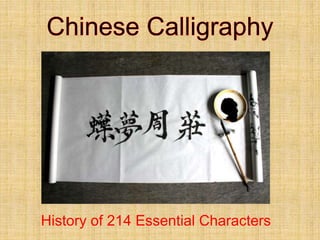
History of 214 Essential Characters
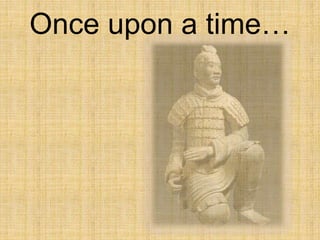
Once upon a time…
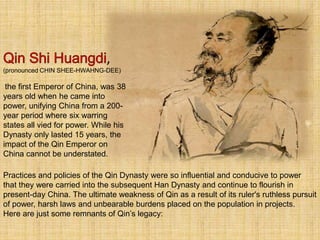
,
(pronounced CHIN SHEE-HWAHNG-DEE)
the first Emperor of China, was 38
years old when he came into
power, unifying China from a 200-
year period where six warring
states all vied for power. While his
Dynasty only lasted 15 years, the
impact of the Qin Emperor on
China cannot be understated.
Practices and policies of the Qin Dynasty were so influential and conducive to power
that they were carried into the subsequent Han Dynasty and continue to flourish in
present-day China. The ultimate weakness of Qin as a result of its ruler's ruthless pursuit
of power, harsh laws and unbearable burdens placed on the population in projects.
Here are just some remnants of Qin’s legacy:
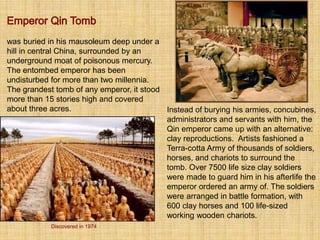
was buried in his mausoleum deep under a
hill in central China, surrounded by an
underground moat of poisonous mercury.
The entombed emperor has been
undisturbed for more than two millennia.
The grandest tomb of any emperor, it stood
more than 15 stories high and covered
about three acres. Instead of burying his armies, concubines,
administrators and servants with him, the
Qin emperor came up with an alternative:
clay reproductions. Artists fashioned a
Terra-cotta Army of thousands of soldiers,
horses, and chariots to surround the
tomb. Over 7500 life size clay soldiers
were made to guard him in his afterlife the
emperor ordered an army of. The soldiers
were arranged in battle formation, with
600 clay horses and 100 life-sized
working wooden chariots.
Discovered in 1974
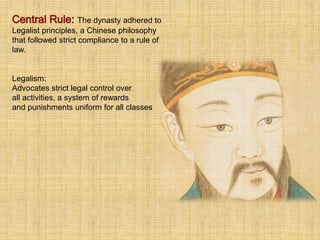
The dynasty adhered to
Legalist principles, a Chinese philosophy
that followed strict compliance to a rule of
law.
Legalism:
Advocates strict legal control over
all activities, a system of rewards
and punishments uniform for all classes
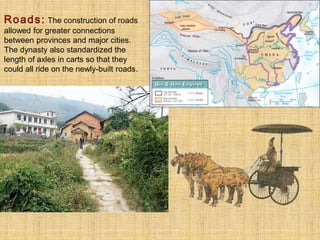
The construction of roads
allowed for greater connections
between provinces and major cities.
The dynasty also standardized the
length of axles in carts so that they
could all ride on the newly-built roads.
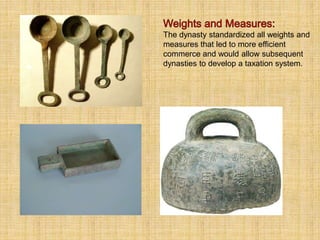
The dynasty standardized all weights and
measures that led to more efficient
commerce and would allow subsequent
dynasties to develop a taxation system.
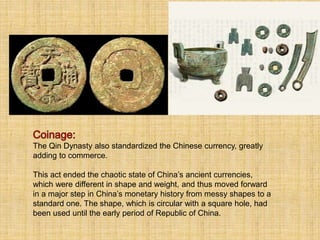
The Qin Dynasty also standardized the Chinese currency, greatly
adding to commerce.
This act ended the chaotic state of China’s ancient currencies,
which were different in shape and weight, and thus moved forward
in a major step in China’s monetary history from messy shapes to a
standard one. The shape, which is circular with a square hole, had
been used until the early period of Republic of China.
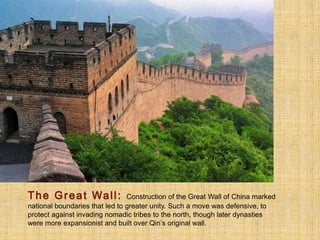
Construction of the Great Wall of China marked
national boundaries that led to greater unity. Such a move was defensive, to
protect against invading nomadic tribes to the north, though later dynasties
were more expansionist and built over Qin’s original wall.
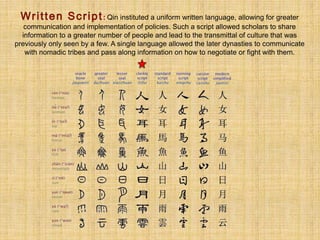
Qin instituted a uniform written language, allowing for greater
communication and implementation of policies. Such a script allowed scholars to share
information to a greater number of people and lead to the transmittal of culture that was
previously only seen by a few. A single language allowed the later dynasties to communicate
with nomadic tribes and pass along information on how to negotiate or fight with them.
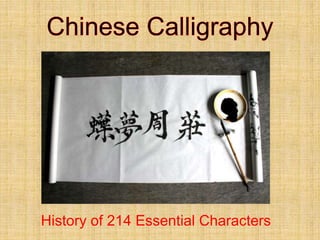
History of 214 Essential Characters
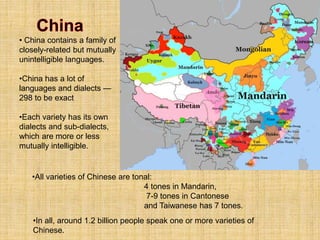
•In all, around 1.2 billion people speak one or more varieties of
Chinese.
• China contains a family of
closely-related but mutually
unintelligible languages.
•China has a lot of
languages and dialects —
298 to be exact
•Each variety has its own
dialects and sub-dialects,
which are more or less
mutually intelligible.
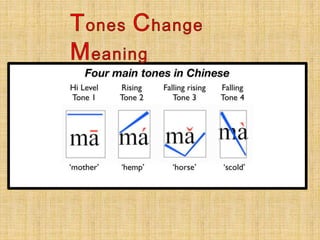
•All varieties of Chinese are tonal:
4 tones in Mandarin,
7-9 tones in Cantonese
and Taiwanese has 7 tones.
The newly ripe cherries scatter like coins of elm seeds.
It is also April in Yangzhou.
Last night red orchids in the thatched hut burst into blossom
Worrying about the wind and rain [that might ruin the blossoms], unable to
sleep.
Huang Shen (1687–1768),
One of the eight eccentric masters of Yangzhou,
was known to excel in the three perfections of the scholar-artist
Emperor
Huizong
Imposed
Poetry
Painting
Calligraphy
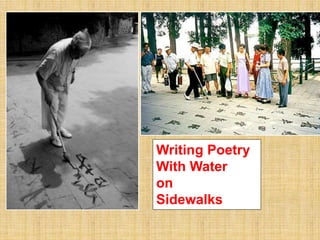
Writing Poetry
With Water
on
Sidewalks
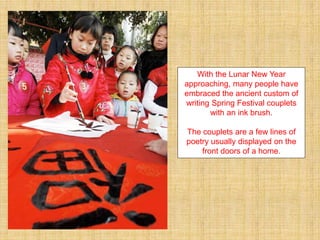
With the Lunar New Year
approaching, many people have
embraced the ancient custom of
writing Spring Festival couplets
with an ink brush.
The couplets are a few lines of
poetry usually displayed on the
front doors of a home.
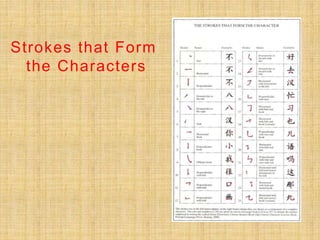
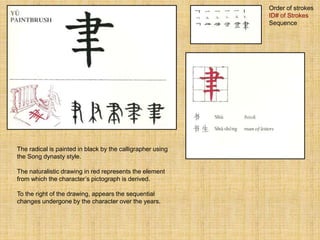
Strokes that Form
the Characters
The radical is painted in black by the calligrapher using
the Song dynasty style.
The naturalistic drawing in red represents the element
from which the character’s pictograph is derived.
To the right of the drawing, appears the sequential
changes undergone by the character over the years.
Order of strokes
ID# of Strokes
Sequence

Chinese calligraphy.4

  • 1.
    History of 214Essential Characters
  • 2.
    Once upon atime…
  • 3.
    , (pronounced CHIN SHEE-HWAHNG-DEE) thefirst Emperor of China, was 38 years old when he came into power, unifying China from a 200- year period where six warring states all vied for power. While his Dynasty only lasted 15 years, the impact of the Qin Emperor on China cannot be understated. Practices and policies of the Qin Dynasty were so influential and conducive to power that they were carried into the subsequent Han Dynasty and continue to flourish in present-day China. The ultimate weakness of Qin as a result of its ruler's ruthless pursuit of power, harsh laws and unbearable burdens placed on the population in projects. Here are just some remnants of Qin’s legacy:
  • 4.
    was buried inhis mausoleum deep under a hill in central China, surrounded by an underground moat of poisonous mercury. The entombed emperor has been undisturbed for more than two millennia. The grandest tomb of any emperor, it stood more than 15 stories high and covered about three acres. Instead of burying his armies, concubines, administrators and servants with him, the Qin emperor came up with an alternative: clay reproductions. Artists fashioned a Terra-cotta Army of thousands of soldiers, horses, and chariots to surround the tomb. Over 7500 life size clay soldiers were made to guard him in his afterlife the emperor ordered an army of. The soldiers were arranged in battle formation, with 600 clay horses and 100 life-sized working wooden chariots. Discovered in 1974
  • 5.
    The dynasty adheredto Legalist principles, a Chinese philosophy that followed strict compliance to a rule of law. Legalism: Advocates strict legal control over all activities, a system of rewards and punishments uniform for all classes
  • 6.
    The construction ofroads allowed for greater connections between provinces and major cities. The dynasty also standardized the length of axles in carts so that they could all ride on the newly-built roads.
  • 7.
    The dynasty standardizedall weights and measures that led to more efficient commerce and would allow subsequent dynasties to develop a taxation system.
  • 8.
    The Qin Dynastyalso standardized the Chinese currency, greatly adding to commerce. This act ended the chaotic state of China’s ancient currencies, which were different in shape and weight, and thus moved forward in a major step in China’s monetary history from messy shapes to a standard one. The shape, which is circular with a square hole, had been used until the early period of Republic of China.
  • 9.
    Construction of theGreat Wall of China marked national boundaries that led to greater unity. Such a move was defensive, to protect against invading nomadic tribes to the north, though later dynasties were more expansionist and built over Qin’s original wall.
  • 10.
    Qin instituted auniform written language, allowing for greater communication and implementation of policies. Such a script allowed scholars to share information to a greater number of people and lead to the transmittal of culture that was previously only seen by a few. A single language allowed the later dynasties to communicate with nomadic tribes and pass along information on how to negotiate or fight with them.
  • 11.
    History of 214Essential Characters
  • 12.
    •In all, around1.2 billion people speak one or more varieties of Chinese. • China contains a family of closely-related but mutually unintelligible languages. •China has a lot of languages and dialects — 298 to be exact •Each variety has its own dialects and sub-dialects, which are more or less mutually intelligible. •All varieties of Chinese are tonal: 4 tones in Mandarin, 7-9 tones in Cantonese and Taiwanese has 7 tones.
  • 14.
    The newly ripecherries scatter like coins of elm seeds. It is also April in Yangzhou. Last night red orchids in the thatched hut burst into blossom Worrying about the wind and rain [that might ruin the blossoms], unable to sleep. Huang Shen (1687–1768), One of the eight eccentric masters of Yangzhou, was known to excel in the three perfections of the scholar-artist Emperor Huizong Imposed Poetry Painting Calligraphy
  • 15.
  • 16.
    With the LunarNew Year approaching, many people have embraced the ancient custom of writing Spring Festival couplets with an ink brush. The couplets are a few lines of poetry usually displayed on the front doors of a home.
  • 17.
  • 18.
    The radical ispainted in black by the calligrapher using the Song dynasty style. The naturalistic drawing in red represents the element from which the character’s pictograph is derived. To the right of the drawing, appears the sequential changes undergone by the character over the years. Order of strokes ID# of Strokes Sequence