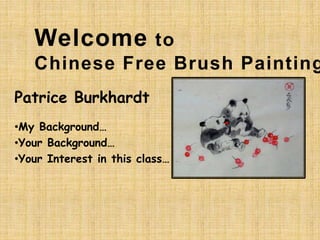
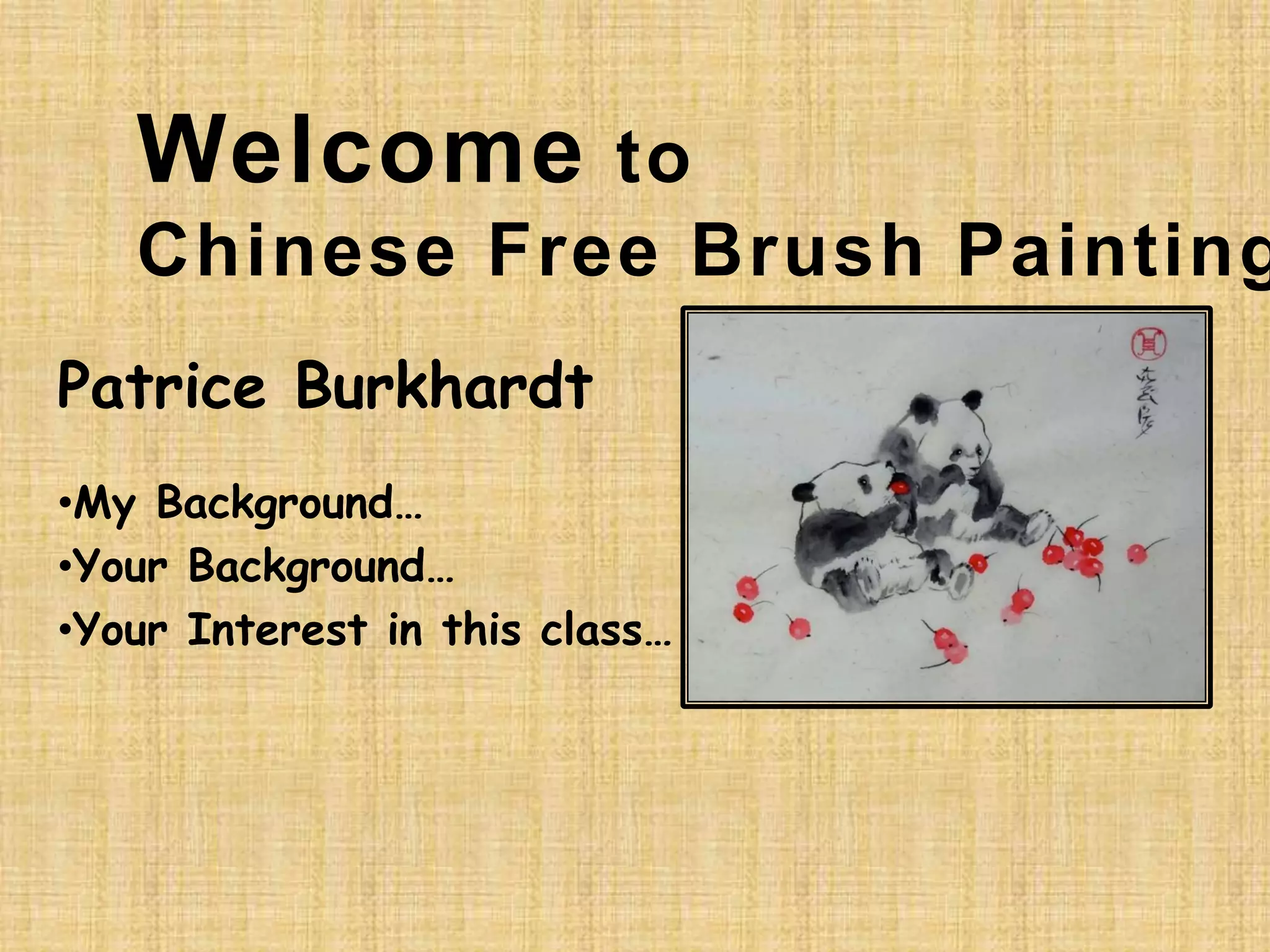
Welcome to
Chinese Free Brush Painting
Patrice Burkhardt
•My Background…
•Your Background…
•Your Interest in this class…
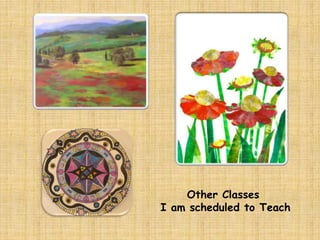
Other Classes
I am scheduled to Teach
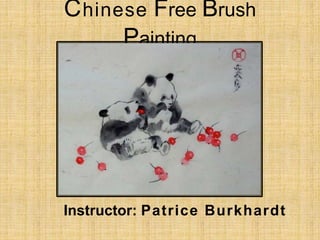
Chinese Free Brush
Painting
Instructor: Patrice Burkhardt
Today’s Agenda
•Take attendance
•Distribute ID Badges/Parking Tags
•Pass out Course Syllabus, Discuss
Discuss:
•Need to wear ID Badges
•Breaks
•Restroom Locations
•Review Recycling
•Review Crisis Response Plan
(Fire drill, Different Codes…)
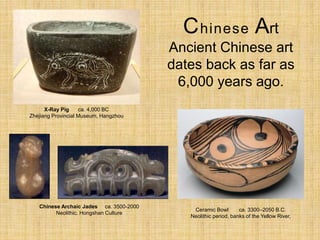
Chinese Art
Ancient Chinese art
dates back as far as
6,000 years ago.
X-Ray Pig ca. 4,000 BC
Zhejiang Provincial Museum, Hangzhou
Ceramic Bowl ca. 3300–2050 B.C.
Neolithic period, banks of the Yellow River,
Chinese Archaic Jades ca. 3500-2000
Neolithic. Hongshan Culture
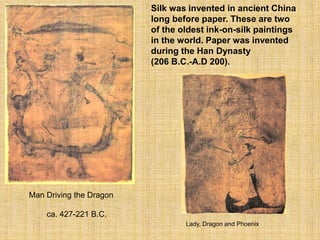
ca. 427-221 B.C.
Lady, Dragon and Phoenix
Man Driving the Dragon
Silk was invented in ancient China
long before paper. These are two
of the oldest ink-on-silk paintings
in the world. Paper was invented
during the Han Dynasty
(206 B.C.-A.D 200).
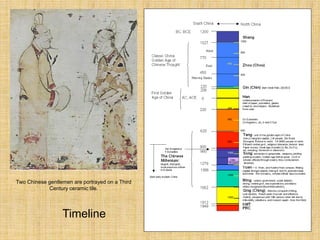
Two Chinese gentlemen are portrayed on a Third
Century ceramic tile.
Timeline
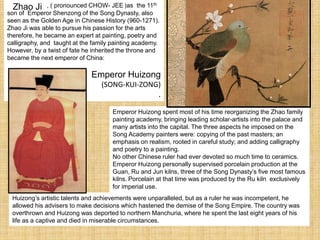
, ( pronounced CHOW- JEE )as the 11th
son of Emperor Shenzong of the Song Dynasty, also
seen as the Golden Age in Chinese History (960-1271).
Zhao Ji was able to pursue his passion for the arts
therefore, he became an expert at painting, poetry and
calligraphy, and taught at the family painting academy.
However, by a twist of fate he inherited the throne and
became the next emperor of China:
Emperor Huizong
(SONG-KUI-ZONG)
.
Emperor Huizong spent most of his time reorganizing the Zhao family
painting academy, bringing leading scholar-artists into the palace and
many artists into the capital. The three aspects he imposed on the
Song Academy painters were: copying of the past masters; an
emphasis on realism, rooted in careful study; and adding calligraphy
and poetry to a painting.
No other Chinese ruler had ever devoted so much time to ceramics.
Emperor Huizong personally supervised porcelain production at the
Guan, Ru and Jun kilns, three of the Song Dynasty’s five most famous
kilns. Porcelain at that time was produced by the Ru kiln exclusively
for imperial use.
Huizong’s artistic talents and achievements were unparalleled, but as a ruler he was incompetent, he
allowed his advisers to make decisions which hastened the demise of the Song Empire. The country was
overthrown and Huizong was deported to northern Manchuria, where he spent the last eight years of his
life as a captive and died in miserable circumstances.
Zhao Ji
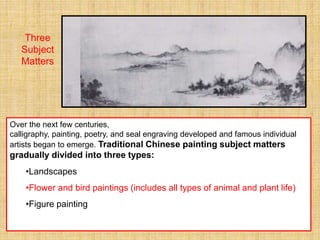
Over the next few centuries,
calligraphy, painting, poetry, and seal engraving developed and famous individual
artists began to emerge. Traditional Chinese painting subject matters
gradually divided into three types:
•Landscapes
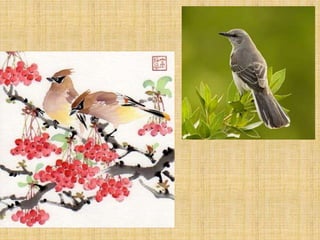
•Flower and bird paintings (includes all types of animal and plant life)
•Figure painting
Three
Subject
Matters
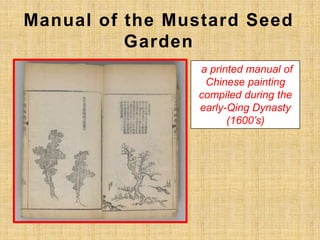
a printed manual of
Chinese painting
compiled during the
early-Qing Dynasty
(1600’s)
Manual of the Mustard Seed
Garden
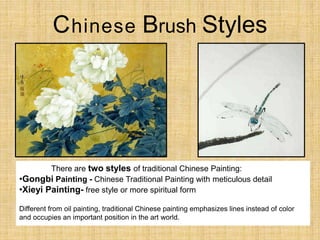
Chinese Brush Styles
There are two styles of traditional Chinese Painting:
•Gongbi Painting - Chinese Traditional Painting with meticulous detail
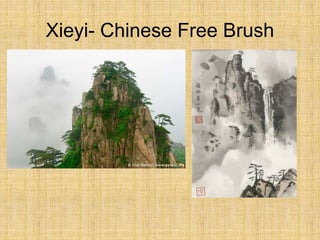
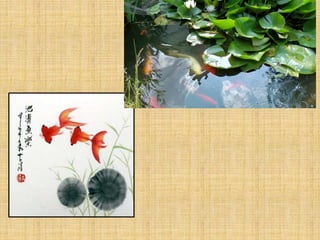
•Xieyi Painting- free style or more spiritual form
Different from oil painting, traditional Chinese painting emphasizes lines instead of color
and occupies an important position in the art world.
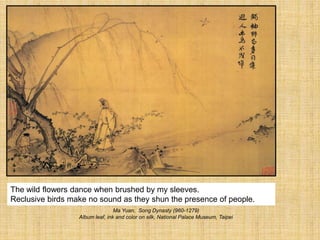
The wild flowers dance when brushed by my sleeves.
Reclusive birds make no sound as they shun the presence of people.
Ma Yuan, Song Dynasty (960-1279)
Album leaf, ink and color on silk, National Palace Museum, Taipei
When approaching new knowledge…
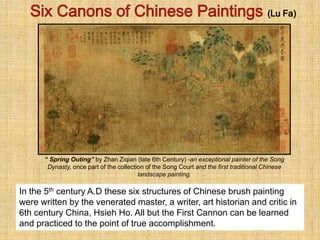
In the 5th century A.D these six structures of Chinese brush painting
were written by the venerated master, a writer, art historian and critic in
6th century China, Hsieh Ho. All but the First Cannon can be learned
and practiced to the point of true accomplishment.
“ Spring Outing” by Zhan Ziqian (late 6th Century) -an exceptional painter of the Song
Dynasty, once part of the collection of the Song Court and the first traditional Chinese
landscape painting.
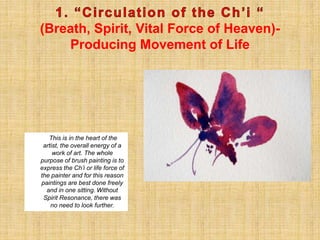
(Breath, Spirit, Vital Force of Heaven)-
Producing Movement of Life
This is in the heart of the
artist, the overall energy of a
work of art. The whole
purpose of brush painting is to
express the Ch’i or life force of
the painter and for this reason
paintings are best done freely
and in one sitting. Without
Spirit Resonance, there was
no need to look further.
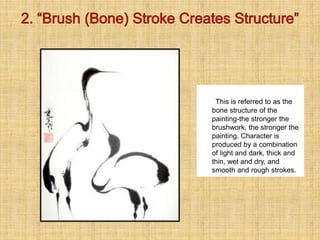
This is referred to as the
bone structure of the
painting-the stronger the
brushwork, the stronger the
painting. Character is
produced by a combination
of light and dark, thick and
thin, wet and dry, and
smooth and rough strokes.
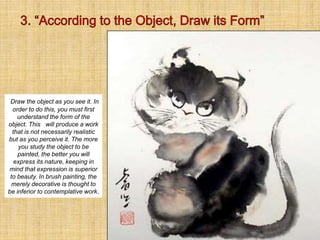
Draw the object as you see it. In
order to do this, you must first
understand the form of the
object. This will produce a work
that is not necessarily realistic
but as you perceive it. The more
you study the object to be
painted, the better you will
express its nature, keeping in
mind that expression is superior
to beauty. In brush painting, the
merely decorative is thought to
be inferior to contemplative work.
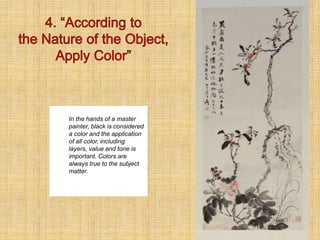
In the hands of a master
painter, black is considered
a color and the application
of all color, including
layers, value and tone is
important. Colors are
always true to the subject
matter.
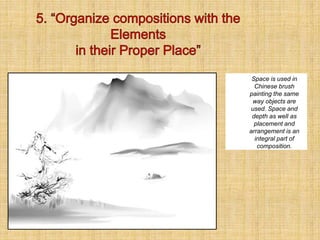
Space is used in
Chinese brush
painting the same
way objects are
used. Space and
depth as well as
placement and
arrangement is an
integral part of
composition.
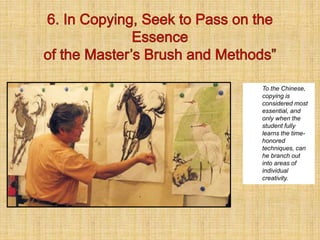
To the Chinese,
copying is
considered most
essential, and
only when the
student fully
learns the time-
honored
techniques, can
he branch out
into areas of
individual
creativity.
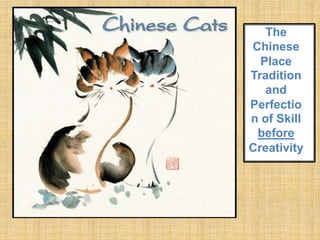
The
Chinese
Place
Tradition
and
Perfectio
n of Skill
before
Creativity
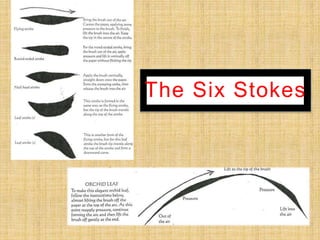
The Six Stokes
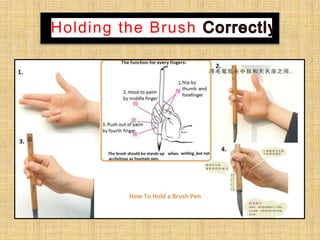
Holding the Brush
Confucius described five major hierarchical
relationships in a well-ordered
Chinese society:
• Ruler and Subject
• Parent and Child
• Older Sibling and Younger Sibling
• Husband and Wife
• Older Friend and Younger Friend
A teacher and student connection— or Master and Disciple —is
viewed in the same way as a parent and child relationship.
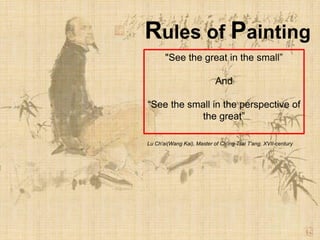
Rules of Painting
"See the great in the small”
And
“See the small in the perspective of
the great”
Lu Ch'ai(Wang Kai), Master of Ch'ing Tsai T'ang, XVII-century
Xieyi- Chinese Free Brush
(Lu Ch’ang)
• To display brushstroke power with good brushwork control
• To posses sturdy simplicity with refinement of true talent
• To possess delicacy of skill with vigor of execution.
• To exhibit originality, even to the point of eccentricity, without
violating the li (the principles or essence) of things.
• In rendering space by leaving the silk or paper untouched, to be
able nevertheless to convey nuances of tone.
• On the flatness of the picture plane, to achieve depth and space.
This "Lu Ch'ang” is quoted from an early XI-century work of biographies of painters of the Five Dynasties
and Northern Sung Periods. These are modifications of the Six Canons.
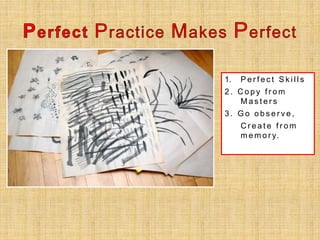
1. P e r f e c t S k i l l s
2 . C o p y f r o m
M a s t e r s
3 . G o o b s e r v e ,
C r e a t e f r o m
m e m o r y.

Chinese free brush.1 a

  • 1.
    Welcome to Chinese FreeBrush Painting Patrice Burkhardt •My Background… •Your Background… •Your Interest in this class…
  • 2.
    Other Classes I amscheduled to Teach
  • 3.
  • 4.
    Today’s Agenda •Take attendance •DistributeID Badges/Parking Tags •Pass out Course Syllabus, Discuss Discuss: •Need to wear ID Badges •Breaks •Restroom Locations •Review Recycling •Review Crisis Response Plan (Fire drill, Different Codes…)
  • 5.
    Chinese Art Ancient Chineseart dates back as far as 6,000 years ago. X-Ray Pig ca. 4,000 BC Zhejiang Provincial Museum, Hangzhou Ceramic Bowl ca. 3300–2050 B.C. Neolithic period, banks of the Yellow River, Chinese Archaic Jades ca. 3500-2000 Neolithic. Hongshan Culture
  • 6.
    ca. 427-221 B.C. Lady,Dragon and Phoenix Man Driving the Dragon Silk was invented in ancient China long before paper. These are two of the oldest ink-on-silk paintings in the world. Paper was invented during the Han Dynasty (206 B.C.-A.D 200).
  • 7.
    Two Chinese gentlemenare portrayed on a Third Century ceramic tile. Timeline
  • 8.
    , ( pronouncedCHOW- JEE )as the 11th son of Emperor Shenzong of the Song Dynasty, also seen as the Golden Age in Chinese History (960-1271). Zhao Ji was able to pursue his passion for the arts therefore, he became an expert at painting, poetry and calligraphy, and taught at the family painting academy. However, by a twist of fate he inherited the throne and became the next emperor of China: Emperor Huizong (SONG-KUI-ZONG) . Emperor Huizong spent most of his time reorganizing the Zhao family painting academy, bringing leading scholar-artists into the palace and many artists into the capital. The three aspects he imposed on the Song Academy painters were: copying of the past masters; an emphasis on realism, rooted in careful study; and adding calligraphy and poetry to a painting. No other Chinese ruler had ever devoted so much time to ceramics. Emperor Huizong personally supervised porcelain production at the Guan, Ru and Jun kilns, three of the Song Dynasty’s five most famous kilns. Porcelain at that time was produced by the Ru kiln exclusively for imperial use. Huizong’s artistic talents and achievements were unparalleled, but as a ruler he was incompetent, he allowed his advisers to make decisions which hastened the demise of the Song Empire. The country was overthrown and Huizong was deported to northern Manchuria, where he spent the last eight years of his life as a captive and died in miserable circumstances. Zhao Ji
  • 9.
    Over the nextfew centuries, calligraphy, painting, poetry, and seal engraving developed and famous individual artists began to emerge. Traditional Chinese painting subject matters gradually divided into three types: •Landscapes •Flower and bird paintings (includes all types of animal and plant life) •Figure painting Three Subject Matters
  • 10.
    a printed manualof Chinese painting compiled during the early-Qing Dynasty (1600’s) Manual of the Mustard Seed Garden
  • 11.
    Chinese Brush Styles Thereare two styles of traditional Chinese Painting: •Gongbi Painting - Chinese Traditional Painting with meticulous detail •Xieyi Painting- free style or more spiritual form Different from oil painting, traditional Chinese painting emphasizes lines instead of color and occupies an important position in the art world.
  • 12.
    The wild flowersdance when brushed by my sleeves. Reclusive birds make no sound as they shun the presence of people. Ma Yuan, Song Dynasty (960-1279) Album leaf, ink and color on silk, National Palace Museum, Taipei
  • 13.
  • 14.
    In the 5thcentury A.D these six structures of Chinese brush painting were written by the venerated master, a writer, art historian and critic in 6th century China, Hsieh Ho. All but the First Cannon can be learned and practiced to the point of true accomplishment. “ Spring Outing” by Zhan Ziqian (late 6th Century) -an exceptional painter of the Song Dynasty, once part of the collection of the Song Court and the first traditional Chinese landscape painting.
  • 15.
    (Breath, Spirit, VitalForce of Heaven)- Producing Movement of Life This is in the heart of the artist, the overall energy of a work of art. The whole purpose of brush painting is to express the Ch’i or life force of the painter and for this reason paintings are best done freely and in one sitting. Without Spirit Resonance, there was no need to look further.
  • 16.
    This is referredto as the bone structure of the painting-the stronger the brushwork, the stronger the painting. Character is produced by a combination of light and dark, thick and thin, wet and dry, and smooth and rough strokes.
  • 17.
    Draw the objectas you see it. In order to do this, you must first understand the form of the object. This will produce a work that is not necessarily realistic but as you perceive it. The more you study the object to be painted, the better you will express its nature, keeping in mind that expression is superior to beauty. In brush painting, the merely decorative is thought to be inferior to contemplative work.
  • 18.
    In the handsof a master painter, black is considered a color and the application of all color, including layers, value and tone is important. Colors are always true to the subject matter.
  • 19.
    Space is usedin Chinese brush painting the same way objects are used. Space and depth as well as placement and arrangement is an integral part of composition.
  • 20.
    To the Chinese, copyingis considered most essential, and only when the student fully learns the time- honored techniques, can he branch out into areas of individual creativity.
  • 21.
  • 22.
  • 23.
  • 24.
    Confucius described fivemajor hierarchical relationships in a well-ordered Chinese society: • Ruler and Subject • Parent and Child • Older Sibling and Younger Sibling • Husband and Wife • Older Friend and Younger Friend A teacher and student connection— or Master and Disciple —is viewed in the same way as a parent and child relationship.
  • 25.
    Rules of Painting "Seethe great in the small” And “See the small in the perspective of the great” Lu Ch'ai(Wang Kai), Master of Ch'ing Tsai T'ang, XVII-century
  • 26.
  • 30.
    (Lu Ch’ang) • Todisplay brushstroke power with good brushwork control • To posses sturdy simplicity with refinement of true talent • To possess delicacy of skill with vigor of execution. • To exhibit originality, even to the point of eccentricity, without violating the li (the principles or essence) of things. • In rendering space by leaving the silk or paper untouched, to be able nevertheless to convey nuances of tone. • On the flatness of the picture plane, to achieve depth and space. This "Lu Ch'ang” is quoted from an early XI-century work of biographies of painters of the Five Dynasties and Northern Sung Periods. These are modifications of the Six Canons.
  • 31.
    1. P er f e c t S k i l l s 2 . C o p y f r o m M a s t e r s 3 . G o o b s e r v e , C r e a t e f r o m m e m o r y.