Tangents
Recognizing and avoiding them
T
a
n
g
e
n
t
s
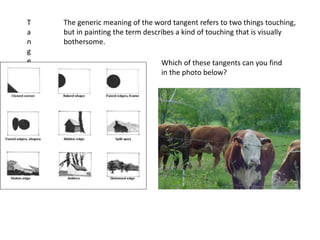
The generic meaning of the word tangent refers to two things touching,
but in painting the term describes a kind of touching that is visually
bothersome.
Which of these tangents can you find
in the photo below?
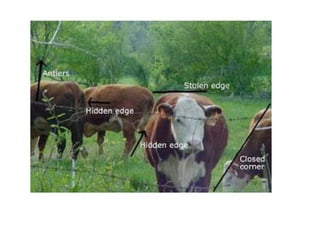
1. Closed corner
When a shape completely blocks off
a corner of the artwork, it can
visually isolate that corner from the
rest of the painting, but if a shape is
integrated from the corner into the
rest of the painting, it can act as a
visual lead-in rather than a sore
thumb.
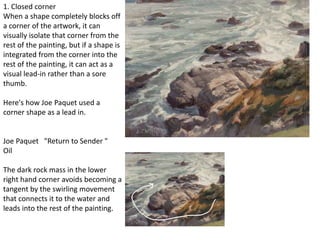
Here's how Joe Paquet used a
corner shape as a lead in.
Joe Paquet "Return to Sender "
Oil
The dark rock mass in the lower
right hand corner avoids becoming a
tangent by the swirling movement
that connects it to the water and
leads into the rest of the painting.
2. Halved shape
When a symmetrical shape is cut in
half at the edge of the painting it
creates an uncomfortable, chopped-
off feeling for the viewer. By bringing
the entire shape inside the picture
plane or by cropping the image
somewhere other than the halfway
point, a symmetrical shape at the
edge does not have to be a problem.
(You will also want to avoid cropping
directly at any joint of an animal or
person, or at a corner of an object or
structure.)
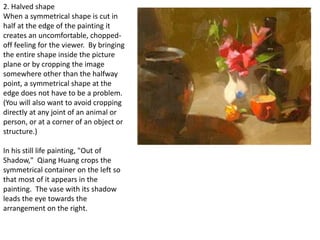
In his still life painting, "Out of
Shadow," Qiang Huang crops the
symmetrical container on the left so
that most of it appears in the
painting. The vase with its shadow
leads the eye towards the
arrangement on the right.
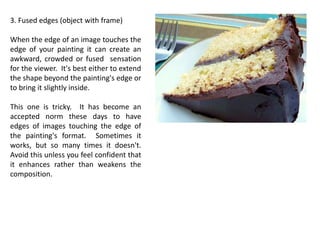
3. Fused edges (object with frame)
When the edge of an image touches the
edge of your painting it can create an
awkward, crowded or fused sensation
for the viewer. It's best either to extend
the shape beyond the painting's edge or
to bring it slightly inside.
This one is tricky. It has become an
accepted norm these days to have
edges of images touching the edge of
the painting's format. Sometimes it
works, but so many times it doesn't.
Avoid this unless you feel confident that
it enhances rather than weakens the
composition.
4. Fused edges (object with object)
When the edges of two shapes touch, they can
visually fuse together.
Just as with a shape's edges touching the
painting's edge, it appears that many of
today's artists have decided that objects
touching willy-nilly is totally acceptable.
Traditionally, shapes touching in an abstract
design work because the objective is arranging
shapes to keep the illusion of two-dimensional
space, but the artist interpreting three-
dimensional space can confuse the spatial
depth if adjacent images are not either
overlapped or given some space between
them. However, when there is a strong
interaction between negative and positive
shapes, images touching can be made to work.
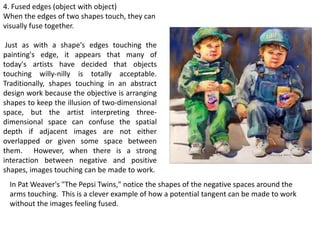
In Pat Weaver's "The Pepsi Twins," notice the shapes of the negative spaces around the
arms touching. This is a clever example of how a potential tangent can be made to work
without the images feeling fused.
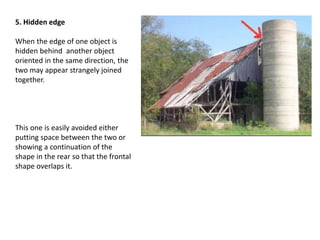
5. Hidden edge
When the edge of one object is
hidden behind another object
oriented in the same direction, the
two may appear strangely joined
together.
This one is easily avoided either
putting space between the two or
showing a continuation of the
shape in the rear so that the frontal
shape overlaps it.
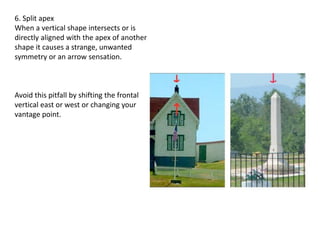
6. Split apex
When a vertical shape intersects or is
directly aligned with the apex of another
shape it causes a strange, unwanted
symmetry or an arrow sensation.
Avoid this pitfall by shifting the frontal
vertical east or west or changing your
vantage point.
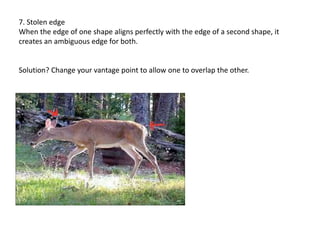
7. Stolen edge
When the edge of one shape aligns perfectly with the edge of a second shape, it
creates an ambiguous edge for both.
Solution? Change your vantage point to allow one to overlap the other.
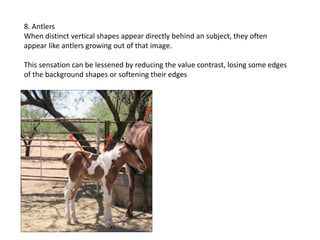
8. Antlers
When distinct vertical shapes appear directly behind an subject, they often
appear like antlers growing out of that image.
This sensation can be lessened by reducing the value contrast, losing some edges
of the background shapes or softening their edges
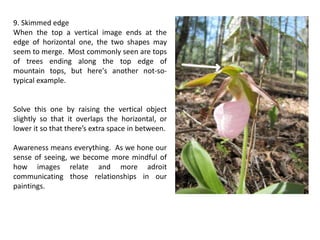
9. Skimmed edge
When the top a vertical image ends at the
edge of horizontal one, the two shapes may
seem to merge. Most commonly seen are tops
of trees ending along the top edge of
mountain tops, but here's another not-so-
typical example.
Solve this one by raising the vertical object
slightly so that it overlaps the horizontal, or
lower it so that there’s extra space in between.
Awareness means everything. As we hone our
sense of seeing, we become more mindful of
how images relate and more adroit
communicating those relationships in our
paintings.

Tangents

  • 1.
  • 2.
    T a n g e n t s The generic meaningof the word tangent refers to two things touching, but in painting the term describes a kind of touching that is visually bothersome. Which of these tangents can you find in the photo below?
  • 4.
    1. Closed corner Whena shape completely blocks off a corner of the artwork, it can visually isolate that corner from the rest of the painting, but if a shape is integrated from the corner into the rest of the painting, it can act as a visual lead-in rather than a sore thumb. Here's how Joe Paquet used a corner shape as a lead in. Joe Paquet "Return to Sender " Oil The dark rock mass in the lower right hand corner avoids becoming a tangent by the swirling movement that connects it to the water and leads into the rest of the painting.
  • 5.
    2. Halved shape Whena symmetrical shape is cut in half at the edge of the painting it creates an uncomfortable, chopped- off feeling for the viewer. By bringing the entire shape inside the picture plane or by cropping the image somewhere other than the halfway point, a symmetrical shape at the edge does not have to be a problem. (You will also want to avoid cropping directly at any joint of an animal or person, or at a corner of an object or structure.) In his still life painting, "Out of Shadow," Qiang Huang crops the symmetrical container on the left so that most of it appears in the painting. The vase with its shadow leads the eye towards the arrangement on the right.
  • 6.
    3. Fused edges(object with frame) When the edge of an image touches the edge of your painting it can create an awkward, crowded or fused sensation for the viewer. It's best either to extend the shape beyond the painting's edge or to bring it slightly inside. This one is tricky. It has become an accepted norm these days to have edges of images touching the edge of the painting's format. Sometimes it works, but so many times it doesn't. Avoid this unless you feel confident that it enhances rather than weakens the composition.
  • 7.
    4. Fused edges(object with object) When the edges of two shapes touch, they can visually fuse together. Just as with a shape's edges touching the painting's edge, it appears that many of today's artists have decided that objects touching willy-nilly is totally acceptable. Traditionally, shapes touching in an abstract design work because the objective is arranging shapes to keep the illusion of two-dimensional space, but the artist interpreting three- dimensional space can confuse the spatial depth if adjacent images are not either overlapped or given some space between them. However, when there is a strong interaction between negative and positive shapes, images touching can be made to work. In Pat Weaver's "The Pepsi Twins," notice the shapes of the negative spaces around the arms touching. This is a clever example of how a potential tangent can be made to work without the images feeling fused.
  • 8.
    5. Hidden edge Whenthe edge of one object is hidden behind another object oriented in the same direction, the two may appear strangely joined together. This one is easily avoided either putting space between the two or showing a continuation of the shape in the rear so that the frontal shape overlaps it.
  • 9.
    6. Split apex Whena vertical shape intersects or is directly aligned with the apex of another shape it causes a strange, unwanted symmetry or an arrow sensation. Avoid this pitfall by shifting the frontal vertical east or west or changing your vantage point.
  • 10.
    7. Stolen edge Whenthe edge of one shape aligns perfectly with the edge of a second shape, it creates an ambiguous edge for both. Solution? Change your vantage point to allow one to overlap the other.
  • 11.
    8. Antlers When distinctvertical shapes appear directly behind an subject, they often appear like antlers growing out of that image. This sensation can be lessened by reducing the value contrast, losing some edges of the background shapes or softening their edges
  • 12.
    9. Skimmed edge Whenthe top a vertical image ends at the edge of horizontal one, the two shapes may seem to merge. Most commonly seen are tops of trees ending along the top edge of mountain tops, but here's another not-so- typical example. Solve this one by raising the vertical object slightly so that it overlaps the horizontal, or lower it so that there’s extra space in between. Awareness means everything. As we hone our sense of seeing, we become more mindful of how images relate and more adroit communicating those relationships in our paintings.