Dr Yeap Ban HarMarshall Cavendish InstituteSingaporebanhar@sg.marshallcavendish.comSeminar on Singapore Math   in ChileSANTIAGO  CONCEPTIONThis seminar is about mathematics teaching and learning that focuses on helping average and struggling learners do well in mathematics while maintaining a suitable challenge for advanced learners.Presentation is available at www.banhar.com
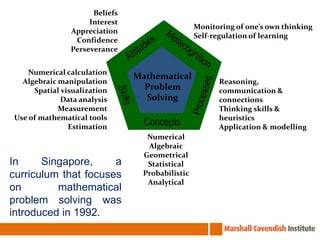
BeliefsInterestAppreciationConfidencePerseveranceMonitoring of one’s own thinkingSelf-regulation of learningAttitudesMetacognitionNumerical calculationAlgebraic manipulationSpatial visualizationData analysisMeasurementUse of mathematical toolsEstimationMathematical Problem SolvingReasoning, communication & connectionsThinking skills & heuristicsApplication & modellingSkillsProcessesConceptsNumericalAlgebraicGeometricalStatisticalProbabilisticAnalyticalIn Singapore, a curriculum that focuses on mathematical problem solving was introduced in 1992.
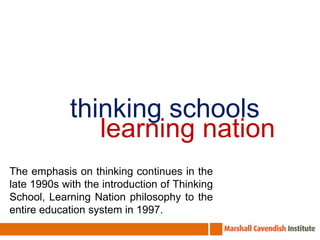
thinking schoolslearning nationThe emphasis on thinking continues in the late 1990s with the introduction of Thinking School, Learning Nation philosophy to the entire education system in 1997.
The assessment reflects the focus of the curriculum. For example, the Grade 6 national examination (Primary School Leaving Examination or PSLE) includes a significant section that requires problem solving.
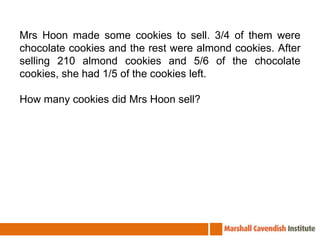
Mrs Hoon made some cookies to sell. 3/4 of them were chocolate cookies and the rest were almond cookies. After selling 210 almond cookies and 5/6 of the chocolate cookies, she had 1/5 of the cookies left.How many cookies did Mrs Hoon sell?
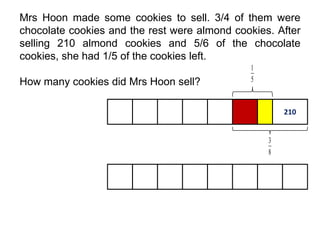
Mrs Hoon made some cookies to sell. 3/4 of them were chocolate cookies and the rest were almond cookies. After selling 210 almond cookies and 5/6 of the chocolate cookies, she had 1/5 of the cookies left.How many cookies did Mrs Hoon sell?210
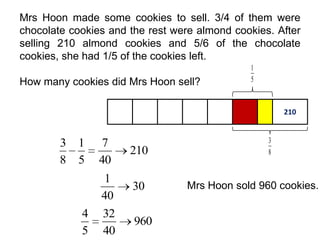
Mrs Hoon made some cookies to sell. 3/4 of them were chocolate cookies and the rest were almond cookies. After selling 210 almond cookies and 5/6 of the chocolate cookies, she had 1/5 of the cookies left.How many cookies did Mrs Hoon sell?210MrsHoon sold 960 cookies.
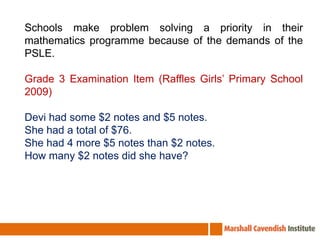
Schools make problem solving a priority in their mathematics programme because of the demands of the PSLE. Grade 3 Examination Item (Raffles Girls’ Primary School 2009)Devi had some $2 notes and $5 notes.She had a total of $76.She had 4 more $5 notes than $2 notes.How many $2 notes did she have?
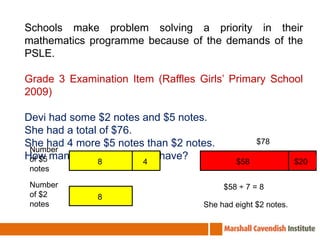
Schools make problem solving a priority in their mathematics programme because of the demands of the PSLE. Grade 3 Examination Item (Raffles Girls’ Primary School 2009)Devi had some $2 notes and $5 notes.She had a total of $76.She had 4 more $5 notes than $2 notes.How many $2 notes did she have?$78Number of $5 notes4$20$588Number of $2 notes$58 ÷ 7 = 88She had eight $2 notes.
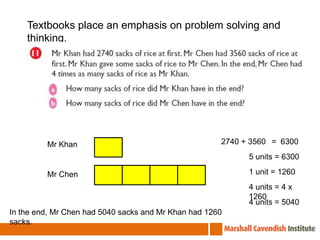
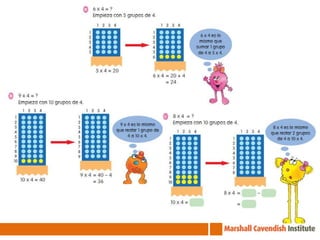
Textbooks place an emphasis on problem solving and thinking.2740 + 3560=  6300Mr Khan5 units = 63001 unit = 1260Mr Chen4 units = 4 x 12604 units = 5040In the end, Mr Chen had 5040 sacks and Mr Khan had 1260 sacks.
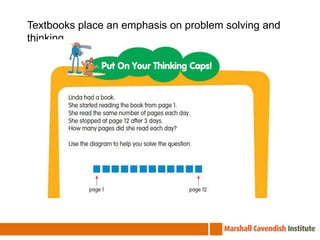
Textbooks place an emphasis on problem solving and thinking.
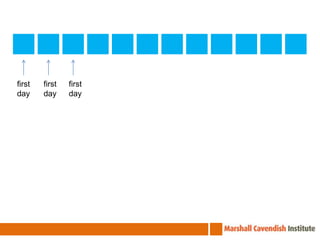
first dayfirst dayfirst day
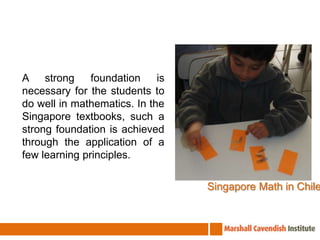
A strong foundation is necessary for the students to do well in mathematics. In the Singapore textbooks, such a strong foundation is achieved through the application of a few learning principles.Singapore Math in Chile
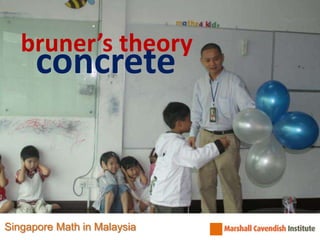
bruner’s theoryconcreteSingapore Math in Malaysia
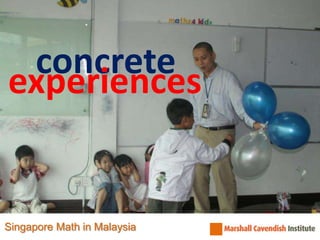
concreteexperiencesSingapore Math in Malaysia
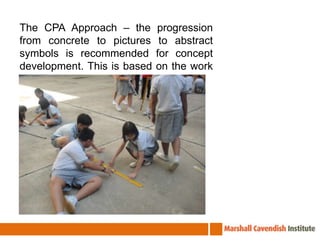
The CPA Approach – the progression from concrete to pictures to abstract symbols is recommended for concept development. This is based on the work of Jerome Bruner.
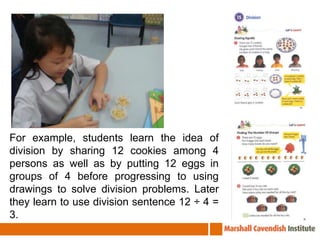
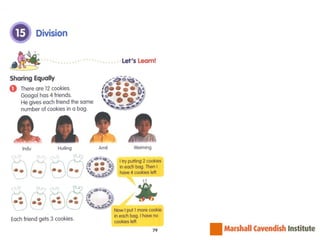
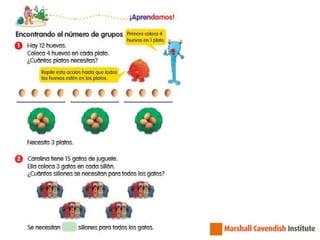
For example, students learn the idea of division by sharing 12 cookies among 4 persons as well as by putting 12 eggs in groups of 4 before progressing to using drawings to solve division problems. Later they learn to use division sentence 12 ÷ 4 = 3.
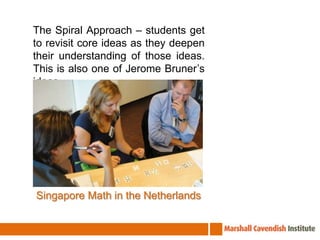
The Spiral Approach – students get to revisit core ideas as they deepen their understanding of those ideas. This is also one of Jerome Bruner’s ideas. Singapore Math in the Netherlands
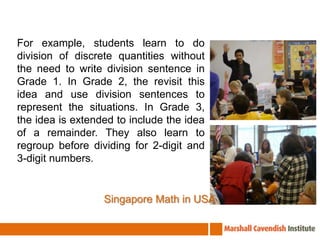
 For example, students learn to do division of discrete quantities without the need to write division sentence in Grade 1. In Grade 2, the revisit this idea and use division sentences to represent the situations. In Grade 3, the idea is extended to include the idea of a remainder. They also learn to regroup before dividing for 2-digit and 3-digit numbers. Singapore Math in USA
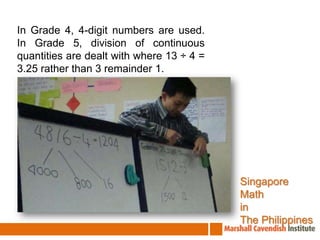
In Grade 4, 4-digit numbers are used. In Grade 5, division of continuous quantities are dealt with where 13 ÷ 4 = 3.25 rather than 3 remainder 1.  Singapore Math in The Philippines
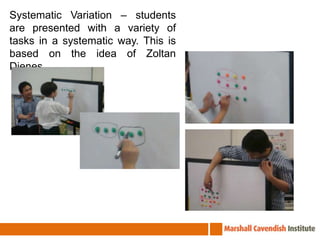
Systematic Variation – students are presented with a variety of tasks in a systematic way. This is based on the idea of ZoltanDienes.
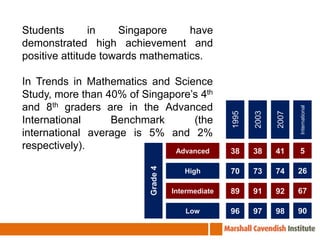
Students in Singapore have demonstrated high achievement and positive attitude towards mathematics. In Trends in Mathematics and Science Study, more than 40% of Singapore’s 4th and 8th graders are in the Advanced International Benchmark (the international average is 5% and 2% respectively). 199520032007International5Advanced384138Grade 426High70747367Intermediate89929190Low969897
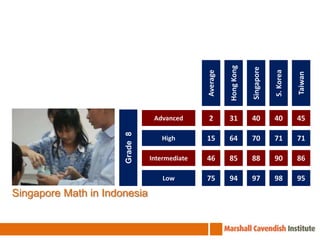
AverageHong KongSingaporeS. KoreaTaiwanGrade  8Advanced240314540High1570647171Intermediate4688858690Low7597949598Singapore Math in Indonesia
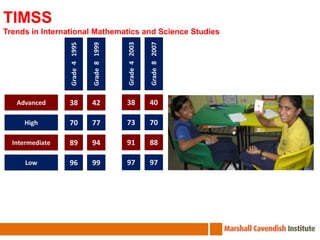
TIMSSTrends in International Mathematics and Science StudiesGrade  4   2003Grade  8   2007Grade  4   1995Grade  8   19993840Advanced38427370High70779188Intermediate89949797Low9699
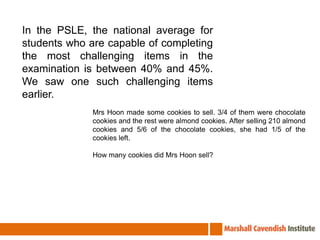
In the PSLE, the national average for students who are capable of completing the most challenging items in the examination is between 40% and 45%. We saw one such challenging items earlier.Mrs Hoon made some cookies to sell. 3/4 of them were chocolate cookies and the rest were almond cookies. After selling 210 almond cookies and 5/6 of the chocolate cookies, she had 1/5 of the cookies left.How many cookies did Mrs Hoon sell?
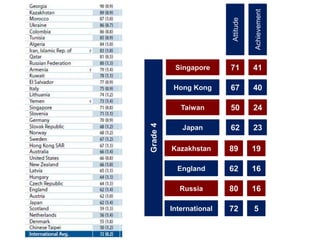
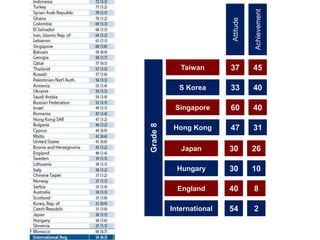
The attitude index for Singapore students in TIMSS is also relatively high compared to other high-performing countries. Also, the majority of students in Singapore opt to study mathematics in Grades 11 and 12 when they are no longer required to.
AttitudeAchievementSingapore7141Grade 4Hong Kong6740Taiwan5024Japan6223Kazakhstan8919England6216Russia8016International725
AttitudeAchievementTaiwan3745Grade 8S Korea3340Singapore6040Hong Kong4731Japan3026Hungary3010England408International542
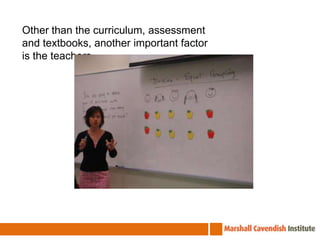
Other than the curriculum, assessment and textbooks, another important factor is the teachers.
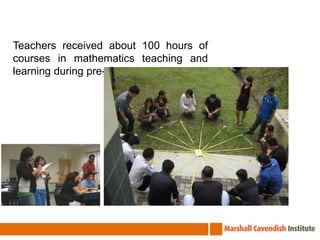
Teachers received about 100 hours of courses in mathematics teaching and learning during pre-service training. 
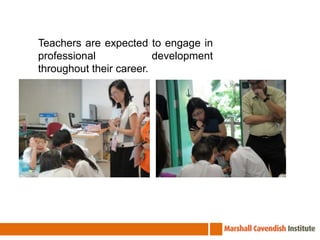
 Teachers are expected to engage in professional development throughout their career. 
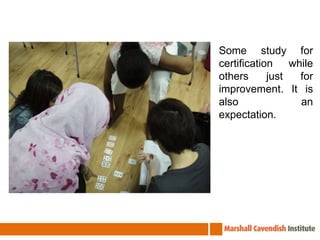
 Some study for certification while others just for improvement. It is also an expectation.
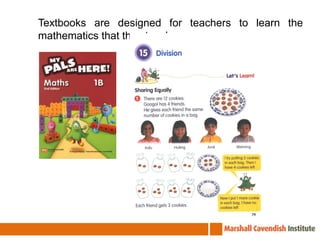
  Textbooks are designed for teachers to learn the mathematics that they teach.
Dr Yeap Ban HarMarshall Cavendish InstituteSingaporebanhar@sg.marshallcavendish.comSeminar on Singapore Math   in ChileSANTIAGO  CONCEPTIONSingapore Math in ChilePresentation is available at www.banhar.com

Chile MOE Seminar English

  • 1.
    Dr Yeap BanHarMarshall Cavendish InstituteSingaporebanhar@sg.marshallcavendish.comSeminar on Singapore Math in ChileSANTIAGO  CONCEPTIONThis seminar is about mathematics teaching and learning that focuses on helping average and struggling learners do well in mathematics while maintaining a suitable challenge for advanced learners.Presentation is available at www.banhar.com
  • 2.
    BeliefsInterestAppreciationConfidencePerseveranceMonitoring of one’sown thinkingSelf-regulation of learningAttitudesMetacognitionNumerical calculationAlgebraic manipulationSpatial visualizationData analysisMeasurementUse of mathematical toolsEstimationMathematical Problem SolvingReasoning, communication & connectionsThinking skills & heuristicsApplication & modellingSkillsProcessesConceptsNumericalAlgebraicGeometricalStatisticalProbabilisticAnalyticalIn Singapore, a curriculum that focuses on mathematical problem solving was introduced in 1992.
  • 3.
    thinking schoolslearning nationTheemphasis on thinking continues in the late 1990s with the introduction of Thinking School, Learning Nation philosophy to the entire education system in 1997.
  • 4.
    The assessment reflectsthe focus of the curriculum. For example, the Grade 6 national examination (Primary School Leaving Examination or PSLE) includes a significant section that requires problem solving.
  • 5.
    Mrs Hoon madesome cookies to sell. 3/4 of them were chocolate cookies and the rest were almond cookies. After selling 210 almond cookies and 5/6 of the chocolate cookies, she had 1/5 of the cookies left.How many cookies did Mrs Hoon sell?
  • 6.
    Mrs Hoon madesome cookies to sell. 3/4 of them were chocolate cookies and the rest were almond cookies. After selling 210 almond cookies and 5/6 of the chocolate cookies, she had 1/5 of the cookies left.How many cookies did Mrs Hoon sell?210
  • 7.
    Mrs Hoon madesome cookies to sell. 3/4 of them were chocolate cookies and the rest were almond cookies. After selling 210 almond cookies and 5/6 of the chocolate cookies, she had 1/5 of the cookies left.How many cookies did Mrs Hoon sell?210MrsHoon sold 960 cookies.
  • 8.
    Schools make problemsolving a priority in their mathematics programme because of the demands of the PSLE. Grade 3 Examination Item (Raffles Girls’ Primary School 2009)Devi had some $2 notes and $5 notes.She had a total of $76.She had 4 more $5 notes than $2 notes.How many $2 notes did she have?
  • 9.
    Schools make problemsolving a priority in their mathematics programme because of the demands of the PSLE. Grade 3 Examination Item (Raffles Girls’ Primary School 2009)Devi had some $2 notes and $5 notes.She had a total of $76.She had 4 more $5 notes than $2 notes.How many $2 notes did she have?$78Number of $5 notes4$20$588Number of $2 notes$58 ÷ 7 = 88She had eight $2 notes.
  • 10.
    Textbooks place anemphasis on problem solving and thinking.2740 + 3560= 6300Mr Khan5 units = 63001 unit = 1260Mr Chen4 units = 4 x 12604 units = 5040In the end, Mr Chen had 5040 sacks and Mr Khan had 1260 sacks.
  • 11.
    Textbooks place anemphasis on problem solving and thinking.
  • 12.
  • 13.
    A strong foundationis necessary for the students to do well in mathematics. In the Singapore textbooks, such a strong foundation is achieved through the application of a few learning principles.Singapore Math in Chile
  • 14.
  • 15.
  • 16.
    The CPA Approach– the progression from concrete to pictures to abstract symbols is recommended for concept development. This is based on the work of Jerome Bruner.
  • 17.
    For example, studentslearn the idea of division by sharing 12 cookies among 4 persons as well as by putting 12 eggs in groups of 4 before progressing to using drawings to solve division problems. Later they learn to use division sentence 12 ÷ 4 = 3.
  • 20.
    The Spiral Approach– students get to revisit core ideas as they deepen their understanding of those ideas. This is also one of Jerome Bruner’s ideas. Singapore Math in the Netherlands
  • 21.
     For example, studentslearn to do division of discrete quantities without the need to write division sentence in Grade 1. In Grade 2, the revisit this idea and use division sentences to represent the situations. In Grade 3, the idea is extended to include the idea of a remainder. They also learn to regroup before dividing for 2-digit and 3-digit numbers. Singapore Math in USA
  • 22.
    In Grade 4,4-digit numbers are used. In Grade 5, division of continuous quantities are dealt with where 13 ÷ 4 = 3.25 rather than 3 remainder 1. Singapore Math in The Philippines
  • 23.
    Systematic Variation –students are presented with a variety of tasks in a systematic way. This is based on the idea of ZoltanDienes.
  • 24.
    Students in Singaporehave demonstrated high achievement and positive attitude towards mathematics. In Trends in Mathematics and Science Study, more than 40% of Singapore’s 4th and 8th graders are in the Advanced International Benchmark (the international average is 5% and 2% respectively). 199520032007International5Advanced384138Grade 426High70747367Intermediate89929190Low969897
  • 25.
    AverageHong KongSingaporeS. KoreaTaiwanGrade 8Advanced240314540High1570647171Intermediate4688858690Low7597949598Singapore Math in Indonesia
  • 26.
    TIMSSTrends in InternationalMathematics and Science StudiesGrade 4 2003Grade 8 2007Grade 4 1995Grade 8 19993840Advanced38427370High70779188Intermediate89949797Low9699
  • 27.
    In the PSLE,the national average for students who are capable of completing the most challenging items in the examination is between 40% and 45%. We saw one such challenging items earlier.Mrs Hoon made some cookies to sell. 3/4 of them were chocolate cookies and the rest were almond cookies. After selling 210 almond cookies and 5/6 of the chocolate cookies, she had 1/5 of the cookies left.How many cookies did Mrs Hoon sell?
  • 28.
    The attitude indexfor Singapore students in TIMSS is also relatively high compared to other high-performing countries. Also, the majority of students in Singapore opt to study mathematics in Grades 11 and 12 when they are no longer required to.
  • 29.
  • 30.
    AttitudeAchievementTaiwan3745Grade 8S Korea3340Singapore6040HongKong4731Japan3026Hungary3010England408International542
  • 31.
    Other than thecurriculum, assessment and textbooks, another important factor is the teachers.
  • 32.
    Teachers received about100 hours of courses in mathematics teaching and learning during pre-service training. 
  • 33.
     Teachers are expectedto engage in professional development throughout their career. 
  • 34.
     Some study forcertification while others just for improvement. It is also an expectation.
  • 35.
      Textbooks are designedfor teachers to learn the mathematics that they teach.
  • 37.
    Dr Yeap BanHarMarshall Cavendish InstituteSingaporebanhar@sg.marshallcavendish.comSeminar on Singapore Math in ChileSANTIAGO  CONCEPTIONSingapore Math in ChilePresentation is available at www.banhar.com