










PRESENTORS
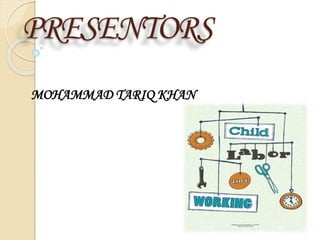
MOHAMMAD TARIQ KHAN
INTRODUCTION
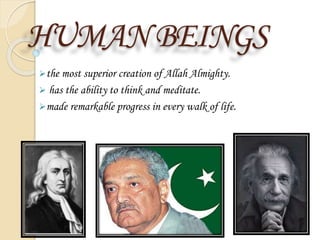
HUMANBEINGS
the most superior creation of Allah Almighty.
 has the ability to think and meditate.
made remarkable progress in every walk of life.
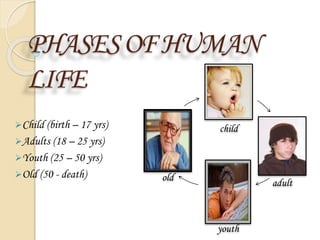
PHASESOFHUMAN
LIFE
Child (birth – 17 yrs)
Adults (18 – 25 yrs)
Youth (25 – 50 yrs)
Old (50 - death)
child
adult
youth
old
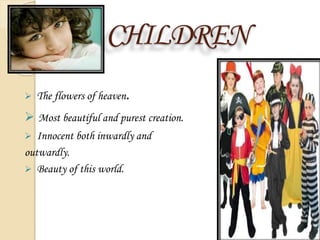
CHILDREN
 The flowers of heaven.
 Most beautiful and purest creation.
 Innocent both inwardly and
outwardly.
 Beauty of this world.
CONT’D
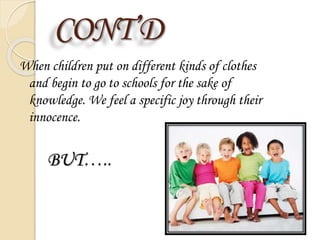
When children put on different kinds of clothes
and begin to go to schools for the sake of
knowledge. We feel a specific joy through their
innocence.
BUT…..
CONT’D
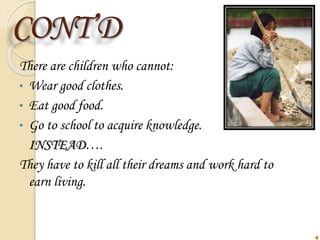
There are children who cannot:
• Wear good clothes.
• Eat good food.
• Go to school to acquire knowledge.
INSTEAD….
They have to kill all their dreams and work hard to
earn living.
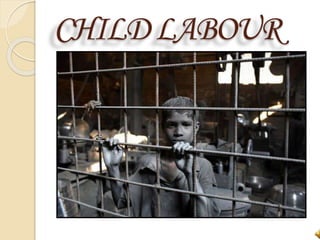
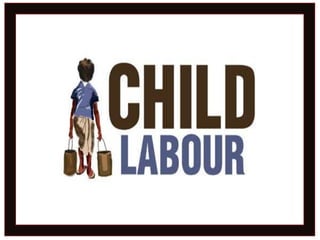
CHILDLABOUR
CONTENTS
What child labor is…???
CYCLE OF CHILD LABOUR
Islamic perspectives
Sectors employing child labor
Causes
Child abuse
Worst forms of child labor
 Comparison
Problems
Remedies
Statistics
Laws
Progress rate of a country
Conclusion
DEFINITIONS
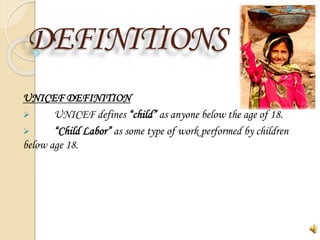
UNICEF DEFINITION
 UNICEF defines “child” as anyone below the age of 18.
 “Child Labor” as some type of work performed by children
below age 18.
CONT’D
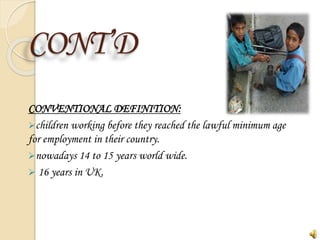
CONVENTIONAL DEFINITION:
children working before they reached the lawful minimum age
for employment in their country.
nowadays 14 to 15 years world wide.
 16 years in UK.
CONT’D
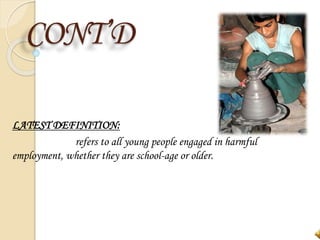
LATEST DEFINITION:
refers to all young people engaged in harmful
employment, whether they are school-age or older.
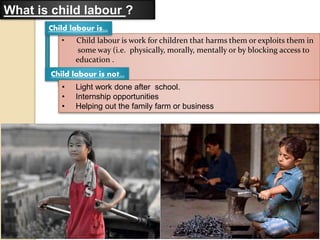
• Child labour is work for children that harms them or exploits them in
some way (i.e. physically, morally, mentally or by blocking access to
education .
What is child labour ?
Child labour is...
Child labour is not...
• Light work done after school.
• Internship opportunities
• Helping out the family farm or business
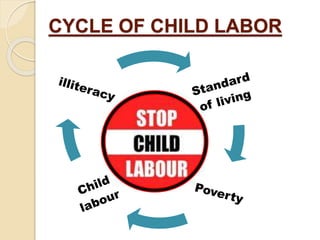
CYCLE OF CHILD LABOR
ISLAMIC
PRESPECTIVE
All human beings are equal.
importance of the children rights.
Our beloved Holy Prophet Hazrat Muhammad (S.A.W) and
children.
Children should be taught to write and read.
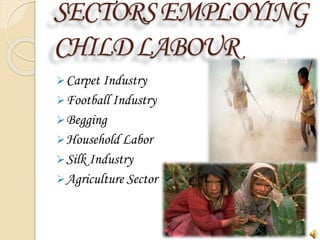
SECTORSEMPLOYING
CHILDLABOUR
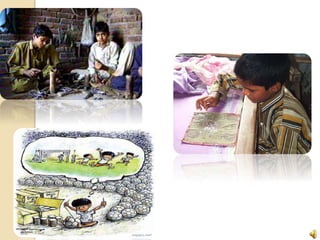
Carpet Industry
Football Industry
Begging
Household Labor
Silk Industry
Agriculture Sector
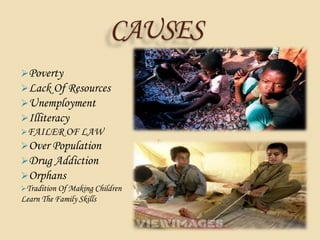
CAUSES
Poverty
Lack Of Resources
Unemployment
Illiteracy
FAILER OF LAW
Over Population
Drug Addiction
Orphans
Tradition Of Making Children
Learn The Family Skills
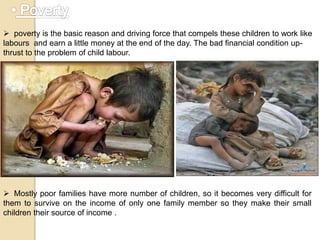
 poverty is the basic reason and driving force that compels these children to work like
labours and earn a little money at the end of the day. The bad financial condition up-
thrust to the problem of child labour.
 Mostly poor families have more number of children, so it becomes very difficult for
them to survive on the income of only one family member so they make their small
children their source of income .
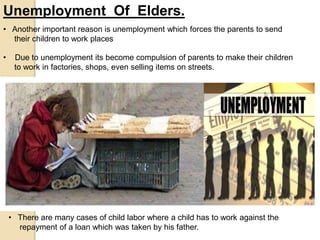
Unemployment Of Elders.
• Due to unemployment its become compulsion of parents to make their children
to work in factories, shops, even selling items on streets.
• There are many cases of child labor where a child has to work against the
repayment of a loan which was taken by his father.
• Another important reason is unemployment which forces the parents to send
their children to work places
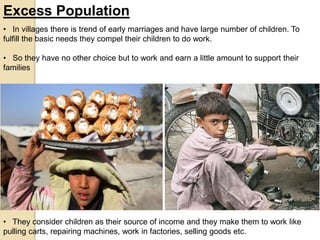
Excess Population
• In villages there is trend of early marriages and have large number of children. To
fulfill the basic needs they compel their children to do work.
• So they have no other choice but to work and earn a little amount to support their
families
• They consider children as their source of income and they make them to work like
pulling carts, repairing machines, work in factories, selling goods etc.
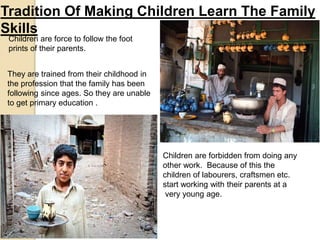
Tradition Of Making Children Learn The Family
Skills
Children are force to follow the foot
prints of their parents.
They are trained from their childhood in
the profession that the family has been
following since ages. So they are unable
to get primary education .
Children are forbidden from doing any
other work. Because of this the
children of labourers, craftsmen etc.
start working with their parents at a
very young age.
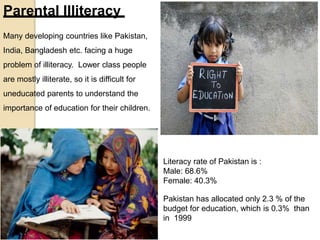
Many developing countries like Pakistan,
India, Bangladesh etc. facing a huge
problem of illiteracy. Lower class people
are mostly illiterate, so it is difficult for
uneducated parents to understand the
importance of education for their children.
Parental Illiteracy
Pakistan has allocated only 2.3 % of the
budget for education, which is 0.3% than
in 1999
Literacy rate of Pakistan is :
Male: 68.6%
Female: 40.3%
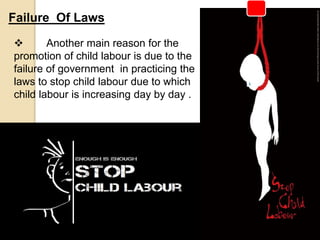
 Another main reason for the
promotion of child labour is due to the
failure of government in practicing the
laws to stop child labour due to which
child labour is increasing day by day .
Failure Of Laws
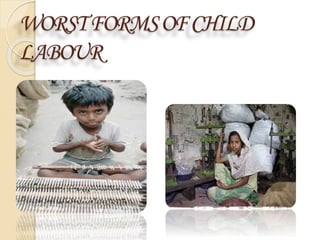
WORSTFORMSOFCHILD
LABOUR
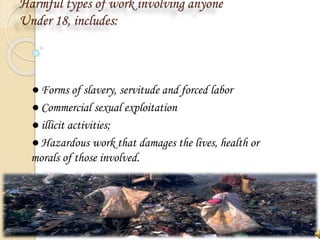
Harmful types of work involving anyone
Under 18, includes:
● Forms of slavery, servitude and forced labor
● Commercial sexual exploitation
● illicit activities;
● Hazardous work that damages the lives, health or
morals of those involved.
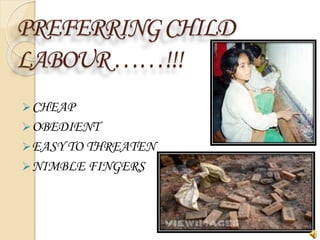
PREFERRINGCHILD
LABOUR……!!!
CHEAP
OBEDIENT
EASY TO THREATEN
NIMBLE FINGERS
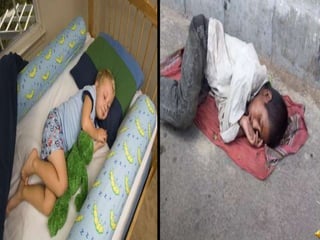
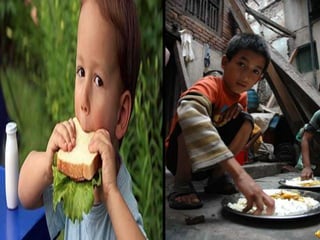
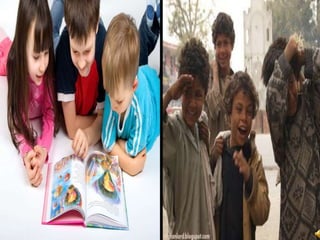
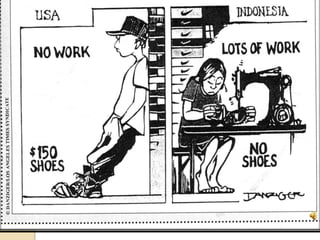
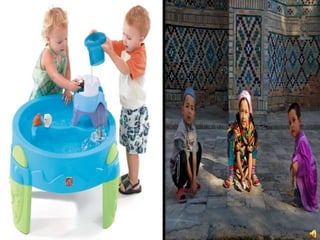
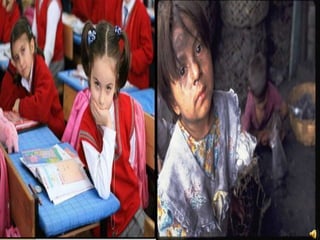
COMPARISON
SLEEPINGWAY
EATINGHABITS
WAYSOF
ENJOYMENT
WORKING
PLAYING
EDUCATION
We need to see both sides of the picture…
We just can’t close our EYES, IGNORE and
THINK, things would get better one day...
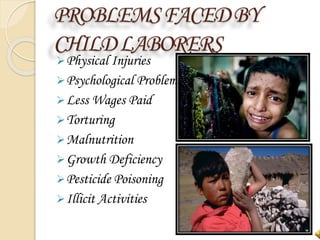
PROBLEMSFACEDBY
CHILDLABORERS
Physical Injuries
Psychological Problems
Less Wages Paid
Torturing
Malnutrition
Growth Deficiency
Pesticide Poisoning
Illicit Activities
REMEDIES
Compulsion of free education
Improving and enforcing laws
Controlled population
Balance in production and consumption
Raise of family income
Antinarcotics agencies
Government efforts
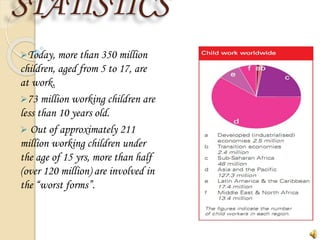
STATISTICS
Today, more than 350 million
children, aged from 5 to 17, are
at work.
73 million working children are
less than 10 years old.
 Out of approximately 211
million working children under
the age of 15 yrs, more than half
(over 120 million) are involved in
the “worst forms”.
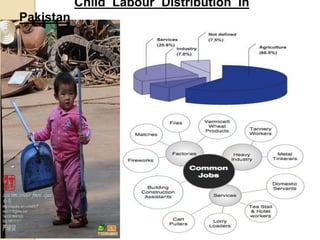
STATISTICSINPAKISTAN
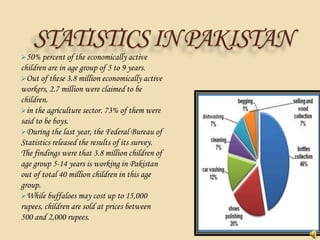
50% percent of the economically active
children are in age group of 5 to 9 years.
Out of these 3.8 million economically active
workers, 2.7 million were claimed to be
children.
in the agriculture sector. 73% of them were
said to be boys.
During the last year, the Federal Bureau of
Statistics released the results of its survey.
The findings were that 3.8 million children of
age group 5-14 years is working in Pakistan
out of total 40 million children in this age
group.
While buffaloes may cost up to 15,000
rupees, children are sold at prices between
500 and 2,000 rupees.
Child Labour Distribution in
Pakistan
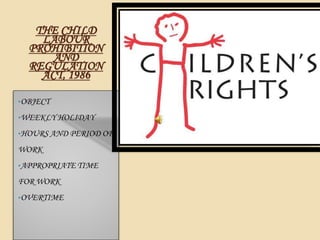
LAWSFORCHILD
LABOURERS
THE CHILD
LABOUR
PROHIBITION
AND
REGULATION
ACT, 1986
•OBJECT
•WEEKLY HOLIDAY
•HOURS AND PERIOD OF
WORK
•APPROPRIATE TIME
FOR WORK
•OVERTIME
LABOURDAY
Celebrated on 1st of May every year since 1882.
PURPOSE:
Protection of the rights of the laborers.
celebrate the economic and social achievements
of workers
Most important of all, to restrict the working
hours of the laborers up to 8 hours.
WhenWEWere
Children?
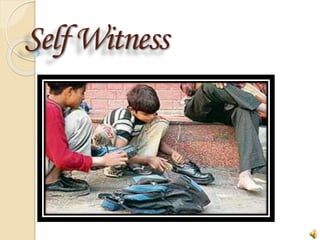
SelfWitness
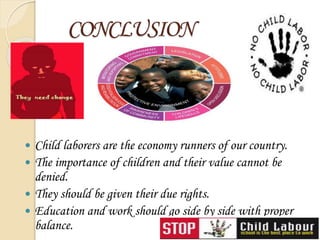
CONCLUSION
 Child laborers are the economy runners of our country.
 The importance of children and their value cannot be
denied.
 They should be given their due rights.
 Education and work should go side by side with proper
balance.
THANK
YOU

CHILD LABOR ..BY M.TARIQ KHAN

  • 2.
  • 3.
  • 4.
    HUMANBEINGS the most superiorcreation of Allah Almighty.  has the ability to think and meditate. made remarkable progress in every walk of life.
  • 5.
    PHASESOFHUMAN LIFE Child (birth –17 yrs) Adults (18 – 25 yrs) Youth (25 – 50 yrs) Old (50 - death) child adult youth old
  • 6.
    CHILDREN  The flowersof heaven.  Most beautiful and purest creation.  Innocent both inwardly and outwardly.  Beauty of this world.
  • 7.
    CONT’D When children puton different kinds of clothes and begin to go to schools for the sake of knowledge. We feel a specific joy through their innocence. BUT…..
  • 8.
    CONT’D There are childrenwho cannot: • Wear good clothes. • Eat good food. • Go to school to acquire knowledge. INSTEAD…. They have to kill all their dreams and work hard to earn living.
  • 9.
  • 10.
    CONTENTS What child laboris…??? CYCLE OF CHILD LABOUR Islamic perspectives Sectors employing child labor Causes Child abuse Worst forms of child labor  Comparison Problems Remedies Statistics Laws Progress rate of a country Conclusion
  • 12.
    DEFINITIONS UNICEF DEFINITION  UNICEFdefines “child” as anyone below the age of 18.  “Child Labor” as some type of work performed by children below age 18.
  • 13.
    CONT’D CONVENTIONAL DEFINITION: children workingbefore they reached the lawful minimum age for employment in their country. nowadays 14 to 15 years world wide.  16 years in UK.
  • 14.
    CONT’D LATEST DEFINITION: refers toall young people engaged in harmful employment, whether they are school-age or older.
  • 15.
    • Child labouris work for children that harms them or exploits them in some way (i.e. physically, morally, mentally or by blocking access to education . What is child labour ? Child labour is... Child labour is not... • Light work done after school. • Internship opportunities • Helping out the family farm or business
  • 16.
  • 17.
    ISLAMIC PRESPECTIVE All human beingsare equal. importance of the children rights. Our beloved Holy Prophet Hazrat Muhammad (S.A.W) and children. Children should be taught to write and read.
  • 18.
  • 19.
    CAUSES Poverty Lack Of Resources Unemployment Illiteracy FAILEROF LAW Over Population Drug Addiction Orphans Tradition Of Making Children Learn The Family Skills
  • 20.
     poverty isthe basic reason and driving force that compels these children to work like labours and earn a little money at the end of the day. The bad financial condition up- thrust to the problem of child labour.  Mostly poor families have more number of children, so it becomes very difficult for them to survive on the income of only one family member so they make their small children their source of income .
  • 21.
    Unemployment Of Elders. •Due to unemployment its become compulsion of parents to make their children to work in factories, shops, even selling items on streets. • There are many cases of child labor where a child has to work against the repayment of a loan which was taken by his father. • Another important reason is unemployment which forces the parents to send their children to work places
  • 22.
    Excess Population • Invillages there is trend of early marriages and have large number of children. To fulfill the basic needs they compel their children to do work. • So they have no other choice but to work and earn a little amount to support their families • They consider children as their source of income and they make them to work like pulling carts, repairing machines, work in factories, selling goods etc.
  • 23.
    Tradition Of MakingChildren Learn The Family Skills Children are force to follow the foot prints of their parents. They are trained from their childhood in the profession that the family has been following since ages. So they are unable to get primary education . Children are forbidden from doing any other work. Because of this the children of labourers, craftsmen etc. start working with their parents at a very young age.
  • 24.
    Many developing countrieslike Pakistan, India, Bangladesh etc. facing a huge problem of illiteracy. Lower class people are mostly illiterate, so it is difficult for uneducated parents to understand the importance of education for their children. Parental Illiteracy Pakistan has allocated only 2.3 % of the budget for education, which is 0.3% than in 1999 Literacy rate of Pakistan is : Male: 68.6% Female: 40.3%
  • 25.
     Another mainreason for the promotion of child labour is due to the failure of government in practicing the laws to stop child labour due to which child labour is increasing day by day . Failure Of Laws
  • 26.
  • 27.
    Harmful types ofwork involving anyone Under 18, includes: ● Forms of slavery, servitude and forced labor ● Commercial sexual exploitation ● illicit activities; ● Hazardous work that damages the lives, health or morals of those involved.
  • 28.
  • 29.
  • 30.
  • 32.
  • 34.
  • 36.
  • 38.
  • 40.
  • 42.
    We need tosee both sides of the picture… We just can’t close our EYES, IGNORE and THINK, things would get better one day...
  • 43.
    PROBLEMSFACEDBY CHILDLABORERS Physical Injuries Psychological Problems LessWages Paid Torturing Malnutrition Growth Deficiency Pesticide Poisoning Illicit Activities
  • 44.
    REMEDIES Compulsion of freeeducation Improving and enforcing laws Controlled population Balance in production and consumption Raise of family income Antinarcotics agencies Government efforts
  • 45.
    STATISTICS Today, more than350 million children, aged from 5 to 17, are at work. 73 million working children are less than 10 years old.  Out of approximately 211 million working children under the age of 15 yrs, more than half (over 120 million) are involved in the “worst forms”.
  • 46.
    STATISTICSINPAKISTAN 50% percent ofthe economically active children are in age group of 5 to 9 years. Out of these 3.8 million economically active workers, 2.7 million were claimed to be children. in the agriculture sector. 73% of them were said to be boys. During the last year, the Federal Bureau of Statistics released the results of its survey. The findings were that 3.8 million children of age group 5-14 years is working in Pakistan out of total 40 million children in this age group. While buffaloes may cost up to 15,000 rupees, children are sold at prices between 500 and 2,000 rupees.
  • 47.
  • 48.
  • 49.
    THE CHILD LABOUR PROHIBITION AND REGULATION ACT, 1986 •OBJECT •WEEKLYHOLIDAY •HOURS AND PERIOD OF WORK •APPROPRIATE TIME FOR WORK •OVERTIME
  • 50.
    LABOURDAY Celebrated on 1stof May every year since 1882. PURPOSE: Protection of the rights of the laborers. celebrate the economic and social achievements of workers Most important of all, to restrict the working hours of the laborers up to 8 hours.
  • 52.
  • 53.
  • 54.
    CONCLUSION  Child laborersare the economy runners of our country.  The importance of children and their value cannot be denied.  They should be given their due rights.  Education and work should go side by side with proper balance.
  • 55.