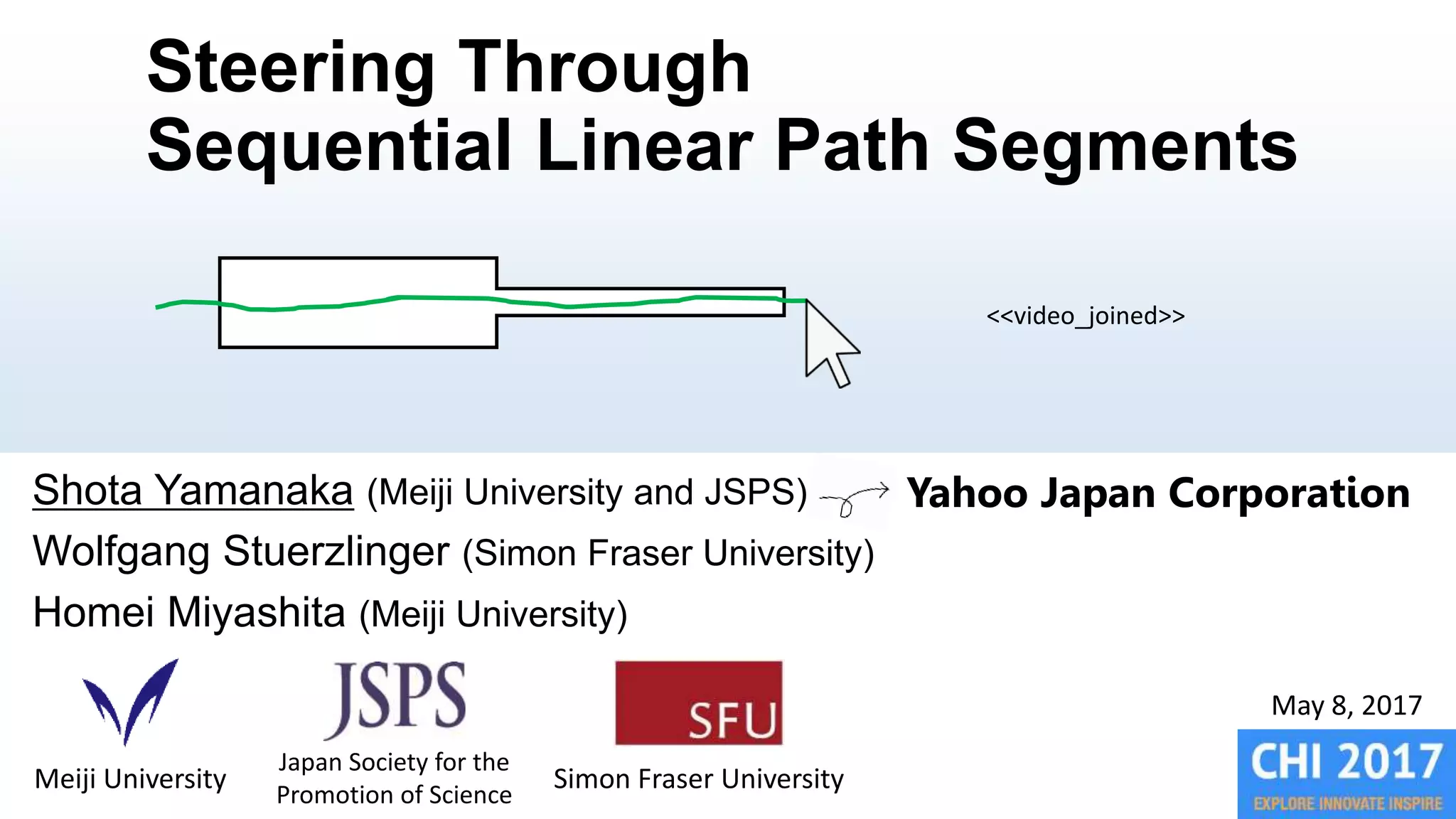
Steering Through
Sequential Linear Path Segments
Shota Yamanaka (Meiji University and JSPS)
Wolfgang Stuerzlinger (Simon Fraser University)
Homei Miyashita (Meiji University)
Japan Society for the
Promotion of Science
Simon Fraser University
May 8, 2017
<<video_joined>>
Yahoo Japan Corporation
Meiji University
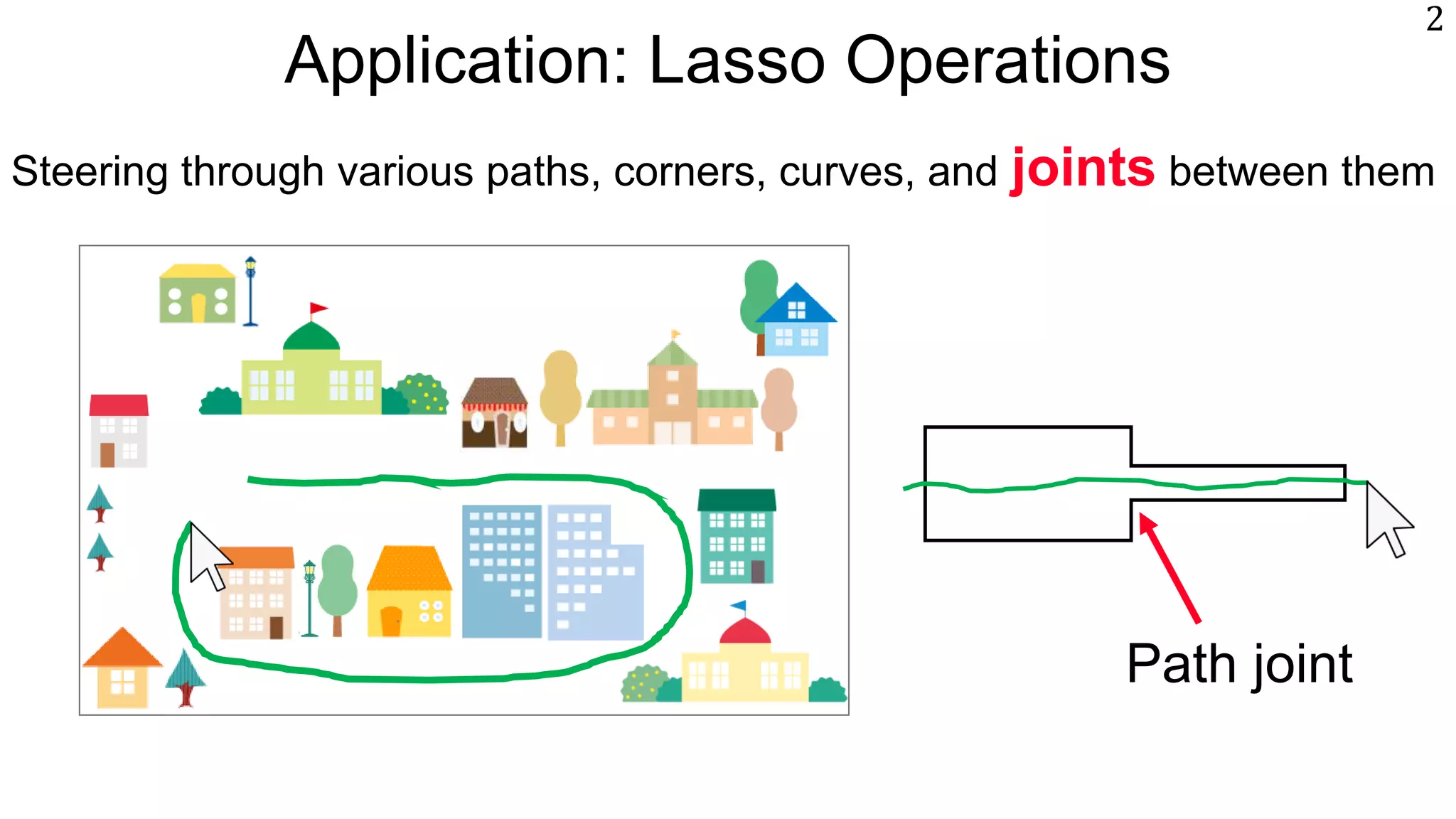
Application: Lasso Operations
Steering through various paths, corners, curves, and joints between them
2
Path joint
𝑀𝑇 = 𝑎 + 𝑏
𝐴
𝑊
The Steering Law [Accot+, CHI '97, '99]
3
W
A
A
W
Movement time
Path length
Path width
Simple form,
constant-width paths
General form,
arbitrary paths
s
W(s)
𝑀𝑇 = 𝑎 + 𝑏
𝐶
𝑑𝑠
𝑊 𝑠
Derived Steering Models
4
Narrowing path
[Accot+, CHI '97]
Spiral path
[Accot+, CHI '97]
WL
A
WR
A
WRWL
Widening path
[Yamanaka+, CHI '16]
Revised Steering Model
Corner requires pointing motion
[Pastel, CHI '06]
5
W
A/2
A/2
𝑀𝑇 = 𝑎 + 𝑏
𝐴
𝑊
+ 𝑐 log2
𝐴/2
𝑊
+ 1
Fitts’ IDSteering-ID
W
A
𝑀𝑇 = 𝑎 + 𝑏 𝐴
Open-loop behavior in very wide paths
[Thibbotuwawa+, Ergonomics '12]
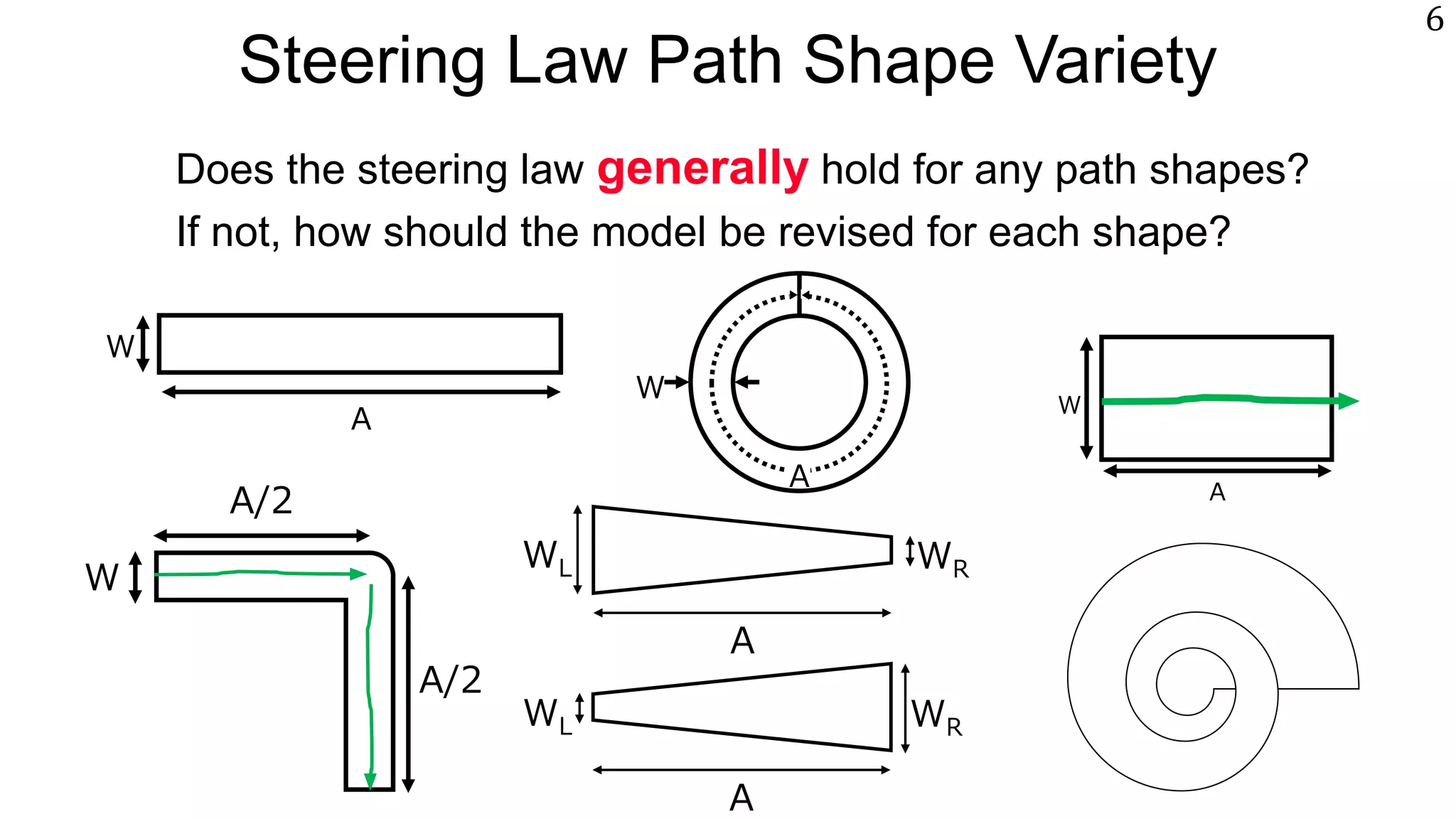
Steering Law Path Shape Variety
Does the steering law generally hold for any path shapes?
If not, how should the model be revised for each shape?
6
W
A
W
A
W
A/2
A/2
WL
A
WR
A
WRWL
A
W
Research Goal
• Can general steering law model time for sequential path segments?
7
𝑀𝑇 = 𝑎 + 𝑏
𝐶
𝑑𝑠
𝑊 𝑠
= 𝑎 + 𝑏
𝐴1
𝑊1
+
𝐴2
𝑊2
General model: “MT is linear to
the sum of the two ID values”
ID of path1 ID of path2
W1
A2 A2
W2
W1
A2 A2
W2
Path1 Path2
Path1 Path2
Exp. 1: Traditional Steering Task, as Baseline
• Instruction
“Pass through the path as quickly and accurately as possible.”
• 13 Participants
• Length A: 2 levels
480 and 640 pixels
• Width W: 4 levels
15, 23, 33, and 45 pixels
8
Avoid moving out of the path
<<video_single>>
Exp. 1: Results (Model Fitness, Speed)
R2 > 0.998
9
y = 47.666x - 57.524
R² = 0.9984
0
700
1400
2100
0 10 20 30 40 50
MovementTime[ms]
ID = A/W [bits]
• Higher speed in wider path
• Gradual acceleration after pen tip
contacted surface
0
0.4
0.8
1.2
1.6
2
960 1120 1280 1440 1600
Speedonthex-axis
Cursor position on the x-axis [pixels]
0 640480320160
W = 15 pixels
W = 23 pixels
W = 33 pixels
W = 45 pixels
𝑀𝑇 = 𝑎 + 𝑏
𝐴
𝑊
Speedonthex-axis[pixels/ms]
Exp. 2: Sequential Path Segments
Navigating two path segments (as used in Exp. 1)
Other conditions same as Exp. 1
Rule: A1 = A2, and W1 ≠ W2 (= always a joint between segments)
10
W1
A1 A2
W2
W1
A1 A2
W2
Path 1
Path 2
Path 1
Path 2
<<video_joined>>
Exp. 2: Results (Model Fitness)
R2 > 0.985
11
𝑀𝑇 = 𝑎 + 𝑏
𝐴1
𝑊1
+
𝐴2
𝑊2
y = 55.508x - 137.28
R² = 0.9856
0
1000
2000
3000
4000
0 20 40 60 80
Movementtime[ms]
ID = A1/W1 + A2/W2 [bits]
Steering law still holds even for
a pair of joined path segments
Exp. 2: Speed Analysis (Narrowing Path)
Path1
Deceleration in advance
of joint
Path2
Gradual acceleration.
similar to single path segment
12
0.0
0.2
0.4
0.6
0.8
1.0
1.2
800 1040 1280 1520 17600 240 480 720 960
Cursor position on the x-axis [pixels]
Speedonthex-axis[pixels/ms]
23
480 480
15
Path1
Path2
Speed Comparison to Exp. 1
In presence of joint, speed
decreased in 1st segment
・911 ms for a single path
・1323 ms for joined paths (45% up)
No notable change in 2nd segment
・1451 ms for a single path
・1444 ms for joined paths
(0.77% down)
Only behavior in 1st segment
affected by joint
13
0.0
0.2
0.4
0.6
0.8
1.0
1.2
800 1040 1280 1520 17600 240 480 720 960
Cursor position on the x-axis [pixels]
Speedonthex-axis[pixels/ms]
23
480 480
15
Exp. 1
Exp. 2
Exp. 1
0
0.2
0.4
0.6
0.8
1
1.2
800 1040 1280 1520 1760
Speed[pixels/ms]
Cursor position on the x-axis [pixels]
Exp. 2: Speed Analysis (Widening Path)
14
0 240 480 720 960
Cursor position on the x-axis [pixels]
Speedonthex-axis[pixels/ms]
23
480 480
15
Speed decreased in 1st segment
1451 ms for single path
1688 ms for joined paths (16% up)
No notable change in 2nd segment
911 ms for single path
890 ms for joined paths (2.3% down)
Only behavior in 1st segment
was affected by joint
Single path: W=15
Single path: W=23
Joined paths: W1=15 & W2=23
Path1
Path2
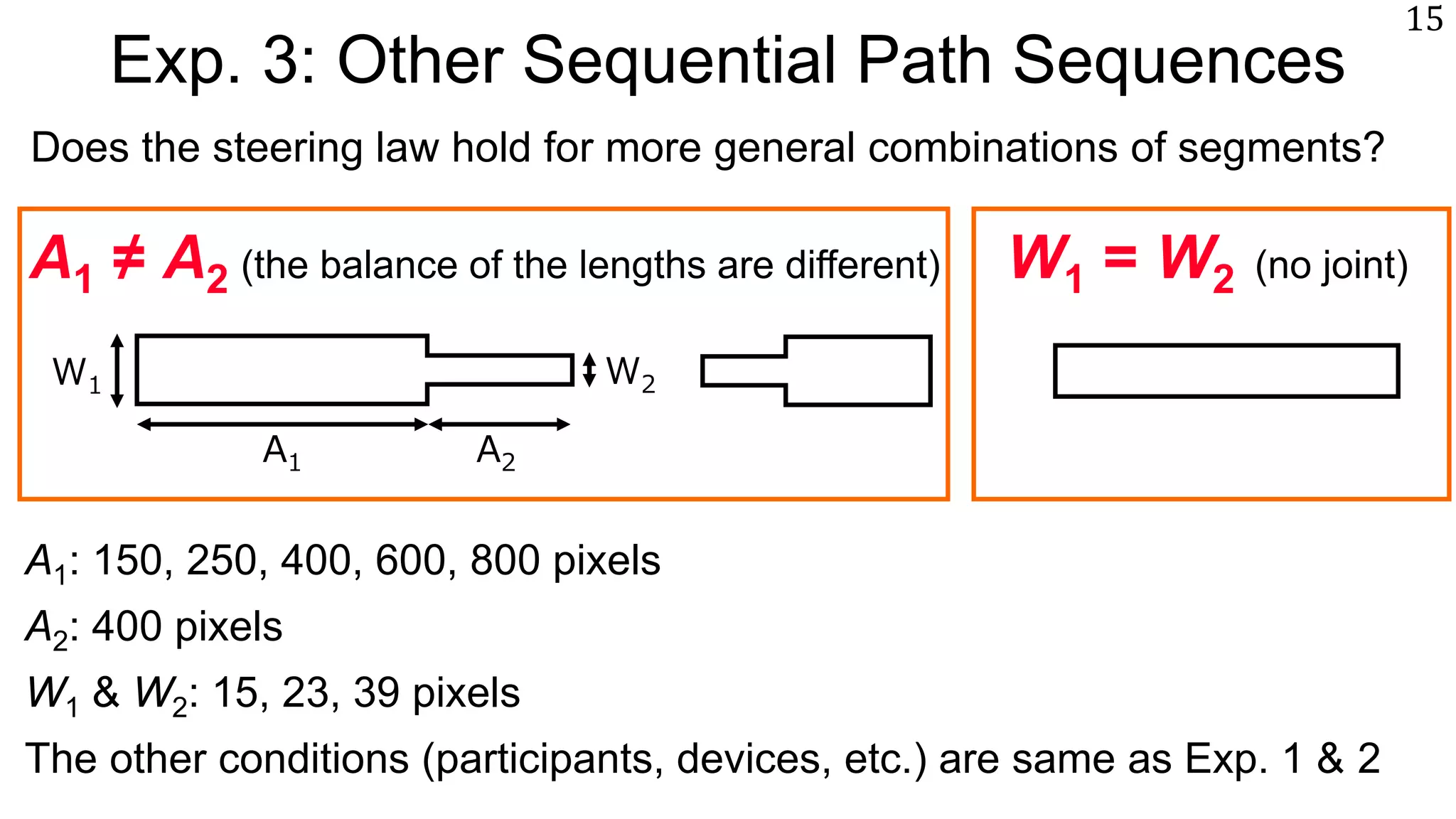
Exp. 3: Other Sequential Path Sequences
15
A1: 150, 250, 400, 600, 800 pixels
A2: 400 pixels
W1 & W2: 15, 23, 39 pixels
The other conditions (participants, devices, etc.) are same as Exp. 1 & 2
W1
A1 A2
W2
Does the steering law hold for more general combinations of segments?
W1 = W2 (no joint)A1 ≠ A2 (the balance of the lengths are different)
Exp. 3: Results (Model Fitness)
High fitness: R2 > 0.962
Even for two joined path segments with
same path type, steering law holds
16
𝑀𝑇 = 𝑎 + 𝑏
𝐴1
𝑊1
+
𝐴2
𝑊2
y = 45.84x - 99.836
R² = 0.9626
0
1000
2000
3000
4000
0 30 60 90
MT[ms]
ID = A1/W1 + A2/W2 [bits]
・Ratio of lengths (A1 : A2)
・Narrowing/widening/constant-width shapes
0
0.4
0.8
1.2
1.6
490 790 1090 1390
0
0.4
0.8
1.2
1.6
490 790 1090 1390
0
0.4
0.8
1.2
1.6
490 790 1090 1390
Exp. 3: Speed Analysis (Single Path)
Speed profiles similar to Exp. 1
• Speed higher in wider path
• Speed gradually increased after pen tip contacted surface
17
W = 15 pixels W = 23 pixels W = 39 pixels
0 300 600 900 1200
Cursor position on the x-axis [pixels]
Speedonthex-axis[pixels/ms]
0 300 600 900 1200
Cursor position on the x-axis [pixels]
Speedonthex-axis[pixels/ms]
0 300 600 900 1200
Cursor position on the x-axis [pixels]
Speedonthex-axis[pixels/ms]
Exp. 3: Speed Analysis (Joined Paths)
18
0
0.5
1
1.5
AxisTitle
Axis Title
0
0.5
1
1.5
AxisTitle
Axis Title
0 200 400 600 800 1000 12000 200 400 600 800 1000 1200
Cursor position on the x-axis [pixels]
Speedonthex-axis[pixels/ms]
Cursor position on the x-axis [pixels]
0
1.0
1.5
0.5
0
1.0
1.5
0.5
Speedonthex-axis[pixels/ms]
Speed profiles similar to Exp. 2
• 1st segment: slower speed than single path
• 2nd segment: no remarkable difference from single path
Narrowing path
(W1 = 23 > W2 = 15)
Widening path
(W1 = 15 < W2 = 23)
Improve prediction accuracy of steering law model through taking
slow-down behavior until joint into account
19
Narrowing path Widening path Constant-width path
0
0.5
1
1.5
480 880 1280 1680
Speedonthex-axis[pixels/ms]
0 400 800 1200
Cursor position on the x-axis [pixels]
0
0.5
1
1.5
480 880 1280 1680
Speedonthex-axis[pixels/ms]
0 400 800 1200
Cursor position on the x-axis [pixels]
0
0.5
1
1.5
490 890 1290
Speedonthex-axis[pixels/ms]
0 400 800 1200
Cursor position on the x-axis [pixels]
Revisions based on Deceleration in 1st Segment
Joints clearly affected users’ behaviors
Approach for Revised Model
Model entering 2nd segment as a crossing task
20
Crossing law [Accot+, CHI '02]: Time to cross a finite-length line:
𝑀𝑇 = 𝑎 + 𝑏 log2
𝐴
𝑊
+ 1
A
W
Our Revised Model
21
W1 W
2
A1 A2
5W1A1-5W1 A2
𝑀𝑇 = 𝑎 + 𝑏
𝐴1 − 5𝑊1
𝑊1
+ 𝑐 𝐥𝐨𝐠 𝟐
𝟓𝑾 𝟏
𝑾 𝟐
+ 𝟏 + 𝑑
𝐴2
𝑊2
Steering-ID
of 1st segment
Crossing–ID
of joint
Steering-ID
of 2nd segment
From related work [Senanayake+]
Best Model Selection
Other variations: Separate Steering-IDs
22
Model
Exp. 2 Exp. 3
R2 AIC R2 AIC
𝑀𝑇 = 𝑎 + 𝑏
𝐴1
𝑊1
+
𝐴2
𝑊2
0.986 290 0.963 578
𝑀𝑇 = 𝑎 + 𝑏
𝐴1
𝑊1
+ 𝑐
𝐴2
𝑊2
0.992 277 0.963 580
𝑀𝑇 = 𝑎 + 𝑏
𝐴1 − 5𝑊1
𝑊1
+ 𝑐 log2
5𝑊1
𝑊2
+ 1 + 𝑑
𝐴2
𝑊2
0.994 272 0.979 556
𝑀𝑇 = 𝑎 + 𝑏
𝐴1 − 5𝑊1
𝑊1
+
𝐴2
𝑊2
+ 𝑐 log2
5𝑊1
𝑊2
+ 1 0.996 272 0.970 571
General
Proposed
General
(Separated)
Proposed
(Merged)
Indicators for selecting best model: R2 (higher is better), AIC: (lower is better)
*Best values are in green cells
Limitations
When joint position is not at center of path,
operational strategies could depend on user
23
Many joined short path segments, or very short path lengths
W1 W2
A1
A2
W2
(A1 + A2) × 6
Steering Through Sequential Linear Path Segments
24
• MT accurately predicted by general steering law (= sum of two IDs),
even if path lengths are different (A1 ≠ A2), and widths are same (W1 = W2)
• Speed profiles affected by shape (narrowing/widening/constant)
• In joined path segments, deceleration was observed clearly in 1st segment
• Model fitness improved by inserting crossing-ID at end of 1st segment
Narrowing path Widening path
0
0.5
1
1.5
480 880 1280 1680
Speedonthex-axis[pixels/ms]
0 400 800 1200
Cursor position on the x-axis [pixels]
0
0.5
1
1.5
480 880 1280 1680
Speedonthex-axis[pixels/ms]
0 400 800 1200
Cursor position on the x-axis [pixels]
<<video_joined>>
Contact: syamanak@yahoo-corp.jp
Appendix: Revised Model
Movement to enter 2nd segment is modeled by crossing-ID
25
To determine crossing-ID, we have to know distance for crossing operation
(= red line)
① Steering ② Crossing ③ Steering
Appendix: Steering Tasks with a Pointing Motion
[Senanayake+, Experimental Brain Research '13]
To click a target at end of a steered path, observed motion changes
at 5W distance from target
(After that point, users seem not to worry about deviating from path)
26
Steering motion Pointing motion
5×W
W
Target
Appendix:
Revised Model with Fewer Free Parameters
27
𝑀𝑇 = 𝑎 + 𝑏
𝐴1 − 5𝑊1
𝑊1
+ 𝑐 𝐥𝐨𝐠 𝟐
𝟓𝑾 𝟏
𝑾 𝟐
+ 𝟏 + 𝑑
𝐴2
𝑊2
𝑀𝑇 = 𝑎 + 𝑏
𝐴1 − 5𝑊1
𝑊1
+
𝐴2
𝑊2
+ 𝑐 𝐥𝐨𝐠 𝟐
𝟓𝑾 𝟏
𝑾 𝟐
+ 𝟏
As number of free parameters (a, b, c, and d) increases,
prediction accuracy decreases (leads to “overfitting”)
If we assume that steering motion parameters (b & d) are similar,
we can merge two steering-ID values
steering steeringcrossing
Appendix:
General Model with More Free Parameters
Separating two steering motions potentially improves fitness
28
𝑀𝑇 = 𝑎 + 𝑏
𝐴1
𝑊1
+
𝐴2
𝑊2
𝑀𝑇 = 𝑎 + 𝑏
𝐴1
𝑊1
+ 𝑐
𝐴2
𝑊2
(Original)
(Separate)
Appendix: Paths Joined at the Top of the Y-axis
Pilot observation with three persons shows different strategies
29
Participant 1
Participant 2
Participant 3
Narrowing path Widening path

Chi2017 yamanaka novideo

  • 1.
    Steering Through Sequential LinearPath Segments Shota Yamanaka (Meiji University and JSPS) Wolfgang Stuerzlinger (Simon Fraser University) Homei Miyashita (Meiji University) Japan Society for the Promotion of Science Simon Fraser University May 8, 2017 <<video_joined>> Yahoo Japan Corporation Meiji University
  • 2.
    Application: Lasso Operations Steeringthrough various paths, corners, curves, and joints between them 2 Path joint
  • 3.
    𝑀𝑇 = 𝑎+ 𝑏 𝐴 𝑊 The Steering Law [Accot+, CHI '97, '99] 3 W A A W Movement time Path length Path width Simple form, constant-width paths General form, arbitrary paths s W(s) 𝑀𝑇 = 𝑎 + 𝑏 𝐶 𝑑𝑠 𝑊 𝑠
  • 4.
    Derived Steering Models 4 Narrowingpath [Accot+, CHI '97] Spiral path [Accot+, CHI '97] WL A WR A WRWL Widening path [Yamanaka+, CHI '16]
  • 5.
    Revised Steering Model Cornerrequires pointing motion [Pastel, CHI '06] 5 W A/2 A/2 𝑀𝑇 = 𝑎 + 𝑏 𝐴 𝑊 + 𝑐 log2 𝐴/2 𝑊 + 1 Fitts’ IDSteering-ID W A 𝑀𝑇 = 𝑎 + 𝑏 𝐴 Open-loop behavior in very wide paths [Thibbotuwawa+, Ergonomics '12]
  • 6.
    Steering Law PathShape Variety Does the steering law generally hold for any path shapes? If not, how should the model be revised for each shape? 6 W A W A W A/2 A/2 WL A WR A WRWL A W
  • 7.
    Research Goal • Cangeneral steering law model time for sequential path segments? 7 𝑀𝑇 = 𝑎 + 𝑏 𝐶 𝑑𝑠 𝑊 𝑠 = 𝑎 + 𝑏 𝐴1 𝑊1 + 𝐴2 𝑊2 General model: “MT is linear to the sum of the two ID values” ID of path1 ID of path2 W1 A2 A2 W2 W1 A2 A2 W2 Path1 Path2 Path1 Path2
  • 8.
    Exp. 1: TraditionalSteering Task, as Baseline • Instruction “Pass through the path as quickly and accurately as possible.” • 13 Participants • Length A: 2 levels 480 and 640 pixels • Width W: 4 levels 15, 23, 33, and 45 pixels 8 Avoid moving out of the path <<video_single>>
  • 9.
    Exp. 1: Results(Model Fitness, Speed) R2 > 0.998 9 y = 47.666x - 57.524 R² = 0.9984 0 700 1400 2100 0 10 20 30 40 50 MovementTime[ms] ID = A/W [bits] • Higher speed in wider path • Gradual acceleration after pen tip contacted surface 0 0.4 0.8 1.2 1.6 2 960 1120 1280 1440 1600 Speedonthex-axis Cursor position on the x-axis [pixels] 0 640480320160 W = 15 pixels W = 23 pixels W = 33 pixels W = 45 pixels 𝑀𝑇 = 𝑎 + 𝑏 𝐴 𝑊 Speedonthex-axis[pixels/ms]
  • 10.
    Exp. 2: SequentialPath Segments Navigating two path segments (as used in Exp. 1) Other conditions same as Exp. 1 Rule: A1 = A2, and W1 ≠ W2 (= always a joint between segments) 10 W1 A1 A2 W2 W1 A1 A2 W2 Path 1 Path 2 Path 1 Path 2 <<video_joined>>
  • 11.
    Exp. 2: Results(Model Fitness) R2 > 0.985 11 𝑀𝑇 = 𝑎 + 𝑏 𝐴1 𝑊1 + 𝐴2 𝑊2 y = 55.508x - 137.28 R² = 0.9856 0 1000 2000 3000 4000 0 20 40 60 80 Movementtime[ms] ID = A1/W1 + A2/W2 [bits] Steering law still holds even for a pair of joined path segments
  • 12.
    Exp. 2: SpeedAnalysis (Narrowing Path) Path1 Deceleration in advance of joint Path2 Gradual acceleration. similar to single path segment 12 0.0 0.2 0.4 0.6 0.8 1.0 1.2 800 1040 1280 1520 17600 240 480 720 960 Cursor position on the x-axis [pixels] Speedonthex-axis[pixels/ms] 23 480 480 15 Path1 Path2
  • 13.
    Speed Comparison toExp. 1 In presence of joint, speed decreased in 1st segment ・911 ms for a single path ・1323 ms for joined paths (45% up) No notable change in 2nd segment ・1451 ms for a single path ・1444 ms for joined paths (0.77% down) Only behavior in 1st segment affected by joint 13 0.0 0.2 0.4 0.6 0.8 1.0 1.2 800 1040 1280 1520 17600 240 480 720 960 Cursor position on the x-axis [pixels] Speedonthex-axis[pixels/ms] 23 480 480 15 Exp. 1 Exp. 2 Exp. 1
  • 14.
    0 0.2 0.4 0.6 0.8 1 1.2 800 1040 12801520 1760 Speed[pixels/ms] Cursor position on the x-axis [pixels] Exp. 2: Speed Analysis (Widening Path) 14 0 240 480 720 960 Cursor position on the x-axis [pixels] Speedonthex-axis[pixels/ms] 23 480 480 15 Speed decreased in 1st segment 1451 ms for single path 1688 ms for joined paths (16% up) No notable change in 2nd segment 911 ms for single path 890 ms for joined paths (2.3% down) Only behavior in 1st segment was affected by joint Single path: W=15 Single path: W=23 Joined paths: W1=15 & W2=23 Path1 Path2
  • 15.
    Exp. 3: OtherSequential Path Sequences 15 A1: 150, 250, 400, 600, 800 pixels A2: 400 pixels W1 & W2: 15, 23, 39 pixels The other conditions (participants, devices, etc.) are same as Exp. 1 & 2 W1 A1 A2 W2 Does the steering law hold for more general combinations of segments? W1 = W2 (no joint)A1 ≠ A2 (the balance of the lengths are different)
  • 16.
    Exp. 3: Results(Model Fitness) High fitness: R2 > 0.962 Even for two joined path segments with same path type, steering law holds 16 𝑀𝑇 = 𝑎 + 𝑏 𝐴1 𝑊1 + 𝐴2 𝑊2 y = 45.84x - 99.836 R² = 0.9626 0 1000 2000 3000 4000 0 30 60 90 MT[ms] ID = A1/W1 + A2/W2 [bits] ・Ratio of lengths (A1 : A2) ・Narrowing/widening/constant-width shapes
  • 17.
    0 0.4 0.8 1.2 1.6 490 790 10901390 0 0.4 0.8 1.2 1.6 490 790 1090 1390 0 0.4 0.8 1.2 1.6 490 790 1090 1390 Exp. 3: Speed Analysis (Single Path) Speed profiles similar to Exp. 1 • Speed higher in wider path • Speed gradually increased after pen tip contacted surface 17 W = 15 pixels W = 23 pixels W = 39 pixels 0 300 600 900 1200 Cursor position on the x-axis [pixels] Speedonthex-axis[pixels/ms] 0 300 600 900 1200 Cursor position on the x-axis [pixels] Speedonthex-axis[pixels/ms] 0 300 600 900 1200 Cursor position on the x-axis [pixels] Speedonthex-axis[pixels/ms]
  • 18.
    Exp. 3: SpeedAnalysis (Joined Paths) 18 0 0.5 1 1.5 AxisTitle Axis Title 0 0.5 1 1.5 AxisTitle Axis Title 0 200 400 600 800 1000 12000 200 400 600 800 1000 1200 Cursor position on the x-axis [pixels] Speedonthex-axis[pixels/ms] Cursor position on the x-axis [pixels] 0 1.0 1.5 0.5 0 1.0 1.5 0.5 Speedonthex-axis[pixels/ms] Speed profiles similar to Exp. 2 • 1st segment: slower speed than single path • 2nd segment: no remarkable difference from single path Narrowing path (W1 = 23 > W2 = 15) Widening path (W1 = 15 < W2 = 23)
  • 19.
    Improve prediction accuracyof steering law model through taking slow-down behavior until joint into account 19 Narrowing path Widening path Constant-width path 0 0.5 1 1.5 480 880 1280 1680 Speedonthex-axis[pixels/ms] 0 400 800 1200 Cursor position on the x-axis [pixels] 0 0.5 1 1.5 480 880 1280 1680 Speedonthex-axis[pixels/ms] 0 400 800 1200 Cursor position on the x-axis [pixels] 0 0.5 1 1.5 490 890 1290 Speedonthex-axis[pixels/ms] 0 400 800 1200 Cursor position on the x-axis [pixels] Revisions based on Deceleration in 1st Segment Joints clearly affected users’ behaviors
  • 20.
    Approach for RevisedModel Model entering 2nd segment as a crossing task 20 Crossing law [Accot+, CHI '02]: Time to cross a finite-length line: 𝑀𝑇 = 𝑎 + 𝑏 log2 𝐴 𝑊 + 1 A W
  • 21.
    Our Revised Model 21 W1W 2 A1 A2 5W1A1-5W1 A2 𝑀𝑇 = 𝑎 + 𝑏 𝐴1 − 5𝑊1 𝑊1 + 𝑐 𝐥𝐨𝐠 𝟐 𝟓𝑾 𝟏 𝑾 𝟐 + 𝟏 + 𝑑 𝐴2 𝑊2 Steering-ID of 1st segment Crossing–ID of joint Steering-ID of 2nd segment From related work [Senanayake+]
  • 22.
    Best Model Selection Othervariations: Separate Steering-IDs 22 Model Exp. 2 Exp. 3 R2 AIC R2 AIC 𝑀𝑇 = 𝑎 + 𝑏 𝐴1 𝑊1 + 𝐴2 𝑊2 0.986 290 0.963 578 𝑀𝑇 = 𝑎 + 𝑏 𝐴1 𝑊1 + 𝑐 𝐴2 𝑊2 0.992 277 0.963 580 𝑀𝑇 = 𝑎 + 𝑏 𝐴1 − 5𝑊1 𝑊1 + 𝑐 log2 5𝑊1 𝑊2 + 1 + 𝑑 𝐴2 𝑊2 0.994 272 0.979 556 𝑀𝑇 = 𝑎 + 𝑏 𝐴1 − 5𝑊1 𝑊1 + 𝐴2 𝑊2 + 𝑐 log2 5𝑊1 𝑊2 + 1 0.996 272 0.970 571 General Proposed General (Separated) Proposed (Merged) Indicators for selecting best model: R2 (higher is better), AIC: (lower is better) *Best values are in green cells
  • 23.
    Limitations When joint positionis not at center of path, operational strategies could depend on user 23 Many joined short path segments, or very short path lengths W1 W2 A1 A2 W2 (A1 + A2) × 6
  • 24.
    Steering Through SequentialLinear Path Segments 24 • MT accurately predicted by general steering law (= sum of two IDs), even if path lengths are different (A1 ≠ A2), and widths are same (W1 = W2) • Speed profiles affected by shape (narrowing/widening/constant) • In joined path segments, deceleration was observed clearly in 1st segment • Model fitness improved by inserting crossing-ID at end of 1st segment Narrowing path Widening path 0 0.5 1 1.5 480 880 1280 1680 Speedonthex-axis[pixels/ms] 0 400 800 1200 Cursor position on the x-axis [pixels] 0 0.5 1 1.5 480 880 1280 1680 Speedonthex-axis[pixels/ms] 0 400 800 1200 Cursor position on the x-axis [pixels] <<video_joined>> Contact: syamanak@yahoo-corp.jp
  • 25.
    Appendix: Revised Model Movementto enter 2nd segment is modeled by crossing-ID 25 To determine crossing-ID, we have to know distance for crossing operation (= red line) ① Steering ② Crossing ③ Steering
  • 26.
    Appendix: Steering Taskswith a Pointing Motion [Senanayake+, Experimental Brain Research '13] To click a target at end of a steered path, observed motion changes at 5W distance from target (After that point, users seem not to worry about deviating from path) 26 Steering motion Pointing motion 5×W W Target
  • 27.
    Appendix: Revised Model withFewer Free Parameters 27 𝑀𝑇 = 𝑎 + 𝑏 𝐴1 − 5𝑊1 𝑊1 + 𝑐 𝐥𝐨𝐠 𝟐 𝟓𝑾 𝟏 𝑾 𝟐 + 𝟏 + 𝑑 𝐴2 𝑊2 𝑀𝑇 = 𝑎 + 𝑏 𝐴1 − 5𝑊1 𝑊1 + 𝐴2 𝑊2 + 𝑐 𝐥𝐨𝐠 𝟐 𝟓𝑾 𝟏 𝑾 𝟐 + 𝟏 As number of free parameters (a, b, c, and d) increases, prediction accuracy decreases (leads to “overfitting”) If we assume that steering motion parameters (b & d) are similar, we can merge two steering-ID values steering steeringcrossing
  • 28.
    Appendix: General Model withMore Free Parameters Separating two steering motions potentially improves fitness 28 𝑀𝑇 = 𝑎 + 𝑏 𝐴1 𝑊1 + 𝐴2 𝑊2 𝑀𝑇 = 𝑎 + 𝑏 𝐴1 𝑊1 + 𝑐 𝐴2 𝑊2 (Original) (Separate)
  • 29.
    Appendix: Paths Joinedat the Top of the Y-axis Pilot observation with three persons shows different strategies 29 Participant 1 Participant 2 Participant 3 Narrowing path Widening path