THE CHERNOBYL
   DISASTER
 The Timeline of Events


         Sean Miller
      NUC-495-OL009
      November 4, 2012
REFERENCES
•   Bethe, H. A. (1986). U.S. panel assesses Chernobyl. Bulletin of the Atomic
    Scientists, 42(10), 45-46.
•   Diatlov, A. (2006, April 9) Why INSAG has still got it wrong. Nuclear
    Engineering International.
•   Frontline. (2012). Nuclear reaction: Why do Americans fear nuclear power?.
•   GreenFacts. (2012). Scientific Facts on the Chernobyl Accident.
    Grishanin, International
•   Atomic Energy Agency, International Nuclear Safety Advisory Group.
    (1992). INSAG-7. The Chernobyl accident: Updating of INSAG-1 (Safety
    Series No. 75-INSAG-7).
•   Lorenzini, P. (2006, January 23). Chernobyl myths. American Spectator.
•   Mikhail, M. (n.d.). The Chernobyl reactor: Design features and reasons for
    accident..
•   Rippon, S. (1986, September 11). Chernobyl: The Soviet report. Nuclear
    News, 1-8.
•   United States Nuclear Regulatory Commission. (2012). Background on Chernobyl
    Nuclear Power Plant Accident.
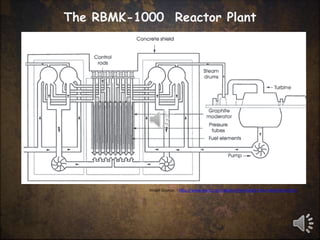
The RBMK-1000 Reactor Plant


            Image Source: : http://www.wentz.net/radiate/chernobyl2/chernobyl/rbmk.html
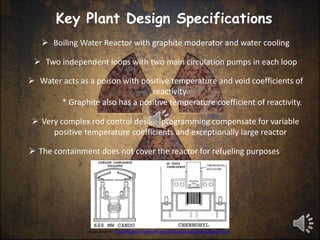
Key Plant Design Specifications
    Boiling Water Reactor with graphite moderator and water cooling

  Two independent loops with two main circulation pumps in each loop

 Water acts as a poison with positive temperature and void coefficients of
                                 reactivity.
       * Graphite also has a positive temperature coefficient of reactivity.

  Very complex rod control design/programming compensate for variable
      positive temperature coefficients and exceptionally large reactor

 The containment does not cover the reactor for refueling purposes


                Image Source: http://library.thinkquest.org/3426/data/cause/design.flaw.html
The Turbine Generator Coastdown Test

Test Problem: The ECCS DGs take too long to pick up electrical load


Proposed Solution: TGs are modified to slow their coastdown, allowing
the TGs to continue to power electrical loads as they coast down


Test Setup: 1)Reconfigure power to electrical loads (MCPs/MFPs);
                       2)Turn off ECCS to prevent inadvertent
activation

Basic Procedure: 1)Reduce reactor power to 22-32%, 2) Trip TG


*NOTE: The test had been run before (twice) with no major issues.
Test Planning Issues

1. Upcoming Maintenance Shutdown Period


2. Higher Authorities not Informed of
Test


3. Electrical Engineer Placed in Charge


4. No evolutionary briefs, walkthroughs, etc   Image Source: http://planetwaves.net/pagetwo/daily-
                                               astrology/radiation-bullshit-levels-increase/
Test Timeline: April
                   25, 1986
       • Operators begin reducing power
0100


       • Power reduced to 50% (~1600MW)
1305   • Half of the MCPs and MFPs configured to off-site power


       • ECCS disabled
       • Load dispatcher requests power be maintained for grid
1400     demands


       • Downpower is resumed
2310   • Switched to low-power backup regulator
Test Timeline: April
                         26, 1986
       • Power drops to 30MW due to faulty low power regulator
       • Operators take manual control of rods to raise power to
0028     200MW

       • Operators start a additional MCP in each loop
       • Negative Reactivity transient on plant
0103   • Low power-flow, low subcooling; plant very sensitive


       • Steam drum level and pressure oscillations
       • Operators disable automatic protection for steam drum level and
0107     pressure to avoid test interference


       • Operators increase feed flow to compensate
       • Negative reactivity effect due to reduced coolant inlet
0119     temperature
Test Timeline: April 26,
                                    1986
         • Automatic control rods move to upper limit to compensate
         • Operators move manual rods to further compensate
0119:3
         • Manual rods move too far=>Automatic rods move back in
  0

         • Plant parameters appear to be stable
         • Decision made to begin the TG Coastdown Test
0122     • Operators block emergency protection signals from turbine stop valve


         • Feed flow sharply reduced to meet testing requirements
0122:1   • Large transient on plant; automatic control rods insert nearly to bottom
           to compensate
  0

         • Printout of power density/control rod configuration received
0122:3   • Data indicates that operating reactivity margin requires immediate plant
           shutdown
  0
Test Timeline: April 26,
                        1986
          • Turbine generator stop valve is shut
          • MCPs and MFPs begin to coast down=>new transient on plant
          • Steam voids collapse=>negative reactivity. Power stays constant due to disabling of
0123:04     TG stop valve protective action


          • Automatic control rods withdraw in response to negative reactivity (void
            collapse)
0123:10   • Graphite in rods is ~1m above bottom of core


          • Automatic control rods now insert to compensate for positive reactivity from flow
            reduction
          • However, power continues to increase when rods cannot overcome positive reactivity
0123:21   • Power/Temperature Continue to Rise: RUNAWAY CONDITION


        • Reactor Scram was ordered (reason unclear)
        • A few seconds following the scram, shocks were felt in
0123:40   the control room
Test Timeline: April
         • Operators notice26, had not reached lower stops=>de-
                            rods 1986
         energize them, allowing them to fall by gravity
0123:4
  1    • Rods not effective until very bottom of the core


       • High power excursion rate alarm. Recorded power: 530MW on
0123:4   20 sec excursion
  3
         • Fuel fragments due to high power and rate of heat generation
         • Fuel fragments explode through the cladding/canning and contact the
           coolant
0123:4
         • Heat transfer from fuel to water rapidly forms steam voids=>more
  5        positive reactivity

         • Reactor is Prompt Critical
         • Rapid steam generation creates backpressure on check valves; steam dump valve
0123:4     opens to relieve pressure
  6      • Circulation flow increases as fuel channels rupture


         NOTE: This was the last recorded data.
Test Timeline: April
                                    26, 1986
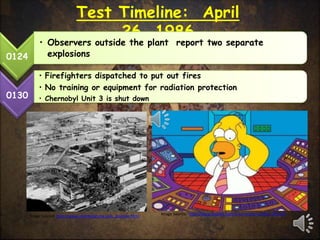
            • Observers outside the plant report two separate
0124          explosions

           • Firefighters dispatched to put out fires
           • No training or equipment for radiation protection
0130       • Chernobyl Unit 3 is shut down


       Image Source: http://www.chernobyl.org.uk/c_disaster.html   Image Source: http://www.dauten.com/e-luminations/2011-10.html
Procedural Violations


                     Bypassed
Deactivated
                      Multiple
   ECCS           Protective Trips


     Violated Countless Rod
          Control Design
           Assumptions


                              Image Source: http://noticiasdiarias10b.blogspot.com/p/radioactividad_03.html
Principle Errors Made

1.Operating Margin of Reactivity (ORM) reduced far
  below allowable limit

2.Power levels lower than that specified for the test
  program

3.Using all recirculation pumps, with some exceeding
  their discharge limits

4.Blocking the shutdown signal from both Turbine
  Generators

5.Blocking the water level and steam pressure trips
  for the steam separators

6.Switching off the ECCS
Questions/Comments?


Image Source: http://bestworldstuff.blogspot.com/2010/11/worst-manmade-disaster-chernobyl.html


                                                                              Image Source: http://www.tumblr.com/tagged/chernobyl-diaries?before=1351410859

Chernobyl Timeline

  • 1.
    THE CHERNOBYL DISASTER The Timeline of Events Sean Miller NUC-495-OL009 November 4, 2012
  • 2.
    REFERENCES • Bethe, H. A. (1986). U.S. panel assesses Chernobyl. Bulletin of the Atomic Scientists, 42(10), 45-46. • Diatlov, A. (2006, April 9) Why INSAG has still got it wrong. Nuclear Engineering International. • Frontline. (2012). Nuclear reaction: Why do Americans fear nuclear power?. • GreenFacts. (2012). Scientific Facts on the Chernobyl Accident. Grishanin, International • Atomic Energy Agency, International Nuclear Safety Advisory Group. (1992). INSAG-7. The Chernobyl accident: Updating of INSAG-1 (Safety Series No. 75-INSAG-7). • Lorenzini, P. (2006, January 23). Chernobyl myths. American Spectator. • Mikhail, M. (n.d.). The Chernobyl reactor: Design features and reasons for accident.. • Rippon, S. (1986, September 11). Chernobyl: The Soviet report. Nuclear News, 1-8. • United States Nuclear Regulatory Commission. (2012). Background on Chernobyl Nuclear Power Plant Accident.
  • 3.
    The RBMK-1000 ReactorPlant Image Source: : http://www.wentz.net/radiate/chernobyl2/chernobyl/rbmk.html
  • 4.
    Key Plant DesignSpecifications  Boiling Water Reactor with graphite moderator and water cooling  Two independent loops with two main circulation pumps in each loop  Water acts as a poison with positive temperature and void coefficients of reactivity. * Graphite also has a positive temperature coefficient of reactivity.  Very complex rod control design/programming compensate for variable positive temperature coefficients and exceptionally large reactor  The containment does not cover the reactor for refueling purposes Image Source: http://library.thinkquest.org/3426/data/cause/design.flaw.html
  • 5.
    The Turbine GeneratorCoastdown Test Test Problem: The ECCS DGs take too long to pick up electrical load Proposed Solution: TGs are modified to slow their coastdown, allowing the TGs to continue to power electrical loads as they coast down Test Setup: 1)Reconfigure power to electrical loads (MCPs/MFPs); 2)Turn off ECCS to prevent inadvertent activation Basic Procedure: 1)Reduce reactor power to 22-32%, 2) Trip TG *NOTE: The test had been run before (twice) with no major issues.
  • 6.
    Test Planning Issues 1.Upcoming Maintenance Shutdown Period 2. Higher Authorities not Informed of Test 3. Electrical Engineer Placed in Charge 4. No evolutionary briefs, walkthroughs, etc Image Source: http://planetwaves.net/pagetwo/daily- astrology/radiation-bullshit-levels-increase/
  • 7.
    Test Timeline: April 25, 1986 • Operators begin reducing power 0100 • Power reduced to 50% (~1600MW) 1305 • Half of the MCPs and MFPs configured to off-site power • ECCS disabled • Load dispatcher requests power be maintained for grid 1400 demands • Downpower is resumed 2310 • Switched to low-power backup regulator
  • 8.
    Test Timeline: April 26, 1986 • Power drops to 30MW due to faulty low power regulator • Operators take manual control of rods to raise power to 0028 200MW • Operators start a additional MCP in each loop • Negative Reactivity transient on plant 0103 • Low power-flow, low subcooling; plant very sensitive • Steam drum level and pressure oscillations • Operators disable automatic protection for steam drum level and 0107 pressure to avoid test interference • Operators increase feed flow to compensate • Negative reactivity effect due to reduced coolant inlet 0119 temperature
  • 9.
    Test Timeline: April26, 1986 • Automatic control rods move to upper limit to compensate • Operators move manual rods to further compensate 0119:3 • Manual rods move too far=>Automatic rods move back in 0 • Plant parameters appear to be stable • Decision made to begin the TG Coastdown Test 0122 • Operators block emergency protection signals from turbine stop valve • Feed flow sharply reduced to meet testing requirements 0122:1 • Large transient on plant; automatic control rods insert nearly to bottom to compensate 0 • Printout of power density/control rod configuration received 0122:3 • Data indicates that operating reactivity margin requires immediate plant shutdown 0
  • 10.
    Test Timeline: April26, 1986 • Turbine generator stop valve is shut • MCPs and MFPs begin to coast down=>new transient on plant • Steam voids collapse=>negative reactivity. Power stays constant due to disabling of 0123:04 TG stop valve protective action • Automatic control rods withdraw in response to negative reactivity (void collapse) 0123:10 • Graphite in rods is ~1m above bottom of core • Automatic control rods now insert to compensate for positive reactivity from flow reduction • However, power continues to increase when rods cannot overcome positive reactivity 0123:21 • Power/Temperature Continue to Rise: RUNAWAY CONDITION • Reactor Scram was ordered (reason unclear) • A few seconds following the scram, shocks were felt in 0123:40 the control room
  • 11.
    Test Timeline: April • Operators notice26, had not reached lower stops=>de- rods 1986 energize them, allowing them to fall by gravity 0123:4 1 • Rods not effective until very bottom of the core • High power excursion rate alarm. Recorded power: 530MW on 0123:4 20 sec excursion 3 • Fuel fragments due to high power and rate of heat generation • Fuel fragments explode through the cladding/canning and contact the coolant 0123:4 • Heat transfer from fuel to water rapidly forms steam voids=>more 5 positive reactivity • Reactor is Prompt Critical • Rapid steam generation creates backpressure on check valves; steam dump valve 0123:4 opens to relieve pressure 6 • Circulation flow increases as fuel channels rupture NOTE: This was the last recorded data.
  • 12.
    Test Timeline: April 26, 1986 • Observers outside the plant report two separate 0124 explosions • Firefighters dispatched to put out fires • No training or equipment for radiation protection 0130 • Chernobyl Unit 3 is shut down Image Source: http://www.chernobyl.org.uk/c_disaster.html Image Source: http://www.dauten.com/e-luminations/2011-10.html
  • 13.
    Procedural Violations Bypassed Deactivated Multiple ECCS Protective Trips Violated Countless Rod Control Design Assumptions Image Source: http://noticiasdiarias10b.blogspot.com/p/radioactividad_03.html
  • 14.
    Principle Errors Made 1.OperatingMargin of Reactivity (ORM) reduced far below allowable limit 2.Power levels lower than that specified for the test program 3.Using all recirculation pumps, with some exceeding their discharge limits 4.Blocking the shutdown signal from both Turbine Generators 5.Blocking the water level and steam pressure trips for the steam separators 6.Switching off the ECCS
  • 15.
    Questions/Comments? Image Source: http://bestworldstuff.blogspot.com/2010/11/worst-manmade-disaster-chernobyl.html Image Source: http://www.tumblr.com/tagged/chernobyl-diaries?before=1351410859