• Definitions
• Importance of EH
 Population overgrowth
 Air pollution
 Ozone depletion/global warming
 Water pollution
• Major global Environmental Problems
• Challenges and Obstacles
• Scope of EH practice
 Traditional and Modern Hazards
 EH & ES concerns
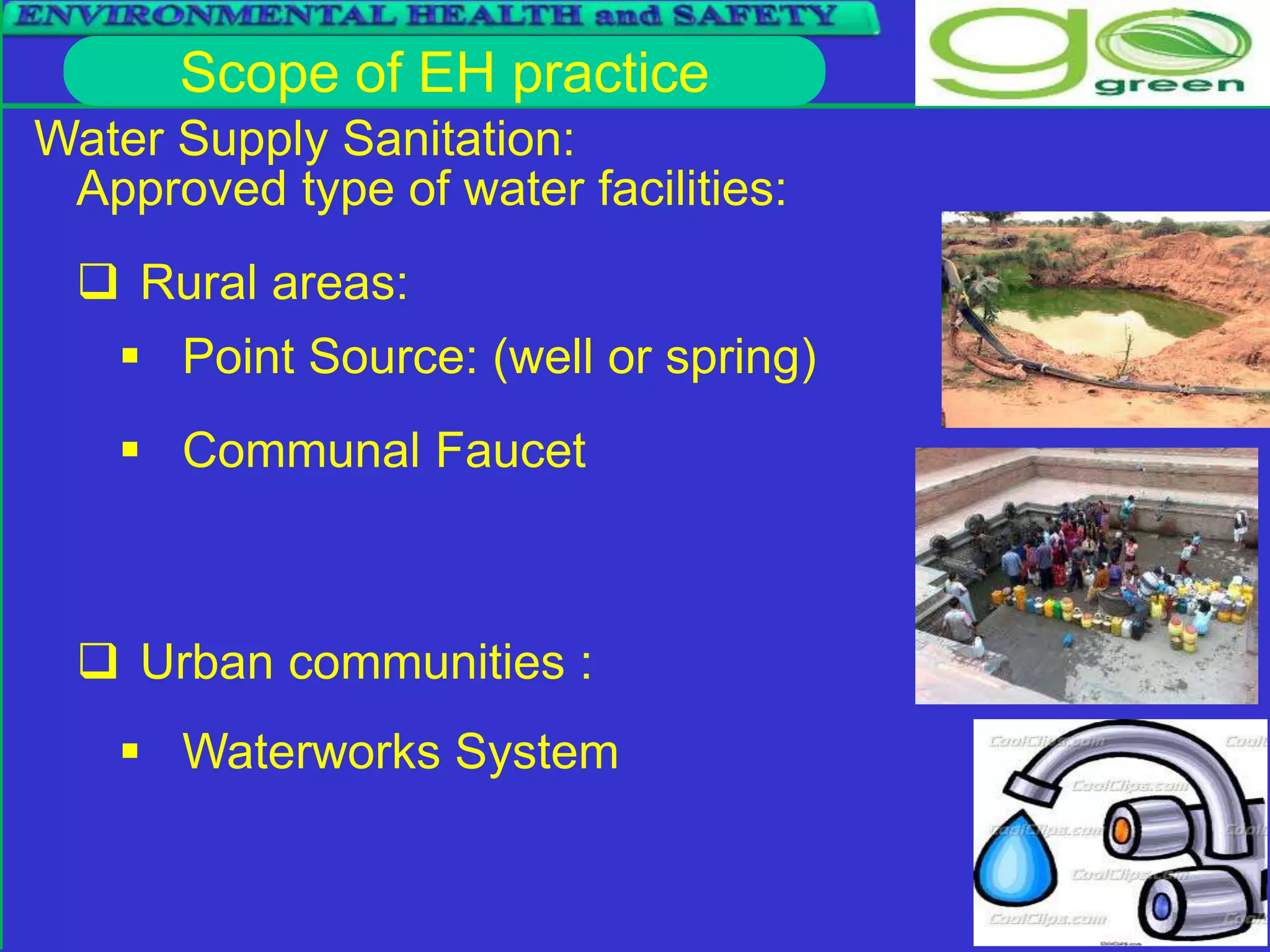
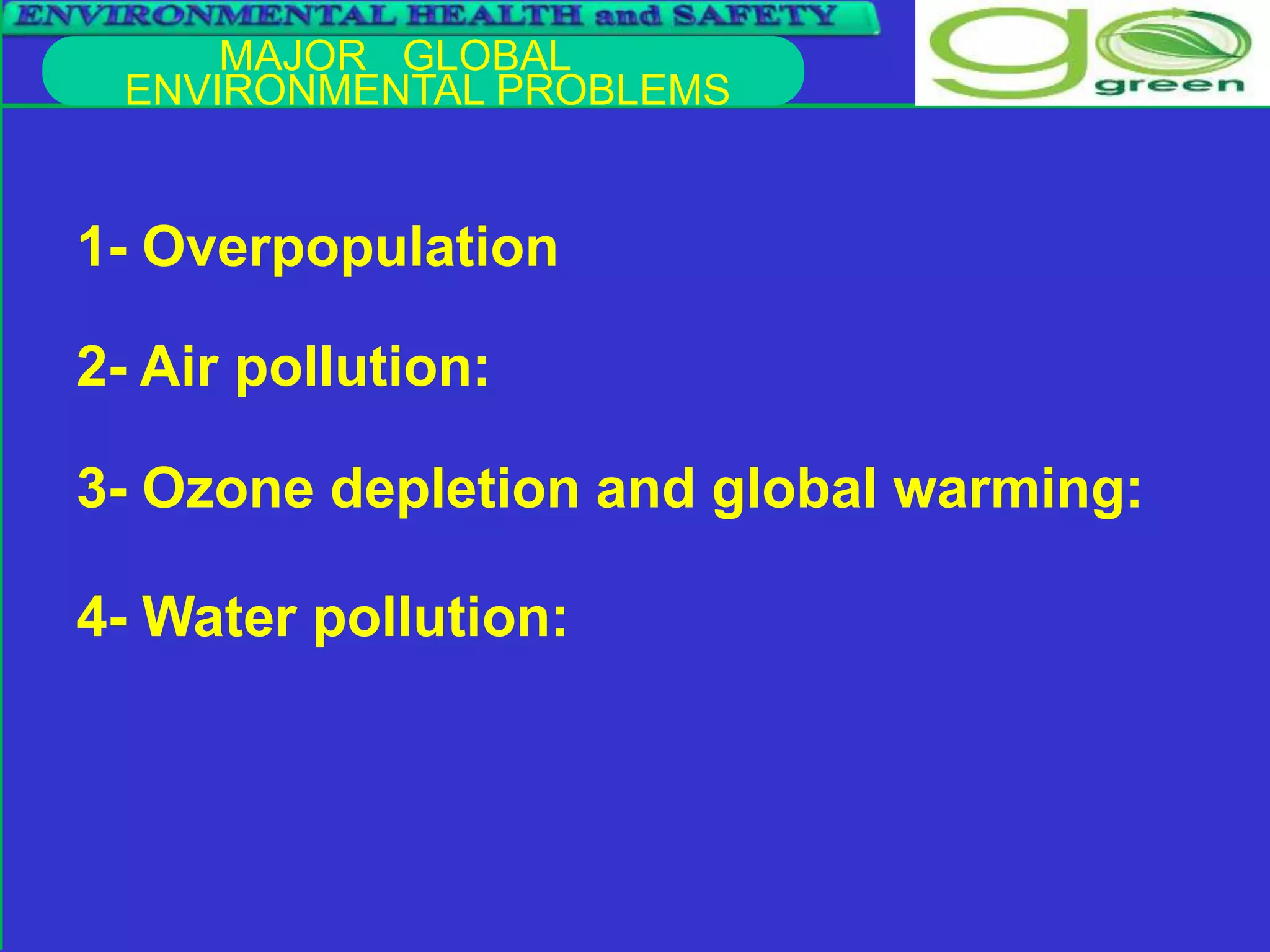
 Water Supply Sanitation
 Waste Disposal
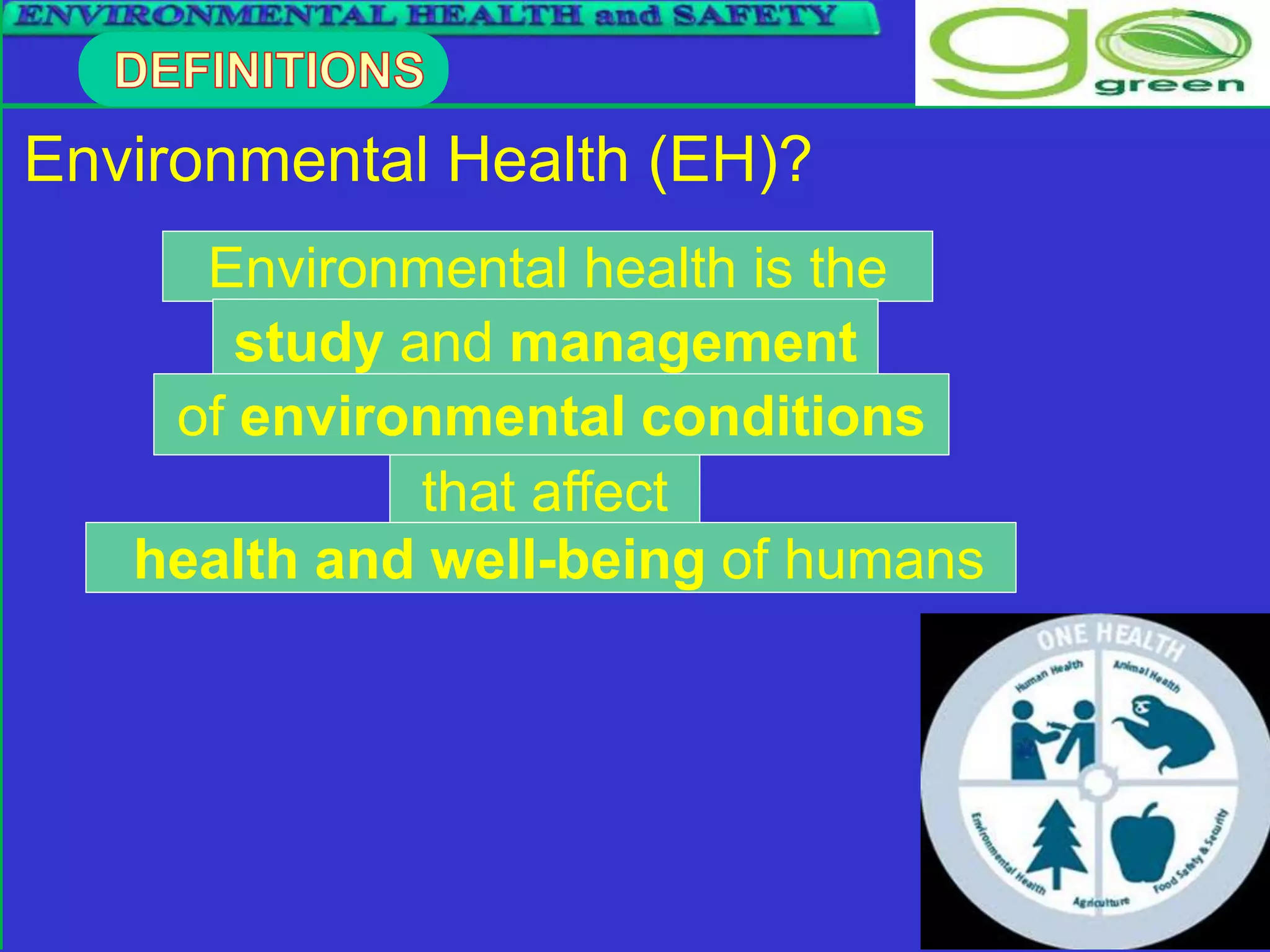
Environmental health is the
Environmental Health (EH)?
study and management
of environmental conditions
that affect
health and well-being of humans
Contamination
The introduction of undesirable materials.
The introduction of harmful materials or
production of harmful conditions.
Pollution
Impure, dirty, or otherwise unclean.
Polluted environment
Pollutant
a waste material that negatively affects
Three factors determine the severity of a
pollutant:
• chemical nature
• concentration
• persistence
air, water or soil.
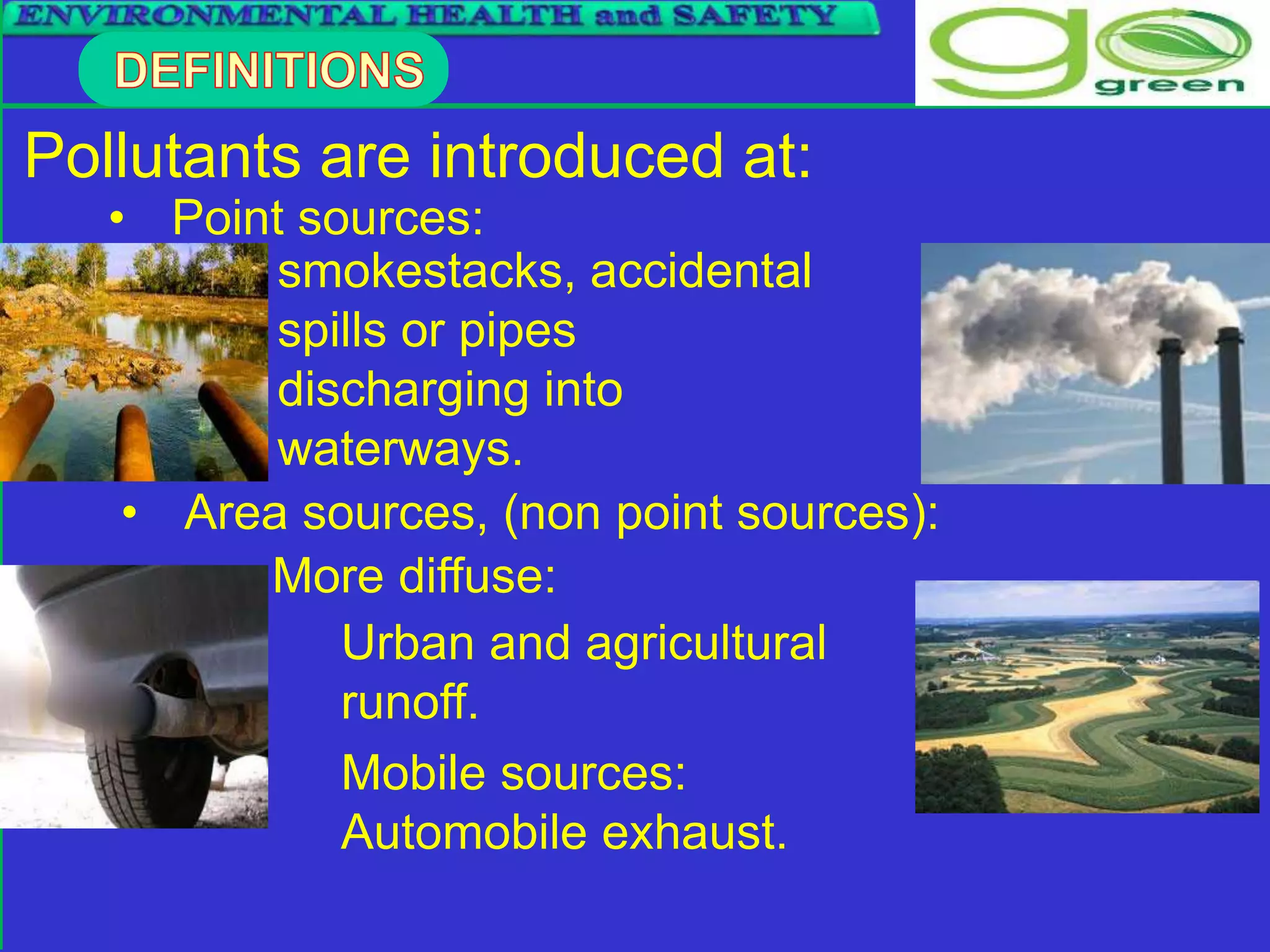
• Point sources:
smokestacks, accidental
spills or pipes
discharging into
waterways.
• Area sources, (non point sources):
More diffuse:
Pollutants are introduced at:
Urban and agricultural
runoff.
Mobile sources:
Automobile exhaust.
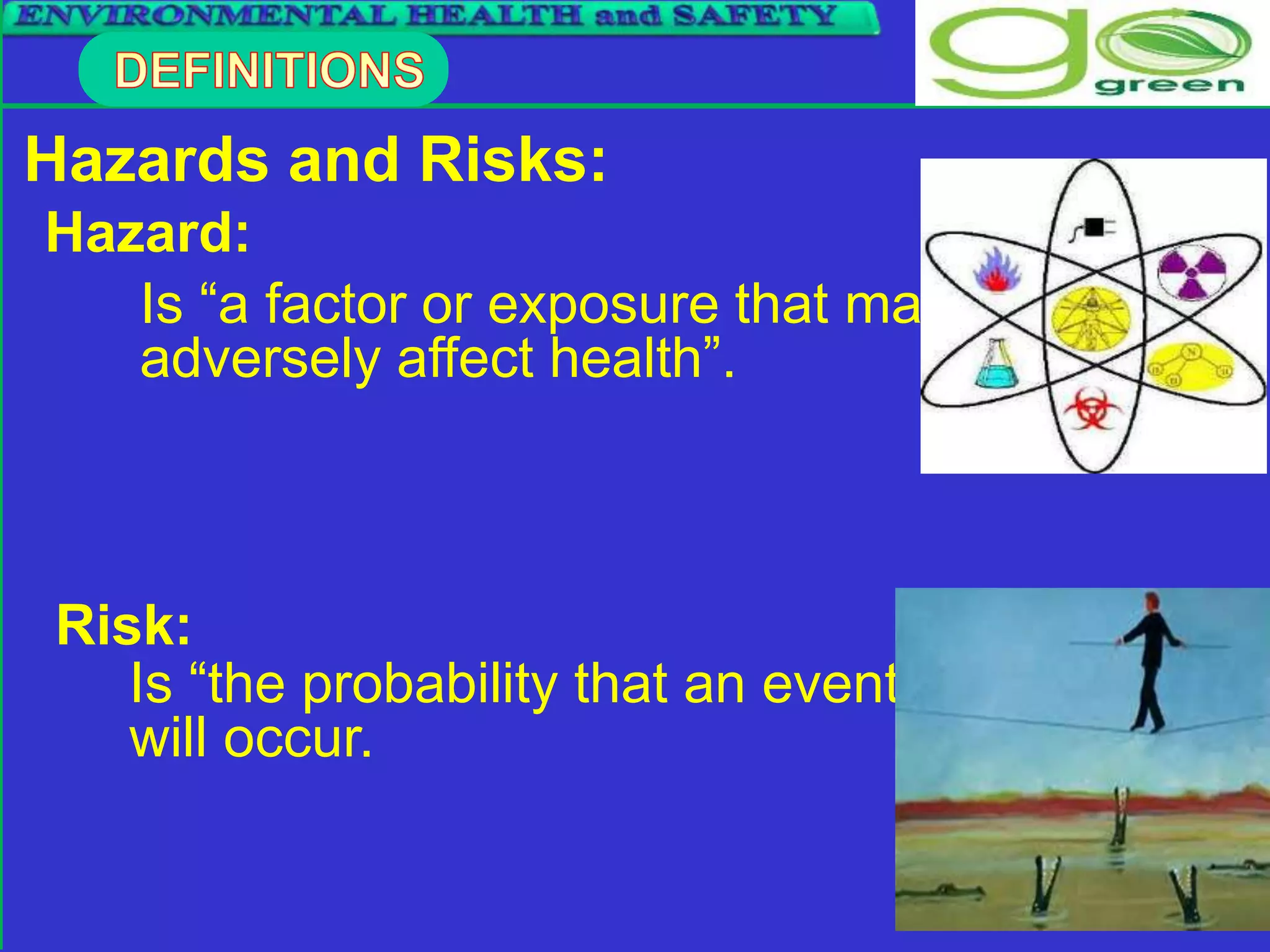
Is “a factor or exposure that may
adversely affect health”.
Is “the probability that an event
will occur.
Risk:
Hazard:
Hazards and Risks:
Control of environmental factors
that form links in transmission of
disease.
Environmental sanitation(ES):
• solid waste management
• treatment of water
• treatment of wastewater
• industrial-waste treatment .
Subsets of this category are:
 It helps understand/control/adapt:
Importance of EH
• Pollution
• Natural/technological disasters
• Physical hazards
• Climatic changes
• Food/Nutritional deficiencies
• Sanitation
Traditional Hazards
•Disease Vectors
•Infectious agents
•Housing and Shelter
hazards
•Drinking Water &
Sanitation hazards
•Indoor air Pollution
•Dietary Deficiencies
•Injury hazards
Modern Hazards
• Tobacco smoking
• Alcohol and drugs
• Transport hazards
• Environmental pollution
• Outdoor air pollution
• Chemical hazards
• Occupational Hazards
• Unbalanced Diet
• Stress
Traditional and Modern Hazards:
Scope of EH practice
Water Supply Sanitation:
Approved type of water facilities:
 Point Source: (well or spring)
 Communal Faucet
 Rural areas:
 Urban communities :
 Waterworks System
Scope of EH practice
Hospital Waste Disposal:
Hospital waste:
• 85% are non-infectious
• 10% are infectious
• 5% are hazardous
Biological
Non biological
MAJOR GLOBAL
ENVIRONMENTAL PROBLEMS
1- Overpopulation
2- Air pollution:
3- Ozone depletion and global warming:
4- Water pollution:
MAJOR GLOBAL
ENVIRONMENTAL PROBLEMS
BILLION
YEAR
1
1804
2
1927
3
1959
4
1974
5
1987
6
1999
7
2011
9
2050*
1- Overpopulation • Pollution
*ESTIMATE
 Air
 Water
 Soil
• Resource depletion
 Forests
 Fossil fuel
• Extinction(52 species)
 Mammals
 Birds
 Amphibians
MAJOR GLOBAL
ENVIRONMENTAL PROBLEMS
2- Air pollution:
• industrialized and urbanized areas
• 75% of children suffer respiratory disease
• The six major air pollutants:
• London fog (1952) killed 4000-8000 (mostly
elderly).
 Carbon monoxide (CO)
 Nitrogen Oxides (NO, NO2)
 particulate matter
 sulfur dioxide (SO2)
 Hydrocarbons
 lead.
MAJOR GLOBAL
ENVIRONMENTAL PROBLEMS
3- Ozone depletion and global warming:
CFCs
CFCs cooling of the stratosphere
accelerates ozone depletion
several thousand x the
greenhouse potential CO2
• Reduce home energy usage
• Buy cars that are fuel-smart
• Transportation alternatives :
mass transit,, bicycling
• Insulate your home to save
money and energy
• Plant trees
• Educate others
What can we do?
MAJOR GLOBAL
ENVIRONMENTAL PROBLEMS
4- Water pollution:
• Population growth.
• Outputs (Industrial, agricultural and urban)
 Causes of water pollution
 Control of water pollution:
• Domestic sewage
 Industrial
 Construction site
 Agricultural
• wastewater
• stormwater
 Urban runoff
MAJOR GLOBAL
ENVIRONMENTAL PROBLEMS
Pollution control :
PREVENT
REDUCE
REUSE
RECYCLE
MITIGATE
COMPOST
DISPOSE
most
favoured
option
least
favoured
option
The basic requirements for
 Clean Air
 Safe and Sufficient Water
 Adequate and Safe Food
 Safe and Peaceful Settlements
 Stable Global Environment
healthy environment

Chem 11 Unit 5 Toxicology.ppt

  • 2.
    • Definitions • Importanceof EH  Population overgrowth  Air pollution  Ozone depletion/global warming  Water pollution • Major global Environmental Problems • Challenges and Obstacles • Scope of EH practice  Traditional and Modern Hazards  EH & ES concerns  Water Supply Sanitation  Waste Disposal
  • 3.
    Environmental health isthe Environmental Health (EH)? study and management of environmental conditions that affect health and well-being of humans
  • 4.
    Contamination The introduction ofundesirable materials. The introduction of harmful materials or production of harmful conditions. Pollution Impure, dirty, or otherwise unclean. Polluted environment
  • 5.
    Pollutant a waste materialthat negatively affects Three factors determine the severity of a pollutant: • chemical nature • concentration • persistence air, water or soil.
  • 6.
    • Point sources: smokestacks,accidental spills or pipes discharging into waterways. • Area sources, (non point sources): More diffuse: Pollutants are introduced at: Urban and agricultural runoff. Mobile sources: Automobile exhaust.
  • 7.
    Is “a factoror exposure that may adversely affect health”. Is “the probability that an event will occur. Risk: Hazard: Hazards and Risks:
  • 8.
    Control of environmentalfactors that form links in transmission of disease. Environmental sanitation(ES): • solid waste management • treatment of water • treatment of wastewater • industrial-waste treatment . Subsets of this category are:
  • 9.
     It helpsunderstand/control/adapt: Importance of EH • Pollution • Natural/technological disasters • Physical hazards • Climatic changes • Food/Nutritional deficiencies • Sanitation
  • 10.
    Traditional Hazards •Disease Vectors •Infectiousagents •Housing and Shelter hazards •Drinking Water & Sanitation hazards •Indoor air Pollution •Dietary Deficiencies •Injury hazards Modern Hazards • Tobacco smoking • Alcohol and drugs • Transport hazards • Environmental pollution • Outdoor air pollution • Chemical hazards • Occupational Hazards • Unbalanced Diet • Stress Traditional and Modern Hazards: Scope of EH practice
  • 11.
    Scope of EHpractice Water Supply Sanitation: Approved type of water facilities:  Point Source: (well or spring)  Communal Faucet  Rural areas:  Urban communities :  Waterworks System
  • 12.
    Scope of EHpractice Hospital Waste Disposal: Hospital waste: • 85% are non-infectious • 10% are infectious • 5% are hazardous Biological Non biological
  • 13.
    MAJOR GLOBAL ENVIRONMENTAL PROBLEMS 1-Overpopulation 2- Air pollution: 3- Ozone depletion and global warming: 4- Water pollution:
  • 14.
    MAJOR GLOBAL ENVIRONMENTAL PROBLEMS BILLION YEAR 1 1804 2 1927 3 1959 4 1974 5 1987 6 1999 7 2011 9 2050* 1-Overpopulation • Pollution *ESTIMATE  Air  Water  Soil • Resource depletion  Forests  Fossil fuel • Extinction(52 species)  Mammals  Birds  Amphibians
  • 15.
    MAJOR GLOBAL ENVIRONMENTAL PROBLEMS 2-Air pollution: • industrialized and urbanized areas • 75% of children suffer respiratory disease • The six major air pollutants: • London fog (1952) killed 4000-8000 (mostly elderly).  Carbon monoxide (CO)  Nitrogen Oxides (NO, NO2)  particulate matter  sulfur dioxide (SO2)  Hydrocarbons  lead.
  • 16.
    MAJOR GLOBAL ENVIRONMENTAL PROBLEMS 3-Ozone depletion and global warming: CFCs CFCs cooling of the stratosphere accelerates ozone depletion several thousand x the greenhouse potential CO2 • Reduce home energy usage • Buy cars that are fuel-smart • Transportation alternatives : mass transit,, bicycling • Insulate your home to save money and energy • Plant trees • Educate others What can we do?
  • 17.
    MAJOR GLOBAL ENVIRONMENTAL PROBLEMS 4-Water pollution: • Population growth. • Outputs (Industrial, agricultural and urban)  Causes of water pollution  Control of water pollution: • Domestic sewage  Industrial  Construction site  Agricultural • wastewater • stormwater  Urban runoff
  • 18.
    MAJOR GLOBAL ENVIRONMENTAL PROBLEMS Pollutioncontrol : PREVENT REDUCE REUSE RECYCLE MITIGATE COMPOST DISPOSE most favoured option least favoured option
  • 19.
    The basic requirementsfor  Clean Air  Safe and Sufficient Water  Adequate and Safe Food  Safe and Peaceful Settlements  Stable Global Environment healthy environment

Editor's Notes

  • #4 Environmental Health Definition (WHO) 1993: Environmental health comprises of those aspects of human health, including quality of life, that are determined by physical, chemical, biological, social, and psychosocial factors in the environment. It also refers to the theory and practice of assessing, correcting, controlling, and preventing those factors in the environment that can potentially affect adversely the health of present and future generations. Environmental Health (Short) Definition (WHO): Those aspects of the human health and disease that are determined by factors in the environment. It also refers to the theory and practice of assessing and controlling factors in the environment that can potentially affect health Environmental health services (WHO): those services which implement environmental health policies through monitoring and control activities. They also carry out that role by promoting the improvement of environmental parameters and by encouraging the use of environmentally friendly and healthy technologies and behaviors. They also have a leading role in developing and suggesting new policy areas.
  • #5 Pollution: is the introduction of contaminants into an environment that causes instability, disorder, harm or discomfort to the ecosystem i.e. physical systems or living organisms. Pollution can take the form of chemical substances, or energy, such as noise, heat, or light energy. Pollutants, the elements of pollution, can be foreign substances or energies, or naturally occurring; when naturally occurring, they are considered contaminants when they exceed natural levels. Pollution is often classed as point source or nonpoint source pollution. Contamination: Introduction into water, air, and soil of microorganisms, chemicals, toxic substances, wastes, or wastewater in a concentration that makes the medium unfit for its next intended use. Also applies to surfaces of objects, buildings, and various household and agricultural use products. Pollution & Contamination: “Pollution" is generally something big, like a whole environment, or an entire river, or something else really large. "Contamination" can refer to small quantities of something - contaminated food, medicine, drinking water supply; it can also mean a small amount of foreign or harmful material, such as bacterial contamination, or a toxin, especially when it's not readily visible or noticeable.
  • #8 Hazard: Is “a factor or exposure that may adversely affect health”. It is a qualitative term expressing the potential of an environmental agent to harm the health of certain individuals if the exposure level is high enough . Risk: Is “the probability that an event will occur, the probability of unfavorable outcome e.g that an individual will become ill or die within a stated period of time or age. It is the quantitative probability that a health effect will occur after an individual has been exposed to a specified amount of a hazard.
  • #10 EH:
  • #12 Point Source: (well or spring): Outlet, no distribution system. Communal Faucet: or Stand Posts: (piped distribution network and communal faucets) Waterworks System: Individual House Connections .
  • #16 Fossil fuels: contain high percentages of carbon and include coal, petroleum, and natural gas. They range from volatile materials with low carbon:hydrogen ratios like methane, to liquid petroleum to nonvolatile materials composed of almost pure carbon, like anthracite coal.
  • #17 Particulate matter: is a complex mixture of extremely small particles and liquid droplets. Particle pollution is made up of a number of components, including acids (such as nitrates and sulfates), organic chemicals, metals, and soil or dust particles. The sources are modern farming, burning oil and coal, dust storms and volcanic eruptions. Once inhaled, the small size of particles can affect the heart and lungs and cause serious health effects.
  • #20 Pollution control :Prevention: Pollution prevention describes activities that reduce the amount of pollution generated by a process. In contrast to most pollution control strategies, which seek to manage a pollutant after it is formed, the pollution prevention approach seeks to increase the efficiency of a process, thereby reducing the amount of pollution generated at its source. Some professionals also use the term pollution prevention to include recycling or reuse. Reduce: reducing the amount of waste produced by a person or a society. Waste minimization involves efforts to minimize resource and energy use during manufacture. Reuse is to use an item more than once. Reuse help save time, money, energy, and resources. Recycling is processing waste into new products to prevent waste of potentially useful materials, reduce the consumption of fresh raw materials, reduce energy usage ….reduce air, water and soil pollution by reducing the need for "conventional" waste disposal. Mitigation: The implementation of measures designed to reduce the undesirable effects of a proposed action on the environment. Fully or partially prevent an impact/reduce a risk by: changing means or technique, changing the site of a project and specifying operating practices to decrease waste. Compost: is organic matter that has been decomposed and recycled as a fertilizer and soil amendment. Composting simply requires making a heap of wetted organic matter (leaves, food waste) and waiting for the materials to break down into humus after a period of weeks or months. Worms and fungi further break up the material. Aerobic bacteria manage the chemical process by converting the inputs into heat, carbon dioxide and ammonium cpds. The ammonium cpds are further converted by bacteria into plant-nourishing nitrites and nitrates through the process of nitrification.