Agenda
I.   Introduction & Overview
II. The Disease of Addiction
III. Population and Risk Factors
IV. Treatment
V.   Center for Addiction Medicine Initiatives


                                                 1
Substance Misuse: The Nation‟s
Number One Public Health Problem
 There are more deaths, illnesses, and disabilities from substance
  use than from any other preventable health condition
     Of the more than 2 million deaths each year in the US, 1 in 4 is
      attributable to alcohol, tobacco, and illicit drug use
 Alcohol alone causes about 20–30% of esophageal cancer, liver
  cancer, cirrhosis of the liver, homicide, epileptic seizures, and motor
  vehicle accidents worldwide (WHO, 2002).

 Over 22.6 million Americans have problem with alcohol or other
  drugs
     More than half of all families in the US has or has had a family member
      suffering from alcohol dependence (NIAAA, 2005)
     Alcohol use is involved in 25-50% of suicides
     37% of those with alcohol dependence and 53% of those with
      dependence on an illicit drug have another psychiatric illness

                                                                                2
Economic Burden
 The economic burden associated with alcohol misuse
  alone is approaching $200 billion annually, far exceeding
  the cost associated with other medical conditions such
  as cancer ($107 billion) and heart disease ($96 billion).

 When combined with other drugs the economic burden
  is close to $400 billion annually.


Gruel and Rehm. 2003


                                                              3
MGH Facts/Figures
 At MGH Outpatient Addiction Services, approximately 2
  out of 3 patients have co-occurring mental health and
  substance use disorder diagnoses

 Inpatients with an SUD primary or secondary diagnoses
  had a LOS of 2.5 days longer than those without

 Patients with alcohol use issues comprise 5% of all ED
  visits, but 7.2% of ED bed hours, or 3 beds in any 24
  hour period
    32% admitted, compared to 26% of other patients
                                                           4
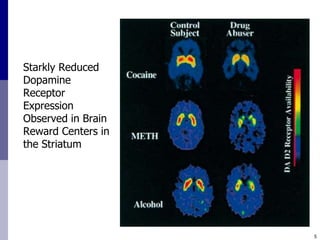
Starkly Reduced
Dopamine
Receptor
Expression
Observed in Brain
Reward Centers in
the Striatum


                    5
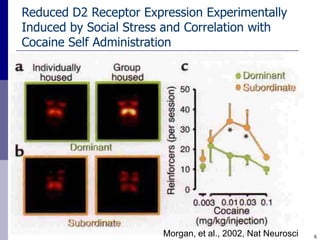
Reduced D2 Receptor Expression Experimentally
Induced by Social Stress and Correlation with
Cocaine Self Administration


                       Morgan, et al., 2002, Nat Neurosci   6
7
3-D Iso-surface Representation of Amygdala
    in Cocaine Addiction Showing 23% Volume
    Reduction
                                                    Superior


                        Right Amygdala

        Right Lateral Ventricle = red    Posterio                 Anterior
        Left Lateral Ventricle = green   r          Patients
                                                    Normal Controls
Makris et al., 2004 Neuron
                                                    Common               8
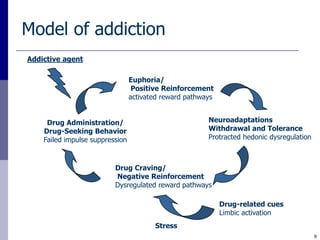
Model of addiction
Addictive agent

                                 Euphoria/
                                  Positive Reinforcement
                                 activated reward pathways


     Drug Administration/                               Neuroadaptations
    Drug-Seeking Behavior                               Withdrawal and Tolerance
    Failed impulse suppression                          Protracted hedonic dysregulation


                          Drug Craving/
                          Negative Reinforcement
                          Dysregulated reward pathways

                                                             Drug-related cues
                                                             Limbic activation
                                        Stress
                                                                                           9
Addiction

Addiction is a disorder of brain reward centers that normally
  insure the survival of organisms and the species

Drugs activate and dysregulate endogenous reward systems such
  that attention, motivation, behavior are directed away from
  survival goals and toward drug-related cues
                                     Dackis and O‟Brien, 2001

Defined by loss of control over intense urges to take the drug
  despite adverse consequences
                                     Volkow and Fowler, Cereb Cortex 2000


                                                                            10
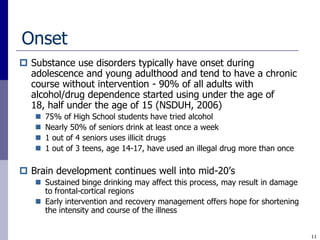
Onset
 Substance use disorders typically have onset during
  adolescence and young adulthood and tend to have a chronic
  course without intervention - 90% of all adults with
  alcohol/drug dependence started using under the age of
  18, half under the age of 15 (NSDUH, 2006)
      75% of High School students have tried alcohol
      Nearly 50% of seniors drink at least once a week
      1 out of 4 seniors uses illicit drugs
      1 out of 3 teens, age 14-17, have used an illegal drug more than once

 Brain development continues well into mid-20‟s
    Sustained binge drinking may affect this process, may result in damage
     to frontal-cortical regions
    Early intervention and recovery management offers hope for shortening
     the intensity and course of the illness


                                                                               11
Age at Onset of DSM-IV Drug
Abuse and Dependence


             Compton et al. Arch Gen Psychiatry/ Vol 64, May 2007; 45(11): 1294 - 1303 12
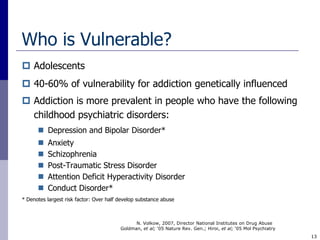
Who is Vulnerable?
 Adolescents
 40-60% of vulnerability for addiction genetically influenced
 Addiction is more prevalent in people who have the following
  childhood psychiatric disorders:
       Depression and Bipolar Disorder*
         Anxiety
         Schizophrenia
         Post-Traumatic Stress Disorder
         Attention Deficit Hyperactivity Disorder
         Conduct Disorder*
* Denotes largest risk factor: Over half develop substance abuse


                                               N. Volkow, 2007, Director National Institutes on Drug Abuse
                                         Goldman, et al; ‘05 Nature Rev. Gen.; Hiroi, et al; ‘05 Mol Psychiatry
                                                                                                                  13
Substances of Abuse are Deleterious
 in Adolescent Brain Development

                                     Negative CNS
                                     effects of chronic
Prefrontal structures                alcohol use in
                                     teens:
                                     - Learning
                                     - Information
                                     recall, memory
                                     (verbal, nonverbal)
                                     - Vocabulary
                                     - Sleep (mood,
                                     attention)


            Striatum & Hippocampus


Medial Wall                                           14
Relationship between Mental Health
and Substance Use Disorders
 Complex, multifaceted
 Genetics/ neurobiological
 Affected by multiple systems of adolescent/young adult life
    Family, Community/ School, Peers, Media

 Life stresses, academic and social issues
 Dynamics-self medication
 Changes with maturation, normal development
 Substance use can worsen the severity of pre-existing mental
  health conditions; untreated mental health issues exacerbate
  substance use


                                                                 15
Clinical Imperative
 Substance Use Disorders are Highly Prevalent,
  Under-recognized and Under-treated


 Screening is fast and effective


 Even brief intervention can effect salutary change


 Early Intervention is optimal


                                                       16
What Can Be Done?
 Treatment works; extensive models are best suited
  to the nature of addiction

 Effective treatments exist:
    Pharmacotherapy
      Rarely Prescribed
    Cognitive-behavioral therapy
    Motivational Interventions
    Community Reinforcement Model
    12-step facilitation
    Family therapy

                                                      17
Innovative Models of Care
 Extensive models are best suited to the nature of
  addiction
    “Aftercare” – Continuing Care – Treatment
    Case monitoring
    Recovery management
      Assertive Continuing Care
      Mutual Help Groups/Peer Support
 Program Evaluation
    Science-based practice
    Practice-based science
    Intermediate Outcomes/Theory
    Provides for systematic evaluation; identification of patient
     subgroups/non-responders
                                                                     19
Treatment Challenges - Stigma
 Conceptualized as a disorder of „Free Will‟
    “substance abuser”

 Perhaps even more than other mental illness, patients with
  substance use disorders feel strong sense of
  shame/embarrassment, and self-loathing

 Shame associated with substance use creates a barrier to
  accessing treatment and disclosure/open communication

 Substance use disorder is a chronic health condition similar to
  hypertension, diabetes and yet is not treated as such


                                                                    20
Is Substance-Related
Treatment Worth Its Cost?
 Addiction treatment is highly cost-effective
 Every $1 invested in addiction treatment programs yields a
  $4-7 saving in reduced drug-related crime, criminal justice
  costs, and theft alone.
 When health care savings are included, total exceeds costs by
  ratio of 12 to 1
 Major savings to the individual and society also come from
  significant drops in interpersonal conflicts, improvements in
  workplace productivity, and reductions in drug-related
  accidents.


  Measuring and Improving Cost, Cost-Effectiveness, and Cost-Benefit for Substance Abuse Treatment Programs, U.S.
  DEPARTMENT OF HEALTH AND HUMAN SERVICES, NIH, NIDA 1999.
                                                                                                                    21

Cheif Presentation - Jerrold Frank Rosenbaum

  • 1.
    Agenda I. Introduction & Overview II. The Disease of Addiction III. Population and Risk Factors IV. Treatment V. Center for Addiction Medicine Initiatives 1
  • 2.
    Substance Misuse: TheNation‟s Number One Public Health Problem  There are more deaths, illnesses, and disabilities from substance use than from any other preventable health condition  Of the more than 2 million deaths each year in the US, 1 in 4 is attributable to alcohol, tobacco, and illicit drug use  Alcohol alone causes about 20–30% of esophageal cancer, liver cancer, cirrhosis of the liver, homicide, epileptic seizures, and motor vehicle accidents worldwide (WHO, 2002).  Over 22.6 million Americans have problem with alcohol or other drugs  More than half of all families in the US has or has had a family member suffering from alcohol dependence (NIAAA, 2005)  Alcohol use is involved in 25-50% of suicides  37% of those with alcohol dependence and 53% of those with dependence on an illicit drug have another psychiatric illness 2
  • 3.
    Economic Burden  Theeconomic burden associated with alcohol misuse alone is approaching $200 billion annually, far exceeding the cost associated with other medical conditions such as cancer ($107 billion) and heart disease ($96 billion).  When combined with other drugs the economic burden is close to $400 billion annually. Gruel and Rehm. 2003 3
  • 4.
    MGH Facts/Figures  AtMGH Outpatient Addiction Services, approximately 2 out of 3 patients have co-occurring mental health and substance use disorder diagnoses  Inpatients with an SUD primary or secondary diagnoses had a LOS of 2.5 days longer than those without  Patients with alcohol use issues comprise 5% of all ED visits, but 7.2% of ED bed hours, or 3 beds in any 24 hour period  32% admitted, compared to 26% of other patients 4
  • 5.
    Starkly Reduced Dopamine Receptor Expression Observed inBrain Reward Centers in the Striatum 5
  • 6.
    Reduced D2 ReceptorExpression Experimentally Induced by Social Stress and Correlation with Cocaine Self Administration Morgan, et al., 2002, Nat Neurosci 6
  • 7.
  • 8.
    3-D Iso-surface Representationof Amygdala in Cocaine Addiction Showing 23% Volume Reduction Superior Right Amygdala Right Lateral Ventricle = red Posterio Anterior Left Lateral Ventricle = green r Patients Normal Controls Makris et al., 2004 Neuron Common 8
  • 9.
    Model of addiction Addictiveagent Euphoria/ Positive Reinforcement activated reward pathways Drug Administration/ Neuroadaptations Drug-Seeking Behavior Withdrawal and Tolerance Failed impulse suppression Protracted hedonic dysregulation Drug Craving/ Negative Reinforcement Dysregulated reward pathways Drug-related cues Limbic activation Stress 9
  • 10.
    Addiction Addiction is adisorder of brain reward centers that normally insure the survival of organisms and the species Drugs activate and dysregulate endogenous reward systems such that attention, motivation, behavior are directed away from survival goals and toward drug-related cues Dackis and O‟Brien, 2001 Defined by loss of control over intense urges to take the drug despite adverse consequences Volkow and Fowler, Cereb Cortex 2000 10
  • 11.
    Onset  Substance usedisorders typically have onset during adolescence and young adulthood and tend to have a chronic course without intervention - 90% of all adults with alcohol/drug dependence started using under the age of 18, half under the age of 15 (NSDUH, 2006)  75% of High School students have tried alcohol  Nearly 50% of seniors drink at least once a week  1 out of 4 seniors uses illicit drugs  1 out of 3 teens, age 14-17, have used an illegal drug more than once  Brain development continues well into mid-20‟s  Sustained binge drinking may affect this process, may result in damage to frontal-cortical regions  Early intervention and recovery management offers hope for shortening the intensity and course of the illness 11
  • 12.
    Age at Onsetof DSM-IV Drug Abuse and Dependence Compton et al. Arch Gen Psychiatry/ Vol 64, May 2007; 45(11): 1294 - 1303 12
  • 13.
    Who is Vulnerable? Adolescents  40-60% of vulnerability for addiction genetically influenced  Addiction is more prevalent in people who have the following childhood psychiatric disorders:  Depression and Bipolar Disorder*  Anxiety  Schizophrenia  Post-Traumatic Stress Disorder  Attention Deficit Hyperactivity Disorder  Conduct Disorder* * Denotes largest risk factor: Over half develop substance abuse N. Volkow, 2007, Director National Institutes on Drug Abuse Goldman, et al; ‘05 Nature Rev. Gen.; Hiroi, et al; ‘05 Mol Psychiatry 13
  • 14.
    Substances of Abuseare Deleterious in Adolescent Brain Development Negative CNS effects of chronic Prefrontal structures alcohol use in teens: - Learning - Information recall, memory (verbal, nonverbal) - Vocabulary - Sleep (mood, attention) Striatum & Hippocampus Medial Wall 14
  • 15.
    Relationship between MentalHealth and Substance Use Disorders  Complex, multifaceted  Genetics/ neurobiological  Affected by multiple systems of adolescent/young adult life  Family, Community/ School, Peers, Media  Life stresses, academic and social issues  Dynamics-self medication  Changes with maturation, normal development  Substance use can worsen the severity of pre-existing mental health conditions; untreated mental health issues exacerbate substance use 15
  • 16.
    Clinical Imperative  SubstanceUse Disorders are Highly Prevalent, Under-recognized and Under-treated  Screening is fast and effective  Even brief intervention can effect salutary change  Early Intervention is optimal 16
  • 17.
    What Can BeDone?  Treatment works; extensive models are best suited to the nature of addiction  Effective treatments exist:  Pharmacotherapy Rarely Prescribed  Cognitive-behavioral therapy  Motivational Interventions  Community Reinforcement Model  12-step facilitation  Family therapy 17
  • 18.
    Innovative Models ofCare  Extensive models are best suited to the nature of addiction  “Aftercare” – Continuing Care – Treatment  Case monitoring  Recovery management Assertive Continuing Care Mutual Help Groups/Peer Support  Program Evaluation  Science-based practice  Practice-based science  Intermediate Outcomes/Theory  Provides for systematic evaluation; identification of patient subgroups/non-responders 19
  • 19.
    Treatment Challenges -Stigma  Conceptualized as a disorder of „Free Will‟  “substance abuser”  Perhaps even more than other mental illness, patients with substance use disorders feel strong sense of shame/embarrassment, and self-loathing  Shame associated with substance use creates a barrier to accessing treatment and disclosure/open communication  Substance use disorder is a chronic health condition similar to hypertension, diabetes and yet is not treated as such 20
  • 20.
    Is Substance-Related Treatment WorthIts Cost?  Addiction treatment is highly cost-effective  Every $1 invested in addiction treatment programs yields a $4-7 saving in reduced drug-related crime, criminal justice costs, and theft alone.  When health care savings are included, total exceeds costs by ratio of 12 to 1  Major savings to the individual and society also come from significant drops in interpersonal conflicts, improvements in workplace productivity, and reductions in drug-related accidents. Measuring and Improving Cost, Cost-Effectiveness, and Cost-Benefit for Substance Abuse Treatment Programs, U.S. DEPARTMENT OF HEALTH AND HUMAN SERVICES, NIH, NIDA 1999. 21