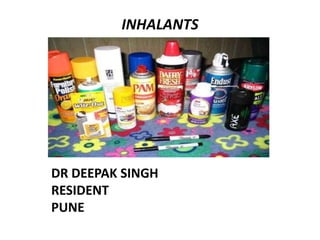
INHALANTS
DR DEEPAK SINGH
RESIDENT
PUNE
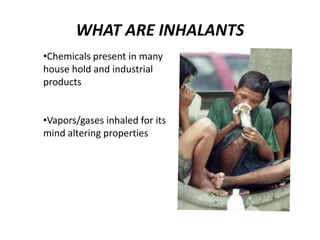
WHAT ARE INHALANTS
•Chemicals present in many
house hold and industrial
products
•Vapors/gases inhaled for its
mind altering properties
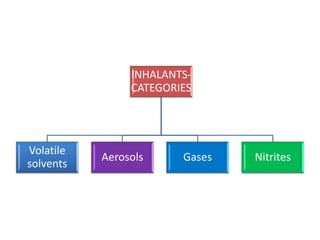
INHALANTS-
CATEGORIES
Volatile
solvents
Aerosols Gases Nitrites
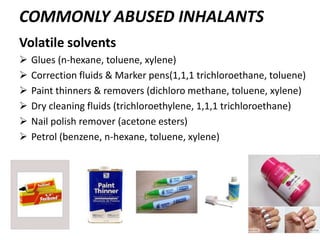
COMMONLY ABUSED INHALANTS
Volatile solvents
 Glues (n-hexane, toluene, xylene)
 Correction fluids & Marker pens(1,1,1 trichloroethane, toluene)
 Paint thinners & removers (dichloro methane, toluene, xylene)
 Dry cleaning fluids (trichloroethylene, 1,1,1 trichloroethane)
 Nail polish remover (acetone esters)
 Petrol (benzene, n-hexane, toluene, xylene)
COMMONLY ABUSED INHALANTS
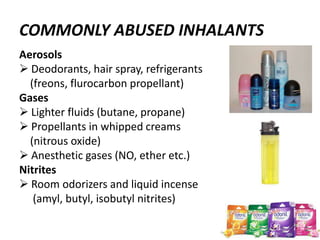
Aerosols
 Deodorants, hair spray, refrigerants
(freons, flurocarbon propellant)
Gases
 Lighter fluids (butane, propane)
 Propellants in whipped creams
(nitrous oxide)
 Anesthetic gases (NO, ether etc.)
Nitrites
 Room odorizers and liquid incense
(amyl, butyl, isobutyl nitrites)
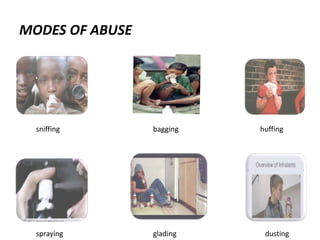
MODES OF ABUSE
sniffing bagging huffing
spraying glading dusting
WHY SOLVENTS ?
A rapid high - much faster than drugs or alcohol.
Relatively cheap, easy to buy.
Not illegal, easily available.
Escape from reality and conflicts.
Novelty seeking and peer influence.
As a replacement for other substances.
(NIDA 2012)
NEUROBIOLOGICAL CONSIDERATIONS
• An abuser intakes 20-30 times exposure of substances
than an accidental exposure (>6000 ppm).
• Solvents are highly lipophilic thus cross biological
membranes easily.
• Affect cell membranes in a similar way to anesthetics.
• Not known to have any unique receptors or mimic an
endogenous ligands.
(Lubeman et al, Br J Pharmacol 2008, May 154(2):316-326)
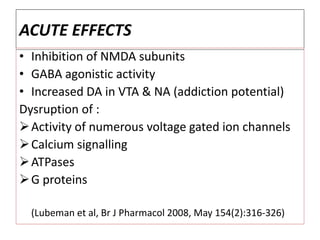
ACUTE EFFECTS
• Inhibition of NMDA subunits
• GABA agonistic activity
• Increased DA in VTA & NA (addiction potential)
Dysruption of :
Activity of numerous voltage gated ion channels
Calcium signalling
ATPases
G proteins
(Lubeman et al, Br J Pharmacol 2008, May 154(2):316-326)
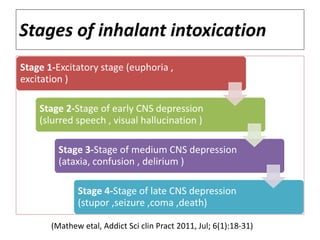
Stages of inhalant intoxication
Stage 1-Excitatory stage (euphoria ,
excitation )
Stage 2-Stage of early CNS depression
(slurred speech , visual hallucination )
Stage 3-Stage of medium CNS depression
(ataxia, confusion , delirium )
Stage 4-Stage of late CNS depression
(stupor ,seizure ,coma ,death)
(Mathew etal, Addict Sci clin Pract 2011, Jul; 6(1):18-31)
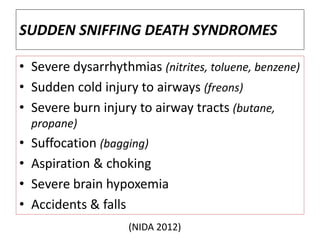
SUDDEN SNIFFING DEATH SYNDROMES
• Severe dysarrhythmias (nitrites, toluene, benzene)
• Sudden cold injury to airways (freons)
• Severe burn injury to airway tracts (butane,
propane)
• Suffocation (bagging)
• Aspiration & choking
• Severe brain hypoxemia
• Accidents & falls
(NIDA 2012)
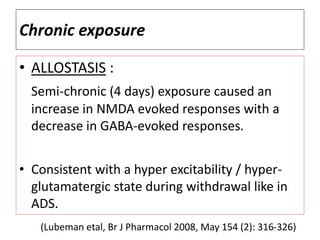
Chronic exposure
• ALLOSTASIS :
Semi-chronic (4 days) exposure caused an
increase in NMDA evoked responses with a
decrease in GABA-evoked responses.
• Consistent with a hyper excitability / hyper-
glutamatergic state during withdrawal like in
ADS.
(Lubeman etal, Br J Pharmacol 2008, May 154 (2): 316-326)
CHRONIC EXPOSURE (Contd.)
• Most damage to white matter structures
and the lipid component of the myelin
sheath.
• Commonly observed neuropsychological
deficits(impairments in processing speed,
sustained attention, memory retrieval,
executive function and language) are
consistent with white matter pathology.
(Geibprasert etal, Am J Neuroradiol 2010, May,31:803-08)
CHRONIC EFFECTS (Contd.)
• Significant improvements in previously
identified impairments(impaired associate
learning and attention deficits)following 2
years abstinence from petrol sniffing.
• MRI abnormalities are however reported to
be irreversible.
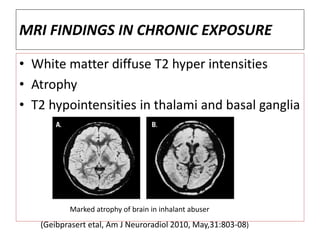
MRI FINDINGS IN CHRONIC EXPOSURE
• White matter diffuse T2 hyper intensities
• Atrophy
• T2 hypointensities in thalami and basal ganglia
Marked atrophy of brain in inhalant abuser
(Geibprasert etal, Am J Neuroradiol 2010, May,31:803-08)
Neurological sequelae
• Diplopia, ataxia, depressed
reflexes, nystagmus, tremor.
• SNHL , optic neuropathy(toluene)
• EEG slowing, peripheral neuropathy (n-hexane)
• Trigeminal neuralgia (trichloroethylene)
• Parkinsonism
• Sensori motor polyneuropathy (methyl butyl
ketone)
(Mathew etal, Addict Sci clin Pract 2011, Jul; 6(1):18-31)
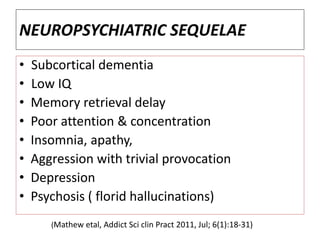
NEUROPSYCHIATRIC SEQUELAE
• Subcortical dementia
• Low IQ
• Memory retrieval delay
• Poor attention & concentration
• Insomnia, apathy,
• Aggression with trivial provocation
• Depression
• Psychosis ( florid hallucinations)
(Mathew etal, Addict Sci clin Pract 2011, Jul; 6(1):18-31)
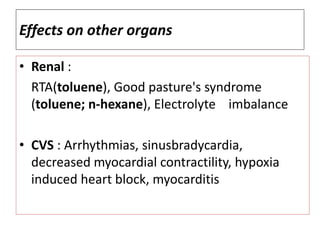
Effects on other organs
• Renal :
RTA(toluene), Good pasture's syndrome
(toluene; n-hexane), Electrolyte imbalance
• CVS : Arrhythmias, sinusbradycardia,
decreased myocardial contractility, hypoxia
induced heart block, myocarditis
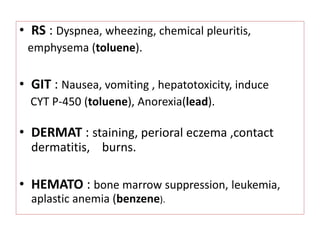
• RS : Dyspnea, wheezing, chemical pleuritis,
emphysema (toluene).
• GIT : Nausea, vomiting , hepatotoxicity, induce
CYT P-450 (toluene), Anorexia(lead).
• DERMAT : staining, perioral eczema ,contact
dermatitis, burns.
• HEMATO : bone marrow suppression, leukemia,
aplastic anemia (benzene).
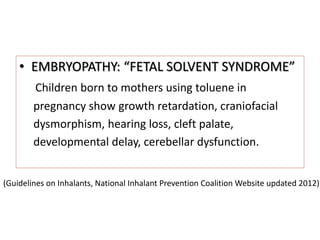
• EMBRYOPATHY: “FETAL SOLVENT SYNDROME”
Children born to mothers using toluene in
pregnancy show growth retardation, craniofacial
dysmorphism, hearing loss, cleft palate,
developmental delay, cerebellar dysfunction.
(Guidelines on Inhalants, National Inhalant Prevention Coalition Website updated 2012)
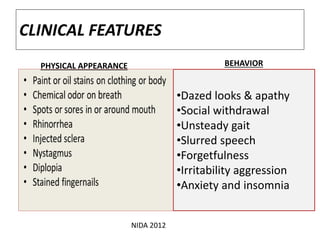
CLINICAL FEATURES
PHYSICAL APPEARANCE BEHAVIOR
•Dazed looks & apathy
•Social withdrawal
•Unsteady gait
•Slurred speech
•Forgetfulness
•Irritability aggression
•Anxiety and insomnia
NIDA 2012
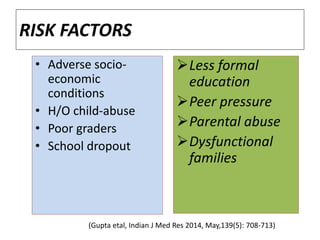
RISK FACTORS
• Adverse socio-
economic
conditions
• H/O child-abuse
• Poor graders
• School dropout
Less formal
education
Peer pressure
Parental abuse
Dysfunctional
families
(Gupta etal, Indian J Med Res 2014, May,139(5): 708-713)
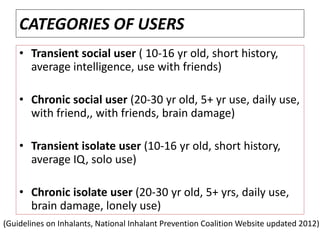
CATEGORIES OF USERS
• Transient social user ( 10-16 yr old, short history,
average intelligence, use with friends)
• Chronic social user (20-30 yr old, 5+ yr use, daily use,
with friend,, with friends, brain damage)
• Transient isolate user (10-16 yr old, short history,
average IQ, solo use)
• Chronic isolate user (20-30 yr old, 5+ yrs, daily use,
brain damage, lonely use)
(Guidelines on Inhalants, National Inhalant Prevention Coalition Website updated 2012)
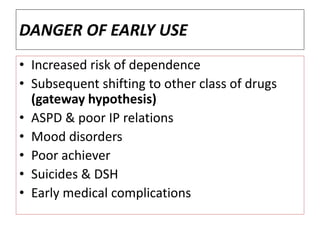
DANGER OF EARLY USE
• Increased risk of dependence
• Subsequent shifting to other class of drugs
(gateway hypothesis)
• ASPD & poor IP relations
• Mood disorders
• Poor achiever
• Suicides & DSH
• Early medical complications
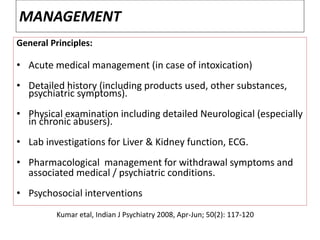
MANAGEMENT
General Principles:
• Acute medical management (in case of intoxication)
• Detailed history (including products used, other substances,
psychiatric symptoms).
• Physical examination including detailed Neurological (especially
in chronic abusers).
• Lab investigations for Liver & Kidney function, ECG.
• Pharmacological management for withdrawal symptoms and
associated medical / psychiatric conditions.
• Psychosocial interventions
Kumar etal, Indian J Psychiatry 2008, Apr-Jun; 50(2): 117-120
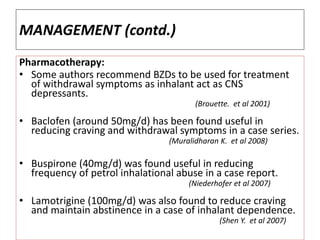
MANAGEMENT (contd.)
Pharmacotherapy:
• Some authors recommend BZDs to be used for treatment
of withdrawal symptoms as inhalant act as CNS
depressants.
(Brouette. et al 2001)
• Baclofen (around 50mg/d) has been found useful in
reducing craving and withdrawal symptoms in a case series.
(Muralidharan K. et al 2008)
• Buspirone (40mg/d) was found useful in reducing
frequency of petrol inhalational abuse in a case report.

(Niederhofer et al 2007)
• Lamotrigine (100mg/d) was also found to reduce craving
and maintain abstinence in a case of inhalant dependence.
(Shen Y. et al 2007)
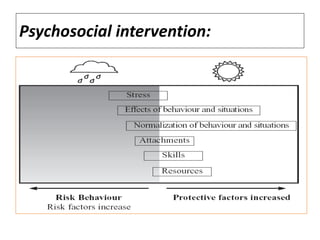
Psychosocial intervention:
PREVENTION
• Tackling supply:
Product elimination/modification
Warning labels
Educating manufacturers/suppliers
Sales controls
• Tackling demand:
Legal control
Information and education with skills-building
• A notification was published in Extraordinary
Gazette, 17th July 2012 by Ministry of Health and
Family Welfare, Government of India:
- Banning production/sale of bottled Correction
fluids/Thinners.
- Mandatory warning regarding effects on health.
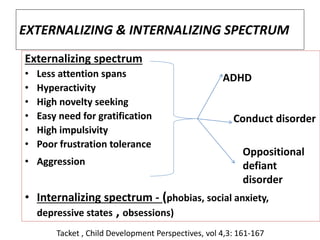
EXTERNALIZING & INTERNALIZING SPECTRUM
Externalizing spectrum
• Less attention spans
• Hyperactivity
• High novelty seeking
• Easy need for gratification
• High impulsivity
• Poor frustration tolerance
• Aggression
• Internalizing spectrum - (phobias, social anxiety,
depressive states , obsessions)
ADHD
Conduct disorder
Oppositional
defiant
disorder
Tacket , Child Development Perspectives, vol 4,3: 161-167
OPPOSITIONAL DEFIANT DISORDER
(ICD -10, F 91.3)
• Pattern of persistently negativistic, hostile, defiant,
provocative and disruptive behavior outside normal range of
behavior for child of same age
• Does not include more serious violations of the rights of
others (unlike aggressive and dissocial behavior of socialized
& unsocialized conduct disorder)
• Tend to be angry, resentful, easily annoyed by other people
whom they blame for their own mistakes or difficulties.
• Low frustration tolerance & readily lose temper.
• More evident in interactions with adults or peers whom child
knows well (may not be evident during clinical interview)
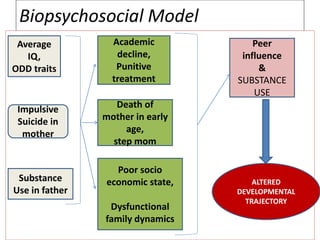
Biopsychosocial Model
Average
IQ,
ODD traits
Impulsive
Suicide in
mother
Substance
Use in father
Academic
decline,
Punitive
treatment
Death of
mother in early
age,
step mom
Poor socio
economic state,
Dysfunctional
family dynamics
Peer
influence
&
SUBSTANCE
USE
ALTERED
DEVELOPMENTAL
TRAJECTORY
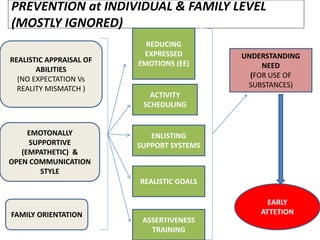
PREVENTION at INDIVIDUAL & FAMILY LEVEL
(MOSTLY IGNORED)
REALISTIC APPRAISAL OF
ABILITIES
(NO EXPECTATION Vs
REALITY MISMATCH )
EMOTONALLY
SUPPORTIVE
(EMPATHETIC) &
OPEN COMMUNICATION
STYLE
REDUCING
EXPRESSED
EMOTIONS (EE)
ACTIVITY
SCHEDULING
ENLISTING
SUPPORT SYSTEMS
UNDERSTANDING
NEED
(FOR USE OF
SUBSTANCES)
REALISTIC GOALS
FAMILY ORIENTATION
ASSERTIVENESS
TRAINING
EARLY
ATTETION
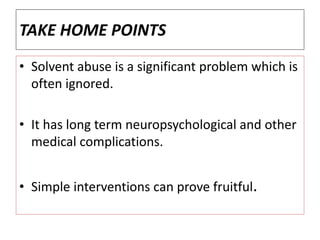
TAKE HOME POINTS
• Solvent abuse is a significant problem which is
often ignored.
• It has long term neuropsychological and other
medical complications.
• Simple interventions can prove fruitful.
Thank you

Inhalant abuse

  • 1.
  • 2.
    WHAT ARE INHALANTS •Chemicalspresent in many house hold and industrial products •Vapors/gases inhaled for its mind altering properties
  • 3.
  • 4.
    COMMONLY ABUSED INHALANTS Volatilesolvents  Glues (n-hexane, toluene, xylene)  Correction fluids & Marker pens(1,1,1 trichloroethane, toluene)  Paint thinners & removers (dichloro methane, toluene, xylene)  Dry cleaning fluids (trichloroethylene, 1,1,1 trichloroethane)  Nail polish remover (acetone esters)  Petrol (benzene, n-hexane, toluene, xylene)
  • 5.
    COMMONLY ABUSED INHALANTS Aerosols Deodorants, hair spray, refrigerants (freons, flurocarbon propellant) Gases  Lighter fluids (butane, propane)  Propellants in whipped creams (nitrous oxide)  Anesthetic gases (NO, ether etc.) Nitrites  Room odorizers and liquid incense (amyl, butyl, isobutyl nitrites)
  • 6.
    MODES OF ABUSE sniffingbagging huffing spraying glading dusting
  • 7.
    WHY SOLVENTS ? Arapid high - much faster than drugs or alcohol. Relatively cheap, easy to buy. Not illegal, easily available. Escape from reality and conflicts. Novelty seeking and peer influence. As a replacement for other substances. (NIDA 2012)
  • 8.
    NEUROBIOLOGICAL CONSIDERATIONS • Anabuser intakes 20-30 times exposure of substances than an accidental exposure (>6000 ppm). • Solvents are highly lipophilic thus cross biological membranes easily. • Affect cell membranes in a similar way to anesthetics. • Not known to have any unique receptors or mimic an endogenous ligands. (Lubeman et al, Br J Pharmacol 2008, May 154(2):316-326)
  • 9.
    ACUTE EFFECTS • Inhibitionof NMDA subunits • GABA agonistic activity • Increased DA in VTA & NA (addiction potential) Dysruption of : Activity of numerous voltage gated ion channels Calcium signalling ATPases G proteins (Lubeman et al, Br J Pharmacol 2008, May 154(2):316-326)
  • 10.
    Stages of inhalantintoxication Stage 1-Excitatory stage (euphoria , excitation ) Stage 2-Stage of early CNS depression (slurred speech , visual hallucination ) Stage 3-Stage of medium CNS depression (ataxia, confusion , delirium ) Stage 4-Stage of late CNS depression (stupor ,seizure ,coma ,death) (Mathew etal, Addict Sci clin Pract 2011, Jul; 6(1):18-31)
  • 11.
    SUDDEN SNIFFING DEATHSYNDROMES • Severe dysarrhythmias (nitrites, toluene, benzene) • Sudden cold injury to airways (freons) • Severe burn injury to airway tracts (butane, propane) • Suffocation (bagging) • Aspiration & choking • Severe brain hypoxemia • Accidents & falls (NIDA 2012)
  • 12.
    Chronic exposure • ALLOSTASIS: Semi-chronic (4 days) exposure caused an increase in NMDA evoked responses with a decrease in GABA-evoked responses. • Consistent with a hyper excitability / hyper- glutamatergic state during withdrawal like in ADS. (Lubeman etal, Br J Pharmacol 2008, May 154 (2): 316-326)
  • 13.
    CHRONIC EXPOSURE (Contd.) •Most damage to white matter structures and the lipid component of the myelin sheath. • Commonly observed neuropsychological deficits(impairments in processing speed, sustained attention, memory retrieval, executive function and language) are consistent with white matter pathology. (Geibprasert etal, Am J Neuroradiol 2010, May,31:803-08)
  • 14.
    CHRONIC EFFECTS (Contd.) •Significant improvements in previously identified impairments(impaired associate learning and attention deficits)following 2 years abstinence from petrol sniffing. • MRI abnormalities are however reported to be irreversible.
  • 15.
    MRI FINDINGS INCHRONIC EXPOSURE • White matter diffuse T2 hyper intensities • Atrophy • T2 hypointensities in thalami and basal ganglia Marked atrophy of brain in inhalant abuser (Geibprasert etal, Am J Neuroradiol 2010, May,31:803-08)
  • 16.
    Neurological sequelae • Diplopia,ataxia, depressed reflexes, nystagmus, tremor. • SNHL , optic neuropathy(toluene) • EEG slowing, peripheral neuropathy (n-hexane) • Trigeminal neuralgia (trichloroethylene) • Parkinsonism • Sensori motor polyneuropathy (methyl butyl ketone) (Mathew etal, Addict Sci clin Pract 2011, Jul; 6(1):18-31)
  • 17.
    NEUROPSYCHIATRIC SEQUELAE • Subcorticaldementia • Low IQ • Memory retrieval delay • Poor attention & concentration • Insomnia, apathy, • Aggression with trivial provocation • Depression • Psychosis ( florid hallucinations) (Mathew etal, Addict Sci clin Pract 2011, Jul; 6(1):18-31)
  • 18.
    Effects on otherorgans • Renal : RTA(toluene), Good pasture's syndrome (toluene; n-hexane), Electrolyte imbalance • CVS : Arrhythmias, sinusbradycardia, decreased myocardial contractility, hypoxia induced heart block, myocarditis
  • 19.
    • RS :Dyspnea, wheezing, chemical pleuritis, emphysema (toluene). • GIT : Nausea, vomiting , hepatotoxicity, induce CYT P-450 (toluene), Anorexia(lead). • DERMAT : staining, perioral eczema ,contact dermatitis, burns. • HEMATO : bone marrow suppression, leukemia, aplastic anemia (benzene).
  • 20.
    • EMBRYOPATHY: “FETALSOLVENT SYNDROME” Children born to mothers using toluene in pregnancy show growth retardation, craniofacial dysmorphism, hearing loss, cleft palate, developmental delay, cerebellar dysfunction. (Guidelines on Inhalants, National Inhalant Prevention Coalition Website updated 2012)
  • 21.
    CLINICAL FEATURES PHYSICAL APPEARANCEBEHAVIOR •Dazed looks & apathy •Social withdrawal •Unsteady gait •Slurred speech •Forgetfulness •Irritability aggression •Anxiety and insomnia NIDA 2012
  • 22.
    RISK FACTORS • Adversesocio- economic conditions • H/O child-abuse • Poor graders • School dropout Less formal education Peer pressure Parental abuse Dysfunctional families (Gupta etal, Indian J Med Res 2014, May,139(5): 708-713)
  • 23.
    CATEGORIES OF USERS •Transient social user ( 10-16 yr old, short history, average intelligence, use with friends) • Chronic social user (20-30 yr old, 5+ yr use, daily use, with friend,, with friends, brain damage) • Transient isolate user (10-16 yr old, short history, average IQ, solo use) • Chronic isolate user (20-30 yr old, 5+ yrs, daily use, brain damage, lonely use) (Guidelines on Inhalants, National Inhalant Prevention Coalition Website updated 2012)
  • 24.
    DANGER OF EARLYUSE • Increased risk of dependence • Subsequent shifting to other class of drugs (gateway hypothesis) • ASPD & poor IP relations • Mood disorders • Poor achiever • Suicides & DSH • Early medical complications
  • 25.
    MANAGEMENT General Principles: • Acutemedical management (in case of intoxication) • Detailed history (including products used, other substances, psychiatric symptoms). • Physical examination including detailed Neurological (especially in chronic abusers). • Lab investigations for Liver & Kidney function, ECG. • Pharmacological management for withdrawal symptoms and associated medical / psychiatric conditions. • Psychosocial interventions Kumar etal, Indian J Psychiatry 2008, Apr-Jun; 50(2): 117-120
  • 26.
    MANAGEMENT (contd.) Pharmacotherapy: • Someauthors recommend BZDs to be used for treatment of withdrawal symptoms as inhalant act as CNS depressants. (Brouette. et al 2001) • Baclofen (around 50mg/d) has been found useful in reducing craving and withdrawal symptoms in a case series. (Muralidharan K. et al 2008) • Buspirone (40mg/d) was found useful in reducing frequency of petrol inhalational abuse in a case report. (Niederhofer et al 2007) • Lamotrigine (100mg/d) was also found to reduce craving and maintain abstinence in a case of inhalant dependence. (Shen Y. et al 2007)
  • 27.
  • 28.
    PREVENTION • Tackling supply: Productelimination/modification Warning labels Educating manufacturers/suppliers Sales controls • Tackling demand: Legal control Information and education with skills-building
  • 29.
    • A notificationwas published in Extraordinary Gazette, 17th July 2012 by Ministry of Health and Family Welfare, Government of India: - Banning production/sale of bottled Correction fluids/Thinners. - Mandatory warning regarding effects on health.
  • 30.
    EXTERNALIZING & INTERNALIZINGSPECTRUM Externalizing spectrum • Less attention spans • Hyperactivity • High novelty seeking • Easy need for gratification • High impulsivity • Poor frustration tolerance • Aggression • Internalizing spectrum - (phobias, social anxiety, depressive states , obsessions) ADHD Conduct disorder Oppositional defiant disorder Tacket , Child Development Perspectives, vol 4,3: 161-167
  • 31.
    OPPOSITIONAL DEFIANT DISORDER (ICD-10, F 91.3) • Pattern of persistently negativistic, hostile, defiant, provocative and disruptive behavior outside normal range of behavior for child of same age • Does not include more serious violations of the rights of others (unlike aggressive and dissocial behavior of socialized & unsocialized conduct disorder) • Tend to be angry, resentful, easily annoyed by other people whom they blame for their own mistakes or difficulties. • Low frustration tolerance & readily lose temper. • More evident in interactions with adults or peers whom child knows well (may not be evident during clinical interview)
  • 32.
    Biopsychosocial Model Average IQ, ODD traits Impulsive Suicidein mother Substance Use in father Academic decline, Punitive treatment Death of mother in early age, step mom Poor socio economic state, Dysfunctional family dynamics Peer influence & SUBSTANCE USE ALTERED DEVELOPMENTAL TRAJECTORY
  • 33.
    PREVENTION at INDIVIDUAL& FAMILY LEVEL (MOSTLY IGNORED) REALISTIC APPRAISAL OF ABILITIES (NO EXPECTATION Vs REALITY MISMATCH ) EMOTONALLY SUPPORTIVE (EMPATHETIC) & OPEN COMMUNICATION STYLE REDUCING EXPRESSED EMOTIONS (EE) ACTIVITY SCHEDULING ENLISTING SUPPORT SYSTEMS UNDERSTANDING NEED (FOR USE OF SUBSTANCES) REALISTIC GOALS FAMILY ORIENTATION ASSERTIVENESS TRAINING EARLY ATTETION
  • 34.
    TAKE HOME POINTS •Solvent abuse is a significant problem which is often ignored. • It has long term neuropsychological and other medical complications. • Simple interventions can prove fruitful.
  • 35.