Collaborative charts created as part of our inanimate aliceunit of  work.
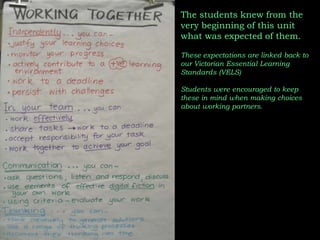
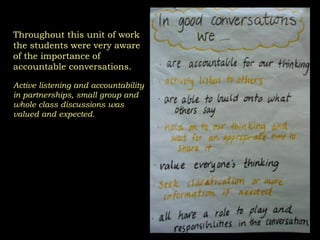
The students knew from the very beginning of this unit what was expected of them.These expectations are linked back to our Victorian Essential Learning Standards (VELS)Students were encouraged to keep these in mind when making choices about working partners.
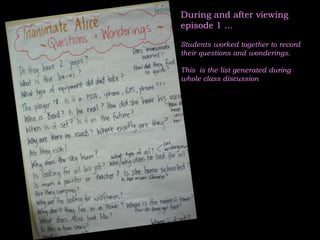
During and after viewing episode 1 ...Students worked together to record their questions and wonderings.This  is the list generated during whole class discussion
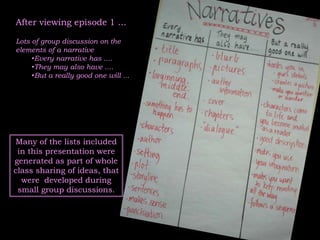
After viewing episode 1 ...Lots of group discussion on the  elements of a narrativeEvery narrative has ....
They may also have ....
But a really good one will ...Many of the lists included in this presentation were generated as part of whole class sharing of ideas, that were  developed during small group discussions.
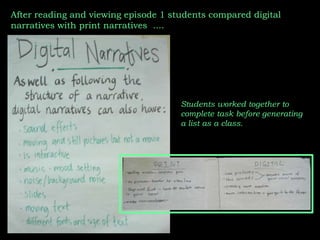
After reading and viewing episode 1 students compared digital narratives with print narratives  .... Students worked together to complete task before generating a list as a class.
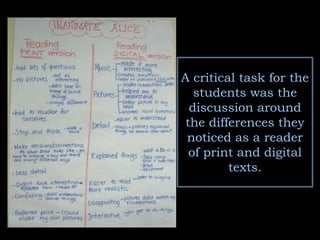
A critical task for the students was the discussion around the differences they noticed as a reader of print and digital texts.
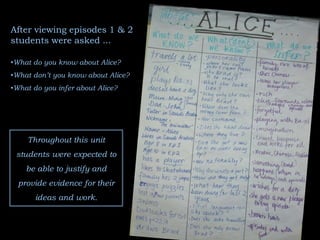
After viewing episodes 1 & 2 students were asked ...What do you know about Alice?
What don’t you know about Alice?
What do you infer about Alice?Throughout this unit students were expected to be able to justify and provide evidence for their ideas and work.
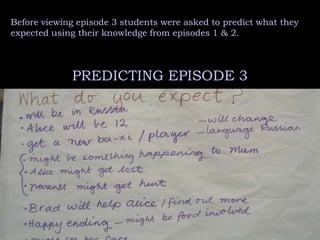
Before viewing episode 3 students were asked to predict what they expected using their knowledge from episodes 1 & 2.PREDICTING EPISODE 3
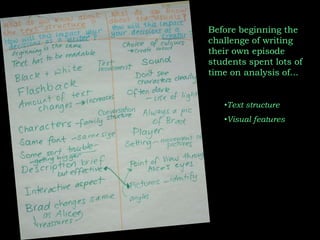
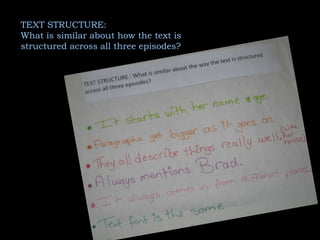
Before beginning the challenge of writing their own episode students spent lots of time on analysis of...Text structure
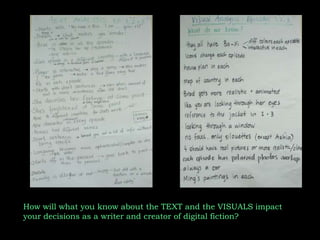
Visual featuresHow will what you know about the TEXT and the VISUALS impact your decisions as a writer and creator of digital fiction?
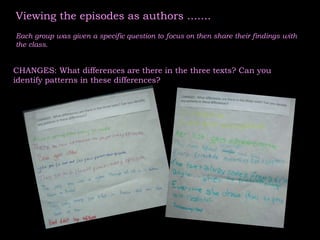
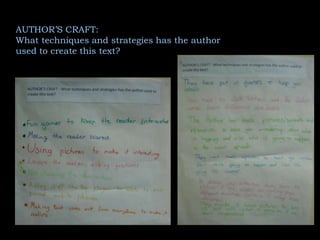
Viewing the episodes as authors .......Each group was given a specific question to focus on then share their findings with the class.CHANGES: What differences are there in the three texts? Can you identify patterns in these differences?
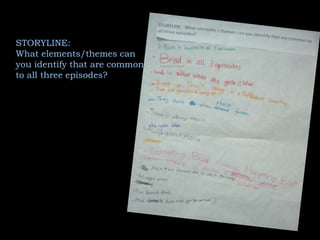
STORYLINE: What elements/themes can you identify that are common to all three episodes?

Charts

  • 1.
    Collaborative charts createdas part of our inanimate aliceunit of work.
  • 2.
    The students knewfrom the very beginning of this unit what was expected of them.These expectations are linked back to our Victorian Essential Learning Standards (VELS)Students were encouraged to keep these in mind when making choices about working partners.
  • 3.
    During and afterviewing episode 1 ...Students worked together to record their questions and wonderings.This is the list generated during whole class discussion
  • 4.
    After viewing episode1 ...Lots of group discussion on the elements of a narrativeEvery narrative has ....
  • 5.
    They may alsohave ....
  • 6.
    But a reallygood one will ...Many of the lists included in this presentation were generated as part of whole class sharing of ideas, that were developed during small group discussions.
  • 7.
    After reading andviewing episode 1 students compared digital narratives with print narratives .... Students worked together to complete task before generating a list as a class.
  • 8.
    A critical taskfor the students was the discussion around the differences they noticed as a reader of print and digital texts.
  • 9.
    After viewing episodes1 & 2 students were asked ...What do you know about Alice?
  • 10.
    What don’t youknow about Alice?
  • 11.
    What do youinfer about Alice?Throughout this unit students were expected to be able to justify and provide evidence for their ideas and work.
  • 12.
    Before viewing episode3 students were asked to predict what they expected using their knowledge from episodes 1 & 2.PREDICTING EPISODE 3
  • 13.
    Before beginning thechallenge of writing their own episode students spent lots of time on analysis of...Text structure
  • 14.
    Visual featuresHow willwhat you know about the TEXT and the VISUALS impact your decisions as a writer and creator of digital fiction?
  • 15.
    Viewing the episodesas authors .......Each group was given a specific question to focus on then share their findings with the class.CHANGES: What differences are there in the three texts? Can you identify patterns in these differences?
  • 16.
    STORYLINE: What elements/themescan you identify that are common to all three episodes?