SEO Training
Helping your charity get found online
Hi! 👋
Charity Box is a company that works exclusively
with third sector organisations.
● Digital design and development
● Support and mentorship
● Digital training workshops.
Follow me:
www.charitybox.io
www.twitter.com/WeAreCharityBox
Thank you to our sponsor, Lightful...
● Social media monitoring tool for charities
● Free plan available
● Get 50% off forever on any paid plan by entering
the code CBOX at checkout
http://bit.ly/lightful-cbox
This session
● What SEO actually is
● Google’s relevance to SEO
● On-page vs off-page SEO
● Backlinks and keywords
● Shout-out quiz (make notes!)
● 10 minute break
● How to measure SEO
● What to look for in an SEO provider
● Q&A
What does SEO
mean to you?
What is SEO?
● SEO stands for “search engine optimisation”
● It is all about helping your organisation to be found online
● SEO can broadly be categorised into “on page” and “off page”
Because SEO is so important, you’ve probably received spam emails from “SEO
experts” promising to get you page 1 rankings.
● A good SEO profile indicates a healthy marketing strategy
● Being easily found online is an indicator of authority and trust
● If people come to you, it makes life a lot easier
Having an SEO strategy enables you to be seen by more of the right people,
reduces how much you need to spend on advertising and enables your
organisation to gain more support and improve its impact.
Why is SEO important?
Let’s talk Google...
There are other search engines...
?%
Google’s UK market share
https://www.statista.com/statistics/280269/market-share-held-by-search-engines-in-the-united-kingdom/
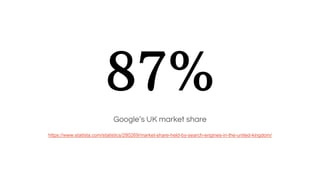
87%
Google’s UK market share
https://www.statista.com/statistics/280269/market-share-held-by-search-engines-in-the-united-kingdom/
Google is synonymous with “search”
● Google’s technology has driven what it means to catalogue and search for
information on the internet.
● In the nineties it patented its own algorithm called “PageRank” which it saw
as the optimal way to index web content. PageRank is still used today.
● Google is driving search in other areas, such as local and voice search.
What’s the
difference between
on-page and off-
page SEO?
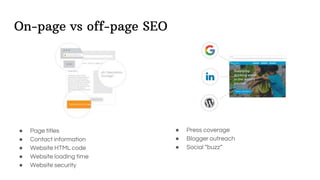
On-page vs off-page SEO
● Page titles
● Contact information
● Website HTML code
● Website loading time
● Website security
● Press coverage
● Blogger outreach
● Social “buzz”
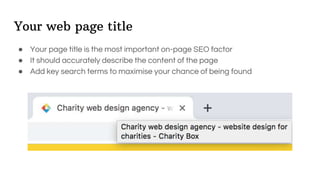
Your web page title
● Your page title is the most important on-page SEO factor
● It should accurately describe the content of the page
● Add key search terms to maximise your chance of being found
Contact information
● Your physical address, telephone
number and email addresses
● Helps you to rank when people search
for your services in the local area
● Adds authority to your organisation as a
“real” business
Be sure to register with Google My Business
to appear in local search results.
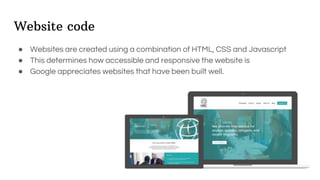
Website code
● Websites are created using a combination of HTML, CSS and Javascript
● This determines how accessible and responsive the website is
● Google appreciates websites that have been built well.
Website security and loading speed
Google prefers websites that are:
● Fast loading
● Secure (SSL)
Why do you think this is?
Well-made, fast,
secure websites that
work for all make
Google a better
search provider
What is off-page SEO?
● Relates to any marketing activities
that happen outside the website
● Relates directly to Google’s
PageRank algorithm
● Is way more important than on-
page SEO
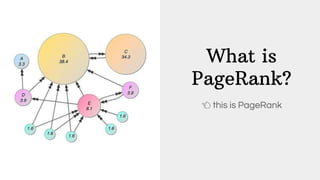
What is
PageRank?
👈 this is PageRank
● Every link that points to your website is an “endorsement”
● The more links that a website has, the bigger the endorsement
● The more links, generally, the better (but quality is important)
Links determine popularity
What examples of
backlinks can you
think of?
Backlink examples
● Blog post mentions
● Press releases
● News coverage
● Social media posts
● Partner/supplier/customer mentions
Exercise:
Write down the places you could
get some coverage right now.
Who’s interested in your story?
Where you can get coverage right now
● Your beneficiaries - sharing their story
● Your fundraisers - they may have their own networks
● Partner organisations
● Local press - always looking for stories and good news
● Local business directories
Keywords are
important.
What are keywords?
● Keywords describe the core services you offer
● They are often location-based
● They can be “head” or “tail” keywords
What is meant by
“head” and “tail”
keywords?
Head vs tail keywords
“Head” keywords
“Cancer charity”
“Chinese restaurant”
“Second hand cars”
Why do this?
“Longtail” keywords
“Testicular cancer support charity Leeds”
“Vegetarian cantonese restaurant”
“Buy second hand cars Manchester”
Why “longtail” keywords are important
● Easier to rank for
● More likely to convert
How to get keyword ideas
https://neilpatel.com/ubersuggest/
Exercise:
Write down some keyword ideas
that apply to your organisation.
How to use your keywords
● On specific landing pages
● In blog posts
● In paid advertisements
● In press coverage
Think keywords every time you write a piece of content!
The shout-out
quiz...
What is the most
important aspect of on-
page SEO?
The page title tag.
What is a “longtail keyword”?
A specific, often lengthier keyword
or search term.
For example: “Testicular cancer support charity Leeds”
How would you describe a
“backlink”?
A backlink is a link to your website
from another, that counts as an
endorsement for your website.
Which is more important:
on-page or off-page SEO?
Off-page SEO.
10 minute coffee
break.
Measuring your SEO
Is the effort worth it?
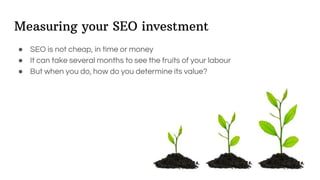
Measuring your SEO investment
● SEO is not cheap, in time or money
● It can take several months to see the fruits of your labour
● But when you do, how do you determine its value?
SEO is difficult to
“measure” because
it is a company
mindset more than
a set of activities.
● Number (and quality) of backlinks
● Domain authority
● Organic website traffic
Check your backlinks and authority at https://ahrefs.com/backlink-checker
Key performance indicators (KPIs)
Setting goals
● Investing in your website is pointless without goals
● And setting goals is pointless unless you track them.
What goals might we set?
Goals are outcomes,
such as enquiries or
sales, not KPIs, such
as website traffic.
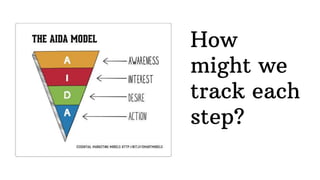
How
might we
track each
step?
Tracking awareness
● Number of website visitors
● Social media engagement, such
as likes and retweets
● Ad impressions
Tracking interest
● Number of web pages viewed
per visit
● Time spent on site
● Percentage of returning visitors
● Average bounce rate
Tracking desire
● Enquiries/social media
messages
● Repeat views of appeal pages
● Clicks to “donate” before drop-
off
Tracking action (goals)
● Donations
● Advocacy (social shares)
● Job/volunteer applications
● Newsletter subscriptions
What has this got to
do with SEO?
SEO keeps
the sales
funnel
topped up.
SEO services
A guide to hiring
Not this 🚫
Tips for hiring SEO services
● Know what your goals are
● Know your budget and timescales
● Understand the strengths and weaknesses within your team
● Be prepared to commit
What to look for in an SEO company
● Proof
● Ethics
● Good communication
● A partnership
Wrapping up
● SEO is not just a way to be found online; it is integral to marketing mindset
● Focus on Google, but be aware of other ways that people find content online
● Off-page SEO trumps on-page SEO
● Get as many backlinks as possible, and use keywords where appropriate
● Measure your progress using the AIDA model, but don’t obsess!
● Consider your strengths before seeking SEO support
Exercise:
Write down three takeaways
from today’s session. What have
you learned? How will you apply
your learnings?
Q&A
Any questions?

Charity SEO Training

  • 1.
    SEO Training Helping yourcharity get found online
  • 2.
    Hi! 👋 Charity Boxis a company that works exclusively with third sector organisations. ● Digital design and development ● Support and mentorship ● Digital training workshops. Follow me: www.charitybox.io www.twitter.com/WeAreCharityBox
  • 3.
    Thank you toour sponsor, Lightful... ● Social media monitoring tool for charities ● Free plan available ● Get 50% off forever on any paid plan by entering the code CBOX at checkout http://bit.ly/lightful-cbox
  • 4.
    This session ● WhatSEO actually is ● Google’s relevance to SEO ● On-page vs off-page SEO ● Backlinks and keywords ● Shout-out quiz (make notes!) ● 10 minute break ● How to measure SEO ● What to look for in an SEO provider ● Q&A
  • 5.
  • 6.
    What is SEO? ●SEO stands for “search engine optimisation” ● It is all about helping your organisation to be found online ● SEO can broadly be categorised into “on page” and “off page” Because SEO is so important, you’ve probably received spam emails from “SEO experts” promising to get you page 1 rankings.
  • 8.
    ● A goodSEO profile indicates a healthy marketing strategy ● Being easily found online is an indicator of authority and trust ● If people come to you, it makes life a lot easier Having an SEO strategy enables you to be seen by more of the right people, reduces how much you need to spend on advertising and enables your organisation to gain more support and improve its impact. Why is SEO important?
  • 9.
  • 10.
    There are othersearch engines...
  • 11.
    ?% Google’s UK marketshare https://www.statista.com/statistics/280269/market-share-held-by-search-engines-in-the-united-kingdom/
  • 12.
    87% Google’s UK marketshare https://www.statista.com/statistics/280269/market-share-held-by-search-engines-in-the-united-kingdom/
  • 13.
    Google is synonymouswith “search” ● Google’s technology has driven what it means to catalogue and search for information on the internet. ● In the nineties it patented its own algorithm called “PageRank” which it saw as the optimal way to index web content. PageRank is still used today. ● Google is driving search in other areas, such as local and voice search.
  • 14.
  • 15.
    On-page vs off-pageSEO ● Page titles ● Contact information ● Website HTML code ● Website loading time ● Website security ● Press coverage ● Blogger outreach ● Social “buzz”
  • 16.
    Your web pagetitle ● Your page title is the most important on-page SEO factor ● It should accurately describe the content of the page ● Add key search terms to maximise your chance of being found
  • 17.
    Contact information ● Yourphysical address, telephone number and email addresses ● Helps you to rank when people search for your services in the local area ● Adds authority to your organisation as a “real” business Be sure to register with Google My Business to appear in local search results.
  • 18.
    Website code ● Websitesare created using a combination of HTML, CSS and Javascript ● This determines how accessible and responsive the website is ● Google appreciates websites that have been built well.
  • 19.
    Website security andloading speed Google prefers websites that are: ● Fast loading ● Secure (SSL) Why do you think this is?
  • 20.
    Well-made, fast, secure websitesthat work for all make Google a better search provider
  • 21.
    What is off-pageSEO? ● Relates to any marketing activities that happen outside the website ● Relates directly to Google’s PageRank algorithm ● Is way more important than on- page SEO
  • 22.
  • 23.
    ● Every linkthat points to your website is an “endorsement” ● The more links that a website has, the bigger the endorsement ● The more links, generally, the better (but quality is important) Links determine popularity
  • 24.
    What examples of backlinkscan you think of?
  • 25.
    Backlink examples ● Blogpost mentions ● Press releases ● News coverage ● Social media posts ● Partner/supplier/customer mentions
  • 26.
    Exercise: Write down theplaces you could get some coverage right now. Who’s interested in your story?
  • 27.
    Where you canget coverage right now ● Your beneficiaries - sharing their story ● Your fundraisers - they may have their own networks ● Partner organisations ● Local press - always looking for stories and good news ● Local business directories
  • 28.
  • 29.
    What are keywords? ●Keywords describe the core services you offer ● They are often location-based ● They can be “head” or “tail” keywords
  • 30.
    What is meantby “head” and “tail” keywords?
  • 31.
    Head vs tailkeywords “Head” keywords “Cancer charity” “Chinese restaurant” “Second hand cars” Why do this? “Longtail” keywords “Testicular cancer support charity Leeds” “Vegetarian cantonese restaurant” “Buy second hand cars Manchester”
  • 32.
    Why “longtail” keywordsare important ● Easier to rank for ● More likely to convert
  • 33.
    How to getkeyword ideas https://neilpatel.com/ubersuggest/
  • 34.
    Exercise: Write down somekeyword ideas that apply to your organisation.
  • 35.
    How to useyour keywords ● On specific landing pages ● In blog posts ● In paid advertisements ● In press coverage Think keywords every time you write a piece of content!
  • 37.
  • 38.
    What is themost important aspect of on- page SEO?
  • 39.
  • 40.
    What is a“longtail keyword”?
  • 41.
    A specific, oftenlengthier keyword or search term. For example: “Testicular cancer support charity Leeds”
  • 42.
    How would youdescribe a “backlink”?
  • 43.
    A backlink isa link to your website from another, that counts as an endorsement for your website.
  • 44.
    Which is moreimportant: on-page or off-page SEO?
  • 45.
  • 46.
  • 47.
    Measuring your SEO Isthe effort worth it?
  • 48.
    Measuring your SEOinvestment ● SEO is not cheap, in time or money ● It can take several months to see the fruits of your labour ● But when you do, how do you determine its value?
  • 49.
    SEO is difficultto “measure” because it is a company mindset more than a set of activities.
  • 50.
    ● Number (andquality) of backlinks ● Domain authority ● Organic website traffic Check your backlinks and authority at https://ahrefs.com/backlink-checker Key performance indicators (KPIs)
  • 51.
    Setting goals ● Investingin your website is pointless without goals ● And setting goals is pointless unless you track them. What goals might we set?
  • 52.
    Goals are outcomes, suchas enquiries or sales, not KPIs, such as website traffic.
  • 54.
  • 55.
    Tracking awareness ● Numberof website visitors ● Social media engagement, such as likes and retweets ● Ad impressions
  • 56.
    Tracking interest ● Numberof web pages viewed per visit ● Time spent on site ● Percentage of returning visitors ● Average bounce rate
  • 57.
    Tracking desire ● Enquiries/socialmedia messages ● Repeat views of appeal pages ● Clicks to “donate” before drop- off
  • 58.
    Tracking action (goals) ●Donations ● Advocacy (social shares) ● Job/volunteer applications ● Newsletter subscriptions
  • 59.
    What has thisgot to do with SEO?
  • 60.
  • 61.
  • 62.
  • 63.
    Tips for hiringSEO services ● Know what your goals are ● Know your budget and timescales ● Understand the strengths and weaknesses within your team ● Be prepared to commit
  • 64.
    What to lookfor in an SEO company ● Proof ● Ethics ● Good communication ● A partnership
  • 65.
    Wrapping up ● SEOis not just a way to be found online; it is integral to marketing mindset ● Focus on Google, but be aware of other ways that people find content online ● Off-page SEO trumps on-page SEO ● Get as many backlinks as possible, and use keywords where appropriate ● Measure your progress using the AIDA model, but don’t obsess! ● Consider your strengths before seeking SEO support
  • 66.
    Exercise: Write down threetakeaways from today’s session. What have you learned? How will you apply your learnings?
  • 67.

Editor's Notes

  • #11 Who can guess what market share Google has?
  • #18 Local citations https://www.seomark.co.uk/local-seo-citations/
  • #32 Why? More specific, more targeted, easier to rank, probably more likely to convert users
  • #34 What does this data tell us? Look at volumes and CPC.
  • #35 10-15 mins to write down ideas and go through them - offer suggestions and improvements
  • #50 You don’t just “do” SEO - all activities centre around it
  • #51 CTR - working on page titles can increase CTR
  • #53 Increasing website traffic is not a goal in of itself
  • #67 10-15 mins to write down ideas and go through them - offer suggestions and improvements