THE READING
PROCESS
Over the years, there have been
conceptual shifts in the way teachers
and researchers think about reading.
• In the 1950's, the teaching of reading followed
only when the learner has developed a working
knowledge of the language spoken.
• The natural order of language teaching was
listening, speaking, reading then writing.
“Reading is essentially
mechanical decoding of
speech written down”.
-Bloomfield & Fries
“Reading is a
psycholinguistic game”
-Kenneth Goodman
• He maintains that efficient reading does not
result from exact perception and identification
of elements; rather, it does come from skill in
selecting the fewest and most productive cues
necessary to produce guesses.
INTERACTIVE READING
-emphasizes that meaning is not fully
present in the text waiting to be decoded.
Rather, meaning is.......?
Why is interactive reading
related to the schema theory?
Frank May says that good readers
allow four cueing systems to interact they
read.
So, Let's find out.
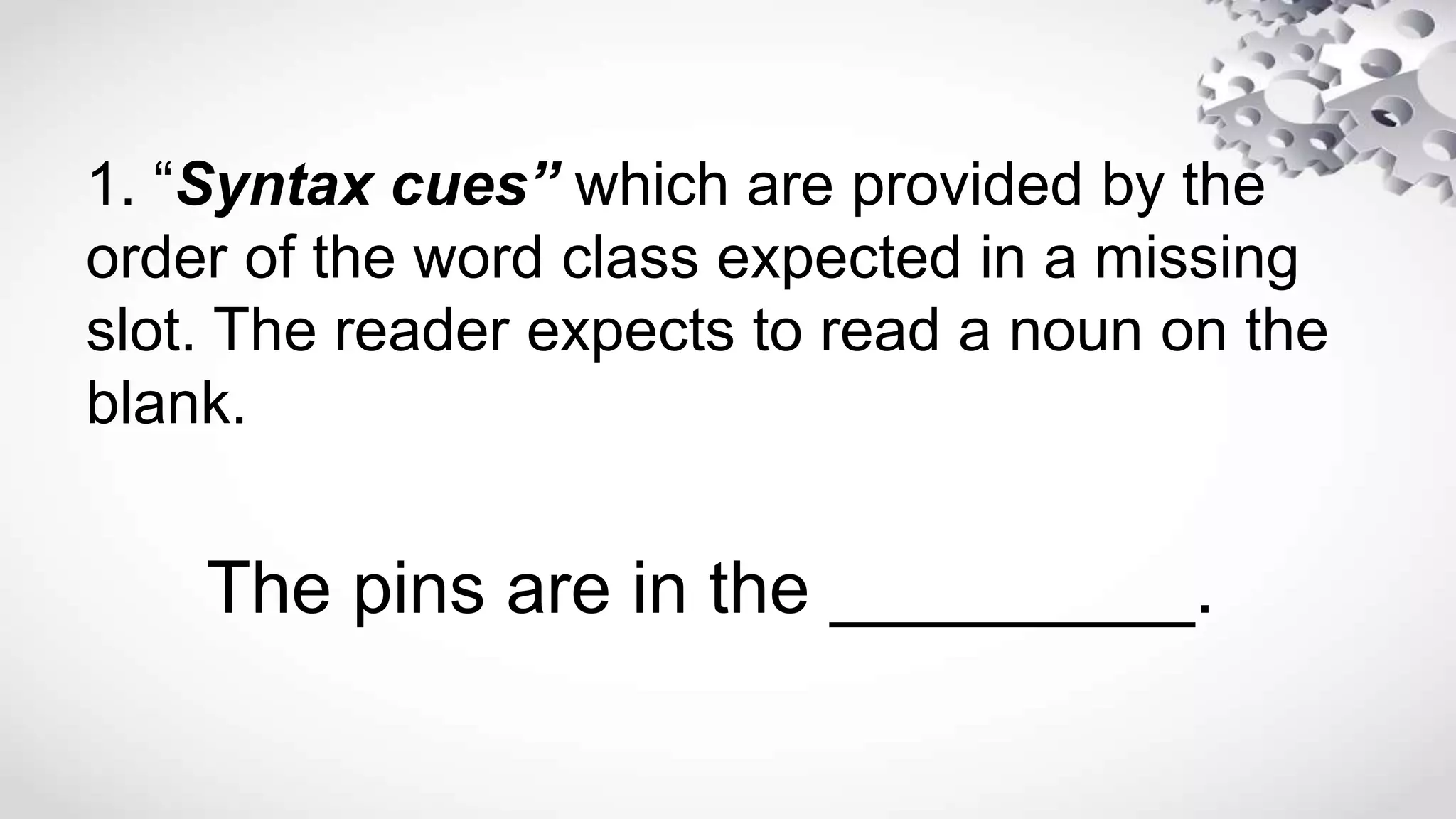
1. “Syntax cues” which are provided by the
order of the word class expected in a missing
slot. The reader expects to read a noun on the
blank.
The pins are in the _________.
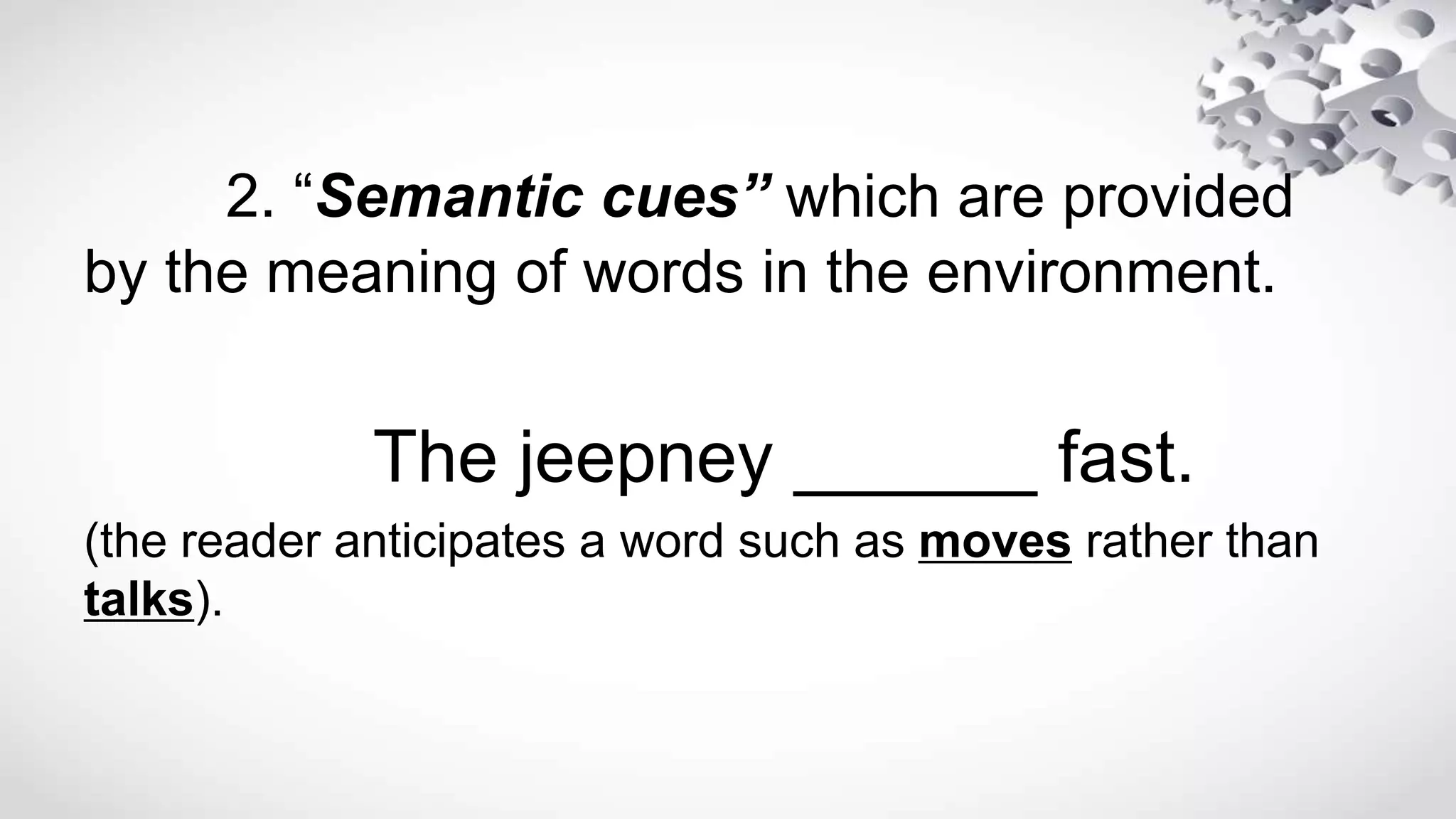
2. “Semantic cues” which are provided
by the meaning of words in the environment.
The jeepney ______ fast.
(the reader anticipates a word such as moves rather than
talks).
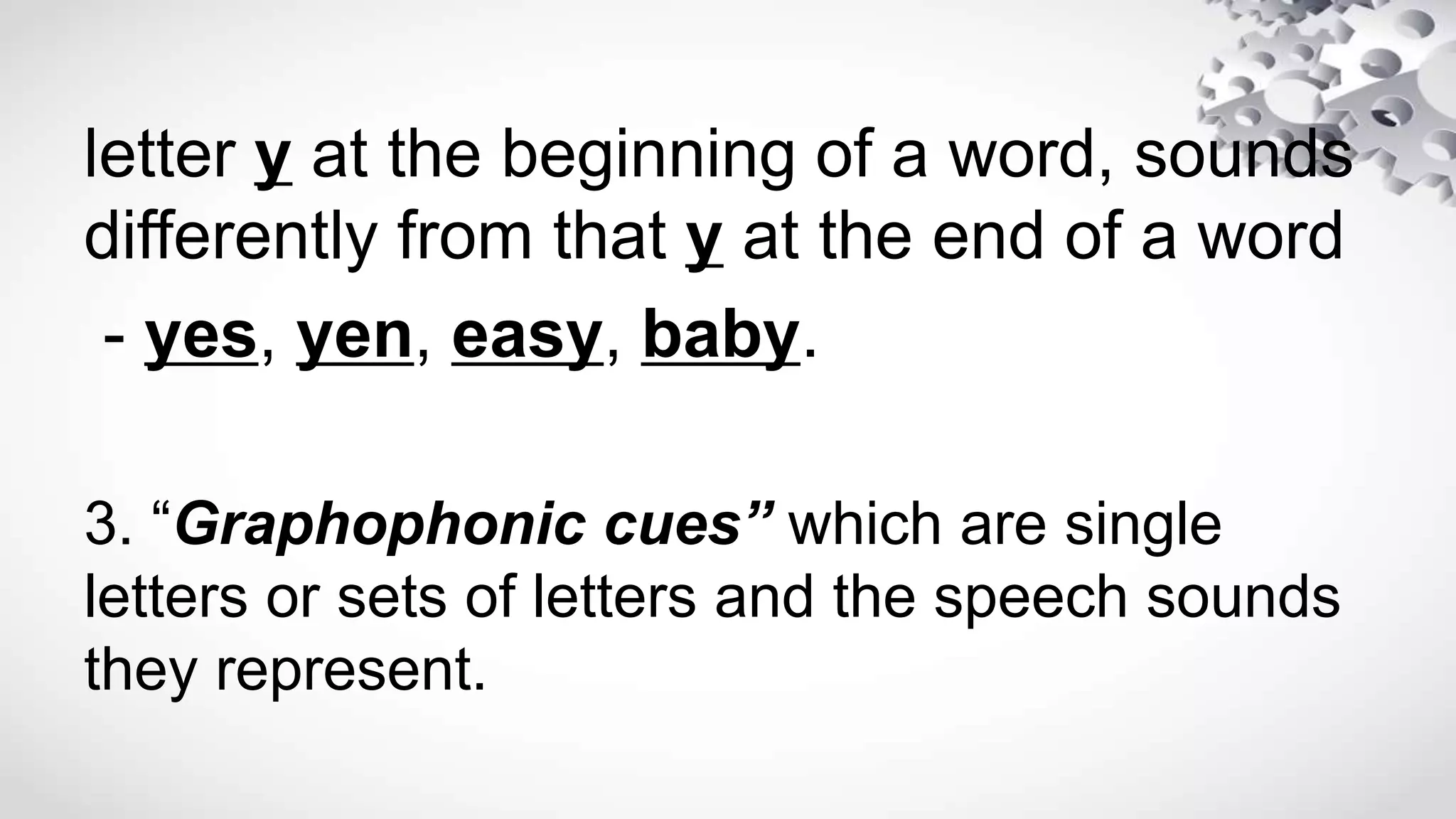
letter y at the beginning of a word, sounds
differently from that y at the end of a word
- yes, yen, easy, baby.
3. “Graphophonic cues” which are single
letters or sets of letters and the speech sounds
they represent.
Plane in “My mother went to Davao by plane.
(can only be read with meaning if the reader has read about
planes or has ridden in one.
4. “Schematic cues” which are memories and
mental images about the world that help the
reader understand.
Let's show what you got....
Given a sentence, predict the next sentence, one
word at a time.
“Mario looked down the valley
and saw a herd.”
“Mario looked down the valley and saw
a herd.”
“Mario looked down the valley and saw
a herd. Several cows grazed on a
_____ hill. Answer: grassy
FINALLY!
You have just done what good readers do to
read with accuracy and understanding- to allow
all four cueing systems- syntactic,
semantic, graphophonic and schematic
- TO INTERACT.

The reading process

  • 1.
  • 2.
    Over the years,there have been conceptual shifts in the way teachers and researchers think about reading.
  • 3.
    • In the1950's, the teaching of reading followed only when the learner has developed a working knowledge of the language spoken. • The natural order of language teaching was listening, speaking, reading then writing.
  • 4.
    “Reading is essentially mechanicaldecoding of speech written down”. -Bloomfield & Fries
  • 5.
    “Reading is a psycholinguisticgame” -Kenneth Goodman
  • 6.
    • He maintainsthat efficient reading does not result from exact perception and identification of elements; rather, it does come from skill in selecting the fewest and most productive cues necessary to produce guesses.
  • 7.
    INTERACTIVE READING -emphasizes thatmeaning is not fully present in the text waiting to be decoded. Rather, meaning is.......?
  • 8.
    Why is interactivereading related to the schema theory?
  • 9.
    Frank May saysthat good readers allow four cueing systems to interact they read.
  • 10.
  • 11.
    1. “Syntax cues”which are provided by the order of the word class expected in a missing slot. The reader expects to read a noun on the blank. The pins are in the _________.
  • 12.
    2. “Semantic cues”which are provided by the meaning of words in the environment. The jeepney ______ fast. (the reader anticipates a word such as moves rather than talks).
  • 13.
    letter y atthe beginning of a word, sounds differently from that y at the end of a word - yes, yen, easy, baby. 3. “Graphophonic cues” which are single letters or sets of letters and the speech sounds they represent.
  • 14.
    Plane in “Mymother went to Davao by plane. (can only be read with meaning if the reader has read about planes or has ridden in one. 4. “Schematic cues” which are memories and mental images about the world that help the reader understand.
  • 15.
    Let's show whatyou got.... Given a sentence, predict the next sentence, one word at a time. “Mario looked down the valley and saw a herd.”
  • 16.
    “Mario looked downthe valley and saw a herd.” “Mario looked down the valley and saw a herd. Several cows grazed on a _____ hill. Answer: grassy
  • 17.
    FINALLY! You have justdone what good readers do to read with accuracy and understanding- to allow all four cueing systems- syntactic, semantic, graphophonic and schematic - TO INTERACT.