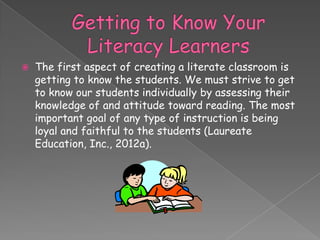
   The first aspect of creating a literate classroom is
    getting to know the students. We must strive to get
    to know our students individually by assessing their
    knowledge of and attitude toward reading. The most
    important goal of any type of instruction is being
    loyal and faithful to the students (Laureate
    Education, Inc., 2012a).
 Assessing Attitude and Motivation
  › The Elementary Reading Attitude Survey
    (Liberty County Schools, 2011) can be
    administered to assess a student’s attitude
    toward reading.
     Research has proven that a student’s attitude toward
      reading is a major factor in reading achievement
      (McKenna & Kear, 1990).
 Assessing Cognitive Abilities
  › The DIBELS assessment (University of
    Oregon, 2011) can be administered to
    assess a student’s acquisition of early
    literacy skills.
     The data collected from this assessment is used to make
      instructional decisions that will benefit the students
      (Tompkins, 2010).
     The skills that a student acquires in phonemic awareness
      and phonics determines the child’s ability to decode and
      read words (Tompkins, 2010).
 How does getting to know your
 student’s create a literate
 environment?
 › The data that is collected from these assessments helps me
   determine who needs additional support and in what areas.
 › The information from the attitude survey gives me the
   opportunity to gear my instruction toward topics that I know
   will interest my students.
 › The assessment results give me concrete evidence to share
   with others at RTI meetings and conferences.
 Choosing the appropriate texts for
 students is important. Students need
 to be introduced to a read a variety of
 texts including both stories and
 informational texts (Laureate
 Education, Inc., 2010b).
Informational                  Texts
 › Students need to be given many opportunities to read and
   learn about informational texts in the early years of literacy
   instruction (Laureate Education, Inc., 2010b).
 › The future success of each child is influenced by his or her
   ability to understand informational texts especially when
   entering the third and fourth grades (Duke, 2004).
 › Most of the texts that are read by adults are informational
   texts whose main purpose is to provide information (Duke,
   2004).
Internet            Texts
 › There are many opportunities for students to broaden their
   reading experiences by allowing access to Internet texts
   (Castek, Bevans-Mangelson, & Goldstone, 2006).
 › Allowing students the opportunity to access reading material
   through the Internet increases motivation for reading as
   well as develops skills that will be necessary in the digital
   future (Castek, Bevans-Mangelson, & Golstone, 2006).
 How does selecting the appropriate
 texts help to create a literate
 environment?
 › Selecting texts that will interest students will build their
   motivation for reading.
 › Texts should not be too easy or too difficult but should fall
   into the student’s instructional reading level (Tompkins,
   2010).
 › Allowing students to read a variety of material in the early
   years will prepare students for the future.
   Students will build upon early literacy instruction
    throughout their lives to become learners who
    are able to fluently read material and
    understand what they are reading. Educators
    must teach students how to become strategic
    readers who are able to decode words, read with
    expression, and comprehend the material
    (Laureate Education, Inc., 2010c).
 The lesson plan that I created allowed
 me to help students begin to use a
 comprehension strategy, prediction, to
 understand the story they read
 (Tompkins, 2010). The students were
 also introduced to a sound-blending
 activity that allowed them to decode
 unfamiliar words (Tompkins, 2010).
   Introduction/Anticipatory Set
    › The students will activate background knowledge by discussing
      different animals and listing information that is already known. The
      students will practice blending the phonemes to words containing
      the short /i/ sound. The students will predict what events will
       occur in the story.
   Building/Applying Knowledge and Skills
    › The students will participate in a shared reading of the text.
   Synthesis/Closure
    › The students will create a drawing describing what events took
       place in the story as well as other things that pigs can do. The
       students will write two sentences containing words that contain the
       short /i/ sound.
 How  did this lesson help to create
 a literate environment?
 › By implementing this lesson plan in my classroom, I was
   able to teach my students the comprehension strategy,
   predicting, in a way that maintained their attention.
 › I was also able to teach a sound blending strategy that
   my students will be able to use in the future to decode
   words.
 Critical   Perspective
  › Teaching students how to examine texts from
    multiple perspectives is important for complete
    understanding (Laureate Education, Inc., 2010d).
 Response    Perspective
  › Allowing students the opportunity to experience
    texts that can change their lives in some way is
    essential (Laureate Education, Inc., 2010e).
   The lesson plan that I created allowed me to
    discuss with my students a negative situation
    that was occurring in my classroom. I was
    able to do this without pointing any fingers
    at specific students. The students were
    given the opportunity to share their emotions
    and reactions as well as model different ways
    to deal with the situation.
   Introduction/Anticipatory Set
    › The students will activate background knowledge by discussing
      what they already know about bullies. The students will describe
      any encounters they have had with a bully.
   Building/Applying Knowledge and Skills
    › The students will participate in a shared reading of the text. The
      students will pause occasionally to discuss what events have
      occurred and their thoughts about the bully’s actions.
   Synthesis/Closure
    › The students will discuss the effects of the bully’s actions on the
       characters in the story. The students will use hand puppets or
       costumes to act out situations in which another student is being a
       bully.
 How  did this lesson help to create
 a literate environment?
 › By implementing this lesson in my classroom, I allowed
   my students the opportunity to take a deeper look at
   the story and its meaning.
 › The students were given the opportunity to make
   connections between the story and their personal lives.
 › The students were given the opportunity to share
   their emotions about the events in the text.
   Castek, J., Bevans-Mangelson, J., & Goldstone, B. (2006). Reading adventures online: Five
         ways to introduce the new literacies of the internet through children’s literature.
         The Reading Teacher, 59(7), 714–728.
   Duke, N. (2004). The case for informational text. Educational Leadership, 61(6), 40–44.
   Laureate Education, Inc. (Executive Producer). (2010A). Week 1: Changes in Literacy
         Education [Webcast]. The Beginning Reader. Baltimore: Author.
   Laureate Education, Inc. (Executive Producer). (2010b). Week 3: Informational text in the
         early years. [Webcast]. The Beginning Reader. Baltimore: Author.
   Laureate Education, Inc. (Executive Producer). (2010c). Week 5: Interactive perspective:
         Strategic processing. [Webcast]. The Beginning Reader. Baltimore: Author.
   Laureate Education, Inc. (Executive Producer). (2010d). Week 6: Critical perspective.
         [Webcast]. The Beginning Reader. Baltimore: Author.
   Laureate Education, Inc. (Executive Producer). (2010e). Week 6: Response perspective.
         [Webcast]. The Beginning Reader. Baltimore: Author.
   Liberty County School System. (2011). Elementary reading attitude survey. Retrieved from
         http://www.liberty.k12.ga.us/jwalts/reading%20materials/Elementary%20Reading%2
         0Attitude%20Survey.pdf.
    McKenna, M. C., & Kear, D. J. (1990). Measuring attitude toward reading: A new tool for
         teachers. The Reading Teacher, 43(9), 626–639.
   Tompkins, G. (2010). Literacy for the 21st century: A balanced approach (5th ed.). Boston,
         MA: Allyn & Bacon.
   University of Oregon. (2011). DIBELS. Retrieved from
         https://dibels.uoregon.edu/dibelsinfo.php.

Creating a Literate Environment

  • 2.
    The first aspect of creating a literate classroom is getting to know the students. We must strive to get to know our students individually by assessing their knowledge of and attitude toward reading. The most important goal of any type of instruction is being loyal and faithful to the students (Laureate Education, Inc., 2012a).
  • 3.
     Assessing Attitudeand Motivation › The Elementary Reading Attitude Survey (Liberty County Schools, 2011) can be administered to assess a student’s attitude toward reading.  Research has proven that a student’s attitude toward reading is a major factor in reading achievement (McKenna & Kear, 1990).
  • 4.
     Assessing CognitiveAbilities › The DIBELS assessment (University of Oregon, 2011) can be administered to assess a student’s acquisition of early literacy skills.  The data collected from this assessment is used to make instructional decisions that will benefit the students (Tompkins, 2010).  The skills that a student acquires in phonemic awareness and phonics determines the child’s ability to decode and read words (Tompkins, 2010).
  • 5.
     How doesgetting to know your student’s create a literate environment? › The data that is collected from these assessments helps me determine who needs additional support and in what areas. › The information from the attitude survey gives me the opportunity to gear my instruction toward topics that I know will interest my students. › The assessment results give me concrete evidence to share with others at RTI meetings and conferences.
  • 6.
     Choosing theappropriate texts for students is important. Students need to be introduced to a read a variety of texts including both stories and informational texts (Laureate Education, Inc., 2010b).
  • 7.
    Informational Texts › Students need to be given many opportunities to read and learn about informational texts in the early years of literacy instruction (Laureate Education, Inc., 2010b). › The future success of each child is influenced by his or her ability to understand informational texts especially when entering the third and fourth grades (Duke, 2004). › Most of the texts that are read by adults are informational texts whose main purpose is to provide information (Duke, 2004).
  • 8.
    Internet Texts › There are many opportunities for students to broaden their reading experiences by allowing access to Internet texts (Castek, Bevans-Mangelson, & Goldstone, 2006). › Allowing students the opportunity to access reading material through the Internet increases motivation for reading as well as develops skills that will be necessary in the digital future (Castek, Bevans-Mangelson, & Golstone, 2006).
  • 9.
     How doesselecting the appropriate texts help to create a literate environment? › Selecting texts that will interest students will build their motivation for reading. › Texts should not be too easy or too difficult but should fall into the student’s instructional reading level (Tompkins, 2010). › Allowing students to read a variety of material in the early years will prepare students for the future.
  • 10.
    Students will build upon early literacy instruction throughout their lives to become learners who are able to fluently read material and understand what they are reading. Educators must teach students how to become strategic readers who are able to decode words, read with expression, and comprehend the material (Laureate Education, Inc., 2010c).
  • 11.
     The lessonplan that I created allowed me to help students begin to use a comprehension strategy, prediction, to understand the story they read (Tompkins, 2010). The students were also introduced to a sound-blending activity that allowed them to decode unfamiliar words (Tompkins, 2010).
  • 12.
    Introduction/Anticipatory Set › The students will activate background knowledge by discussing different animals and listing information that is already known. The students will practice blending the phonemes to words containing the short /i/ sound. The students will predict what events will occur in the story.  Building/Applying Knowledge and Skills › The students will participate in a shared reading of the text.  Synthesis/Closure › The students will create a drawing describing what events took place in the story as well as other things that pigs can do. The students will write two sentences containing words that contain the short /i/ sound.
  • 13.
     How did this lesson help to create a literate environment? › By implementing this lesson plan in my classroom, I was able to teach my students the comprehension strategy, predicting, in a way that maintained their attention. › I was also able to teach a sound blending strategy that my students will be able to use in the future to decode words.
  • 14.
     Critical Perspective › Teaching students how to examine texts from multiple perspectives is important for complete understanding (Laureate Education, Inc., 2010d).  Response Perspective › Allowing students the opportunity to experience texts that can change their lives in some way is essential (Laureate Education, Inc., 2010e).
  • 15.
    The lesson plan that I created allowed me to discuss with my students a negative situation that was occurring in my classroom. I was able to do this without pointing any fingers at specific students. The students were given the opportunity to share their emotions and reactions as well as model different ways to deal with the situation.
  • 16.
    Introduction/Anticipatory Set › The students will activate background knowledge by discussing what they already know about bullies. The students will describe any encounters they have had with a bully.  Building/Applying Knowledge and Skills › The students will participate in a shared reading of the text. The students will pause occasionally to discuss what events have occurred and their thoughts about the bully’s actions.  Synthesis/Closure › The students will discuss the effects of the bully’s actions on the characters in the story. The students will use hand puppets or costumes to act out situations in which another student is being a bully.
  • 17.
     How did this lesson help to create a literate environment? › By implementing this lesson in my classroom, I allowed my students the opportunity to take a deeper look at the story and its meaning. › The students were given the opportunity to make connections between the story and their personal lives. › The students were given the opportunity to share their emotions about the events in the text.
  • 18.
    Castek, J., Bevans-Mangelson, J., & Goldstone, B. (2006). Reading adventures online: Five ways to introduce the new literacies of the internet through children’s literature. The Reading Teacher, 59(7), 714–728.  Duke, N. (2004). The case for informational text. Educational Leadership, 61(6), 40–44.  Laureate Education, Inc. (Executive Producer). (2010A). Week 1: Changes in Literacy Education [Webcast]. The Beginning Reader. Baltimore: Author.  Laureate Education, Inc. (Executive Producer). (2010b). Week 3: Informational text in the early years. [Webcast]. The Beginning Reader. Baltimore: Author.  Laureate Education, Inc. (Executive Producer). (2010c). Week 5: Interactive perspective: Strategic processing. [Webcast]. The Beginning Reader. Baltimore: Author.  Laureate Education, Inc. (Executive Producer). (2010d). Week 6: Critical perspective. [Webcast]. The Beginning Reader. Baltimore: Author.  Laureate Education, Inc. (Executive Producer). (2010e). Week 6: Response perspective. [Webcast]. The Beginning Reader. Baltimore: Author.  Liberty County School System. (2011). Elementary reading attitude survey. Retrieved from http://www.liberty.k12.ga.us/jwalts/reading%20materials/Elementary%20Reading%2 0Attitude%20Survey.pdf.  McKenna, M. C., & Kear, D. J. (1990). Measuring attitude toward reading: A new tool for teachers. The Reading Teacher, 43(9), 626–639.  Tompkins, G. (2010). Literacy for the 21st century: A balanced approach (5th ed.). Boston, MA: Allyn & Bacon.  University of Oregon. (2011). DIBELS. Retrieved from https://dibels.uoregon.edu/dibelsinfo.php.