Literate Environment
Analysis
Wilma Music

Dr. Gina Pink
The Beginning Reader, Pre-K-3 EDUC-6706-2
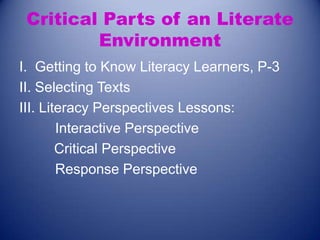
Critical Parts of an Literate
Environment
I. Getting to Know Literacy Learners, P-3
II. Selecting Texts
III. Literacy Perspectives Lessons:
Interactive Perspective
Critical Perspective
Response Perspective
I. Getting to Know Your Literacy Learners
There are many ways to get to know your students.
I use several assessment at the beginning of the
year to see where each of my student’s reading
level, reading interest, and reading motivation is.
As a teacher, all these components are important
to getting to know my student.
Assessments:

Reading inventory (Dibels)
The Reader Self-Perception Scale (RSPS) (Henk & Melnick, 1995, p.470
The Elementary Reading Attitude Survey (McKenna & Kear, 1990, p. 626)
Activities to Assess Cognitive
and Non-cognitive abilities
•

“cognitive which is how the students thinks and learns and these are measured
through standardized testing (Roberts, 2013).

• Cognitive Assessment:
• “Reading inventories provide us with the means to assess and evaluate
many of these differs aspects of students’ reading performance and growth
and can provide information on the students’ phonemic awareness, phonics,
fluency, vocabulary, and comprehension (Afflerbach, 2012, p. 27-28).
• When a reading inventory assessment is given, it enable’s a teacher to
recognize several cognitive aspects of a students’ literacy development
such as their reading fluency and comprehension levels. With this
knowledge, teachers are able to understand and develop a program to assist
their students’ needs.
Non-Cognitive Assessment
•

“Non-cognitive aspects include interpersonal skills, persistence,
communication skills and other "soft" skills that are not objectively measured”
(Roberts, 2013).

• The Elementary Reading Attitude Survey. The article states that
“the student’s attitude toward reading is a central-factor affecting
reading performance” and it was observed that “the emotional
response to reading…is the primary reason most readers read, and
probably the primary reason most nonreaders do not read”
(McKenna & Kear, 1990, p. 626).
• The Reader Self-Perception Scale (RSPS): This is a new tool for
measuring how children feel about themselves as readers. As stated
in this article: “we know that when children feel negatively about
reading, their achievement tends to suffer. These children will either
avoid reading altogether or read with little real involvement (Henk
& Melnick, 1995, p.470).
II. Selecting Text
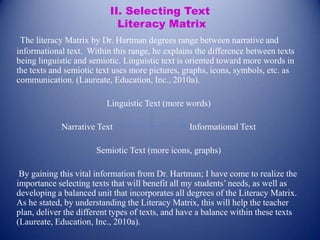
Literacy Matrix
The literacy Matrix by Dr. Hartman degrees range between narrative and
informational text. Within this range, he explains the difference between texts
being linguistic and semiotic. Linguistic text is oriented toward more words in
the texts and semiotic text uses more pictures, graphs, icons, symbols, etc. as
communication. (Laureate, Education, Inc., 2010a).
Linguistic Text (more words)
Narrative Text

Informational Text

Semiotic Text (more icons, graphs)
By gaining this vital information from Dr. Hartman; I have come to realize the
importance selecting texts that will benefit all my students’ needs, as well as
developing a balanced unit that incorporates all degrees of the Literacy Matrix.
As he stated, by understanding the Literacy Matrix, this will help the teacher
plan, deliver the different types of texts, and have a balance within these texts
(Laureate, Education, Inc., 2010a).
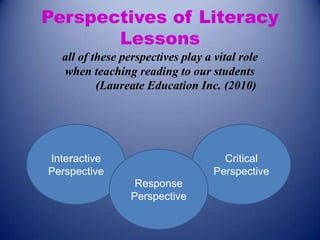
Perspectives of Literacy
Lessons
all of these perspectives play a vital role
when teaching reading to our students
(Laureate Education Inc. (2010)

Interactive
Perspective

Critical
Perspective
Response
Perspective
Three Literacy Perspectives
• The “interactive perspective” that teaches
students to be strategic processors and thinkers,
which often teachers lend toward this perspective
when teaching. Dr. Almasi (2010)
• The “critical perspective” is teaching a student
how to examine text and think critically about the
text when reading. Dr. Almasi (2010)
• The “response perspective” that allows children
the opportunity to experience and respond to text
in a range of ways. Dr. Almasi (2010)
III. Interactive Perspective
“Interactive perspective” teaches students to be strategic
processors and thinkers and promotes students’ independent
use of reading strategies and skills. - (Laureate Education Inc.
2010)
The interactive perspective teaches students how to read. These
strategies may include, letter recognition, teaching phonics
awareness, the different reading strategies and many other
reading skills.
. One strategy is making words “Making words is a teacherdirected spelling activity in which students arrange letter cards to
spell words (Tompkins, 2010, p. 447). I use words from the text
and I also have a book “Making Words” that focuses on different
word families.
IV. Critical and Response
Perspectives
The critical perspective is very important that it allows students
to think deeper when reading a text. It is very important that
students are able to able to judge and view things critically and
distinguish whether the text is valid. “Students also need to
understand and be able to see the difference in how the text is
written and the purpose the author had in writing the text”
(Laureate Education Inc., 2010a).
One method :
Question-Answer-Relationship “teaches students to be aware of
whether they are likely to find the answer to a comprehension
question “right there” on the page, between the lines, or beyond
the information provided in the text so that they’re better able to
answer it (Tompkins, 2010, p. 451).
The response perspective allows the teacher to
experience teaching on a more personal level with
students. When a student is allowed to respond to a
text, it helps them to understand what they have read
and be able to better relate (Laureate Education Inc.,
2010)
Ways for students to response is through…
• Reading logs
• Double Entry Journals
• Partner or Buddy Journals and/or discussions
• Readers Theater (students enjoy acting out and reluctant
readers tend to do better while acting.)

I have found letting students response to text keeps their interest
levels higher and this in turn helps with motivation in reading.
Resources
Laureate Education, Inc. (Producer). (2010a). [Video Webcast]. Perspectives on literacy Learning.
Retrieved from The Beginning Reader, Pre-K
Laureate Education, Inc. (Producer). (2010a). Critical Perspective [Videowebcast]. In The beginning
reader, prek-3.
Laureate Education, Inc. (Producer). (2010b). Response Perspective [Videowebcast]. In The beginning
reader, prek-3
Laureate Education, Inc., (Producer). (2010a). Analyzing and Selecting Text [Video webcast]. Retrieved
from the Beginning Reader, Pre K-3

McKenna, M. C., & Kear, D. J. (1990). Measuring attitude toward reading: A new tool for teachers. The
Reading Teacher, 43(9), 626–639.
Tompkins, G. E. (2010). Literacy for the 21st century: A balanced approach (5th ed.). Boston, MA: Allyn
& Bacon.
The Reader Self-Perception Scale (RSPS): A new tool for measuring how children feel about
themselves as readers: Henk, William A; Melnick, Steven A.The Reading Teacher; Mar 1995; 48, 6;
Research Library Core pg. 470. Retrieved September 13, 2013 http://www.siuvoss.net/Henk___Melnick_1995_RSPS.pdf

Literate environment analysis powerpoint by Wilma Music The Beginner Reader

  • 1.
    Literate Environment Analysis Wilma Music Dr.Gina Pink The Beginning Reader, Pre-K-3 EDUC-6706-2
  • 2.
    Critical Parts ofan Literate Environment I. Getting to Know Literacy Learners, P-3 II. Selecting Texts III. Literacy Perspectives Lessons: Interactive Perspective Critical Perspective Response Perspective
  • 3.
    I. Getting toKnow Your Literacy Learners There are many ways to get to know your students. I use several assessment at the beginning of the year to see where each of my student’s reading level, reading interest, and reading motivation is. As a teacher, all these components are important to getting to know my student. Assessments: Reading inventory (Dibels) The Reader Self-Perception Scale (RSPS) (Henk & Melnick, 1995, p.470 The Elementary Reading Attitude Survey (McKenna & Kear, 1990, p. 626)
  • 4.
    Activities to AssessCognitive and Non-cognitive abilities • “cognitive which is how the students thinks and learns and these are measured through standardized testing (Roberts, 2013). • Cognitive Assessment: • “Reading inventories provide us with the means to assess and evaluate many of these differs aspects of students’ reading performance and growth and can provide information on the students’ phonemic awareness, phonics, fluency, vocabulary, and comprehension (Afflerbach, 2012, p. 27-28). • When a reading inventory assessment is given, it enable’s a teacher to recognize several cognitive aspects of a students’ literacy development such as their reading fluency and comprehension levels. With this knowledge, teachers are able to understand and develop a program to assist their students’ needs.
  • 5.
    Non-Cognitive Assessment • “Non-cognitive aspectsinclude interpersonal skills, persistence, communication skills and other "soft" skills that are not objectively measured” (Roberts, 2013). • The Elementary Reading Attitude Survey. The article states that “the student’s attitude toward reading is a central-factor affecting reading performance” and it was observed that “the emotional response to reading…is the primary reason most readers read, and probably the primary reason most nonreaders do not read” (McKenna & Kear, 1990, p. 626). • The Reader Self-Perception Scale (RSPS): This is a new tool for measuring how children feel about themselves as readers. As stated in this article: “we know that when children feel negatively about reading, their achievement tends to suffer. These children will either avoid reading altogether or read with little real involvement (Henk & Melnick, 1995, p.470).
  • 6.
    II. Selecting Text LiteracyMatrix The literacy Matrix by Dr. Hartman degrees range between narrative and informational text. Within this range, he explains the difference between texts being linguistic and semiotic. Linguistic text is oriented toward more words in the texts and semiotic text uses more pictures, graphs, icons, symbols, etc. as communication. (Laureate, Education, Inc., 2010a). Linguistic Text (more words) Narrative Text Informational Text Semiotic Text (more icons, graphs) By gaining this vital information from Dr. Hartman; I have come to realize the importance selecting texts that will benefit all my students’ needs, as well as developing a balanced unit that incorporates all degrees of the Literacy Matrix. As he stated, by understanding the Literacy Matrix, this will help the teacher plan, deliver the different types of texts, and have a balance within these texts (Laureate, Education, Inc., 2010a).
  • 7.
    Perspectives of Literacy Lessons allof these perspectives play a vital role when teaching reading to our students (Laureate Education Inc. (2010) Interactive Perspective Critical Perspective Response Perspective
  • 8.
    Three Literacy Perspectives •The “interactive perspective” that teaches students to be strategic processors and thinkers, which often teachers lend toward this perspective when teaching. Dr. Almasi (2010) • The “critical perspective” is teaching a student how to examine text and think critically about the text when reading. Dr. Almasi (2010) • The “response perspective” that allows children the opportunity to experience and respond to text in a range of ways. Dr. Almasi (2010)
  • 9.
    III. Interactive Perspective “Interactiveperspective” teaches students to be strategic processors and thinkers and promotes students’ independent use of reading strategies and skills. - (Laureate Education Inc. 2010) The interactive perspective teaches students how to read. These strategies may include, letter recognition, teaching phonics awareness, the different reading strategies and many other reading skills. . One strategy is making words “Making words is a teacherdirected spelling activity in which students arrange letter cards to spell words (Tompkins, 2010, p. 447). I use words from the text and I also have a book “Making Words” that focuses on different word families.
  • 10.
    IV. Critical andResponse Perspectives The critical perspective is very important that it allows students to think deeper when reading a text. It is very important that students are able to able to judge and view things critically and distinguish whether the text is valid. “Students also need to understand and be able to see the difference in how the text is written and the purpose the author had in writing the text” (Laureate Education Inc., 2010a). One method : Question-Answer-Relationship “teaches students to be aware of whether they are likely to find the answer to a comprehension question “right there” on the page, between the lines, or beyond the information provided in the text so that they’re better able to answer it (Tompkins, 2010, p. 451).
  • 11.
    The response perspectiveallows the teacher to experience teaching on a more personal level with students. When a student is allowed to respond to a text, it helps them to understand what they have read and be able to better relate (Laureate Education Inc., 2010) Ways for students to response is through… • Reading logs • Double Entry Journals • Partner or Buddy Journals and/or discussions • Readers Theater (students enjoy acting out and reluctant readers tend to do better while acting.) I have found letting students response to text keeps their interest levels higher and this in turn helps with motivation in reading.
  • 12.
    Resources Laureate Education, Inc.(Producer). (2010a). [Video Webcast]. Perspectives on literacy Learning. Retrieved from The Beginning Reader, Pre-K Laureate Education, Inc. (Producer). (2010a). Critical Perspective [Videowebcast]. In The beginning reader, prek-3. Laureate Education, Inc. (Producer). (2010b). Response Perspective [Videowebcast]. In The beginning reader, prek-3 Laureate Education, Inc., (Producer). (2010a). Analyzing and Selecting Text [Video webcast]. Retrieved from the Beginning Reader, Pre K-3 McKenna, M. C., & Kear, D. J. (1990). Measuring attitude toward reading: A new tool for teachers. The Reading Teacher, 43(9), 626–639. Tompkins, G. E. (2010). Literacy for the 21st century: A balanced approach (5th ed.). Boston, MA: Allyn & Bacon. The Reader Self-Perception Scale (RSPS): A new tool for measuring how children feel about themselves as readers: Henk, William A; Melnick, Steven A.The Reading Teacher; Mar 1995; 48, 6; Research Library Core pg. 470. Retrieved September 13, 2013 http://www.siuvoss.net/Henk___Melnick_1995_RSPS.pdf