Copyright © 2016 Ramez Elmasri and Shamkant B. Navathe
CHAPTER 21
Concurrency Control Techniques
Copyright © 2016 Ramez Elmasri and Shamkant B. Navathe
Introduction
 Concurrency control protocols
 Set of rules to guarantee serializability
 Two-phase locking protocols
 Lock data items to prevent concurrent access
 Timestamp
 Unique identifier for each transaction
 Multiversion currency control protocols
 Use multiple versions of a data item
 Validation or certification of a transaction
Slide 21- 3
Copyright © 2016 Ramez Elmasri and Shamkant B. Navathe
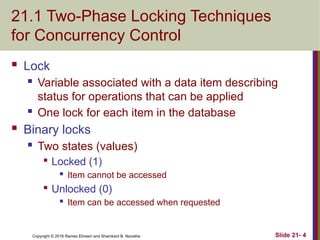
21.1 Two-Phase Locking Techniques
for Concurrency Control
 Lock
 Variable associated with a data item describing
status for operations that can be applied
 One lock for each item in the database
 Binary locks
 Two states (values)

Locked (1)
 Item cannot be accessed

Unlocked (0)
 Item can be accessed when requested
Slide 21- 4
Copyright © 2016 Ramez Elmasri and Shamkant B. Navathe
Two-Phase Locking Techniques
for Concurrency Control (cont’d.)
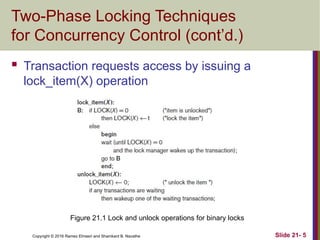
 Transaction requests access by issuing a
lock_item(X) operation
Slide 21- 5
Figure 21.1 Lock and unlock operations for binary locks
Copyright © 2016 Ramez Elmasri and Shamkant B. Navathe
Two-Phase Locking Techniques
for Concurrency Control (cont’d.)
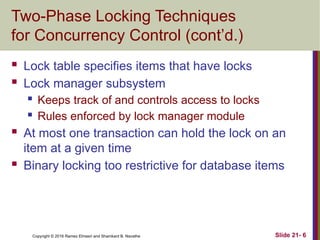
 Lock table specifies items that have locks
 Lock manager subsystem
 Keeps track of and controls access to locks
 Rules enforced by lock manager module
 At most one transaction can hold the lock on an
item at a given time
 Binary locking too restrictive for database items
Slide 21- 6
Copyright © 2016 Ramez Elmasri and Shamkant B. Navathe
Two-Phase Locking Techniques
for Concurrency Control (cont’d.)
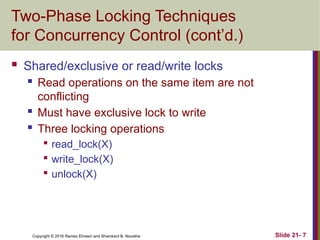
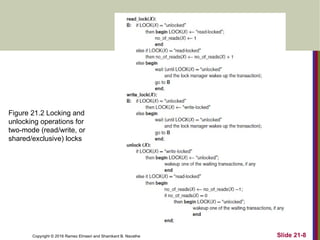
 Shared/exclusive or read/write locks
 Read operations on the same item are not
conflicting
 Must have exclusive lock to write
 Three locking operations

read_lock(X)

write_lock(X)

unlock(X)
Slide 21- 7
Copyright © 2016 Ramez Elmasri and Shamkant B. Navathe Slide 21-8
Figure 21.2 Locking and
unlocking operations for
two-mode (read/write, or
shared/exclusive) locks
Copyright © 2016 Ramez Elmasri and Shamkant B. Navathe
Two-Phase Locking Techniques
for Concurrency Control (cont’d.)
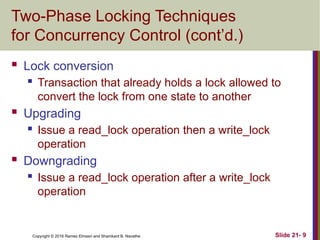
 Lock conversion
 Transaction that already holds a lock allowed to
convert the lock from one state to another
 Upgrading
 Issue a read_lock operation then a write_lock
operation
 Downgrading
 Issue a read_lock operation after a write_lock
operation
Slide 21- 9
Copyright © 2016 Ramez Elmasri and Shamkant B. Navathe
Guaranteeing Serializability by Two-
Phase Locking
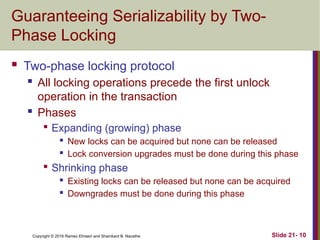
 Two-phase locking protocol
 All locking operations precede the first unlock
operation in the transaction
 Phases

Expanding (growing) phase
 New locks can be acquired but none can be released
 Lock conversion upgrades must be done during this phase

Shrinking phase
 Existing locks can be released but none can be acquired
 Downgrades must be done during this phase
Slide 21- 10
Copyright © 2016 Ramez Elmasri and Shamkant B. Navathe Slide 21- 11
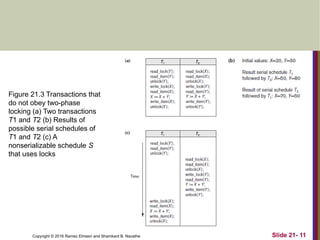
Figure 21.3 Transactions that
do not obey two-phase
locking (a) Two transactions
T1 and T2 (b) Results of
possible serial schedules of
T1 and T2 (c) A
nonserializable schedule S
that uses locks
Copyright © 2016 Ramez Elmasri and Shamkant B. Navathe
Guaranteeing Serializability by Two-
Phase Locking
 If every transaction in a schedule follows the two-
phase locking protocol, schedule guaranteed to
be serializable
 Two-phase locking may limit the amount of
concurrency that can occur in a schedule
 Some serializable schedules will be prohibited by
two-phase locking protocol
Slide 21- 12
Copyright © 2016 Ramez Elmasri and Shamkant B. Navathe
Variations of Two-Phase Locking
 Basic 2PL
 Technique described on previous slides
 Conservative (static) 2PL
 Requires a transaction to lock all the items it
accesses before the transaction begins

Predeclare read-set and write-set
 Deadlock-free protocol
 Strict 2PL
 Transaction does not release exclusive locks until
after it commits or aborts
Slide 21- 13
Copyright © 2016 Ramez Elmasri and Shamkant B. Navathe
Variations of Two-Phase Locking
(cont’d.)
 Rigorous 2PL
 Transaction does not release any locks until after it
commits or aborts
 Concurrency control subsystem responsible for
generating read_lock and write_lock requests
 Locking generally considered to have high
overhead
Slide 21- 14
Copyright © 2016 Ramez Elmasri and Shamkant B. Navathe
Dealing with Deadlock and Starvation
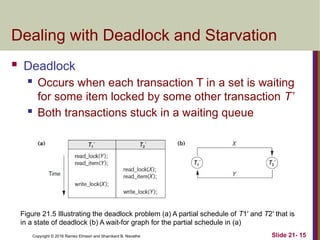
 Deadlock
 Occurs when each transaction T in a set is waiting
for some item locked by some other transaction T’
 Both transactions stuck in a waiting queue
Slide 21- 15
Figure 21.5 Illustrating the deadlock problem (a) A partial schedule of T1′ and T2′ that is
in a state of deadlock (b) A wait-for graph for the partial schedule in (a)
Copyright © 2016 Ramez Elmasri and Shamkant B. Navathe
Dealing with Deadlock and Starvation
(cont’d.)
 Deadlock prevention protocols
 Every transaction locks all items it needs in
advance
 Ordering all items in the database

Transaction that needs several items will lock them
in that order
 Both approaches impractical
 Protocols based on a timestamp
 Wait-die
 Wound-wait
Slide 21- 16
Copyright © 2016 Ramez Elmasri and Shamkant B. Navathe
Dealing with Deadlock and Starvation
(cont’d.)
 No waiting algorithm
 If transaction unable to obtain a lock, immediately
aborted and restarted later
 Cautious waiting algorithm
 Deadlock-free
 Deadlock detection
 System checks to see if a state of deadlock exists
 Wait-for graph
Slide 21- 17
Copyright © 2016 Ramez Elmasri and Shamkant B. Navathe
Dealing with Deadlock and Starvation
(cont’d.)
 Victim selection
 Deciding which transaction to abort in case of
deadlock
 Timeouts
 If system waits longer than a predefined time, it
aborts the transaction
 Starvation
 Occurs if a transaction cannot proceed for an
indefinite period of time while other transactions
continue normally
 Solution: first-come-first-served queue
Slide 21- 18
Copyright © 2016 Ramez Elmasri and Shamkant B. Navathe
21.2 Concurrency Control Based
on Timestamp Ordering
 Timestamp
 Unique identifier assigned by the DBMS to identify
a transaction
 Assigned in the order submitted
 Transaction start time
 Concurrency control techniques based on
timestamps do not use locks
 Deadlocks cannot occur
Slide 21- 19
Copyright © 2016 Ramez Elmasri and Shamkant B. Navathe
Concurrency Control Based
on Timestamp Ordering (cont’d.)
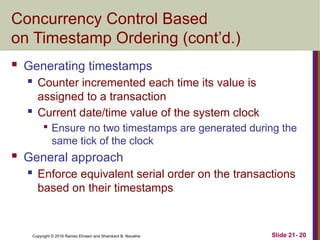
 Generating timestamps
 Counter incremented each time its value is
assigned to a transaction
 Current date/time value of the system clock

Ensure no two timestamps are generated during the
same tick of the clock
 General approach
 Enforce equivalent serial order on the transactions
based on their timestamps
Slide 21- 20
Copyright © 2016 Ramez Elmasri and Shamkant B. Navathe
Concurrency Control Based
on Timestamp Ordering (cont’d.)
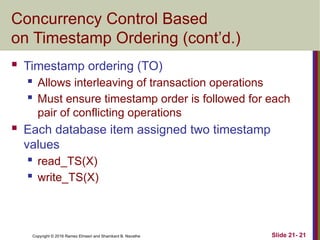
 Timestamp ordering (TO)
 Allows interleaving of transaction operations
 Must ensure timestamp order is followed for each
pair of conflicting operations
 Each database item assigned two timestamp
values
 read_TS(X)
 write_TS(X)
Slide 21- 21
Copyright © 2016 Ramez Elmasri and Shamkant B. Navathe
Concurrency Control Based
on Timestamp Ordering (cont’d.)
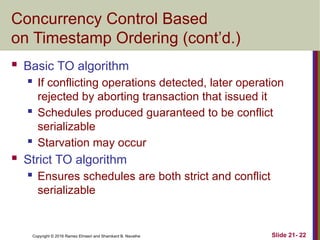
 Basic TO algorithm
 If conflicting operations detected, later operation
rejected by aborting transaction that issued it
 Schedules produced guaranteed to be conflict
serializable
 Starvation may occur
 Strict TO algorithm
 Ensures schedules are both strict and conflict
serializable
Slide 21- 22
Copyright © 2016 Ramez Elmasri and Shamkant B. Navathe
Concurrency Control Based
on Timestamp Ordering (cont’d.)
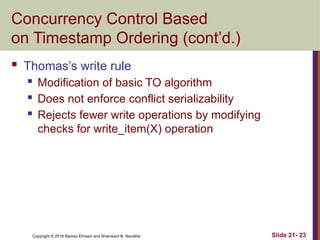
 Thomas’s write rule
 Modification of basic TO algorithm
 Does not enforce conflict serializability
 Rejects fewer write operations by modifying
checks for write_item(X) operation
Slide 21- 23
Copyright © 2016 Ramez Elmasri and Shamkant B. Navathe
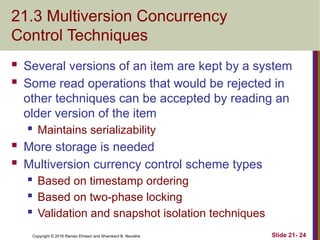
21.3 Multiversion Concurrency
Control Techniques
 Several versions of an item are kept by a system
 Some read operations that would be rejected in
other techniques can be accepted by reading an
older version of the item
 Maintains serializability
 More storage is needed
 Multiversion currency control scheme types
 Based on timestamp ordering
 Based on two-phase locking
 Validation and snapshot isolation techniques
Slide 21- 24
Copyright © 2016 Ramez Elmasri and Shamkant B. Navathe
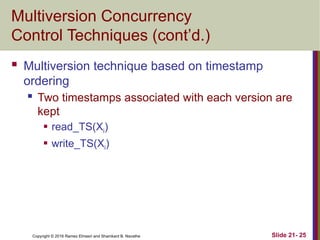
Multiversion Concurrency
Control Techniques (cont’d.)
 Multiversion technique based on timestamp
ordering
 Two timestamps associated with each version are
kept
 read_TS(Xi)
 write_TS(Xi)
Slide 21- 25
Copyright © 2016 Ramez Elmasri and Shamkant B. Navathe
Multiversion Concurrency
Control Techniques (cont’d.)
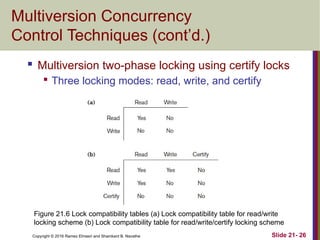
 Multiversion two-phase locking using certify locks

Three locking modes: read, write, and certify
Slide 21- 26
Figure 21.6 Lock compatibility tables (a) Lock compatibility table for read/write
locking scheme (b) Lock compatibility table for read/write/certify locking scheme
Copyright © 2016 Ramez Elmasri and Shamkant B. Navathe
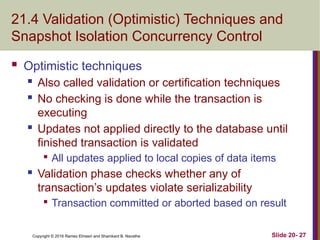
21.4 Validation (Optimistic) Techniques and
Snapshot Isolation Concurrency Control
 Optimistic techniques
 Also called validation or certification techniques
 No checking is done while the transaction is
executing
 Updates not applied directly to the database until
finished transaction is validated

All updates applied to local copies of data items
 Validation phase checks whether any of
transaction’s updates violate serializability

Transaction committed or aborted based on result
Slide 20- 27
Copyright © 2016 Ramez Elmasri and Shamkant B. Navathe
Concurrency Control Based on
Snapshot Isolation
 Transaction sees data items based on committed
values of the items in the database snapshot
 Does not see updates that occur after transaction
starts
 Read operations do not require read locks
 Write operations require write locks
 Temporary version store keeps track of older
versions of updated items
 Variation: serializable snapshot isolation (SSI)
Slide 20- 28
Copyright © 2016 Ramez Elmasri and Shamkant B. Navathe
21.5 Granularity of Data Items and
Multiple Granularity Locking
 Size of data items known as granularity
 Fine (small)
 Coarse (large)
 Larger the data item size, lower the degree of
concurrency permitted
 Example: entire disk block locked
 Smaller the data item size, more locks required
 Higher overhead
 Best item size depends on transaction type
Slide 20- 29
Copyright © 2016 Ramez Elmasri and Shamkant B. Navathe
Multiple Granularity Level Locking
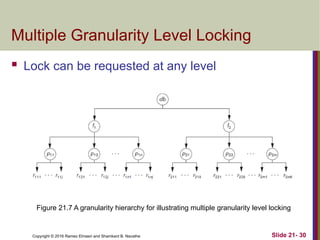
 Lock can be requested at any level
Slide 21- 30
Figure 21.7 A granularity hierarchy for illustrating multiple granularity level locking
Copyright © 2016 Ramez Elmasri and Shamkant B. Navathe
Multiple Granularity Level Locking
(cont’d.)
 Intention locks are needed
 Transaction indicates along the path from the root
to the desired node, what type of lock (shared or
exclusive) it will require from one of the node’s
descendants
 Intention lock types
 Intention-shared (IS)

Shared locks will be requested on a descendant
node
 Intention-exclusive (IX)

Exclusive locks will be requested
Slide 21- 31
Copyright © 2016 Ramez Elmasri and Shamkant B. Navathe
Multiple Granularity Level Locking
(cont’d.)
 Intention lock types (cont’d.)
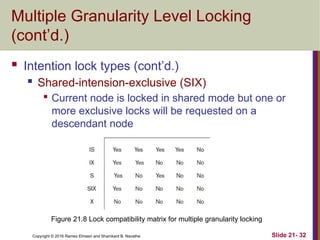
 Shared-intension-exclusive (SIX)

Current node is locked in shared mode but one or
more exclusive locks will be requested on a
descendant node
Slide 21- 32
Figure 21.8 Lock compatibility matrix for multiple granularity locking
Copyright © 2016 Ramez Elmasri and Shamkant B. Navathe
Multiple Granularity Level Locking
(cont’d.)
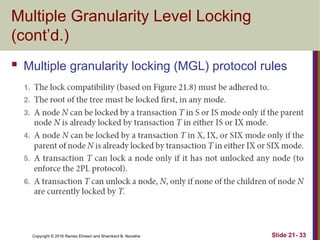
 Multiple granularity locking (MGL) protocol rules
Slide 21- 33
Copyright © 2016 Ramez Elmasri and Shamkant B. Navathe
21.6 Using Locks for Concurrency
Control in Indexes
 Two-phase locking can be applied to B-tree and
B+ -tree indexes
 Nodes of an index correspond to disk pages
 Holding locks on index pages could cause
transaction blocking
 Other approaches must be used
 Conservative approach
 Lock the root node in exclusive mode and then
access the appropriate child node of the root
Slide 21- 34
Copyright © 2016 Ramez Elmasri and Shamkant B. Navathe
Using Locks for Concurrency
Control in Indexes (cont’d.)
 Optimistic approach
 Request and hold shared locks on nodes leading
to the leaf node, with exclusive lock on the leaf
 B-link tree approach
 Sibling nodes on the same level are linked at
every level
 Allows shared locks when requesting a page
 Requires lock be released before accessing the
child node
Slide 21- 35
Copyright © 2016 Ramez Elmasri and Shamkant B. Navathe
21.7 Other Concurrency Control
Issues
 Insertion
 When new data item is inserted, it cannot be
accessed until after operation is completed
 Deletion operation on the existing data item
 Write lock must be obtained before deletion
 Phantom problem
 Can occur when a new record being inserted
satisfies a condition that a set of records accessed
by another transaction must satisfy
 Record causing conflict not recognized by
concurrency control protocol
Slide 21- 36
Copyright © 2016 Ramez Elmasri and Shamkant B. Navathe
Other Concurrency Control Issues
(cont’d.)
 Interactive transactions
 User can input a value of a data item to a
transaction T based on some value written to the
screen by transaction T′, which may not have
committed
 Solution approach: postpone output of
transactions to the screen until committed
 Latches
 Locks held for a short duration
 Do not follow usual concurrency control protocol
Slide 21- 37
Copyright © 2016 Ramez Elmasri and Shamkant B. Navathe
21.8 Summary
 Concurrency control techniques
 Two-phase locking
 Timestamp-based ordering
 Multiversion protocols
 Snapshot isolation
 Data item granularity
 Locking protocols for indexes
 Phantom problem and interactive transaction
issues
Slide 21- 38

Databaseconcurrencycontroltechniquepresentations

  • 1.
    Copyright © 2016Ramez Elmasri and Shamkant B. Navathe
  • 2.
    Copyright © 2016Ramez Elmasri and Shamkant B. Navathe CHAPTER 21 Concurrency Control Techniques
  • 3.
    Copyright © 2016Ramez Elmasri and Shamkant B. Navathe Introduction  Concurrency control protocols  Set of rules to guarantee serializability  Two-phase locking protocols  Lock data items to prevent concurrent access  Timestamp  Unique identifier for each transaction  Multiversion currency control protocols  Use multiple versions of a data item  Validation or certification of a transaction Slide 21- 3
  • 4.
    Copyright © 2016Ramez Elmasri and Shamkant B. Navathe 21.1 Two-Phase Locking Techniques for Concurrency Control  Lock  Variable associated with a data item describing status for operations that can be applied  One lock for each item in the database  Binary locks  Two states (values)  Locked (1)  Item cannot be accessed  Unlocked (0)  Item can be accessed when requested Slide 21- 4
  • 5.
    Copyright © 2016Ramez Elmasri and Shamkant B. Navathe Two-Phase Locking Techniques for Concurrency Control (cont’d.)  Transaction requests access by issuing a lock_item(X) operation Slide 21- 5 Figure 21.1 Lock and unlock operations for binary locks
  • 6.
    Copyright © 2016Ramez Elmasri and Shamkant B. Navathe Two-Phase Locking Techniques for Concurrency Control (cont’d.)  Lock table specifies items that have locks  Lock manager subsystem  Keeps track of and controls access to locks  Rules enforced by lock manager module  At most one transaction can hold the lock on an item at a given time  Binary locking too restrictive for database items Slide 21- 6
  • 7.
    Copyright © 2016Ramez Elmasri and Shamkant B. Navathe Two-Phase Locking Techniques for Concurrency Control (cont’d.)  Shared/exclusive or read/write locks  Read operations on the same item are not conflicting  Must have exclusive lock to write  Three locking operations  read_lock(X)  write_lock(X)  unlock(X) Slide 21- 7
  • 8.
    Copyright © 2016Ramez Elmasri and Shamkant B. Navathe Slide 21-8 Figure 21.2 Locking and unlocking operations for two-mode (read/write, or shared/exclusive) locks
  • 9.
    Copyright © 2016Ramez Elmasri and Shamkant B. Navathe Two-Phase Locking Techniques for Concurrency Control (cont’d.)  Lock conversion  Transaction that already holds a lock allowed to convert the lock from one state to another  Upgrading  Issue a read_lock operation then a write_lock operation  Downgrading  Issue a read_lock operation after a write_lock operation Slide 21- 9
  • 10.
    Copyright © 2016Ramez Elmasri and Shamkant B. Navathe Guaranteeing Serializability by Two- Phase Locking  Two-phase locking protocol  All locking operations precede the first unlock operation in the transaction  Phases  Expanding (growing) phase  New locks can be acquired but none can be released  Lock conversion upgrades must be done during this phase  Shrinking phase  Existing locks can be released but none can be acquired  Downgrades must be done during this phase Slide 21- 10
  • 11.
    Copyright © 2016Ramez Elmasri and Shamkant B. Navathe Slide 21- 11 Figure 21.3 Transactions that do not obey two-phase locking (a) Two transactions T1 and T2 (b) Results of possible serial schedules of T1 and T2 (c) A nonserializable schedule S that uses locks
  • 12.
    Copyright © 2016Ramez Elmasri and Shamkant B. Navathe Guaranteeing Serializability by Two- Phase Locking  If every transaction in a schedule follows the two- phase locking protocol, schedule guaranteed to be serializable  Two-phase locking may limit the amount of concurrency that can occur in a schedule  Some serializable schedules will be prohibited by two-phase locking protocol Slide 21- 12
  • 13.
    Copyright © 2016Ramez Elmasri and Shamkant B. Navathe Variations of Two-Phase Locking  Basic 2PL  Technique described on previous slides  Conservative (static) 2PL  Requires a transaction to lock all the items it accesses before the transaction begins  Predeclare read-set and write-set  Deadlock-free protocol  Strict 2PL  Transaction does not release exclusive locks until after it commits or aborts Slide 21- 13
  • 14.
    Copyright © 2016Ramez Elmasri and Shamkant B. Navathe Variations of Two-Phase Locking (cont’d.)  Rigorous 2PL  Transaction does not release any locks until after it commits or aborts  Concurrency control subsystem responsible for generating read_lock and write_lock requests  Locking generally considered to have high overhead Slide 21- 14
  • 15.
    Copyright © 2016Ramez Elmasri and Shamkant B. Navathe Dealing with Deadlock and Starvation  Deadlock  Occurs when each transaction T in a set is waiting for some item locked by some other transaction T’  Both transactions stuck in a waiting queue Slide 21- 15 Figure 21.5 Illustrating the deadlock problem (a) A partial schedule of T1′ and T2′ that is in a state of deadlock (b) A wait-for graph for the partial schedule in (a)
  • 16.
    Copyright © 2016Ramez Elmasri and Shamkant B. Navathe Dealing with Deadlock and Starvation (cont’d.)  Deadlock prevention protocols  Every transaction locks all items it needs in advance  Ordering all items in the database  Transaction that needs several items will lock them in that order  Both approaches impractical  Protocols based on a timestamp  Wait-die  Wound-wait Slide 21- 16
  • 17.
    Copyright © 2016Ramez Elmasri and Shamkant B. Navathe Dealing with Deadlock and Starvation (cont’d.)  No waiting algorithm  If transaction unable to obtain a lock, immediately aborted and restarted later  Cautious waiting algorithm  Deadlock-free  Deadlock detection  System checks to see if a state of deadlock exists  Wait-for graph Slide 21- 17
  • 18.
    Copyright © 2016Ramez Elmasri and Shamkant B. Navathe Dealing with Deadlock and Starvation (cont’d.)  Victim selection  Deciding which transaction to abort in case of deadlock  Timeouts  If system waits longer than a predefined time, it aborts the transaction  Starvation  Occurs if a transaction cannot proceed for an indefinite period of time while other transactions continue normally  Solution: first-come-first-served queue Slide 21- 18
  • 19.
    Copyright © 2016Ramez Elmasri and Shamkant B. Navathe 21.2 Concurrency Control Based on Timestamp Ordering  Timestamp  Unique identifier assigned by the DBMS to identify a transaction  Assigned in the order submitted  Transaction start time  Concurrency control techniques based on timestamps do not use locks  Deadlocks cannot occur Slide 21- 19
  • 20.
    Copyright © 2016Ramez Elmasri and Shamkant B. Navathe Concurrency Control Based on Timestamp Ordering (cont’d.)  Generating timestamps  Counter incremented each time its value is assigned to a transaction  Current date/time value of the system clock  Ensure no two timestamps are generated during the same tick of the clock  General approach  Enforce equivalent serial order on the transactions based on their timestamps Slide 21- 20
  • 21.
    Copyright © 2016Ramez Elmasri and Shamkant B. Navathe Concurrency Control Based on Timestamp Ordering (cont’d.)  Timestamp ordering (TO)  Allows interleaving of transaction operations  Must ensure timestamp order is followed for each pair of conflicting operations  Each database item assigned two timestamp values  read_TS(X)  write_TS(X) Slide 21- 21
  • 22.
    Copyright © 2016Ramez Elmasri and Shamkant B. Navathe Concurrency Control Based on Timestamp Ordering (cont’d.)  Basic TO algorithm  If conflicting operations detected, later operation rejected by aborting transaction that issued it  Schedules produced guaranteed to be conflict serializable  Starvation may occur  Strict TO algorithm  Ensures schedules are both strict and conflict serializable Slide 21- 22
  • 23.
    Copyright © 2016Ramez Elmasri and Shamkant B. Navathe Concurrency Control Based on Timestamp Ordering (cont’d.)  Thomas’s write rule  Modification of basic TO algorithm  Does not enforce conflict serializability  Rejects fewer write operations by modifying checks for write_item(X) operation Slide 21- 23
  • 24.
    Copyright © 2016Ramez Elmasri and Shamkant B. Navathe 21.3 Multiversion Concurrency Control Techniques  Several versions of an item are kept by a system  Some read operations that would be rejected in other techniques can be accepted by reading an older version of the item  Maintains serializability  More storage is needed  Multiversion currency control scheme types  Based on timestamp ordering  Based on two-phase locking  Validation and snapshot isolation techniques Slide 21- 24
  • 25.
    Copyright © 2016Ramez Elmasri and Shamkant B. Navathe Multiversion Concurrency Control Techniques (cont’d.)  Multiversion technique based on timestamp ordering  Two timestamps associated with each version are kept  read_TS(Xi)  write_TS(Xi) Slide 21- 25
  • 26.
    Copyright © 2016Ramez Elmasri and Shamkant B. Navathe Multiversion Concurrency Control Techniques (cont’d.)  Multiversion two-phase locking using certify locks  Three locking modes: read, write, and certify Slide 21- 26 Figure 21.6 Lock compatibility tables (a) Lock compatibility table for read/write locking scheme (b) Lock compatibility table for read/write/certify locking scheme
  • 27.
    Copyright © 2016Ramez Elmasri and Shamkant B. Navathe 21.4 Validation (Optimistic) Techniques and Snapshot Isolation Concurrency Control  Optimistic techniques  Also called validation or certification techniques  No checking is done while the transaction is executing  Updates not applied directly to the database until finished transaction is validated  All updates applied to local copies of data items  Validation phase checks whether any of transaction’s updates violate serializability  Transaction committed or aborted based on result Slide 20- 27
  • 28.
    Copyright © 2016Ramez Elmasri and Shamkant B. Navathe Concurrency Control Based on Snapshot Isolation  Transaction sees data items based on committed values of the items in the database snapshot  Does not see updates that occur after transaction starts  Read operations do not require read locks  Write operations require write locks  Temporary version store keeps track of older versions of updated items  Variation: serializable snapshot isolation (SSI) Slide 20- 28
  • 29.
    Copyright © 2016Ramez Elmasri and Shamkant B. Navathe 21.5 Granularity of Data Items and Multiple Granularity Locking  Size of data items known as granularity  Fine (small)  Coarse (large)  Larger the data item size, lower the degree of concurrency permitted  Example: entire disk block locked  Smaller the data item size, more locks required  Higher overhead  Best item size depends on transaction type Slide 20- 29
  • 30.
    Copyright © 2016Ramez Elmasri and Shamkant B. Navathe Multiple Granularity Level Locking  Lock can be requested at any level Slide 21- 30 Figure 21.7 A granularity hierarchy for illustrating multiple granularity level locking
  • 31.
    Copyright © 2016Ramez Elmasri and Shamkant B. Navathe Multiple Granularity Level Locking (cont’d.)  Intention locks are needed  Transaction indicates along the path from the root to the desired node, what type of lock (shared or exclusive) it will require from one of the node’s descendants  Intention lock types  Intention-shared (IS)  Shared locks will be requested on a descendant node  Intention-exclusive (IX)  Exclusive locks will be requested Slide 21- 31
  • 32.
    Copyright © 2016Ramez Elmasri and Shamkant B. Navathe Multiple Granularity Level Locking (cont’d.)  Intention lock types (cont’d.)  Shared-intension-exclusive (SIX)  Current node is locked in shared mode but one or more exclusive locks will be requested on a descendant node Slide 21- 32 Figure 21.8 Lock compatibility matrix for multiple granularity locking
  • 33.
    Copyright © 2016Ramez Elmasri and Shamkant B. Navathe Multiple Granularity Level Locking (cont’d.)  Multiple granularity locking (MGL) protocol rules Slide 21- 33
  • 34.
    Copyright © 2016Ramez Elmasri and Shamkant B. Navathe 21.6 Using Locks for Concurrency Control in Indexes  Two-phase locking can be applied to B-tree and B+ -tree indexes  Nodes of an index correspond to disk pages  Holding locks on index pages could cause transaction blocking  Other approaches must be used  Conservative approach  Lock the root node in exclusive mode and then access the appropriate child node of the root Slide 21- 34
  • 35.
    Copyright © 2016Ramez Elmasri and Shamkant B. Navathe Using Locks for Concurrency Control in Indexes (cont’d.)  Optimistic approach  Request and hold shared locks on nodes leading to the leaf node, with exclusive lock on the leaf  B-link tree approach  Sibling nodes on the same level are linked at every level  Allows shared locks when requesting a page  Requires lock be released before accessing the child node Slide 21- 35
  • 36.
    Copyright © 2016Ramez Elmasri and Shamkant B. Navathe 21.7 Other Concurrency Control Issues  Insertion  When new data item is inserted, it cannot be accessed until after operation is completed  Deletion operation on the existing data item  Write lock must be obtained before deletion  Phantom problem  Can occur when a new record being inserted satisfies a condition that a set of records accessed by another transaction must satisfy  Record causing conflict not recognized by concurrency control protocol Slide 21- 36
  • 37.
    Copyright © 2016Ramez Elmasri and Shamkant B. Navathe Other Concurrency Control Issues (cont’d.)  Interactive transactions  User can input a value of a data item to a transaction T based on some value written to the screen by transaction T′, which may not have committed  Solution approach: postpone output of transactions to the screen until committed  Latches  Locks held for a short duration  Do not follow usual concurrency control protocol Slide 21- 37
  • 38.
    Copyright © 2016Ramez Elmasri and Shamkant B. Navathe 21.8 Summary  Concurrency control techniques  Two-phase locking  Timestamp-based ordering  Multiversion protocols  Snapshot isolation  Data item granularity  Locking protocols for indexes  Phantom problem and interactive transaction issues Slide 21- 38