cpe 252: Computer Organization 1
Chapter 7: Microprogrammed Control
cpe 252: Computer Organization 2
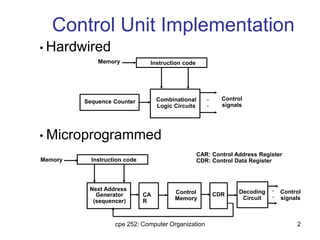
Control Unit Implementation
• Hardwired
• Microprogrammed
Instruction code
Combinational
Logic Circuits
Memory
Sequence Counter
.
.
Control
signals
Control
signals
Next Address
Generator
(sequencer)
CA
R
Control
Memory
CDR Decoding
Circuit
Memory
.
.
CAR: Control Address Register
CDR: Control Data Register
Instruction code
cpe 252: Computer Organization 3
Microprogrammed Control Unit
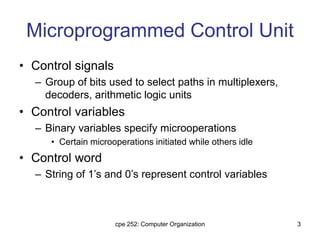
• Control signals
– Group of bits used to select paths in multiplexers,
decoders, arithmetic logic units
• Control variables
– Binary variables specify microoperations
• Certain microoperations initiated while others idle
• Control word
– String of 1’s and 0’s represent control variables
cpe 252: Computer Organization 4
Microprogrammed Control Unit
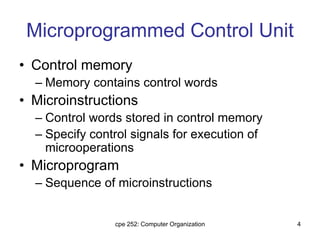
• Control memory
– Memory contains control words
• Microinstructions
– Control words stored in control memory
– Specify control signals for execution of
microoperations
• Microprogram
– Sequence of microinstructions
cpe 252: Computer Organization 5
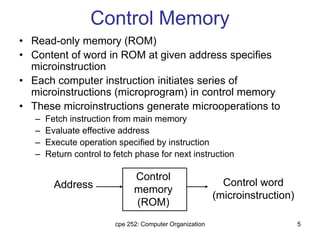
Control Memory
• Read-only memory (ROM)
• Content of word in ROM at given address specifies
microinstruction
• Each computer instruction initiates series of
microinstructions (microprogram) in control memory
• These microinstructions generate microoperations to
– Fetch instruction from main memory
– Evaluate effective address
– Execute operation specified by instruction
– Return control to fetch phase for next instruction
Control
memory
(ROM)
Control word
(microinstruction)
Address
cpe 252: Computer Organization 6
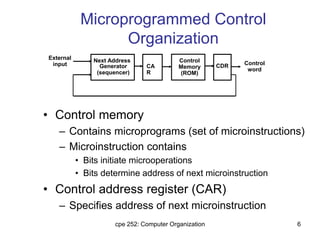
• Control memory
– Contains microprograms (set of microinstructions)
– Microinstruction contains
• Bits initiate microoperations
• Bits determine address of next microinstruction
• Control address register (CAR)
– Specifies address of next microinstruction
Microprogrammed Control
Organization
Control
word
Next Address
Generator
(sequencer)
CA
R
Control
Memory
(ROM)
CDR
External
input
cpe 252: Computer Organization 7
Microprogrammed Control Organization
• Next address generator (microprogram
sequencer)
– Determines address sequence for control memory
• Microprogram sequencer functions
– Increment CAR by one
– Transfer external address into CAR
– Load initial address into CAR to start control
operations
cpe 252: Computer Organization 8
Microprogrammed Control
Organization
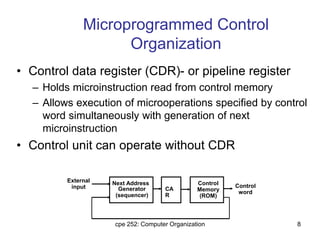
• Control data register (CDR)- or pipeline register
– Holds microinstruction read from control memory
– Allows execution of microoperations specified by control
word simultaneously with generation of next
microinstruction
• Control unit can operate without CDR
Control
word
Next Address
Generator
(sequencer)
CA
R
Control
Memory
(ROM)
External
input
cpe 252: Computer Organization 9
Microprogram Routines
• Routine
– Group of microinstructions stored in control
memory
• Each computer instruction has its own
microprogram routine to generate
microoperations that execute the
instruction
cpe 252: Computer Organization 10
Microprogram Routines
• Subroutine
– Sequence of microinstructions used by other routines
to accomplish particular task
• Example
– Subroutine to generate effective address of operand
for memory reference instruction
• Subroutine register (SBR)
– Stores return address during subroutine call
cpe 252: Computer Organization 11
Conditional Branching
• Branching from one routine to another
depends on status bit conditions
• Status bits provide parameter info such as
– Carry-out of adder
– Sign bit of number
– Mode bits of instruction
• Info in status bits can be tested and actions
initiated based on their conditions: 1 or 0
• Unconditional branch
– Fix value of status bit to 1
cpe 252: Computer Organization 12
Mapping of Instruction
• Each computer instruction has its own
microprogram routine stored in a given
location of the control memory
• Mapping
– Transformation from instruction code bits to
address in control memory where routine is
located
cpe 252: Computer Organization 13
Mapping of Instruction
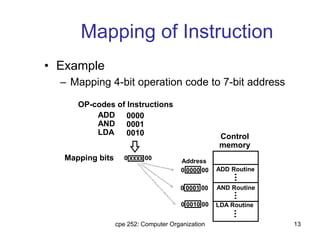
• Example
– Mapping 4-bit operation code to 7-bit address
OP-codes of Instructions
ADD
AND
LDA
0000
0001
0010
Address
0 0000 00
0 0001 00
0 0010 00
Mapping bits 0 xxxx 00
ADD Routine
AND Routine
LDA Routine
Control
memory
cpe 252: Computer Organization 14
Address Sequencing
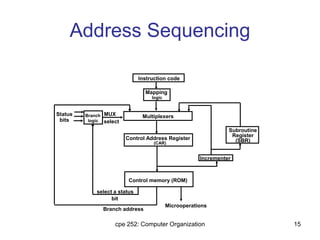
• Address sequencing capabilities required
in control unit
– Incrementing CAR
– Unconditional or conditional branch,
depending on status bit conditions
– Mapping from bits of instruction to address for
control memory
– Facility for subroutine call and return
cpe 252: Computer Organization 15
Address Sequencing
Instruction code
Mapping
logic
Multiplexers
Control memory (ROM)
Subroutine
Register
(SBR)
Branch
logic
Status
bits
Microoperations
Control Address Register
(CAR)
Incrementer
MUX
select
select a status
bit
Branch address
cpe 252: Computer Organization 16
Microprogram Example
Computer
Configuration
MUX
AR
10 0
PC
10 0
Address Memory
2048 x 16
MUX
DR
15 0
Arithmetic
logic and
shift unit
AC
15 0
SBR
6 0
CAR
6 0
Control memory
128 x 20
Control unit
cpe 252: Computer Organization 17
Microprogram Example
Microinstruction Format
EA is the effective address
Symbol OP-code Description
ADD 0000 AC  AC + M[EA]
BRANCH 0001 if (AC < 0) then (PC  EA)
STORE 0010 M[EA]  AC
EXCHANGE 0011 AC  M[EA], M[EA]  AC
Computer instruction format
I Opcode
15 14 11 10
Address
0
Four computer instructions
F1 F2 F3 CD BR AD
3 3 3 2 2 7
F1, F2, F3: Microoperation fields
CD: Condition for branching
BR: Branch field
AD: Address field
cpe 252: Computer Organization 18
Microinstruction Fields
F1 Microoperation Symbol
000 None NOP
001 AC  AC + DR ADD
010 AC  0 CLRAC
011 AC  AC + 1 INCAC
100 AC  DR DRTAC
101 AR  DR(0-10) DRTAR
110 AR  PC PCTAR
111 M[AR]  DR WRITE
F2 Microoperation Symbol
000 None NOP
001 AC  AC - DR SUB
010 AC  AC  DR OR
011 AC  AC  DR AND
100 DR  M[AR] READ
101 DR  AC ACTDR
110 DR  DR + 1 INCDR
111 DR(0-10)  PC PCTDR
F3 Microoperation Symbol
000 None NOP
001 AC  AC  DR XOR
010 AC  AC’ COM
011 AC  shl AC SHL
100 AC  shr AC SHR
101 PC  PC + 1 INCPC
110 PC  AR ARTPC
111 Reserved
cpe 252: Computer Organization 19
Microinstruction Fields
CD Condition Symbol Comments
00 Always = 1 U Unconditional branch
01 DR(15) I Indirect address bit
10 AC(15) S Sign bit of AC
11 AC = 0 Z Zero value in AC
BR Symbol Function
00 JMP CAR  AD if condition = 1
CAR  CAR + 1 if condition = 0
01 CALL CAR  AD, SBR  CAR + 1 if condition = 1
CAR  CAR + 1 if condition = 0
10 RET CAR  SBR (Return from subroutine)
11 MAP CAR(2-5)  DR(11-14), CAR(0,1,6)  0
cpe 252: Computer Organization 20
Symbolic Microinstruction
 Sample Format Label: Micro-ops CD BR AD
 Label may be empty or may specify symbolic address
terminated with colon
 Micro-ops consists of 1, 2, or 3 symbols separated by commas
 CD one of {U, I, S, Z}
U: Unconditional Branch
I: Indirect address bit
S: Sign of AC
Z: Zero value in AC
 BR one of {JMP, CALL, RET, MAP}
 AD one of {Symbolic address, NEXT, empty}
cpe 252: Computer Organization 21
Fetch Routine
 Fetch routine
- Read instruction from memory
- Decode instruction and update PC
AR  PC
DR  M[AR], PC  PC + 1
AR  DR(0-10), CAR(2-5)  DR(11-14), CAR(0,1,6)  0
Symbolic microprogram for fetch routine:
ORG 64
PCTAR U JMP NEXT
READ, INCPC U JMP NEXT
DRTAR U MAP
FETCH:
Binary microporgram for fetch routine:
1000000 110 000 000 00 00 1000001
1000001 000 100 101 00 00 1000010
1000010 101 000 000 00 11 0000000
Binary
address F1 F2 F3 CD BR AD
Microinstructions for fetch routine:
cpe 252: Computer Organization 22
Symbolic Microprogram
• Control memory: 128 20-bit words
• First 64 words: Routines for 16 machine instructions
• Last 64 words: Used for other purpose (e.g., fetch routine and other subroutines)
• Mapping: OP-code XXXX into 0XXXX00, first address for 16 routines are
0(0 0000 00), 4(0 0001 00), 8, 12, 16, 20, ..., 60
ORG 0
NOP
READ
ADD
ORG 4
NOP
NOP
NOP
ARTPC
ORG 8
NOP
ACTDR
WRITE
ORG 12
NOP
READ
ACTDR, DRTAC
WRITE
ORG 64
PCTAR
READ, INCPC
DRTAR
READ
DRTAR
I
U
U
S
U
I
U
I
U
U
I
U
U
U
U
U
U
U
U
CALL
JMP
JMP
JMP
JMP
CALL
JMP
CALL
JMP
JMP
CALL
JMP
JMP
JMP
JMP
JMP
MAP
JMP
RET
INDRCT
NEXT
FETCH
OVER
FETCH
INDRCT
FETCH
INDRCT
NEXT
FETCH
INDRCT
NEXT
NEXT
FETCH
NEXT
NEXT
NEXT
ADD:
BRANCH:
OVER:
STORE:
EXCHANGE:
FETCH:
INDRCT:
Label Microops CD BR AD
Partial Symbolic Microprogram
cpe 252: Computer Organization 23
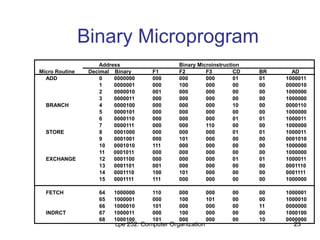
Binary Microprogram
Address Binary Microinstruction
Micro Routine Decimal Binary F1 F2 F3 CD BR AD
ADD 0 0000000 000 000 000 01 01 1000011
1 0000001 000 100 000 00 00 0000010
2 0000010 001 000 000 00 00 1000000
3 0000011 000 000 000 00 00 1000000
BRANCH 4 0000100 000 000 000 10 00 0000110
5 0000101 000 000 000 00 00 1000000
6 0000110 000 000 000 01 01 1000011
7 0000111 000 000 110 00 00 1000000
STORE 8 0001000 000 000 000 01 01 1000011
9 0001001 000 101 000 00 00 0001010
10 0001010 111 000 000 00 00 1000000
11 0001011 000 000 000 00 00 1000000
EXCHANGE 12 0001100 000 000 000 01 01 1000011
13 0001101 001 000 000 00 00 0001110
14 0001110 100 101 000 00 00 0001111
15 0001111 111 000 000 00 00 1000000
FETCH 64 1000000 110 000 000 00 00 1000001
65 1000001 000 100 101 00 00 1000010
66 1000010 101 000 000 00 11 0000000
INDRCT 67 1000011 000 100 000 00 00 1000100
68 1000100 101 000 000 00 10 0000000
cpe 252: Computer Organization 24
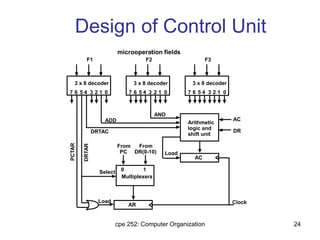
Design of Control Unit
microoperation fields
3 x 8 decoder
7 6 5 4 3 2 1 0
F1
3 x 8 decoder
7 6 5 4 3 2 1 0
F2
3 x 8 decoder
7 6 5 4 3 2 1 0
F3
Arithmetic
logic and
shift unit
AND
ADD
DRTAC
AC
Load
From
PC
From
DR(0-10)
Select 0 1
Multiplexers
AR
Load Clock
AC
DR
DRTAR
PCTAR
cpe 252: Computer Organization 25
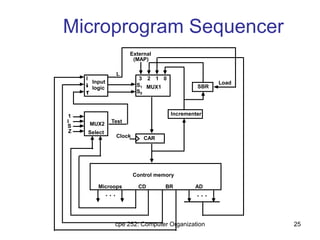
Microprogram Sequencer
3 2 1 0
S1 MUX1
External
(MAP)
SBR
Load
Incrementer
CAR
Input
logic
I
0
T
MUX2
Select
1
I
S
Z
Test
Clock
Control memory
Microops CD BR AD
L
I
1 S0
. . .
. . .
cpe 252: Computer Organization 26
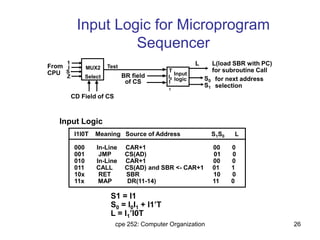
Input Logic for Microprogram
Sequencer
Input
logic
I0
I
1
T
MUX2
Select
1
I
S
Z
Test
CD Field of CS
From
CPU BR field
of CS
L(load SBR with PC)
for subroutine Call
S0
S1
for next address
selection
I1I0T Meaning Source of Address S1S0 L
000 In-Line CAR+1 00 0
001 JMP CS(AD) 01 0
010 In-Line CAR+1 00 0
011 CALL CS(AD) and SBR <- CAR+1 01 1
10x RET SBR 10 0
11x MAP DR(11-14) 11 0
L
S1 = I1
S0 = I0I1 + I1’T
L = I1’I0T
Input Logic

Chapter7.pptx

  • 1.
    cpe 252: ComputerOrganization 1 Chapter 7: Microprogrammed Control
  • 2.
    cpe 252: ComputerOrganization 2 Control Unit Implementation • Hardwired • Microprogrammed Instruction code Combinational Logic Circuits Memory Sequence Counter . . Control signals Control signals Next Address Generator (sequencer) CA R Control Memory CDR Decoding Circuit Memory . . CAR: Control Address Register CDR: Control Data Register Instruction code
  • 3.
    cpe 252: ComputerOrganization 3 Microprogrammed Control Unit • Control signals – Group of bits used to select paths in multiplexers, decoders, arithmetic logic units • Control variables – Binary variables specify microoperations • Certain microoperations initiated while others idle • Control word – String of 1’s and 0’s represent control variables
  • 4.
    cpe 252: ComputerOrganization 4 Microprogrammed Control Unit • Control memory – Memory contains control words • Microinstructions – Control words stored in control memory – Specify control signals for execution of microoperations • Microprogram – Sequence of microinstructions
  • 5.
    cpe 252: ComputerOrganization 5 Control Memory • Read-only memory (ROM) • Content of word in ROM at given address specifies microinstruction • Each computer instruction initiates series of microinstructions (microprogram) in control memory • These microinstructions generate microoperations to – Fetch instruction from main memory – Evaluate effective address – Execute operation specified by instruction – Return control to fetch phase for next instruction Control memory (ROM) Control word (microinstruction) Address
  • 6.
    cpe 252: ComputerOrganization 6 • Control memory – Contains microprograms (set of microinstructions) – Microinstruction contains • Bits initiate microoperations • Bits determine address of next microinstruction • Control address register (CAR) – Specifies address of next microinstruction Microprogrammed Control Organization Control word Next Address Generator (sequencer) CA R Control Memory (ROM) CDR External input
  • 7.
    cpe 252: ComputerOrganization 7 Microprogrammed Control Organization • Next address generator (microprogram sequencer) – Determines address sequence for control memory • Microprogram sequencer functions – Increment CAR by one – Transfer external address into CAR – Load initial address into CAR to start control operations
  • 8.
    cpe 252: ComputerOrganization 8 Microprogrammed Control Organization • Control data register (CDR)- or pipeline register – Holds microinstruction read from control memory – Allows execution of microoperations specified by control word simultaneously with generation of next microinstruction • Control unit can operate without CDR Control word Next Address Generator (sequencer) CA R Control Memory (ROM) External input
  • 9.
    cpe 252: ComputerOrganization 9 Microprogram Routines • Routine – Group of microinstructions stored in control memory • Each computer instruction has its own microprogram routine to generate microoperations that execute the instruction
  • 10.
    cpe 252: ComputerOrganization 10 Microprogram Routines • Subroutine – Sequence of microinstructions used by other routines to accomplish particular task • Example – Subroutine to generate effective address of operand for memory reference instruction • Subroutine register (SBR) – Stores return address during subroutine call
  • 11.
    cpe 252: ComputerOrganization 11 Conditional Branching • Branching from one routine to another depends on status bit conditions • Status bits provide parameter info such as – Carry-out of adder – Sign bit of number – Mode bits of instruction • Info in status bits can be tested and actions initiated based on their conditions: 1 or 0 • Unconditional branch – Fix value of status bit to 1
  • 12.
    cpe 252: ComputerOrganization 12 Mapping of Instruction • Each computer instruction has its own microprogram routine stored in a given location of the control memory • Mapping – Transformation from instruction code bits to address in control memory where routine is located
  • 13.
    cpe 252: ComputerOrganization 13 Mapping of Instruction • Example – Mapping 4-bit operation code to 7-bit address OP-codes of Instructions ADD AND LDA 0000 0001 0010 Address 0 0000 00 0 0001 00 0 0010 00 Mapping bits 0 xxxx 00 ADD Routine AND Routine LDA Routine Control memory
  • 14.
    cpe 252: ComputerOrganization 14 Address Sequencing • Address sequencing capabilities required in control unit – Incrementing CAR – Unconditional or conditional branch, depending on status bit conditions – Mapping from bits of instruction to address for control memory – Facility for subroutine call and return
  • 15.
    cpe 252: ComputerOrganization 15 Address Sequencing Instruction code Mapping logic Multiplexers Control memory (ROM) Subroutine Register (SBR) Branch logic Status bits Microoperations Control Address Register (CAR) Incrementer MUX select select a status bit Branch address
  • 16.
    cpe 252: ComputerOrganization 16 Microprogram Example Computer Configuration MUX AR 10 0 PC 10 0 Address Memory 2048 x 16 MUX DR 15 0 Arithmetic logic and shift unit AC 15 0 SBR 6 0 CAR 6 0 Control memory 128 x 20 Control unit
  • 17.
    cpe 252: ComputerOrganization 17 Microprogram Example Microinstruction Format EA is the effective address Symbol OP-code Description ADD 0000 AC  AC + M[EA] BRANCH 0001 if (AC < 0) then (PC  EA) STORE 0010 M[EA]  AC EXCHANGE 0011 AC  M[EA], M[EA]  AC Computer instruction format I Opcode 15 14 11 10 Address 0 Four computer instructions F1 F2 F3 CD BR AD 3 3 3 2 2 7 F1, F2, F3: Microoperation fields CD: Condition for branching BR: Branch field AD: Address field
  • 18.
    cpe 252: ComputerOrganization 18 Microinstruction Fields F1 Microoperation Symbol 000 None NOP 001 AC  AC + DR ADD 010 AC  0 CLRAC 011 AC  AC + 1 INCAC 100 AC  DR DRTAC 101 AR  DR(0-10) DRTAR 110 AR  PC PCTAR 111 M[AR]  DR WRITE F2 Microoperation Symbol 000 None NOP 001 AC  AC - DR SUB 010 AC  AC  DR OR 011 AC  AC  DR AND 100 DR  M[AR] READ 101 DR  AC ACTDR 110 DR  DR + 1 INCDR 111 DR(0-10)  PC PCTDR F3 Microoperation Symbol 000 None NOP 001 AC  AC  DR XOR 010 AC  AC’ COM 011 AC  shl AC SHL 100 AC  shr AC SHR 101 PC  PC + 1 INCPC 110 PC  AR ARTPC 111 Reserved
  • 19.
    cpe 252: ComputerOrganization 19 Microinstruction Fields CD Condition Symbol Comments 00 Always = 1 U Unconditional branch 01 DR(15) I Indirect address bit 10 AC(15) S Sign bit of AC 11 AC = 0 Z Zero value in AC BR Symbol Function 00 JMP CAR  AD if condition = 1 CAR  CAR + 1 if condition = 0 01 CALL CAR  AD, SBR  CAR + 1 if condition = 1 CAR  CAR + 1 if condition = 0 10 RET CAR  SBR (Return from subroutine) 11 MAP CAR(2-5)  DR(11-14), CAR(0,1,6)  0
  • 20.
    cpe 252: ComputerOrganization 20 Symbolic Microinstruction  Sample Format Label: Micro-ops CD BR AD  Label may be empty or may specify symbolic address terminated with colon  Micro-ops consists of 1, 2, or 3 symbols separated by commas  CD one of {U, I, S, Z} U: Unconditional Branch I: Indirect address bit S: Sign of AC Z: Zero value in AC  BR one of {JMP, CALL, RET, MAP}  AD one of {Symbolic address, NEXT, empty}
  • 21.
    cpe 252: ComputerOrganization 21 Fetch Routine  Fetch routine - Read instruction from memory - Decode instruction and update PC AR  PC DR  M[AR], PC  PC + 1 AR  DR(0-10), CAR(2-5)  DR(11-14), CAR(0,1,6)  0 Symbolic microprogram for fetch routine: ORG 64 PCTAR U JMP NEXT READ, INCPC U JMP NEXT DRTAR U MAP FETCH: Binary microporgram for fetch routine: 1000000 110 000 000 00 00 1000001 1000001 000 100 101 00 00 1000010 1000010 101 000 000 00 11 0000000 Binary address F1 F2 F3 CD BR AD Microinstructions for fetch routine:
  • 22.
    cpe 252: ComputerOrganization 22 Symbolic Microprogram • Control memory: 128 20-bit words • First 64 words: Routines for 16 machine instructions • Last 64 words: Used for other purpose (e.g., fetch routine and other subroutines) • Mapping: OP-code XXXX into 0XXXX00, first address for 16 routines are 0(0 0000 00), 4(0 0001 00), 8, 12, 16, 20, ..., 60 ORG 0 NOP READ ADD ORG 4 NOP NOP NOP ARTPC ORG 8 NOP ACTDR WRITE ORG 12 NOP READ ACTDR, DRTAC WRITE ORG 64 PCTAR READ, INCPC DRTAR READ DRTAR I U U S U I U I U U I U U U U U U U U CALL JMP JMP JMP JMP CALL JMP CALL JMP JMP CALL JMP JMP JMP JMP JMP MAP JMP RET INDRCT NEXT FETCH OVER FETCH INDRCT FETCH INDRCT NEXT FETCH INDRCT NEXT NEXT FETCH NEXT NEXT NEXT ADD: BRANCH: OVER: STORE: EXCHANGE: FETCH: INDRCT: Label Microops CD BR AD Partial Symbolic Microprogram
  • 23.
    cpe 252: ComputerOrganization 23 Binary Microprogram Address Binary Microinstruction Micro Routine Decimal Binary F1 F2 F3 CD BR AD ADD 0 0000000 000 000 000 01 01 1000011 1 0000001 000 100 000 00 00 0000010 2 0000010 001 000 000 00 00 1000000 3 0000011 000 000 000 00 00 1000000 BRANCH 4 0000100 000 000 000 10 00 0000110 5 0000101 000 000 000 00 00 1000000 6 0000110 000 000 000 01 01 1000011 7 0000111 000 000 110 00 00 1000000 STORE 8 0001000 000 000 000 01 01 1000011 9 0001001 000 101 000 00 00 0001010 10 0001010 111 000 000 00 00 1000000 11 0001011 000 000 000 00 00 1000000 EXCHANGE 12 0001100 000 000 000 01 01 1000011 13 0001101 001 000 000 00 00 0001110 14 0001110 100 101 000 00 00 0001111 15 0001111 111 000 000 00 00 1000000 FETCH 64 1000000 110 000 000 00 00 1000001 65 1000001 000 100 101 00 00 1000010 66 1000010 101 000 000 00 11 0000000 INDRCT 67 1000011 000 100 000 00 00 1000100 68 1000100 101 000 000 00 10 0000000
  • 24.
    cpe 252: ComputerOrganization 24 Design of Control Unit microoperation fields 3 x 8 decoder 7 6 5 4 3 2 1 0 F1 3 x 8 decoder 7 6 5 4 3 2 1 0 F2 3 x 8 decoder 7 6 5 4 3 2 1 0 F3 Arithmetic logic and shift unit AND ADD DRTAC AC Load From PC From DR(0-10) Select 0 1 Multiplexers AR Load Clock AC DR DRTAR PCTAR
  • 25.
    cpe 252: ComputerOrganization 25 Microprogram Sequencer 3 2 1 0 S1 MUX1 External (MAP) SBR Load Incrementer CAR Input logic I 0 T MUX2 Select 1 I S Z Test Clock Control memory Microops CD BR AD L I 1 S0 . . . . . .
  • 26.
    cpe 252: ComputerOrganization 26 Input Logic for Microprogram Sequencer Input logic I0 I 1 T MUX2 Select 1 I S Z Test CD Field of CS From CPU BR field of CS L(load SBR with PC) for subroutine Call S0 S1 for next address selection I1I0T Meaning Source of Address S1S0 L 000 In-Line CAR+1 00 0 001 JMP CS(AD) 01 0 010 In-Line CAR+1 00 0 011 CALL CS(AD) and SBR <- CAR+1 01 1 10x RET SBR 10 0 11x MAP DR(11-14) 11 0 L S1 = I1 S0 = I0I1 + I1’T L = I1’I0T Input Logic