cpe 252: Computer Organization 1
Ashok Rachapalli
Chapter 3: Central Processing Unit
cpe 252: Computer Organization 2
CENTRAL PROCESSING UNIT
• Introduction
• General Register Organization
•Instruction Formats
• Addressing Modes
cpe 252: Computer Organization 3
MAJOR COMPONENTS OF CPU
Storage Components:
Registers
Flip-flops
Execution (Processing) Components:
Arithmetic Logic Unit (ALU):
Arithmetic calculations, Logical computations, Shifts/Rotates
Transfer Components:
Bus
Control Components:
Control Unit
Register
File ALU
Control Unit
cpe 252: Computer Organization 4
GENERAL REGISTER ORGANIZATION
MUX
SELA{ MUX }SELB
ALU
OPR
R1
R2
R3
R4
R5
R6
R7
Input
3 x 8
decoder
SELD
Load
(7 lines)
Output
A bus B bus
Clock
OPERATION OF CONTROL UNIT
The control unit directs the information flow through ALU by:
- Selecting various Components in the system
- Selecting the Function of ALU
Example: R1 <- R2 + R3
[1] MUX A selector (SELA): BUS A  R2
[2] MUX B selector (SELB): BUS B  R3
[3] ALU operation selector (OPR): ALU to ADD
[4] Decoder destination selector (SELD): R1  Out Bus
Control Word
Encoding of register selection fields
Binary
Code SELA SELB SELD
000 Input Input None
001 R1 R1 R1
010 R2 R2 R2
011 R3 R3 R3
100 R4 R4 R4
101 R5 R5 R5
110 R6 R6 R6
111 R7 R7 R7
SELA SELB SELD OPR
3 3 3 5
6
ALU CONTROL
Encoding of ALU operations OPR
Select Operation Symbol
00000 Transfer A TSFA
00001 Increment A INCA
00010 ADD A + B ADD
00101 Subtract A - B SUB
00110 Decrement A DECA
01000 AND A and B AND
01010 OR A and B OR
01100 XOR A and B XOR
01110 Complement A COMA
10000 Shift right A SHRA
11000 Shift left A SHLA
Examples of ALU Microoperations
Symbolic Designation
Microoperation SELA SELB SELD OPR Control Word
Control
R1  R2 - R3 R2 R3 R1 SUB 010 011 001 00101
R4  R4  R5 R4 R5 R4 OR 100 101 100 01010
R6  R6 + 1 R6 - R6 INCA 110 000 110 00001
R7  R1 R1 - R7 TSFA 001 000 111 00000
Output  R2 R2 - None TSFA 010 000 000 00000
Output  Input Input - None TSFA 000 000 000 00000
R4  shl R4 R4 - R4 SHLA 100 000 100 11000
R5  0 R5 R5 R5 XOR 101 101 101 01100
cpe 252: Computer Organization 7
INSTRUCTION FORMAT
OP-code field - specifies the operation to be performed
Address field - designates memory address(s) or a processor register(s)
Mode field - specifies the way the operand or the
effective address is determined
The number of address fields in the instruction format
depends on the internal organization of CPU
- The three most common CPU organizations:
Instruction Format
Single accumulator organization:
ADD X /* AC  AC + M[X] */
General register organization:
ADD R1, R2, R3 /* R1  R2 + R3 */
ADD R1, R2 /* R1  R1 + R2 */
MOV R1, R2 /* R1  R2 */
ADD R1, X /* R1  R1 + M[X] */
Stack organization:
PUSH X /* TOS  M[X] */
ADD
Instruction Fields
cpe 252: Computer Organization 8
Three-Address Instructions:
Program to evaluate X = (A + B) * (C + D) :
ADD R1, A, B /* R1  M[A] + M[B] */
ADD R2, C, D /* R2  M[C] + M[D] */
MUL X, R1, R2 /* M[X]  R1 * R2 */
- Results in short programs
- Instruction becomes long (many bits)
Two-Address Instructions:
Program to evaluate X = (A + B) * (C + D) :
MOV R1, A /* R1  M[A] */
ADD R1, B /* R1  R1 + M[B] */
MOV R2, C /* R2  M[C] */
ADD R2, D /* R2  R2 + M[D] */
MUL R1, R2 /* R1  R1 * R2 */
MOV X, R1 /* M[X]  R1 */
THREE, and TWO-ADDRESS INSTRUCTIONS
cpe 252: Computer Organization 9
ONE, and ZERO-ADDRESS INSTRUCTIONS
One-Address Instructions:
- Use an implied AC register for all data manipulation
- Program to evaluate X = (A + B) * (C + D) :
LOAD A /* AC  M[A] */
ADD B /* AC  AC + M[B] */
STORE T /* M[T]  AC */
LOAD C /* AC  M[C] */
ADD D /* AC  AC + M[D] */
MUL T /* AC  AC * M[T] */
STORE X /* M[X]  AC */
Zero-Address Instructions:
- Can be found in a stack-organized computer
- Program to evaluate X = (A + B) * (C + D) :
PUSH A /* TOS  A */
PUSH B /* TOS  B */
ADD /* TOS  (A + B) */
PUSH C /* TOS  C */
PUSH D /* TOS  D */
ADD /* TOS  (C + D) */
MUL /* TOS  (C + D) * (A + B) */
POP X /* M[X]  TOS */
cpe 252: Computer Organization 10
ADDRESSING MODES
Addressing Modes:
* Specifies a rule for interpreting or modifying the
address field of the instruction (before the operand
is actually referenced)
* Variety of addressing modes
- to give programming flexibility to the user
- to use the bits in the address field of the
instruction efficiently
cpe 252: Computer Organization 11
TYPES OF ADDRESSING MODES
Implied Mode
Address of the operands are specified implicitly
in the definition of the instruction
- No need to specify address in the instruction
- EA = AC, or EA = Stack[SP], EA: Effective Address.
Immediate Mode
Instead of specifying the address of the operand,
operand itself is specified
- No need to specify address in the instruction
- However, operand itself needs to be specified
- Sometimes, require more bits than the address
- Fast to acquire an operand
Register Mode
Address specified in the instruction is the register address
- Designated operand need to be in a register
- Shorter address than the memory address
- Saving address field in the instruction
- Faster to acquire an operand than the memory addressing
- EA = IR(R) (IR(R): Register field of IR)
cpe 252: Computer Organization 12
TYPES OF ADDRESSING MODES
Register Indirect Mode
Instruction specifies a register which contains
the memory address of the operand
- Saving instruction bits since register address
is shorter than the memory address
- Slower to acquire an operand than both the
register addressing or memory addressing
- EA = [IR(R)] ([x]: Content of x)
Auto-increment or Auto-decrement features:
Same as the Register Indirect, but:
- When the address in the register is used to access memory, the
value in the register is incremented or decremented by 1 (after or
before the execution of the instruction)
cpe 252: Computer Organization 13
TYPES OF ADDRESSING MODES
Direct Address Mode
Instruction specifies the memory address which
can be used directly to the physical memory
- Faster than the other memory addressing modes
- Too many bits are needed to specify the address
for a large physical memory space
- EA = IR(address), (IR(address): address field of IR)
Indirect Addressing Mode
The address field of an instruction specifies the address of a memory
location that contains the address of the operand
- When the abbreviated address is used, large physical memory can
be addressed with a relatively small number of bits
- Slow to acquire an operand because of an additional memory
access
- EA = M[IR(address)]
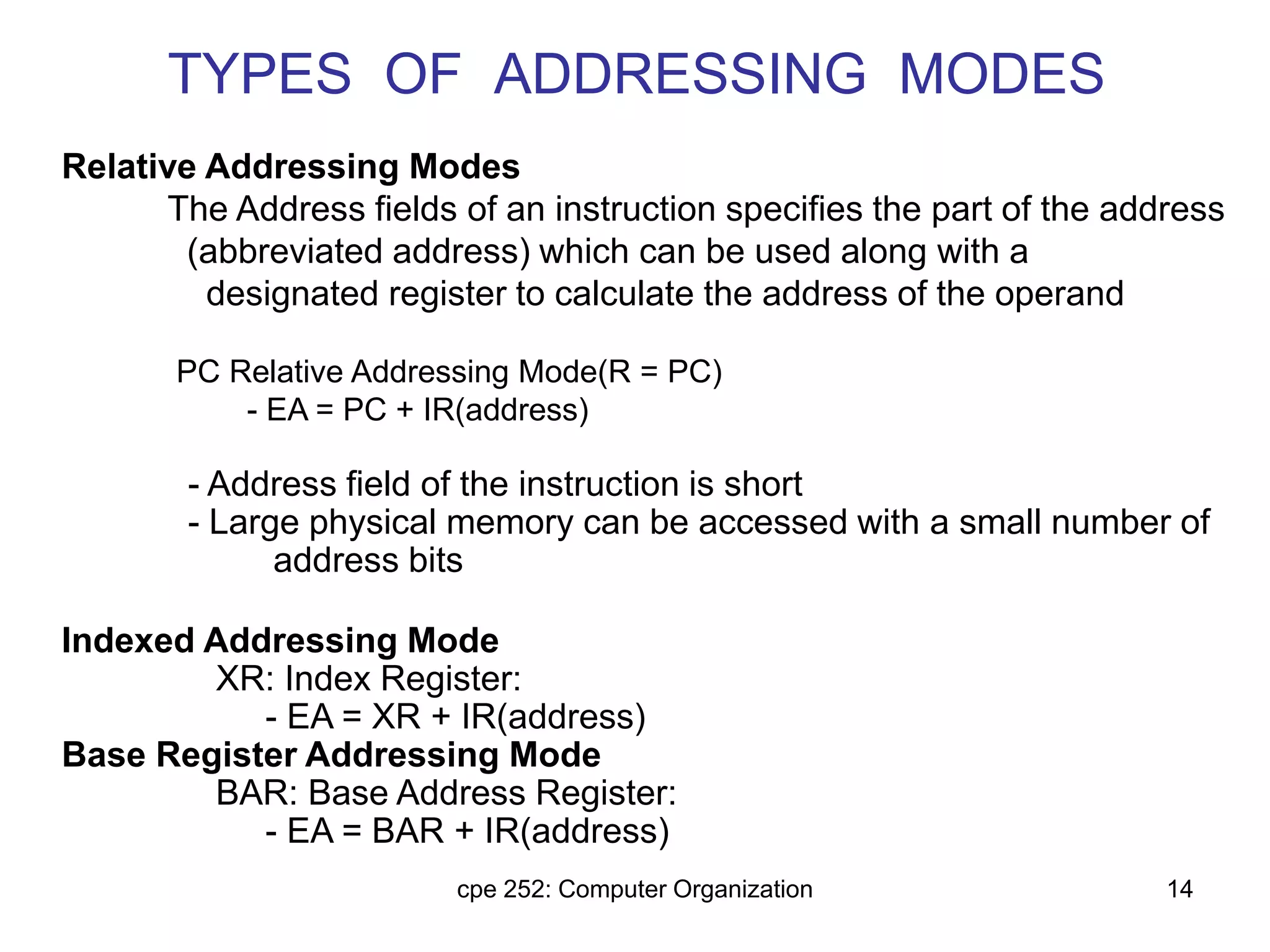
cpe 252: Computer Organization 14
TYPES OF ADDRESSING MODES
Relative Addressing Modes
The Address fields of an instruction specifies the part of the address
(abbreviated address) which can be used along with a
designated register to calculate the address of the operand
PC Relative Addressing Mode(R = PC)
- EA = PC + IR(address)
- Address field of the instruction is short
- Large physical memory can be accessed with a small number of
address bits
Indexed Addressing Mode
XR: Index Register:
- EA = XR + IR(address)
Base Register Addressing Mode
BAR: Base Address Register:
- EA = BAR + IR(address)
cpe 252: Computer Organization 15
ADDRESSING MODES - EXAMPLES
Addressing
Mode
Effective
Address
Content
of AC
Direct address 500 /* AC  (500) */ 800
Immediate operand - /* AC  500 */ 500
Indirect address 800 /* AC  ((500)) */ 300
Relative address 702 /* AC  (PC+500) */ 325
Indexed address 600 /* AC  (XR+500) */ 900
Register - /* AC  R1 */ 400
Register indirect 400 /* AC  (R1) */ 700
Autoincrement 400 /* AC  (R1)+ */ 700
Autodecrement 399 /* AC  -(R) */ 450
Load to AC Mode
Address = 500
Next instruction
200
201
202
399
400
450
700
500 800
600 900
702 325
800 300
Memory
Address
PC = 200
R1 = 400
XR = 100
AC
cpe 252: Computer Organization 16
RISC: REDUCED INSTRUCTION SET
COMPUTERS
Historical Background
IBM System/360, 1964
- The real beginning of modern computer architecture
- Distinction between Architecture and Implementation
- Architecture: The abstract structure of a computer
seen by an assembly-language programmer
High-Level
Language
Instruction
Set
Hardware
Compiler -program
Architecture Implementation
Continuing growth in semiconductor memory and microprogramming
-> A much richer and complicated instruction sets
=> CISC(Complex Instruction Set Computer)
- Arguments advanced at that time
Richer instruction sets would simplify compilers
Richer instruction sets would alleviate the software crisis
- move as much functions to the hardware as possible
- close Semantic Gap between machine language
and the high-level language
Richer instruction sets would improve the architecture quality
cpe 252: Computer Organization 17
COMPLEX INSTRUCTION SET COMPUTERS:
CISC
High Performance General Purpose Instructions
Characteristics of CISC:
1. A large number of instructions (from 100-250 usually)
2. Some instructions that performs a certain tasks are not used frequently.
3. Many addressing modes are used (5 to 20)
4. Variable length instruction format.
5. Instructions that manipulate operands in memory.
cpe 252: Computer Organization 18
PHYLOSOPHY OF RISC
Reduce the semantic gap between
machine instruction and microinstruction
1-Cycle instruction
Most of the instructions complete their execution
in 1 CPU clock cycle - like a microoperation
* Functions of the instruction (contrast to CISC)
- Very simple functions
- Very simple instruction format
- Similar to microinstructions
=> No need for microprogrammed control
* Register-Register Instructions
- Avoid memory reference instructions except
Load and Store instructions
- Most of the operands can be found in the
registers instead of main memory
=> Shorter instructions
=> Uniform instruction cycle
=> Requirement of large number of registers
* Employ instruction pipeline
cpe 252: Computer Organization 19
CHARACTERISTICS OF RISC
Common RISC Characteristics
- Operations are register-to-register, with only LOAD and
STORE accessing memory
- The operations and addressing modes are reduced
Instruction formats are simple
cpe 252: Computer Organization 20
CHARACTERISTICS OF RISC
RISC Characteristics
- Relatively few instructions
- Relatively few addressing modes
- Memory access limited to load and store instructions
- All operations done within the registers of the CPU
- Fixed-length, easily decoded instruction format
- Single-cycle instruction format
- Hardwired rather than microprogrammed control
-A relatively large numbers of registers in the processor unit.
-Efficient instruction pipeline
-Compiler support: provides efficient translation of high-level language
programs into machine language programs.
More RISC Characteristics
Advantages of RISC
- VLSI Realization
- Computing Speed
- Design Costs and Reliability
- High Level Language Support

Chapter3.ppt

  • 1.
    cpe 252: ComputerOrganization 1 Ashok Rachapalli Chapter 3: Central Processing Unit
  • 2.
    cpe 252: ComputerOrganization 2 CENTRAL PROCESSING UNIT • Introduction • General Register Organization •Instruction Formats • Addressing Modes
  • 3.
    cpe 252: ComputerOrganization 3 MAJOR COMPONENTS OF CPU Storage Components: Registers Flip-flops Execution (Processing) Components: Arithmetic Logic Unit (ALU): Arithmetic calculations, Logical computations, Shifts/Rotates Transfer Components: Bus Control Components: Control Unit Register File ALU Control Unit
  • 4.
    cpe 252: ComputerOrganization 4 GENERAL REGISTER ORGANIZATION MUX SELA{ MUX }SELB ALU OPR R1 R2 R3 R4 R5 R6 R7 Input 3 x 8 decoder SELD Load (7 lines) Output A bus B bus Clock
  • 5.
    OPERATION OF CONTROLUNIT The control unit directs the information flow through ALU by: - Selecting various Components in the system - Selecting the Function of ALU Example: R1 <- R2 + R3 [1] MUX A selector (SELA): BUS A  R2 [2] MUX B selector (SELB): BUS B  R3 [3] ALU operation selector (OPR): ALU to ADD [4] Decoder destination selector (SELD): R1  Out Bus Control Word Encoding of register selection fields Binary Code SELA SELB SELD 000 Input Input None 001 R1 R1 R1 010 R2 R2 R2 011 R3 R3 R3 100 R4 R4 R4 101 R5 R5 R5 110 R6 R6 R6 111 R7 R7 R7 SELA SELB SELD OPR 3 3 3 5
  • 6.
    6 ALU CONTROL Encoding ofALU operations OPR Select Operation Symbol 00000 Transfer A TSFA 00001 Increment A INCA 00010 ADD A + B ADD 00101 Subtract A - B SUB 00110 Decrement A DECA 01000 AND A and B AND 01010 OR A and B OR 01100 XOR A and B XOR 01110 Complement A COMA 10000 Shift right A SHRA 11000 Shift left A SHLA Examples of ALU Microoperations Symbolic Designation Microoperation SELA SELB SELD OPR Control Word Control R1  R2 - R3 R2 R3 R1 SUB 010 011 001 00101 R4  R4  R5 R4 R5 R4 OR 100 101 100 01010 R6  R6 + 1 R6 - R6 INCA 110 000 110 00001 R7  R1 R1 - R7 TSFA 001 000 111 00000 Output  R2 R2 - None TSFA 010 000 000 00000 Output  Input Input - None TSFA 000 000 000 00000 R4  shl R4 R4 - R4 SHLA 100 000 100 11000 R5  0 R5 R5 R5 XOR 101 101 101 01100
  • 7.
    cpe 252: ComputerOrganization 7 INSTRUCTION FORMAT OP-code field - specifies the operation to be performed Address field - designates memory address(s) or a processor register(s) Mode field - specifies the way the operand or the effective address is determined The number of address fields in the instruction format depends on the internal organization of CPU - The three most common CPU organizations: Instruction Format Single accumulator organization: ADD X /* AC  AC + M[X] */ General register organization: ADD R1, R2, R3 /* R1  R2 + R3 */ ADD R1, R2 /* R1  R1 + R2 */ MOV R1, R2 /* R1  R2 */ ADD R1, X /* R1  R1 + M[X] */ Stack organization: PUSH X /* TOS  M[X] */ ADD Instruction Fields
  • 8.
    cpe 252: ComputerOrganization 8 Three-Address Instructions: Program to evaluate X = (A + B) * (C + D) : ADD R1, A, B /* R1  M[A] + M[B] */ ADD R2, C, D /* R2  M[C] + M[D] */ MUL X, R1, R2 /* M[X]  R1 * R2 */ - Results in short programs - Instruction becomes long (many bits) Two-Address Instructions: Program to evaluate X = (A + B) * (C + D) : MOV R1, A /* R1  M[A] */ ADD R1, B /* R1  R1 + M[B] */ MOV R2, C /* R2  M[C] */ ADD R2, D /* R2  R2 + M[D] */ MUL R1, R2 /* R1  R1 * R2 */ MOV X, R1 /* M[X]  R1 */ THREE, and TWO-ADDRESS INSTRUCTIONS
  • 9.
    cpe 252: ComputerOrganization 9 ONE, and ZERO-ADDRESS INSTRUCTIONS One-Address Instructions: - Use an implied AC register for all data manipulation - Program to evaluate X = (A + B) * (C + D) : LOAD A /* AC  M[A] */ ADD B /* AC  AC + M[B] */ STORE T /* M[T]  AC */ LOAD C /* AC  M[C] */ ADD D /* AC  AC + M[D] */ MUL T /* AC  AC * M[T] */ STORE X /* M[X]  AC */ Zero-Address Instructions: - Can be found in a stack-organized computer - Program to evaluate X = (A + B) * (C + D) : PUSH A /* TOS  A */ PUSH B /* TOS  B */ ADD /* TOS  (A + B) */ PUSH C /* TOS  C */ PUSH D /* TOS  D */ ADD /* TOS  (C + D) */ MUL /* TOS  (C + D) * (A + B) */ POP X /* M[X]  TOS */
  • 10.
    cpe 252: ComputerOrganization 10 ADDRESSING MODES Addressing Modes: * Specifies a rule for interpreting or modifying the address field of the instruction (before the operand is actually referenced) * Variety of addressing modes - to give programming flexibility to the user - to use the bits in the address field of the instruction efficiently
  • 11.
    cpe 252: ComputerOrganization 11 TYPES OF ADDRESSING MODES Implied Mode Address of the operands are specified implicitly in the definition of the instruction - No need to specify address in the instruction - EA = AC, or EA = Stack[SP], EA: Effective Address. Immediate Mode Instead of specifying the address of the operand, operand itself is specified - No need to specify address in the instruction - However, operand itself needs to be specified - Sometimes, require more bits than the address - Fast to acquire an operand Register Mode Address specified in the instruction is the register address - Designated operand need to be in a register - Shorter address than the memory address - Saving address field in the instruction - Faster to acquire an operand than the memory addressing - EA = IR(R) (IR(R): Register field of IR)
  • 12.
    cpe 252: ComputerOrganization 12 TYPES OF ADDRESSING MODES Register Indirect Mode Instruction specifies a register which contains the memory address of the operand - Saving instruction bits since register address is shorter than the memory address - Slower to acquire an operand than both the register addressing or memory addressing - EA = [IR(R)] ([x]: Content of x) Auto-increment or Auto-decrement features: Same as the Register Indirect, but: - When the address in the register is used to access memory, the value in the register is incremented or decremented by 1 (after or before the execution of the instruction)
  • 13.
    cpe 252: ComputerOrganization 13 TYPES OF ADDRESSING MODES Direct Address Mode Instruction specifies the memory address which can be used directly to the physical memory - Faster than the other memory addressing modes - Too many bits are needed to specify the address for a large physical memory space - EA = IR(address), (IR(address): address field of IR) Indirect Addressing Mode The address field of an instruction specifies the address of a memory location that contains the address of the operand - When the abbreviated address is used, large physical memory can be addressed with a relatively small number of bits - Slow to acquire an operand because of an additional memory access - EA = M[IR(address)]
  • 14.
    cpe 252: ComputerOrganization 14 TYPES OF ADDRESSING MODES Relative Addressing Modes The Address fields of an instruction specifies the part of the address (abbreviated address) which can be used along with a designated register to calculate the address of the operand PC Relative Addressing Mode(R = PC) - EA = PC + IR(address) - Address field of the instruction is short - Large physical memory can be accessed with a small number of address bits Indexed Addressing Mode XR: Index Register: - EA = XR + IR(address) Base Register Addressing Mode BAR: Base Address Register: - EA = BAR + IR(address)
  • 15.
    cpe 252: ComputerOrganization 15 ADDRESSING MODES - EXAMPLES Addressing Mode Effective Address Content of AC Direct address 500 /* AC  (500) */ 800 Immediate operand - /* AC  500 */ 500 Indirect address 800 /* AC  ((500)) */ 300 Relative address 702 /* AC  (PC+500) */ 325 Indexed address 600 /* AC  (XR+500) */ 900 Register - /* AC  R1 */ 400 Register indirect 400 /* AC  (R1) */ 700 Autoincrement 400 /* AC  (R1)+ */ 700 Autodecrement 399 /* AC  -(R) */ 450 Load to AC Mode Address = 500 Next instruction 200 201 202 399 400 450 700 500 800 600 900 702 325 800 300 Memory Address PC = 200 R1 = 400 XR = 100 AC
  • 16.
    cpe 252: ComputerOrganization 16 RISC: REDUCED INSTRUCTION SET COMPUTERS Historical Background IBM System/360, 1964 - The real beginning of modern computer architecture - Distinction between Architecture and Implementation - Architecture: The abstract structure of a computer seen by an assembly-language programmer High-Level Language Instruction Set Hardware Compiler -program Architecture Implementation Continuing growth in semiconductor memory and microprogramming -> A much richer and complicated instruction sets => CISC(Complex Instruction Set Computer) - Arguments advanced at that time Richer instruction sets would simplify compilers Richer instruction sets would alleviate the software crisis - move as much functions to the hardware as possible - close Semantic Gap between machine language and the high-level language Richer instruction sets would improve the architecture quality
  • 17.
    cpe 252: ComputerOrganization 17 COMPLEX INSTRUCTION SET COMPUTERS: CISC High Performance General Purpose Instructions Characteristics of CISC: 1. A large number of instructions (from 100-250 usually) 2. Some instructions that performs a certain tasks are not used frequently. 3. Many addressing modes are used (5 to 20) 4. Variable length instruction format. 5. Instructions that manipulate operands in memory.
  • 18.
    cpe 252: ComputerOrganization 18 PHYLOSOPHY OF RISC Reduce the semantic gap between machine instruction and microinstruction 1-Cycle instruction Most of the instructions complete their execution in 1 CPU clock cycle - like a microoperation * Functions of the instruction (contrast to CISC) - Very simple functions - Very simple instruction format - Similar to microinstructions => No need for microprogrammed control * Register-Register Instructions - Avoid memory reference instructions except Load and Store instructions - Most of the operands can be found in the registers instead of main memory => Shorter instructions => Uniform instruction cycle => Requirement of large number of registers * Employ instruction pipeline
  • 19.
    cpe 252: ComputerOrganization 19 CHARACTERISTICS OF RISC Common RISC Characteristics - Operations are register-to-register, with only LOAD and STORE accessing memory - The operations and addressing modes are reduced Instruction formats are simple
  • 20.
    cpe 252: ComputerOrganization 20 CHARACTERISTICS OF RISC RISC Characteristics - Relatively few instructions - Relatively few addressing modes - Memory access limited to load and store instructions - All operations done within the registers of the CPU - Fixed-length, easily decoded instruction format - Single-cycle instruction format - Hardwired rather than microprogrammed control -A relatively large numbers of registers in the processor unit. -Efficient instruction pipeline -Compiler support: provides efficient translation of high-level language programs into machine language programs. More RISC Characteristics Advantages of RISC - VLSI Realization - Computing Speed - Design Costs and Reliability - High Level Language Support