Laxmi Institute of Technology, Sarigam
Academic Year - 2023-2024
COMPUTER SCIENCE AND ENGINEERING DEPARTMENT
CLASS: B.E, 2nd Year, Semester - 4th
Faculty Name: Ms. Sanchi Upadhyay
CSE Department
LIT, Sarigam
Subject: Computer Organization & Architecture
Subject Code: 3140707
Semester: IV
Subject: Computer Organization & Architecture
Subject Code: 3140707
Semester: IV
Teaching and Examination Scheme:
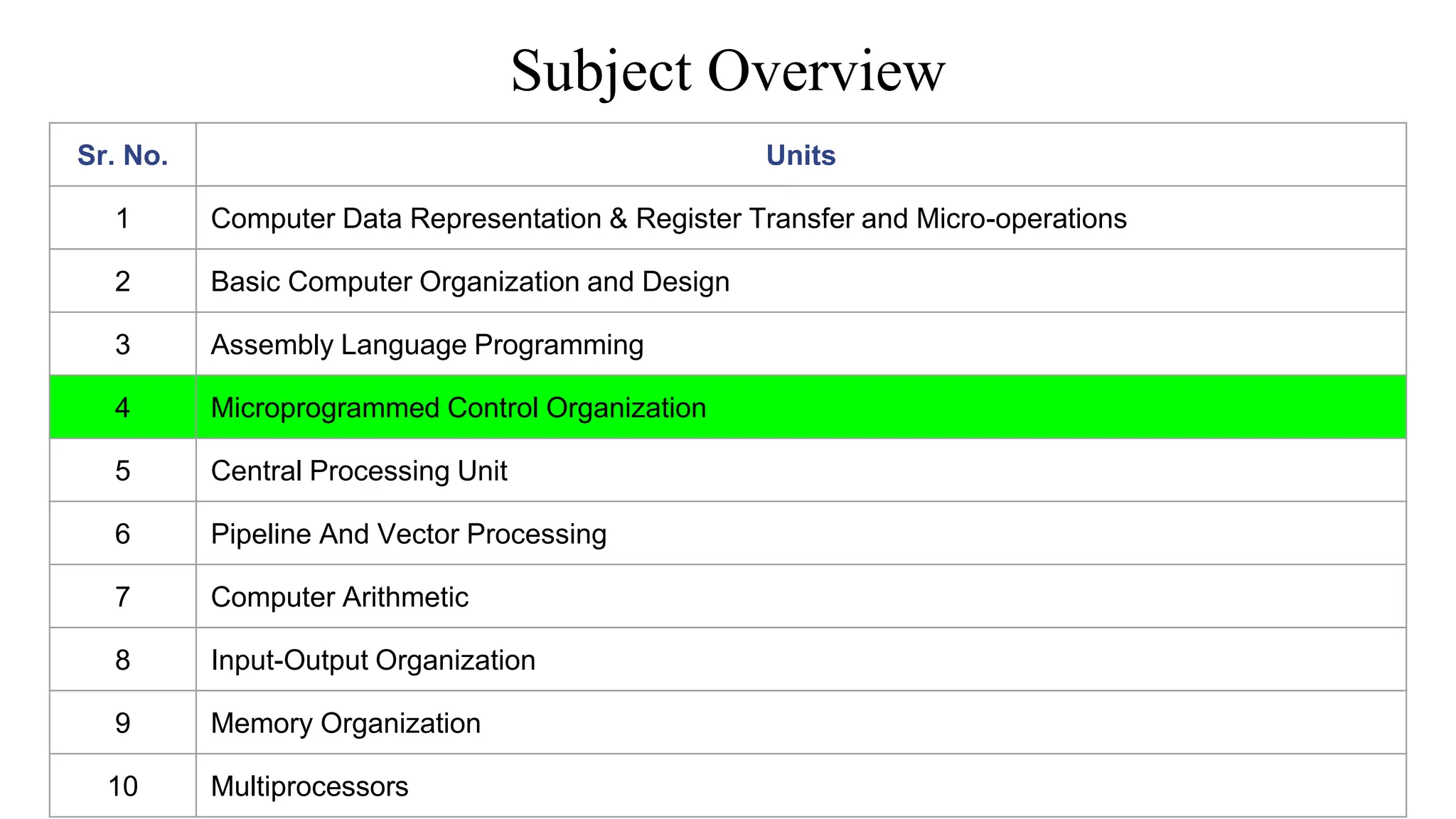
Subject Overview
Sr. No. Units
1 Computer Data Representation & Register Transfer and Micro-operations
2 Basic Computer Organization and Design
3 Assembly Language Programming
4 Microprogrammed Control Organization
5 Central Processing Unit
6 Pipeline And Vector Processing
7 Computer Arithmetic
8 Input-Output Organization
9 Memory Organization
10 Multiprocessors
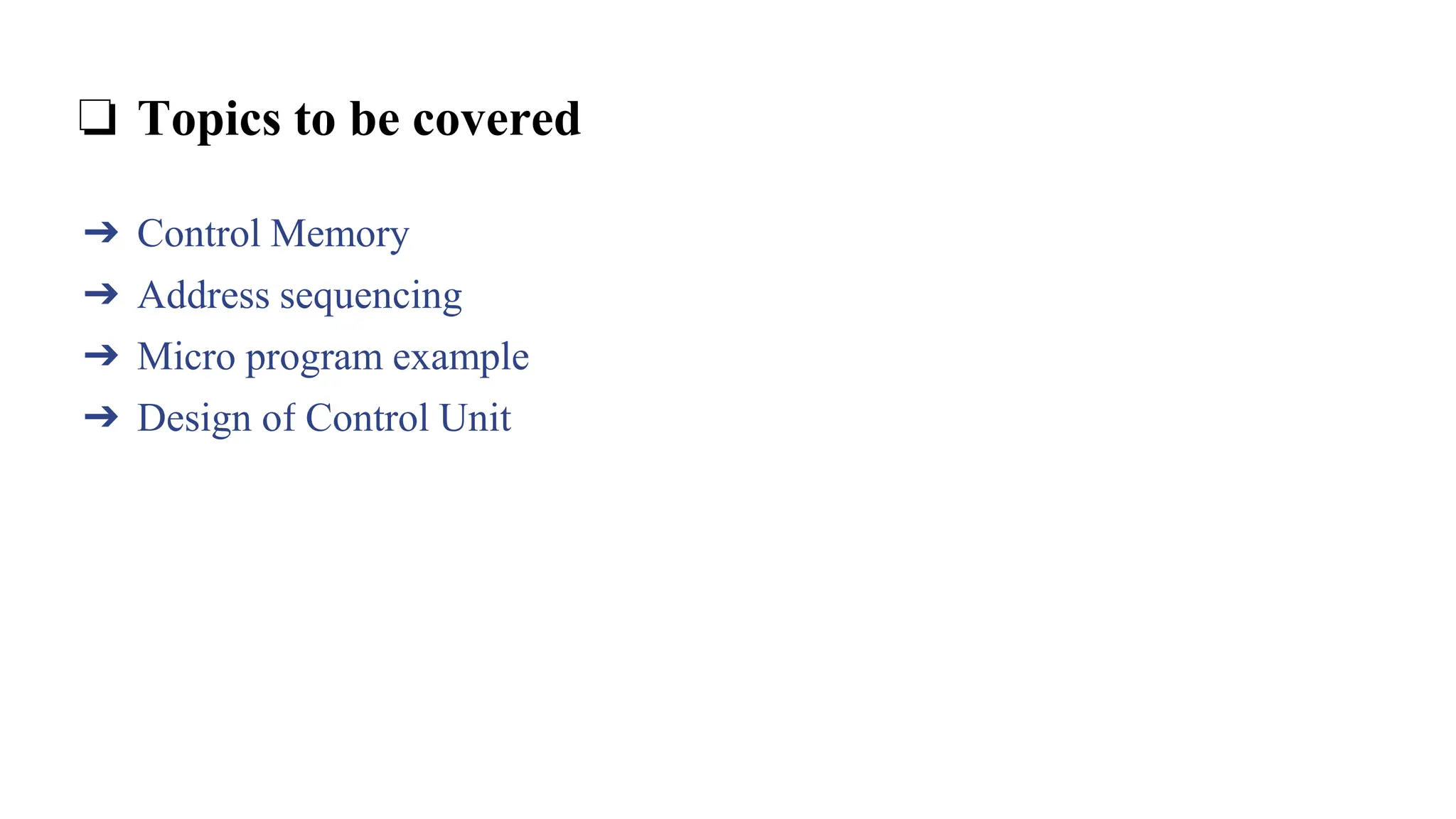
❏ Topics to be covered
➔ Control Memory
➔ Address sequencing
➔ Micro program example
➔ Design of Control Unit
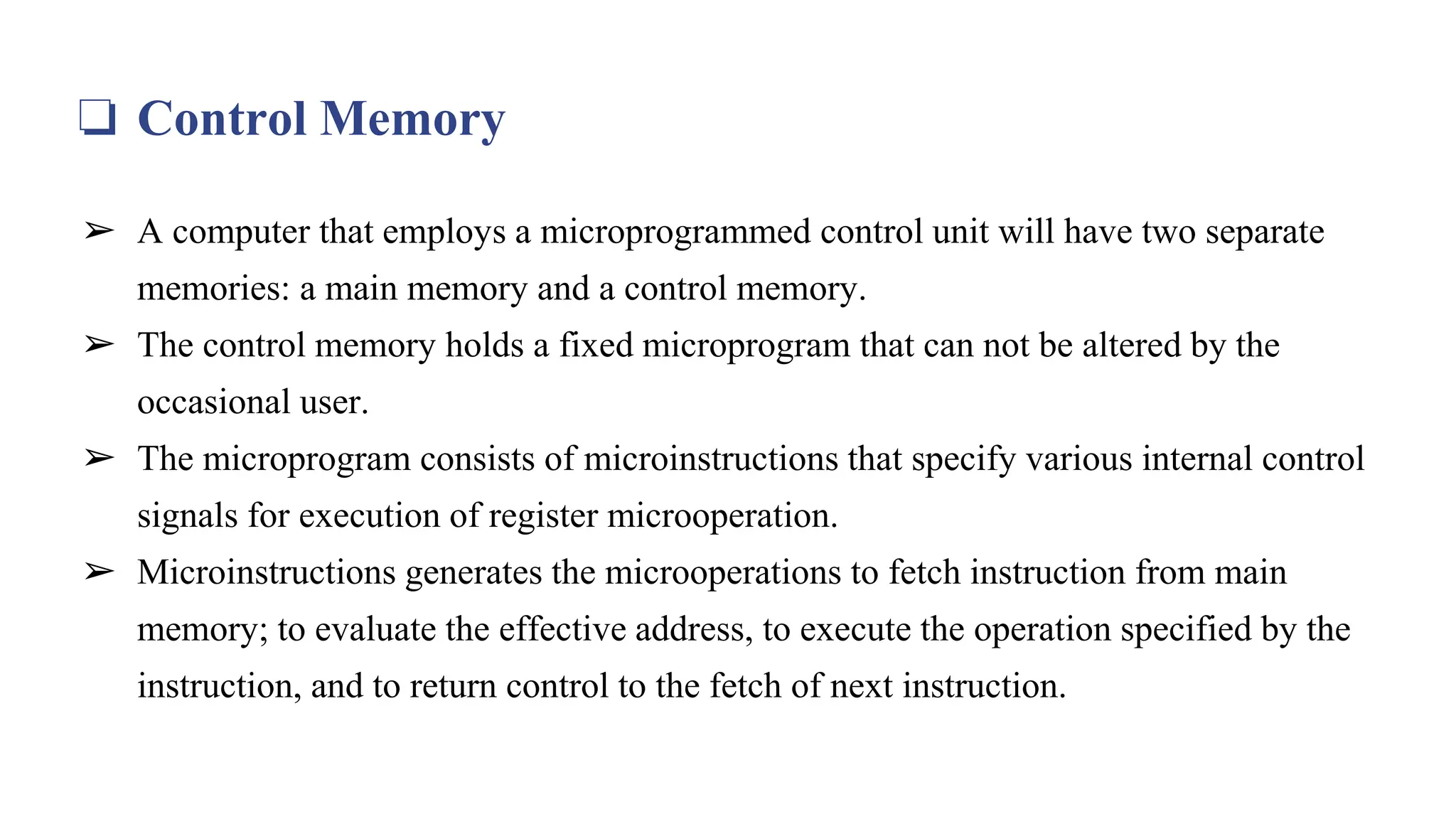
❏ Control Memory
❏ Control Memory
➢ A computer that employs a microprogrammed control unit will have two separate
memories: a main memory and a control memory.
➢ The control memory holds a fixed microprogram that can not be altered by the
occasional user.
➢ The microprogram consists of microinstructions that specify various internal control
signals for execution of register microoperation.
➢ Microinstructions generates the microoperations to fetch instruction from main
memory; to evaluate the effective address, to execute the operation specified by the
instruction, and to return control to the fetch of next instruction.
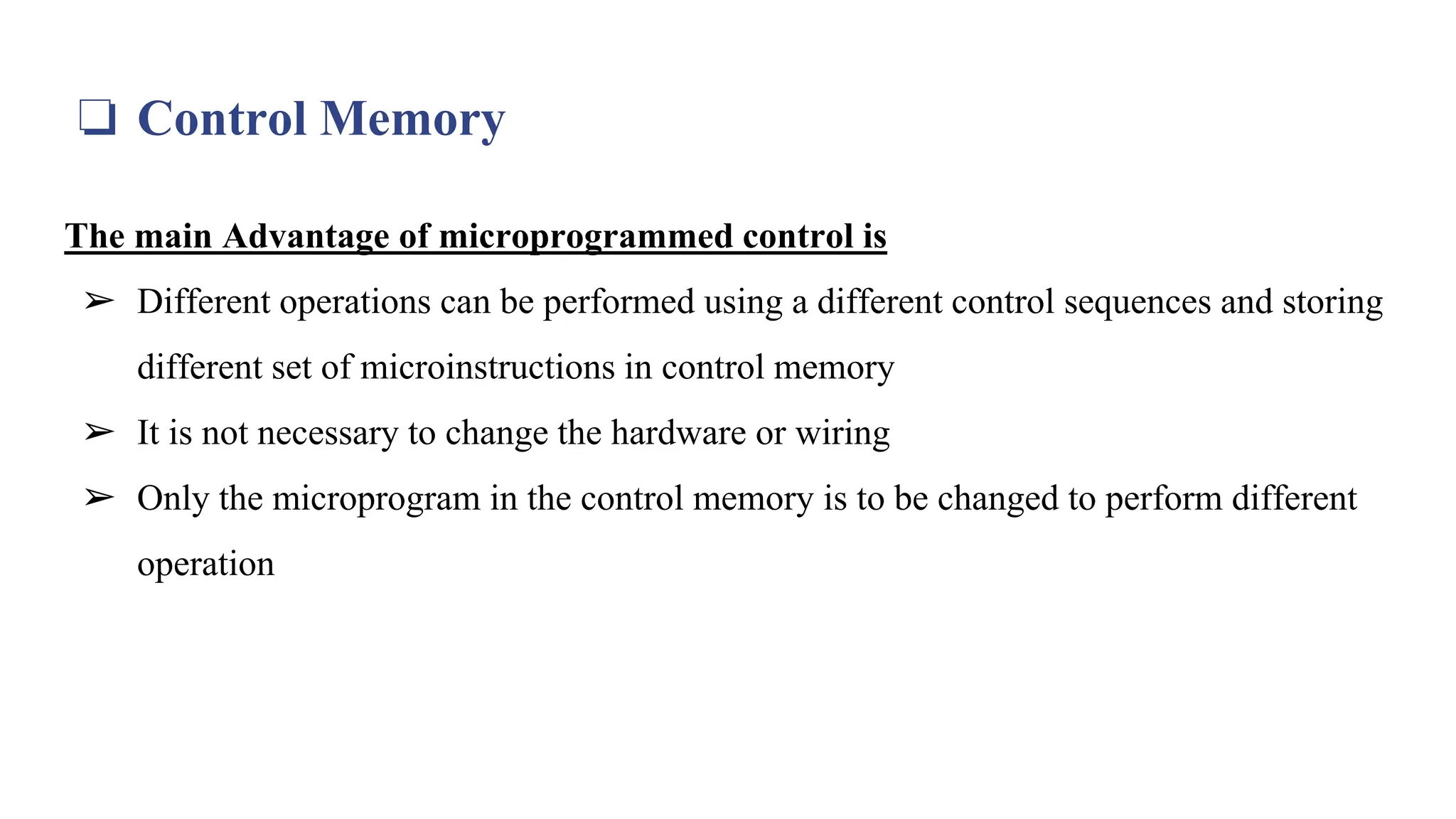
❏ Control Memory
The main Advantage of microprogrammed control is
➢ Different operations can be performed using a different control sequences and storing
different set of microinstructions in control memory
➢ It is not necessary to change the hardware or wiring
➢ Only the microprogram in the control memory is to be changed to perform different
operation
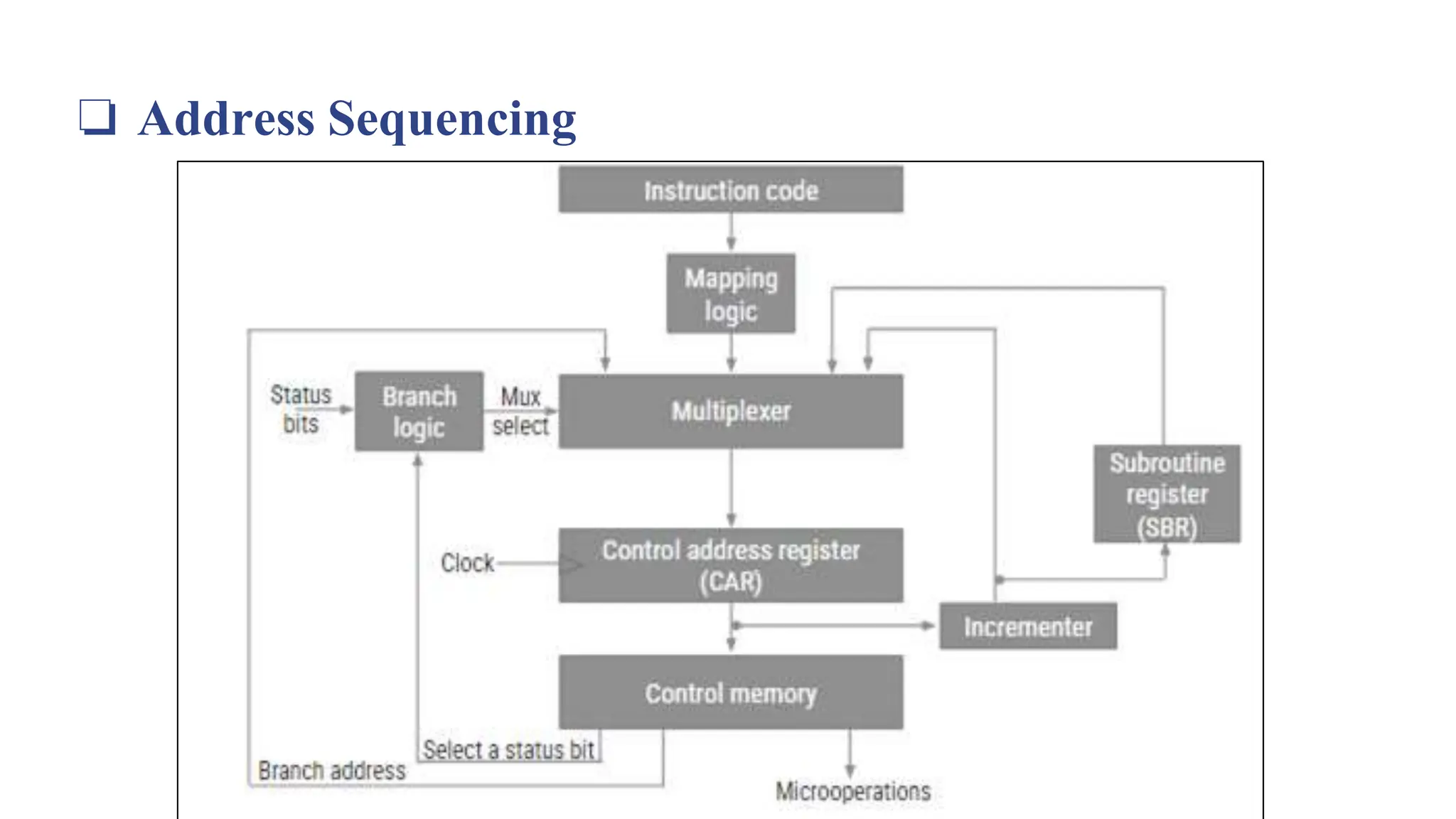
❏ Address Sequencing
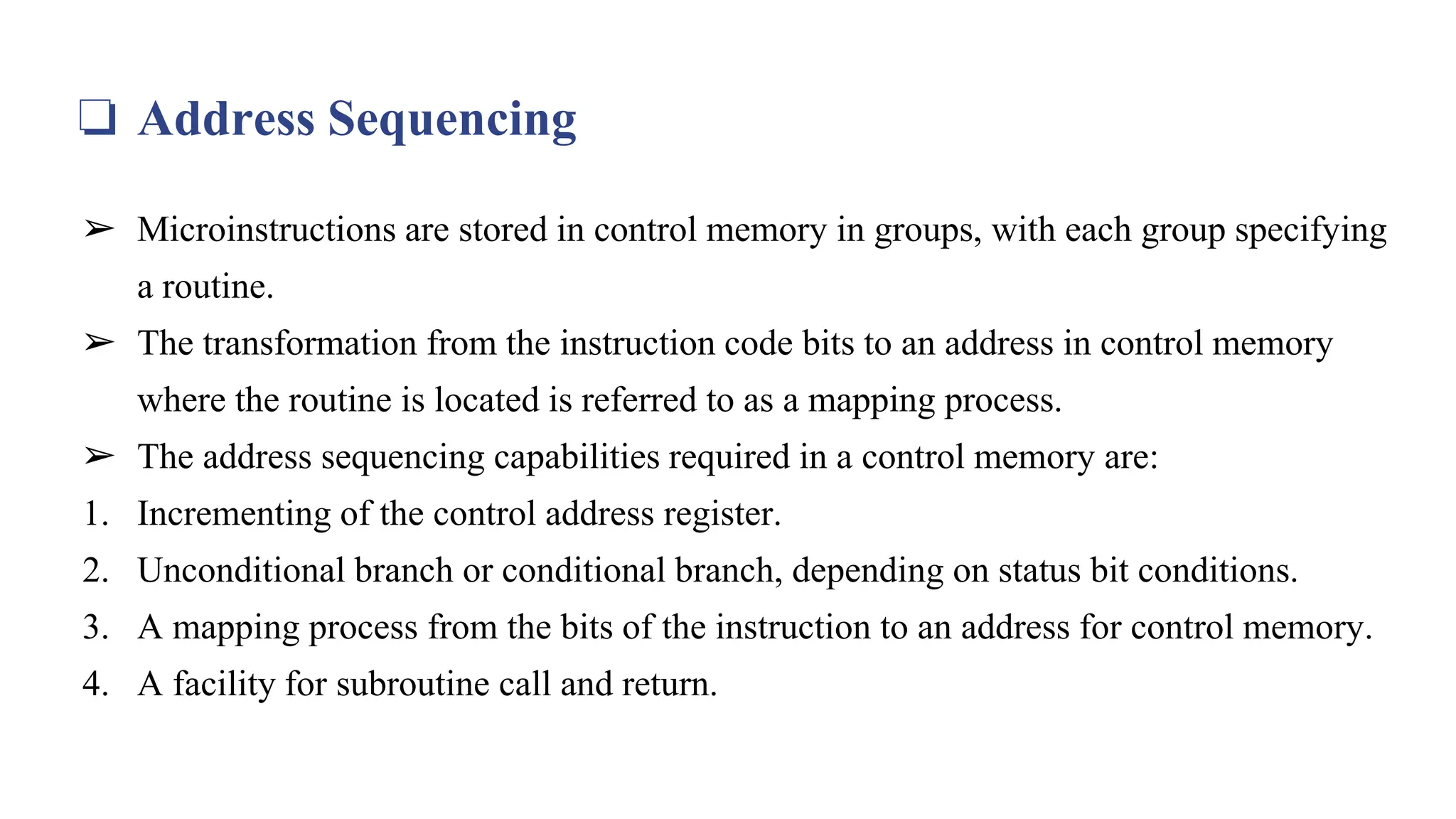
➢ Microinstructions are stored in control memory in groups, with each group specifying
a routine.
➢ The transformation from the instruction code bits to an address in control memory
where the routine is located is referred to as a mapping process.
➢ The address sequencing capabilities required in a control memory are:
1. Incrementing of the control address register.
2. Unconditional branch or conditional branch, depending on status bit conditions.
3. A mapping process from the bits of the instruction to an address for control memory.
4. A facility for subroutine call and return.
❏ Address Sequencing
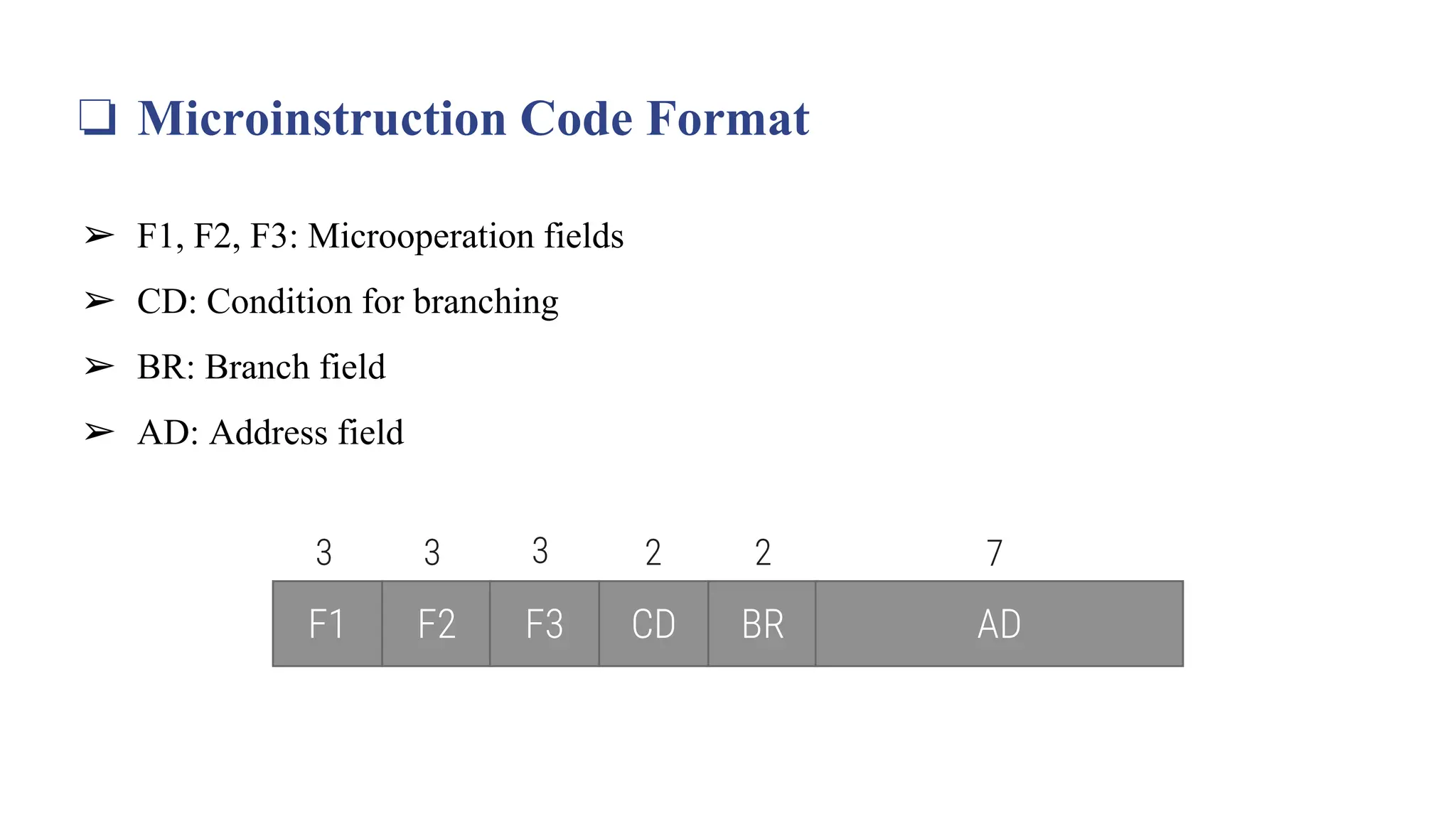
❏ Microinstruction Code Format
➢ F1, F2, F3: Microoperation fields
➢ CD: Condition for branching
➢ BR: Branch field
➢ AD: Address field
F1 F2 F3 CD BR AD
3 3 3 2 2 7
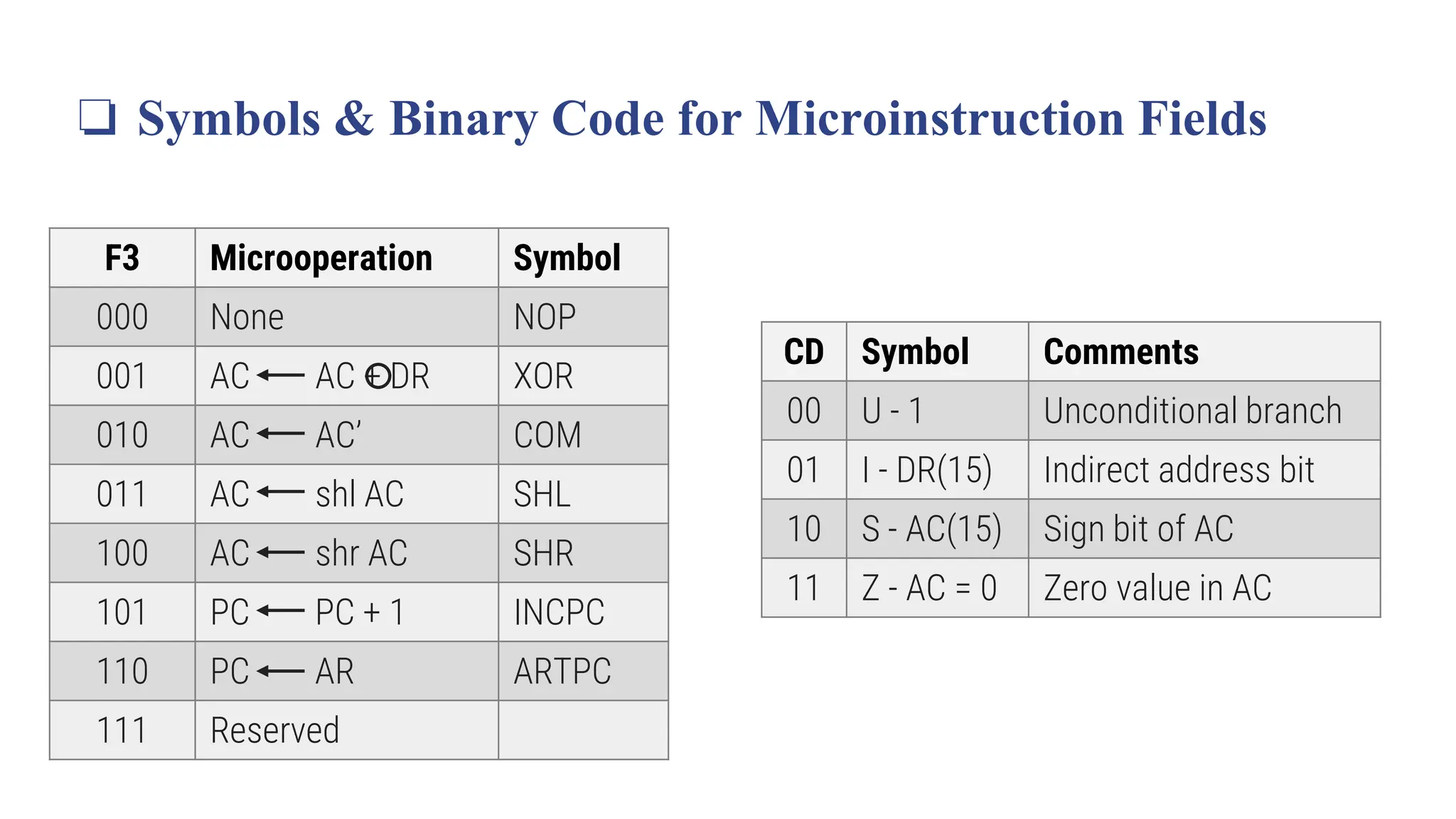
❏ Symbols & Binary Code for Microinstruction Fields
F1 Microoperation Symbol
000 None NOP
001 AC AC + DR ADD
010 AC 0 CLRAC
011 AC AC + 1 INCAC
100 AC DR DRTAC
101 AR DR(0-10) DRTAR
110 AR PC PCTAR
111 M[AR] DR WRITE
F2 Microoperation Symbol
000 None NOP
001 AC AC - DR SUB
010 AC AC DR OR
011 AC AC DR AND
100 DR M[AR] READ
101 DR AC ACTDR
110 DR DR + 1 INCDR
111 DR(0-10) PC PCTDR
❏ Symbols & Binary Code for Microinstruction Fields
F3 Microoperation Symbol
000 None NOP
001 AC AC + DR XOR
010 AC AC’ COM
011 AC shl AC SHL
100 AC shr AC SHR
101 PC PC + 1 INCPC
110 PC AR ARTPC
111 Reserved
CD Symbol Comments
00 U - 1 Unconditional branch
01 I - DR(15) Indirect address bit
10 S - AC(15) Sign bit of AC
11 Z - AC = 0 Zero value in AC
❏ Symbols & Binary Code for Microinstruction Fields
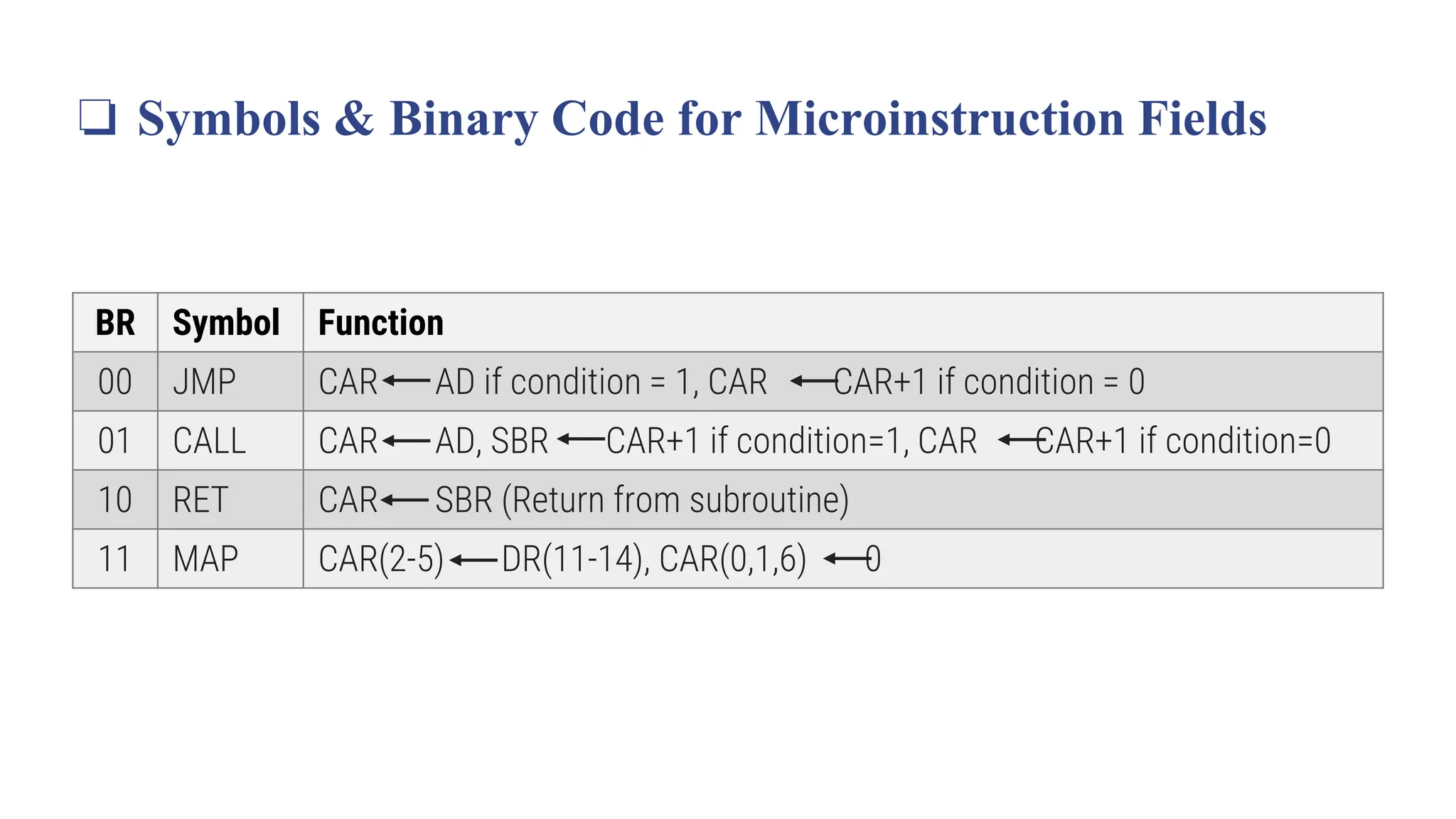
BR Symbol Function
00 JMP CAR AD if condition = 1, CAR CAR+1 if condition = 0
01 CALL CAR AD, SBR CAR+1 if condition=1, CAR CAR+1 if condition=0
10 RET CAR SBR (Return from subroutine)
11 MAP CAR(2-5) DR(11-14), CAR(0,1,6) 0
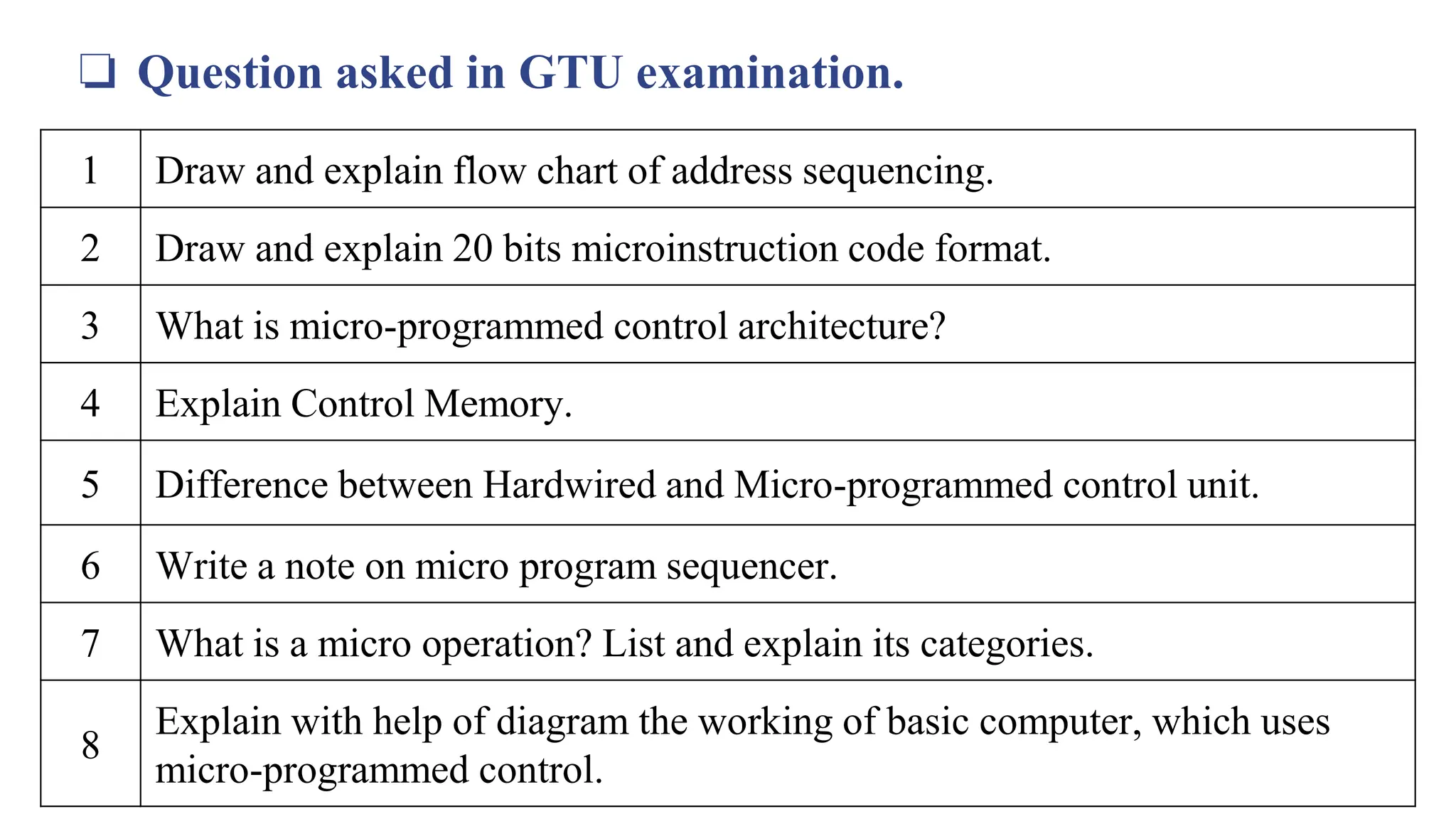
❏ Question asked in GTU examination.
1 Draw and explain flow chart of address sequencing.
2 Draw and explain 20 bits microinstruction code format.
3 What is micro-programmed control architecture?
4 Explain Control Memory.
5 Difference between Hardwired and Micro-programmed control unit.
6 Write a note on micro program sequencer.
7 What is a micro operation? List and explain its categories.
8
Explain with help of diagram the working of basic computer, which uses
micro-programmed control.
Thank You!

Computer Organization & Architecture (COA)Unit 4

  • 1.
    Laxmi Institute ofTechnology, Sarigam Academic Year - 2023-2024 COMPUTER SCIENCE AND ENGINEERING DEPARTMENT CLASS: B.E, 2nd Year, Semester - 4th Faculty Name: Ms. Sanchi Upadhyay CSE Department LIT, Sarigam Subject: Computer Organization & Architecture Subject Code: 3140707 Semester: IV
  • 2.
    Subject: Computer Organization& Architecture Subject Code: 3140707 Semester: IV Teaching and Examination Scheme:
  • 3.
    Subject Overview Sr. No.Units 1 Computer Data Representation & Register Transfer and Micro-operations 2 Basic Computer Organization and Design 3 Assembly Language Programming 4 Microprogrammed Control Organization 5 Central Processing Unit 6 Pipeline And Vector Processing 7 Computer Arithmetic 8 Input-Output Organization 9 Memory Organization 10 Multiprocessors
  • 4.
    ❏ Topics tobe covered ➔ Control Memory ➔ Address sequencing ➔ Micro program example ➔ Design of Control Unit
  • 5.
  • 6.
    ❏ Control Memory ➢A computer that employs a microprogrammed control unit will have two separate memories: a main memory and a control memory. ➢ The control memory holds a fixed microprogram that can not be altered by the occasional user. ➢ The microprogram consists of microinstructions that specify various internal control signals for execution of register microoperation. ➢ Microinstructions generates the microoperations to fetch instruction from main memory; to evaluate the effective address, to execute the operation specified by the instruction, and to return control to the fetch of next instruction.
  • 7.
    ❏ Control Memory Themain Advantage of microprogrammed control is ➢ Different operations can be performed using a different control sequences and storing different set of microinstructions in control memory ➢ It is not necessary to change the hardware or wiring ➢ Only the microprogram in the control memory is to be changed to perform different operation
  • 8.
    ❏ Address Sequencing ➢Microinstructions are stored in control memory in groups, with each group specifying a routine. ➢ The transformation from the instruction code bits to an address in control memory where the routine is located is referred to as a mapping process. ➢ The address sequencing capabilities required in a control memory are: 1. Incrementing of the control address register. 2. Unconditional branch or conditional branch, depending on status bit conditions. 3. A mapping process from the bits of the instruction to an address for control memory. 4. A facility for subroutine call and return.
  • 9.
  • 10.
    ❏ Microinstruction CodeFormat ➢ F1, F2, F3: Microoperation fields ➢ CD: Condition for branching ➢ BR: Branch field ➢ AD: Address field F1 F2 F3 CD BR AD 3 3 3 2 2 7
  • 11.
    ❏ Symbols &Binary Code for Microinstruction Fields F1 Microoperation Symbol 000 None NOP 001 AC AC + DR ADD 010 AC 0 CLRAC 011 AC AC + 1 INCAC 100 AC DR DRTAC 101 AR DR(0-10) DRTAR 110 AR PC PCTAR 111 M[AR] DR WRITE F2 Microoperation Symbol 000 None NOP 001 AC AC - DR SUB 010 AC AC DR OR 011 AC AC DR AND 100 DR M[AR] READ 101 DR AC ACTDR 110 DR DR + 1 INCDR 111 DR(0-10) PC PCTDR
  • 12.
    ❏ Symbols &Binary Code for Microinstruction Fields F3 Microoperation Symbol 000 None NOP 001 AC AC + DR XOR 010 AC AC’ COM 011 AC shl AC SHL 100 AC shr AC SHR 101 PC PC + 1 INCPC 110 PC AR ARTPC 111 Reserved CD Symbol Comments 00 U - 1 Unconditional branch 01 I - DR(15) Indirect address bit 10 S - AC(15) Sign bit of AC 11 Z - AC = 0 Zero value in AC
  • 13.
    ❏ Symbols &Binary Code for Microinstruction Fields BR Symbol Function 00 JMP CAR AD if condition = 1, CAR CAR+1 if condition = 0 01 CALL CAR AD, SBR CAR+1 if condition=1, CAR CAR+1 if condition=0 10 RET CAR SBR (Return from subroutine) 11 MAP CAR(2-5) DR(11-14), CAR(0,1,6) 0
  • 15.
    ❏ Question askedin GTU examination. 1 Draw and explain flow chart of address sequencing. 2 Draw and explain 20 bits microinstruction code format. 3 What is micro-programmed control architecture? 4 Explain Control Memory. 5 Difference between Hardwired and Micro-programmed control unit. 6 Write a note on micro program sequencer. 7 What is a micro operation? List and explain its categories. 8 Explain with help of diagram the working of basic computer, which uses micro-programmed control.
  • 16.